That ties up with things that I've seen since. In other documents it seems they use various RCS values for the Su-27 when making comparisons. They seemed to think the current (at the time) Su-27 was about 10m2, while future versions could have various RCS values as low as 2m2 or maybe slightly less.a lower figure, estimated by Defence Intelligence to be achievable by the Russians around the turn of the century for this class of aircraft with weapons

You are using an out of date browser. It may not display this or other websites correctly.
You should upgrade or use an alternative browser.
You should upgrade or use an alternative browser.
Eurofighter Typhoon Avionics

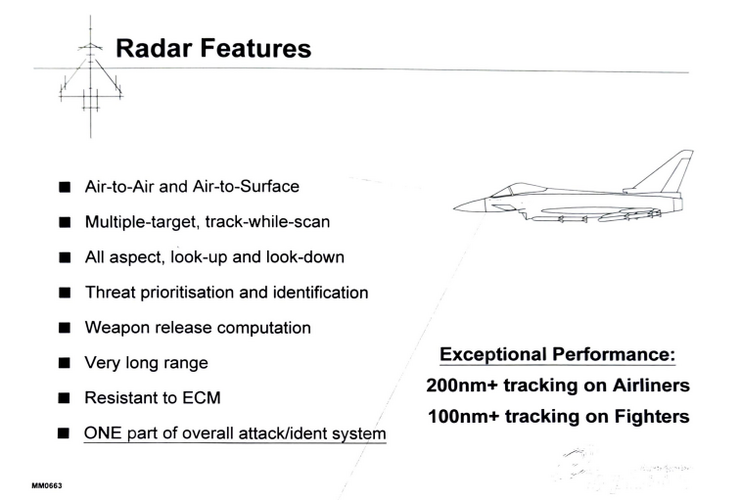
I've now found this in a presentation given by a Eurofighter representative in 1999. It gives much better performance than the document from the early 90s, and is more in line with what I expected.Here is some details on the performance of the Eurofighter's ECR-90 radar compared to the Su-27's Slotback radar. The comparison comes from July 1992, so the Eurofighter / radar was still under development at that point:
MysteriousHonza
ACCESS: Restricted
- Joined
- 4 January 2022
- Messages
- 1
- Reaction score
- 2
Hello everyone,
I would like to ask if there is any public information/source (as official as possible) about ECR-90 or Captor-M scan speed/rate. Not dish movement itself (even though useful too) but also how long it either takes to complete full scan.
Or just number of how fast it moves under RWS/TWS. Any info about priority track would be welcomed too.
I cant really find any numbers about it. Just antenna scan limits, modes but no numbers about speed.
I've read that it can perform AG/AA modes at the same time few times but i cant find any official source for that, neither how fast it is (should be given you need quick scan for proper TWS and priority target track)
I would like to ask if there is any public information/source (as official as possible) about ECR-90 or Captor-M scan speed/rate. Not dish movement itself (even though useful too) but also how long it either takes to complete full scan.
Or just number of how fast it moves under RWS/TWS. Any info about priority track would be welcomed too.
I cant really find any numbers about it. Just antenna scan limits, modes but no numbers about speed.
I've read that it can perform AG/AA modes at the same time few times but i cant find any official source for that, neither how fast it is (should be given you need quick scan for proper TWS and priority target track)

F-2
ACCESS: Top Secret
- Joined
- 22 May 2020
- Messages
- 1,189
- Reaction score
- 2,575
Autopilot:
The autopilot offers a number of modes and is able to catch and hold speed, altitude and heading. In some modes the autopilot offers automatic terrain following. Specific modes include:
Does the Eurofighter have automatic terrain following? I understood TERPROM to typically provide passive manual terrain following, but I see some reference ms to it being automatic.
F-2
ACCESS: Top Secret
- Joined
- 22 May 2020
- Messages
- 1,189
- Reaction score
- 2,575
I've now found this in a presentation given by a Eurofighter representative in 1999. It gives much better performance than the document from the early 90s, and is more in line with what I expected.
View attachment 751118
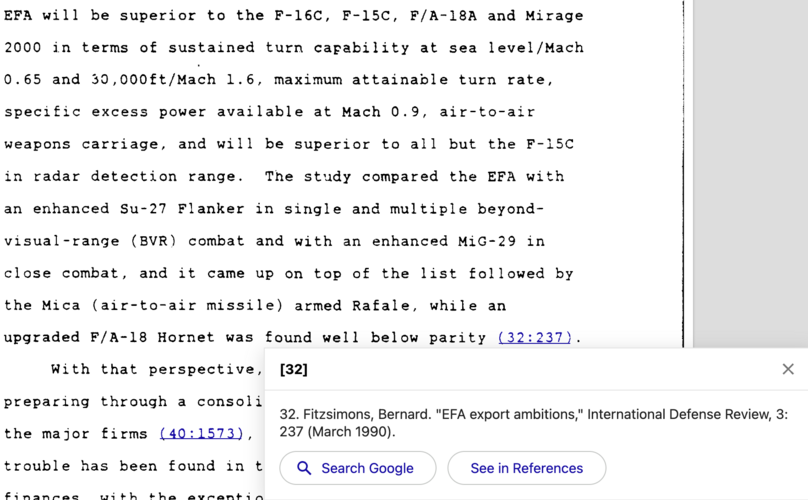
Page 74and will be superior to all but the F-15C in radar detection range.
https://apps.dtic.mil/sti/tr/pdf/ADA230867.pdf
That could still technically be true for the first report, but RDY would still be playing in the same league so to speak. They said F/A-18A which would exclude APG-73 as well.

SlowHandClap
ACCESS: Confidential
- Joined
- 5 December 2024
- Messages
- 54
- Reaction score
- 77
Page 74
https://apps.dtic.mil/sti/tr/pdf/ADA230867.pdf
That could still technically be true for the first report, but RDY would still be playing in the same league so to speak. They said F/A-18A which would exclude APG-73 as well.
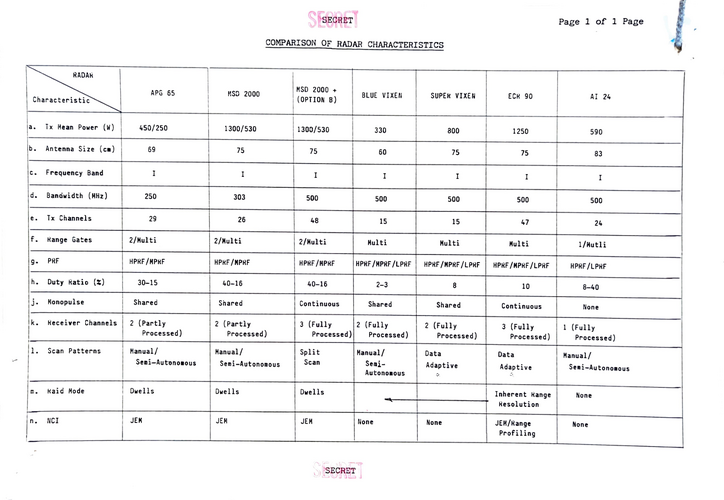
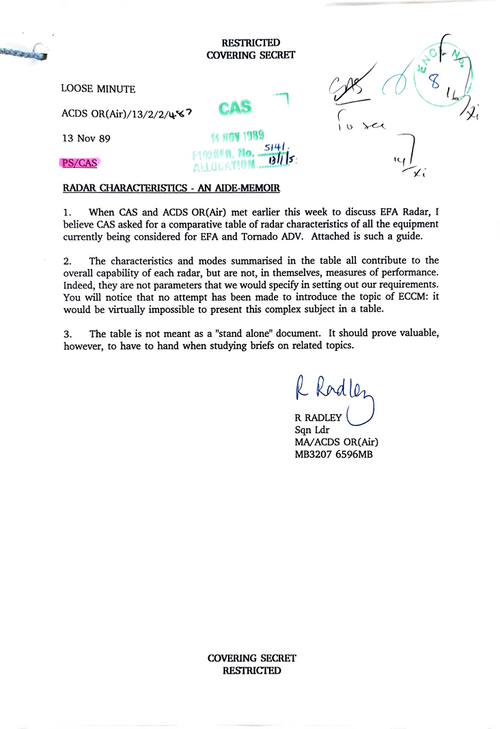
Here's a nice little table comparing some of the key technical characteristics of the different radars that were considered for the Eurofighter.
For those unaware there were two main radars considered the MSD 2000 (a derivative of the AN/APG-65 radar from the F-18 Hornet) and the ECR-90 (a derivative of the Blue Vixen from the Sea Harrier FA.2). The MSD2000 was assessed as having major deficiencies against some areas of the agreed requirements, while the ECR-90 largely met / exceeded the requirements and was considered superior to MSD2000 in many respects. As a result Britain, Italy & Spain all selected ECR-90 as the only acceptable choice of radar; meanwhile Germany insisted that the MSD2000 must be chosen as they believed the development of ECR-90 would too risky. Eventually after nearly two years of negotiations Germany agreed to accept the ECR-90.
For those unaware there were two main radars considered the MSD 2000 (a derivative of the AN/APG-65 radar from the F-18 Hornet) and the ECR-90 (a derivative of the Blue Vixen from the Sea Harrier FA.2). The MSD2000 was assessed as having major deficiencies against some areas of the agreed requirements, while the ECR-90 largely met / exceeded the requirements and was considered superior to MSD2000 in many respects. As a result Britain, Italy & Spain all selected ECR-90 as the only acceptable choice of radar; meanwhile Germany insisted that the MSD2000 must be chosen as they believed the development of ECR-90 would too risky. Eventually after nearly two years of negotiations Germany agreed to accept the ECR-90.
Attachments
aonestudio
I really should change my personal text
- Joined
- 11 March 2018
- Messages
- 3,381
- Reaction score
- 9,228
F-2
ACCESS: Top Secret
- Joined
- 22 May 2020
- Messages
- 1,189
- Reaction score
- 2,575
So I think the MK 0 Radar is actually CAESAR, take note the TR modules as give as 64.4x13.5x4.5 mm
https://web.archive.org/web/2024022...s.de/editorials/the-eurofighters-aesa-radars/
Almost identical.
In addition
Note which LRU are replaced
Now this paper
https://www.scribd.com/document/469104692/04720972
They also mention the same noise target
On the MK0EADS flight tests Typhoon AESA radar
Initial flight tests with an active electronically scanned array (AESA) radar designed to equip the German-Italian-Spanish-UK Eurofighter Typhoon fighter aircraft have been successful, EADS Defence Electronics (Ulm, Germany) said at the ILA 2006 air show in Berlin.
Flight trials in a real Typhoon are now anticipated to take place possibly later in 2006, depending on Eurofighter test aircraft availability.
The tests, held earlier this year -- using a BAC One-Eleven flying testbed aircraft -- at Bournemouth, southern England, involved the prototype of a future electronically scanning Captor-E derivative of the mechanically scanning Captor radar that is currently in production for the Typhoon Tranche 2 aircraft, said Dr Elmar Compans, head of the company's sensors department.
The prototype is known as CAESAR (Captor AESA Radar) and features an array with a classified number (between 1,000-2,000) of transmit/receive (T/R) modules. Its diameter is "slightly larger" than the mechanically scanned antenna that is now on Captor.
CAESAR has been developed since April 2002 by the four-country Euroradar consortium, led by Selex in the UK and including EADS Defence & Security in Germany; Galileo Avionica in Italy; and Indra in Spain.
Compans described the current mechanically scanning Typhoon radar, which he referred to as "Captor-M", as a "high-end multifunction X-band (10 GHz) pulse-Doppler radar with a modular architecture and more than 30 operational modes for air-to-air and air-to-ground operations". The radar, developed and produced by Euroradar (and delivered to BAE Systems in Warton, England), has a high resistance against electronic countermeasures and multitarget capability including track-while-scan, he said.
Scanning, however, is done by mechanically pointing the radar's antenna, which means that "a lot of time is wasted moving the antenna so that relatively little time can be spent on analysing targets", Compans added, "particularly if several targets spread out in space have to be tracked.
"By moving to an AESA radar, featuring an array packed with many hundreds of independently controlled [T/R] modules, it would become possible to do zero- delay switching between differ- ent look-angles
of the antenna, greatly enhancing the track-while-scan process."
Another advantage is the ability to introduce adaptive power management, which means that the radar's computer uses no more transmitting power than is needed to obtain the required information for each individual target -- resulting in a reduced probability that hostile forces can intercept the radar's signals.
Furthermore, the large number of T/R modules means that an AESA radar is not immediately in trouble if components start to fail, a process known as graceful degradation. "Performance degradation becomes
visible only after about 10 per cent of the T/R modules become extinct; you can lose around 100 before you have to cancel the mission," Compans explained.
In the fully developed version, a future Captor-E radar features multichannel signal processing and space-time adaptive processing, allowing the radar to distinguish between a moving target on the
ground and the ground clutter (ground moving target indication -- GMTI). The radar is also capable of adaptive beamforming, which includes the generation of multiple independent beams by dividing up the AESA array into sub-arrays. This is useful for jammer suppression.
According to Compans, an AESA fighter radar such as Captor-E will be able to simultaneously perform search, track, datalink, synthetic aperture radar imaging and other functions.
CAESAR was started in 2002 as a Euroradar-funded technology- demonstrator project. It was backed by a bilateral German-UK Captor radar e-scan risk-reduction project known as CECAR, which started in 2003.
According to Compans, CAESAR and CECAR objectives are to:
· perform experimental flight trials to demonstrate the feasibility of e-scan technology and its potential operational benefits;
· make maximum use of existing Captor radar subsystems;
· gathering data on the performance of the AESA array placed inside the standard Captor radome so that the radar's air-to-air radar modes could be optimised;
· de-risking the possible development and integration of an e-scan radar by identifying critical integration issues early on; and
· demonstrating the e-scan radar capabilities of the four Euroradar companies.
"The concept for CAESAR was to take the existing Captor radar; to replace its mechanically scanned antenna with the new AESA array, and to leave the whole of the back-end as it is, with the exception of
the antenna control unit and the antenna power supply unit. All Eurofighter avionics also remain unchanged. In terms of the new array there are no weight or centre of gravity issues that the aircraft cannot deal with.
"We believe that this evolutionary approach toward introducing an AESA radar on board Typhoon is the only way that it will be affordable for the customers." However, the proposed Captor-E is still expected to be more expensive than the standard Captor-M, Compans admitted. "It will certainly not be a factor two more expensive, but it will not be factor one," he said.
The SMTRM T/R modules in the CAESAR prototype are based on expertise gathered by EADS Defence Electronics in several other programmes, including the French-German-UK AMSAR fighter radar technology
programme, the SOSTAR-X airborne ground surveillance radar programme, the MEADS air-defence radar, the TERRA-SAR space-based radar and the BÜR next-generation ground-surveillance radar.
The standardised modular T/R modules (known as SMTRMs, size 64.4x13.5x4.5 mm) for CAESAR were completed by EADS Defence Electronics in April 2004, after which integration of the AESA array plus ground and environmental tests started in Ulm in July 2004.
Around that time, EADS also performed a fit check using a German Eurofighter at Manching, Germany, to verify that the CAESAR array would actually fit with the mechanical interfaces and the radome. In May 2005, the array was shipped to Selex in the UK where it was integrated with the rest of the radar.
In September 2005, the first transmission test of the complete CAESAR system was done, followed by: system integration in November 2005, installation on the BAC One-Eleven flying testbed aircraft at FR
Aviation in Bournemouth in December 2005/January 2006 and flight tests starting on 24 February 2006.
The flight-test campaign involved seven missions during which a total of 50 test runs were made over Wiltshire county in the southwest of England. "The AESA array operated successfully for more than 20 hours within one single T/R module failure," Compans stated. For the campaign, two aircraft were available to fly co-operative target profiles (these were an Alpha Jet A jet trainer and a Hawker Siddeley 748 twin-turboprop aircraft). "These targets were detected and tracked, including during crossing and weaving manoeuvres, while it was also possible to distinguish between them when they were flying
in close formation," said Compans.
"Various targets of opportunity were also detected and tracked. Data recording was successful and we have demonstrated track revisiting [looking back at targets detected earlier]. For cost reasons, the
CAESAR array was not fully populated with T/R modules, but approximately 75 per cent." The flight tests on the BAC One-Eleven involved the radar operating at "limited range but still representative of the full-up system". The AESA array's datalink capability was not included.
According to Compans, the CAESAR and CECAR projects have opened the door to full-scale development of the Captor-E radar for Typhoon Tranche 3, deliveries of which are scheduled to start in 2012. "That
means the radar deliveries are to start in 2011, and that means that there is less than six years left for development, industrialisation and production. We propose to use the existing back-end of the Captor
as is used in Tranche 2, as this is basically e-scan ready. The AESA array and the new LRUs [line-replacable units] are to be inserted in a plug-and-play fashion while the main avionics software would also not need to be changed.
"The intention is that the first production Captor-E sets should have the same functionalities that are now available in the Tranche 2 variant. Some easily implemented 'low hanging fruits' may also be added, but more difficult new capabilities will probably be introduced later as part of the radar's growth path."
In case the Tranche 3 aircraft are not built (Compans stressed that the contract for them has been signed), the Captor-E radar could be retrofitted into the fleet of Tranche 2 aircraft.
"The next step now is to perform CAESAR flight tests on board a real Typhoon aircraft, the main goal being to check out the radar's features in relation with the overall weapons system. There is no date fixed for this yet, but I would be disappointed if it did not take place during 2006," Compans said. He could not say at which location the Typhoon AESA flight trials will happen, but added that he "would be happy with any location as long as it happens".
Euroradar completed deliveries of Captor radars for Eurofighter Typhoon Tranche 1 at the beginning of 2006. The Tranche 1 version of Captor cannot be readily converted to an AESA radar because it features older, less performant processing technology. The Tranche 2 Captor radar that is now in production has the latest processing equipment and features a high-resolution ground-mapping mode that is not available in Tranche 1.
https://web.archive.org/web/2024022...s.de/editorials/the-eurofighters-aesa-radars/
The T/R module’s components are housed on a hermetically sealed PCB. The compact dimensions of 64.5 x 13.5 x 4.5mm result in a weight of less than 15 grams. On the PCB there is an integrated circuit (ASIC) composed of a GaAs-based high power amplifier (HPA), circulator, limiter, Low Noise Amplifier (LNA), phase controller, amplifier controller and a circulator. Due its compact design, the power losses during signal processing are very low. However, air cooling is no longer sufficient for these devices and thus the T/R modules are liquid-cooled.
The module covers frequencies from 8GHz to 11GHz (X-Band). A power of up to 39dBm (8W) can be delivered at the output. Relatively low power consumption leads to an overall efficiency of more than 20%. The typical noise figure of the complete module amounts to <3.0dB over the entire frequency range.
Almost identical.
In addition
https://web.archive.org/web/2014112...Presentaciones/xIndra _Seminario_CEI_2009.pdfAccording to Indra Sistemas, Antenne (LRI #9), Transmitter Auxiliary Unit (TAU) and Antenna Power Supply & Controller (APSC) will be different from the CAPTOR-M. The TAU of the CAPTOR-E is to be fed with 12.75 kVA, so that after losses 10.58 kW flow into the APSC, which is to operate with over 88% efficiency.[91]Consequently, the output power here would be over 9.31 kW. The cooling of the components in the CAPTOR-E is to be realized by vapor cooling.
Note which LRU are replaced
Now this paper
https://www.scribd.com/document/469104692/04720972
Same LRUIII. CAESAR: AESA UPGRADE
The CAESAR (Captor Active Electronically Scanned Array Radar) design concept replaces existing Transmitter, Waveguide Unit and Scanner/antenna LRis with a new AESA. Associated power and control functions are provided by Antenna Power Supply and Antenna Control Unit LRIs.
All other CAPTOR LRis are retained with minimal modification, while aircraft interfaces remain unchanged (Figure 1).
They also mention the same noise target
I don't think you're correct about this assumption:So I think the MK 0 Radar is actually CAESAR, take note the TR modules as give as 64.4x13.5x4.5 mm
On the MK0
https://web.archive.org/web/2024022...s.de/editorials/the-eurofighters-aesa-radars/
Almost identical.
In addition
https://web.archive.org/web/2014112...Presentaciones/xIndra _Seminario_CEI_2009.pdf
Note which LRU are replaced
Now this paper
https://www.scribd.com/document/469104692/04720972
Same LRU
They also mention the same noise target
CEASAR TRM

Captor-E/ECRS Mk0 TRM taken from https://web.archive.org/web/2020071...in/hensoldt/Datenblätter/0717_14_Captor_E.pdf

And there's also the more up-to-date https://uk.leonardo.com/documents/64103/22616345/LDO_UK24_00622+ECRS+MK0+LQ.pdf brochure clearly showing that the ECRS Mk0 has the swashplate mechanism not yet found on the CAESAR.
Also for reference the ECRS Mk1 TRM from Hensoldt's promotional video (https://www.hensoldt.net/products/ecrs-mk1-eurofighter-common-radar-system)

F-2
ACCESS: Top Secret
- Joined
- 22 May 2020
- Messages
- 1,189
- Reaction score
- 2,575
Ah my man! Thank you for those T/R module pictures! Sometimes test modules use a provisional module for testing that differ from the final radar. But this is enough ambiguity that it’s probably not so clear cut for me to make those claims.I don't think you're correct about this assumption:
CEASAR TRM

Captor-E/ECRS Mk0 TRM taken from https://web.archive.org/web/20200719185206/www.hensoldt.net/fileadmin/hensoldt/Datenblätter/0717_14_Captor_E.pdf
View attachment 783902
And there's also the more up-to-date https://uk.leonardo.com/documents/64103/22616345/LDO_UK24_00622+ECRS+MK0+LQ.pdf brochure clearly showing that the ECRS Mk0 has the swashplate mechanism not yet found on the CAESAR.
Also for reference the ECRS Mk1 TRM from Hensoldt's promotional video (https://www.hensoldt.net/products/ecrs-mk1-eurofighter-common-radar-system)
Scorpion82
ACCESS: Secret
- Joined
- 20 May 2006
- Messages
- 407
- Reaction score
- 877
To cut it short, CAESAR was just a demonstrator. ECRS Mk0 a much newer operational radar.
CAESAR featured a separate Antenna Control Unit (ACU) and Antenna Power Supply (APS) in an overall 6 (major) LRI configuration, pretty much like Captor-M. ACU and APS replaced the TPA and WGU in the CAESAR setup. Captor-E aka Radar 1+ aka ECRS Mk0 has a 4 LRI setup with the APSC replacing the TAU, ACU and APS in the CAESAR.
ECRS Mk0 features a new antenna and upgraded processor and receiver compared to CAESAR, among other auxiliary radar equipment.
There is not really much of a commonality between CAESAR and ECRS Mk0.
CAESAR featured a separate Antenna Control Unit (ACU) and Antenna Power Supply (APS) in an overall 6 (major) LRI configuration, pretty much like Captor-M. ACU and APS replaced the TPA and WGU in the CAESAR setup. Captor-E aka Radar 1+ aka ECRS Mk0 has a 4 LRI setup with the APSC replacing the TAU, ACU and APS in the CAESAR.
ECRS Mk0 features a new antenna and upgraded processor and receiver compared to CAESAR, among other auxiliary radar equipment.
There is not really much of a commonality between CAESAR and ECRS Mk0.
Last edited:

Aeria Gloria
ACCESS: Secret
- Joined
- 8 February 2024
- Messages
- 416
- Reaction score
- 481
My post was deleted on main Eurofighter topic because it was “off topic,” so hopefully I have better luck here
EF pirate quotes up to 145 km and practical average of 50-80 km.
I’m sure there’s no other practical info
EF pirate quotes up to 145 km and practical average of 50-80 km.
I’m sure there’s no other practical info
Scorpion82
ACCESS: Secret
- Joined
- 20 May 2006
- Messages
- 407
- Reaction score
- 877
At least not publicly.
Similar threads
-
Low-cost Eurofighter alternative design
- Started by giorgio
- Replies: 4
-
 What if, France never left the Eurofighter consortium
- Started by helmutkohl
- Replies: 57
-
 Options in case of an EFA breakdown
- Started by Lascaris
- Replies: 14
-

-
 The 1968 French civil war and it's aftermath
- Started by Michel Van
- Replies: 28