steffen19k
ACCESS: Restricted
- Joined
- 7 August 2020
- Messages
- 2
- Reaction score
- 1
Its really kind of sad that the B36 never got past the "need for sexy" that seems to drive everything the Chair Farce does.


Not sure what you mean by that. The B-52 was infinitely more capable than the B-36 was ever going to be.Its really kind of sad that the B36 never got past the "need for sexy" that seems to drive everything the Chair Farce does.
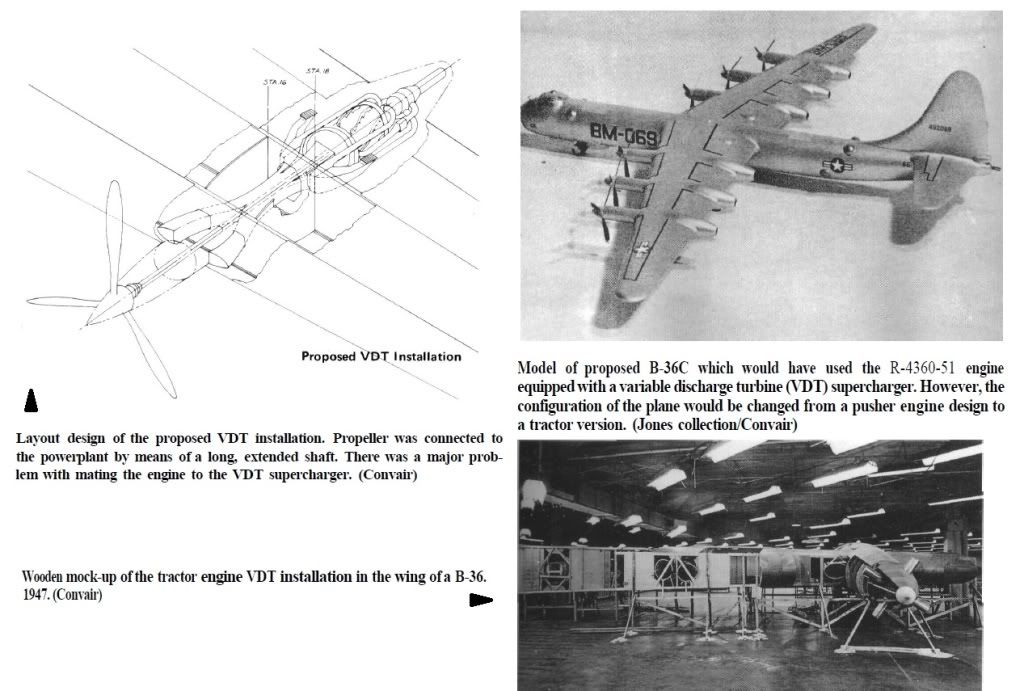
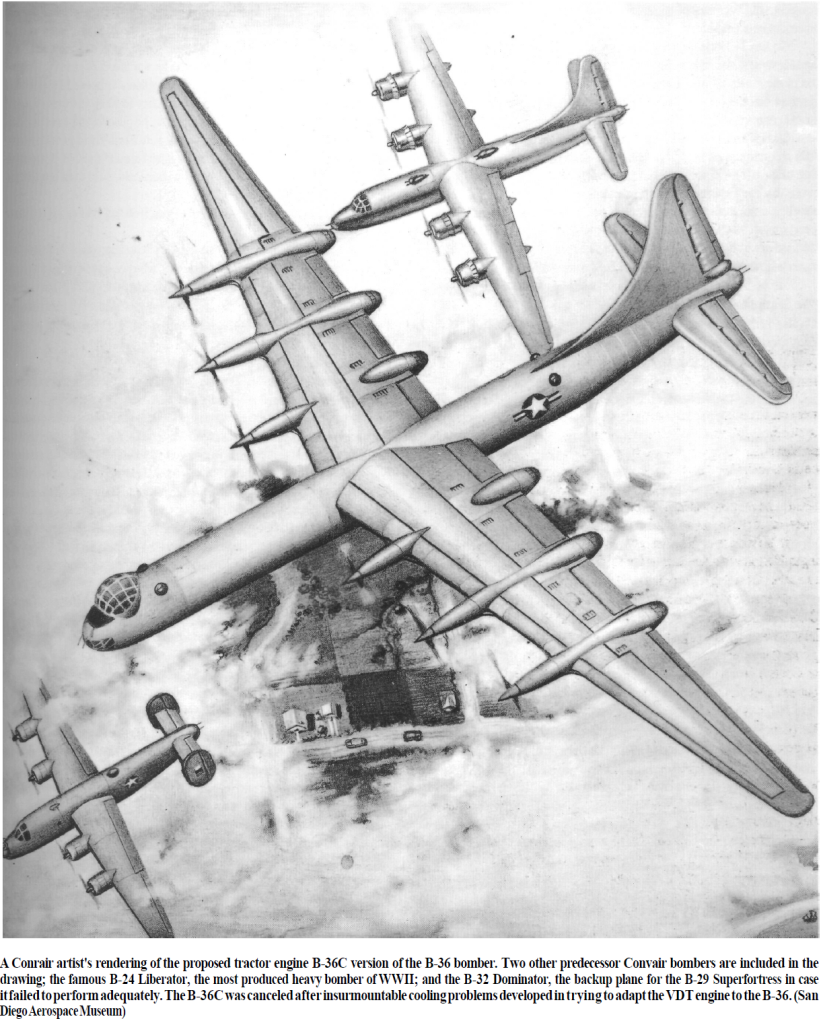
Wouldn't a turbo-compound version of the R-7755 have been a better choice for the B-36C?Interesting, I thought the "B-36C was to be powered by six 4300 hp Pratt & Whitney R-4360-51 variable discharge turbine (VDT, or turbocompound) engines. In the VDT engine, exhaust gases from the piston engine would pass through a General Electric CHM-2 turbosupercharger which featured a clamshell nozzle that could create a jet thrust by varying the size of the turbine exit. The variable discharge nozzle was to be operated by automatic control activated by a manifold pressure sensor. "
Source

regards,
Greg

I wish this canard could be put to bed: fewer blades are not, per se, more efficient. If structural considerations didn't screw up the aerodynamics, spreading the required blade area over more blades will reduce induced losses and increase efficiency.Four blades (or two, or six) would be unfavorable from a vibration perspective, as you'd have a pretty strong mode associated with two blades passing through the wing wake at the same time. Three blades does not have this problem. Neither does five etc, but less blades tends to be more efficient, as long as you're not running into sonic tip or ground clearance issues.
The B-52 may well have had lower maintenance man hours per flight hour and lower operating costs than the B-36.Not sure what you mean by that. The B-52 was infinitely more capable than the B-36 was ever going to be.
I feel that liquid cooling would have been a better choice that the air-cooled R-4360. Having said that, the Lycoming R-7755 was a 'dog', too heavy for the power output. I feel the Allison DV-6840 would have been a better choice (for those not familiar, the DV-6840 was a pair of V-3420s coupled, the V-3420 being a pair of V-1710s integrated on a single crankcase). The engines should /would Initially be turbocharged, later upgraded to VDT when the turbine control issues were worked out.Wouldn't a turbo-compound version of the R-7755 have been a better choice for the B-36C?
It very much did, the B36s engines were infamous for breaking in ways that ment you needed to pull the entire thing from its housing.The B-52 may well have had lower maintenance man hours per flight hour and lower operating costs than the B-36.
It very much did, the B36s engines were infamous for breaking in ways that ment you needed to pull the entire thing from its housing.
Which was a day long affair due to issues with the switch from the OG puller design to the iconic pusher.
Then it was a basically a rebuild of the engine which was a week itself. Add in that the Wasp Major had a reputation for breaking even when doing nothing? Ment the maintance guys was constantly doing maintenance to keep them up.
Comparably in that same time you could redo all 8 engines of the B52 TWICE and you could leave chilling on the pad and have a good chance of it running just fine.
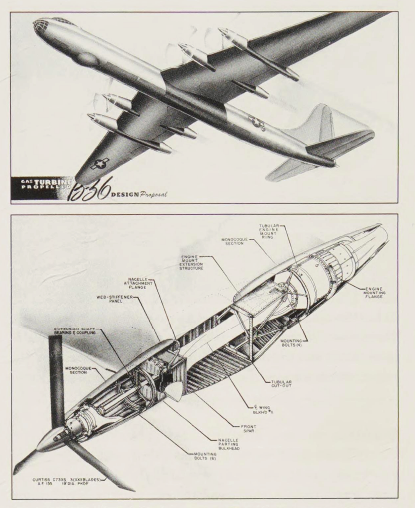
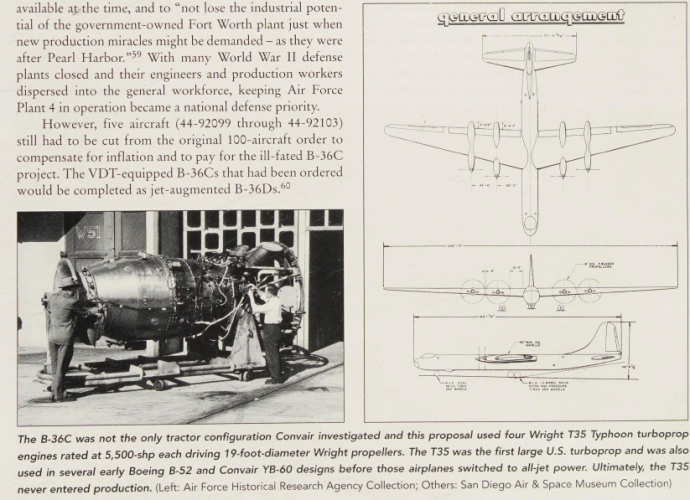
Yup turbo props are better in all aspect so long as you don't screw up the gearbox.From memory, they had between them 144 sparks. Mechanics were banging their heads against walls. How about T56 turboprops ? rock-solid, as shown on the P-3 and Hercules combined 130 years of operations.
Nope, it is the prop's relationship to the engine and not the wing....Nope. The way I learned it, if the prop's behind the wing, it's a pusher. Which is how the B-36's butter paddles were mounted.
Yup turbo props are better in all aspect so long as you don't screw up the gearbox.
Bigger issue be well.
Either reworking the wing to a Tractor design, which need a new wing, or figuring out how to make the T56 a pusher and not break the gearbox.
VDT was not turbocompound. It was an attempt at turbosupercharging without the loss in power recovery suffered at low / medium-altitude, by getting rid of the waste-gate.Wouldn't a turbo-compound version of the R-7755 have been a better choice for the B-36C?
VDT was not turbocompound as staded above. The exhaust thrust increase provided by the VDT would eliminate the loss in total power of a conventional turbosupercharging system.No, the advantage of the VDT was producing more exhaust thrust. The back pressure of this system even lowered the shaft horse power compared to a waste gate. the mentioned cooling problems were surly related to the increased back pressue. VDT nozzels might have been more usefull on Diesel engines which are imune to knocking and pre ignition and also have little to no valve overlap.
VDT was not turbocompound as staded above. The exhaust thrust increase provided by the VDT would eliminate the loss in total power of a conventional turbosupercharging system.
Can't do that, engine out scenarios and logistics.Were there plans to have three pair of different engines each with its own strength?
At higher altitudes, the two engines closest to the fuselage are throttled forward.
The Wasp Majors were a headache in every plane they were in. Incredible maintenance needs.It very much did, the B36s engines were infamous for breaking in ways that ment you needed to pull the entire thing from its housing.
Which was a day long affair due to issues with the switch from the OG puller design to the iconic pusher.
Then it was a basically a rebuild of the engine which was a week itself. Add in that the Wasp Major had a reputation for breaking even when doing nothing? Ment the maintance guys was constantly doing maintenance to keep them up.
Comparably in that same time you could redo all 8 engines of the B52 TWICE and you could leave chilling on the pad and have a good chance of it running just fine.
That's the B-52. ~75,000lbs max load between internal and external. And midair refueling made the fuel capacity unnecessary.The Wasp Majors were a headache in every plane they were in. Incredible maintenance needs.
Now what I wonder is why a proper jet design with the weight and volume capacity of the B-36 (not a chopped up B-36 but a from-the-start-design) was never created.
hihi, I was fasterThat's the B-52. ~75,000lbs max load between internal and external. And midair refueling made the fuel capacity unnecessary.
Except it needed a fleet of KC-135s. Yes, I realize the B-36's thick wings (and gasoline engines) are what gave it the range, even though strangely it had a lower fuel capacity (b-36->33,500 gallons Av Gasoline vs B-52->48,000 gallons kerosene). They are what kept it slow too. A jet powered B-36 would have all that more bomb tonnage and ability to carry and drop larger individual payloads. The B-36-like body could have carried the Tsar bomba as an internal load (but couldn't get far enough away to avoid destruction unless it had the B-52's speed, and the Tsar bomb just was an inefficient use of the release energy, although it was an efficient burn). Anyway, I'm surprised the C-5 is so much slower than a B-52, yet a 747 is so much faster. Time criticality of cargo mandating different tweaks.....That's the B-52. ~75,000lbs max load between internal and external. And midair refueling made the fuel capacity unnecessary.
So did the B-47s, B-58s, and FB-111s. Plus all the fighters.Except it needed a fleet of KC-135s.
A jet B-36 would have required a complete wing redesign, which would have cost you fuel capacity. But we could make an argument for something that visually looks like a B-52 but with a fatter fuselage.Yes, I realize the B-36's thick wings (and gasoline engines) are what gave it the range, even though strangely it had a lower fuel capacity (b-36->33,500 gallons Av Gasoline vs B-52->48,000 gallons kerosene). They are what kept it slow too. A jet powered B-36 would have all that more bomb tonnage and ability to carry and drop larger individual payloads.

Theoretically, early B-52s were capable of carrying them. I don't know that they were ever tested, and certainly weren't released for service, but the B-52 weapon bay was large enough and it was designed to be able to handle a single store of up to 50,000lb.The bombs that only the B36 could carry, the Mk17 or Mk24, were 15MT and were ~40,000lbs each.
Kept the thick wing from the B-36 to reduce design changes and therefore cost, which left it 100mph slower than the BUFF.
Except that you could get a 25MT bomb in something 1/4 the size of those monsters by 1960. Any carriage of those huge bombs would be limited to ~1955-1963 at the latest, more likely 1960.Theoretically, early B-52s were capable of carrying them. I don't know that they were ever tested, and certainly weren't released for service, but the B-52 weapon bay was large enough and it was designed to be able to handle a single store of up to 50,000lb.
Didn't stop certain USAF figures from realising that if you could get the same 'bang' in a smaller package, you could also get more 'bang' in the same size package. A 60 megaton, 25,000lb bomb was being seriously considered for testing in 1958, and in the early 1960s there was still discussion of the largest possible bomb that you could put in a B-52. It wouldn't be useful, but that the USAF still asked about it.Except that you could get a 25MT bomb in something 1/4 the size of those monsters by 1960. Any carriage of those huge bombs would be limited to ~1955-1963 at the latest, more likely 1960.
Yeah, it's LeMay at his least sane for sure.Didn't stop certain USAF figures from realising that if you could get the same 'bang' in a smaller package, you could also get more 'bang' in the same size package. A 60 megaton, 25,000lb bomb was being seriously considered for testing in 1958, and in the early 1960s there was still discussion of the largest possible bomb that you could put in a B-52. It wouldn't be useful, but that the USAF still asked about it.
I don't know what, and where you read, but I didn't say that. I just asked if a possible turbo-compound version of the XR-7755 would have been a better option for the B-36C.VDT was not turbocompound. It was an attempt at turbosupercharging without the loss in power recovery suffered at low / medium-altitude, by getting rid of the waste-gate.