

You are using an out of date browser. It may not display this or other websites correctly.
You should upgrade or use an alternative browser.
You should upgrade or use an alternative browser.
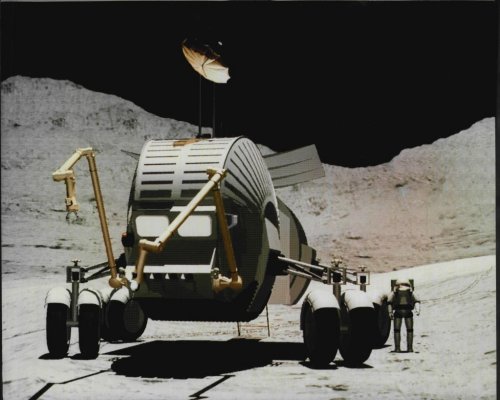
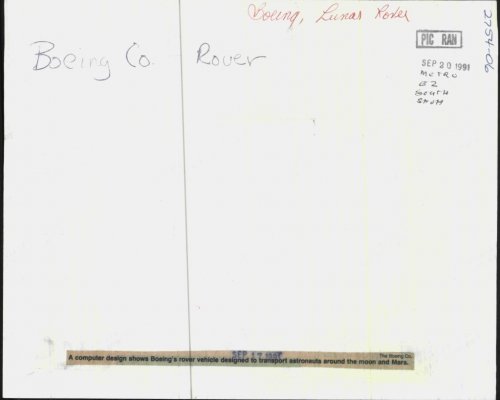
Boeing Lunar Rover circa 1991
- Thread starter Triton
- Start date
- Joined
- 26 January 2011
- Messages
- 2,227
- Reaction score
- 721
blackstar said:That cabin shape doesn't seem very sensible. Wouldn't you want something that didn't waste volume like that?
If the cabin is pressurised then it is quite a sensible shape.
- Joined
- 26 September 2008
- Messages
- 2,216
- Reaction score
- 1,541
Imagine standing in it. It's like standing in the middle of a wheel--you have trouble moving forward or backward in it, and you're always going to hit your head. And notice where the windows are located, not where your head would be, but lower down. Nobody builds cars or trucks like that. It just doesn't make sense.

Brett Davidson
ACCESS: Top Secret
- Joined
- 26 September 2006
- Messages
- 4,436
- Reaction score
- 12,819
Not necessarily. Look at the scale of it compared to the space-suited figure outside. If it's a two-level cabin, then a seated driver behind the windows should have a good position, while there would be space above for sleeping berths (or whatever). I assume that this is a rover intended for long-term excursions.
- Joined
- 26 September 2008
- Messages
- 2,216
- Reaction score
- 1,541
But it's a _circle_. Nobody builds cars like that. You want a cabin that is horizontal so that people can move around in it. And you don't want to raise the center of gravity with a second floor, because then it topples over more easily.
Brett Davidson
ACCESS: Top Secret
- Joined
- 26 September 2006
- Messages
- 4,436
- Reaction score
- 12,819
I do note that it has a very wide track. I'm trying to find the rationale - you're right, the designers wouldn't waste space overhead, so what would go up there? Bunks is my guess and perhaps whatever's up there doubles as radiation shielding. I agree that it's not a GOOD design, with the ergonomic tradeoffs not being worth whatever other advantages there might be and likely that's why we haven't seen any later iterations. 
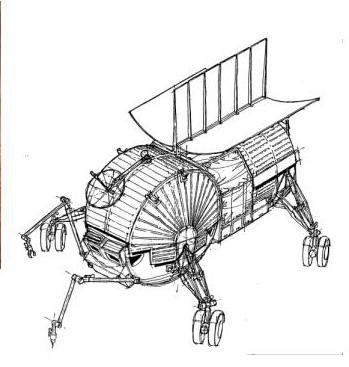
Edit: I've just dug up another image (sorry, source unknown), and there's a second section visible, possibly allowing freer longitudinal movement, though that could just be an unpressurised service module.
Anyway, I'm going to make these guesses - the scale of the suited figure suggests that a hypothetical upper level wouldn't be high enough to allow standing, but would allow something like a Japanese capsule hotel (http://en.wikipedia.org/wiki/Capsule_hotel) and there is no hatch visible on at least one side of the vehicle, suggesting that the aft section is in fact accessible (or has a tunnel), with an airlock and/or docking port at the rear.
Certainly there are more elegant designs around, such as the SEV (http://en.wikipedia.org/wiki/Space_Exploration_Vehicle) in its current form.
Edit: I've just dug up another image (sorry, source unknown), and there's a second section visible, possibly allowing freer longitudinal movement, though that could just be an unpressurised service module.
Anyway, I'm going to make these guesses - the scale of the suited figure suggests that a hypothetical upper level wouldn't be high enough to allow standing, but would allow something like a Japanese capsule hotel (http://en.wikipedia.org/wiki/Capsule_hotel) and there is no hatch visible on at least one side of the vehicle, suggesting that the aft section is in fact accessible (or has a tunnel), with an airlock and/or docking port at the rear.
Certainly there are more elegant designs around, such as the SEV (http://en.wikipedia.org/wiki/Space_Exploration_Vehicle) in its current form.
Attachments

OM
ACCESS: Top Secret
blackstar said:But it's a _circle_. Nobody builds cars like that. You want a cabin that is horizontal so that people can move around in it. And you don't want to raise the center of gravity with a second floor, because then it topples over more easily.
...You're a) forgetting that this would be in a 1/6g environment, so the c/g issues might not be as crucial - remember, we've only had *two* designs of rovers on the Moon, and only one of those actually had a driver and passenger on board, and b) we haven't seen the docs/images on *how* this thing was packed, delivered and/or deployed; ergo, the final operational shape we see is the end result, and the details on the trip itself aren't shown.
Again, the key words are "inflatable" and "pressurized". I read this still-short thread, look at that one deployed concept drawing, see the "it can't be done, you'll fall off the edge of the Earth if you keep going west, Christobal!" comment, and keep shaking my head at the fact that for all the positive support I've given Bigelow for their blimphabs, I can't recall ever seeing any images of it undeployed and just ready for launch.
Anyone got images or links to said on how this Moonble Home looks all gift-wrapped and ready for launch and/or deployment?
- Joined
- 26 September 2008
- Messages
- 2,216
- Reaction score
- 1,541
Rhinocrates said:I do note that it has a very wide track. I'm trying to find the rationale
I drove around in the Lunar Electric Rover in late July at JSC (they wouldn't let me drive it). Internal volume is at a premium in such a vehicle. There just doesn't seem to be any good reason to add volume above people's heads. If you're going to add volume, you add it horizontally.
I'm guessing that their rationale was they were drinking beer.
Brett Davidson
ACCESS: Top Secret
- Joined
- 26 September 2006
- Messages
- 4,436
- Reaction score
- 12,819
Without further information, I'm giving the benefit of the assumption of competence and assuming that something useful was supposed to go up there, such as compact sleeping berths and/or stuff that was supposed to be radiation shielding. In any case, it appears that there have been far more elegant solutions since and this design concept has been abandoned.
"I drove around in the Lunar Electric Rover in late July at JSC"
You lucky bastard.
"I drove around in the Lunar Electric Rover in late July at JSC"
You lucky bastard.
Brett Davidson
ACCESS: Top Secret
- Joined
- 26 September 2006
- Messages
- 4,436
- Reaction score
- 12,819
Added (the window for amendments ran out):
For the SEV design, the seats were supposed to convert into beds anyway? Separate beds - if that was what the upper level was meant to provide - are redundant since the SEV has been developed.
"If you're going to add volume, you add it horizontally."
For the SEV design, the seats were supposed to convert into beds anyway? Separate beds - if that was what the upper level was meant to provide - are redundant since the SEV has been developed.
"If you're going to add volume, you add it horizontally."
Brett Davidson
ACCESS: Top Secret
- Joined
- 26 September 2006
- Messages
- 4,436
- Reaction score
- 12,819
(separate post since the window for amendments ran out)
Which must have been Boeing's eventual decision. It's a fundamentally flawed design, of historical interest only, but interesting because of that because it shows a step along the path to a more sophisticated manned rover design. In the process of designing things, people make proposals that could potentially work, but which get superseded in the next design cycle. I think that what we're seeing is an idea that addressed some issues, but had penalties that meant that the concept was not worth pursuing and later, better solutions came up and they were followed.
Which must have been Boeing's eventual decision. It's a fundamentally flawed design, of historical interest only, but interesting because of that because it shows a step along the path to a more sophisticated manned rover design. In the process of designing things, people make proposals that could potentially work, but which get superseded in the next design cycle. I think that what we're seeing is an idea that addressed some issues, but had penalties that meant that the concept was not worth pursuing and later, better solutions came up and they were followed.
Actually the design DOES make sense, in contextRhinocrates said:Edit: I've just dug up another image (sorry, source unknown), and there's a second section visible, possibly allowing freer longitudinal movement, though that could just be an unpressurised service module.
Ok look at the design Rhinocrates posted, the "cab" is maybe a little bigger than the aft "module" but you see two possible same-size segments at the very aft of the module. Look how "deep" they are, (or imagine how deep it would be turned sideways
) and you see that by turning the "circle" side-ways Boeing gave the "crew-deck" the maximum horizontal space (fore-aft) possilbe in the space. Meanwhile you have equipment, (batteries, electronics, life support, etc) in the "basement" to lower the cabin CG, while storing equipment, supplies and maybe even sleeping cubicles in the "attic" are.Accessing the "side" windows is important, as in the SEV "seeing" is important and given the design constraint that it appears to be under the set up makes the most of needing a "narrow" designed cab without being to constricting in overall inside movement space. (I suspect that it was driven while standing up, to allow greater movement ability. A lot of the rovers around the time-frame used that as I recall with a restraining "harness" but allowing the astonauts own body to absorb shocks)
Round shapes are always hard to partition, but round it what rockets (and cargo bays) tend to be which dicates what you have to work with. This looks like such a case as the positioning is probably the best available for the constraints. But without knowing all the constraints and at least SOME of the "assumptions" made during the design process I have to agree with Rhinocrates, that it was a design meant to address the issues Boeing knew about rather than a free-form "best-case" design. (I wouldn't go so far as to call it "fundamentally flawed" because Blackstar makes a bit of a "fundamental" mistake in his critisism that people don't build cars or trucks "that way" when in fact people DO build rather "weird" designs when working to a point solution around constraints. For example one would think that designing and building a series of trucks that had a single person, high mounted cab placed on the chasis on the left side of the vehicle engine would be "flawed" because of such things as low visibility to the right side among others. Yet there are thousands of those trucks driving around on US highways working the 'niche' of field-to-processing transportation. In the context they make technical and economic sense
)Randy
- Joined
- 26 September 2008
- Messages
- 2,216
- Reaction score
- 1,541
RanulfC said:But without knowing all the constraints and at least SOME of the "assumptions" made during the design process I have to agree with Rhinocrates, that it was a design meant to address the issues Boeing knew about rather than a free-form "best-case" design. (I wouldn't go so far as to call it "fundamentally flawed" because Blackstar makes a bit of a "fundamental" mistake in his critisism that people don't build cars or trucks "that way" when in fact people DO build rather "weird" designs when working to a point solution around constraints. For example one would think that designing and building a series of trucks that had a single person, high mounted cab placed on the chasis on the left side of the vehicle engine would be "flawed" because of such things as low visibility to the right side among others. Yet there are thousands of those trucks driving around on US highways working the 'niche' of field-to-processing transportation. In the context they make technical and economic sense
Randy
The fact that there are all those vehicles with the cab mounted to one side indicates that there is some kind of value to that design (although I don't know what it is).
But show me a single other vehicle that is shaped like this hamster wheel that is used for anything at all.

Grey Havoc
ACCESS: USAP
- Joined
- 9 October 2009
- Messages
- 24,500
- Reaction score
- 18,169
Grey Havoc
ACCESS: USAP
- Joined
- 9 October 2009
- Messages
- 24,500
- Reaction score
- 18,169
Some background on the late '80s / early '90s program that the Boeing's 1991 lunar rover design was for:
http://www.astronautix.com/l/lunaroutpost.html
The program lingered on for a short while in the Clinton Administration in the scaled down form of NASA's first lunar outpost program.
http://www.astronautix.com/l/lunaroutpost.html
The program lingered on for a short while in the Clinton Administration in the scaled down form of NASA's first lunar outpost program.
- Joined
- 26 September 2008
- Messages
- 2,216
- Reaction score
- 1,541
Some background on the late '80s / early '90s program that the Boeing's 1991 lunar rover design was for:
http://www.astronautix.com/l/lunaroutpost.html
The program lingered on for a short while in the Clinton Administration in the scaled down form of NASA's first lunar outpost program.
First Lunar Outpost was already dead when Clinton took office. I think that technically the only things that were alive were the proposed lunar precursor missions. But they had no funding, and they were soon dead as well. (The Bush administration could not convince Congress to fund any of this.) The Clinton administration was looking to cancel the space station until they were convinced to keep it as a way of engaging with Russia. They had no interest in the Moon.

- Joined
- 1 April 2006
- Messages
- 12,276
- Reaction score
- 15,084
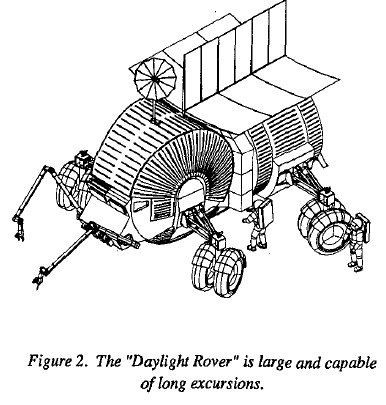
http://www.astronautix.com/d/daylightrover.htmlhttps://ntrs.nasa.gov/api/citations/20050175879/downloads/20050175879.pdf
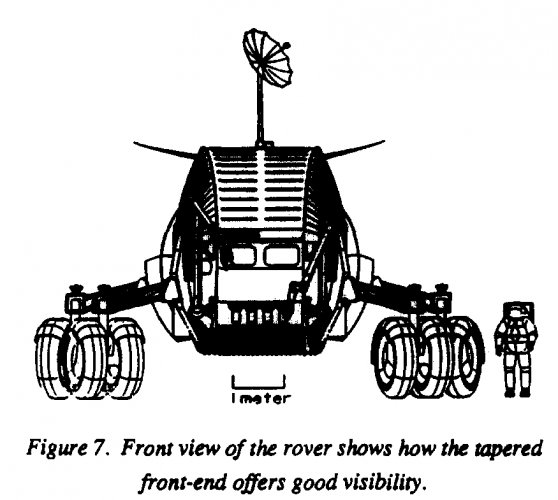
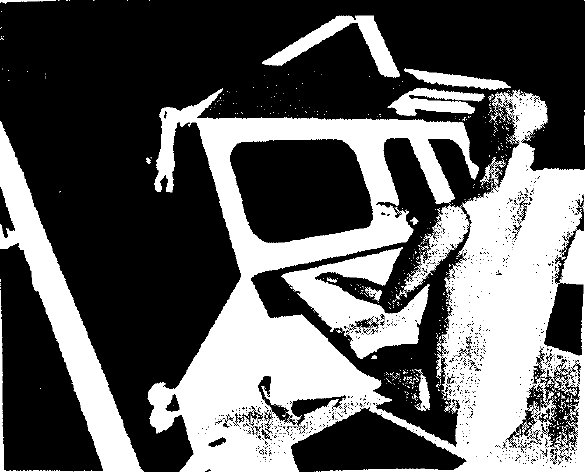
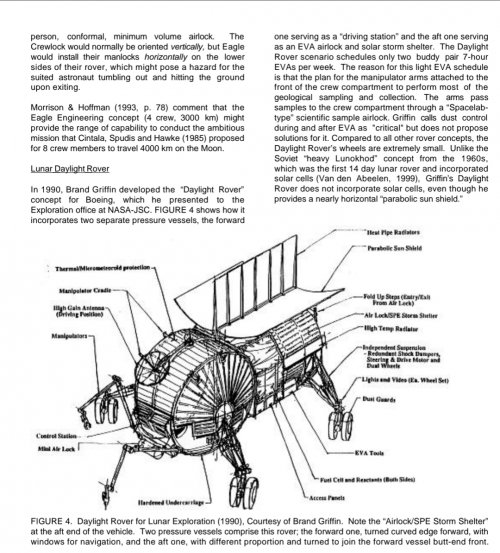
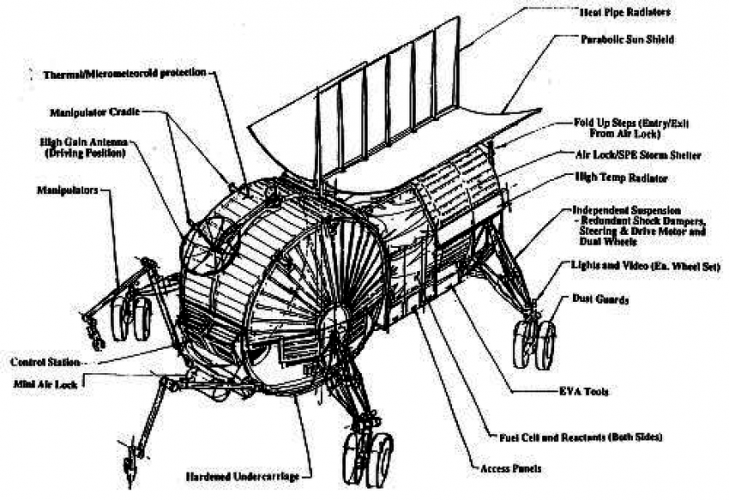
Finley proposed the “Daylight Rover” concept for Boeing in 1990* The daylight Rover incorporates two separate pressure vessels, as shown in figure 12. The majority of the power is derived from regenerative fuel cells. The concept has two separate pressure vessels. The forward serves as thedriving station, and the rear serves as a storm shelter, and EVA airlock. The two manipulating arms at the front of the rover performs most of the geological sampling and collecting, this minimizing actual EVA required. A small airlock is incorporated in the front to allow samples to be transferred tothe module. Additional characteristics are as follows:
Size: 23 to 25 mt.
Structural Characteristics: Two cylindrical pressure vessels, the rear of which serves as the airlock for EVA.
Power System: 10kW continuous electrical power from regenerative fuel cells.
Propulsion System: Four sets of dual wheels, two on each vessel. The wheels have integrated steering andelectric drive mechanisms.
Unique Characteristics: Two manipulating arms for a majority of geological sampling and collecting.
*Finley, Roland, “Pressurized Rover for Lunar Exploration, Daylight Rover Conceptual Design. Piloted rover technologyassessment study,” Task 5.9.4, NAS8–37857, Boeing Advanced Civil Space Systems, 1990Capabilities: Crew of 2 for up to an 80 day mission, at a maximum range of 1000km. Can accommodate4 people in an emergency. Average speed is 4 km/hr in daylight, and 2 km/hr in dark.
Attachments

Last edited:
- Joined
- 1 April 2006
- Messages
- 12,276
- Reaction score
- 15,084
Attachments
Grey Havoc
ACCESS: USAP
- Joined
- 9 October 2009
- Messages
- 24,500
- Reaction score
- 18,169
I added my previous, now deleted post, for new members of the forum who might not necessarily know about the old Apollo era LRV, or Boeing's involvement with it.


