
You are using an out of date browser. It may not display this or other websites correctly.
You should upgrade or use an alternative browser.
You should upgrade or use an alternative browser.
Avro 721, proposed low-level bomber for Spec. B.126T
- Thread starter hesham
- Start date


Nik
ACCESS: Top Secret
- Joined
- 15 July 2009
- Messages
- 1,374
- Reaction score
- 1,211
Sorta runway version of the 'Push-Pots' once suggested as zero-stage rocket launchers...
Featured in Murray Leinster stories ? Space Platform and Space Tug ?? Piloted, barrel-shaped tail-sitter VTOLs hooked onto side of very wide 1st stage as boosters ?? With hindsight, 'Two stops beyond Barking', but fitted the 50s ethos...
Featured in Murray Leinster stories ? Space Platform and Space Tug ?? Piloted, barrel-shaped tail-sitter VTOLs hooked onto side of very wide 1st stage as boosters ?? With hindsight, 'Two stops beyond Barking', but fitted the 50s ethos...
- Joined
- 8 January 2006
- Messages
- 1,692
- Reaction score
- 993
Considering that Murray Leinster (real name: Will F. Jenkins) wrote starting in 1919 up until he died and has a lot of "firsts" in numerous story concepts, I suspect he had lots of interesting people he could contact for help. He can also have a somewhat puckish sense of humor; I refer you to his "The Pirates of Zan" as an example.Sorta runway version of the 'Push-Pots' once suggested as zero-stage rocket launchers...
Featured in Murray Leinster stories ? Space Platform and Space Tug ?? Piloted, barrel-shaped tail-sitter VTOLs hooked onto side of very wide 1st stage as boosters ?? With hindsight, 'Two stops beyond Barking', but fitted the 50s ethos...

Grey Havoc
ACCESS: USAP
- Joined
- 9 October 2009
- Messages
- 24,500
- Reaction score
- 18,175

blackkite
Don't laugh, don't cry, don't even curse, but.....
- Joined
- 31 May 2007
- Messages
- 9,515
- Reaction score
- 9,661
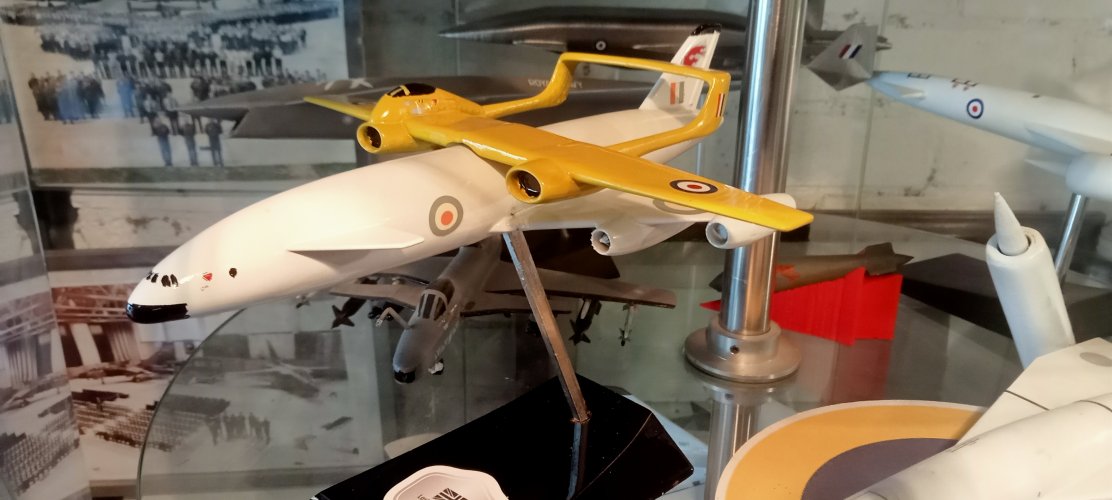
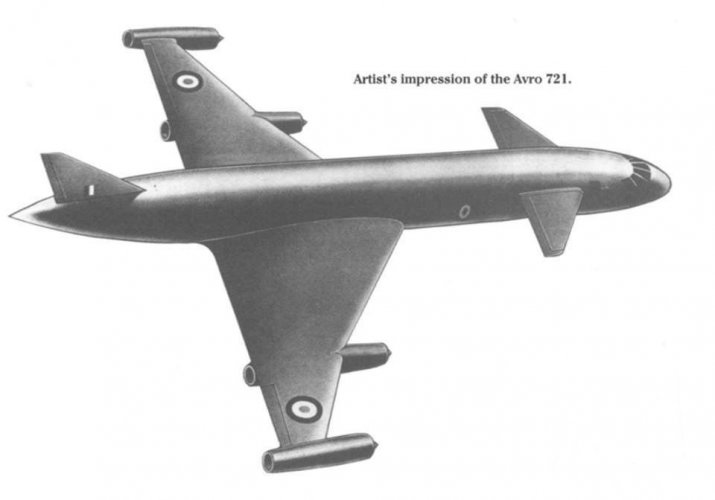
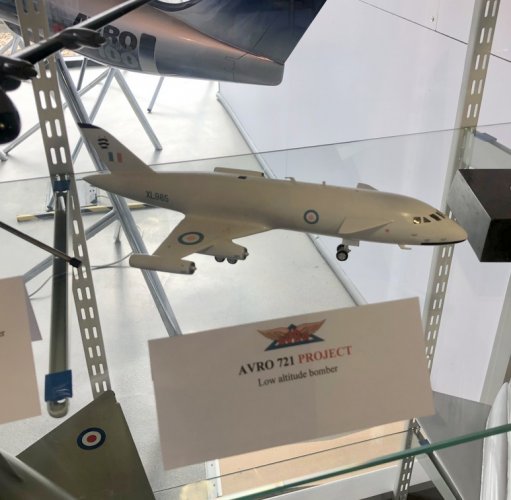
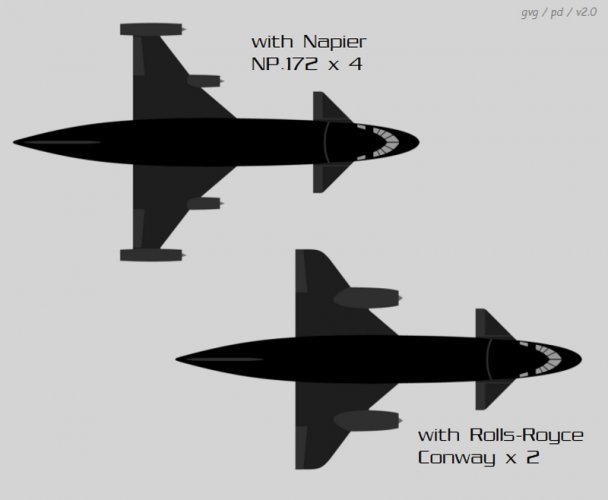
Avro 721 proposed low-level bomber for spec. B.126T.
https://www.facebook.com/1000719247...uirements-from-the-early-50s/690324423375043/
https://www.airvectors.net/avvulcan_2.html"The three V-bombers were all originally built for the high-altitude bombing role. In 1952, while the Vulcan was performing its first flights, the Air Ministry requested preliminary concepts for a "Low Altitude Bomber (LAB)" to complement the high-altitude bomber force, with the LAB penetrating enemy defenses at an altitude of about 150 meters (500 feet) at close to Mach 1.
General concepts were submitted by most of Britain's aircraft manufacturers. The Avro proposal was the "Avro 721", and was in the form of a canard machine with a small, cranked-delta wing. Powerplant options included four projected Napier NP.172 turbofans or two Rolls-Royce Conway turbofans. The small wing made getting off the runway with a full warload troublesome, and so built-in rocket boosters were considered. The bomb was to be ejected backwards through doors in the rear.
The LAB concepts submitted by the manufacturers were given a looking-over; meetings were conducted in 1954 on moving to a full requirement specifying an operational aircraft, but the studies indicated that a LAB would require considerable effort and involve high risk. The aircraft demanded a high strength-to-weight ratio, new navigation systems, new weapons and associated delivery schemes, and so on. The cost of development was estimated as high as 15 million pounds -- a modest sum for development of a combat aircraft these days, even adjusting for inflation, but a major expense for those days, and more than the budget could bear. The conclusion was to not seek an operational system.
Since the V-bombers ended up operating at low level anyway, the decision not to proceed comes across as a lost opportunity, but LAB really was pushing the state of the art. The Royal Navy did obtain a low-altitude tactical bomber in the early 1960s, the superlative Blackburn Buccaneer, which the RAF would adopt as well -- though only because all alternatives got the axe. The RAF was not happy about the Buccaneer at first, but once in service it proved an outstanding combat aircraft."
https://www.facebook.com/1000719247...uirements-from-the-early-50s/690324423375043/
https://www.airvectors.net/avvulcan_2.html"The three V-bombers were all originally built for the high-altitude bombing role. In 1952, while the Vulcan was performing its first flights, the Air Ministry requested preliminary concepts for a "Low Altitude Bomber (LAB)" to complement the high-altitude bomber force, with the LAB penetrating enemy defenses at an altitude of about 150 meters (500 feet) at close to Mach 1.
General concepts were submitted by most of Britain's aircraft manufacturers. The Avro proposal was the "Avro 721", and was in the form of a canard machine with a small, cranked-delta wing. Powerplant options included four projected Napier NP.172 turbofans or two Rolls-Royce Conway turbofans. The small wing made getting off the runway with a full warload troublesome, and so built-in rocket boosters were considered. The bomb was to be ejected backwards through doors in the rear.
The LAB concepts submitted by the manufacturers were given a looking-over; meetings were conducted in 1954 on moving to a full requirement specifying an operational aircraft, but the studies indicated that a LAB would require considerable effort and involve high risk. The aircraft demanded a high strength-to-weight ratio, new navigation systems, new weapons and associated delivery schemes, and so on. The cost of development was estimated as high as 15 million pounds -- a modest sum for development of a combat aircraft these days, even adjusting for inflation, but a major expense for those days, and more than the budget could bear. The conclusion was to not seek an operational system.
Since the V-bombers ended up operating at low level anyway, the decision not to proceed comes across as a lost opportunity, but LAB really was pushing the state of the art. The Royal Navy did obtain a low-altitude tactical bomber in the early 1960s, the superlative Blackburn Buccaneer, which the RAF would adopt as well -- though only because all alternatives got the axe. The RAF was not happy about the Buccaneer at first, but once in service it proved an outstanding combat aircraft."
Attachments

Last edited:

- Joined
- 26 May 2006
- Messages
- 38,288
- Reaction score
- 20,424
Hard to see it as a direct competitor to Buccaneer, but it could make a very interesting platform as maritime patrol, ISR, tankers and such aircraft.The Avro proposal was the "Avro 721", and was in the form of a canard machine with a small, cranked-delta wing.
blackkite
Don't laugh, don't cry, don't even curse, but.....
- Joined
- 31 May 2007
- Messages
- 9,515
- Reaction score
- 9,661
Attachments
- Joined
- 26 May 2006
- Messages
- 38,288
- Reaction score
- 20,424
Attachments
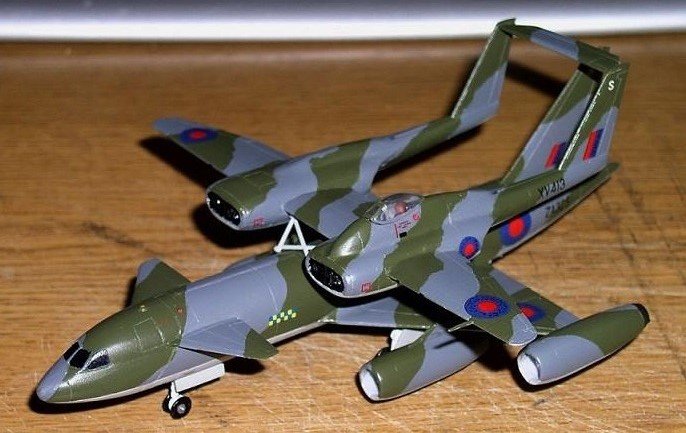
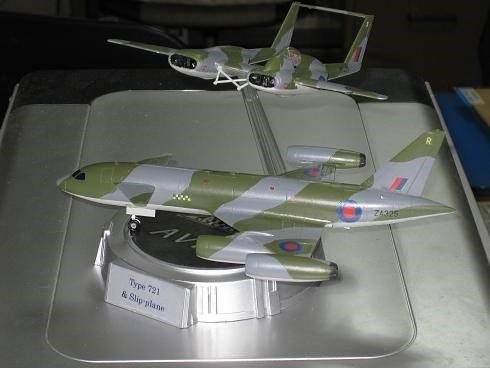
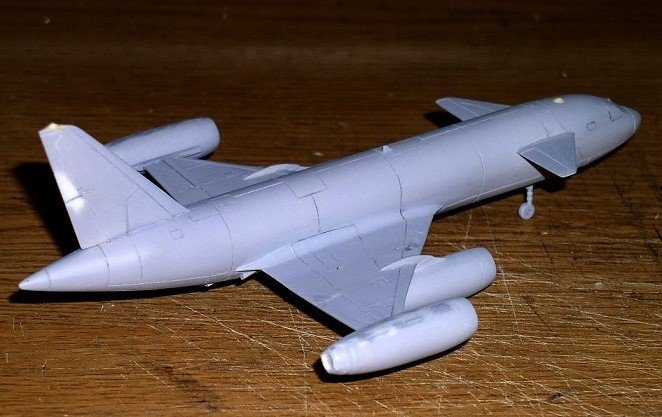

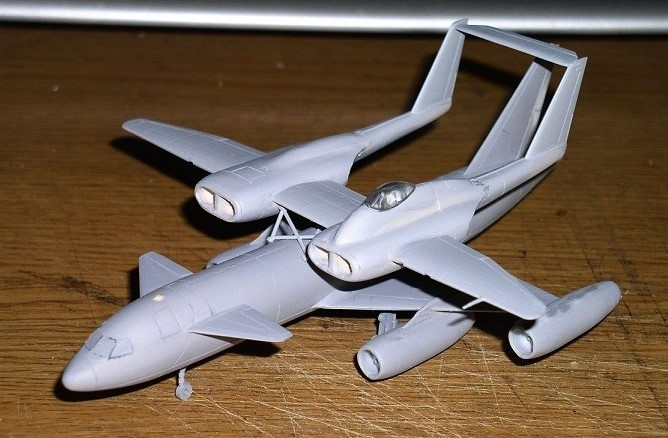
- Joined
- 15 July 2007
- Messages
- 5,740
- Reaction score
- 6,324
I dread to think what one should've done to end up a pilot for the upper thing.What is this?
martinbayer
ACCESS: Above Top Secret
- Joined
- 6 January 2009
- Messages
- 5,081
- Reaction score
- 6,998
I'm not even going to start doing your homework on actually flown staged aircraft, randomly beginning with the Short Mayo Composite...I dread to think what one should've done to end up a pilot for the upper thing.
Scott Kenny
ACCESS: USAP
- Joined
- 15 May 2023
- Messages
- 19,676
- Reaction score
- 28,162
I'm not sure this would have worked well. The A-5 used a similar bomb bay if I'm understanding the description correctly, and it didn't work very well. The bombs tended to get carried along in the wake of the aircraft unpredictably.
Either that or they were the instructors and they needed to keep up their own "pilot in command" time.
Really, really pissed off the instructors?I dread to think what one should've done to end up a pilot for the upper thing.
Either that or they were the instructors and they needed to keep up their own "pilot in command" time.

Mugs914
ACCESS: Restricted
- Joined
- 7 August 2009
- Messages
- 32
- Reaction score
- 99
"Hey boss, what should we do with all of this junk out behind the hangar?"
"I dunno, what all is back there?"
"Well, there are two B-52 engine pods, a couple of MBB tail booms, an old Whirlwind wing and a Vampire fuselage, but just the upper half."
"Man, I don't know... We still have that old Airbus fuselage and Myasishchev wings piled up on the south ramp too. What are we gunna do with all this stuff?
"WAIT, I have an idea!"

"I dunno, what all is back there?"
"Well, there are two B-52 engine pods, a couple of MBB tail booms, an old Whirlwind wing and a Vampire fuselage, but just the upper half."
"Man, I don't know... We still have that old Airbus fuselage and Myasishchev wings piled up on the south ramp too. What are we gunna do with all this stuff?
"WAIT, I have an idea!"
blackkite
Don't laugh, don't cry, don't even curse, but.....
- Joined
- 31 May 2007
- Messages
- 9,515
- Reaction score
- 9,661
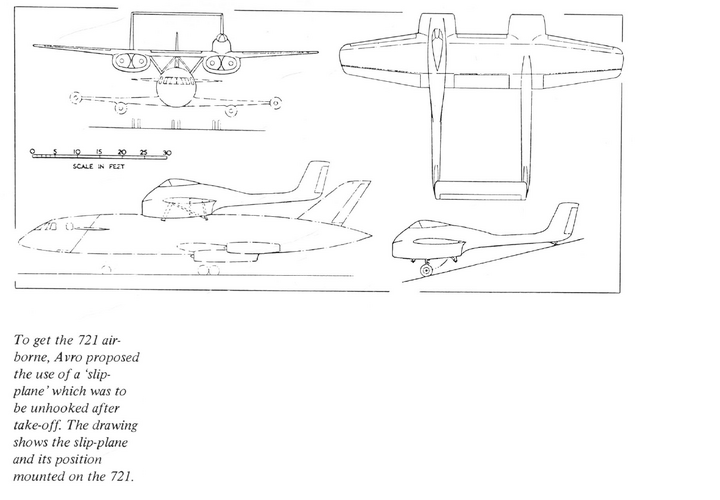
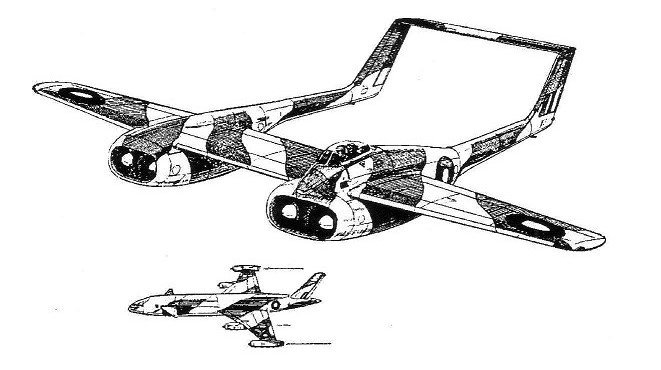
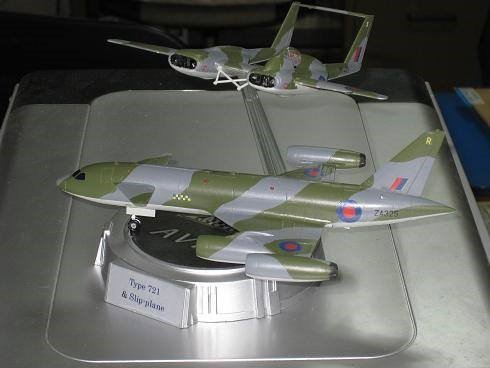
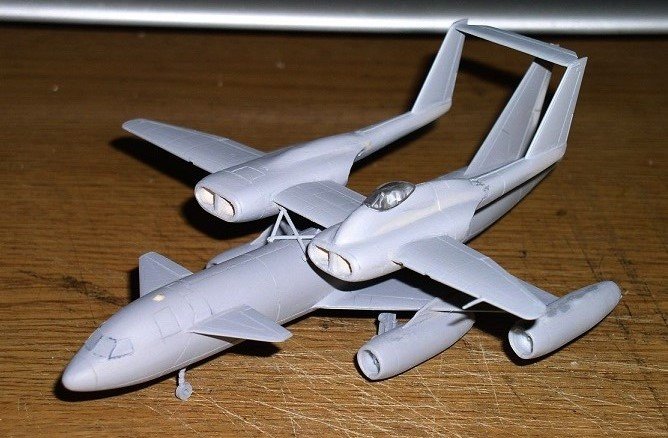
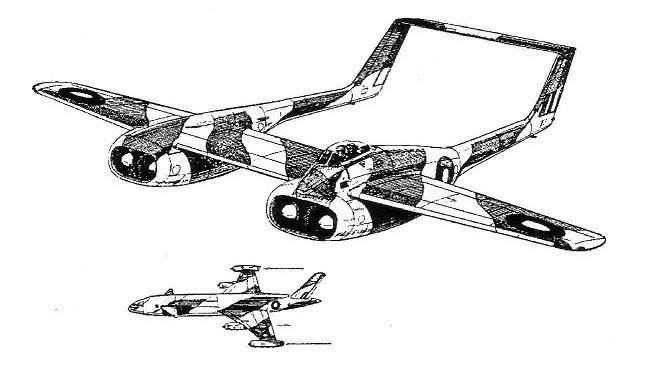
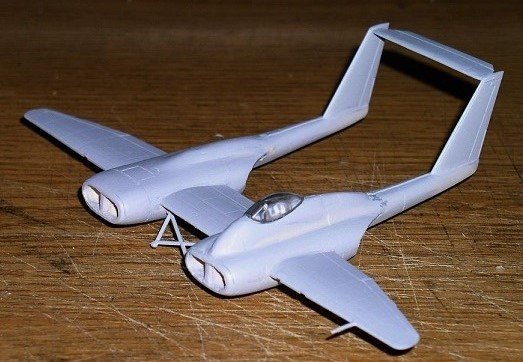
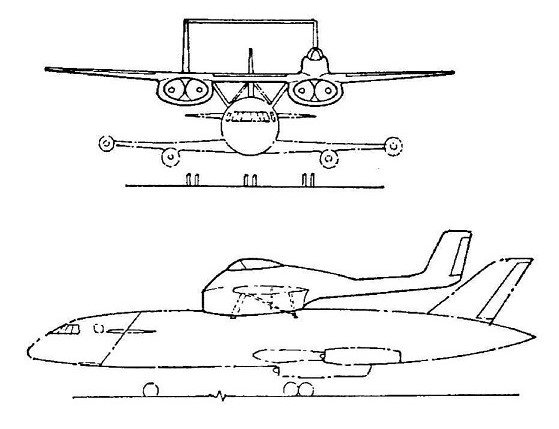
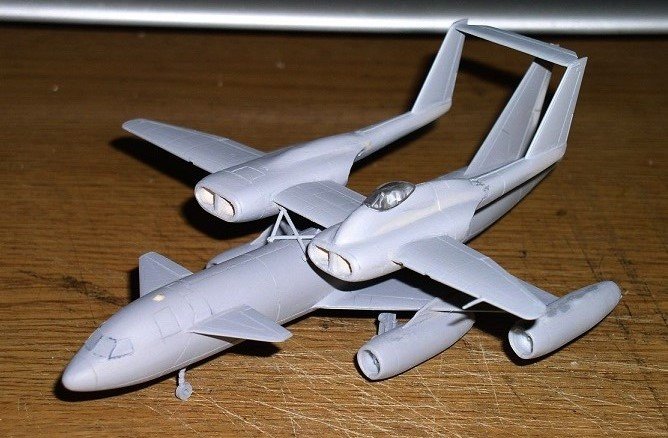
For the basic 721, with fuel for 5500nm(10191.5km) and all-up weight of 124000lb(56246kg), take-off using a 'slip-plane' was suggested.The 30000lb(13608kg) weight slip-plave would have been of twin-boom layout with the pilot in the port boom and four sapphire engines under the wing.
All these complex systems were necessary because of the almost impossible task of meeting the RAF's very long range demands.
The bomber aircraft was in effect a flying fuel tank with an unpressurised three-man cabin forward, which could be jettisoned and landed by parachute from an unstated altitude.
Source : PROJECT CANCELLED, Derek Wood, 1986, Jane's
All these complex systems were necessary because of the almost impossible task of meeting the RAF's very long range demands.
The bomber aircraft was in effect a flying fuel tank with an unpressurised three-man cabin forward, which could be jettisoned and landed by parachute from an unstated altitude.
Source : PROJECT CANCELLED, Derek Wood, 1986, Jane's
Similar threads
-

-
 B.126T / OR.314 / OR.324 Low Altitude Bomber Designs
- Started by JFC Fuller
- Replies: 11
-
OLow Level to Moscow: B.126T and the Handley Page HP-99
- Started by Overkiller
- Replies: 3
-
 Avro 730 and other OR.330 Reconnaissance/Bomber designs
- Started by overscan (PaulMM)
- Replies: 78
-