RyanC

Crazy Researcher
Top Contributor
Senior Member
Joined
19 December 2006
Messages
1,117
Reaction score
1,535
Website
www.generalstaff.org
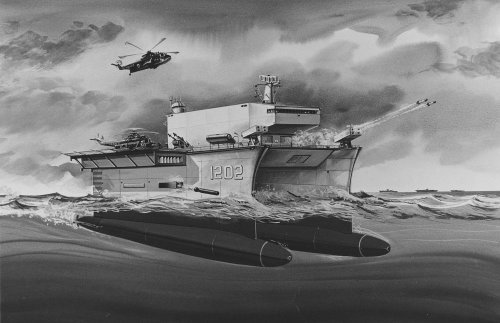
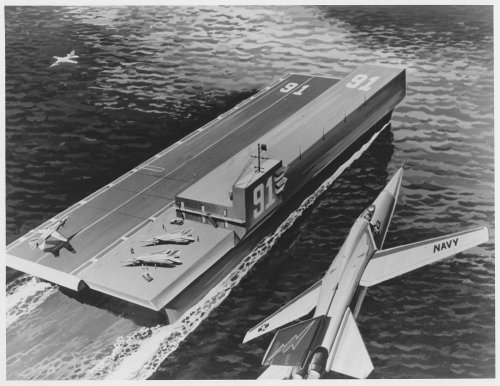
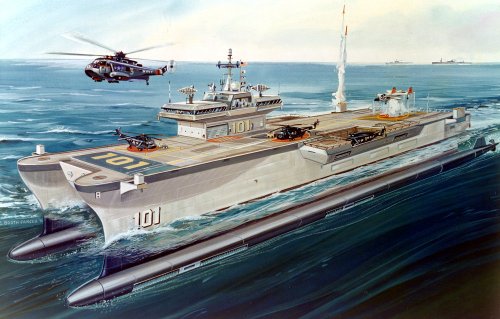
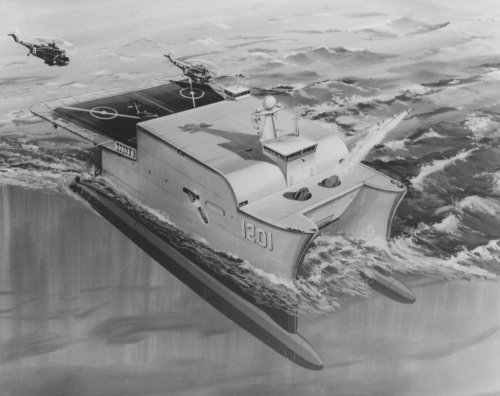
Again, NHHC was big on these. Apologies for smallish size. I'll upload them to my site eventually.
 

Attachments

  • SWATH Concept - 12 Feb 1973.jpg
    SWATH Concept - 12 Feb 1973.jpg
    117.2 KB · Views: 342
  • Unknwon SWATH CV.jpg
    Unknwon SWATH CV.jpg
    137.8 KB · Views: 346
  • Unknown SWATH Concept.jpg
    Unknown SWATH Concept.jpg
    187.2 KB · Views: 379
  • Unknown SWATH Concept 2.jpg
    Unknown SWATH Concept 2.jpg
    116.6 KB · Views: 351
Finally a reason why the US Navy never went ahead with SWATH combatant ships:

[ img ]just too ugly[ /img ]

Dey Ugly!

PS Thanks to Ryan for the latest picture dump.
 
Quite interesting on (uh...) CVV-101 are the apparent wide-aperture sonar arrays, the two-level hangar (reminiscent of Moskva), and the funky dish hatches which I suspect are analogous to the strange ASROC-like thing on the DD below. The radars are also quite strange (almost like baby-SPS-2) and the strange elevated VLS for presumably Sea Sparrow (since there are clearly illuminators above the island).

Altogether bizarre.
 
Again, NHHC was big on these. Apologies for smallish size. I'll upload them to my site eventually.
@RyanC Hi. Sorry for restarting a very old topic. But I am really curious about what the images are supposed to represent. Do you, or anybody else, have any info about at least the design in the first image?

If it's an image from the NHHC archive, it should have had a short description accompanying it, right? Did a bit of searching on the NHHC site but couldn't find the image myself (their archive is huge).
 
REPORT OF THE MINE WARFARE STUDY GROUP (U)
Vol. VIII The SWATH as an MCM Platform

(September 1982)


From 2001:
https://apps.dtic.mil/sti/tr/pdf/ADA413076.pdf
Clandestine Mine Reconnaissance and Countermemures System (CMR/CS).
The VSW (40 to 10 ft) is the area where mines are most likely to bury due to bottom impact, wave scour, and traveling sand ridges, and where the density of NOMBOs is likely to be the greatest. Therefore, an effective minefield reconnaissance system for this area should be capable of detecting, classifying, and identifying moored, bottom, and buried mines. A proposed system capable of accomplishing this difficult task has been on the table for much of the past decade.

The CMR/CS is a small small-waterplane area twin hull (SWATH) platform with displacement in the range of 15 to 20 tons that utilizes suitably adapted Sea Shadow technology to reduce radar cross section and acoustic quieting, and is equipped to transport, launch, operate, and recover two mammal systems. Except for the stealth modification, the SWATH platform can be similar in size and function to the MHS-1-like baseline discussed below in the section "The Mine Clearance Task," or even the same vehicle for both purposes, A variant of the MHS-1 hull design has the ability to ballast down such that the SWATH superstructure is near water level.'12 This variant, combined with Sea Shadow technology, may be preferred for the CMR/CS application owing to a further reduction in profile and a better mammal-handling capability. The craft can then de-ballast for its own MCM operation in shallow water.

The baseline SWATH (MHS-1) is 40 ft long and 18 ft wide. It draws 4.5 ft and has a top speed of 18 knots and a range of 750 miles at an efficient cruise speed of 7 knots. It is operational in sea state 4. Therefore, the platform is capable of being launched from over the horizon, and operating in to the SZ, defense permitting. Thus it is capable of covering the three main mine belts described in the committee's threat lay-down.
 

Similar threads

Back
Top Bottom