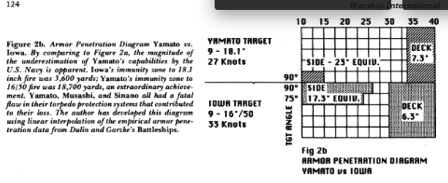
By Paul Forest. Pse take note US Formula is mostly used here in these tables. Last one is about them 'parbuckling' ropes from Massy's AR at Casa.
Ummmmm, your own source states that the line failed due to operator error, and nothing inherent in the line itself. The report clearly says that the crew on the shell handling deck overstressed the line due to improper use, and there were no further issues with the line after that since the crew learned from their mistake. The gun in question only missed 1 salvo the entire engagement as well
 
You may have the full after- action report. I have only "Operational experience of Fast Battleships..." The AAR of the latter states that Iowa obtained straddles on Nowaki and that "...fire and smoke were observed to appear on target" in connection with salvo one. A later paragraph on ordnance material and equipment performance claims a hit based on the above. New Jersey's AAR contained nothing about NJ herself claiming hits but stated (as you said) that "...the air observer reported several straddles but no hits."

Regarding Iowa vs. Katori- I've never seen anything regarding CAG- 17 being an experienced spotter but assume that you have. Frankly, I see it as significant that Iowa was in communication with this experienced spotter, but that Captain McCrea nevertheless claimed no hits on Katori in his AAR. My impression was that CAG offered a "gimme" so that Iowa wouldn't come up empty- handed. In any case, we're discussing one hit vs. no hits- in a short- ranged action under ideal conditions where Iowa should reasonably have obtained multiple hits on a stationary target.
First of all CAG-17 pilot was a Air Group Commnader based on Bunker Hill - with good experience in spotting duties. He had an special F6F for this duty - this plane had engine problem that morning so he had to take regular Hellcat - no cameras.

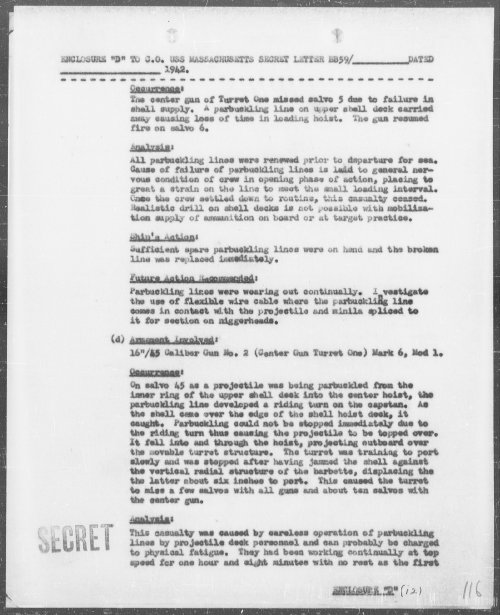
He was not in contact with Iowa - but was communicating with NJ. See attached, from Iowa's AR. Iowa did not have 'air spot' that day - sure she heard what Plane 99 was sending over the radio - but spotting of fall of shot - NJ.

In his report he is very clear about the fall of shot - first salvo 500 yards 'short', second 500 yards 'over' and rest on range but wide. Nowhere the word 'straddle' can be found on Nowaki shoot. He was few thousand feet from target whereas battleships were about 35000 yards away. I think we was in better position to see what happened down range. (battleship jockey's were notoriously 'optimistic' with their gunnery results - see Washington and SoDak during 'Kirishima Night')

Straddles were observed on Katori - and air spotter reported one hit. If one looks at Iowa class 16/50 hit rate tables - one can see that possibly 1 hit was expected at over 30000 yard range and about 13 more at 14000 yard range.
 
Ummmmm, your own source states that the line failed due to operator error, and nothing inherent in the line itself. The report clearly says that the crew on the shell handling deck overstressed the line due to improper use, and there were no further issues with the line after that since the crew learned from their mistake. The gun in question only missed 1 salvo the entire engagement as well
Indeed - this a sample only how fragile the system can be. There is more of same here - and seems they never changed to wire ropes. Seems like a problem as per USN. I'm sure You can imagine this systems weakness when ships is heeling at full speed (anything up to about 10 degs) or in the ruff seas where heel can be even more.
 

Attachments

  • 0823 parbuckling.jpg
    0823 parbuckling.jpg
    3.2 MB · Views: 13
So, you believe that Yamato hit White Plains. I haven't found many who are of that opinion. I don't know myself, but it would be quite a fluke that an 18" diameter gouge was left in White Plains' bilge keel.
Correct. But - Yamato, that morning, was shooting accurately. Target was White Plains and Yamato's first salvo at 35000 yards range was a 300 yard miss, over. Next 3 salvoes were straddles of which last one at 34000 yards produced this hit. As old gunnery saying goes: 'Good shooting gives straddles - only God gives hits'. This hit took WP out of front lines duries permanently. Hit was also observed on Haruna's bridge with exactly to same minute.
 
As interesting as this discussion is, I'm not really seeing a direct link with the Montana Class, which is the topic of this thread.
May well be so - think this discussion is due to the same main guns Montana's were suppose to carry and comparison to 18/45....
 
First of all CAG-17 pilot was a Air Group Commnader based on Bunker Hill - with good experience in spotting duties. He had an special F6F for this duty - this plane had engine problem that morning so he had to take regular Hellcat - no cameras.

He was not in contact with Iowa - but was communicating with NJ. See attached, from Iowa's AR. Iowa did not have 'air spot' that day - sure she heard what Plane 99 was sending over the radio - but spotting of fall of shot - NJ.

In his report he is very clear about the fall of shot - first salvo 500 yards 'short', second 500 yards 'over' and rest on range but wide. Nowhere the word 'straddle' can be found on Nowaki shoot. He was few thousand feet from target whereas battleships were about 35000 yards away. I think we was in better position to see what happened down range. (battleship jockey's were notoriously 'optimistic' with their gunnery results - see Washington and SoDak during 'Kirishima Night')

Straddles were observed on Katori - and air spotter reported one hit. If one looks at Iowa class 16/50 hit rate tables - one can see that possibly 1 hit was expected at over 30000 yard range and about 13 more at 14000 yard range.
In "Operational Experience of Fast Battleships..." page 73, it does state under "Effectiveness of Gunnery" (this is NJ, per my OP, in case you thought Iowa) that "Heavy smoke was seen to rise from the target following the fourth salvo. This may have been the result of fragments from a short burst as, following the action, the Air Observer reported several straddles but no hits."

I swear your knowledge base (as well as that of the other regulars here) is off the charts. Do you do this sort of thing for a living?? If so, my goodness you're a lucky man. I envy you sincerely...
 
In "Operational Experience of Fast Battleships..." page 73, it does state under "Effectiveness of Gunnery" (this is NJ, per my OP, in case you thought Iowa) that "Heavy smoke was seen to rise from the target following the fourth salvo. This may have been the result of fragments from a short burst as, following the action, the Air Observer reported several straddles but no hits."

I swear your knowledge base (as well as that of the other regulars here) is off the charts. Do you do this sort of thing for a living?? If so, my goodness you're a lucky man. I envy you sincerely...
NJ's like Iowa's observers spotting was indeed 'optimistic' I wager. I tend to trust this observer pilot as he indeed was just few thousand feet from target vs 35000 yards for battleships. Can't say were from NJ got 'spotter report' of them straddles - but there were none observed on his report.
The smoke observed - most likely it is Nowaki's CE cranking max power as they realized that huge shells are coming at them. Same thing happened when Yamato was shooting at White Plains - Yamato observed smoke on target after 4th salvo - and assumed a hit and burn on target - however this smoke was just White Plain getting smoke screen generator on at the same moment when salvo landed. The hit was though observed by Haruna (or Kong, can't recall now).
Many a poster are telling about 'Nowaki was damaged by these salvoes' - report. But - for whatever reason none have presented this 'report' yet. Should it some day turn up and show the details of damage - we might call NJ's gunfire a bit more accurate....
 
Because metal on metal makes very bad things happen in a room full of high explosives. This isn't that hard to understand
Correct. Moving around metal (shell) - to - metal (deck) and ship is moving in the seaway..... no wonder ropes go...
 
NJ's like Iowa's observers spotting was indeed 'optimistic' I wager. I tend to trust this observer pilot as he indeed was just few thousand feet from target vs 35000 yards for battleships. Can't say were from NJ got 'spotter report' of them straddles - but there were none observed on his report.
The smoke observed - most likely it is Nowaki's CE cranking max power as they realized that huge shells are coming at them. Same thing happened when Yamato was shooting at White Plains - Yamato observed smoke on target after 4th salvo - and assumed a hit and burn on target - however this smoke was just White Plain getting smoke screen generator on at the same moment when salvo landed. The hit was though observed by Haruna (or Kong, can't recall now).
Many a poster are telling about 'Nowaki was damaged by these salvoes' - report. But - for whatever reason none have presented this 'report' yet. Should it some day turn up and show the details of damage - we might call NJ's gunfire a bit more accurate....
A couple things worth noting here. I personally have not seen the actual AAR from CAG 17 but there is a transcription of it that apparently emanated from Dan Bailey’s WW II Wrecks of the Truk Lagoon. Assuming that there are no transcription errors CAG 17 does not explicitly state that he only observed just one hit rather

The first observed hit came about 1530 from a black splash. It was at the waterline under the bridge. Black got on the target the second salvo. The black pattern had good density, as did the orange.

Note the use of the word "first" here which would of course imply other hits but none were explicitly stated or assigned to splash colors. It is also worth noting that his narrative of events was somewhat confused in that he stated the cruisers came in, apparently because he observed larger splashes and assumed they were from them:

Shortly thereafter larger splashes appeared around Cruiser "K". These were apparently from the heavy cruisers. Some were close but no definite hits were observed
He then states the battleships came in and fired and stated the colored dyes that he identified: blue, red, orange and black. Problem is that there were only two ships firing dyed projectiles, Minneapolis and New Orleans. I can not recall which is which as I am not at home to look at those AARs however one was shooting blue and the other was shooting orange as I recall. He probably saw some orange splashes, and from his vantage point thought they looked red. In any case, no other ship present was shooting dyed projectiles. Black was certainly Iowa as high capacity rounds tend to have a blackish base and this seen in the later narrative when describing the gunnery portion against Nowaki where those splashes are described as black.

It is also worth noting that even as experienced as he may be presumed to have been, it is highly unlikely he was able to concentrate fully on observation on the fall of shot as he had to split his attention with flying and observation. Iowa and the cruisers were not in communication with the spotter so he would not have been alerted to a "rain drop" call when a salvo was about to land. On top of all of this, as was illustrated before in this discussion, Katori was burning nearly stem to stern, barely a quarter of it visible from the heavy smoke prior to the arrival of TG 50.9. His position and distance relative to Katori, are also considerations as I can guarantee you that there was a healthy distance from CAG 17 and Katori to clear the line of fire. Another relevant point is that and had to orbit and would not have had visual on her the entire time when he was wing up in a turn. The fact that he observed a hit, assuming that is indeed what he saw, is quite frankly remarkable.

Action reports, even they are official, are better sources of information but are far from infallible, and I would strongly suggest taking them as with any human observation with a grain of salt. We've seen many times when the pilot/unit/ship/commander are over exuberant in their observations (fighter kill claims are a notorious example, but also South Dakota at Santa Cruz) but we have also seen the opposite such as Adm. Lee thought Washington hit Kirishima 8 times yet recent research from Mr. Lundgren now shows that Washington probably hit Kirishima around 20 times.

The point isn't that CAG 17 was wrong—he may well have seen exactly what he reported, but that doesn't mean that he saw everything that actually transpired. This is also true from the ships themselves. The point is that action reports reflect what observers believed they saw under difficult conditions, and we have ample evidence that such observations can err substantially in either direction. Washington's experience at Guadalcanal shows us that even good observers can significantly undercount. Fighter kill claims show us overcounting is equally common. CAG 17's report should be treated as one data point among several, not as definitive confirmation.

And it bears repeating, again, that Iowa's crew felt that the main battery effectiveness was "considerable". That is not a term that one would have used had they believed they did not hit anything.

For full disclosure, this is the narrative that I have from the Bailey book, I do not have the second half against Nowaki:

Dan Bailey’s “WW II Wrecks of the Truk Lagoon’ quotes the Action Report of Carrier Air Group 17. It says in part:

“At about 1515, the screen destroyers opened up on Cruiser "K" (KATORI). We took position at 1,000 feet altitude and about one mile to the southeast in order to observe results. The cruiser was lying helpless in the trough of the waves, bow to northwest (Tokyo). She had a slight list to port and a red flame could be seen amidships. Her after twin turret was trained amidships and she did not at any time fire her main battery or AA guns.

The shooting of the destroyers was poor. Not until the 5th or 6th salvo did any shots land within 25 yards of the target. About ninety percent were well over. I did not see any hits from the destroyer gunfire. The pattern had good density - at least one splash every 25 yards. There were a few wild shorts.

Shortly thereafter larger splashes appeared around Cruiser "K". These were apparently from the heavy cruisers. Some were close but no definite hits were observed….

The battleships then opened fire on cruiser "K", which now had a marked list to port. The red and blue colored splashes were not close. The blue straddled, but the pattern was about 100 yards between each splash. The red did not straddle. The first observed hit came about 1530 from a black splash. It was at the waterline under the bridge. Black got on the target the second salvo. The black pattern had good density, as did the orange.

The cruiser quickly listed to her port beam and lay for a few moments on her beams ends. I obtained a good sketch of her profile as she lay this way free from smoke. From this I am positive she was a CL of the KATORI class. She had two large shell holes about six feet in diameter in her starboard side, one under the bridge about six feet below the waterline and the other amidships about at the waterline, plus about six small holes.

In a few moments she rolled over on her back, exposed her red bottom, then sank stern first…..”

 
A couple things worth noting here. I personally have not seen the actual AAR from CAG 17 but there is a transcription of it that apparently emanated from Dan Bailey’s WW II Wrecks of the Truk Lagoon. Assuming that there are no transcription errors CAG 17 does not explicitly state that he only observed just one hit rather


Note the use of the word "first" here which would of course imply other hits but none were explicitly stated or assigned to splash colors. It is also worth noting that his narrative of events was somewhat confused in that he stated the cruisers came in, apparently because he observed larger splashes and assumed they were from them:


He then states the battleships came in and fired and stated the colored dyes that he identified: blue, red, orange and black. Problem is that there were only two ships firing dyed projectiles, Minneapolis and New Orleans. I can not recall which is which as I am not at home to look at those AARs however one was shooting blue and the other was shooting orange as I recall. He probably saw some orange splashes, and from his vantage point thought they looked red. In any case, no other ship present was shooting dyed projectiles. Black was certainly Iowa as high capacity rounds tend to have a blackish base and this seen in the later narrative when describing the gunnery portion against Nowaki where those splashes are described as black.

It is also worth noting that even as experienced as he may be presumed to have been, it is highly unlikely he was able to concentrate fully on observation on the fall of shot as he had to split his attention with flying and observation. Iowa and the cruisers were not in communication with the spotter so he would not have been alerted to a "rain drop" call when a salvo was about to land. On top of all of this, as was illustrated before in this discussion, Katori was burning nearly stem to stern, barely a quarter of it visible from the heavy smoke prior to the arrival of TG 50.9. His position and distance relative to Katori, are also considerations as I can guarantee you that there was a healthy distance from CAG 17 and Katori to clear the line of fire. Another relevant point is that and had to orbit and would not have had visual on her the entire time when he was wing up in a turn. The fact that he observed a hit, assuming that is indeed what he saw, is quite frankly remarkable.

Action reports, even they are official, are better sources of information but are far from infallible, and I would strongly suggest taking them as with any human observation with a grain of salt. We've seen many times when the pilot/unit/ship/commander are over exuberant in their observations (fighter kill claims are a notorious example, but also South Dakota at Santa Cruz) but we have also seen the opposite such as Adm. Lee thought Washington hit Kirishima 8 times yet recent research from Mr. Lundgren now shows that Washington probably hit Kirishima around 20 times.

The point isn't that CAG 17 was wrong—he may well have seen exactly what he reported, but that doesn't mean that he saw everything that actually transpired. This is also true from the ships themselves. The point is that action reports reflect what observers believed they saw under difficult conditions, and we have ample evidence that such observations can err substantially in either direction. Washington's experience at Guadalcanal shows us that even good observers can significantly undercount. Fighter kill claims show us overcounting is equally common. CAG 17's report should be treated as one data point among several, not as definitive confirmation.

And it bears repeating, again, that Iowa's crew felt that the main battery effectiveness was "considerable". That is not a term that one would have used had they believed they did not hit anything.

For full disclosure, this is the narrative that I have from the Bailey book, I do not have the second half against Nowaki:

Dan Bailey’s “WW II Wrecks of the Truk Lagoon’ quotes the Action Report of Carrier Air Group 17. It says in part:

“At about 1515, the screen destroyers opened up on Cruiser "K" (KATORI). We took position at 1,000 feet altitude and about one mile to the southeast in order to observe results. The cruiser was lying helpless in the trough of the waves, bow to northwest (Tokyo). She had a slight list to port and a red flame could be seen amidships. Her after twin turret was trained amidships and she did not at any time fire her main battery or AA guns.

The shooting of the destroyers was poor. Not until the 5th or 6th salvo did any shots land within 25 yards of the target. About ninety percent were well over. I did not see any hits from the destroyer gunfire. The pattern had good density - at least one splash every 25 yards. There were a few wild shorts.

Shortly thereafter larger splashes appeared around Cruiser "K". These were apparently from the heavy cruisers. Some were close but no definite hits were observed….

The battleships then opened fire on cruiser "K", which now had a marked list to port. The red and blue colored splashes were not close. The blue straddled, but the pattern was about 100 yards between each splash. The red did not straddle. The first observed hit came about 1530 from a black splash. It was at the waterline under the bridge. Black got on the target the second salvo. The black pattern had good density, as did the orange.

The cruiser quickly listed to her port beam and lay for a few moments on her beams ends. I obtained a good sketch of her profile as she lay this way free from smoke. From this I am positive she was a CL of the KATORI class. She had two large shell holes about six feet in diameter in her starboard side, one under the bridge about six feet below the waterline and the other amidships about at the waterline, plus about six small holes.

In a few moments she rolled over on her back, exposed her red bottom, then sank stern first…..”
I have a couple of questions here. Didn't Iowa use orange dye, or was it not in use yet? Secondly, how would the observer be able to tell the difference between a shell hole and a hole from a bomb near- miss? IIRC, Katori was hit by from 2- 7 bombs. Might a bomb landing right alongside have created the hole, or is there a recognizable difference between the two?
 
Last edited:
Many a poster are telling about 'Nowaki was damaged by these salvoes' - report. But - for whatever reason none have presented this 'report' yet. Should it some day turn up and show the details of damage - we might call NJ's gunfire a bit more accurate....
You can find it in the 10th Squadron War log JACAR ID C08030050200 the damaged Nowaki took from the Iowa's Straddle, NJ completely missed, was...

Some splinter damage to a Torp Tube resulting in electric issues that got fixed, and 1 dead 3 wounded.

Basically took shrapnel damage from the shell exploding. With the IJN report stating it was from the first straddle, which be from Iowa at around 35k according to that Battleships logs.

Afterwards the Iowa lost contact and stop firing when NJ cross over in front of her. With that tub preceding to miss the rest of her shots with no further damage reported on Nowaki.

So Iowa shot better and New Jersey tried to kill steal got punished by MISSING ALL her shots.
 
I have a couple of questions here. Didn't Iowa use orange dye, or was it not in use yet? Secondly, how would the observer be able to tell the difference between a shell hole and a hole from a bomb near- miss? IIRC, Katori was hit by from 2- 7 bombs. Might a bomb landing right alongside have created the hole, or is their a recognizable difference between the two?
No dye here because the Mark 13 High Capacity rounds that Iowa was using do not carry dye loads. HiCap splashes are really surface bursts because the point detonating fuze or the base detonating fuze will trigger on water impact, with the former being "instant" and the latter being nearly so (I can't recall the time delay, but it was much shorter than the Mark 21 BDF on the Mark 8 AP rounds). This creates a greyish or blackish coloration around the base of the splash. (Note I am using the USN spelling of the word "fuse" intentionally here.)

This is confirmed in the second half of the CAG-17 AAR (which I do not have but have seen on the various forums) which describes the gunnery action against Nowaki where he again describes the splash color as black.

As for the damage on the side, you should ask Bill Jurens as he is the resident marine forensics expert, and it is a bit out of my wheelhouse. Assuming his 6-foot estimate is correct, that is almost certainly too small for a bomb (or torpedo) contact explosion damage against the hull. It could be, however, from a bomb that detonated at some distance from the hull. I am not sure and one would have to get a good look at how the hull plating deformed to have a better idea. The wreck is divable so it would be interesting to see if it is well documented and that would provide the opportunity to assess the damage better.
 
A couple things worth noting here. I personally have not seen the actual AAR from CAG 17 but there is a transcription of it that apparently emanated from Dan Bailey’s WW II Wrecks of the Truk Lagoon. Assuming that there are no transcription errors CAG 17 does not explicitly state that he only observed just one hit rather


Note the use of the word "first" here which would of course imply other hits but none were explicitly stated or assigned to splash colors. It is also worth noting that his narrative of events was somewhat confused in that he stated the cruisers came in, apparently because he observed larger splashes and assumed they were from them:


He then states the battleships came in and fired and stated the colored dyes that he identified: blue, red, orange and black. Problem is that there were only two ships firing dyed projectiles, Minneapolis and New Orleans. I can not recall which is which as I am not at home to look at those AARs however one was shooting blue and the other was shooting orange as I recall. He probably saw some orange splashes, and from his vantage point thought they looked red. In any case, no other ship present was shooting dyed projectiles. Black was certainly Iowa as high capacity rounds tend to have a blackish base and this seen in the later narrative when describing the gunnery portion against Nowaki where those splashes are described as black.

It is also worth noting that even as experienced as he may be presumed to have been, it is highly unlikely he was able to concentrate fully on observation on the fall of shot as he had to split his attention with flying and observation. Iowa and the cruisers were not in communication with the spotter so he would not have been alerted to a "rain drop" call when a salvo was about to land. On top of all of this, as was illustrated before in this discussion, Katori was burning nearly stem to stern, barely a quarter of it visible from the heavy smoke prior to the arrival of TG 50.9. His position and distance relative to Katori, are also considerations as I can guarantee you that there was a healthy distance from CAG 17 and Katori to clear the line of fire. Another relevant point is that and had to orbit and would not have had visual on her the entire time when he was wing up in a turn. The fact that he observed a hit, assuming that is indeed what he saw, is quite frankly remarkable.

Action reports, even they are official, are better sources of information but are far from infallible, and I would strongly suggest taking them as with any human observation with a grain of salt. We've seen many times when the pilot/unit/ship/commander are over exuberant in their observations (fighter kill claims are a notorious example, but also South Dakota at Santa Cruz) but we have also seen the opposite such as Adm. Lee thought Washington hit Kirishima 8 times yet recent research from Mr. Lundgren now shows that Washington probably hit Kirishima around 20 times.

The point isn't that CAG 17 was wrong—he may well have seen exactly what he reported, but that doesn't mean that he saw everything that actually transpired. This is also true from the ships themselves. The point is that action reports reflect what observers believed they saw under difficult conditions, and we have ample evidence that such observations can err substantially in either direction. Washington's experience at Guadalcanal shows us that even good observers can significantly undercount. Fighter kill claims show us overcounting is equally common. CAG 17's report should be treated as one data point among several, not as definitive confirmation.

And it bears repeating, again, that Iowa's crew felt that the main battery effectiveness was "considerable". That is not a term that one would have used had they believed they did not hit anything.

For full disclosure, this is the narrative that I have from the Bailey book, I do not have the second half against Nowaki:

Dan Bailey’s “WW II Wrecks of the Truk Lagoon’ quotes the Action Report of Carrier Air Group 17. It says in part:

“At about 1515, the screen destroyers opened up on Cruiser "K" (KATORI). We took position at 1,000 feet altitude and about one mile to the southeast in order to observe results. The cruiser was lying helpless in the trough of the waves, bow to northwest (Tokyo). She had a slight list to port and a red flame could be seen amidships. Her after twin turret was trained amidships and she did not at any time fire her main battery or AA guns.

The shooting of the destroyers was poor. Not until the 5th or 6th salvo did any shots land within 25 yards of the target. About ninety percent were well over. I did not see any hits from the destroyer gunfire. The pattern had good density - at least one splash every 25 yards. There were a few wild shorts.

Shortly thereafter larger splashes appeared around Cruiser "K". These were apparently from the heavy cruisers. Some were close but no definite hits were observed….

The battleships then opened fire on cruiser "K", which now had a marked list to port. The red and blue colored splashes were not close. The blue straddled, but the pattern was about 100 yards between each splash. The red did not straddle. The first observed hit came about 1530 from a black splash. It was at the waterline under the bridge. Black got on the target the second salvo. The black pattern had good density, as did the orange.

The cruiser quickly listed to her port beam and lay for a few moments on her beams ends. I obtained a good sketch of her profile as she lay this way free from smoke. From this I am positive she was a CL of the KATORI class. She had two large shell holes about six feet in diameter in her starboard side, one under the bridge about six feet below the waterline and the other amidships about at the waterline, plus about six small holes.

In a few moments she rolled over on her back, exposed her red bottom, then sank stern first…..”
Wasn't Lee's estimate of "about nine" a reference to 16" hits only? I believe that the latest expedition to Kirishima's wreck has noted an estimated 1o (EDIT: 10) 16" hits, with many of the believed 16" hits proving to be 5' hits. I believe that another expedition is planned to try and get a look at the remainder of the ship. Last I read anyway.
 
Last edited:
Wasn't Lee's estimate of "about nine" a reference to 16" hits only? I believe that the latest expedition to Kirishima's wreck has noted an estimated 1o 16" hits, with many of the believed 16" hits proving to be 5' hits. I believe that another expedition is planned to try and get a look at the remainder of the ship. Last I read anyway.
Last i read, the last survey of Kirishima showed at least 20 16" hits on the wreck.
 
Because metal on metal makes very bad things happen in a room full of high explosives. This isn't that hard to understand

Probably more that line is more flexible, easier to work with and has give to it that wire rope doesn't. Also line will readily snug up on capstan, while wire rope tends to slip.

Sparking (from steel on steel) would be much more of an issue in magazines; not really a concern in shell flat as HE is very insensitive and completely enclosed anyway.
 
Back
Top Bottom