That you very much for that information. The factors which you referenced regarding dispersion were of great interest. Some of them (different lots of powder, for example) were eye openers.

From what I've read, the poor gunnery results of Japanese A class cruisers in the early 30s were the genesis of the Type 98 fire control system, and the gunnery of those cruisers doesn't appear to have 'markedly' increased during the Pacific war.

I generally agree with your statement that using a few short actions under varying conditions to make broad claims is undesirable. I'm not satisfied however, that 'that' is the case here. Samar was the first occasion in which Yamato, its crew, and the Type 98 fire control system were put to the test in a long range surface action. Yet in that first test, they obtained four 1st- salvo 18.1" and three 1st- salvo 6.1" hits on two different vessels from over 20,000 yards- and one of the main battery hits was aimed solely by the ship's Type 22 radar. Moreover, Lundgren has stated in forum conversation (tapatalk) that Yamato 'did' hit White Plains from 34,000+ yards and put an 18" diameter by 8" deep gouge in White Plains' hull.

White it's certainly true that although this first surface action was Yamato's only surface action, the results which the ship obtained are far in excess of the norm. As far as I'm aware, no capital ship of any navy achieved anything close to this level of performance during the Second World War. So, either the Japanese were blessed with good fortune which was rarely, if ever, equaled in naval history, or Yamato's crew performance and/or the Type 98 fire control system were better that we in the west have given them credit for. Certainly, the fact that her gunnery officer ranged on Gambier Bay with her first salvo using only the ship's Type 22 radar would seem to indicate that it was far from being terrible, and was instead a good system at ranging (although clearly inferior to what we put at sea by that time).

Let me just address this first then I will respond about Truk in a following post. The overarching issue here is selection bias. Using an isolated case as proof of overall capability is methodologically problematic - it's like judging a baseball player's career by their best (or worst) game; even if we take these reports at face value. Naval gunnery is inherently stochastic and with the very small sample sizes that we have for capital ship naval gunnery as a whole which makes any analysis problematic in general. No serious systematic analysis would consider such a approach.

The Type 98 GFCS on the Yamtos was a improvement over the older Type 94 systems but it wasn't a dramatic improvement. To that end, most fire control systems during the interwar years were a series of incremental improvements over their predecessors. Only with the introduction of radar was there a true dramatic shift. If I am being honest, I would opine that the action off Sumar more likely represented a "best game" performance for Yamato rather than the mean. I say this because she was largely inactive most of the war and from what I have been able to piece together from the TROMs and secondary sources such as Senkan Yamato, Senkan Yamato no Kenzô, and Senkan Yamato. Sono Sei to Shi is that in her 40 months of operational career, she only exercised her main battery a total of 8 times.

These records may not be complete but it is worth noting that in some of those Japanese references they detail those exercises and they were very lacking in not only in fidelity (shooting at a anchored target) but also only expended 1 or two salvos. There was no mention of firing against a moving target that other navies of the period did. Given that even the most automated systems require crew training and practical experience, I think there was a credible job on the part of Yamato's crew that day. I will say, however, I the idea of crediting her with a "hit" on White Plains and if that is a valid criteria then you have to assign a hit by Iowa off Truk on Nowaki. I do not accept either as valid criteria as a actual hit.
 
Regarding Iowa's performance in Operation Hailstone, an overreliance on calculations and practice gunnery exercises which are not backed up by actual combat performance is an issue. The percentages of expected hits which you referenced (14%?) are, as far as I'm aware, well short of historical gunnery performance by any capital ship during WW2. Everyone shoots better in practice than they do in actual combat when the prospect of physical harm is present, and I believe that this is no less true of warships than it is of infantry. The common denominator is human beings, and warships in action are collections of individual human beings attempting to function as one. I don't question the science or the data that you've presented. I'm by no means an expert in the field of naval gunnery, much less a professional. The cause of Iowa's dismal performance against Katori, I believe, is due to human application. In what specific area that occurred, I'm unable to say. What I do know is that Iowa should have secured a number of hits on Katori and ravaged the ship under the conditions of that engagement, and yet her captain (the last person who would be inclined to acknowledge it) made it clear in his after- action report that Iowa obtained no main battery hits in a short to medium range engagement which took place under ideal conditions. Regarding shell splashes obscuring possible hits on Katori, I believe that the air strike coordinator observed Iowa's fall of shot, and that he did record a possible hit on the second salvo- which Iowa's captain did not claim in his after- action report.

I think it’s important to point out that action reports are really a compilation of observations and reports from the various department heads. These reports are rarely personalized observations, and, in that regard, the captain of a battleship would rarely be in the best position to observe the effects of gunfire. The performance of the batteries would be promulgated from the Gunnery Officer to the captain in his own report which would then be incorporated within the official action reports.

There is, of course, a significant difference between combat and exercise and I am certainly not arguing otherwise. However, I question the validity of that observation here. By your own statements previously, Katori was dead in the water with half the ship engulfed in fire and smoke. She was not observed to have been returning fire and the amount of return fire in general from the handful of ships that were intercepted was rather light. While not entirely stress-free, it was hardly a taxing engagement, and I remain quite skeptical that it played a significant role. You've essentially described conditions more favorable than many peacetime exercises yet still claim what would essentially be a catastrophic degradation of accuracy.

I have previously illustrated why hits were difficult to discern which is why it is important to discuss other possibilities. This is precisely why mathematical analysis matters - it quantifies just how improbable zero hits would be under these conditions. The gunnery data we have accumulated was used to calibrate a couple of math models. One was from Princeton University’s Statistic Research Group as well as a Monte Carlo simulation. Both models have been validated against the actual fleet data.

These models are predictive in nature and can accurately recreate observed events when provided with specific data inputs on MPI and dispersion. For example, one must plug in values of Mean MPI errors, Standard Deviation of MPI errors and TMD. When this is done then they give very accurate results. While combat conditions rarely provide such precise measurements, however, radar spotting data offers a reliable alternative.

Specifically, radar spotting proved capable of determining MPI to within ±60 yards, providing accuracy broadly comparable to photographic or mechanical rake methods. I have used this data as a substitute for photographic rake data, which is how fall of shot is normally measured, to plug into those models and have found that the results are accurate to within 0.5-0.75% of the more precise rake data. Ex. for a given event, the models using rake data predicts 6.5% hits whereas the models just using the radar spotting data might show 7%.

Now why is this relevant? Because we have radar spotting data here. I do not have TMD data but making a fairly conservative estimate on TMD gives one a good starting point for analysis. When I did that, I found that every single simulation run I would make I always produced hits. I then decided to start increasing MPI and TMD values and simulating them again.

What I eventually found was that it required me to quadruple the MPI errors and TMD values to get situations where no hits were predicted and even then, it was relatively rare at around 15% of the simulation runs.

One may ask would such MPI and TMD errors be obvious to the Iowa crew and yes it would have been blatantly obvious. A TMD that is 4 times average would be 2.52% of range which would translate to an 8-gun pattern of 9.8% of range. To put this in perspective, the Mark 8 radar scope, when in PRECISION SWEEP, displays about 1000 yards on either side of the target and in this example, the splash pips would have been distributed across 3/4ths of the scope in range.

In addition to that, the patterns would have been shifting wildly salvo to salvo, (on average 400 yards or ¼ of the scope) and the amount of straddles would have been roughly halved. So in any case such wildly inaccurate gunnery would have been obvious and would certainly have been noted in the action reports. The absence of such notes is telling.

I believe that there's no question regarding his statement but that Captain McCrea was referring to the effect of his ship's secondary battery only.

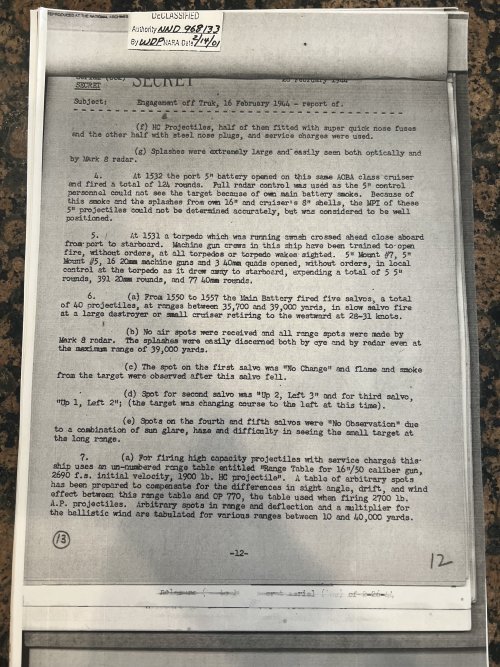
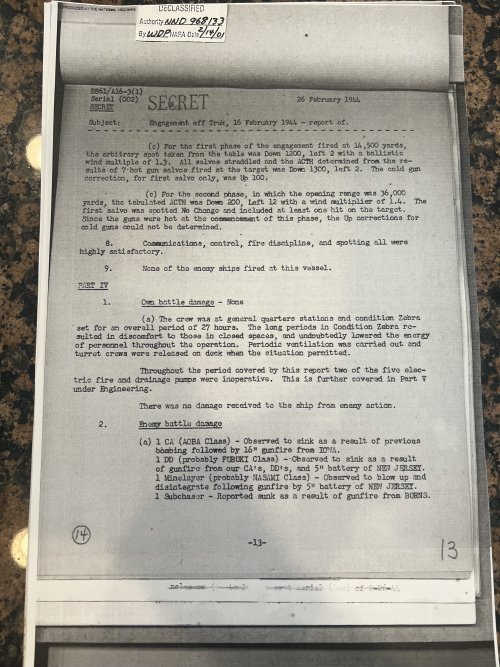
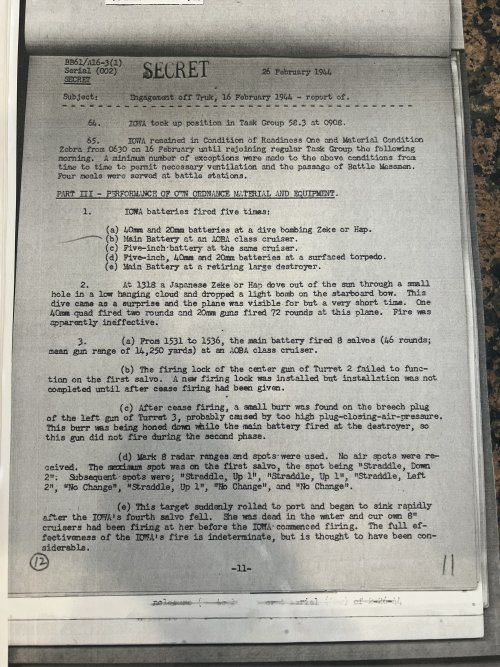
No this is not at all what the Action Report says. I have included the entire gunnery narrative in this message however this is the only details of the secondary battery:

At 1532, the port 5" battery opened on this same AOBA class cruiser and fired a total of 124 rounds. Full radar control was used as the 5" control personnel could not see the target because of own main battery smoke. Because of this smoke and the splashes from own 16" and cruiser's 8" shells, the MPI of these 5" projectiles could not be determined accurately, but was considered to be well positioned.

The quote I post previously is clearly in reference to the main battery fire as you can see it is under point 3, reference “e” which is the main battery narrative against Katori. The secondary battery narrative is discussed under point 4.

All of this evidence - from radar data to the action report to mathematical improbability - points in the same direction. Dismissing this convergent evidence in favor of an unsupported assertion about what is essentially human factors requires more than just speculation. It would be much more productive to quantify these human factors rather than rely on a broad statement that combat reduces accuracy.
 

Attachments

  • IOWA_gun_report.jpeg
    IOWA_gun_report.jpeg
    2.6 MB · Views: 68
  • IOWA_gun_report_2.jpeg
    IOWA_gun_report_2.jpeg
    2.6 MB · Views: 18
  • IOWA_gun_report3.jpeg
    IOWA_gun_report3.jpeg
    2.5 MB · Views: 61
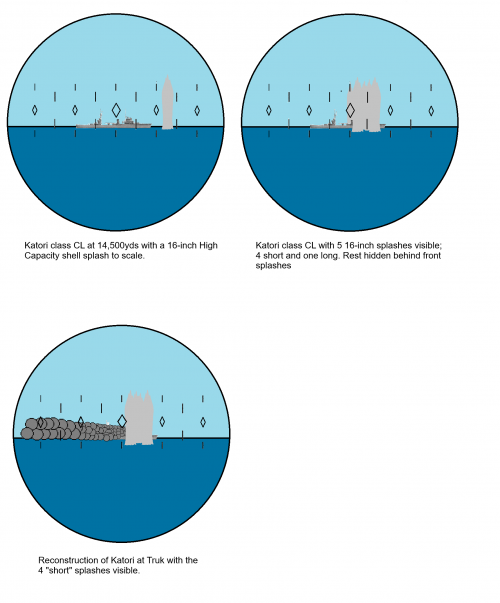
This might be interest to some. This is a illustration (I am not a artist so I apologize if its a bit crude) of how the operator of the Mark 48 rangefinder would see the Katori engagement through his 25x power optics. The ship and splashes are drawn to scale with the bottom illustration done to recreate the state of Katori as described in the Action Report and as seen in the photographs. The splashes are shown in a typical pattern where roughly half the pattern is landing short of the target and the other half are landing over. Note at this range the deflection pattern would be roughly 3-5 mils (45-70 yards at this range). The distance between the diamonds is 5 mils so the pattern illustrated here might be one that lands on the tighter side but well within normal variation.
 

Attachments

  • iowa_at_katori_1.png
    iowa_at_katori_1.png
    118.2 KB · Views: 65
SecNav Daniels also ordered the USN to be dry before Prohibition, no alcohol allowed onboard, because he didn't drink.


Depends on rates of fire. Most of the 18"+ guns were very slow firing compared to the 16" guns.

The Yamato threw 9x3200lb AP shells every 45 seconds or so, total weight of 28,800lbs per volley. Montana with 12x16" 2700lb AP is throwing 32,400lbs per volley, every 30 seconds. That's a 4600lb advantage per volley.

In two minutes, the Yamato would throw a total of 86,400lbs; while a 16" Montana would throw 129,600lbs, over 50% more weight of shells! An Iowa would throw 97,200lbs in 2 minutes, 11klbs or ~12% more than the Yamato.


Agreed, being about to throw shells almost as heavy at twice the rate of fire give a huge advantage to the Montana class with 4x Iowa turrets.

Now, if the USN 18" monster could somehow have a sub 45second reload time... 3800lb superheavy shells at either 4x2 turrets or 3x3 is a different discussion entirely.
Both 16/50 fired at the rate of 2rpm at normal battle ranges or say out to about 25000 yards after which US gun became marginally faster. At max 40000+ range Yamato's rate was still 1,5 rpm. Your numbers are somewhat slewed towards US gun. Anyways - NO WW2 battleship fired their guns at max rate - highest rate attained was Rodney 'killing' Bismarck at point blank range - at 1,7rpm.
 
In fact - KGV's were best performers among WW2 modern battleships. Even if them guns were 'so small' - they did score easily most hits on enemy heavy units at sea. No other bb, Allied or Axis, came even close. They were obviously also best armored battleships excluding Yamato's of the WW2 lot.
They simply put them 'so small' bullets on target - something for example Iowa;s really struggled with.
PoW was sunk by somewhat questionable damage control in the midst of very heated air attacks.
 
Friedman is a great source for design history, but like any author isn't above mistakes and one must be careful with secondary sources. For instance, what are the sources of his drawings? Friedman himself , while a fantastic author isn't a primary source and like any of us can make mistakes and may have been forced to make interpretations. It is also important to keep in mind that when he (and Dulin and Gartzke) wrote their respective books on American Battleships, there was still restrictions to record access because of classification (these books were researched in the 1970s).

I have also seen many times where information keeps getting passed down from source to source without much check with primary sources. One example is the supposed "misalignment" of the main battery that the Iowa class had until after Leyte Gulf*. I have well over 600 pages of main battery related primary source documents and I was never able to locate any even hint of alignment issue. Further correspondents with those who were part Iowa class gunnery improvement program in the 1980s, where they combed through class gunnery related documents stored at Dalghren, could find no such references either.

My suspicion is that it was a memo or document that referenced issues where the Fast Battleships initially had range table differential modifiers that caused them to overshoot the range tables. It turned out to not be a massive issue as, particularly with radar spotting, the MPI could quickly be adjusted back on to the target.

I can reach out to John to see what he has to say (if he recalls as it's been decades). But I could swear it was AD Baker who was Friedman's illustrator for that book? But I have to say, unless there was some documentation John (or AD Baker) or Friedman have I'd suggest the Contract Plans are probably the most definitive.

*edited to clarify that the supposed alignment issue was a vexing issue until after Leyte Gulf
I wonder where from this mis-alignment got going originally ? Word is clear without doubt. Campbell's book has mention about that though source is not footnoted. I seen a claim that those elusive docs about this problem were found long ago by G. Slover and if this indeed is true - there must be something into this problems existence.
 
When using Super heavy shells, the 16"/50 gave armor penetration equal to the 18" gun. But it delivered it at a higher rate of fire, and with fewer reliability issues. As is with 16" guns, the Montana class would have delivered a heavier broadside than the Yamato class did. And delivered it more often. I think the Navy sticks with the 16"
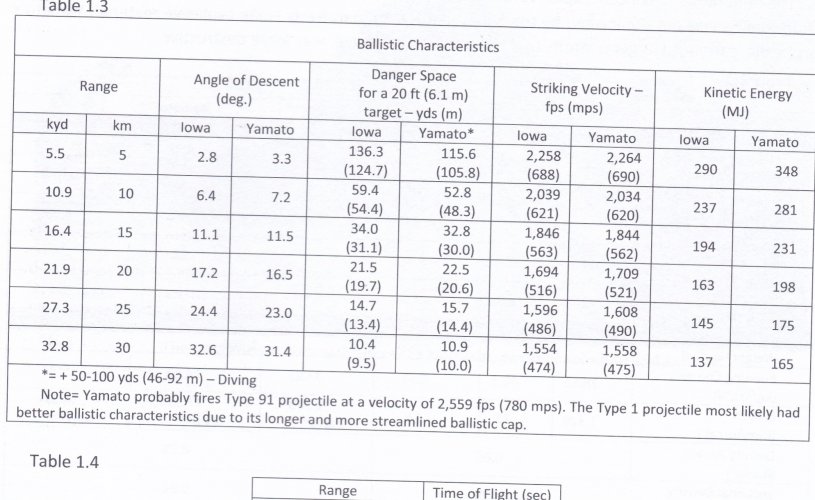
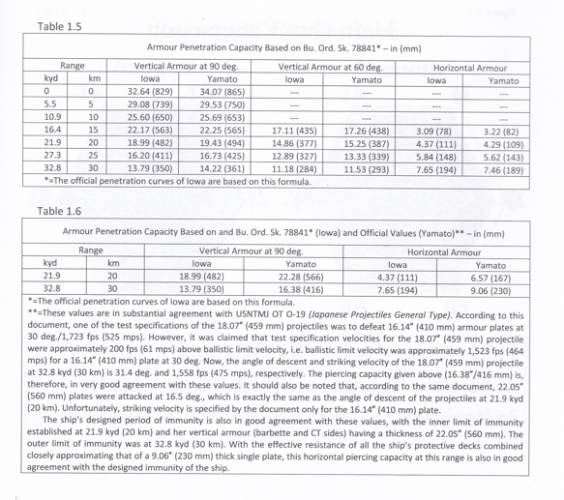
I think not. 18/45 was slightly better belt penetrator at all ranges and also marginally better deck penetrator out to about 32/33000 yard ranges where 16/50 got marginally (less than 10mm) better. Total destructive energy delivered down range however was massively bigger for Japanese shell.
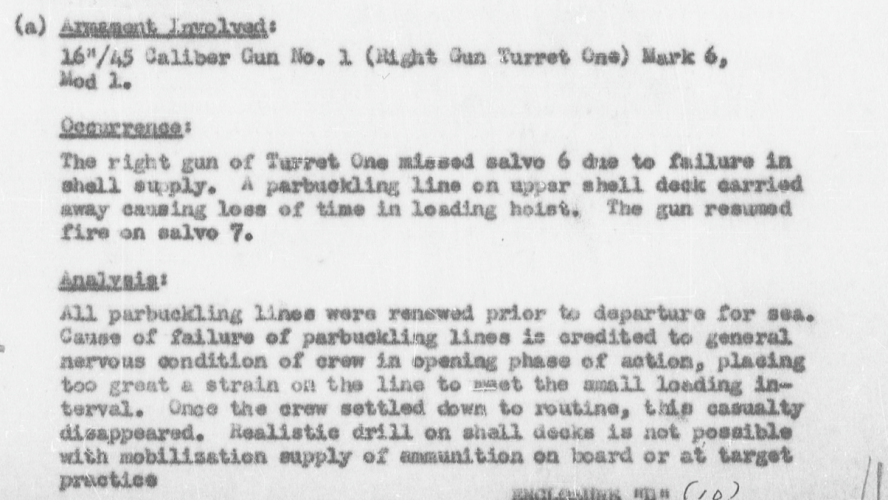
Rate of fire was better on Japanese gun at close ranges, medieum ranges possibly were same rpm and at long ranges US gun was slightly faster. 18/45 could still fire at 1,5 rpm at 40000+ ranges. 18/45 turret seems to have been somewhat more mechanized - 16/50 for example used 'parbuckling ' to move shells. Problematic when in a bit ruff seas.
 
Last edited by a moderator:
SecNav Daniels also ordered the USN to be dry before Prohibition, no alcohol allowed onboard, because he didn't drink.


Depends on rates of fire. Most of the 18"+ guns were very slow firing compared to the 16" guns.

The Yamato threw 9x3200lb AP shells every 45 seconds or so, total weight of 28,800lbs per volley. Montana with 12x16" 2700lb AP is throwing 32,400lbs per volley, every 30 seconds. That's a 4600lb advantage per volley.

In two minutes, the Yamato would throw a total of 86,400lbs; while a 16" Montana would throw 129,600lbs, over 50% more weight of shells! An Iowa would throw 97,200lbs in 2 minutes, 11klbs or ~12% more than the Yamato.


Agreed, being about to throw shells almost as heavy at twice the rate of fire give a huge advantage to the Montana class with 4x Iowa turrets.

Now, if the USN 18" monster could somehow have a sub 45second reload time... 3800lb superheavy shells at either 4x2 turrets or 3x3 is a different discussion entirely.
Depends on the ranges the guns were fired. Japanese 18/45 was faster firing gun, marginally, that 16/50 - at near loading angle ie at close ranges. At medium ranges they were both about 2rpm - at extreme ranges 18/45 could still go at 1,5 rpm. Would think 16/50 was faster at extreme ranges. But - not one battleship fired their guns at max rate during WW2. Fastest I've been able to find was Rodney 'killing' Bismarck - 1,7rpm at point blank range.
 
Last edited by a moderator:
So long as they dont use RN powder practices...

Enough hits to last to see the Yamato sunk.

Hell think post war studies on both sides agree that 3 USN Standards or two Fast BBs was enough to confirm a victory with acceptable casualties against the Yamato.

Party cause Yamato could only shot one at a time. Trying to do separate Turret targeting resulted in 2 of the turrets limited to the far weaker local fire control. Not to mention that you needed more then the 3 shots to get a good target solution for the basically manual fire control.

Throw in that the Fast BBS could maneuver while maintaining target solutions?
IIRC Yamato class was designed two separate targets in mind also. She indeed had more FCT than the one on top of the bridge. Local FC they'd use when all other FCT's are shot out.
 
Rather simple. While any damage to Yamato accumulate, damage to one of Standards would not affect two others. Sure, Yamato concentrating fire on one Standard would inflict sigfnificant damage (maybe even knock it out). But Yamato would be also hit, and its vulnerable parts - fire control directors, superstructure, unarmored bow and stern - would suffer damage.

With her central fire control degraded, Yamato ability to dealt damage to remaining two Standards would be significantly decreased. While the other two Standards, not damaged and now facing little threat from Yamato fire, could pound her as hard as they wish. Yamato would be forced to either flee (assuming it could still maintain full speed - unarmored bow flooding due to HE hits may cause her to lose speed advantage), maintain safe distance (and succumb to accumulated damage from multiple hits, even if none would pierce her armor), or try to close distance to compensate for fire control degradation (and thus lose the invulnerability - on close distance 14-inch and 16-inch guns of Standards would be perfectly able to penetrate her armor).
Central fire control - was below 8" armored deck. Not easily destroyed - on the other hand FCT's are vulnerable to even small caliber guns. Like SoDak found out at Guadalcanal 1942 - mostly cruiser caliber shells rendered SoDak - as Lee described - 'blind, deaf and dumb'. Topsides were basically shot to pieces. Citadel intact...
 
On long range? Most likely, since HE destructive power aren't decreasing with distance, and they would assume that new Japanese battleship have superior armor anyway.


Actually they would. US fire control systems are significantly better than Japanese, more automatic. Japanese have better optics, but their system as a whole was not as advanced as American; too many manual operations, too many sources of error. And Japanese gunners on battleships were generally less trained than American - due to simple cost limitations. Replacing the worn-out barrels often were too costly for Japan... especially on Yamato-class, where you basically need to replace the whole gun.
Yet, Yamato did shoot remarkably well at Samar. Regardless "their system as a whole was not as advanced as American; too many manual operations, too many sources of error. And Japanese gunners on battleships were generally less trained than American". Hits from moderate to extreme ranges - and using radar for ranging.
Iowa and NJ at Truk with latest "US fire control systems are significantly better than Japanese, more automatic" fired over 100 shells at Japanese ships - and Iowa managed to score only one hit on a stationary target - at close range. Something is not right with this, right ?
I believe that in Theory "US fire control systems are significantly better than Japanese, more automatic" was indeed great but in Practice - not so much. As proven by real combat records. "their system as a whole was not as advanced as American; too many manual operations, too many sources of error. And Japanese gunners on battleships were generally less trained than American" did in fact put shells reliably on target - including a 34000 yard hit on USS White Plains.
 
Last edited by a moderator:
Sure. Assuming that Americans did not pull rather obvious trick with putting smoke screen between them & enemy and firing using radar) But okay, let's even assume they wouldn't.

View attachment 716820
What would happen with this "ginormous structure", if several 14-inch/16-inch HE shells would hit the superstructure below it, and exlpode, severing cables, shaking the whole construction and producing a fountains of heavy fragments? How good would be Japanese optic after being shakened and probably shattered by shockwaves? Let's not forget, it isn't radar antenna; to make rangefinder absolutely useless even the slight damage would suffice.
Correct. One bb caliber hit anywhere near that RF and it's bound to blow out of kilter. Haruna suffered this during Samar and that time it took over an hour to repair it. Both Bismarck and Scharnhorst were both hit in their fwd FCT early in engagement - danger of this kind of hit was real. SoDak same thing basically during 'Kirishima Night'...
 
Not true. USN intelligence was circulating reports of 17.7 inch guns in spring 1943 and 18 inch following aerial recce in Feb 1944. After obtaining the latter, it seems to have been later in 1944 early 1945 before that was fully accepted, but still before Yamatos sinking.

http://www.navweaps.com/index_tech/tech-084.php
This memo did not reach fast battleships, obviously. Fast battleship Gunnery Instruction - Yamato class, 45000t, 16/45's, 12" belt (not inclined) and 6,4" deck - speed 28 - 30 knots.
 
Yamato obtained three first- salvo 18.1" and three 6.1" hits on USS Johnston off Samar from over 20,000 yards. She also obtained a first- salvo hit on Gambier Bay) from just under 22,000 yards, aimed solely by the ship's Type 22 Mod 4 radar because of a lack of a visual to the target until about a minute after opening fire. In contrast, Iowa engaged Katori from an average range of less than 14,500 yards in clear visibility conditions during Operation Hailstone. Katori had already been hit by a torpedo, from 2- 7 bombs, numerous 8" and 5" hits from a U.S. heavy cruiser and a destroyer, was making no more than 1- 2 knots (one report recorded her as dead in the water) and was already sinking when Iowa opened fire. Iowa failed to hit Katori with eight salvoes (46 rounds) with her main battery during operation Hailstone. The reasons? High shell dispersion (among the highest of any navy in WW2) and a lack of main battery practice after arriving in the Pacific theater.
IIRC Yamato also put a shell on tarhet, White Plains, at 34000 yards. First salvo at 35000 yards was 300 yards over - rest 3 were straddles and last produced a hit.
Iowa and NJ at Truk. Air observer spotted one hit on Katori by Iowa. Katori should have been an 'easy target'.....
 
The high dispersion (or sometimes written as a main battery alignment issue) with the Iowas has been a pervasive myth for decades and I have yet uncover any primary source documents that support this. For context, myself and Bill Jurens co-wrote a article in Warship International in 2006 on the USN's fast battleship gunnery training in a two part article titled: Fast Battleship Gunnery During WWII: A Gunnery Revolution. Our article is based entirely on primary documentation that I had duplicated from NARA in the previous years. This was supplemented with correspondence with several whom served on the Iowas during the 1980s including the type's master chief gunner Stephen Skelley.

While we did not recover the entire catalogue of gunnery exercises for the battleships, we did recover a lot of data, including over 50 Day Battle Practice where the ships expended AP with Service velocity charges. From the observation of deck logs, it appears that op-tempo permitting, the fast battleships were typically exercising in Day Battle Practice every other month or so and often sprinkling in calibration and radar spotting practice in the intervening time. So basically every few weeks the main batteries were exercised with live fire in some way. The Iowa's were no exception. BatDiv 7 (Iowa and New Jersey) in fact had conducted several Day Battle Practices during their workups prior to their deployment to the pacific. Additionally, they both had calibrated their main batteries after they cleared the canal and were a week out of Pearl Harbor. This was just weeks prior to HAILSTONE.

The idea that the Iowa's had bad True Mean Dispersion is not supported in any of the data that we uncovered. Their average with AP-Service was ±0.43% of range which corresponds to a 9-gun range pattern of 1.72% of range which is very good. Now Iowa used the Mark 13 High Capacity (HiCap) rounds with service velocity charges which does have a higher dispersion which is roughly 0.6% of range. It is true that Iowa never directly observed hits on Katori though in her action report she believed her gunfire was very effective having achieved a average MPI error of less 100yds according to radar spots. Radar spots during gunnery exercises were accurate to within ±60yds with large salvos such as what happened here so this is very likely quite accurate.

The lack of hits observed is interesting however I had discussed this on several occasions with Master Chief Skelley and he was not surprised. MC Skelley had personally controlled over 3,000 rounds of 16-inch gunfire (including combat in ODS) for context. He pointed out how colossal the HiCap splashes are: 300' high and around 45 feet wide. Iowa's average MPI error was on the short side of Katori which would place the majority of 16-inch splashes in front of their view of Katori. Additionally, the secondary battery was firing which I was surprised to learn was very distracting, resulting in heavy virbration in the Mark 38 director optics. During the 1980s it was practice to withhold a 5-inch salvo if the main battery fall of shot was about to land.

It also appears that the DD and CA gunfire was not very accurate. I have the action reports of New Orleans and Minneapolis in my personal collection (somewhere) and it is worth noting that New Orleans had a very bad tracking error (personnell error on the part of the rangekeeper operator) and had a difficult time maintaining the hitting deflection. Interestingly some additional detail from CAG 15's action report is highlighted below. He provided airspot for a time and his observations are below.

Some context: New Orleans was firing orange projectile dye and Minneapolis was firing blue. He notes a red dye but there was no red dye by any of the ships present and probably was the orange dye. What is interesting is his comment about black dye. Black dye was not used by the USN and in this case is almost certainly Iowa. HiCap do tend to have a dirty blackish base of the splash when nose fused super quick fuze action was selected on those rounds as was the case here.

“At about 1515, the screen destroyers opened up on Cruiser "K" (KATORI). We took position at 1,000 feet altitude and about one mile to the southeast in order to observe results. The cruiser was lying helpless in the trough of the waves, bow to northwest (Tokyo). She had a slight list to port and a red flame could be seen amidships. Her after twin turret was trained amidships and she did not at any time fire her main battery or AA guns.

The shooting of the destroyers was poor. Not until the 5th or 6th salvo did any shots land within 25 yards of the target. About ninety percent were well over. I did not see any hits from the destroyer gunfire. The pattern had good density - at least one splash every 25 yards. There were a few wild shorts.

Shortly thereafter larger splashes appeared around Cruiser "K". These were apparently from the heavy cruisers. Some were close but no definite hits were observed….

The battleships then opened fire on cruiser "K", which now had a marked list to port. The red [sic] and blue colored splashes were not close. The blue straddled, but the pattern was about 100 yards between each splash. The red did not straddle. The first observed hit came about 1530 from a black splash. It was at the waterline under the bridge. Black got on the target the second salvo. The black pattern had good density, as did the orange.

The cruiser quickly listed to her port beam and lay for a few moments on her beams ends. I obtained a good sketch of her profile as she lay this way free from smoke. From this I am positive she was a CL of the KATORI class. She had two large shell holes about six feet in diameter in her starboard side, one under the bridge about six feet below the waterline and the other amidships about at the waterline, plus about six small holes.

In a few moments she rolled over on her back, exposed her red bottom, then sank stern first…..”


A comment on Yamato's radar: The type 22 radar had terrible resolution. 1,500m in range and 40° (!) in bearing. So at 22kyds you're looking at a resolution cell of 1,600 x 770 yds. That is nearly worthless for accurate tracking in any situation except perhaps a single ship with optics supplimenting it. It certainly was not a viable tool for radar spotting.

A final observation: If we are to take these hit claims at face value it really is not very indicative how effective a gunnery system is on average. That is because natural statistical effects hits can be seemingly random and given the very small sample sizes in general of battleships during WWII, it can skew the data. For example, I have seen many time in gunnery exercises where traditional measures of main battery aim, MPI and standard deviation of MPI error, are very good and even the TMD is good but no hits or a lower than expected hit percentage was obtained. Conversely I've seen exercises where fantastic results were acheived (South Dakota obtained 22% hits at 35,000yds in 1943 in one exercise). This is simply because the engagements or exercises only expended a few dozen rounds at a given target and not a large slug fest such as the runs to the south and north during Jutland where much larger round expenditures evens things out.

So in my honest opinion, drawing conclusions from either of these examples if very problematic when trying to extrapolate to what a fleet engagement might look like from a gunnery perspective.
Indeed - Cmdr Dale the designated spotter in F6F observed one hit on Katori.
Yamato at Samar - in DAR she specifically mentions that radar was used - for ranging only. Other 3 Japanese battleships did the same. They commented that results were good.
 
Last edited by a moderator:
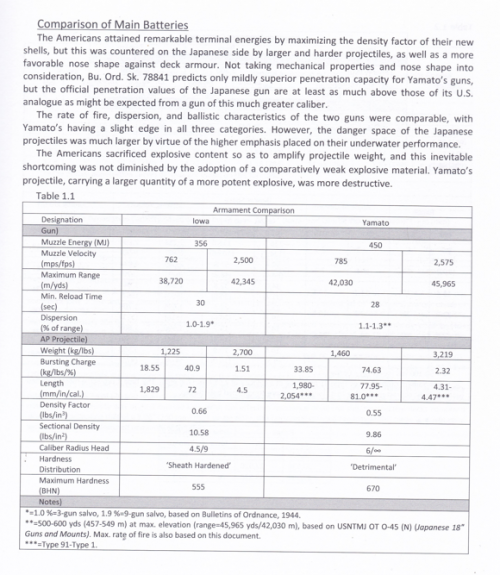
Per a 1944 U.S. Navy Bulletin of Ordnance, dispersion of the Iowa class was 1.9% of range for a nine- gun salvo, and 1.0% of range for a three- gun salvo (one gun per turret). Per the USNTMJ OT O-45 (N) "Japanese 18" Guns and Mounts", dispersion of the Yamato class was 1.2- 1.3% of range for a nine- gun salvo primarily due to the Type 98 Discharge Delay Unit. Mr. Jurens has already stated on Bismarck's forum that the Iowas had a shell dispersion rate of 1.9% of range.

Iowa's 5" secondary battery was not firing simultaneously with her main battery. In Iowa's after- action report, Captain McCrea stated that permission had just been given for her 5" battery to open fire when Katori capsized toward Iowa and sank rapidly. The claimed shell holes in Katori that you refer to are unconfirmed. Katori was hit by from 2-7 bombs and took multiple near misses from carrier aircraft before they were called away so that 50.9 could engage the Japanese in a surface action.

Per USNTMJ OT O-31 "Japanese Surface and General Fire Control", the Type 22 Mod 4 radar had a range accuracy of 109 yards, and Yamato's foretop optics had a resolution of from 57- 89 yards. The Type 22 Mod 4 could detect a 100- foot high battleship- sized target at over 35,000 yards. The U.S. Navy Mark 8 Radar Range keeper had a range accuracy of plus/minus 15 yards + 0.1% of range. At from 20- 25,000 yards, that translated to 35- 40 yards, while that of Iowa's foretop optics was from 105- 165 yards. Yamato's gunnery used the average of the ranges of Yamato's foretop and after range finders and her Type 22. This resulted in multiple first- salvo hits off Samar on both USS Johnston and USS Gambier Bay. By comparison, Iowa failed to register a hit on what was effectively a stationary target at short range. This happened to Iowa again in July of 1948, when she was tasked with sinking USS Nevada. In a multi- day exercise, she failed to do so, and Nevada was sunk by aerial torpedo attack. I'm not trying to crack on the Iowas (I was part of that Navy once), but that's the history.
"again in July of 1948, when she was tasked with sinking USS Nevada".
Do we have any details about this shoot ? IIRC only 27 shells were expended by Iowa. I seen the NARA film but one really can't see whether there is a hit or not...
 
Thank you for the table. My understanding is that dispersion factors include the rigidity of the hull and proximity of the guns to one another in a turret. If TMD is the theoretical dispersion of a single gun corrected for systematic errors and measurement inaccuracies, and as the factors I referenced would vary from class to class, wouldn't TMD be highly general in nature?

I understand that the Type 98 wasn't unique, as we used delay coils ourselves. That said, the Japanese were clearly doing something right, referencing the action off Samar. Speaking of that, that action has been gone over with a fine tooth comb. The firing and impact times of the principal vessels involved mesh, as do the firing angles of the targeting vessels. I'm no professional in the field by a long shot, but I have yet to see anything in print even partially refuting Lundgren's work.

It strikes me that as multiple observers aboard Iowa failed to record any hits on Katori, and that her shell splashes were tracked both visually and with the Mark 8, stating 80+ years later that no hits are an improbability would require some supporting evidence other than mere calculation. That said, I sincerely respect your viewpoint.

Finally, I've been likewise unable to locate any data as to the particulars of Iowas assignment regarding Nevada. Even the number and type of vessels involved varies by source. The only constant that I've seen is that Iowa was assigned the task of sinking Nevada. A couple of dozen rounds would suffice if Nevada had been opened up and prepped for sinking.
CAG 17 F6F spotter observed one hit on Katori - on 2nd salvo. IIRC Iowa expended 27 shells at Nevada. Cannot find other details abou this - though NARA has two film clips about Iowa and Avengers - maybe DD;s as well, working over Nevada.
 
Captain McCrea's after- action report stated that main battery shell splashes were tracked both optically and with the Mark 8, and that all eight salvoes were straddles. Katori was clobbered with a torpedo, from 2- 7 bomb hits, multiple near misses from carrier aircraft, and numerous 8" and 5" hits from a heavy cruiser and a destroyer. She was on fire, making from 1- 2 knots, and was already sinking when Iowa opened fire.
As per carrier pilots reports - 11 bomb hits, 11 bomb near misses and 2 torpedo hits were scored - suppose we have to deduct at least half of this as 'over claiming'. (Yamato was hit by 10/11 torpedoes 7 Apr 45 - carrier pilots claimed 30 torpedo hits). Heavy cruisers expended close to 400x8" shells - hard to assume that there were no hits ? DD gunfire, as per spotter plane' was inefficient with large dispersion patterns. Yet these should have left a mark on the unarmored little training cruiser... talking about them 'shell holes' on target ship.
 
Indeed - Cmdr Dale the designated spotter in F6F observed one hit on Katori.
Yamato at Samar - in DAR she specifically mentions that radar was used - for ranging only. Other 3 Jap battleships did the same. They commented that results were good.
I haven't seen that report in quite some time, but didn't he record a "...possible hit on the second salvo"?
 
CAG 17 F6F spotter observed one hit on Katori - on 2nd salvo. IIRC Iowa expended 27 shells at Nevada. Cannot find other details abou this - though NARA has two film clips about Iowa and Avengers - maybe DD;s as well, working over Nevada.
I've never seen details of the operation either, and I've seen two different compositions of the force involved. What I have read is that Iowa was assigned to sink Nevada and failed to do so, and that Nevada was sunk by an aerial torpedo.
 
IIRC Yamato also put a shell on tarhet, White Plains, at 34000 yards. First salvo at 35000 yards was 300 yards over - rest 3 were straddles and last produced a hit.
Iowa and NJ at Truk. Air observer spotted one hit on Katori by Iowa. Katori should have been an 'easy target'.....
So, you believe that Yamato hit White Plains. I haven't found many who are of that opinion. I don't know myself, but it would be quite a fluke that an 18" diameter gouge was left in White Plains' bilge keel.
 
He wrote - a hit. Iowa was on target on 2nd salvo.
That's odd. In Iowa's after- action report, Captain McCrea stated that shell splashes were tracked both visually and with the Mark 8. As I recall, Iowa was also in contact with the aerial spotter, and yet the captain reported all eight salvos as straddles and recorded no main battery hits. EDIT: Didn't CAG- 17 spot for New Jersey?
 
So, you believe that Yamato hit White Plains. I haven't found many who are of that opinion. I don't know myself, but it would be quite a fluke that an 18" diameter gouge was left in White Plains' bilge keel.
It was a Proxy hit not a skin on skin hit.

Basically it's the one confirm time that those Japanese diving shells work, basically it missed but went off close enough to dent White Plain hull.

Which they did confirm in a post war dry docking of her. Which they had no idea of til someone did the math.

Can find it in The World Wonder'd by Robert Lundgren.

But since all it did was dent the CVE's Skin Metal which didn't even leak...

It's debatable that it even counts as a hit.
 
In fact - KGV's were best performers among WW2 modern battleships. Even if them guns were 'so small' - they did score easily most hits on enemy heavy units at sea. No other bb, Allied or Axis, came even close. They were obviously also best armored battleships excluding Yamato's of the WW2 lot.
They simply put them 'so small' bullets on target - something for example Iowa;s really struggled with.
PoW was sunk by somewhat questionable damage control in the midst of very heated air attacks.
Links or proof please. “Trust me, bro” doesn’t fly.
 
Depends on the ranges the guns were fired. Jap 18/45 was faster firing gun, marginally, that 16/50 - at near loading angle ie at close ranges. At medium ranges they were both about 2rpm - at extreme ranges 18/45 could still go at 1,5 rpm. Would think 16/50 was faster at extreme ranges. But - not one battleship fired their guns at max rate during WW2. Fastest I've been able to find was Rodney 'killing' Bismarck - 1,7rpm at point blank range.
Once shell time of flight is in excess of reloading time, it doesn't matter what your reloading times are. And that means at pretty much any range beyond 20,000 yards for the Iowa-class.
 
And once Time of flight is greater then 30 seconds?

Its up to fucking God and Lady Luck if it hits.

Unless you can activately guide the shot the target can do A LOT to dodge the incoming before adding in the natural inaccuracy of these guns.
 
And once Time of flight is greater then 30 seconds?

Its up to fucking God and Lady Luck if it hits.

Unless you can activately guide the shot the target can do A LOT to dodge the incoming before adding in the natural inaccuracy of these guns.
And we have a direct hit, pun intended, on why very long range ship vs ship gunnery went the way of extinction.

WAY too many variables plus no terminal guidance.

I’m as big, or was, of a battleship fan as you could find, but they just couldn’t hit consistently another moving ship at greater than ~20K yards. Even the USN knew deck hits at say 35K yards would be very unlikely even with aerial spotting.

Torpedoes, missiles on whatever launch platform are just far superior weapons.
 
I wonder where from this mis-alignment got going originally ? Word is clear without doubt. Campbell's book has mention about that though source is not footnoted. I seen a claim that those elusive docs about this problem were found long ago by G. Slover and if this indeed is true - there must be something into this problems existence.

I will try to be as delicate as I possible can with respect to the late Mr. Slover. He told some great sea stories and his website is a fantastic resource but a LOT of his claims that he made on Navweaps were factually incorrect and did not correlate at all with any primary source documentation or people whom I knew actually served on Battleships. I do know he served for a short time as a fire control specialist which obviously gave him exposure but he was not gunnery officer as many presume. I do not want to take anything away from his contribution to Naval History as his website in particular is a fantastic resource. I just suggest caution using his recollections as a primary source.

I suspect what happened is that Dr. Friedman or perhaps Campbell came across a memo or document in NARA that discussed something similar. This anecdote then got passed around from author to author as you unfortunately see quite often in secondary sources. I suspect what they came across was the "issue" where the fast battleships had incorrect temperature differential modifiers to the range tables and thus would "overshoot" the range table value. They developed a system to deal with this, called a Arbitrary Correction To Hit (ACTH) monogram. It was essentially a compilation empirical data that allowed them to create their own spotting input to compensate. Even if that was in error for the propellant radar spotting allowed them to rapidly spot back on in any case.

I have many (but not all) of the Iowa's gunnery exercise reports and a lot of memos from the ComBatCruPac and ComPac file stacks and there is zero issue with the Iowa class alignment or dispersion.
 
Last edited:
I think not. 18/45 was slightly better belt penetrator at all ranges and also marginally better deck penetrator out to about 32/33000 yard ranges where 16/50 got marginally (less than 10mm) better. Total destructive energy delivered down range however was massively bigger for Jap shell.
Rate of fire was better on Jap gun at close ranges, medieum ranges possibly were same rpm and at long ranges US gun was slightly faster. 18/45 could still fire at 1,5 rpm at 40000+ ranges. 18/45 turret seems to have been somewhat more mechanized - 16/50 for example used 'parbuckling ' to move shells. Problematic when in a bit ruff seas.
And yet, the Navy stated that the 18"/45 provided no "practical" benefit over using the 16"/50 with Super Heavy shells. Primarily because at all expected battle ranges the 16" would penetrate any expected enemy vessel's armor. There was no practical amount of armor that would resist either gun at all normal battle ranges (essentially anything under 25,000 yards). And at the shorter range, the higher rate of fire from the 16" gun was worth more than the heavier shell of the 18". And as for the last bit about the 18" being more mechanized, that wasn't a good thing. It had to be mechanized because the 18" Super Heavy shell was too massive to be moved about the turret ring and loaded manually. The 2,700lb 16" shell was right at the upper limit of what could be moved manually. And given when the ships were designed, the equipment needed to move those massive 18" shells was quite a bit slower than the men needed to move the 16" shells.
 
That's odd. In Iowa's after- action report, Captain McCrea stated that shell splashes were tracked both visually and with the Mark 8. As I recall, Iowa was also in contact with the aerial spotter, and yet the captain reported all eight salvos as straddles and recorded no main battery hits. EDIT: Didn't CAG- 17 spot for New Jersey?
I'd wager that while Iowa herself indeed did not claim hits - the spotter had much better view of target and could see that hit at close and from another angle. CAG 17 spotted for NJ during the long range gunnery at Nowaki. IIRC both Iowa and NJ reported one hit and straddles on Nowaki - however CAG 17 did not - he spotted nearest splashes at 500 yard away. CAG 17 was few thousand feet away from target and battleships were at around 35000 yards away. Think CAG 17's report is more accurate obviously - he was experienced spotter.
 
And yet, the Navy stated that the 18"/45 provided no "practical" benefit over using the 16"/50 with Super Heavy shells. Primarily because at all expected battle ranges the 16" would penetrate any expected enemy vessel's armor. There was no practical amount of armor that would resist either gun at all normal battle ranges (essentially anything under 25,000 yards). And at the shorter range, the higher rate of fire from the 16" gun was worth more than the heavier shell of the 18". And as for the last bit about the 18" being more mechanized, that wasn't a good thing. It had to be mechanized because the 18" Super Heavy shell was too massive to be moved about the turret ring and loaded manually. The 2,700lb 16" shell was right at the upper limit of what could be moved manually. And given when the ships were designed, the equipment needed to move those massive 18" shells was quite a bit slower than the men needed to move the 16" shells.
I think not so. While it is true that there was no 'practical' advantage for 18/45 (until a hit and penetration occurred as the energy of 3219AP was way more than that of much smaller 2700AP) as both shells caused problems at target. Penetration was slightly better overall for 18/45. (16/50 enjoyed marginal advantage at over 33000 yards or so - less than 10mm IIRC).
'At shorter range' - 18/45 was marginally faster at close ranges (low loading angle) - medium range they had about same rate of fire and at long ranges 16/50 was marginally faster. 'more mechanized' has something to do with this. Plus US manhandling of shells with parbuckling - was a bit problematic if ship did drastic maneuveres or in ruff seas. As shown on Massy at Casa - weak link - the parbuckling rope was broken few times affecting gun output.
Anyways - no WW2 battleship managed that max rate of fire in combat - especially at long ranges. Fastest I have seen was Rodney 'killing' B. At point blank range she did 1,7rpm.
 

Attachments

  • WNUS_16-50_mk7_parbuckle_pic.jpg
    WNUS_16-50_mk7_parbuckle_pic.jpg
    189.3 KB · Views: 28
Well, this opinion is based - on facts, obviously. It would be crazy to go and invent own stories here, right ? What particular opinion You do not buy here - and I present You more details ?
Links or images please. “Trust, but verify.”
 
I'd wager that while Iowa herself indeed did not claim hits - the spotter had much better view of target and could see that hit at close and from another angle. CAG 17 spotted for NJ during the long range gunnery at Nowaki. IIRC both Iowa and NJ reported one hit and straddles on Nowaki - however CAG 17 did not - he spotted nearest splashes at 500 yard away. CAG 17 was few thousand feet away from target and battleships were at around 35000 yards away. Think CAG 17's report is more accurate obviously - he was experienced spotter.
You may have the full after- action report. I have only "Operational experience of Fast Battleships..." The AAR of the latter states that Iowa obtained straddles on Nowaki and that "...fire and smoke were observed to appear on target" in connection with salvo one. A later paragraph on ordnance material and equipment performance claims a hit based on the above. New Jersey's AAR contained nothing about NJ herself claiming hits but stated (as you said) that "...the air observer reported several straddles but no hits."

Regarding Iowa vs. Katori- I've never seen anything regarding CAG- 17 being an experienced spotter but assume that you have. Frankly, I see it as significant that Iowa was in communication with this experienced spotter, but that Captain McCrea nevertheless claimed no hits on Katori in his AAR. My impression was that CAG offered a "gimme" so that Iowa wouldn't come up empty- handed. In any case, we're discussing one hit vs. no hits- in a short- ranged action under ideal conditions where Iowa should reasonably have obtained multiple hits on a stationary target.
 

Attachments

  • 001 - 16-50 vs 18-45.png
    001 - 16-50 vs 18-45.png
    552.3 KB · Views: 18
  • 001 - Ballistics for main guns.jpg
    001 - Ballistics for main guns.jpg
    415.2 KB · Views: 20
  • 001 - Penetration os 50 vs 45.png
    001 - Penetration os 50 vs 45.png
    477.9 KB · Views: 16
  • Screenshot 2025-11-28 070358.png
    Screenshot 2025-11-28 070358.png
    1.1 MB · Views: 17
By Paul Forest. Pse take note US Formula is mostly used here in these tables. Last one is about them 'parbuckling' ropes from Massy's AR at Casa.
At your convenience, I'd like to read your take on his immunity zones for the two vessels, which he states is sourced from the USN BuOrd.
 
Back
Top Bottom