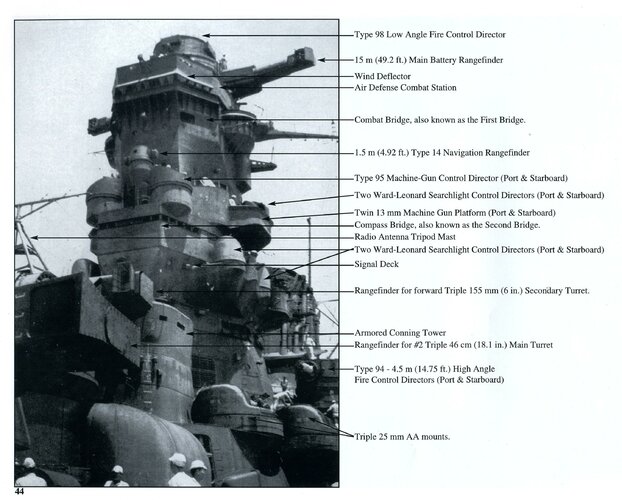
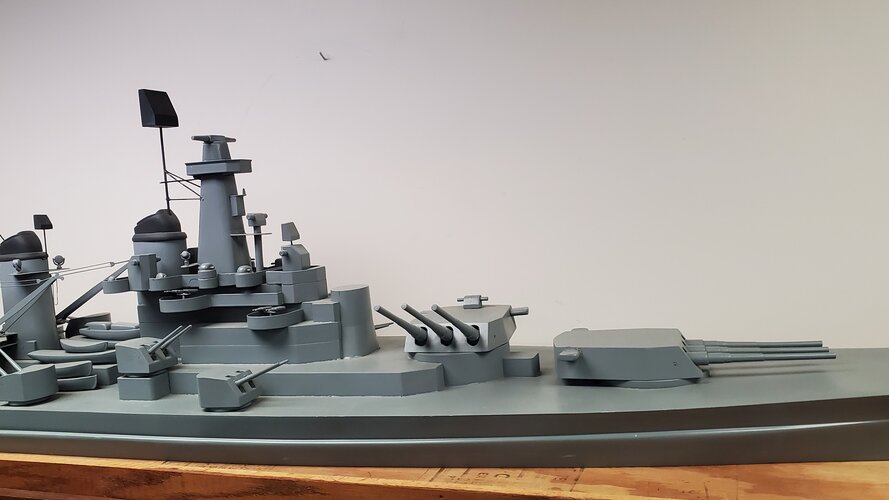
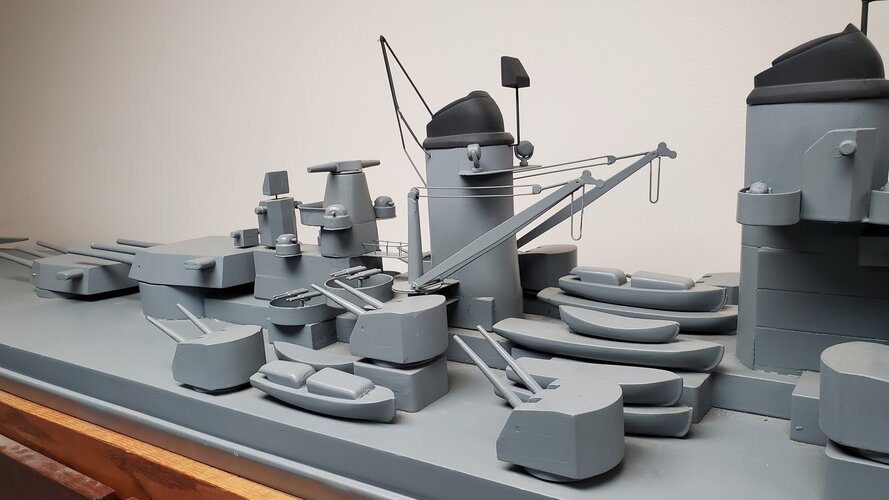
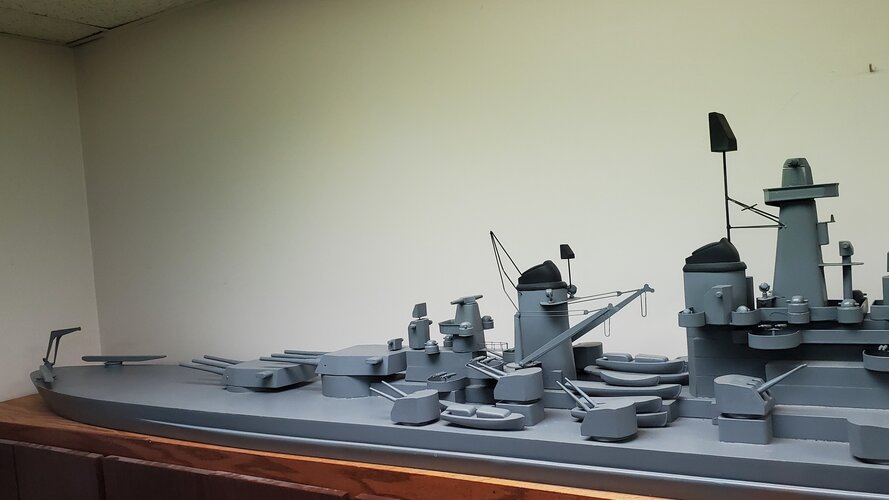
That 15m rangefinder, while active, is going to give Yamato a big advantage during any daylight engagement. That thing is ginormous, and Japanese optics are no joke.
Sure. Assuming that Americans did not pull rather obvious trick with putting smoke screen between them & enemy and firing using radar) But okay, let's even assume they wouldn't.

1704985255887.jpeg
What would happen with this "ginormous structure", if several 14-inch/16-inch HE shells would hit the superstructure below it, and exlpode, severing cables, shaking the whole construction and producing a fountains of heavy fragments? How good would be Japanese optic after being shakened and probably shattered by shockwaves? Let's not forget, it isn't radar antenna; to make rangefinder absolutely useless even the slight damage would suffice.
 
Sure. Assuming that Americans did not pull rather obvious trick with putting smoke screen between them & enemy and firing using radar) But okay, let's even assume they wouldn't.

View attachment 716820
What would happen with this "ginormous structure", if several 14-inch/16-inch HE shells would hit the superstructure below it, and exlpode, severing cables, shaking the whole construction and producing a fountains of heavy fragments? How good would be Japanese optic after being shakened and probably shattered by shockwaves? Let's not forget, it isn't radar antenna; to make rangefinder absolutely useless even the slight damage would suffice.
So, I get what you're saying. But the US would most emphatically not be firing HE rounds at an enemy battleship unless they had nothing else in the magazines. USN doctrine was to fire AP rounds at anything above a destroyer. They aren't going to suddenly switch to using HE against a battleship.

You're using a lot of hindsight here in saying that the USN knew the guns on the Standards couldn't pen the Yamato's armor. You have to remember, the US thought the Yamato-class battleships were armed with 16" guns until well after they were both sunk. So any battleships firing on a Yamato would be using AP rounds in the expectation that they could get at least some penetration of the Citadel
 
OK, but, taking thisa a stage further would serve to illustrate the scope for variation in this discussion. Look at how many hits were requirted to stop Bismark. Less armour and alone against numerous foes while unable to manouvre the ship.

Again, the argument has been made that three ships are ranged against the Yamato class ship, how likely is that?

As a paper exercise this discussion has merit but in reality there are far too many holes in the collander to allow it to float.

Sorry, btw, Bismark was unable to offer any real defence so is at a further disadvantage and could not in any case, outrange her opponents.

Bismark was scuttled too.
 
Bismark was scuttled too.
After reading numerous accounts from the survivors...ship was doomed. 100%.
So, I get what you're saying. But the US would most emphatically not be firing HE rounds at an enemy battleship unless they had nothing else in the magazines. USN doctrine was to fire AP rounds at anything above a destroyer. They aren't going to suddenly switch to using HE against a battleship.

You're using a lot of hindsight here in saying that the USN knew the guns on the Standards couldn't pen the Yamato's armor. You have to remember, the US thought the Yamato-class battleships were armed with 16" guns until well after they were both sunk. So any battleships firing on a Yamato would be using AP rounds in the expectation that they could get at least some penetration of the Citadel
That's what I figured, thanks for confirming.
What would happen with this "ginormous structure", if several 14-inch/16-inch HE shells would hit the superstructure below it, and exlpode, severing cables, shaking the whole construction and producing a fountains of heavy fragments? How good would be Japanese optic after being shakened and probably shattered by shockwaves? Let's not forget, it isn't radar antenna; to make rangefinder absolutely useless even the slight damage would suffice.
What goes around comes around. What good is an early radar or US optics versus severe vibration? Wouldn't their gunnery be degraded as well?
By "ginormous" I was referring to the rangefinder itself, because 15m is huge...intended for effective long-range gunnery, outside the capabilities of most ships to penetrate their armor or even hit them. It's a qualitative advantage, which the Yamato embodies.
 
So, I get what you're saying. But the US would most emphatically not be firing HE rounds at an enemy battleship unless they had nothing else in the magazines. USN doctrine was to fire AP rounds at anything above a destroyer. They aren't going to suddenly switch to using HE against a battleship.

You're using a lot of hindsight here in saying that the USN knew the guns on the Standards couldn't pen the Yamato's armor. You have to remember, the US thought the Yamato-class battleships were armed with 16" guns until well after they were both sunk. So any battleships firing on a Yamato would be using AP rounds in the expectation that they could get at least some penetration of the Citadel
Okay, that's an argument. I really thought that facing apparently heavier battleship they would try first to deplete her as much as possible.
 
What goes around comes around. What good is an early radar or US optics versus severe vibration? Wouldn't their gunnery be degraded as well?
Yes but not as much.

While the US did have issues with the early Radars.

It was after MULTIPLE FULL SALVO FIRINGS.

A full salvo is all guns firing at once more or less and was extremely rare even in combat. Partial firing and similar naval weapon engages prolong the time to breakage greatly.

With Vibration coming into factor only at full speed and only on the North Carolina Class, the South Dakota and Iowas did not have said issue as badly to effect gunnery.

A hit nearby will fucker the system on both.

But until that point?

The Yamatos be working at say a 75 percent to the Washington 80 percent degradation. Which come closer to a 50 75 split once you account for the vast differences of IJN and USN fire control practices respectfully. Resulting in the USN ship being more likely to get the first hit dispite the range disadvantages.

Throw in that more ships firing on a target vastly increases the hit chances on said target?

Multiple on 1 sucks ass no matter how you try to slice it.

Makes for amazing stories but it actually extremely hellish cause well the odds are against you in the extreme.

Before adding in doctrine difference in soft specs.

Like damage control...

Which the IJN doctrine for...

Was a case of good in theory, bad to outright actively harmful in practice.

So any hit is going to hurt more or similar despite the fire power differences. Due to being unable to bounce back as effectively after a hit.

There so many factors involve its not funny.

From the hard Specs to the Soft ones like Damcon, training and morale.
 
Okay, that's an argument. I really thought that facing apparently heavier battleship they would try first to deplete her as much as possible.
No. For the simple reason that, in theory, a battleship can have her entire superstructure blown away and still be capable of combat. Everything you need to destroy to mission kill (or outright kill) a battleship is under the armor. Demolishing superstructure will make it less effective, but it won't kill it
 
Again, the argument has been made that three ships are ranged against the Yamato class ship, how likely is that?
Given how many more battleships the US had in the Pacific over the Japanese?

Pretty good odds that the Yamato would be facing an entire division of USN battleships. Remember that all the 16" battleships were in the Pacific!
 
Concentration of firepower doctrine made it quite certain if air, submarine, and the destroyers could not take it out. Ultimately they did it in with weapons for which it was most vulnerable. Why risk a battleship if unnecessary?
 
...... You have to remember, the US thought the Yamato-class battleships were armed with 16" guns until well after they were both sunk.
Not true. USN intelligence was circulating reports of 17.7 inch guns in spring 1943 and 18 inch following aerial recce in Feb 1944. After obtaining the latter, it seems to have been later in 1944 early 1945 before that was fully accepted, but still before Yamatos sinking.

http://www.navweaps.com/index_tech/tech-084.php
 
Given how many more battleships the US had in the Pacific over the Japanese?

Pretty good odds that the Yamato would be facing an entire division of USN battleships. Remember that all the 16" battleships were in the Pacific!
Granted more were available but the ranging of one battleship means including the fleet of ships around that ship. The pacific is a big ol' bathtub granted but, making that many targets for mines and submarines seems cringeworthy. I know, off topic. I cannot see so many 'fleets' being deployed in the region of one Yamato class ship.

Especially when we consider the huge number of carriers and their aircraft which in the end, did the deed, which makes the question why would they deploy the big guns in that concerntration when they do not need to?
 
Not true. USN intelligence was circulating reports of 17.7 inch guns in spring 1943 and 18 inch following aerial recce in Feb 1944. After obtaining the latter, it seems to have been later in 1944 early 1945 before that was fully accepted, but still before Yamatos sinking.

http://www.navweaps.com/index_tech/tech-084.php
Intelligence via aerial photos ain't that accurare hence in every document the USN and RN listed the Yamato with 16" guns. It is the same that in the 1950's the USN thought the Soviets were building battleships the K-1000's. So they might had suggested that the Yamatos carry larger guns then 16" they did not had concrete knowledge. It is the same as determining the capabilities of the now under construction carriers vs actual info provided by the Chinese.
 
Last edited:
Granted more were available but the ranging of one battleship means including the fleet of ships around that ship. The pacific is a big ol' bathtub granted but, making that many targets for mines and submarines seems cringeworthy. I know, off topic. I cannot see so many 'fleets' being deployed in the region of one Yamato class ship.

Especially when we consider the huge number of carriers and their aircraft which in the end, did the deed, which makes the question why would they deploy the big guns in that concerntration when they do not need to?
Aside from the fact that the US was using fast battleships as carrier escorts, leaving the Standards to mob up?
 
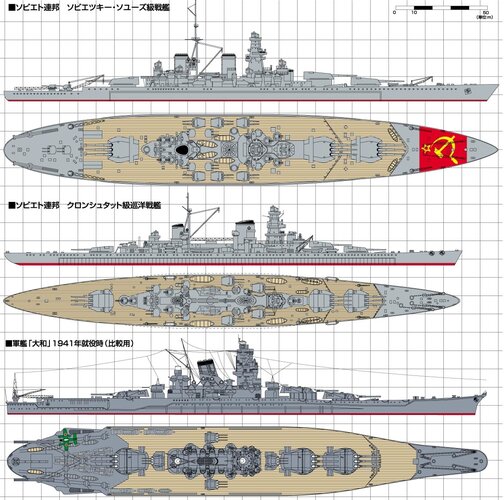
Intelligence via aerial photos ain't that accurare hence in every document the USN and RN listed the Yamato with 16" guns. It is the same that in the 1950's the USN thought the Soviets were building battleships the K-1000's.

Hi Tzoli.

Did the USN and RN actually believe the K-1000 hoax? I know for sure that Jane's Fighting Ships did, as did several magazines, but I haven't seen any USN or RN documents that suggest that they believe it.

I have at least one magazine article (Popular Mechanics, July 1950) showing a ship that looks like a cross between Project 23 and K-1000. To the best of my knowledge, the USN never even remotely considered a Montana revival in response, and around 1950, the RN's Lion project breathed its last. Curiously enough, 1950 is the same year that the Soviet Project 24 died.

As for the 18" guns on the Yamato, my theory is that some people in the USN believed that they had 18" guns, and others didn't. In the end, it didn't matter much, as the USN didn't change tactics or construction plans.

I'll drive the Yamatoholics a bit crazy: the one time that the Yamato was involved in a surface action, she was chased away by a spread of torpedoes from the USS Heerman (DD-532) a Fletcher-class destroyer. Moral of this story: real battles don't always behave like simulations. It's not that simple, and there are often unforseen circumstances.

I did a wargame once that involved the Yamato, Nagato, Haruna and Kongo vs. several older USN battleships and a few newer ones. I can't remember the exact results, but I do recall it did not go as expected.

DRW
 
As cold war ain't my specialty I don't have documents how well the USN believed the K-1000 but knowing the secretive nature of the Soviet Union towards western Imperalist powers and knowing how the RN was afraid of the Sverdlovs, it isn't unlikely they believed it strongly.

But consider this:
The Germans build the Deutschland class big gun cruisers, the other navies start to design similar ships, (RN, MN, RM) the ONI reports either:
1. willingly, (to persuade the politicians to encourage a naval building programme)
2. erroneously, (not accurate info was gained due to Japan's secrecy)
3. misinformation from the IJN (Possible but not read anything from the Japanese side on the Chichibu "hoax")
4. all the above (most likely)
that the Japanese were building 2-3 Deutschland like big gun cruisers with 30,5cm guns, the Chichibu class.
The USN actively starts to design the Alaska class Battlecruisers/Large Cruisers to counter these warships.
The IJN got hold of information about the Alaska design process and construction so they design their own counter to them, the B-65 with first 3x3 31cm later with more info about the Alaskas 3x2 35,6cm cannons.
The Soviets design their own Alaska counter the battlecruiser/large cruiser of the Stalingrad class.
 
Hi all!

I've had several times the intention to post into this topic, but time is really now. So as many of you might be aware I'm running a 3 part article on the Montana class over at warshipprojects.com , with the 3rd part lagging behind a lot, exactly to investigate some open questions.
I've been kindly provided by some very nice research material, thanks to Chris Wright and Bill Jurens, but there still are some open questions, like the bridge configurations, at least regarding the fleet flagship variant for hull BB-69. There are fairly detailed weight info for both force flagship and fleet flagship variants and it is safe to say the latter would have had a larger CT , just like BB-57 and BB-61, but not necessarily in the same form (an additional level added in below) as that would not suit the existing official Navy models and final (though not contract) plans. So this is one fairly difficult part.

The other hazy part in the story are the fast designs and their sub-variants (BB-65Y 1-3 and BB-65-8 A-D) which are almost casually mentioned by both Friedman and Dulin&Garzke. As you might know the relevant Spring Styles books are most probably destroyed and Norman (Friedman) told me he only has copies of what is already in his books (generally only the BB-55 prelims). So our only hope once Chris gets back to NARA is that Montana class files would reveal some more info. The issue with this is these were recently declassified only (not 'cos they were so secret but probably they were stored with other files that were indeed containing sensitive info, and neither the Navy nor NARA had the manpower to sort these out).
I've also heard that there might be a revised book coming out from D&G, but only for the Axis and Allied BBs, not the US ones...but maybe. Their original book has so many inaccuracies or better said conflicting info that I'm not sure this would be in the focus anyway.

Finally I see a lot of back-and-forth arguments on the 16" vs 18" guns question. I think I've covered this pretty well already in the first two parts of my Montana class genesis article, but in short, the 18" gun was considered several times during various parts of the development cycle and at least once it was serious. The arguments listed here in the topic are all valid (or partly so) but there was one factor which rarely gets mentioned and judging from General Board correspondence files it mattered the most: the design and production times. The Mark 7 16"/50, together with it's mount were already available and in production, ready to go. While funding was secured for the Mark 4 test gun to be converted back from it's 16"/56 incarnation to the Mk A 18"/47 and was actually done, it was a bit late already and a production version was not even in sight (at least we don't have info on it). Also Captain Chantry, who was instrumental in shaping the class' development was in favour of the heavier gun and he quite correctly suspected that the enemy would up it's caliber as well. However it was already pretty difficult to provide aducate protection vs. the existing gun and shell and it is highly doubtful if they would have allowed again the gun part of the new design to outgrow the protection (as it was with all three fast BB classes), especially not in a design who's main point was to up the protection to the level of it's guns.
There were other, stonger political forces in play too, the President and Adm. King. The former was pro for the big BBs to a points but the latter was sort of an avid opponent of the whole 'classic' or 'heavy' battleship concept during the whole of the project (already when he was part of General Board before his promiton to CINCLANT and COMINCH).
So I feel there were a lot of outside factors in play outside of pure technical questions against the bigger gun at several points.
 
Nothing remarkably new here, just a black & white version of the May 1941 plans we've seen previously. I think that these are easier to read.

As nearly as I can tell, the USN continued to tinker with the design at least until 1942, and possibly into 1943, but if any later drawings still exist, I haven't seen them.

DRW
 

Attachments

  • 02 - second deck & below_Smaller_BW.jpg
    1.1 MB · Views: 59
  • 01 - main deck & above, profile & sections_Smaller_BW.jpeg
    844.4 KB · Views: 59

Attachments

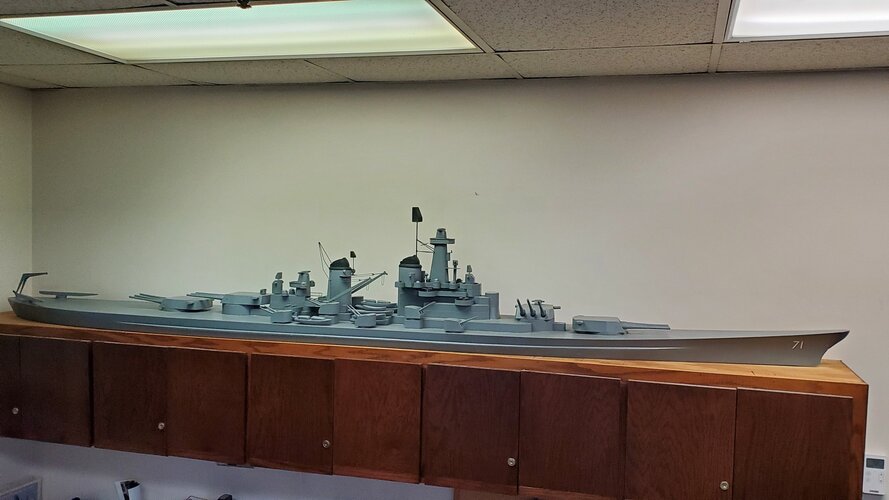
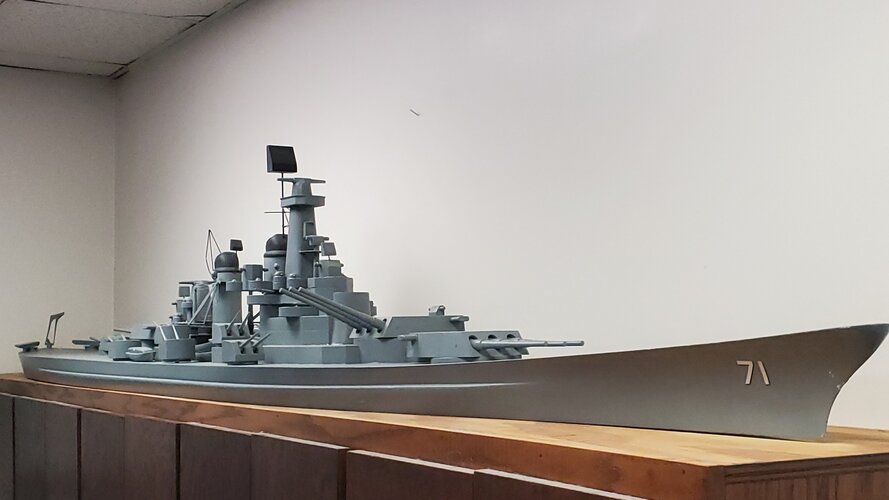
  • USS Louisiana BB-71-1.jpg
    USS Louisiana BB-71-1.jpg
    170 KB · Views: 163
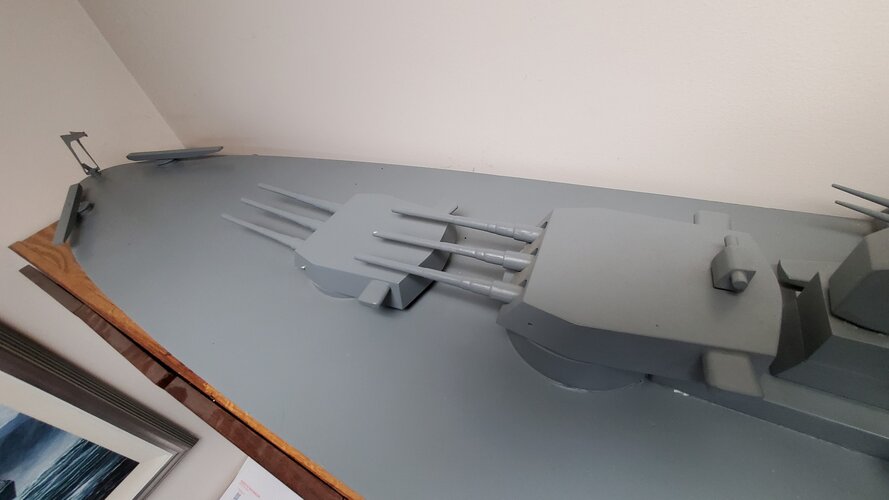
  • USS Louisiana BB-71-2.jpg
    USS Louisiana BB-71-2.jpg
    459.5 KB · Views: 131
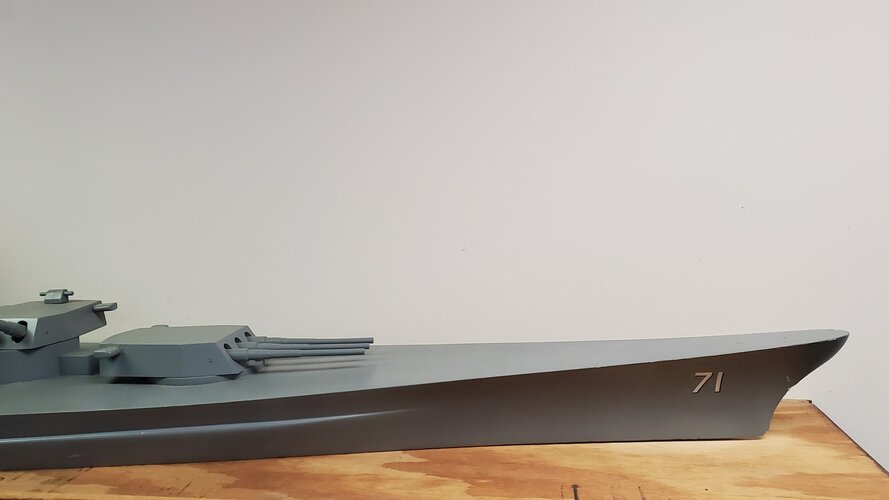
  • USS Louisiana BB-71-3.jpg
    USS Louisiana BB-71-3.jpg
    305.8 KB · Views: 129
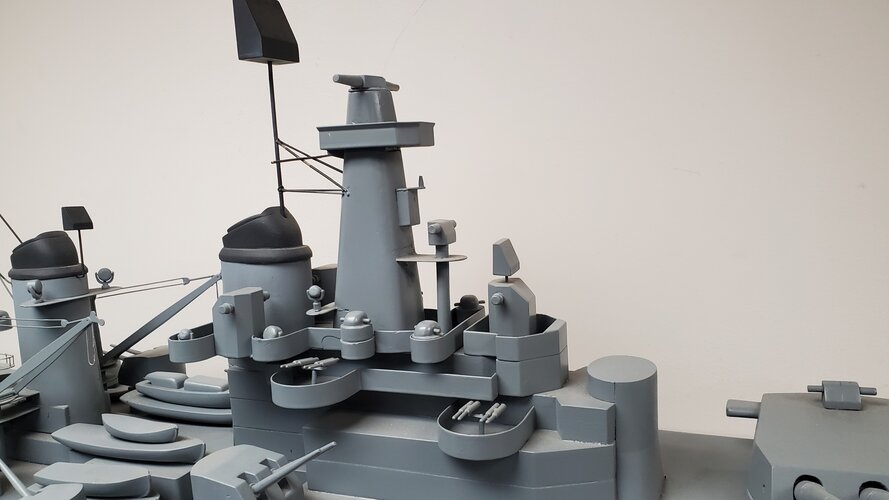
  • USS Louisiana BB-71-4.jpg
    USS Louisiana BB-71-4.jpg
    304 KB · Views: 105
  • USS Louisiana BB-71-5.jpg
    USS Louisiana BB-71-5.jpg
    181.6 KB · Views: 99
  • USS Louisiana BB-71-6.jpg
    USS Louisiana BB-71-6.jpg
    275 KB · Views: 93
  • USS Louisiana BB-71-7.jpg
    USS Louisiana BB-71-7.jpg
    275.4 KB · Views: 91
  • USS Louisiana BB-71-8.jpg
    USS Louisiana BB-71-8.jpg
    367.8 KB · Views: 84
  • USS Louisiana BB-71-9.jpg
    USS Louisiana BB-71-9.jpg
    344.3 KB · Views: 78
I marveled at long development design of Montana Class , so i don't know if there were proposal to convert some ship in carrier .
Not that I came across. As mentioned in Part 3 the conversion mania was in June 1942, and only the then building units were investigated for conversion. No Montanas were laid or in fact contract designed by then so it precluded any real consideration for conversion. Besides it would not have made much sense for the same reason the Iowa/Alaska conversions were rejected as well.
 
SecNav Daniels also ordered the USN to be dry before Prohibition, no alcohol allowed onboard, because he didn't drink.


Depends on rates of fire. Most of the 18"+ guns were very slow firing compared to the 16" guns.

The Yamato threw 9x3200lb AP shells every 45 seconds or so, total weight of 28,800lbs per volley. Montana with 12x16" 2700lb AP is throwing 32,400lbs per volley, every 30 seconds. That's a 4600lb advantage per volley.

In two minutes, the Yamato would throw a total of 86,400lbs; while a 16" Montana would throw 129,600lbs, over 50% more weight of shells! An Iowa would throw 97,200lbs in 2 minutes, 11klbs or ~12% more than the Yamato.


Agreed, being about to throw shells almost as heavy at twice the rate of fire give a huge advantage to the Montana class with 4x Iowa turrets.

Now, if the USN 18" monster could somehow have a sub 45second reload time... 3800lb superheavy shells at either 4x2 turrets or 3x3 is a different discussion entirely.
The Yamatos and the Iowas had almost identical rates of fire. The USNTMJ recorded 28 sec. for the Yamatos, as opposed to 30 sec. for the Iowas. These were optimal times based on low elevation firing. Realistic combat times for both at typical battle ranges were on the order of 40- 50 seconds. Moreover, the bursting charge of the 18.1" .45 cal. shell was half again as large as that of the 16" .50 cal. shell. The increase in shell weight of the 16" .50 cal. shell over that of the 16" .45 cal. shell was devoted entirely to penetration characteristics, and their bursting charges were identical in weight. Just sayin...
 
Hi Tzoli.

Did the USN and RN actually believe the K-1000 hoax? I know for sure that Jane's Fighting Ships did, as did several magazines, but I haven't seen any USN or RN documents that suggest that they believe it.

I have at least one magazine article (Popular Mechanics, July 1950) showing a ship that looks like a cross between Project 23 and K-1000. To the best of my knowledge, the USN never even remotely considered a Montana revival in response, and around 1950, the RN's Lion project breathed its last. Curiously enough, 1950 is the same year that the Soviet Project 24 died.

As for the 18" guns on the Yamato, my theory is that some people in the USN believed that they had 18" guns, and others didn't. In the end, it didn't matter much, as the USN didn't change tactics or construction plans.

I'll drive the Yamatoholics a bit crazy: the one time that the Yamato was involved in a surface action, she was chased away by a spread of torpedoes from the USS Heerman (DD-532) a Fletcher-class destroyer. Moral of this story: real battles don't always behave like simulations. It's not that simple, and there are often unforseen circumstances.

I did a wargame once that involved the Yamato, Nagato, Haruna and Kongo vs. several older USN battleships and a few newer ones. I can't remember the exact results, but I do recall it did not go as expected.

DRW
Yamato obtained three first- salvo 18.1" and three 6.1" hits on USS Johnston off Samar from over 20,000 yards. She also obtained a first- salvo hit on Gambier Bay) from just under 22,000 yards, aimed solely by the ship's Type 22 Mod 4 radar because of a lack of a visual to the target until about a minute after opening fire. In contrast, Iowa engaged Katori from an average range of less than 14,500 yards in clear visibility conditions during Operation Hailstone. Katori had already been hit by a torpedo, from 2- 7 bombs, numerous 8" and 5" hits from a U.S. heavy cruiser and a destroyer, was making no more than 1- 2 knots (one report recorded her as dead in the water) and was already sinking when Iowa opened fire. Iowa failed to hit Katori with eight salvoes (46 rounds) with her main battery during operation Hailstone. The reasons? High shell dispersion (among the highest of any navy in WW2) and a lack of main battery practice after arriving in the Pacific theater.
 
Yamato obtained three first- salvo 18.1" and three 6.1" hits on USS Johnston off Samar from over 20,000 yards. She also obtained a first- salvo hit on Gambier Bay) from just under 22,000 yards, aimed solely by the ship's Type 22 Mod 4 radar because of a lack of a visual to the target until about a minute after opening fire. In contrast, Iowa engaged Katori from an average range of less than 14,500 yards in clear visibility conditions during Operation Hailstone. Katori had already been hit by a torpedo, from 2- 7 bombs, numerous 8" and 5" hits from a U.S. heavy cruiser and a destroyer, was making no more than 1- 2 knots (one report recorded her as dead in the water) and was already sinking when Iowa opened fire. Iowa failed to hit Katori with eight salvoes (46 rounds) with her main battery during operation Hailstone. The reasons? High shell dispersion (among the highest of any navy in WW2) and a lack of main battery practice after arriving in the Pacific theater.

The high dispersion (or sometimes written as a main battery alignment issue) with the Iowas has been a pervasive myth for decades and I have yet uncover any primary source documents that support this. For context, myself and Bill Jurens co-wrote a article in Warship International in 2006 on the USN's fast battleship gunnery training in a two part article titled: Fast Battleship Gunnery During WWII: A Gunnery Revolution. Our article is based entirely on primary documentation that I had duplicated from NARA in the previous years. This was supplemented with correspondence with several whom served on the Iowas during the 1980s including the type's master chief gunner Stephen Skelley.

While we did not recover the entire catalogue of gunnery exercises for the battleships, we did recover a lot of data, including over 50 Day Battle Practice where the ships expended AP with Service velocity charges. From the observation of deck logs, it appears that op-tempo permitting, the fast battleships were typically exercising in Day Battle Practice every other month or so and often sprinkling in calibration and radar spotting practice in the intervening time. So basically every few weeks the main batteries were exercised with live fire in some way. The Iowa's were no exception. BatDiv 7 (Iowa and New Jersey) in fact had conducted several Day Battle Practices during their workups prior to their deployment to the pacific. Additionally, they both had calibrated their main batteries after they cleared the canal and were a week out of Pearl Harbor. This was just weeks prior to HAILSTONE.

The idea that the Iowa's had bad True Mean Dispersion is not supported in any of the data that we uncovered. Their average with AP-Service was ±0.43% of range which corresponds to a 9-gun range pattern of 1.72% of range which is very good. Now Iowa used the Mark 13 High Capacity (HiCap) rounds with service velocity charges which does have a higher dispersion which is roughly 0.6% of range. It is true that Iowa never directly observed hits on Katori though in her action report she believed her gunfire was very effective having achieved a average MPI error of less 100yds according to radar spots. Radar spots during gunnery exercises were accurate to within ±60yds with large salvos such as what happened here so this is very likely quite accurate.

The lack of hits observed is interesting however I had discussed this on several occasions with Master Chief Skelley and he was not surprised. MC Skelley had personally controlled over 3,000 rounds of 16-inch gunfire (including combat in ODS) for context. He pointed out how colossal the HiCap splashes are: 300' high and around 45 feet wide. Iowa's average MPI error was on the short side of Katori which would place the majority of 16-inch splashes in front of their view of Katori. Additionally, the secondary battery was firing which I was surprised to learn was very distracting, resulting in heavy virbration in the Mark 38 director optics. During the 1980s it was practice to withhold a 5-inch salvo if the main battery fall of shot was about to land.

It also appears that the DD and CA gunfire was not very accurate. I have the action reports of New Orleans and Minneapolis in my personal collection (somewhere) and it is worth noting that New Orleans had a very bad tracking error (personnell error on the part of the rangekeeper operator) and had a difficult time maintaining the hitting deflection. Interestingly some additional detail from CAG 15's action report is highlighted below. He provided airspot for a time and his observations are below.

Some context: New Orleans was firing orange projectile dye and Minneapolis was firing blue. He notes a red dye but there was no red dye by any of the ships present and probably was the orange dye. What is interesting is his comment about black dye. Black dye was not used by the USN and in this case is almost certainly Iowa. HiCap do tend to have a dirty blackish base of the splash when nose fused super quick fuze action was selected on those rounds as was the case here.

“At about 1515, the screen destroyers opened up on Cruiser "K" (KATORI). We took position at 1,000 feet altitude and about one mile to the southeast in order to observe results. The cruiser was lying helpless in the trough of the waves, bow to northwest (Tokyo). She had a slight list to port and a red flame could be seen amidships. Her after twin turret was trained amidships and she did not at any time fire her main battery or AA guns.

The shooting of the destroyers was poor. Not until the 5th or 6th salvo did any shots land within 25 yards of the target. About ninety percent were well over. I did not see any hits from the destroyer gunfire. The pattern had good density - at least one splash every 25 yards. There were a few wild shorts.

Shortly thereafter larger splashes appeared around Cruiser "K". These were apparently from the heavy cruisers. Some were close but no definite hits were observed….

The battleships then opened fire on cruiser "K", which now had a marked list to port. The red [sic] and blue colored splashes were not close. The blue straddled, but the pattern was about 100 yards between each splash. The red did not straddle. The first observed hit came about 1530 from a black splash. It was at the waterline under the bridge. Black got on the target the second salvo. The black pattern had good density, as did the orange.

The cruiser quickly listed to her port beam and lay for a few moments on her beams ends. I obtained a good sketch of her profile as she lay this way free from smoke. From this I am positive she was a CL of the KATORI class. She had two large shell holes about six feet in diameter in her starboard side, one under the bridge about six feet below the waterline and the other amidships about at the waterline, plus about six small holes.

In a few moments she rolled over on her back, exposed her red bottom, then sank stern first…..”


A comment on Yamato's radar: The type 22 radar had terrible resolution. 1,500m in range and 40° (!) in bearing. So at 22kyds you're looking at a resolution cell of 1,600 x 770 yds. That is nearly worthless for accurate tracking in any situation except perhaps a single ship with optics supplimenting it. It certainly was not a viable tool for radar spotting.

A final observation: If we are to take these hit claims at face value it really is not very indicative how effective a gunnery system is on average. That is because natural statistical effects hits can be seemingly random and given the very small sample sizes in general of battleships during WWII, it can skew the data. For example, I have seen many time in gunnery exercises where traditional measures of main battery aim, MPI and standard deviation of MPI error, are very good and even the TMD is good but no hits or a lower than expected hit percentage was obtained. Conversely I've seen exercises where fantastic results were acheived (South Dakota obtained 22% hits at 35,000yds in 1943 in one exercise). This is simply because the engagements or exercises only expended a few dozen rounds at a given target and not a large slug fest such as the runs to the south and north during Jutland where much larger round expenditures evens things out.

So in my honest opinion, drawing conclusions from either of these examples if very problematic when trying to extrapolate to what a fleet engagement might look like from a gunnery perspective.

 
The high dispersion (or sometimes written as a main battery alignment issue) with the Iowas has been a pervasive myth for decades and I have yet uncover any primary source documents that support this. For context, myself and Bill Jurens co-wrote a article in Warship International in 2006 on the USN's fast battleship gunnery training in a two part article titled: Fast Battleship Gunnery During WWII: A Gunnery Revolution. Our article is based entirely on primary documentation that I had duplicated from NARA in the previous years. This was supplemented with correspondence with several whom served on the Iowas during the 1980s including the type's master chief gunner Stephen Skelley.

While we did not recover the entire catalogue of gunnery exercises for the battleships, we did recover a lot of data, including over 50 Day Battle Practice where the ships expended AP with Service velocity charges. From the observation of deck logs, it appears that op-tempo permitting, the fast battleships were typically exercising in Day Battle Practice every other month or so and often sprinkling in calibration and radar spotting practice in the intervening time. So basically every few weeks the main batteries were exercised with live fire in some way. The Iowa's were no exception. BatDiv 7 (Iowa and New Jersey) in fact had conducted several Day Battle Practices during their workups prior to their deployment to the pacific. Additionally, they both had calibrated their main batteries after they cleared the canal and were a week out of Pearl Harbor. This was just weeks prior to HAILSTONE.

The idea that the Iowa's had bad True Mean Dispersion is not supported in any of the data that we uncovered. Their average with AP-Service was ±0.43% of range which corresponds to a 9-gun range pattern of 1.72% of range which is very good. Now Iowa used the Mark 13 High Capacity (HiCap) rounds with service velocity charges which does have a higher dispersion which is roughly 0.6% of range. It is true that Iowa never directly observed hits on Katori though in her action report she believed her gunfire was very effective having achieved a average MPI error of less 100yds according to radar spots. Radar spots during gunnery exercises were accurate to within ±60yds with large salvos such as what happened here so this is very likely quite accurate.

The lack of hits observed is interesting however I had discussed this on several occasions with Master Chief Skelley and he was not surprised. MC Skelley had personally controlled over 3,000 rounds of 16-inch gunfire (including combat in ODS) for context. He pointed out how colossal the HiCap splashes are: 300' high and around 45 feet wide. Iowa's average MPI error was on the short side of Katori which would place the majority of 16-inch splashes in front of their view of Katori. Additionally, the secondary battery was firing which I was surprised to learn was very distracting, resulting in heavy virbration in the Mark 38 director optics. During the 1980s it was practice to withhold a 5-inch salvo if the main battery fall of shot was about to land.

It also appears that the DD and CA gunfire was not very accurate. I have the action reports of New Orleans and Minneapolis in my personal collection (somewhere) and it is worth noting that New Orleans had a very bad tracking error (personnell error on the part of the rangekeeper operator) and had a difficult time maintaining the hitting deflection. Interestingly some additional detail from CAG 15's action report is highlighted below. He provided airspot for a time and his observations are below.

Some context: New Orleans was firing orange projectile dye and Minneapolis was firing blue. He notes a red dye but there was no red dye by any of the ships present and probably was the orange dye. What is interesting is his comment about black dye. Black dye was not used by the USN and in this case is almost certainly Iowa. HiCap do tend to have a dirty blackish base of the splash when nose fused super quick fuze action was selected on those rounds as was the case here.

“At about 1515, the screen destroyers opened up on Cruiser "K" (KATORI). We took position at 1,000 feet altitude and about one mile to the southeast in order to observe results. The cruiser was lying helpless in the trough of the waves, bow to northwest (Tokyo). She had a slight list to port and a red flame could be seen amidships. Her after twin turret was trained amidships and she did not at any time fire her main battery or AA guns.

The shooting of the destroyers was poor. Not until the 5th or 6th salvo did any shots land within 25 yards of the target. About ninety percent were well over. I did not see any hits from the destroyer gunfire. The pattern had good density - at least one splash every 25 yards. There were a few wild shorts.

Shortly thereafter larger splashes appeared around Cruiser "K". These were apparently from the heavy cruisers. Some were close but no definite hits were observed….

The battleships then opened fire on cruiser "K", which now had a marked list to port. The red [sic] and blue colored splashes were not close. The blue straddled, but the pattern was about 100 yards between each splash. The red did not straddle. The first observed hit came about 1530 from a black splash. It was at the waterline under the bridge. Black got on the target the second salvo. The black pattern had good density, as did the orange.

The cruiser quickly listed to her port beam and lay for a few moments on her beams ends. I obtained a good sketch of her profile as she lay this way free from smoke. From this I am positive she was a CL of the KATORI class. She had two large shell holes about six feet in diameter in her starboard side, one under the bridge about six feet below the waterline and the other amidships about at the waterline, plus about six small holes.

In a few moments she rolled over on her back, exposed her red bottom, then sank stern first…..”


A comment on Yamato's radar: The type 22 radar had terrible resolution. 1,500m in range and 40° (!) in bearing. So at 22kyds you're looking at a resolution cell of 1,600 x 770 yds. That is nearly worthless for accurate tracking in any situation except perhaps a single ship with optics supplimenting it. It certainly was not a viable tool for radar spotting.

A final observation: If we are to take these hit claims at face value it really is not very indicative how effective a gunnery system is on average. That is because natural statistical effects hits can be seemingly random and given the very small sample sizes in general of battleships during WWII, it can skew the data. For example, I have seen many time in gunnery exercises where traditional measures of main battery aim, MPI and standard deviation of MPI error, are very good and even the TMD is good but no hits or a lower than expected hit percentage was obtained. Conversely I've seen exercises where fantastic results were acheived (South Dakota obtained 22% hits at 35,000yds in 1943 in one exercise). This is simply because the engagements or exercises only expended a few dozen rounds at a given target and not a large slug fest such as the runs to the south and north during Jutland where much larger round expenditures evens things out.

So in my honest opinion, drawing conclusions from either of these examples if very problematic when trying to extrapolate to what a fleet engagement might look like from a gunnery perspective.
Per a 1944 U.S. Navy Bulletin of Ordnance, dispersion of the Iowa class was 1.9% of range for a nine- gun salvo, and 1.0% of range for a three- gun salvo (one gun per turret). Per the USNTMJ OT O-45 (N) "Japanese 18" Guns and Mounts", dispersion of the Yamato class was 1.2- 1.3% of range for a nine- gun salvo primarily due to the Type 98 Discharge Delay Unit. Mr. Jurens has already stated on Bismarck's forum that the Iowas had a shell dispersion rate of 1.9% of range.

Iowa's 5" secondary battery was not firing simultaneously with her main battery. In Iowa's after- action report, Captain McCrea stated that permission had just been given for her 5" battery to open fire when Katori capsized toward Iowa and sank rapidly. The claimed shell holes in Katori that you refer to are unconfirmed. Katori was hit by from 2-7 bombs and took multiple near misses from carrier aircraft before they were called away so that 50.9 could engage the Japanese in a surface action.

Per USNTMJ OT O-31 "Japanese Surface and General Fire Control", the Type 22 Mod 4 radar had a range accuracy of 109 yards, and Yamato's foretop optics had a resolution of from 57- 89 yards. The Type 22 Mod 4 could detect a 100- foot high battleship- sized target at over 35,000 yards. The U.S. Navy Mark 8 Radar Range keeper had a range accuracy of plus/minus 15 yards + 0.1% of range. At from 20- 25,000 yards, that translated to 35- 40 yards, while that of Iowa's foretop optics was from 105- 165 yards. Yamato's gunnery used the average of the ranges of Yamato's foretop and after range finders and her Type 22. This resulted in multiple first- salvo hits off Samar on both USS Johnston and USS Gambier Bay. By comparison, Iowa failed to register a hit on what was effectively a stationary target at short range. This happened to Iowa again in July of 1948, when she was tasked with sinking USS Nevada. In a multi- day exercise, she failed to do so, and Nevada was sunk by aerial torpedo attack. I'm not trying to crack on the Iowas (I was part of that Navy once), but that's the history.
 
Per a 1944 U.S. Navy Bulletin of Ordnance, dispersion of the Iowa class was 1.9% of range for a nine- gun salvo, and 1.0% of range for a three- gun salvo (one gun per turret). Per the USNTMJ OT O-45 (N) "Japanese 18" Guns and Mounts", dispersion of the Yamato class was 1.2- 1.3% of range for a nine- gun salvo primarily due to the Type 98 Discharge Delay Unit. Mr. Jurens has already stated on Bismarck's forum that the Iowas had a shell dispersion rate of 1.9% of range.

Iowa's 5" secondary battery was not firing simultaneously with her main battery. In Iowa's after- action report, Captain McCrea stated that permission had just been given for her 5" battery to open fire when Katori capsized toward Iowa and sank rapidly. The claimed shell holes in Katori that you refer to are unconfirmed. Katori was hit by from 2-7 bombs and took multiple near misses from carrier aircraft before they were called away so that 50.9 could engage the Japanese in a surface action.

Per USNTMJ OT O-31 "Japanese Surface and General Fire Control", the Type 22 Mod 4 radar had a range accuracy of 109 yards, and Yamato's foretop optics had a resolution of from 57- 89 yards. The Type 22 Mod 4 could detect a 100- foot high battleship- sized target at over 35,000 yards. The U.S. Navy Mark 8 Radar Range keeper had a range accuracy of plus/minus 15 yards + 0.1% of range. At from 20- 25,000 yards, that translated to 35- 40 yards, while that of Iowa's foretop optics was from 105- 165 yards. Yamato's gunnery used the average of the ranges of Yamato's foretop and after range finders and her Type 22. This resulted in multiple first- salvo hits off Samar on both USS Johnston and USS Gambier Bay. By comparison, Iowa failed to register a hit on what was effectively a stationary target at short range. This happened to Iowa again in July of 1948, when she was tasked with sinking USS Nevada. In a multi- day exercise, she failed to do so, and Nevada was sunk by aerial torpedo attack. I'm not trying to crack on the Iowas (I was part of that Navy once), but that's the history.

The BuOrd "1.9%" of range for a 9-gun pattern encompass all ammunition types; i.e. armor pierce with practice & service charges as well as HiCap with reduced charges. HiCap did not have as good of TMD as AP. Bill tends to stick with this as it is more conservative and generally, quibbling over minor variations in TMD is nearly statistically meaningless as the impact on hit probability is negligible unless the TMD is wildly different. I tend to quote what our data shows because I prefer the precision of it however I totally agree with Bill's view point that small variations in TMD is not tactically significant.

Your quote of Yamato's is wrong. I have the complete set of NavTechMisJap here. The exact quote in that report is:

The normal spreads [range pattern] obtained with the 18-inch guns were reported to be about 500 to 600 yards at maximum range when firing five and four gun salvoes. When firing broadsides the spreads were larger than this.

There are issues with this because taking one data point (maximum range) does not tell you enough about the dispersion behavior. The biggest issue is that at the very maximum range that is discussed here the patterns tend to tighten down a bit because the elevation sensitivity is negligible and almost all the dispersion effects in range is attributed to IV variation and projectile variations. The truth is that range patterns using a linear relationship with range are a convenient rule of thumb and in reality they do not have a precise linear relationship. They tend to be flat at low elevations and flatten out again at very high elevations.

But let's take this data point at face value. We'll split it right down the middle and say 550 yard range pattern for 4.5 guns. 550 ÷ 45600 = 0.012. 0.012 ÷ 3 = 0.040%. 1.9% of range is 0.475%. Assuming same MPI control (which is dubious) at 35Kyds using my monte carlo simulation I get 10.8% hit probability vs. 10.1% for 0.475% TMD. This simulation is based on MPI errors from the USN's fast battleships during gunnery exercises and may not be applicable to Yamato. If we go off of the AP service charge data of 0.43% TMD then the difference is 10.8% vs 10.5%. Neither are tactically significant.

It should be noted, and Bill will certainly tell you this, that big bag guns were very mature technology by WW2 and almot all TMD from the major naval powers are roughly comparable. With the highest being the KGV class at around 0.56% as I recall with perhaps the lowest being the 16-inch Mark 6 guns of the North Carolina and South Dakota at around 0.385%. Bismarck class was around 0.42% of range as I recall.

Your comment about Iowa's secondary battery not participating is not correct. See attached image directly from her Action Report. Note: she misidentified Katori as a Aoba class CA but in a supplimental AAR she corrected this assesment. You can clearly see she opened fire with both batteries at Katori. The primary issue to hit observation is the size of the projectile splashes more so than the distraction of the secondary battery.

You are also confusing radar accuracy with resolution. They are not the same.

The gunnery exercise against Nevada is meaningless. She employed a few dozen HiCap rounds and did not employ AP. It was a chance to exercise the main battery not a exercise to see if she could sink her.

A few other tid bits: There is the Mark 8 radar and a Mark 8 rangekeeper, but not a Mark 8 radar rangekeeper. You comparison between fire control is very simple and with all respect does not appear to me you fully grasp the nuances of naval gunfire. I highly recommend reading the article Bill and I wrote for Warship International as we discuss this in great detail. You can obtain back issues here:

https://www.warship.org/back issues.htm
Note: I do not get a single cent for this article but purchasing from WI would help keep that organization going.

IMG_4037.jpg
 
I'm by no means a professional in this field and I'll grant that you have that title. I follow you regarding dispersion being a general figure which varies with ammunition. Help me out here and correct me if I'm mistaken. Maximum range of the 18.1" gun was 46,050 yards. 1.1% of that range is 506 yards while 1.3% is 598 yards. These are at the lower and upper limits of the 500- 600 figures given in USNTMJ OT O-45 (N). A five- gun salvo would make use of the Type 98 Trigger Time Limiting Device which was designed to limit the time of firing of two or more guns (see page 7 of USNTMJ OT O-31), so a full salvo would not (IMHO) be markedly greater than that. Multiple 1st- salvo hits off Samar on USS Johnston and USS Gambier Bay would appear to bear that out, as does page 1 paragraph 2 of USNTMJ OT O-31.

OTOH, Iowa at 1.9% of range (and Jurens has in fact used that figure at Bismarck's forum in, I believe, the Iowa class real performance thread) at a maximum range of 42,345 yards would have a dispersion of just over 800 yards. Failure to obtain a main battery hit at from short to medium range on a sinking stationary target which is not firing back stands in stark contrast to Samar.

Iowa's performance against Nevada is hardly meaningless, as Iowa was not simply conducting a gunnery exercise. She was assigned the task of sinking Nevada.

You are correct and I am mistaken. Iowa's main and secondary batteries did fire on fire on Katori. I read too quickly and mistook Iowa preparing to fire her secondaries on Maikaze when she capsized (point 40, I believe, in the report). My bad, endless apologies.

Regarding radar- are you saying that the figures which I provided regarding the range accuracy of the Mark 8 and the Type 22 Mod 4 are inaccurate? Or that the resolution of Iowa's and Yamato's foretop optics are inaccurate?
 
I'm by no means a professional in this field and I'll grant that you have that title. I follow you regarding dispersion being a general figure which varies with ammunition. Help me out here and correct me if I'm mistaken. Maximum range of the 18.1" gun was 46,050 yards. 1.1% of that range is 506 yards while 1.3% is 598 yards. These are at the lower and upper limits of the 500- 600 figures given in USNTMJ OT O-45 (N). A five- gun salvo would make use of the Type 98 Trigger Time Limiting Device which was designed to limit the time of firing of two or more guns (see page 7 of USNTMJ OT O-31), so a full salvo would not (IMHO) be markedly greater than that. Multiple 1st- salvo hits off Samar on USS Johnston and USS Gambier Bay would appear to bear that out, as does page 1 paragraph 2 of USNTMJ OT O-31.

OTOH, Iowa at 1.9% of range (and Jurens has in fact used that figure at Bismarck's forum in, I believe, the Iowa class real performance thread) at a maximum range of 42,345 yards would have a dispersion of just over 800 yards. Failure to obtain a main battery hit at from short to medium range on a sinking stationary target which is not firing back stands in stark contrast to Samar.

Iowa's performance against Nevada is hardly meaningless, as Iowa was not simply conducting a gunnery exercise. She was assigned the task of sinking Nevada.

You are correct and I am mistaken. Iowa's main and secondary batteries did fire on fire on Katori. I read too quickly and mistook Iowa preparing to fire her secondaries on Maikaze when she capsized (point 40, I believe, in the report). My bad, endless apologies.

Regarding radar- are you saying that the figures which I provided regarding the range accuracy of the Mark 8 and the Type 22 Mod 4 are inaccurate? Or that the resolution of Iowa's and Yamato's foretop optics are inaccurate?

Don't mistake pattern size with True Mean Dispersion. Pattern size (for range) is the length of a pattern from the closest shot to the furthest shot. As you might expect, it varies depending on how many guns are in a salvo. Dispersion is defined as the shot to shot variation of a gun about the mean point of impact. TMD is the theoretical dispersion of a single gun corrected for systematic errors and measurement inaccuracies. You can calculate the average size of a pattern using the TMD and how many guns are in the salvo and vice versa with the following table:

Guns Ratio
2 1.69
3 2.43
4 2.89
5 3.21
6 3.47
7 3.67
8 3.85
9 4.00
10 4.13
11 4.24
12 4.34

So to go over the math again for Yamato: 550yd pattern at 46Kyds is 0.12%. 0.12% ÷ 3 = 0.04% of range. But I'll point out again, this is but one data point and in a range band where the TMD decreases because of the aforementioned reduced elevation sensitivity. To have anything remotely apples to apples comparison you need a much larger data set from multiple range bands. All that we have currently is a anecdote.

I should point out that the Type 98 trigger time limiting device was hardly a unique technical solution and all navies had sophisticated firing circuits. For instance, the fast battleships had either the Mark 41 or Mark 43 stable vertical where the firing circuits originate. Delay can be set anywhere between 0 to 0.18 seconds with the best results set to 0.03 seconds and at the turrets, the guns had a very wide bore spacing and the center guns were delayed 60 milliseconds to prevent muzzle blast interference. This reduces TMD but does not eliminate it. In face at greater ranges, dispersion is mainly driven by differences in IV.

I'll reiterate what I wrote above, the 1.9% figure from BuOrd represents the average for all ammunition types, AP or HiCap with all the possible propellant types. The most apple to apple comparison between the Yamato's and the Iowas would be comparing the AP + service velocity propellant of the Iowa's to the Yamato anecdote. Which is 0.429% to 0.400%. (HiCap TMD for the Iowas was 0.63% for both velocity propellants.) I'll reiterate again, it is not tactically significant.

I think it is also important to point out at this juncture that what we are currently discussing is dispersion but that is but one measure of "delivery accuracy". There are control errors which are how well the target is tracked and the guns are aimed at the target and this is measured in Mean Point of Impact error(s). The other measure is the aforementioned dispersion which is a measure of the fall of show about the point of aim (i.e. the MPI). MPI is a measure of how accurately the fire control system is tracking and aiming (and how well the teams are correcting the errors of the target track) and dispersion is how well the guns are able to land the shots at that point of aim.

We do not have any data for the Yamato outside of anecdotal evidnce from action reports which makes it very difficult to assess the system in a controlled way. I can see you are a fan of anecdotes but I am far less sanquine on them. To be quite honest, I do not confidently know one way or the other about either of these actions. I find it improbable but not impossible that Iowa did not obtain hits on Katori, however, I do not say that she did. Conversly I am not convinced the traditionally accepted narrative is entirely accurate either for Yamato at Sumar. I think ultimately it is unwise to accecpt one set of anecdotal evidence and dismiss another simply because it may not fit our own ideals. I would say neither cases are definitve and certainly I would be very reluctant to draw any meaningful conclusions from them.

Finally regarding the sinking of Nevada. You seem very confident in that event is a worthwhile data point to extrapolate from so I would really invite you to provide a detailed narrative of the event. Preferrably from primary source documents. I should note that I could not find any primary source documentation at NARA when I was there over the course of a couple years researching for our paper. I have only seen small anecdotal acounts without any detail. MC Skelley did find some documentation from NSWC Dalghren when he was working on the Iowa class gunnery improvement program and relayed to me, as I mentioned before, it was a couple dozen HiCap rounds. That is certainly not a attempt to sink a battleship. There was no use of AP for instance.
 
Here are a couple passages from our article that relate to the Iowa's, specifically gunnery exercise narratives and observations:

The division practice fired by Battleship Division 7, Iowa, New Jersey, and Wisconsin on 11 December 1944 gives a glance at their proficiency at this stage in the war.37 Using one of her aircraft as a controlling spotter, Iowa opened fire with a nine-gun salvo at 24,385 yards, with her first MPI landing 325 yards over. The controlling spotter called for a “Drop 100” and the MPI of the second salvo landed 150 yards over in a long straddle that was spotted ‘No Change.’ With the hitting range established, the MPI of the last nine-gun salvo landed 100 yards short again straddling the target. Up to this point Iowa had been firing in slow salvo fire, with a salvo interval of sixty seconds. She now shifted to rapid salvo fire, churning out three-gun salvos at a brisk 2.7 Shots Per Gun Per Minute38. The MPI of Iowa’s first three-gun salvo landed only 50 yards short, but the next two salvos drifted off the target, landing 250 and 200 yards short respectively. See figure 13.

Iowa’s radar spotter put in a superlative performance, with an average radar spotting error of fifty-five yards. Unfortunately the aircraft spotter did not do as well—his average error was 132 yards and he made the common “rookie” mistake of ‘nibbling’ at the spot. After spotting the first salvo as “Drop 100,” he thereafter made corrections of no more than sixty yards, spotting the last two salvos “Up 50” and “Up 60” respectively. The spot coordinator on the ship apparently realized that the air spotter was “chasing the spot” and let the majority of salvos go as “No Change” except the first, which he dropped 100, and the fifth, to which he applied an “Up 100.” Iowa turned in a decent performance; her TMD was good, ±0.381% of range, with an average nine-gun pattern of 400 yards (1.65% of range). Her control was about average with a mean MPI error of ninety yards short and with a standard deviation of ± 156 yards. Her performance would probably have been better if she had allowed her radar spotters to control instead of air spot. The results of these gunnery practices indicate that the Third Fleet’s battleships, and in particular BatDiv 7, were at a high state of proficiency despite the recent completion of the Leyte campaign. (Operation King II). 39

Constructive hits were not recorded but a monte carlo simulation of a battleship contructive target would correspond to a 14.5% hit probability on a Yamato sized target as seen below.

1752031716223.png


On March 23 1945 Iowa conducted a Day Spotting Practice that was very similar to Iowa’s engagement against Katori (although in the case of this practice the target was moving). Iowa expended 24 rounds at a mean range of 15,300 yards in eight three-gun salvos. The TMD of the 1945 practice was ± 0.522% of range, which is somewhat less than the average H.C. TMD of ± 0.63% of range. Overlaying the actual fall of shot from Iowa’s 1945 practice exercise on a projection of a Katori class cruiser shows two hits for a 9.8° angle of fall-- 9% hits.

Comparing radar spots to the actual MPI for this exercise, Iowa’s radar spots indicated that the mean MPI error was -25 yards and the standard deviation of MPI error as ± 219 yards. The actual MPI errors were -2 yards for the mean and ± 182 yards for the actual standard deviation of MPI error. In contrast, Iowa’s spots off Truk indicate that the mean MPI error was approximately -13 yards for the mean and standard deviation of MPI error was ± 99 yards.

It appears then that off Truk Iowa’s control was as good or better than it was in the 1945 practice and that the actual hit performance was similar or perhaps even better off Truk. Even allowing for an overly large ‘fudge factor’ to account for unusually large spotting error, TMD etc., Monte Carlo runs on a Katori class target show that it’s very unlikely that no hits were scored. The 14,000 yard angle of fall of 7.25° yields a danger space of sixty-three yards for Katori’s hull alone, about 17% of a nominal nine-gun pattern at this range. Assuming only half the salvos were straddles, this still equates to an 8.5% hit percentage, or about four expected hits.
 
Don't mistake pattern size with True Mean Dispersion. Pattern size (for range) is the length of a pattern from the closest shot to the furthest shot. As you might expect, it varies depending on how many guns are in a salvo. Dispersion is defined as the shot to shot variation of a gun about the mean point of impact. TMD is the theoretical dispersion of a single gun corrected for systematic errors and measurement inaccuracies. You can calculate the average size of a pattern using the TMD and how many guns are in the salvo and vice versa with the following table:

Guns Ratio
2 1.69
3 2.43
4 2.89
5 3.21
6 3.47
7 3.67
8 3.85
9 4.00
10 4.13
11 4.24
12 4.34

So to go over the math again for Yamato: 550yd pattern at 46Kyds is 0.12%. 0.12% ÷ 3 = 0.04% of range. But I'll point out again, this is but one data point and in a range band where the TMD decreases because of the aforementioned reduced elevation sensitivity. To have anything remotely apples to apples comparison you need a much larger data set from multiple range bands. All that we have currently is a anecdote.

I should point out that the Type 98 trigger time limiting device was hardly a unique technical solution and all navies had sophisticated firing circuits. For instance, the fast battleships had either the Mark 41 or Mark 43 stable vertical where the firing circuits originate. Delay can be set anywhere between 0 to 0.18 seconds with the best results set to 0.03 seconds and at the turrets, the guns had a very wide bore spacing and the center guns were delayed 60 milliseconds to prevent muzzle blast interference. This reduces TMD but does not eliminate it. In face at greater ranges, dispersion is mainly driven by differences in IV.

I'll reiterate what I wrote above, the 1.9% figure from BuOrd represents the average for all ammunition types, AP or HiCap with all the possible propellant types. The most apple to apple comparison between the Yamato's and the Iowas would be comparing the AP + service velocity propellant of the Iowa's to the Yamato anecdote. Which is 0.429% to 0.400%. (HiCap TMD for the Iowas was 0.63% for both velocity propellants.) I'll reiterate again, it is not tactically significant.

I think it is also important to point out at this juncture that what we are currently discussing is dispersion but that is but one measure of "delivery accuracy". There are control errors which are how well the target is tracked and the guns are aimed at the target and this is measured in Mean Point of Impact error(s). The other measure is the aforementioned dispersion which is a measure of the fall of show about the point of aim (i.e. the MPI). MPI is a measure of how accurately the fire control system is tracking and aiming (and how well the teams are correcting the errors of the target track) and dispersion is how well the guns are able to land the shots at that point of aim.

We do not have any data for the Yamato outside of anecdotal evidnce from action reports which makes it very difficult to assess the system in a controlled way. I can see you are a fan of anecdotes but I am far less sanquine on them. To be quite honest, I do not confidently know one way or the other about either of these actions. I find it improbable but not impossible that Iowa did not obtain hits on Katori, however, I do not say that she did. Conversly I am not convinced the traditionally accepted narrative is entirely accurate either for Yamato at Sumar. I think ultimately it is unwise to accecpt one set of anecdotal evidence and dismiss another simply because it may not fit our own ideals. I would say neither cases are definitve and certainly I would be very reluctant to draw any meaningful conclusions from them.

Finally regarding the sinking of Nevada. You seem very confident in that event is a worthwhile data point to extrapolate from so I would really invite you to provide a detailed narrative of the event. Preferrably from primary source documents. I should note that I could not find any primary source documentation at NARA when I was there over the course of a couple years researching for our paper. I have only seen small anecdotal acounts without any detail. MC Skelley did find some documentation from NSWC Dalghren when he was working on the Iowa class gunnery improvement program and relayed to me, as I mentioned before, it was a couple dozen HiCap rounds. That is certainly not a attempt to sink a battleship. There was no use of AP for instance.
Thank you for the table. My understanding is that dispersion factors include the rigidity of the hull and proximity of the guns to one another in a turret. If TMD is the theoretical dispersion of a single gun corrected for systematic errors and measurement inaccuracies, and as the factors I referenced would vary from class to class, wouldn't TMD be highly general in nature?

I understand that the Type 98 wasn't unique, as we used delay coils ourselves. That said, the Japanese were clearly doing something right, referencing the action off Samar. Speaking of that, that action has been gone over with a fine tooth comb. The firing and impact times of the principal vessels involved mesh, as do the firing angles of the targeting vessels. I'm no professional in the field by a long shot, but I have yet to see anything in print even partially refuting Lundgren's work.

It strikes me that as multiple observers aboard Iowa failed to record any hits on Katori, and that her shell splashes were tracked both visually and with the Mark 8, stating 80+ years later that no hits are an improbability would require some supporting evidence other than mere calculation. That said, I sincerely respect your viewpoint.

Finally, I've been likewise unable to locate any data as to the particulars of Iowas assignment regarding Nevada. Even the number and type of vessels involved varies by source. The only constant that I've seen is that Iowa was assigned the task of sinking Nevada. A couple of dozen rounds would suffice if Nevada had been opened up and prepped for sinking.
 
I'm not all that familiar with the action that sunk Katori, but it seems a bit unlikely to me that the ship only succumbed to prior damage after Iowa had fired several salvoes which supposedly scored no hits.
 
I'm not all that familiar with the action that sunk Katori, but it seems a bit unlikely to me that the ship only succumbed to prior damage after Iowa had fired several salvoes which supposedly scored no hits.
Captain McCrea's after- action report stated that main battery shell splashes were tracked both optically and with the Mark 8, and that all eight salvoes were straddles. Katori was clobbered with a torpedo, from 2- 7 bomb hits, multiple near misses from carrier aircraft, and numerous 8" and 5" hits from a heavy cruiser and a destroyer. She was on fire, making from 1- 2 knots, and was already sinking when Iowa opened fire.
 
Thank you for the table. My understanding is that dispersion factors include the rigidity of the hull and proximity of the guns to one another in a turret. If TMD is the theoretical dispersion of a single gun corrected for systematic errors and measurement inaccuracies, and as the factors I referenced would vary from class to class, wouldn't TMD be highly general in nature?

Hull flex and strain effect dispersion but it is a second order effect at most. The biggest contributors are as follows:
  • Variations in propellant weight, temperature and burn rate
  • Variations in projectile geometry, weight and stability
  • Variations in bore & chamber geometry and wear
  • Variations between each gun, turret and recoil systems
TMD varies from month to month, day to day and even hour to hour. No two ships will have identical TMD and they can vary sometimes considerably. For instance BatDiv 7 probably had different lots of powder loaded out when the deployed to the Pacific. That alone will result in a difference alone. It is also very important to to understand that dispersion carries a crew skill component as well. Careful attention to detail such as monitoring magazine temperature (for calculating velocity offsets), maintaining turret and fire control machinery (keeping it within operating specs), fastidious collection of all firing data and analyzing said data to identify each individual gun's charateristics etc.

In other words crew skill played a very active role in maintaining good patterns and there is no substitute for actively training with the equipment. Extended inactive periods are detremental to this and ships coming out of extended maintenance periods or down time always have higher than desired patterns and it takes a couple days of exercise and calibrations to bring the patterns back in line with expectations.

I understand that the Type 98 wasn't unique, as we used delay coils ourselves. That said, the Japanese were clearly doing something right, referencing the action off Samar. Speaking of that, that action has been gone over with a fine tooth comb. The firing and impact times of the principal vessels involved mesh, as do the firing angles of the targeting vessels. I'm no professional in the field by a long shot, but I have yet to see anything in print even partially refuting Lundgren's work.

Delay coils and firing timing are two different things. I brought this up because there appeared to be a insunuation in early comments that this was some sort of advantage whereas it was in line with other techincal capabilities of other navies. If you look at the fantastic book on Japanese cruisers Japanese Cruisers of the Pacific War by LaCroix and Wells, they have average patterns for their vaunted heavy cruisers in the prewar years. They averaged 0.52% of range to 0.46% of range. These are the same ships that have been written ad infinitum about how supposedly tight their patterns are as you see these comments in US Action Reports. The reality, as might be expected, is that they are essentially about the same as everyone else.

My issue is not with Lundgren's work at all. My concern is with using a few short actions under varying conditions to make broad claims, while simultaneously treating some sources as reliable and others as suspect without consistent criteria. The notion that missing reports of hits being observed somehow prove inherent inaccuracy turns the absence of evidence into evidence of absence—a remarkable logical leap.

It strikes me that as multiple observers aboard Iowa failed to record any hits on Katori, and that her shell splashes were tracked both visually and with the Mark 8, stating 80+ years later that no hits are an improbability would require some supporting evidence other than mere calculation. That said, I sincerely respect your viewpoint.

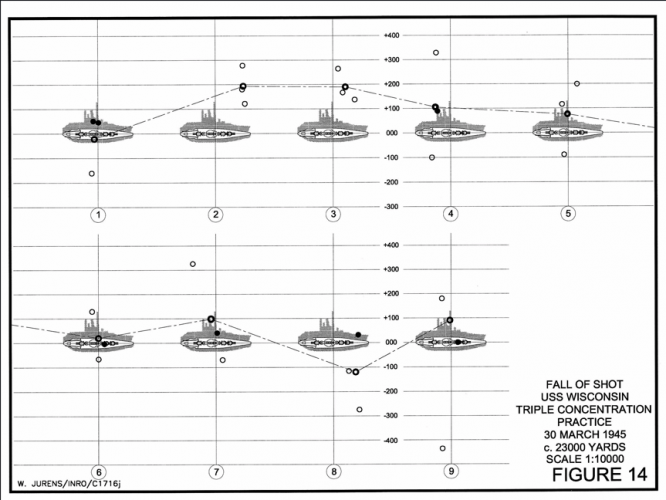
The issue is that if there were such a issue with accuracy of the Iowas, which was your original assertion, it would easily be verifiable during gunnery exercises yet it clearly was not a issue as I have illustrated. For instance, here is graphical recreation from Wisconsin from 1945 from our article:

1752095616041.png

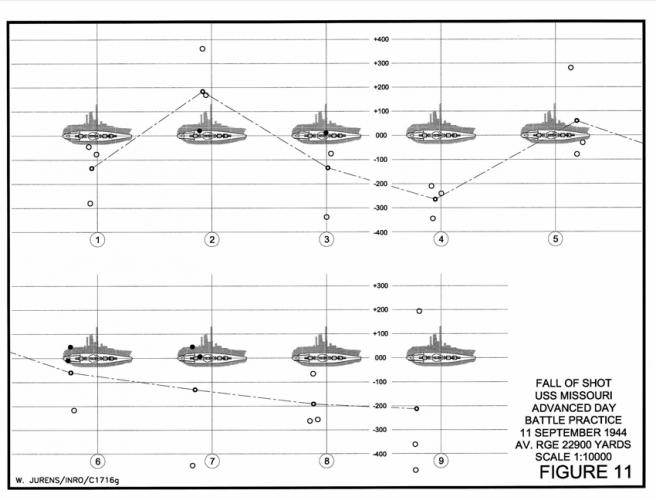
And Missouri from late 1944:

1752095674177.png

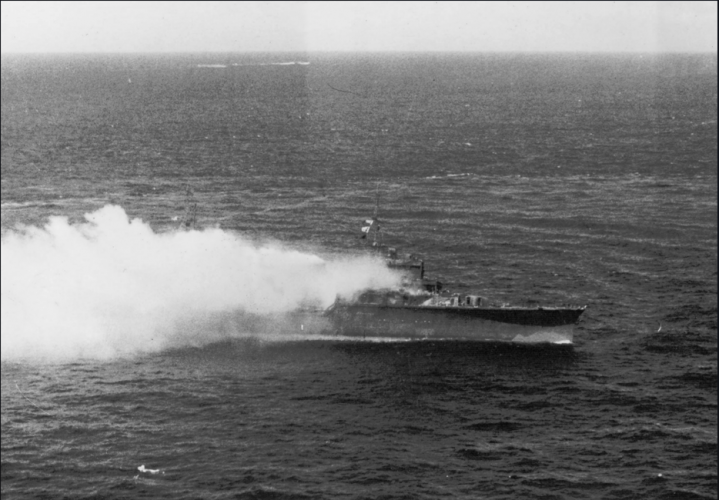
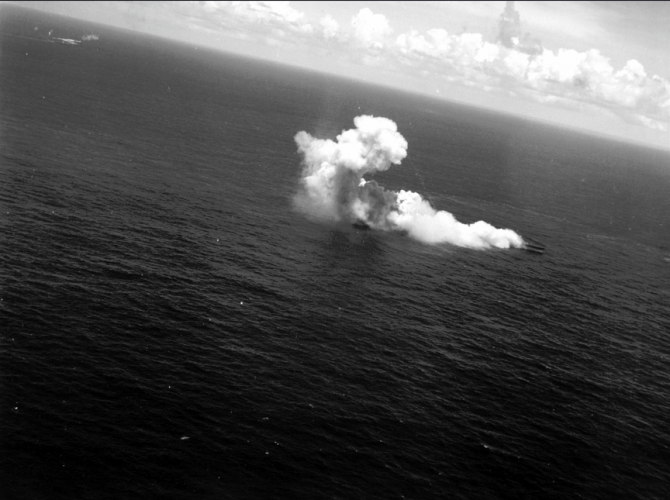
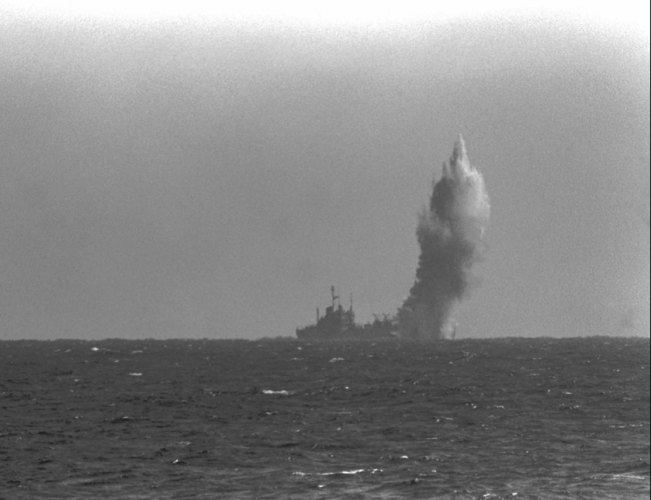
These are but a couple examples and I have much more that are not in a graphical format. Further if we examine the condition of Katori she was smoking heavily and on fire with only the bow area being observed from TG50.9:

1752095788524.png

1752095860695.png

Note that TF50.9 engaged the Japanese from their port sides and passed down Japanese starboard side.

Now take a look at a 16-inch HiCap splash:

1752095919185.png

That is but one 16-inch HiCap splash. Imagine the view when there were several more along the line of sight from the director crew.

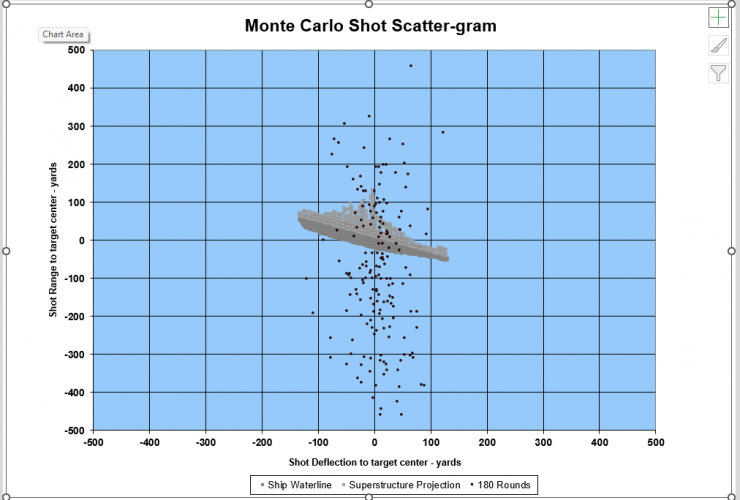
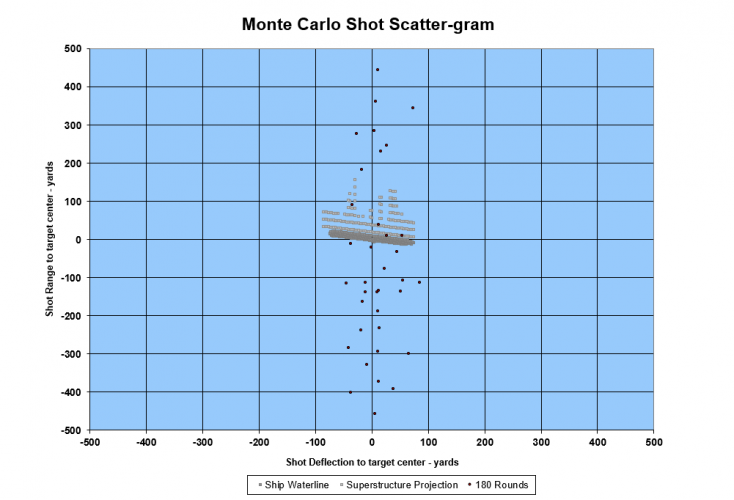
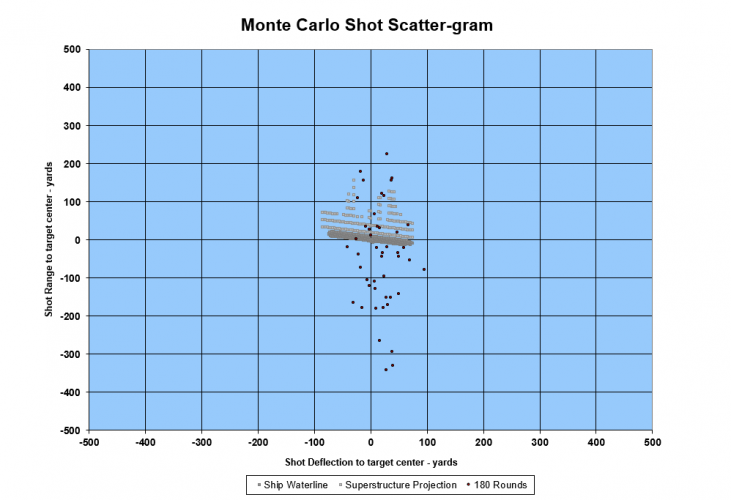
Finally running simulations, based on actual fleet data—where the models have been validated against actual exercises and show strong agreement with observed results, the simulation runs never show no hits, even aft many multiple runs.

1752096430062.png

Now here is a example of a run where I used the observed mean MPI error (-13 yds) and SD of MPI errors (± 99yds) and assuming the average TMD of HiCap w/ service charges of 0.63% of range:

1752096635780.png

Both illustrations are 46 shots.

Finally, I've been likewise unable to locate any data as to the particulars of Iowas assignment regarding Nevada. Even the number and type of vessels involved varies by source. The only constant that I've seen is that Iowa was assigned the task of sinking Nevada. A couple of dozen rounds would suffice if Nevada had been opened up and prepped for sinking.

Again, this is just a assertion. We have no official narrative of events or results contained therein. Additionally, HiCap rounds are very inefficient means of sinking a heavily armor target. To that end, gunfire in general is very inefficient means of sinking ships. Torpedoes are historically far more effective to actually sink a ship. Gunfire is at it's best at destroying a ship.
 
Captain McCrea's after- action report stated that main battery shell splashes were tracked both optically and with the Mark 8, and that all eight salvoes were straddles. Katori was clobbered with a torpedo, from 2- 7 bomb hits, multiple near misses from carrier aircraft, and numerous 8" and 5" hits from a heavy cruiser and a destroyer. She was on fire, making from 1- 2 knots, and was already sinking when Iowa opened fire.
It is also worth noting that in that report they state:

The full effectiveness of IOWA's fire is indeterminate, but is thought to have been considerable.
 
Hull flex and strain effect dispersion but it is a second order effect at most. The biggest contributors are as follows:
  • Variations in propellant weight, temperature and burn rate
  • Variations in projectile geometry, weight and stability
  • Variations in bore & chamber geometry and wear
  • Variations between each gun, turret and recoil systems
TMD varies from month to month, day to day and even hour to hour. No two ships will have identical TMD and they can vary sometimes considerably. For instance BatDiv 7 probably had different lots of powder loaded out when the deployed to the Pacific. That alone will result in a difference alone. It is also very important to to understand that dispersion carries a crew skill component as well. Careful attention to detail such as monitoring magazine temperature (for calculating velocity offsets), maintaining turret and fire control machinery (keeping it within operating specs), fastidious collection of all firing data and analyzing said data to identify each individual gun's charateristics etc.

In other words crew skill played a very active role in maintaining good patterns and there is no substitute for actively training with the equipment. Extended inactive periods are detremental to this and ships coming out of extended maintenance periods or down time always have higher than desired patterns and it takes a couple days of exercise and calibrations to bring the patterns back in line with expectations.


Delay coils and firing timing are two different things. I brought this up because there appeared to be a insunuation in early comments that this was some sort of advantage whereas it was in line with other techincal capabilities of other navies. If you look at the fantastic book on Japanese cruisers Japanese Cruisers of the Pacific War by LaCroix and Wells, they have average patterns for their vaunted heavy cruisers in the prewar years. They averaged 0.52% of range to 0.46% of range. These are the same ships that have been written ad infinitum about how supposedly tight their patterns are as you see these comments in US Action Reports. The reality, as might be expected, is that they are essentially about the same as everyone else.

My issue is not with Lundgren's work at all. My concern is with using a few short actions under varying conditions to make broad claims, while simultaneously treating some sources as reliable and others as suspect without consistent criteria. The notion that missing reports of hits being observed somehow prove inherent inaccuracy turns the absence of evidence into evidence of absence—a remarkable logical leap.


The issue is that if there were such a issue with accuracy of the Iowas, which was your original assertion, it would easily be verifiable during gunnery exercises yet it clearly was not a issue as I have illustrated. For instance, here is graphical recreation from Wisconsin from 1945 from our article:

View attachment 777512

And Missouri from late 1944:

View attachment 777513

These are but a couple examples and I have much more that are not in a graphical format. Further if we examine the condition of Katori she was smoking heavily and on fire with only the bow area being observed from TG50.9:

View attachment 777514

View attachment 777515

Note that TF50.9 engaged the Japanese from their port sides and passed down Japanese starboard side.

Now take a look at a 16-inch HiCap splash:

View attachment 777516

That is but one 16-inch HiCap splash. Imagine the view when there were several more along the line of sight from the director crew.

Finally running simulations, based on actual fleet data—where the models have been validated against actual exercises and show strong agreement with observed results, the simulation runs never show no hits, even aft many multiple runs.

View attachment 777517

Now here is a example of a run where I used the observed mean MPI error (-13 yds) and SD of MPI errors (± 99yds) and assuming the average TMD of HiCap w/ service charges of 0.63% of range:

View attachment 777518

Both illustrations are 46 shots.


Again, this is just a assertion. We have no official narrative of events or results contained therein. Additionally, HiCap rounds are very inefficient means of sinking a heavily armor target. To that end, gunfire in general is very inefficient means of sinking ships. Torpedoes are historically far more effective to actually sink a ship. Gunfire is at it's best at destroying a ship.
That you very much for that information. The factors which you referenced regarding dispersion were of great interest. Some of them (different lots of powder, for example) were eye openers.

From what I've read, the poor gunnery results of Japanese A class cruisers in the early 30s were the genesis of the Type 98 fire control system, and the gunnery of those cruisers doesn't appear to have 'markedly' increased during the Pacific war.

I generally agree with your statement that using a few short actions under varying conditions to make broad claims is undesirable. I'm not satisfied however, that 'that' is the case here. Samar was the first occasion in which Yamato, its crew, and the Type 98 fire control system were put to the test in a long range surface action. Yet in that first test, they obtained four 1st- salvo 18.1" and three 1st- salvo 6.1" hits on two different vessels from over 20,000 yards- and one of the main battery hits was aimed solely by the ship's Type 22 radar. Moreover, Lundgren has stated in forum conversation (tapatalk) that Yamato 'did' hit White Plains from 34,000+ yards and put an 18" diameter by 8" deep gouge in White Plains' hull.

White it's certainly true that although this first surface action was Yamato's only surface action, the results which the ship obtained are far in excess of the norm. As far as I'm aware, no capital ship of any navy achieved anything close to this level of performance during the Second World War. So, either the Japanese were blessed with good fortune which was rarely, if ever, equaled in naval history, or Yamato's crew performance and/or the Type 98 fire control system were better that we in the west have given them credit for. Certainly, the fact that her gunnery officer ranged on Gambier Bay with her first salvo using only the ship's Type 22 radar would seem to indicate that it was far from being terrible, and was instead a good system at ranging (although clearly inferior to what we put at sea by that time).

Regarding Iowa's performance in Operation Hailstone, an overreliance on calculations and practice gunnery exercises which are not backed up by actual combat performance is an issue. The percentages of expected hits which you referenced (14%?) are, as far as I'm aware, well short of historical gunnery performance by any capital ship during WW2. Everyone shoots better in practice than they do in actual combat when the prospect of physical harm is present, and I believe that this is no less true of warships than it is of infantry. The common denominator is human beings, and warships in action are collections of individual human beings attempting to function as one. I don't question the science or the data that you've presented. I'm by no means an expert in the field of naval gunnery, much less a professional. The cause of Iowa's dismal performance against Katori, I believe, is due to human application. In what specific area that occurred, I'm unable to say. What I do know is that Iowa should have secured a number of hits on Katori and ravaged the ship under the conditions of that engagement, and yet her captain (the last person who would be inclined to acknowledge it) made it clear in his after- action report that Iowa obtained no main battery hits in a short to medium range engagement which took place under ideal conditions. Regarding shell splashes obscuring possible hits on Katori, I believe that the air strike coordinator observed Iowa's fall of shot, and that he did record a possible hit on the second salvo- which Iowa's captain did not claim in his after- action report.
 
It is also worth noting that in that report they state:

The full effectiveness of IOWA's fire is indeterminate, but is thought to have been considerable.
I believe that there's no question regarding his statement but that Captain McCrea was referring to the effect of his ship's secondary battery only.
 
Last edited:
Back
Top Bottom