ArmchairSamurai

ACCESS: Confidential
Joined
1 July 2019
Messages
198
Reaction score
295
Been a while everybody, hope all is well

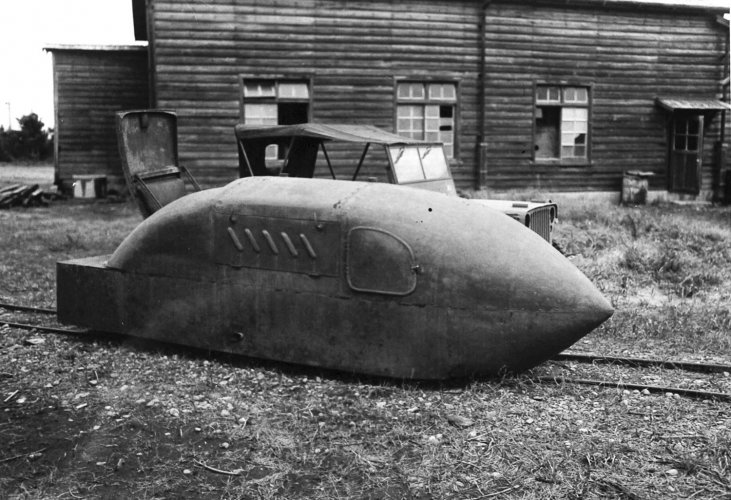
I have had the following photo for some time in my archive. It was and still is a oddity, as to this day I cannot find a solid explanation for what it is. That is to say, I might have a theory now, if you all would allow me. To my knowledge, the photo first originated online in a article from the Atlantic, link below:
https://www.theatlantic.com/photo/2...ese-decoys-used-in-world-war-ii/480186/#img10

Where the author of said article retrieved said photo, is here: https://www.archives.gov/research/guide-fed-records/groups/243.html#243.4.2

Frankly that particular record is massive in volume, so woe to whoever wishes to actually dig through it all and find the photo in question.

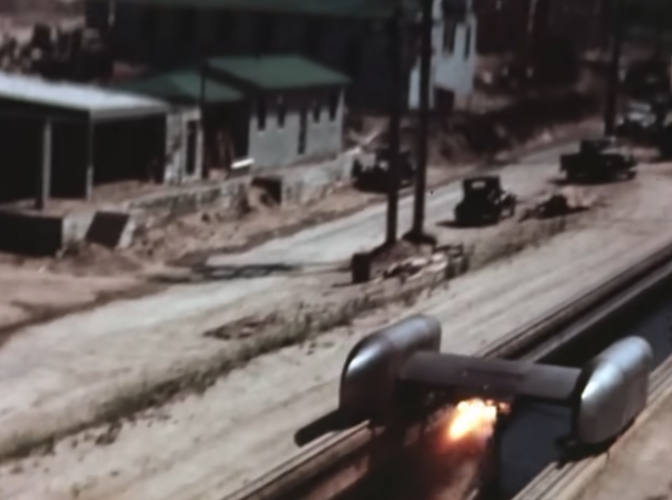
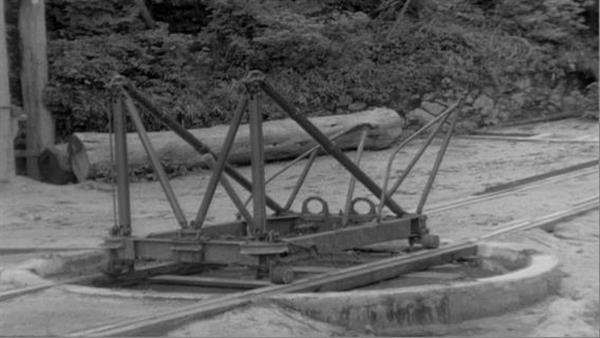
To cut it all short, I am watching a Youtube documentary on the double life of Jack Parsons, a chemist and one of the so-called "Suicide Squad" who developed the JATO for the USAAF. When watching said documentary, a particular shot caught my eye. I clipped it below. It shows a rolling platform for testing of JATOs.

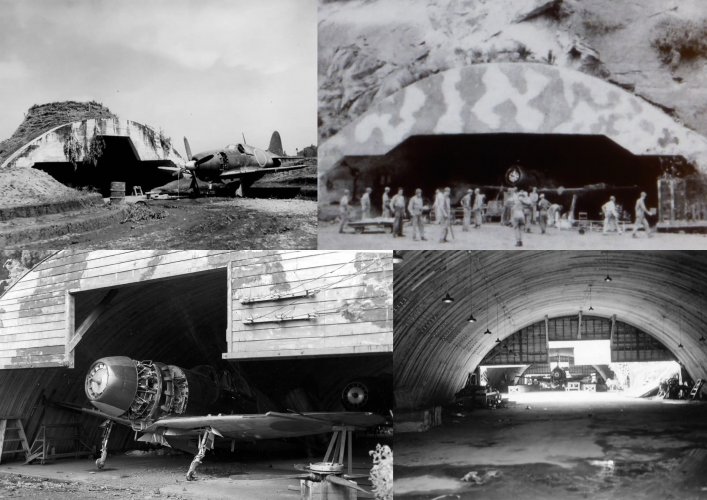
My theory is thus: the mystery object is not a ad-hoc kamikaze railroad torpedo as I have seen theorized elsewhere, but perhaps a prototype test-bed platform for a JATO program. Given Japan's wartime situation at this point in time, airfields were likely being bombed or reconned for activity weekly if not daily, leaving little room for what little airplanes that existed to take off without interference, let alone to land and to be stored safely. That leads credence to the entaigou built across the home islands and elsewhere as Japan lost all air-superiority over its remaining territory. Hinting at the rather frail looking rails seen at the sides of the photo, I imagine the object is either empty, and was merely being towed or pushed to test its ability to ride on rails, or is a indication of the poor conditions of Japan's industry at that point to meet production standards. Either way, I doubt it was laden with any rocket--though I suspect whoever took the photo was likely expecting a rocket or missile, given it was important enough to photograph in the first place. Furthermore, the square tail at the rear of the object looks to be for directing / focusing thrust, as any other means of propulsion is out of the question. The large hatch off-set in the photo may indicate the main means of access to the platform, with a smaller hatch on the side being noted perhaps for instrumentation devices measuring pressure or fuel capacity for example. Heat vents should also be noted, which for a rocket propulsion system, makes sense, as does the overall shape of the object being aerodynamic. It could be that the platform itself allowed for the testing of various different rockets, or combination of rockets, which were being designed to augment Japan's increasing inability to get airplanes airborne in the midst of US airstrikes. Shorter runways, obscured and scattered, made in lieu of airfields, would have allowed Japan to keep pressing fighters into the air, even if only a handful. Afterall, Japan's military junta was committed to the fighting, at whatever cost, which is especially relevant when all of the various ad-hoc kamikaze weapons and equipment are noted. It would be no surprise then that such a program could have been in the works, even if the war was lost, even if there were not any planes to sortie. Such was the nature of last days of Japan and Germany alike. Finally, with Germany exchanging technology with Japan during the war, like for example with the development of Japan's jet aircraft, it cannot be ruled out that Germany's own JATO designs were not in that exchange.

Thoughts?
 

Attachments

  • Mystery (2).jpg
    Mystery (2).jpg
    372 KB · Views: 86
  • Screenshot 2025-07-29 150017.png
    Screenshot 2025-07-29 150017.png
    1.2 MB · Views: 79
  • Entaigou.jpg
    Entaigou.jpg
    2.5 MB · Views: 92
Japanese JATO samples
 

Attachments

  • Squad097.jpg
    Squad097.jpg
    917.7 KB · Views: 93
  • Squad098.jpg
    Squad098.jpg
    1 MB · Views: 68
  • Squad099.jpg
    Squad099.jpg
    759.6 KB · Views: 57
  • Squad100.jpg
    Squad100.jpg
    928.5 KB · Views: 53
  • Squad102.jpg
    Squad102.jpg
    1,016.5 KB · Views: 58
  • Squad106.jpg
    Squad106.jpg
    783 KB · Views: 57
  • Squad108.jpg
    Squad108.jpg
    666.8 KB · Views: 52
  • Squad111.jpg
    Squad111.jpg
    717 KB · Views: 48
  • Squad113.jpg
    Squad113.jpg
    929.6 KB · Views: 48
  • Squad115.jpg
    Squad115.jpg
    721.9 KB · Views: 53
Fairly sure a JATO unit doesn't need an exhaust pipe - bottom of the vehicle, directly below the left hand diagonal embossing, which actually appears to be an air inlet, again consistent with an internal-combustion engine and not a JATO.

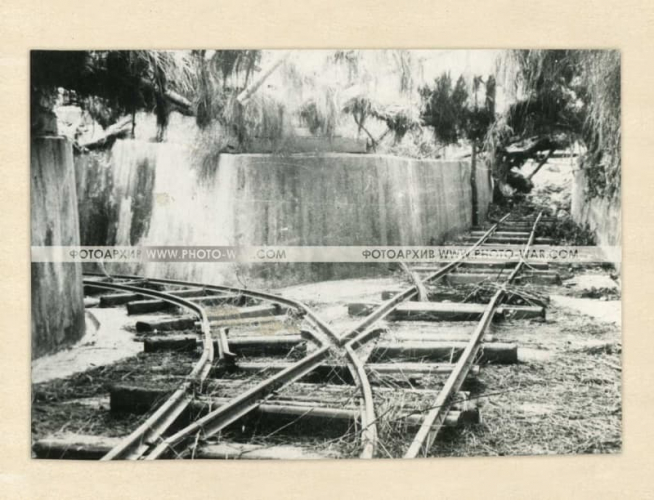
The tracks are clearly (very) narrow gauge, which isn't really appropriate for a high-speed vehicle, particularly a tall, narrow one, doubly so as they don't seem to have much in the way of sleepers to stabilise the rails. While the vehicle is actually at a slight angle to the tracks, not on them, I think it probably is associated with them. My guess would be a small internal-combustion powered locomotive, possibly with controls at the rear accessed via the flip-up hatch, or on the far side - it's not unknown for small shunters to be driven from the side.
 
I don't see there a contradiction, after firing a Jato rocket and breaking the vehicle, it needs to get back into the shed, therefore a combustion engine would have been very useful.

You don't really need a high speed in case you will determine the impulse by vehicle acceleration. Keeping the air and rolling resistance to a minimum in combination with a very high vehicle mass could be a useful approach. Of course, this might have also been done in static testing, but maybe the cloud of smoke and the vibration made it more difficult than accelerating a rail car.

Despite that, it might have also been a test device testing the impact of shells on steel plates. It would even make sense to use a rocket to speed up the vehicle.
 
Last edited:
My theory is thus: the mystery object is not a ad-hoc kamikaze railroad torpedo as I have seen theorized elsewhere, but perhaps a prototype test-bed platform for a JATO program
My IMHO - it's merely an armored shunter for narrow-gauge fortress railroads. Japanese fortresses used narrow-gauge rails quite extensively to transport ammo, personnel and supplies within the fortress. And the idea to add some armor to small engine seems quite obvious.
 
Fairly sure a JATO unit doesn't need an exhaust pipe - bottom of the vehicle, directly below the left hand diagonal embossing, which actually appears to be an air inlet, again consistent with an internal-combustion engine and not a JATO.

The tracks are clearly (very) narrow gauge, which isn't really appropriate for a high-speed vehicle, particularly a tall, narrow one, doubly so as they don't seem to have much in the way of sleepers to stabilise the rails. While the vehicle is actually at a slight angle to the tracks, not on them, I think it probably is associated with them. My guess would be a small internal-combustion powered locomotive, possibly with controls at the rear accessed via the flip-up hatch, or on the far side - it's not unknown for small shunters to be driven from the side.
That's a good point! Now that you put it that way, it does seem more obvious. I did not think about a shunter.

My IMHO - it's merely an armored shunter for narrow-gauge fortress railroads. Japanese fortresses used narrow-gauge rails quite extensively to transport ammo, personnel and supplies within the fortress. And the idea to add some armor to small engine seems quite obvious.
I can see the picture now... but were there any fortresses of such size on mainland Japan? I know of the Koto Fortress Line in Manchuria, but nothing much on what fortifications were surrendered on Japan proper. Frankly, I wouldn't even know of a good source on that.

First photo attached is the impression your ideas give me. Its from the Koto Fortress. I was thinking more along the lines of the other attached photo. I suppose now it doesn't make sense to go through all the fuss to rig up a trolley to be aerodynamic.
 

Attachments

  • 1753859279852.png
    1753859279852.png
    933.5 KB · Views: 51
  • 1753859487784.jpeg
    1753859487784.jpeg
    31.8 KB · Views: 74
The quite elaborate aerodynamic looking shape doesn't make sense for a shunter. Maybe it was used in a movie as a futuristic locomotive?

Otherwise, I think more and more it makes sense as an impact test device.
 
My IMHO - it's merely an armored shunter for narrow-gauge fortress railroads. Japanese fortresses used narrow-gauge rails quite extensively to transport ammo, personnel and supplies within the fortress. And the idea to add some armor to small engine seems quite obvious.
Precisely my thinking. Narrow gauge is common in coast defence installations.
 
but were there any fortresses of such size on mainland Japan? I know of the Koto Fortress Line in Manchuria, but nothing much on what fortifications were surrendered on Japan proper. Frankly, I wouldn't even know of a good source on that.
Yes, there were major coastal fortresses in Japan, including some 16.1" 3rd Year Type turrets.

Wiki has a useful list, with more details available if you follow up the Japanese wiki links (ie the ones in Kanji) and then use google translate.

https://en.wikipedia.org/wiki/List_of_Coastal_Fortresses_in_Japan_during_World_War_II
 
The quite elaborate aerodynamic looking shape doesn't make sense for a shunter. Maybe it was used in a movie as a futuristic locomotive?
Remember, the '30s were the era of streamlining for locomotives as the wave of the future, even though, as William Stanier reputedly pointed out when told to add streamlining to the LMS's Coronation class, they didn't actually spend enough time going fast to make it worthwhile, and that was for the elite London to Glasgow service. It's the period equivalent of go-faster stripes and ridiculously large spoilers.
 
Nobody would cover a narrow gage diesel shunter for prestige reasons, this really doesn't make any sense. Note, there not even a coupling in the front, so using it for shunting is quite uselless...

Furthermore, I don't see any indication, that it was operated with a driver, no seat, no real platform or intumentation, nothing like that can be seen.

The pointed nose and the smooth transition to a rounded rectengular shape requires quite a lot of effort, bending steelplates in two dimensions ist not wasy.

If it wasn't for a movie, it must have had a special pupose, I believe inpact testing is the most likely because the pointed nose looks very much like a shell. The whole body is made of welded steel plates and the engine is only accesseble by a small opening, this might have been done to built a very solid structure. Of course, this is completly inpractical for a conventional locootive.

The Jato test vehicle is another possibility, but an aerodynamic shape could have been made much easier without 2 dimensional bending and without welding the whole shell together.
 
Last edited:
Nobody would cover a narrow gage diesel shunter for prestige reasons, this really doesn't make any sense. Note, there not even a coupling in the front, so using it for shunting is quite uselless...

Furthermore, I don't see any indication, that it was operated with a driver, no seat, no real platform or intumentation, nothing like that can be seen.

The pointed nose and the smooth transition to a rounded rectengular shape requires quite a lot of effort, bending steelplates in two dimensions ist not wasy.

If it wasn't for a movie, it must have had a special pupose, I believe inpact testing is the most likely because the pointed nose looks very much like a shell. The whole body is made of welded steel plates and the engine is only accesseble by a small opening, this might have been done to built a very solid structure. Of course, this is completly inpractical for a conventional locootive.

The Jato test vehicle is another possibility, but an aerodynamic shape could have been made much easier without 2 dimensional bending and without welding the whole shell together.
You make a solid point too. Within reason, what intelligence value does a ordinary shunter have to necessitate its photograph being taken? In addition, you are right, there is no coupling in the front, and the aerodynamic aspect does not make much sense either in that regard when considering it as a shunter.

I'd argue that in the sense it is a test platform, for impact or propulsion, that the lackluster aerodynamic design is still a reflection of Japan's dying industrial capacity. Food for thought. That is perhaps all they had available.

I wonder if the original photograph's description, buried in the archive link I originally posted, has the answer to what this object is... if only it were easy to find among the thousands of other photos in the lot. :(
 
Nobody would cover a narrow gage diesel shunter for prestige reasons, this really doesn't make any sense.
No one would stick go-faster stripes and huge spoilers on a family hatchback and expect them to make a difference, but we still regularly see it.

Note, there not even a coupling in the front, so using it for shunting is quite uselless...
Coastal artillery use is distinct from normal shunting, where the ability to work both ends of the shunting engine is useful. Rather than working a shunting yard, the engine may simply be working back and forth, magazine to turret to magazine - a front coupling isn't only not needed in that scenario, it's unusable.

Furthermore, I don't see any indication, that it was operated with a driver, no seat, no real platform or intumentation, nothing like that can be seen.

I actually suspect that flipped-up hatch could cover a driving position, either standing, or sitting, there are small amusement-ride type engines with a similar setup. Small shunting engines like the NS 200 could be driven from the side with a shunter standing on a footplate/running board. If there are controls on the far side we simply wouldn't see them.

If it wasn't for a movie, it must have had a special pupose, I believe inpact testing is the most likely because the pointed nose looks very much like a shell.
A shell on that scale would have walls inches thick.
 
The flipped up hatdch is from the car behind.

Again, shunting without a frontcoupling???

It might have been used to test torpedo ignition systems. The shape fits and the speed of a torpedo can very well be reached by a small locomotive.
 
The flipped up hatdch is from the car behind.

Again, shunting without a frontcoupling???

It might have been used to test torpedo ignition systems. The shape fits and the speed of a torpedo can very well be reached by a small locomotive.
Actually Nicknick, that hatch is from the object. Willys Jeeps do not have that. All models of that age were soft tops with a simple one piece bathtub like construction. Whatever this object is, we are not seeing the full shape, as the hatch indicates there is a asymmetrical contour out of sight, to which that hatch it attached.
 
Hatch or no hatch, it is definately not a shunter and even an impact test locomotive might have had a hatch.

I agree, the hatch might be from the vehicle, but I don't see something indicating an unsymmetrical structure in this case.
 
Last edited:

Similar threads

Back
Top Bottom