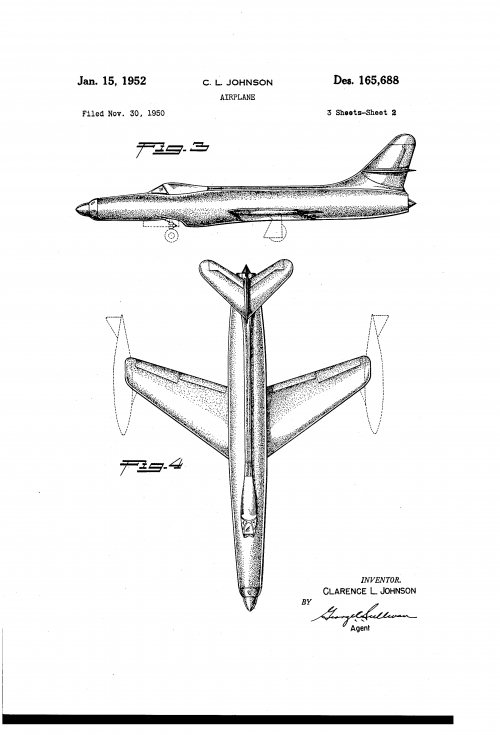
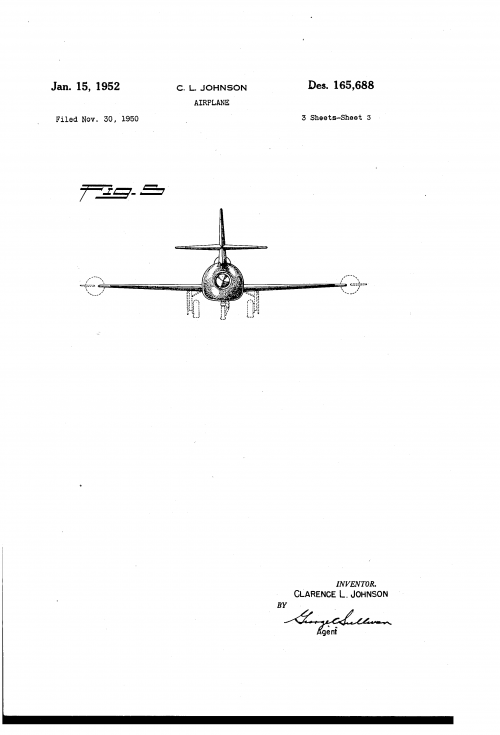
I'm highly doubtful about this particular assertion since Consolidated Vultee's own entry in that competition was designated P-1032. The site Military Factory does mention a series of "P-1032" designs as being Curtiss-Wright in nature (https://www.militaryfactory.com/aircraft/detail.php?aircraft_id=2532 and https://www.militaryfactory.com/aircraft/detail.php?aircraft_id=2533) but I tend to take their assertions with a pinch of salt, considering they claim "help of (...) topic specialists" but never mention any author's name of source document reference... and also the fact that they often completely invent graphic details such as paneling on their re-creations. Even supposing they were right about it, they claim that P-1032-13 was the final iteration of the design, and do not mention of a "P-1032-50". However, the USAAF's Engineering Division Finding Aid for Records DOES list P-1032-50, but as a Consolidated Vultee entry in the Penetration fighter (P) competition, which it was!

CVAC P-1A DWG P-1032-50 General Arrangement
CVAC P-1A DWG P-1032-51 Inboard Profile

Of course, this makes me wonder if the Military Factory website isn't just plain wrong, and if the earlier P-1032 designs could have been Consolidated Vultee designs... Sure they do look Curtiss-ish, but who knows? "Similar shapes for similar requirements" has been seen before... Just for the record, at the time of those designs (1944) Curtiss-Wright's project series used designations in the P-290/-310 range (except for the few P-1500+ designs reserved for transport designs originating in Louisville). I strongly doubt that Curtiss-Wright would suddenly have gone totally off with a "P-1032" designator. In 1945, C-W had a P-304-4 jet powered canard pursuit proposal with a General Electric TG-180 engine, and a P-304-5 variant with slightly different specifications. I would be inclined to consider an iteration of P-304 as a valid Curtiss-Wright entry in the penetration fighter competition, but of course it could also be one of the undocumented numbers of that period (P-300, -301, -308, -310-up)

Curtiss-Wright P-1032 was a set of 4 designs (-7, -9, -11, -13) three jet one turboprop, designed for long range and in one case labelled as "Tandem Escort Fighter", submitted in Feb 1944, as Antonio said see "Early US Jet Fighters" by Tony Buttler p20 to p23. Seems to be roughly similar to the Penetration Fighter in concept.

Curtiss-Wright then submitted P-1032-50 to the 1945 Penetration Fighter competition. This is illustrated on p61, it looks somewhat like XF-87.

Convair (Downey division, heritage Vultee) did submit a proposal described on p59 to p60 but it has no known designation other than "Convair Penetration Fighter") in Tony's book. Our own @aim9xray has said it was proposal VF 4511 for the 1945 AAF Penetration Fighter here: https://www.secretprojects.co.uk/th...onvair-model-numbers.11189/page-2#post-790130
 
Last edited:
Convair (Downey division, heritage Vultee) did submit a proposal described on p59 to p60 but it has no known designation other than "Convair Penetration Fighter") in Tony's book. Our own @aim9xray has said it was proposal VF 4511 for the 1945 AAF Penetration Fighter here: https://www.secretprojects.co.uk/th...onvair-model-numbers.11189/page-2#post-790130
Hmm... OK. But then how do you explain these entries in the Engineering Division Finding Aid? Because obviously "CVAC" means "Consolidated Vultee Aircraft Corp." not "Curtiss-Vright"!
CVAC P-1A DWG P-1032-50 General Arrangement
CVAC P-1A DWG P-1032-51 Inboard Profile
 
Mislabelling?

The evidence is scans of the two actual proposal documents from RG-342 at NARA College Park which trumps an index.

Mislabelling does occur of course, but more in the form of inverted digits, not replacing a company by another.

Sorry, I'm not usually one to argue, but I'd want to see those scans to be convinced. Too often researchers see what they want to see, and if the bias from the beginning was that it was a Curtiss-Wright, they may believe in good faith that this was so. Some great researchers have made mistakes before, so when push comes to shove, I only trust what I can verify. Have you seen those scans yourself? If so, I'd love to see some of it. If not, then it's hearsay (and therefore trumped by the index, which I saw...)

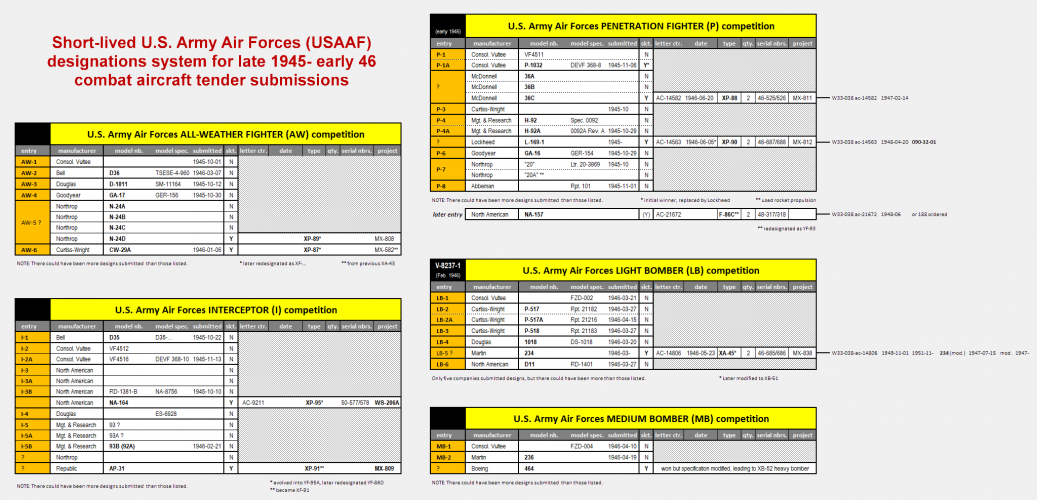
Here is the list I was able to reconstruct from the data found online for all the 1945-46 competitions using the short-lived alphanumerical system. Data that is uncertain has a question mark (?) next to it.

1752145971277.png

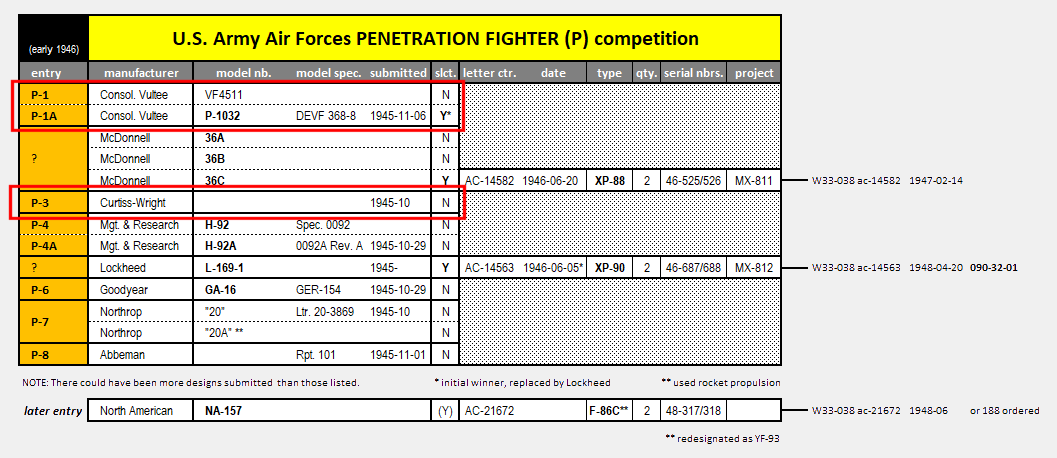
First of all, it makes NO sense that Curtiss-Wright should have been allocated the "P-1A" designation since it's very clear that plain "P-1" was a Consolidated Vultee design (VF4511). In that short-lived 1945 system, each P- number was allocated to one specific design from a specific manufacturer (see attachment for the entire designation system). Curtiss-Wright's proposal was allocated the P-3, not P-1 slot. And even if they had submitted two distinct designs, the second one would not have reused CVAC's number.

Also, note that the P-1A mention as a CVAC product comes with Model Spec. N° DEVF 368-8 (6 Nov. 45), which is consistent with CVAC's simultaneous I-1A entry for the Interceptor competition which was Model N° DEVF 368-10 (13 Nov. 45). By contrast, Curtiss-Wright Model Specs for the LB competition used report numbers Rpt. 21182, Rpt. 21216 and Rpt. 21183 (see attachment).

Additionally, Curtiss-Wright's P- numbers at the time were typically in the 300+ or 500+ range, not 1000+. I do not have the P- number for the P-3 proposal, but for instance, the company's design submissions for the simultaneous Light Bomber (LB) competition were P-517 (LB-2), P-517 (LB-2A) and P-518 (LB-3) (see attachment). Find me a single example of a Curtiss P-1000+ project and I'll be happy to be proven wrong — I do have three P-1500+ designations in 1943-44 which were specifically for Louisville Engineering Dept. designs, so I'll readily admit P-1000+ for another division remains possible, though I suppose we would have come across more of those before.

So until I can see a document that clearly connects "P-1A" and "P-1032" with Curtiss-Wright, I'll stick to the CVAC reference.
 

Attachments

  • 1752145619843.png
    1752145619843.png
    215 KB · Views: 102
@Stargazer: STOP!
You are oversalting the soup!

Entry AW-1 is Convair Ft Worth Division (XA-44 adaptation) Report "FZP-01-001" 10-9-45

Entry I-1 is (model Spec is unknown; is probably D-35-9xx-001) - Preliminary Performance Spec is "D35-943-001"
Entry I-3 is likely NAA RD-1381 (see Jared Zichek NAA drawings)
Entry I-3a is likely NAA RD-1381A (see Jared Zicheck NAA drawings) (revisions due to increased range requirements from AAF)
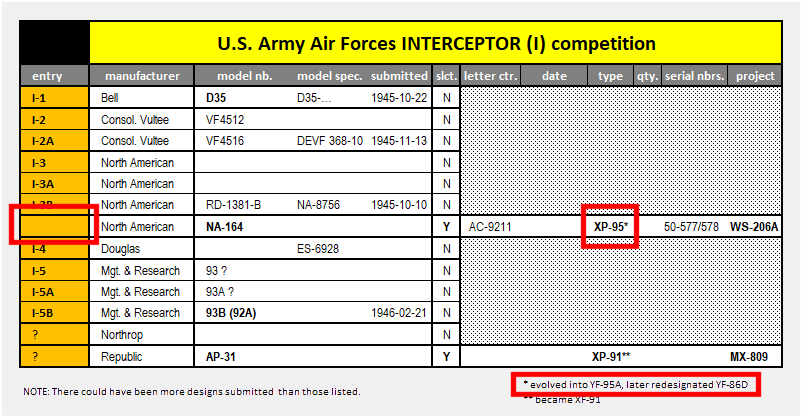
Entry " " NAA NA-164 YF-95/YF-95 is not a part of this 1945 competition. (Hint, A/C serials are FY 1950!)
Entry 1-4 is Douglas El Segundo model D-558 Phase 3 (original designation for swept wing D-558 Phase 1)
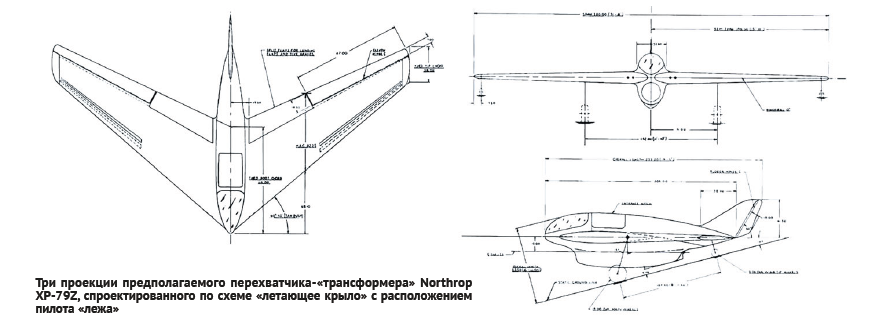
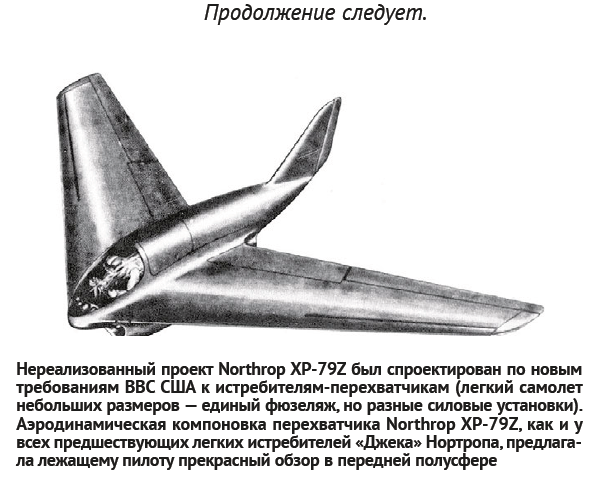
Entry "?" Northrop XP-79Z (rocket power) does not have a "I" number because it was not included in the final round of evaluations. This is because no final proposal was submitted (Northrop concentrated effort on N-24 for the AW competition)

Entry P-1 is VF 4511 Report "DEVF 368-8"
Entry P-1A is VF 4511 (VF-4511, 4511-1, 4511-2 options) Report "DEVF-368-8 (addendum)"
"P-1032" model designation is Curtiss-related.
Entry P-8 is Northrop XP-79Z (turbojet aircraft) (my appellation). Reports "AM-20" and "AM-20A" describe the XP-79Z (turbojet aircraft) and XP-79Z (rocket aircraft) respectively. They are part of the AM-series of reports (having nothing to do with the Northrop project number). Meaning of "AM" is unknown but means "Performance Estimate" (a documented example is "AM-58A - Performance Estimate for Model N-31A"). Letter 20-3969:JKN:eh dated 1 November 1945 - and signed by Jack Northrop himself (!) describes the XP-79Z (turbojet aircraft) and the XP-79Z (rocket aircraft) as a variant in the same seven pages. Likewise, "W" is a "Weights" report prefix (again with the report number running consecutively in its own series, with no relation to the Northrop project number).

NAA NA-157 was not part of the 1945 design competition.

The Boeing 464/XB-52 was not a Medium Bomber. That was the XB-55.

And for what it's worth (and in my humble opinion), these designations ("I", "AW", "P" etc) were shorthand "labels" used by the 20-40 engineers involved at Wright Field to refer to the different proposals during evaluation rather than some overarching "Designation System". You are making more of this than there was. Sometimes a banana ... is just a banana (John Belushi).
 
Mislabelling does occur of course, but more in the form of inverted digits, not replacing a company by another.

Sorry, I'm not usually one to argue, but I'd want to see those scans to be convinced. Too often researchers see what they want to see, and if the bias from the beginning was that it was a Curtiss-Wright, they may believe in good faith that this was so. Some great researchers have made mistakes before, so when push comes to shove, I only trust what I can verify. Have you seen those scans yourself? If so, I'd love to see some of it. If not, then it's hearsay (and therefore trumped by the index, which I saw...)
You are clinging stubbornly to your idea here. You also have a touching faith in people indexing items correctly that suggests you haven't ever done much primary research in archives.

I don't have the relevant scans from NARA. Alan Griffiths does, Tony Buttler does. Neither has a vested interest in wanting to mislabel the designs with incorrect designations. Where do you think they got the designations from, if not the brochures?

There are multiple subtype designations known - the P-1032-7/9/11/13 in1944 brochure, the P-1032-50/51 in the 1945 brochure. Both brochures concern long range fighters, the first "escort" fighters, the second penetration fighters.
 
You are clinging stubbornly to your idea here. You also have a touching faith in people indexing items correctly that suggests you haven't ever done much primary research in archives.
You are very wrong about this "touching faith" bit, and if you take the time to go over all the topics I dedicated over the years to the online indexes I have thoroughly analyzed and committed to Excel (Sara Clark, Bernard Lindenbaum, Engineering Division, Bellanca, etc.) you'll see that I never stop comparing and questioning the data in the light of other sources, and often just sheer logic.
I have found tons of mistakes and debunked them along the way, and I am well aware that the main problem of those archive indexes (and many archives in general) is that the work is done by summer helps or volunteers who are zealous but not necessarily conversant with the material, the companies' histories, etc.
I unfortunately CANNOT do much "primary research in archives" (since I'm mostly into US aircraft but based in Europe) but I believe my past work of analyzing/editing/reorganizing the aforementioned indexes has value — and if I judge solely by the number of times I've seen people refer to it online, I'm not wrong here. This kind of work is invaluable for those people who can actually go to a physical archive and dig, because it saves precious time and effort!
Not to boast here, but until I brought the 1945-46 USAAF tender codes into light, and showed how they were part of a very short-lived way to designate proposals, NO-ONE had made any sense of them. So I may have made a couple of mistakes (who doesn't? I never claimed to be infallible) but the above charts, elaborated mainly from the Engineering Division Index, are consistent on the whole.

Entry P-1 is VF 4511 Report "DEVF 368-8"
Entry P-1A is VF 4511 (VF-4511, 4511-1, 4511-2 options) Report "DEVF-368-8 (addendum)"
"P-1032" model designation is Curtiss-related.
  • if P-1A was CVAC alright (as the VF4511 designation amply proves)...
  • ... if Curtiss-Wright was allocated the P-3 slot...
  • ... and if P-1032 turns out to be a Curtiss-Wright designation (bold type and red print doesn't make an assertion more convincing, but let's assume you're right)...
... then isn't it safe to assume that the P-1032 was actually P-3 and not P-1A, and that a confusion exists between the two?

And for what it's worth (and in my humble opinion), these designations ("I", "AW", "P" etc) were shorthand "labels" used by the 20-40 engineers involved at Wright Field to refer to the different proposals during evaluation rather than some overarching "Designation System".
So what? I'm sure these designations WERE indeed used by only a small committee of people and the companies submitting designs in those tenders... Yet does it mean these folks would not be logical in their use of them? That they would create a nomenclature only to trample over it afterwards and allocate numbers randomly?

You are clinging stubbornly to your idea here.
No, I'm simply trying to avoid mistakes and respect the logic of this designation system. In those days, nomenclature meant something. It was not something that those who used it treated lightly. I do NOT absolutely want the P-1032 to be a Convair, nor do I want my theories to be absolutely right... I just strive to get coherence and to not jump to conclusions. When I ask to see evidence, I'm dismissed as "stubborn" and asked to "stop", as if my intention was to troll... while that need for evidence is supposed to be a prerequisite and is routinely toted in the face of anyone coming up with a theory on this forum, so I don't quite understand in what way my insistence here is any different.
Or maybe I do. Some "names" have plot armor and their work should NOT be questioned. Well... experience has shown me that even respected authors such as Peter Bowers or Steve Pace made MANY mistakes in their research (the latter being the first to admit it—he even asked me to proofread part of his last book and thanked me for it in the credits). It doesn't cancel all the great contributions they made... but it certainly gives an incentive to take everything with a pinch of salt.
 
That's not really the same thing at all Stephane, and with the appropriate respect to Bowers & Pace, both authors of a different era and calibre of research than Alan Griffiths (ASP1) or @aim9xray aka Craig Kaston (ASP2. ASP3)

Have you read Tony' Buttler's book on Early US Jet Fighters? Its the best source on the Penetration Fighter competition I've read by far.
 
Last edited:
That's not really the same thing at all Stephane, and with the appropriate respect to Bowers & Pace, both authors of a different era and calibre of research than Alan Griffiths (ASP1) or @aim9xray aka Craig Kaston (ASP2. ASP3)

Have you read Tony' Buttler's book on Early US Jet Fighters? Its the best source on the Penetration Fighter competition I've read by far.
I've only got the American Fighters & Interceptors 1945-1978 book and a few others, non-US related (Japanese, British).
(Not directly related, I've also got the two Convair books from other publishers, which are excellent.)
Wish I could afford to purchase all the others... Had a difficult patch with the purchase of a house while the apartment wasn't yet sold, but now that it's done, hopefully I'll be able to indulge more!
 
Its not easy to get hold of copies of Early US Jet Fighters sadly - it was published back in 2013. Access to the US National Archives RG-342 collection of proposal submissions really unlocked this era from a projects / competition basis. American Fighters & Interceptors 1945-1978 is much more incomplete- for instance it is missing the Curtiss-Wright 1032-50 and the Goodyear GA-16 proposals, mentioned only as not known at that time.
 
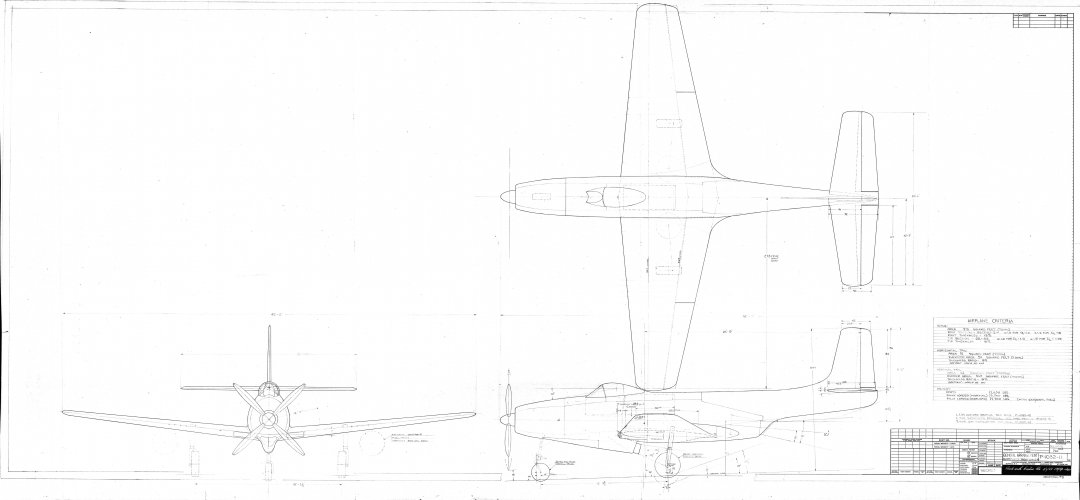
Tony Buttler has supplied this scan from the 1944 brochure. The info block shows P-1032-11. Note that the text on the drawing suggests that the designations (the suffixes at least) relate to drawing numbers rather than designating "variants" per se, which we have seen in other manufacturer's designation systems. I think this proves the P-1032 designation is real. Curtiss Tandem fighter GA P-1032-11.jpg
 
Last edited:
Tony Buttler has supplied this scan from the 1944 brochure. The info block shows P-1032-11. Note that the text on the drawing suggests that the designations (the suffixes at least) relate to drawing numbers rather than designating "variants" per se, which we have seen in other manufacturer's designation systems. I think this proves the P-1032 designation is real.
Just BRILLIANT! So P-1032 is Curtiss-Wright indeed... A not-so-distant brother to the Navy XF15C-1.
Thank you so much for asking Mr. Butler and thanks a lot to him for obliging!
 
Just BRILLIANT! So P-1032 is Curtiss-Wright indeed... A not-so-distant brother to the Navy XF15C-1.
Thank you so much for asking Mr. Butler and thanks a lot to him for obliging!
The 4 drawings (-7,-9,-11,-13,-50) are all very different designs. -11 is the turboprop + jet compound design, others are jet only and different in appearance.
 
  • ... and if P-1032 turns out to be a Curtiss-Wright designation (bold type and red print doesn't make an assertion more convincing, but let's assume you're right)...
The red & bold was meant to catch your eye, not your ire. I apologize for that. As to the "STOP!" I was rather aggregated aggravated by your inclusion of the YF-95A/F-86D into the Fall 1945 acquisition timeframe. (At this point the P-86A was still a straightwing design.)

edit: speeling. Yikes.
 
Last edited:
I was rather aggregated by your inclusion of the YF/95A/F-86D into the Fall 1945 acquisition timeframe. (At this point the P-86A was still a straightwing design.)
Yeah, I simplified things but it was misleading. For my defense, though, I never pretended that the NA-164 was part of the "I-" competition, just indicated that it was eventually selected for production. My mistake is I should have blackened out the cell in the first column, and not written "Y" in the selection column. Ideally, there should have been additional columns to indicate it was a later submission... I'll readily admit this one wasn't crystal clear!
 

Attachments

  • 1752482314235.png
    1752482314235.png
    41.7 KB · Views: 126
FWIW, I would contend that that the NA-164 has no place in a table entitled "U.S. Army Air Forces INTERCEPTOR (I) competition" other than perhaps as a footnote. Even so, I then would contend that the MX-1554 competition was the logical "new start" follow-on to the 1945 Interceptor competition.
 
Last edited:
Hmm... OK. But then how do you explain these entries in the Engineering Division Finding Aid? Because obviously "CVAC" means "Consolidated Vultee Aircraft Corp." not "Curtiss-Wright"!
CVAC P-1A DWG P-1032-50 General Arrangement
CVAC P-1A DWG P-1032-51 Inboard Profile
To beat this into the weeds, and definitively close this issue out, I can now say that based on an "eyes-on" report from an on-site researcher at NARA II that:

- the blueprint drawings are indeed of a Curtiss XP-87-like aircraft and are pencil marked "P-3" [presumably by Wright Field personnel] indicating that they are part of the Curtiss Penetration fighter proposal package.
- therefore the "CVAC P-1A" portion of the index listings above are spurious and incorrect.

I offer the revised listing:
CVAC P-1A Curtiss Penetration Fighter DWG P-1032-50 General Arrangement
CVAC P-1A Curtiss Penetration Fighter DWG P-1032-51 Inboard Profile

This has further implications for the understanding of the P-1032 (P-1032-7, -9, -11, -13) drawings discussed above - these are likely best to be viewed as drawing numbers and not design numbers. Since these are all general arrangement drawings, it would make sense that the succeeding drawing (say, the -8 following the -7) would be the inboard profile.

If this all follows and tracks, and you accept this conjecture, than "P-1032" can not be a model number or an advanced design number because it covers a large number of mutually exclusive designs. This is unlike other Curtiss "P-numbers".
 
Nice report my dear PaulMM,

and from Jstor site,maybe that was early concept of 1947 for Lockheed
XF-90,or that was a generic design ?.

https://www.jstor.org/
Sorry for that my dear Paul,

the report was from 1953,my fault,please accept my apology,and
the whole article from Lockheed,and here is anther two fighter
Projects,maybe from the same period (1947) ?.

https://www.jstor.org/stable/445473...c8fb29acf946&seq=5#metadata_info_tab_contents

My dear Jstor,

please if it's possible,can you send the report.
 
Tony Buttler has supplied this scan from the 1944 brochure. The info block shows P-1032-11. Note that the text on the drawing suggests that the designations (the suffixes at least) relate to drawing numbers rather than designating "variants" per se, which we have seen in other manufacturer's designation systems. I think this proves the P-1032 designation is real.View attachment 777650
That looks a lot like the Curtiss XF-15C Stingeree

R.872a665ea12887e1511d5ae118a7d29b
 

Similar threads

Back
Top Bottom