The national workshare was set by the treaty at a governmental level for each of the individual pillars, 50-50 between France and Germany for the manned pillar and during the awarding of the Phase 1 feasibility/concept design studies that workshare was honoured. But Dassault is trying to muscle its way to an 80% share of the commercial contracts during the commercial contracting for the Pillar 2 flight demonstrator stage, ignoring the pre-agreed workshare.
Keep in mind that the definition of "work share" is complicated by the fact that many work packages are divided up between a designated leader from one country and the other partners. Leadership of these work packages was split about 40% to Dassault and 60% to Airbus DS and Airbus Spain, but with the actual work being split evenly across all 3 partners.
Also half of the work packages are joint, with no designated leader. This was a major sticking point in the initial Phase 1b negotiations in 2021 because Dassault argued that the lack of a leader was detrimental to the goal of minimizing cost and execution risk (e.g. it would prevent the ability to reuse existing know-how in critical areas like the flight control software).
So the key question is whether Dassault is asking for 80% work share (as German sources alledge, but they have often been biased/wrong in the past) or rather for leadership of 80% of the work packages, under the "best athlete" principle. (But with work still being split 1/3rd between partners).
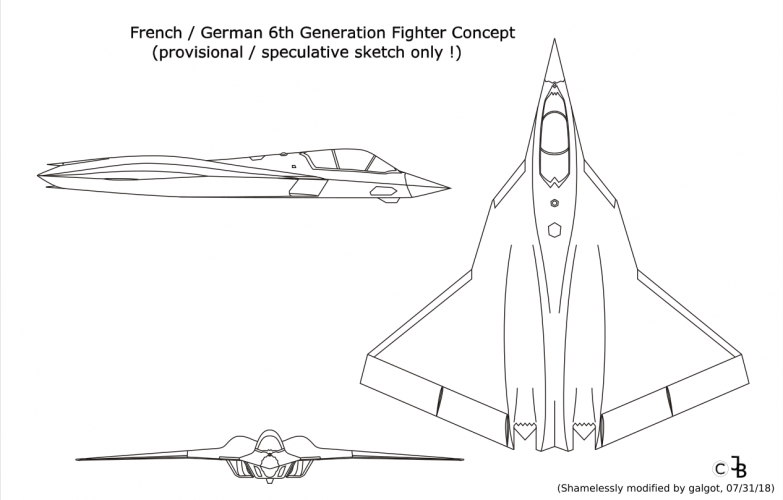
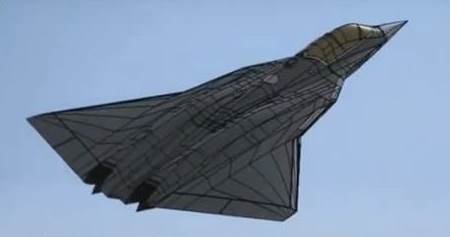
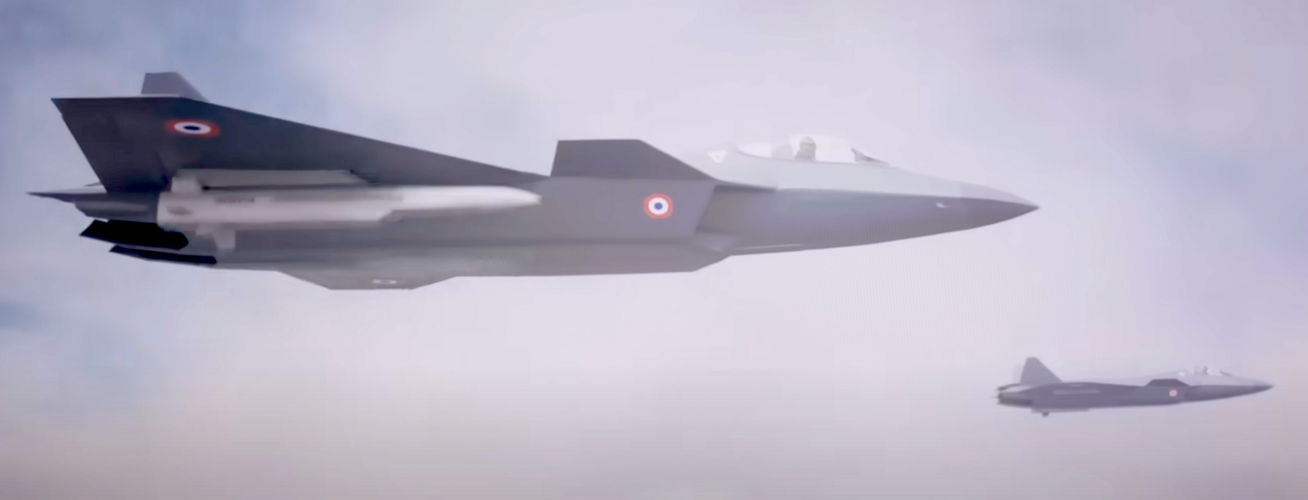
Looking at the first Dassault concept models from 2018, which looked to me smaller (Rafale size) and more realistic than the latests NGF super fighters concepts, while retaining the same plan form, I have my idea that was initially their plan.
Something the size of F-47, or J-20, or these latests NGF images seems to me unrealistic and of no need for France anyway, not to talk about the difficulty of exporting these monsters unless you are USA or China.
The issue would be that a 5th Gen could have come already 10 years ago. It's pretty late for that, especially for a country that doesn't field any other low observable aircraft. So developing a 5th generation fighter in the 2030s may not be the smartest decision for a country like France, which all things considered still holds regional power ambitions.
For context, the capability France would establish in the 2030s already exists in the UK and Italy for a while, with Japan joining in and the US and China obviously being ahead in that regard (counting China here as ahead, due to Fujian being arguably the most capable carrier outside of the USN, the J-35s have yet to make their debut on it).
Any fighter Dassault builds will be 6th gen, not 5th gen. They already have the VLO stealth technology (Neuron), are developing the advanced sensors for Rafale F5 (Thales), the collaborative combat cloud (Dassault UCAV + MBDA Smart Weapons) and AI features. They have a decent engine option (Snecma M88 T-Rex) that might be upscaled further (e.g. greater bypass ratio, convergent-divergent nozzle)...
There's no reason they would stop at just another 5th gen J-35/KF-21/Kaan lookalike. Even if they might have to accept a few compromises or use spiral upgrades to reach the full 6th gen potential (e.g. starting with M88 T-Rex then funding an engine upgrade later).
Dunno, hard to guess the exact sizes, but again to me it seemed still much smaller than the latest NGF concept images.
Here a scale plan made back then using all references available at the time :
Seems to me more Rafale size (if a bit bigger) than a F-47, J-20 or the other super fighters.
Any fighter Dassault builds will be 6th gen, not 5th gen. They already have the VLO stealth technology (Neuron), are developing the advanced sensors for Rafale F5 (Thales), the collaborative combat cloud (Dassault UCAV + MBDA Smart Weapons) and AI features. They have a decent engine option (Snecma M88 T-Rex) that might be upscaled further (e.g. greater bypass ratio, convergent-divergent nozzle)...
There's no reason they would stop at just another 5th gen J-35/KF-21/Kaan lookalike. Even if they might have to accept a few compromises or use spiral upgrades to reach the full 6th gen potential (e.g. starting with M88 T-Rex then funding an engine upgrade later).
I seriously doubt dassault alone could develop a genuine sixth generation fighter with all the necessary bells and whistles (like VCEs, just to name one example). There is a reason they banded together, and the reason certainly wasn't money alone. If anything I'd be far more confident that Germany and Spain could pull it off, thanks to Airbus being able to leverage decades of research and stealth developments to their advantage (Lampyridae, TDEFS, Mako, LOUT). But all of that has already been discussed at extreme length repeatedly in the FCAS thread.
This isn't the appropriate thread for this really, we should move this there or come back to the drone that's the actual topic.
Yes, EmoBirb, all of that is clear and accurate.
But what will the reality be for the Armée de l'Air and the Marine Nationale in the 2030s—and even the 2040s? That reality will be the Rafale F5.
An aircraft that, while unmistakably French and beautiful, hasn’t fundamentally changed in its design since 1991, and has hard limitations that are already incompatible with the demands of today’s battlefield.
And a bit of irony: won't it be considered a defeat that the French colonies in North Africa will already have experience with 5th generation fighters?
It's something the likes of our dear Friend Eric should think very hard about, right now.
Indigenous 5th Gen instead of the FCAS in the 2030-2040 time frame (you know, when other countries are going to put 6th Gens on their carriers).
Making concessions and continuing this program with fair shares.
Becoming one of many customers of the F-35 (F-35A/C being the obvious contenders respectively).
Perhaps joining in on F/A-XX???? (highly unlikely).
These are in essence the options and non-options. So realistically Dassault yields and France, Germany and Spain finally get this thing done. Or having to settle with a second rate aircraft that would also have to contend with the F-35, Su-57, J-35, KF-21, KAAN and Su-75 on the 2030s export market in the crowded segment of stealth aircraft.
The new NGF will inevitably be bigger than Rafale - if it carries its weapons and fuel internally. A Rafale-sized fifth or sixth gen fighter will be much less capable.
It's something the likes of our dear Friend Eric should think very hard about, right now.
Indigenous 5th Gen instead of the FCAS in the 2030-2040 time frame (you know, when other countries are going to put 6th Gens on their carriers).
Making concessions and continuing this program with fair shares.
Becoming one of many customers of the F-35 (F-35A/C being the obvious contenders respectively).
Perhaps joining in on F/A-XX???? (highly unlikely).
These are in essence the options and non-options. So realistically Dassault yields and France, Germany and Spain finally get this thing done. Or having to settle with a second rate aircraft that would also have to contend with the F-35, Su-57, J-35, KF-21, KAAN and Su-75 on the 2030s export market in the crowded segment of stealth aircraft.
I could see France buying in on FAXX, assuming production in France.
IMO the big problem is the difference between what Germany and France want for their next-gen aircraft.
Germany owns F-35s, and what they need is to replace the Typhoon. Germany needs an air dominance fighter.
France has Rafales. Strike fighters. And needs to replace them.
I could see France buying in on FAXX, assuming production in France.
IMO the big problem is the difference between what Germany and France want for their next-gen aircraft.
Germany owns F-35s, and what they need is to replace the Typhoon. Germany needs an air dominance fighter.
France has Rafales. Strike fighters. And needs to replace them.
Thats not 100% true. What germany wants is a multirole fighter. Yes air dominance is important but the russian invasion has shown it the best. Just having 35 jets + whatever Eurofighter is still in service is not enough for modern combat. The strike Part is seems as important as air dominance but as we all know everything comes with trade offs and i would understand if they want strike capabilitys but not something like having 2 internal ASMP-A's (as example).
Edit: Also the refitting of the eurofighter with strike capabilitys has shown to be mutch harder and costly than just developing it as sutch which becomes even harder with true stealth capabilitys (which we see with the F-22).
It's something the likes of our dear Friend Eric should think very hard about, right now.
Indigenous 5th Gen instead of the FCAS in the 2030-2040 time frame (you know, when other countries are going to put 6th Gens on their carriers).
Making concessions and continuing this program with fair shares.
Becoming one of many customers of the F-35 (F-35A/C being the obvious contenders respectively).
Perhaps joining in on F/A-XX???? (highly unlikely).
These are in essence the options and non-options. So realistically Dassault yields and France, Germany and Spain finally get this thing done. Or having to settle with a second rate aircraft that would also have to contend with the F-35, Su-57, J-35, KF-21, KAAN and Su-75 on the 2030s export market in the crowded segment of stealth aircraft.
We'll see where this all leads.
And while history may not repeat itself, it doesn't hurt to look at some historical parallels.
The Mirage 2000 was born as a Plan B (after more technologically complex and ambitious projects like the AFVG, Mirage G/G8/G8A…). It was the simplified, pragmatic design that proved not only financially viable in adequate numbers and competitive (even against the bestselling F-16), but also combat-effective when compared with contemporary superfighters such as the F-14, F-15, or Su-27. Needless to say, it employed a number of evolutionary solutions that allowed for efficient cost distribution across the entire program.
The second historical parallel is the Rafale. In the 1980s, it wasn’t intended to be a superfighter—neither over land (compared to the American ATF or Soviet MFI), nor at sea (compared to proposed designs like the NATF or Su-27KM). In terms of size and weight, it actually sat between then-lightweight fighters such as the F-16 and MiG-29. And even though the French were well aware of what a VLO aircraft looked like by the late '80s and early '90s, they continued developing a more conservative design in line with real-world capabilities. In the end, the Rafale became a commercially successful aircraft—one that even today, Erik and the French admiralty wouldn’t hesitate to deploy in future scenarios against sixth-generation aircraft (ehm...).
This isn’t about France building another F-35 or Kaan.
The point is whether it makes sense to focus—at all costs—on complicated international cooperation aimed at developing a 35-ton “monster” (incidentally, compared to the J-36, any twin-engine aircraft will seem like a pygmy unless it's powered by a pair of NK-32s…), or whether it might be wiser to concentrate on an “Omnirole Fighter NG.”
Such an aircraft can still be highly innovative (something the French are quite capable of) and meet the basic criteria of a so-called sixth-generation fighter—while keeping development and lifecycle costs significantly lower than the current NGF concept. I mentioned the KF-21’s weight class deliberately, as a design of that scale could initially use future versions of the M88 engine—saving significant time and cost on the development of a VCE, which could be integrated later.
The result could be a capable, forward-looking fighter—compact enough to operate from the PANG as well.
So if the SCAF is to be compact enough to operate from the PANG we could end up with a fighter that is only marginally bigger than the Rafale by my thinking.
So if the SCAF is to be compact enough to operate from the PANG we could end up with a fighter that is only marginally bigger than the Rafale by my thinking.
Such an aircraft can still be highly innovative (something the French are quite capable of) and meet the basic criteria of a so-called sixth-generation fighter—while keeping development and lifecycle costs significantly lower than the current NGF concept. I mentioned the KF-21’s weight class deliberately, as a design of that scale could initially use future versions of the M88 engine—
Right after a snow storm hits Ougadougou and Iran is invited to be a partner in the development of the F-47...
The idea that France was going to throw Dassault under the bus and buy American was ludicrous even before the current US Administration took over, now its entirely impossible, not even mentioning that the FA-XX program is on life suport.
The French will do a "Franco European" or "Franco Gallois" flying bit of kit.
The strike Part is seems as important as air dominance but as we all know everything comes with trade offs and i would understand if they want strike capabilitys but not something like having 2 internal ASMP-A's (as example).
So if the SCAF is to be compact enough to operate from the PANG we could end up with a fighter that is only marginally bigger than the Rafale by my thinking.
The recent MBDA reveals about FC/ASW showed SCAF carrying two missiles (5.5m, ~1300kg) externally, so that gives you a maximum size limit and similar overall payload to Rafale.
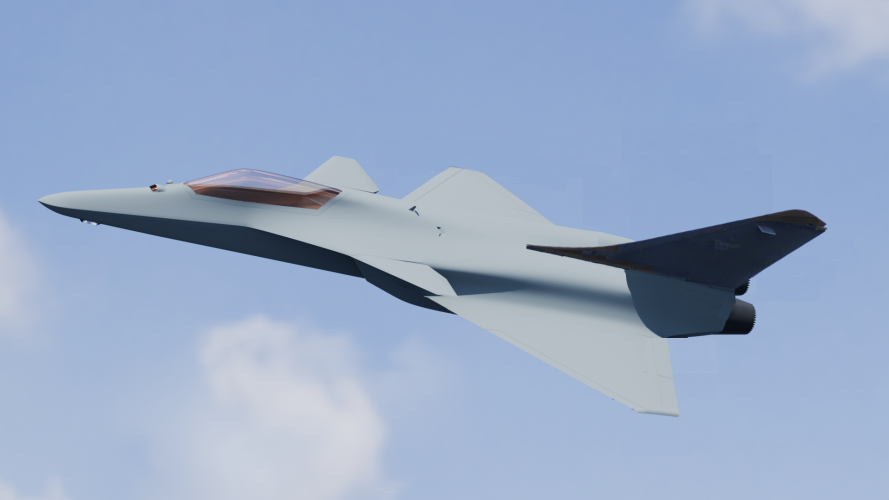
@Geo I think you're advocating for something like this?
This is a mash-up to illustrate a 40% scaled-up stealthy Rafale (i.e. approx. 120% in length and wingspan), which would bring it back to the original Mirage 4000 dimensions. Say ~13.5t empty weight... similar in size to an F-15 or KF-21.
The Mirage 4000 had 2x more internal fuel than a Rafale (9t vs. 4.7t), so there would be room to trade off internal fuel for weapons bays. Add optional CFTs to make up for the fuel capacity needed for long-ranged missions, maybe replace the single tail with a twin tail (or ideally the NGF's YF-23 inspired butterfly tail). Rafale F5 avionics and M88 growth engine (~10 t).
So if the SCAF is to be compact enough to operate from the PANG we could end up with a fighter that is only marginally bigger than the Rafale by my thinking.
@Geo I think you're advocating for something like this?
This is a mash-up to illustrate a 40% scaled-up stealthy Rafale (i.e. approx. 120% in length and wingspan), which would bring it back to the original Mirage 4000 dimensions. Say ~13.5t empty weight... similar in size to an F-15 or KF-21.
The Mirage 4000 had 2x more internal fuel than a Rafale (9t vs. 4.7t), so there would be room to trade off internal fuel for weapons bays. Add optional CFTs to make up for the fuel capacity needed for long-ranged missions, maybe replace the single tail with a twin tail (or ideally the NGF's YF-23 inspired butterfly tail). Rafale F5 avionics and M88 growth engine (~10 t).
In terms of size and weight parameters—yes, essentially. Simply put, larger than the Rafale but smaller than the NGF. If we use a brutally rough calculation, scaling up from 75 kN to 100 kN class gives us a proportional increase in empty weight—about 25% more than the Rafale. But that’s a very crude approximation. The remaining weight characteristics would depend on the aircraft’s overall concept, which would be expected to provide ample internal space for fuel and weapons.
As for the design, I’m nowhere near making any hypothetical proposals—none of them would work, just as none of Dassault’s publicly revealed placeholders will actually work.
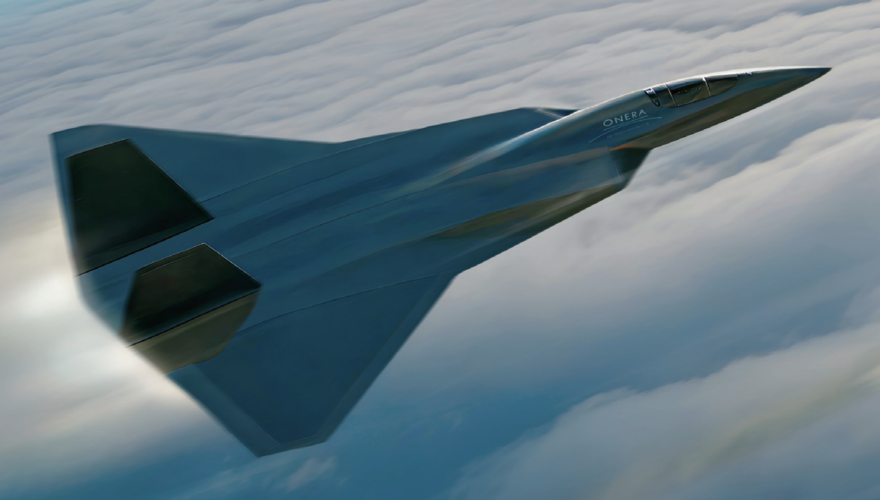
The ONERA studies might offer some useful hints, but the ones that have been made public were likely shared precisely because a different direction is being pursued.
What they do suggest, however, is an innovative approach—one that will almost certainly result in something more interesting than all those boring Raptor lookalikes. (In the end, we can probably be thankful that Taiwan’s Vega project failed—because we’d have a hard time telling it apart from the Boramae…).
The recent MBDA reveals about FC/ASW showed SCAF carrying two missiles (5.5m, ~1300kg) externally, so that gives you a maximum size limit and similar overall payload to Rafale.
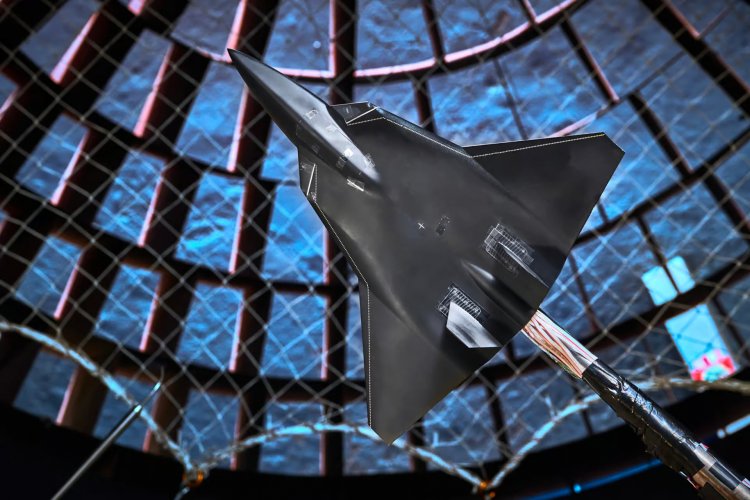
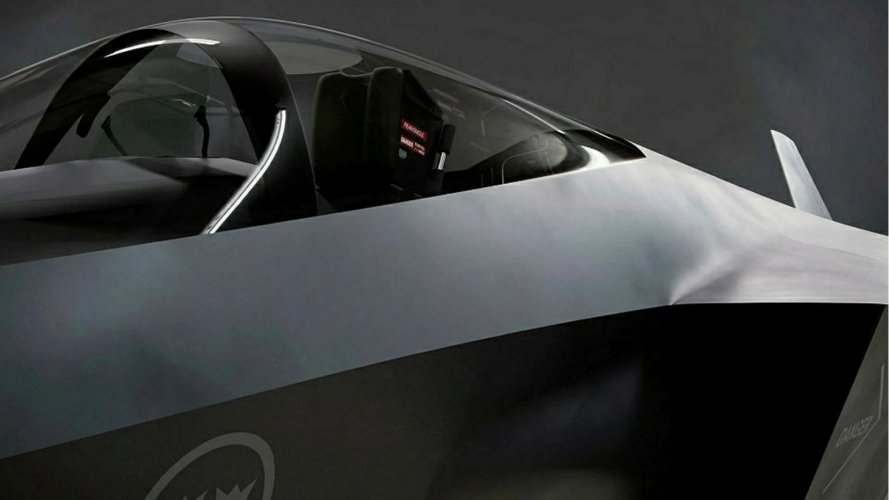
Adding a pic of MBDA's FCAS/NGF model so everyone knows what you're referring to.
IMHO the wings and canard geometry is very rudimentary and detracts from the overall impression... clearly just a placeholder for MBDA to showcase their FC/ASW missile.
IMHO the real FCAS/NGF configuration will either be a triple delta with Levcons (as that is what both DLR and Onera have intensively studied) or a butterfly tail (i.e. ruddervators) as that is what Dassault's NGF mock up showed and it would make a lot of sense from a structural efficiency, stealth and advanced control sense.
The odds of FCAS/NGF having a traditional twin vertical tail with horizontal stabilizers like most other stealth fighters (F-22, F-35KF-21, Kaan, J-35) are close to nil IMHO as that goes against Dassault's design philosophy. A delta canard is possible but would be more 5th gen than 6th gen so possible but also not likely (though perhaps necessary for carrier capability).
Adding a pic of MBDA's FCAS model so everyone knows what you're referring to.
IMHO the wings and canard geometry is very rudimentary and detracts from the overall impression... clearly just a placeholder for MBDA to showcase their FC/ASW missile.
If it's a tailless delta-canard I could see it. Given that Boeing perhaps even ended up with it. But genuine vertical stabilizers? That would not really be the leap in low observable design I'd expect for "next generation" aircraft. And if we look towards China with a tailless delta and a tailless lambda wing, it's not how the trend is going.
Ruddervators seem like a solid middle ground with regards to low observable properties and maneuverability. Perhaps they also help with the carrier related side of things. In that case I expect a striking resemblance to the YF-23, generally speaking.
I could also see the SCAF being a tailless delta canard fighter too EmoBrib. Also regarding verticals I think that they have had their day and it is going to be three dimentional thrust vectoring nozzles from now on.
RCS reduction features on what is basically an ONERA concept from a wind tunnel model (most likely the only one among others that they've chosen to show) would be a bit unnecessary.
IMHO the real FCAS/NGF configuration will either be a triple delta with Levcons (as that is what both DLR and Onera have intensively studied) or a butterfly tail (i.e. ruddervators) as that is what Dassault's NGF mock up showed and it would make a lot of sense from a structural efficiency, stealth and advanced control sense.
The odds of FCAS/NGF having a traditional twin vertical tail with horizontal stabilizers like most other stealth fighters (F-22, F-35KF-21, Kaan, J-35) are close to nil IMHO as that goes against Dassault's design philosophy. A delta canard is possible but would be more 5th gen than 6th gen so possible but also not likely (though perhaps necessary for carrier capability).
IMHO the wings and canard geometry is very rudimentary and detracts from the overall impression... clearly just a placeholder for MBDA to showcase their FC/ASW missile.
IMHO the real FCAS/NGF configuration will either be a triple delta with Levcons (as that is what both DLR and Onera have intensively studied) or a butterfly tail (i.e. ruddervators) as that is what Dassault's NGF mock up showed and it would make a lot of sense from a structural efficiency, stealth and advanced control sense.
The odds of FCAS/NGF having a traditional twin vertical tail with horizontal stabilizers like most other stealth fighters (F-22, F-35KF-21, Kaan, J-35) are close to nil IMHO as that goes against Dassault's design philosophy. A delta canard is possible but would be more 5th gen than 6th gen so possible but also not likely (though perhaps necessary for carrier capability).
The aerodynamic configuration of any aircraft always reflects the requirements embedded in its design.
Unfortunately, media continue to promote a rather formulaic way of thinking—one shaped by a recent past marked by clearly defined contours. Since the set of requirements for multirole combat aircraft of the so-called 4th and 5th generations was relatively straightforward and became visibly embedded in the form of those aircraft, many of us have simply taken it for granted that every “6th generation” fighter must look like something out of a Rodrigo Avella rendering.
While the appearance of previous generations was shaped by the rigid context of the Cold War, today’s world is undergoing an extremely complex transformation—economic, social, technological (think NBICS convergence), and geopolitical. (And to make things even more chaotic, the information explosion—as a side effect of that technological transformation—is relativizing literally everything.)
The spectrum of threats and mission types is expanding endlessly.
So what should a so-called 6th-generation fighter focus on? What defines its aerodynamics?
A requirement for full-aspect stealth?
Cruise speeds beyond Mach 2?
Extended range?
The ability to carry long-range weapons?
Well, somehow all of that together, right? Makes sense.
When it comes to contemporary aerial combat, the 2024 reports from the Ukrainian battlefield are clear: maneuvering combat is obsolete—because the MiG-31BM and its ultra-long-range BVR combo with the R-37M can solve everything.
But hold on—it’s 2025 now, and there are new reports coming from the same battlefield. Old F-16s are striking targets in the Sumy region—covertly and effectively, even though they aren’t stealth aircraft. Russian pilots are being granted greater autonomy, and hostile aircraft are closing in on each other within 6 to 7 kilometers. That’s simply what the situation demands. Dogfighting?
Wait, that’s not how it’s supposed to be! Just give one side or the other the PL-15!
But seriously now: it's likely that only the United States and China can afford to develop those giant flat “manta rays.”
And even then, it’s certainly not because they intend to replace all aircraft with vertical tail surfaces—regardless of which generation they belong to.
Some of the most "fascinating" questions are like:
“I wonder when the Chinese will start replacing their 5th-generation jets with 6th-generation ones.”
When? Maybe never.
The J-36 belongs to an entirely different category, and the Chinese aren’t developing enhanced versions of the J-20 for nothing—they’re not going to replace them in the 2030s or 2040s with “6th-generation fighters.”
Sure, the J-20 can’t act as a "supersonic AEW&C", an invulnerable airborne command center for CCA operations, or a hyper-powerful electronic warfare platform, and it can’t carry a PL-17 or an air-launched anti-ship ballistic missile internally. But it can fully exploit its very capable maneuverability across the entire flight envelope.
Goodness—less than four years passed between the prototype flight of the J-35 and the “J-50”!
So how can anyone seriously talk about replacing the current "5th-gen" mix (J-20 & J-35) with a "6th-gen" mix (J-36, “J-50”, and CCA)?
This too reflects a chronic tendency to oversimplify.
Other countries lucky enough to be able to develop a supersonic combat aircraft at all will have to make more compromises.
So there’s no reason to be disappointed that GCAP, though proudly declared by the British to be a 6th-generation aircraft, looks nothing like Avella’s fantasies.
And now we come to SCAF/NGF.
France—which almost certainly won’t be acquiring the F-35—will have to create an even more versatile (omnirole…) product, while keeping it economically viable.
A tough challenge, but not an impossible one. So let’s not be surprised that “Superman” has vertical tail fins or that it looks “similar to the Felon.”
Want more stealth? Remove the vertical stabilizers.
Want to land even more riskily on an aircraft carrier during a tropical cyclone in the Western Pacific?
Want to compromise your directional stability at speeds above Mach 2.5?
Want to reduce your ability to outmaneuver a surface-to-air missile fired from a concealed Buk system?
No problem—just r e m o v e the vertical fins.
Or maybe… you don’t?
For this reason, it can’t be ruled out that the final design of the SCAF/NGF—if it materializes—will remain relatively conservative. Perhaps it will even resemble the public ONERA studies or the more grounded Airbus (Eric, are you here?) renderings (which, by the way, share quite a few features).
And it's no coincidence that the same can be said for the studies coming out of Saab.
French DGA's explanation in response to the German press reports... in order to meet the service entry target (2040), lessons must be learned from the challenges in Phase 1 and "stronger industrial leadership" is needed (read: by Dassault), with more freedom to make technical decisions and a reworked division of labor rather than arbitrary work shares (read: "best athlete" principle). However FCAS would remain a "program of equals".
France asks FCAS partners to ‘rethink’ work share on fighter project
France proposed to partners Germany and Spain to “rethink” the work share on the Future Combat Air System project in order to stick to a schedule that would see a future fighter enter into service from 2040 onwards, the country’s Directorate General for Armament said.
While the program has made significant progress, including deciding on the shape of the fighter demonstrator, it’s currently encountering difficulties, the DGA told Defense News in an emailed reply to questions. France therefore recently proposed to its partners to redesign their cooperation based on “strengthening industrial leadership,” the armaments agency said.
“France, as the program’s lead nation, is proposing to its government and industrial partners that they draw lessons from the first years of cooperation in order to continue to ensure that the schedule is met and the project is successful,” the DGA said. “The principle and details of this redesigned cooperation are currently being discussed with the partners.”
The program has met four critical milestones, and the current difficulties are “inherent in a program of this scale and ambition,” according to the DGA, which described FCAS as a project of “unprecedented complexity.”
Discussions on revamping the FCAS cooperation don’t call into question the goals and overall balance of the project, which is a “program of equals,” the armaments directorate said. However, the ongoing talks will “lead to a reworking of the division of labor between each industrial player,” the DGA said. “Each player’s share of the work is not a given but will be the result of discussions between the partners.”
FCAS is a key program for European sovereignty in defense, and continuing the program is of strategic interest for France, which is “firmly committed” to the project, according to the DGA.
Some of the most "fascinating" questions are like:
“I wonder when the Chinese will start replacing their 5th-generation jets with 6th-generation ones.”
When? Maybe never.
The J-36 belongs to an entirely different category, and the Chinese aren’t developing enhanced versions of the J-20 for nothing—they’re not going to replace them in the 2030s or 2040s with “6th-generation fighters.”
Sure, the J-20 can’t act as a "supersonic AEW&C", an invulnerable airborne command center for CCA operations, or a hyper-powerful electronic warfare platform, and it can’t carry a PL-17 or an air-launched anti-ship ballistic missile internally. But it can fully exploit its very capable maneuverability across the entire flight envelope.
Goodness—less than four years passed between the prototype flight of the J-35 and the “J-50”!
So how can anyone seriously talk about replacing the current "5th-gen" mix (J-20 & J-35) with a "6th-gen" mix (J-36, “J-50”, and CCA)?
Not to derail the conversation in this thread, but it's probably worth mentioning that aircraft like J-36 and J-XDS will not be anticipated to directly replace J-20s and J-35s -- after all the PLA will have plentiful 4th and 4.5th generation aircraft left to replace even after J-20 and J-35 production ends, and that force would likely be solved by a combination of next generation aircraft and CCAs/UCAVs.
We'll see where this all leads.
And while history may not repeat itself, it doesn't hurt to look at some historical parallels.
The Mirage 2000 was born as a Plan B (after more technologically complex and ambitious projects like the AFVG, Mirage G/G8/G8A…). It was the simplified, pragmatic design that proved not only financially viable in adequate numbers and competitive (even against the bestselling F-16), but also combat-effective when compared with contemporary superfighters such as the F-14, F-15, or Su-27. Needless to say, it employed a number of evolutionary solutions that allowed for efficient cost distribution across the entire program.
The second historical parallel is the Rafale. In the 1980s, it wasn’t intended to be a superfighter—neither over land (compared to the American ATF or Soviet MFI), nor at sea (compared to proposed designs like the NATF or Su-27KM). In terms of size and weight, it actually sat between then-lightweight fighters such as the F-16 and MiG-29. And even though the French were well aware of what a VLO aircraft looked like by the late '80s and early '90s, they continued developing a more conservative design in line with real-world capabilities. In the end, the Rafale became a commercially successful aircraft—one that even today, Erik and the French admiralty wouldn’t hesitate to deploy in future scenarios against sixth-generation aircraft (ehm...).
This isn’t about France building another F-35 or Kaan.
The point is whether it makes sense to focus—at all costs—on complicated international cooperation aimed at developing a 35-ton “monster” (incidentally, compared to the J-36, any twin-engine aircraft will seem like a pygmy unless it's powered by a pair of NK-32s…), or whether it might be wiser to concentrate on an “Omnirole Fighter NG.”
Such an aircraft can still be highly innovative (something the French are quite capable of) and meet the basic criteria of a so-called sixth-generation fighter—while keeping development and lifecycle costs significantly lower than the current NGF concept. I mentioned the KF-21’s weight class deliberately, as a design of that scale could initially use future versions of the M88 engine—saving significant time and cost on the development of a VCE, which could be integrated later.
The result could be a capable, forward-looking fighter—compact enough to operate from the PANG as well.
French DGA's explanation in response to the German press reports... in order to meet the service entry target (2040), lessons must be learned from the challenges in Phase 1 and "stronger industrial leadership" is needed (read: by Dassault), with more freedom to make technical decisions and a reworked division of labor rather than arbitrary work shares (read: "best athlete" principle). However FCAS would remain a "program of equals".
.
So, again France wants all the workshare and design control - Germany is supposed to shut up, pay France a large share of the development and production costs, and settle for whatever France designs & builds.
Just like nearly every multi-national project France has been involved in the last 65 years.
This site uses cookies to help personalise content, tailor your experience and to keep you logged in if you register.
By continuing to use this site, you are consenting to our use of cookies.