When comparing FCAS Vs GCAP planned entries into service, do not forget the Japan factor. Japanese have been running a 5th Gen fighter program well before UK or France were teaming on the FCAS as it was known then.
Japan initially found positive inputs teaming with the UK industry that had a long reliable history developing 5th gen systems (and then with Italy).
That's why GCAP is planned to come earlier, unless something get wrong on the way.

Then, having talks around 2035 or 2045 just like if we were discussing interstellar events is plainly... Ridiculous. There are 10 YEARS b/w the two, with probably a large conflict happening during that interval of time that will see aviation modernizes drastically.

FCAS can not be compared to GCAP. If that is the plan, it's a failed one, inherently.

You can see trace of this understanding in the late French military planning speaking of Very High Altitude being dominant.*
[I used the term Hyperstealth (stealth + hypersonic) long ago but it might even only induce flying counter space mission where stealth is not a factor (since orbital assets have to fly... Orbits (at lest partially), you can probably choose often enough favorable airspace where to engage them outside of an enemy IADS).]

So the question remains: why does FCAS have to be extended that far into the fog of future wars?
Inherently that erases the clarity of the message being sent to our allies... But also toward our opponents.

*FCAS is neither advertised or known to be developed for such, even being contradictory with that.
 
Last edited:
FCAS can not be compared to GCAP. If that is the plan, it's failed one, inherently.
I'm starting to see FCAS versus GCAP as FAXX versus NGAD.

GCAP and NGAD are interceptors/fighters. FCAS and FAXX are strike planes that can shoot down other aircraft.

France needs a Rafale replacement, which means a carrier compatible striker.

Germany doesn't need a striker so much with their F-35s, so may be pushing their requirements more towards a fighter.
 
I think Spain is an interesting partner if only because of their air force past and present combat jet inventory. Also they are resisting F-35 so far despite their Harriers.
 
Lets
I'm starting to see FCAS versus GCAP as FAXX versus NGAD.
Yeah but there willing to go more risky (for example variable cycle engine) Wish could explain there longer timeline wish is planed with considerations for expected hardships.
GCAP and NGAD are interceptors/fighters. FCAS and FAXX are strike planes that can shoot down other aircraft.
I don't think that in germany there is a larger need for fighter compared to before while even when FCAS comes atleast 40 Eurofighter will still be there and assuming that FCAS will be similiar to Rafale compared to eurofighter then almost nothing on performance is gone. My guess would be increased interrest for larger payloads which are very hard to achieve with FCAS when you have to balance everything. But maybe some form of CFT solution could be designed? One would have to do it from the get go but an CFT equipped non navy fighter (like F-18L) could achieve similiar weights with either more fuel, weapons or both.
France needs a Rafale replacement, which means a carrier compatible striker.
Germany doesn't need a striker so much with their F-35s, so may be pushing their requirements more towards a fighter.
The strike armament for F-35 are very small with only some cruise missiles and bombs being an option for now. We also gotta assume that allways a part of the fleet needs to be in an ready state for a possible strike which reduces the total strike fleet even more.
 
Last edited:
Another way of putting it: Germany will soon have stealth, 5-gen fighter in the shape of F-35. Spain and France: not so much, they are presently stuck with Typhoon and Rafale. So it is not the same degree of emergency (which brings an interesting question: with France near-term plan being Rafale F5 + Neuron CCA, could Spain be a partner in the said CCA, to help their not-stealth Typhoons ?)

In the end it boils down to : Rafale F5 + CCA versus SCAF, which one is the correct mid-term strategic choice ?

This link provides an honest pros-and-cons.
https://www-opex360-com.translate.g...rancaise/?_x_tr_sl=fr&_x_tr_tl=en&_x_tr_hl=fr

Sticky point: Rafale F5 while not stealth will have some tricks under its sleeve, see below.

That being said, this "sensor" issue is intriguing. While an aircraft like the F-35 may be "invisible" to some detection means [this is a priori not the case for passive radars and it depends on the frequency bands used], its infrared signature – with its F-135 engine – can betray it. The IR channel of the Rafale's Front Sector Optronics [OSF] would be able to detect it head-on, subject, however, to weather conditions.

Incidentally, the Rafale will soon be equipped with an improved OSF, the General Directorate of Armaments having recently carried out tests on a new optic on the infrared channel of the OSF, this being supposed to improve the "image quality of the Night Identification function".

This development will be accompanied by the integration of Link 16 block 2, the CONTACT software digital radio, as well as the TRAGEDAC systems [which will give the Rafale a passive target location capability through networking of aircraft in the same patrol, editor's note] and CAPOEIRA [for improved connectivity for Rafale developments]. What's more, the development of an anti-radar missile is also underway, as part of the major impact program "Future Air-Surface Armament", which "meets the need for a capability to neutralize short and medium-range surface-to-air threats, an essential prerequisite for the Rafale's first entry capability".

It remains to be seen whether this little bag of tricks plus a fully stealth CCA sidekick drone will be enough to wait until SCAF, into the 2030's.
That's the 800 pound gorilla question.

I want to insist on two important points:

First, Rafale while not 5-gen full stealth and having flown in the late 1980's / early 1990's, still has a lot of growth potential: as shown by the F5 standard.

Second point: Dassault and the Armée de l'Air have a plan, and I think they can be reasonably trusted.
1- Rafale F5 smart tricks against stealth planes
2- The stealth CCA drone sidekick
3- SCAF, with or without Germany, plus Spain.

 
Last edited:
Why bash Dassault
"The French company weighs for only a third in decision making, with Airbus having two-thirds of the vote on behalf of Germany and Spain, Trappier said. That means the lead company on the NGF can’t divvy up the work as it sees fit, the CEO complained."

That's why. It's the same story as when France was part of Eurofighter, Dassault wanted, and now wants, complete dominance on decision making, even where the decision making is properly a political decision. The other partners won't forget that, so why is Trappier demanding complete control? From where I sit it reads as a deliberate attempt to alienate the other partners into quitting the programme so SCAF becomes a Dassault only aircraft, it'll cost them the German and Spanish buys, but he clearly thinks 100% of the French pie, + 100% of export sales, will more than make up for that.
 
Another way of putting it: Germany will soon have stealth, 5-gen fighter in the shape of F-35. Spain and France: not so much, they are presently stuck with Typhoon and Rafale. So it is not the same degree of emergency.

Which brings an interesting question: with France near-term plan being Rafale F5 + Neuron CCA, could Spain be a partner in the said CCA, to help their not-stealth Typhoons ?
Did they say there was a partner? Because i don't think they actualy have any real needs for an stealth fighter anytime soon but this may change with the upcoming possible SU-57s. That said with there TR-4(+) and assuming they upgrade TR-3A at similiar speed to P4E all of them get mutch more strike capabilitys (when they buy them).
In the end it boils down to : Rafale F5 + CCA versus SCAF, which one is the correct mid-term strategic choice ?

This link provides an honest pros-and-cons.
https://www-opex360-com.translate.g...rancaise/?_x_tr_sl=fr&_x_tr_tl=en&_x_tr_hl=fr

Sticky point: Rafale F5 while not stealth will have some tricks under its sleeve, see below.


It remains to be seen whether this little bag of tricks plus a fully stealth CCA sidekick drone will be enough to wait until SCAF, into the 2030's. That's the 800 pound gorilla question.
Even if its not enough can the 3 (maybe 4) get enough money to accelerate the development?
 
Second point: Dassault and the Armée de l'Air have a plan, and I think they can be reasonably trusted.
It's one argument, but France also has few other near term options unless they buy F-35 (unlikely being an understatement). Sweden is also in a similar position.

It'll be interesting to see how the global market for "CCA" actually turns out. They still cost money and effort.
 
It's one argument, but France also has few other near term options unless they buy F-35 (unlikely being an understatement). Sweden is also in a similar position.

It'll be interesting to see how the global market for "CCA" actually turns out. They still cost money and effort.
Yeah future CCA or in general more UCAV families could be really potent on the market but its also just as dangerous to share
 
Another way of putting it: Germany will soon have stealth, 5-gen fighter in the shape of F-35. Spain and France: not so much, they are presently stuck with Typhoon and Rafale. So it is not the same degree of emergency (which brings an interesting question: with France near-term plan being Rafale F5 + Neuron CCA, could Spain be a partner in the said CCA, to help their not-stealth Typhoons ?)

In the end it boils down to : Rafale F5 + CCA versus SCAF, which one is the correct mid-term strategic choice ?

This link provides an honest pros-and-cons.
https://www-opex360-com.translate.g...rancaise/?_x_tr_sl=fr&_x_tr_tl=en&_x_tr_hl=fr

Sticky point: Rafale F5 while not stealth will have some tricks under its sleeve, see below.


It remains to be seen whether this little bag of tricks plus a fully stealth CCA sidekick drone will be enough to wait until SCAF, into the 2030's.
That's the 800 pound gorilla question.

I want to insist on two important points:

First, Rafale while not 5-gen full stealth and having flown in the late 1980's / early 1990's, still has a lot of growth potential: as shown by the F5 standard.

Second point: Dassault and the Armée de l'Air have a plan, and I think they can be reasonably trusted.
1- Rafale F5 smart tricks against stealth planes
2- The stealth CCA drone sidekick
3- SCAF, with or without Germany, plus Spain.
Yet another way to put it: Germany is stuck in buying "5-gen" in the shape of F-35 just to carry these US B-61 nukes, hoping that pleases the US enough to keep these bombs there. Spain and France: not so much, they are presently using Typhoon and Rafale which still have development potential...

And if you think of what they could be facing, say in 10 years, I don't see Ru AF fielding 80 - 100 Su-57 (which we can even question the operational value, they are not even used in the current war) in that time scale given Russian economy now and even after that war.

Completely agree with the other points. Moreover again, with the fast progress in IA and drones nowadays, true unmanned A/A and A/G combat drones could become much more feasible than pouring billions in "6-gen" Stealth Macross super fighters everyone is dreaming of, just to be able to field a squadron of 12.
In Ukraine, cheap slow drones are already doing to work of cruise missiles to struck Ru refineries/airfields, kamikaze drones are used successfully to stop Ru advances in place of artillery on some parts of the front. Drones are regularly shot doing by other drones too... Things are changing .
 
Last edited:
Very specific (if not desperate) circumstances: by 1987 Crusaders were falling appart with severe attrition; they would not last into the 1990's; while Rafale M was hoped for 1996, best case except it was 2001 in the end.
So the Aéronavale requested 15 second-hand Hornets but Dassault and President Mitterrand blew a fuse and F-8P upgrade happened instead. It was very ugly political manoeuvering.

More generally, France has no problem buying american rather than re-inventing the wheel, see the E-3 AWACS and the Hawkeyes. But indigenous fighter is considering a core strategic capability so no compromise there. Last truly foreign combat jets were NATO / MAP F-100 Super Sabres, retired from Djibouti in 1977.
 
Yep, but if it isn't replacing all the fleet?
Just a supplementary 1st day of war force, say 24 a/c + spares.

Rafale tries to be everything, but isn't possible to make one aircraft perform all tricks at world level for half a century. Sport careers are shorter for a reason.
 
Another way of putting it: Germany will soon have stealth, 5-gen fighter in the shape of F-35. Spain and France: not so much, they are presently stuck with Typhoon and Rafale. So it is not the same degree of emergency (which brings an interesting question: with France near-term plan being Rafale F5 + Neuron CCA, could Spain be a partner in the said CCA, to help their not-stealth Typhoons ?)

In the end it boils down to : Rafale F5 + CCA versus SCAF, which one is the correct mid-term strategic choice ?

This link provides an honest pros-and-cons.
https://www-opex360-com.translate.g...rancaise/?_x_tr_sl=fr&_x_tr_tl=en&_x_tr_hl=fr

Sticky point: Rafale F5 while not stealth will have some tricks under its sleeve, see below.


It remains to be seen whether this little bag of tricks plus a fully stealth CCA sidekick drone will be enough to wait until SCAF, into the 2030's.
That's the 800 pound gorilla question.

I want to insist on two important points:

First, Rafale while not 5-gen full stealth and having flown in the late 1980's / early 1990's, still has a lot of growth potential: as shown by the F5 standard.

Second point: Dassault and the Armée de l'Air have a plan, and I think they can be reasonably trusted.
1- Rafale F5 smart tricks against stealth planes
2- The stealth CCA drone sidekick
3- SCAF, with or without Germany, plus Spain.

Many non-stealth jets have still a lot of growth potential, otherwise the likes of the Eurofighter, Rafale, Su-35, F-15 or F-16 wouldn't see consistent or planned upgrades right now or in the near future. However it is also undeniable that the modern state of warfare is incredibly hostile to such aircraft. ECM and IRSTs are nice, but stealth opens up a whole new dimension to combat aviation. And in my eyes it would be questionable to invest into a legacy airframe instead of a modern stealth aircraft. Ideally you have a top of the line stealth fighter that can operate in contested environments and a modernized legacy airframe that can support and supplement it.

So it's less about Rafale F5 over FCAS and more so about what should come first really, the Rafale upgrades or the stealth fighter. If France wants to remain competitive on the global stage they will need one regardless. That's either coupled to FCAS succeeding or giving up and either developing a stealth fighter on the basis of the Rafale in an (unlikely) attempt to reduce cost (it would still be virtually a new aircraft altogether) or buying a foreign model. And given the sorry state of Franco-Chinese and Franco-Russia relationships that immediately excludes the J-35, Su-57E and Su-75E. Only options left would be the F-35A/C, the KAAN and the later blocks of the KF-21. And how likely any of these are is written in the stars.

(On a different note, can we stop pretending like IRST is the end-all-be-all stealth counter? That stuff is being said since the F-22 arrived)
 
Yeah future CCA or in general more UCAV families could be really potent on the market but its also just as dangerous to share
Not only that, truly potent CCAs won't be cheap at all. Perhaps cheaper than full on stealth fighter, but they will still cost tens of millions. Definitely not expendable. And if we really mean collaborative combat aircraft, you also need to operate aircraft, be it fighters, fighter bombers or AEW&C type aircraft, that are able to operate with CCAs, probably through specialized upgrade systems sold with the CCAs.

It's a promising market, but I think it's a market that also is only available to nations which can afford to spend the necessary money.
 
You don't need stealth to combat other fighters, surely it helps but that's not the main reason as most countries operate majority non-stealth fleets anyway.

You need stealth aircraft to operate over an area despite the presence of modern GBAD networks and conduct SEAD/DEAD. The alternative is doing that with Ballistic Missiles, as been proven for 3 years now, but that costs significantly more than dropping/launching cheaper munitions from your stealth fighter.

That's where the current need for stealth fighters come from, it was also a force behind the development of the JSF, the proliferation of advanced and semi advanced AD.

And dedicated aircraft to escort SEAD sorties with electronic countermeasures like the E/A-18G or J-16D are also costly. While something like an F-35A rolls stealth, potent ECM capabilities and strike performance into a single airframe.

And if we look at the last decades, we simply see that fighters are more often than not used to engage targets on the ground, rather than in the air.

https://www-opex360-com.translate.g...rancaise/?_x_tr_sl=fr&_x_tr_tl=en&_x_tr_hl=fr

What's more, the development of an anti-radar missile is also underway, as part of the major impact program "Future Air-Surface Armament", which "meets the need for a capability to neutralize short and medium-range surface-to-air threats, an essential prerequisite for the Rafale's first entry capability".

 
Rumor is the French may drop out of the program.

Not a surprise really, at least to me.

The French has demonstrated time and time again the ability to design very competant, modern, military aircraft.

What they need is money, not necessarily engineering and project management support.

These multi-nation efforts sometimes collapse under the weight of convoluted decision-making and competing national interests.

I hope it all turns out well but I think it's an uphill climb.
 
So let's sum this up:

First you agree with me that stealth is a decisive advantage, but you weirdly frame it like you disagree.
Yes it is a advantage but you make it should like there is nothing else that matters anymore. Doesn't matter how we turn those arguments we and at both ends...
> Money can only do so mutch and testing takes time.

Money is what moves these sort of programs forward, money and people.
And money is a "fixed" asset with limit budgets and everyone needing more money for everything else. Putting everything on 1 project and then rushing it trought while only throwing money at it seems like a risky plan.
Which brings us back to the initial point of dassault slowing everything down when Germany wants to speed development up, DESPITE having ordered F-35As to replace the Tornado.
Dassault wants more power because airbus (being prime for germany and spain) has mutch more leverage (similiar situation in MGCS with KMW and Rheinmetall being both german). Does Rafale have big ties with the french goverment? 100% but so does airbus with the german (that said probaly not as strong) and developing an UCAV / Loyal Wingmann outside of FCAS/SCAF isn't against the decided work either but i can understand Airbus frustrations. Also as one can see F-35 as only a partial Tornado replacement (around half the fleet) with limit A2G armament and focused around the nuclear role. As far as i know they don't even have AARGM integreated into the external harpoints so they can only do a more passive Jammer role for SEAD/DEAD.
> They don't need to

So you think France, a nuclear power, a regional power in the mediterranen and North Africa, which involvements in Africa as a whole, doesn't need to be competitive in a world where potent AD systems become more and more common. Got it.
Okay lets splitt those arguments first. First of all most of those nations are hardly operating even cold war GBAD systems as they mostly are fighting warlords, terrorists, each other or themselfs. The few that actualy have something modern are actualy close to france so a conflict is very unlikely.
Did the French MoD also get that memo though?
I think they know very well where there threats are now and probaly tomorrow which is WHY they know what they need and are developing a stealthy UCAV/ Loyal Wingmann for Rafale F5 and later FCAS/SCAF. But let me rephrase that as they don't need to anytime soon. Better?

Anyway as we all can't change anything here we may aswell agree to disagree and wait for whats to happen.
 
Last edited:
Yeah but there willing to go more risky (for example variable cycle engine) Wish could explain there longer timeline wish is planed with considerations for expected hardships.
I'm honestly expecting the FAXX-B model to get adaptive engines. The Navy needed to cut the total development time short, so they're gambling like they did with the Tomcats. Buying the first batch with an F110 derivative that is probably mostly done already, then the "real" version of the fighter gets the A102/103 from the F-47.

But that's for the FAXX discussion thread. [/off topic]

My comparison was really about the two very different primary missions the two planes were designed for. How the F-47 is designed as a fighter first and foremost, while FAXX is designed as a striker that can shoot down airplanes. It's honestly unclear if the F-47 has a single pound for air to ground.


I don't think that in germany there is a larger need for fighter compared to before while even when FCAS comes atleast 40 Eurofighter will still be there and assuming that FCAS will be similiar to Rafale compared to eurofighter then almost nothing on performance is gone. My guess would be increased interrest for larger payloads which are very hard to achieve with FCAS when you have to balance everything. But maybe some form of CFT solution could be designed? One would have to do it from the get go but an CFT equipped non navy fighter (like F-18L) could achieve similiar weights with either more fuel, weapons or both.
How long do you think 40 Eurofighters will last in combat?

IF Germany wants a plane with larger weapons bays than the F-35, then yes FCAS would be the logical option.

But I'm still seeing Germany as wanting a stealthy replacement for their Typhoons, not a bigger F-35.


The strike armament for F-35 are very small with only some cruise missiles and bombs being an option for now. We also gotta assume that allways a part of the fleet needs to be in an ready state for a possible strike which reduces the total strike fleet even more.
F-35 is a stealthy A-7 that can go supersonic. It's a striker, not a particularly good dogfighter. It's only got 2x AAMs if it's doing a ground-attack mission, and IIRC the AIM260 was supposed to have an anti-radar mode to it as well.

It can carry AARGMs, it can carry bunker buster bombs, it can carry 8x SDBs if we're playing that game. It can also carry AGM-154 JSOW glide bombs if you need to.
 
I'm honestly expecting the FAXX-B model to get adaptive engines. The Navy needed to cut the total development time short, so they're gambling like they did with the Tomcats. Buying the first batch with an F110 derivative that is probably mostly done already, then the "real" version of the fighter gets the A102/103 from the F-47.

But that's for the FAXX discussion thread. [/off topic]

My comparison was really about the two very different primary missions the two planes were designed for. How the F-47 is designed as a fighter first and foremost, while FAXX is designed as a striker that can shoot down airplanes. It's honestly unclear if the F-47 has a single pound for air to ground.
And i assume that FCAS will be similiar to FAXX which atleast until now has shown to be just as good in most situations.
How long do you think 40 Eurofighters will last in combat?
Thats a good question but at the same time we could ask at which timepoint do they attack? How many eurofighter could be put in service again or how does SCAF far in air to air combat.
IF Germany wants a plane with larger weapons bays than the F-35, then yes FCAS would be the logical option.

But I'm still seeing Germany as wanting a stealthy replacement for their Typhoons, not a bigger F-35.
In the end the goal (as far as they said) is too replace everything with FCAS in the end (but considering the advent of of drones its a bit questionable).
F-35 is a stealthy A-7 that can go supersonic. It's a striker, not a particularly good dogfighter. It's only got 2x AAMs if it's doing a ground-attack mission, and IIRC the AIM260 was supposed to have an anti-radar mode to it as well.
It can carry AARGMs, it can carry bunker buster bombs, it can carry 8x SDBs if we're playing that game. It can also carry AGM-154 JSOW glide bombs if you need to.
I havent seen a single F-35 flying with AARGM so far which means any ground munition the Luftwaffe has for F-35 are 75 JASSM, ~420 JADMs (multiple sizes) and 344 SDBs outside of what the BW has in stock (mostly bombs). Even without maybe up too 20 of them in a ready stance, thoses F-35 wont be mutch as sole strike package next too TR4 (mostly). So germany has as mutch interest in strike as specific fighter design. Like i say with Rafale being a better strike solution than eurofighter even if we count in germanys f-35 they both have large needs of a strike and superiority fighter.

Outside of that one could use it as reference model to compare FCAS/SCAF with the capabilitys of most Nato fighters.
 
Last edited:
Just to be clear i do think that at the beginning the Luftwaffe wanted a F-22 like plane with F-35 electronics which is something we see in the DLR-FFD studies. For france this probaly wasn't a problem as any large payload munition against most african nation or other didn't even need to be internal. But even then they probaly came too the conclusion that any large payload could allways be outsized to a UCAV. That said the lastet geopolitical developments have shown that any nation needs to have A2A and A2G capabilitys which the existing loadout is well (taking the DLR-FFD as example configuration) inadequate i think. I mean they designed it with 2 SRAAM, 2 MRAAM and 4 1000 Ibs bomb. Better than F-22 but is that enough?

Thread too DLR-FFD:

Sidenote: looking at it those bays aren't that small. The big bay seems to be around 6m long and have a with of around ~1m. This is them supported by 2 smaller bays over 6.6m long (assuming 1 Iris-T and 1 meteor).
 
Last edited:
That said the lastet geopolitical developments have shown that any nation needs to have A2A and A2G capabilitys which the existing loadout is well (taking the DLR-FFD as example configuration) inadequate i think. I mean they designed it with 2 SRAAM, 2 MRAAM and 4 1000 Ibs bomb. Better than F-22 but is that enough?

Thread too DLR-FFD:
I believe that the F-22 can carry that same load, as a 1000lb bomb is the same box volume as an AMRAAM. So IIRC the F-22 can carry 4x 1000lb, 2x MRAAM, and 2x SRAAM. It's just that we usually see it with 2x SDBs per spot instead.
 
It also helps that UK and Japan had very similar requirements already (very long range CAP), so the required compromise in requirements is "whose range do we pick?" I suspect that both agreed, without seeing the numbers, that the longer range between the two requirements was more desirable.
Adding: I suspect that Italy's requirements were more for long-range strike than long-range CAP.
 
I believe that the F-22 can carry that same load, as a 1000lb bomb is the same box volume as an AMRAAM. So IIRC the F-22 can carry 4x 1000lb, 2x MRAAM, and 2x SRAAM. It's just that we usually see it with 2x SDBs per spot instead.
You mean two 1k class? Because ol Raptor only have 4 hardpoints in the ventral bay and the side ones can only accomodate SRAAMs.
 
Moritz was also at pains to explain that the British-Italian-Japanese Global Combat Air Program (GCAP) formerly known as Tempest, is not comparable to the SCAF because it involves only the development of the next-generation combat aircraft. It is not a system of systems as the SCAF is.

That strikes me as mistaken or a bit disingenuous as GCAP is meant to operate as a system of systems. Practically every new combat aircraft design is.

While obviously we don't have final designs for either, judging by the renders and models we have seen, GCAP seems to be a monster compared to SCAF. The latter will be expected to operate from French carrier(s) while GCAP will not - but it may have greater range and payload, requiring a larger aircraft.
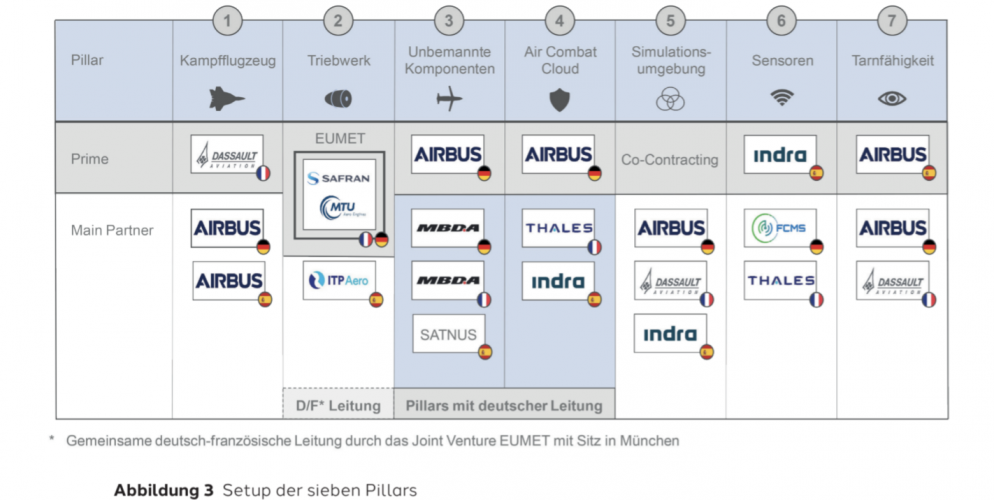
You got the nuance wrong I think. What Moritz pointed out is that SCAF is a programme where the entirety of the SoS, which is SCAF itself, being managed as a multi-national joint programme. Hence the seven core pillars and the three most important cores, the NGWS.

GCAP is not that. GCAP only corresponds to 4~5 pillars of SCAF, that being the core fighter, the engine, stealth technology, sensors and networking suite and partially the simulation. Remote carrier equivalent drones are not part of the GIGO arrangement, nor the combat cloud equivalent SoS networking scheme. The underlying hardwares like the radio systems and terminals for the combat air cloud will be joint-developed, but the waveform and other infrastrucutre enabling SoS cloud service is up to Britain and Japan, separately.

Now the question obviously is if NGWS could continue as is, since the remote carrier component has continuously came under fire from both France (Dassault's own wingman drone) and Germany (Anglo-German drone agreed upon Trinity House Agreement) when it comes to the Recoverable Remote Carrier component.

Their development is being conducted along two lines: large and costly recoverable remote carriers (RRCs), for which Airbus serves as the prime contractor, and expendable remote carriers (ERCs).

MBDA leads the development for the latter and is working toward the first flight of a technology demonstrator in 2029 as part of the FCAS Phase 2.
For now, only ERC seems to be safe.

NGWS workshare onky works because France took NGF, while Germany is responsible for the RRC, ERC and the Combat Cloud. If anything, diverting French commitments for RRC to Dassault's own project (linked to Rafale F5) outside of FCAS will make it much harder for them to fend off German demands, which is perhaps the reason Eric Trappier is constantly bitching about Airbus.
 

Attachments

  • Screenshot_20250603-040740.png
    Screenshot_20250603-040740.png
    328.9 KB · Views: 58
  • screen-shot-2020-12-09-at-11-21-50-am.png
    screen-shot-2020-12-09-at-11-21-50-am.png
    35 KB · Views: 62
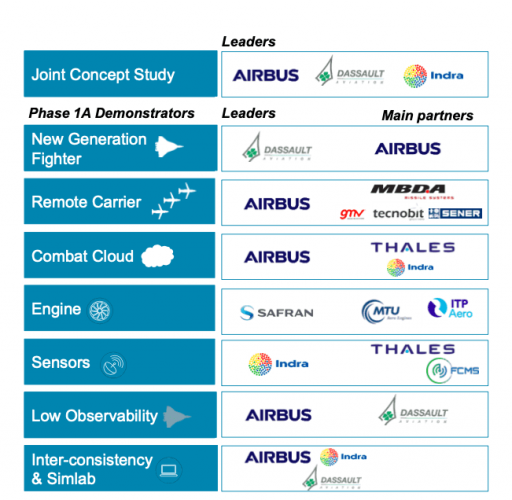
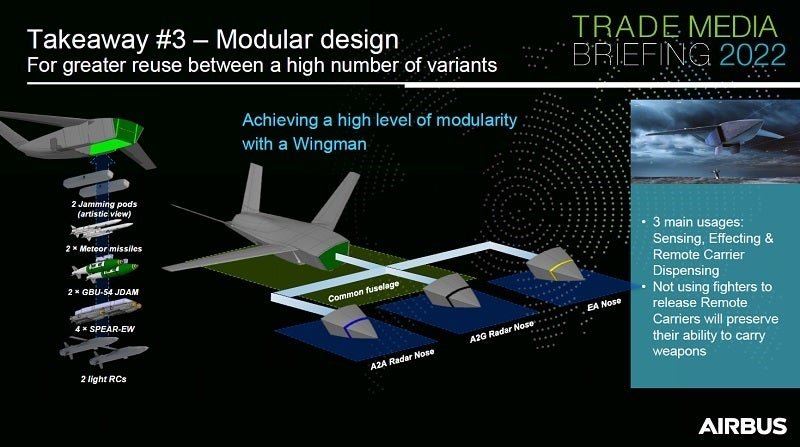
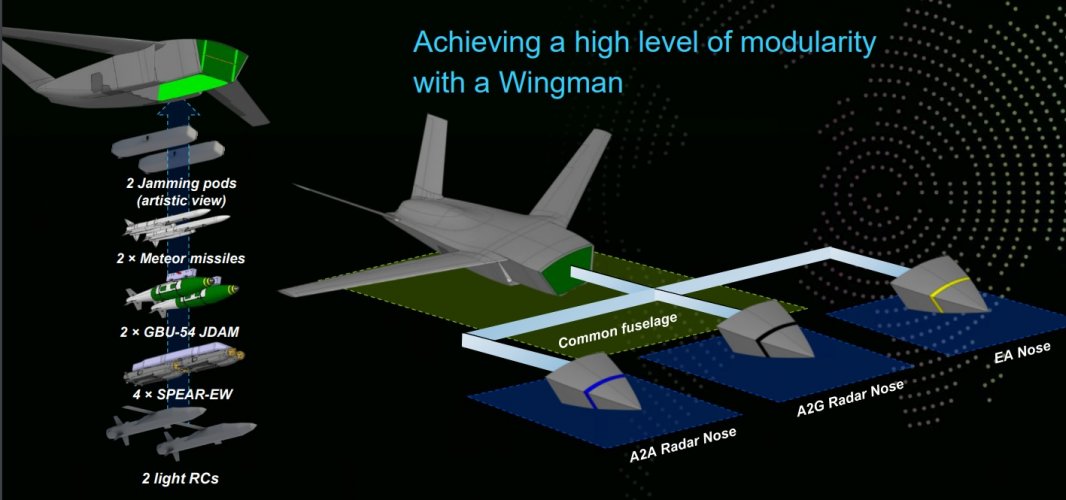
Also noticed that these were never shared here. From 2022. It does seem like earlier Remote Carrier was somewhere in the grey zone between the current RRC (actual wingman drone with separate ordnance as payloads) and ERC (modular payload, air vehicle itself could also dub as ordnance) distinction.
 

Attachments

  • HRC-concept.jpg
    HRC-concept.jpg
    70.2 KB · Views: 76
  • Remote-Carrier-Airbus.jpg
    Remote-Carrier-Airbus.jpg
    173.5 KB · Views: 73
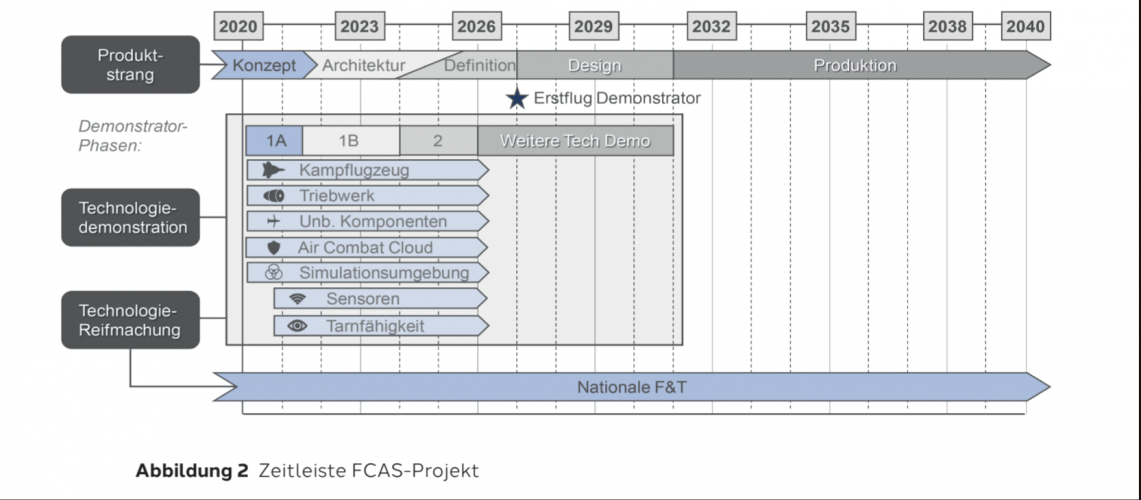
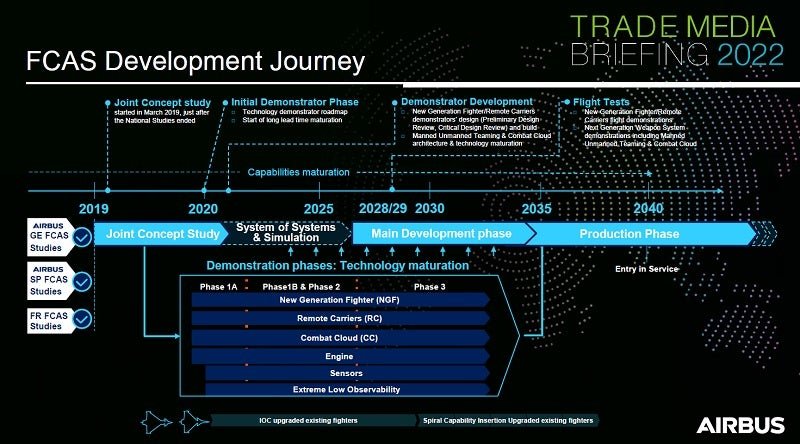
Also from 2021 (BDLI document) and 2022 (Airbus media brief, I think in ILA?), overall project timeline for SCAF. Distinction for Demonstration Phase 1A, 1B, 2 and 3 are quite easy to understand.

Note that the workshare and IP disagreements have delayed PH1B by one and a half years, PH2 will commence two and a half years later than originally anticipated, and maiden flight of the demonstrator is also delayed by at least two years.
 

Attachments

  • Screenshot_20250603-040704.png
    Screenshot_20250603-040704.png
    263.2 KB · Views: 57
  • FCAS-dvp.jpg
    FCAS-dvp.jpg
    87.3 KB · Views: 48
Last edited:
Long Q&A interview with Dassault CEO Eric Trappier, with a few NGF updates:
  • First flight of the NGF demonstrator in 2029-30.
  • "We have already finalized the design, tested the shape in the wind tunnel, now we have to manufacture the aircraft". However, "the reality is that we have an organization that isn't optimal for making an ambitious demonstrator"
  • "Most of the parts are Rafale parts" including the M88 engine, "because Eurofighter does not want to give us these parts"
  • NGF will weigh "33 or 34 tonnes"
https://www.challenges.fr/entrepris...nois-les-verites-du-patron-de-dassault_605879

The SCAF (Future Combat Air System) program, which involves the development of a new Franco-German-Spanish fighter (NGF, for New Generation Fighter), appears to be motivating governments and manufacturers less and less. Could it explode in flight?

I think that states are realizing what we were able to explain to them at one time. Some told them: "There's no problem, it's just Dassault that's bothering us, it'll be sorted out." The reality is that we have an organization that isn't optimal for making an ambitious demonstrator . There are three of us around the table [Dassault, Airbus Germany, Airbus Spain], we have the same rights. It's total equality, it's a large federation, but that's not how you set up an effective program. When the United States launches the F-47, they don't say: "Half for Lockheed, half for Boeing." They say: "It's Boeing, and you sort it out yourselves." And then there's only one decision-maker: the US Department of Defense.

What should be done?

What we're asking for is to be the true project leader. A project leader in the construction industry, has the choice of his subcontractors. We don't have that: with the principle of "fair return," each state wants the noblest share of the work, and a burden equal, to the millimeter, to that of the others. When I say that, everyone agrees, but we don't draw any conclusions from it.

When could the NGF demonstrator fly?

If we stick to the initial goal of launching the manufacturing phase next year (phase 2), we can fly the aircraft in 2029-2030. We have already finalized the design, tested the shape in the wind tunnel, now we have to manufacture the aircraft. It is feasible before 2030 because, for the engine, we take an M88 that we adapt. Most of the parts are Rafale parts, because Eurofighter does not want to give us these parts , for fear that we will copy them. It is well known that Dassault needs Eurofighter technologies to make aircraft (laughs)!

When could the NGF enter service, given the current pace of development? If you want Eric Trappier, the optimist, my answer is 2045.

And that of Eric Trappier, the pessimist? 2045 also…

Can't we really go any faster?

I hear some very incompetent people say that we should do it by 2035. That seems impossible to me. To make an airplane fly, you need an engine. If these people come up with a non-American engine before 2030, capable of powering an airplane that weighs 33 or 34 tonnes, then we can try. On the other hand, to carry out such a program, you need a lot of money. We saw with the Rafale that budgets could be reduced or postponed. There were 20 years between the flight of the Rafale A demonstrator and the entry into service of the airplane.

Is there a plan B for FCAS/SCAF?

No, there is no long-term Plan B. There is a Plan B for 2035, with the Rafale F5 and its stealth combat drone, which will allow us to wait for the future combat aircraft. But we can't wait forever: after the Rafale F5 and the UCAV, we'll have to follow up with an NGF.
 
Last edited:
Is he talking Empty weight or MGTOW? Was that in lb or kg?
That seems like a lot for a fighter a/c.
 
Actually, Snecma and Turkish TEI could be a decent fit together, if there are no egos involded. Plus Spanish ITP and German MTU, which did 13 and 33 percent of ej200 development.

Between them they should have the market size, money and know how to develop an upsized, modernized m88 with a 9:1 power weight ratio, enough for both ngf and Kaan.
 
Is he talking Empty weight or MGTOW? Was that in lb or kg?
That seems like a lot for a fighter a/c.
Tons and should be MTOW. Kaan MTOW is 34-35 tons with F110.

Actually, Snecma and Turkish TEI could be a decent fit together, if there are no egos involded. Plus Spanish ITP and German MTU, which did 13 and 33 percent of ej200 development.

Between them they should have the market size, money and know how to develop an upsized, modernized m88 with a 9:1 power weight ratio, enough for both ngf and Kaan.
Seeing how things have evolved between EU and Turkiye, (Leonardo-Baykar, Hurjet for Spain), the French might very well swallow their pride and eventually will have a look at the TF35000 for the FCAS.

The Spaniards won't have any objections as long as they can produce some parts and the Germans don't really have a choice but to follow SNECMA in this potential Turkish adventure.

As soon as the TF35000 has done its first test runs, interest should peak in EU circles.

Btw, a former chief of the "Marine National" has flown in the Hurjet

Grnn49yWYAA2z9L
 
Seeing how things have evolved between EU and Turkiye, (Leonardo-Baykar, Hurjet for Spain), the French might very well swallow their pride and eventually will have a look at the TF35000 for the FCAS.

Yeeeeeah... in your fantasy dream world. SNECMA has built jet engines since 1948, when Turkey has built... nothing ? paper engines. Military turbofans are the most difficult things to develop, China took 50 years (1975 - 2015) before WS-10 succeeded. India's Kaveri is a miserable failure. Wish Turkey good luck !

Didn't knew Turkey was in the kool-aid manufacturing, but it seems to be powerful stuff.

Bottom line: another one for my IGNORE list. Funny how they all have the same (insufferable) profile, and they are multiplying those days.
 
Last edited by a moderator:
Is he talking Empty weight or MGTOW? Was that in lb or kg?
That seems like a lot for a fighter a/c.
33-34 tonnes metric.

Assuming that’s a mission weight loaded with at least internal weapons that’s not really surprising, given that a clean F-15E is 28.5 tonnes (with CFTs and PW-229 engines ) and a clean Mirage IVA is 27.5 tonnes (with conformal ventral tank). Add 2-3 tonnes of internal weapons (A2G mission) and you’re in the same ballpark.
 

Similar threads

Back
Top Bottom