Do cruise missiles also used as AShMs but attacking a land target count?

Because I'm pretty sure SLAM, SLAM-ER, and TacTom have all gotten midcourse updates and datalink stuff.
Not really because some fixed target on land doesn't move around.
 
The problem with those long-range missiles is that they've never been proven in combat. To date, there have been no uses of an AShM where it used targeting updates or intermediate data-link control to be guided to a target. It has been the firing platform getting a firing solution and launching on a target directly. While it may be possible to do, it seems to me that the odds, at this point, of it being done successfully are very low.
Or to be smart enough to find, identify and formulate attack plans autonomously, like P-700 "Granit". Of course it would be VERY big and VERY costly missile then.
 
1750029792978.png

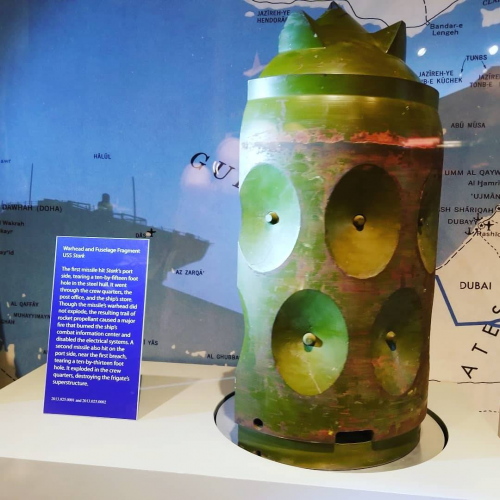
It's amazing what you find on this site. @Dilandu posted this picture of an Exocet warhead in the Tiger class cruiser thread ages ago.

It shows the shallow indentations in the warhead's casing which would create explosively formed (forged?) projectiles that would themselves penetrate nearby structural plates and caused explosive and firey overpressures that would blow out watertight doors and set alight everything in those spaces.
 
View attachment 774388

It's amazing what you find on this site. @Dilandu posted this picture of an Exocet warhead in the Tiger class cruiser thread ages ago.

It shows the shallow indentations in the warhead's casing which would create explosively formed (forged?) projectiles that would themselves penetrate nearby structural plates and caused explosive and firey overpressures that would blow out watertight doors and set alight everything in those spaces.
EFPs do not themselves explode. They're "just" metal moving at reasonably high speed
 
EFPs do not themselves explode. They're "just" metal moving at reasonably high speed

They are molten metal moving at Mach 5 or 6. When they penetrate a steel bulkhead they spall off hot metal fragments and introduce great heat and overpressure into the compartment which will blow off the watertight doors and set everything alight. This makes fires spread further than the immediate warhead blast area, makes fire and flooding more difficult to contain. It's horrendously clever.
 
They are molten metal moving at Mach 5 or 6. When they penetrate a steel bulkhead they spall off hot metal fragments and introduce great heat and overpressure into the compartment which will blow off the watertight doors and set everything alight. This makes fires spread further than the immediate warhead blast area, makes fire and flooding more difficult to contain. It's horrendously clever.
Not molten.
 
Hot enough to turn various temper-colors. So, ~400degF for steel.

Hot enough to cause flash-over fires and blow off watertight doors in closed compartments?

After all it's not as if the relatively small holes and spall damage the EFPs would make through structural steel aren going to sink a ship by themselves. IIUC they make the main warhead blast more effective by spreading different damage types further.
 
Hot enough to cause flash-over fires and blow off watertight doors in closed compartments?

After all it's not as if the relatively small holes and spall damage the EFPs would make through structural steel aren going to sink a ship by themselves. IIUC they make the main warhead blast more effective by spreading different damage types further.
Ideally, yes.

Just not molten. Molten metals don't penetrate solids well, no matter how fast the two meet.
 
Ideally, yes.

Just not molten. Molten metals don't penetrate solids well, no matter how fast the two meet.

The explosive formation makes them molten in order to got from a dish in the warhead casing to a projectile. Presumably it turns solid very quickly, although some HEAT ATGMs have stand-off probes to allow the penetrator more time and space to properly form.
 
The explosive formation makes them molten in order to got from a dish in the warhead casing to a projectile. Presumably it turns solid very quickly, although some HEAT ATGMs have stand-off probes to allow the penetrator more time and space to properly form.
Not even a HEAT charge makes them molten.

This was demonstrated by taking a live HEAT charge, carefully sawing it into slices the length of the charge, strapping the charge back into a cylinder, and firing it into a water tank. The copper liner was recovered, still in the slices.
 
After all it's not as if the relatively small holes and spall damage the EFPs would make through structural steel aren going to sink a ship by themselves
Yes, they do. An ordinary fragmentation warhead sinks ships by putting holes through the watertight bulkheads. EFPs are intended to make those holes go deeper into the ship – they're not particularly effective at causing overpressure or fire in other compartments except as a by-product.

FWIW, cluster bombs are downright terrifying against ships. They make lots of little holes and make damage control almost impossible.
 
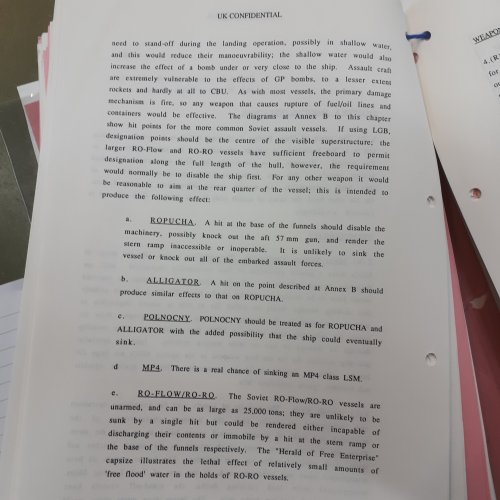
Ships can be tricky to sink. In the Gulf War two Jaguars emptied four pods of CRV-7* into a Polnochny-C-class landing ship plus 480 rounds of 30mm Aden shells. And that was after USN A-6 Avengers had had a pop at it. It was burning and wrecked but still afloat. The Jag pilots suspected the crew had jumped overboard before that though.
The CRV-7 round - the RLU 5002/B (C15) - the RAF acquired was a 3lb SAP warhead designed for anti-ship use.

Burning a lightly-built late 20th Century warship was just as effective as sinking it in most cases. If the crew don't want to hang around then its out of the fight.

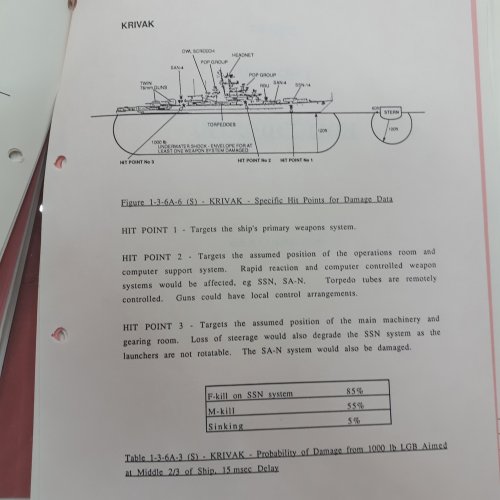
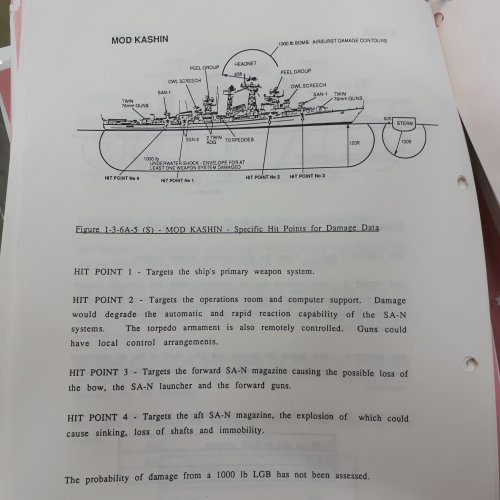
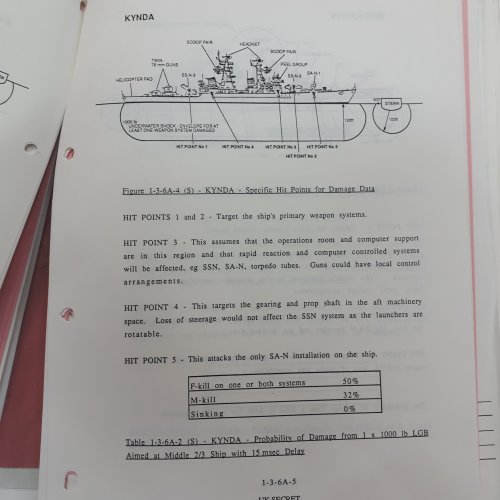
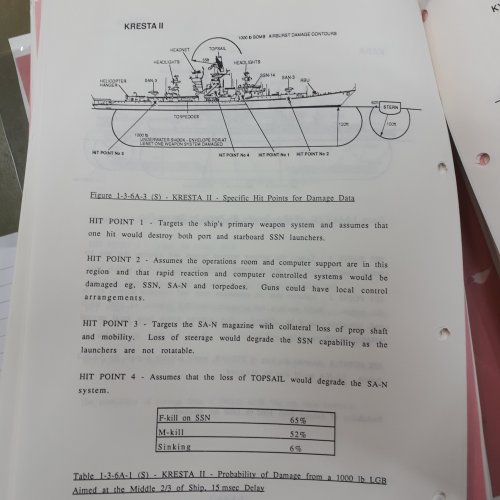
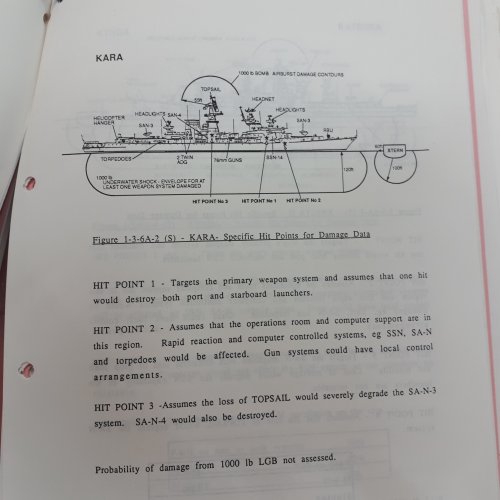
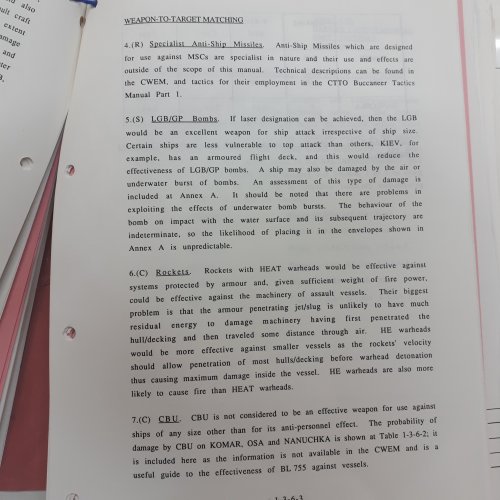
Some pages from the Jaguar operations manual on the best ways to knock out various Soviet ships.
 

Attachments

  • 20230524_133651.jpg
    20230524_133651.jpg
    564 KB · Views: 27
  • 20230524_133755.jpg
    20230524_133755.jpg
    461.4 KB · Views: 24
  • 20230524_133750.jpg
    20230524_133750.jpg
    533.9 KB · Views: 23
  • 20230524_133740.jpg
    20230524_133740.jpg
    505.8 KB · Views: 26
  • 20230524_133735.jpg
    20230524_133735.jpg
    501.3 KB · Views: 26
  • 20230524_133723.jpg
    20230524_133723.jpg
    488.9 KB · Views: 27
  • 20230524_133720.jpg
    20230524_133720.jpg
    381.3 KB · Views: 32
  • 20230524_133655.jpg
    20230524_133655.jpg
    618.1 KB · Views: 29
The SS-N-3, the one we're discussing here for the late 60's is huge. It is aircraft sized at nearly 40 feet long.
Talos stats for comparison (Wikipedia):

Mass7,800 lb (3,500 kg) (missile: 3,400 lb (1,500 kg), booster: 4,400 lb (2,000 kg))
Length32 ft (9.8 m)
Diameter28 in (71 cm)
Wingspan280 cm (110 in)
Warhead211 kg (465 lb) continuous-rod HE warhead or W30 nuclear warhead (2–5 kt)
 
They are molten metal moving at Mach 5 or 6. When they penetrate a steel bulkhead they spall off hot metal fragments and introduce great heat and overpressure into the compartment which will blow off the watertight doors and set everything alight. This makes fires spread further than the immediate warhead blast area, makes fire and flooding more difficult to contain. It's horrendously clever.
They're moving comparably fast to something like an APFSDS dart. Fast compared to a naval shell, but nowhere near as fast as a munroe effect (hollow-charge) jet, which is on the order of 10km/s. I'd be very skeptical of a watertight door being blown off from the EFP slug. At the same time, the shock from the warhead going off is more than likely to cause damage to watertight doors, and the hole from the EFP will absolutely cause problems for fire and smoke barriers and/or watertight integrity.

The best way to think of the EFP is that it's one step above pre-fragmented shrapnel. A normal shell casing makes lots of semi-random shrapnel in random directions, a pre-fragmented casing makes more consistent shrapnel in more consistent directions, and EFPs make VERY consistent shrapnel in particular directions. It's optimizing it to fly through several internal bulkheads/walls vs make a lot of little holes.

It fits in the middle of the spectrum of anti-ship warheads between stuff like TASM (a 1000lbs SAP bullpup warhead), Harpoon's blast-frag, Walleye/Condor's 500kg 'death star' linear shaped charges, P-700's 750kg SAP egg, BROACH's two-stage shaped charge and follow-through warhead, and the Styx-Kitchen family of 500-1000kg combined shaped charge / HE-FRAG warheads.

Ideally, yes.

Just not molten. Molten metals don't penetrate solids well, no matter how fast the two meet.
this is one of the reasons APFSDS top out around 2km/s. Above a certain speed you start getting hydrodynamic penetration interactions (i.e. it's all going so fast it acts like liquids) and this is less than ideal.

The explosive formation makes them molten in order to got from a dish in the warhead casing to a projectile. Presumably it turns solid very quickly, although some HEAT ATGMs have stand-off probes to allow the penetrator more time and space to properly form.
No, it is not liquid. The explosives are putting so much force on the metal that it induces superplastic deformation, which is the same modus operandi as lined munroe effect (hollow-charge) jets, but it is a much slower and heavier projectile. EFPs trade penetration for better coherence and stability. This gives better stand-off and coherence, which gives some advantages when attempting to penetrate complex but thin structures.

I also can't remember off the top of my head if EFPs use the Misnay–Schardin effect or the Munroe effect (IIRC it's Misnay–Schardin, but I'm not 100%). Hollow Charges / HEAT warheads use Munroe Effect and a liner.

 
Last edited:
Ships can be tricky to sink. In the Gulf War two Jaguars emptied four pods of CRV-7* into a Polnochny-C-class landing ship plus 480 rounds of 30mm Aden shells. And that was after USN A-6 Avengers had had a pop at it. It was burning and wrecked but still afloat. The Jag pilots suspected the crew had jumped overboard before that though.
The CRV-7 round - the RLU 5002/B (C15) - the RAF acquired was a 3lb SAP warhead designed for anti-ship use.

Burning a lightly-built late 20th Century warship was just as effective as sinking it in most cases. If the crew don't want to hang around then its out of the fight.

Some pages from the Jaguar operations manual on the best ways to knock out various Soviet ships.
Another example would be the M/V New Carissa eating nearly 70 5" rounds with no real issues but being sunk by a single Mk.48.
 
They're moving comparably fast to something like an APFSDS dart. Fast compared to a naval shell, but nowhere near as fast as a munroe effect (hollow-charge) jet, which is on the order of 10km/s. I'd be very skeptical of a watertight door being blown off from the EFP slug. At the same time, the shock from the warhead going off is more than likely to cause damage to watertight doors, and the hole from the EFP will absolutely cause problems for fire and smoke barriers and/or watertight integrity.
It probably won't blow a WTD off its hinges, but it will blow a large hole clear through the WTD.
 
It probably won't blow a WTD off its hinges, but it will blow a large hole clear through the WTD.
To be honest it doesn't matter too much whether the hole is in the door or the bulkhead, as long as it's large.

If you can knacker someone's *vertical* watertight integrity – that is, put holes in watertight decks and hatches – you're going to guarantee a really bad day at sea.
 
To be honest it doesn't matter too much whether the hole is in the door or the bulkhead, as long as it's large.

If you can knacker someone's *vertical* watertight integrity – that is, put holes in watertight decks and hatches – you're going to guarantee a really bad day at sea.
It's almost like that's why you'd want a number of EFPs arranged radially around the warhead!
 
I was assuming we weren't talking about a direct hit? Cuz yeah it'll just hole punch it.
Correct, the EFP was getting set off some distance away from the WTD.

Basically, you want a warhead that is set up to punch through ~1" of steel, 8-15ft of air, another ~1" of steel, repeat 5x. If you can do that with each EFP like in that Exocet warhead example, then it's a good start.

Using a magnesium airframe that the warhead will light on fire is adding insult to injury.
 
They are molten metal moving at Mach 5 or 6.
Erm, no. They are not molten. They are cold, solid metal, moving at Mach 5-6. The forming process did not change the aggregate state of metal; its not heated till melting, its squeezed till it start to act like liquid due to extreme pressure.
 
The explosive formation makes them molten in order to got from a dish in the warhead casing to a projectile. Presumably it turns solid very quickly, although some HEAT ATGMs have stand-off probes to allow the penetrator more time and space to properly form.
Okay, explanation is required. Molten metal means that aggregate state changed - through heating - from solid to liquid. This is NOT what happens. Instead, the extreme pressure compress the metal to the point when it starts to get superplasticity properties; i.e. it starts to behave like liquid. The metal structure remains solid all the time, and as soon as pressure is removed, the metal acted like a cold solid body again. That's why EFP could actually break through the armor & stuff; it remains solid all the way. If it was a drop of molten metal, it would just splash against the armor.
 
superplasticity

Yes, this is the term I meant when saying molten.

So, there is no flashover fire or overpressure to blow off doors. However, these holes and damage make damage control of the main blast more difficult.
 
It's almost like that's why you'd want a number of EFPs arranged radially around the warhead!
Imagine that, the people who design these things for a living might have thought of the same stuff as some people shooting the breeze on a forum!
Using a magnesium airframe that the warhead will light on fire is adding insult to injury.
IIRC there's at least one weapon that arranges the warhead and fuel tanks such that the former disperses and ignites any unspent fuel in the latter, further ruining the day of whomever is on the receiving end.
 
View attachment 774388

It's amazing what you find on this site. @Dilandu posted this picture of an Exocet warhead in the Tiger class cruiser thread ages ago.

It shows the shallow indentations in the warhead's casing which would create explosively formed (forged?) projectiles that would themselves penetrate nearby structural plates and caused explosive and firey overpressures that would blow out watertight doors and set alight everything in those spaces.
The AS.34 Kormoran has a similar warhead. Saw a picture of it years ago.
 
So, there is no flashover fire or overpressure to blow off doors. However, these holes and damage make damage control of the main blast more difficult.
There may still be overpressure from the 500+lbs of HE in the warhead, but that will only apply for a couple of compartments.


IIRC there's at least one weapon that arranges the warhead and fuel tanks such that the former disperses and ignites any unspent fuel in the latter, further ruining the day of whomever is on the receiving end.
I mean, if you're using a kerosene ramjet that's fine.

If you're using a solid fuel rocket, you can honestly just detonate the HE in the fuel instead of burning it for propulsion to get some extra boom.

But as an old Sailor, you want that magnesium airframe that is now attempting to burn its way through the hull and there's not a damn thing the target can do about it.


This is why the Regulus II is too big for the job. It absolutely dwarfs the P-500 Bazalt! Of course, if we're allowing nuclear warheads, it may prove to be fair game, since we're talking 1.5MT versus a fleet.

A modified Talos with more boom and less steel in the warhead would be good, if limited in how many ships it could be installed on. Especially since the ships are already used to having more warheads than missiles due to the swappable nuclear warhead on the RIM-8E. There were only 7 ships fitted with Talos! Furthermore, the US only built 16 ships of the Baltimore and Oregon City classes that could be converted into Albany-class.

For the US, I think the easiest weapon to fit to lots of ships would be a modified Ryan Firefly II or Lightning Bug, BQM-34. Replace the parachute with a warhead, replace the intel payload with a warhead. Fit spring-loaded folding wings that will pop out and lock, so you're not dealing with a 12-15ft wide object until it's actually in flight.
 
A modified Talos with more boom and less steel in the warhead would be good, if limited in how many ships it could be installed on. Especially since the ships are already used to having more warheads than missiles due to the swappable nuclear warhead on the RIM-8E. There were only 7 ships fitted with Talos! Furthermore, the US only built 16 ships of the Baltimore and Oregon City classes that could be converted into Albany-class.
There would be a guidance problem with over-the-horizon targeting. Talos was not an autonomous missile, after all. While its perfectly possible to develope a container-launched version, it would not be of much use without anew over-the-horizon guidance system.


For the US, I think the easiest weapon to fit to lots of ships would be a modified Ryan Firefly II or Lightning Bug, BQM-34. Replace the parachute with a warhead, replace the intel payload with a warhead. Fit spring-loaded folding wings that will pop out and lock, so you're not dealing with a 12-15ft wide object until it's actually in flight.
Agreed completely. But again, guidance. Albeit on Firebee its easier to solve, since it have much more space for seeker.
 
There may still be overpressure from the 500+lbs of HE in the warhead, but that will only apply for a couple of compartments.


I mean, if you're using a kerosene ramjet that's fine.

If you're using a solid fuel rocket, you can honestly just detonate the HE in the fuel instead of burning it for propulsion to get some extra boom.

But as an old Sailor, you want that magnesium airframe that is now attempting to burn its way through the hull and there's not a damn thing the target can do about it.


This is why the Regulus II is too big for the job. It absolutely dwarfs the P-500 Bazalt! Of course, if we're allowing nuclear warheads, it may prove to be fair game, since we're talking 1.5MT versus a fleet.

A modified Talos with more boom and less steel in the warhead would be good, if limited in how many ships it could be installed on. Especially since the ships are already used to having more warheads than missiles due to the swappable nuclear warhead on the RIM-8E. There were only 7 ships fitted with Talos! Furthermore, the US only built 16 ships of the Baltimore and Oregon City classes that could be converted into Albany-class.

For the US, I think the easiest weapon to fit to lots of ships would be a modified Ryan Firefly II or Lightning Bug, BQM-34. Replace the parachute with a warhead, replace the intel payload with a warhead. Fit spring-loaded folding wings that will pop out and lock, so you're not dealing with a 12-15ft wide object until it's actually in flight.
I think more aggressively pursuing anti ship Tartar/Standard derivatives is probably fine? I think you could probably do that reasonably by the time you hit Digital Tartar/ SM-1? Or a Corvus-derivative, especially if you could have leveraged something like the Missileer's gargantuan radome and power generation...
 
I've been a bit surprised by how many AShMs were produced during the Cold War. France built over 3000 anti-radar Martels (also used against land targets), and Britain built another 1000 TV versions and more than 500 Sea Eagles. Germany built over 800 Kormorans, Italy and France over 1000 Otomat Mk2. Then there's the big 2, France with 3300 surface and another 1100 air launched Exocets and the US with almost 7000 harpoon during the cold war.
 
There would be a guidance problem with over-the-horizon targeting. Talos was not an autonomous missile, after all. While its perfectly possible to develope a container-launched version, it would not be of much use without anew over-the-horizon guidance system.
Yeah, you're probably limited to ~50km without using the ARM variant. Maybe 60km versus a target the size of the launching ship.
 
I've been a bit surprised by how many AShMs were produced during the Cold War. France built over 3000 anti-radar Martels (also used against land targets), and Britain built another 1000 TV versions and more than 500 Sea Eagles. Germany built over 800 Kormorans, Italy and France over 1000 Otomat Mk2. Then there's the big 2, France with 3300 surface and another 1100 air launched Exocets and the US with almost 7000 harpoon during the cold war.
Well, the navies were much larger then. For example, USN by 1990 have 42 cruisers, 52 destroyers and 103 frigates. Merely equipping all of them with one combat load of eight Harpoon missiles (frigates usually carry less, but let's not get too detailed) would require 1500+ missiles. Having at least one reload stored for each would require 3000 missiles. And we didn't even started to count submarines, planes, export sales...
 
Last edited:
Not to mention that attrition, downchecks, and the like were given much more attention then than during recent times.
 
Australia went harpoon mad in the 80s. Of course the DDGs, FFGs, P3s and the new F/18As had them, but we also integrated them with the Oberon-class subs and F111Cs. The RAAF alone would have needed hundreds and the RAN dozens.
 

Similar threads

Back
Top Bottom