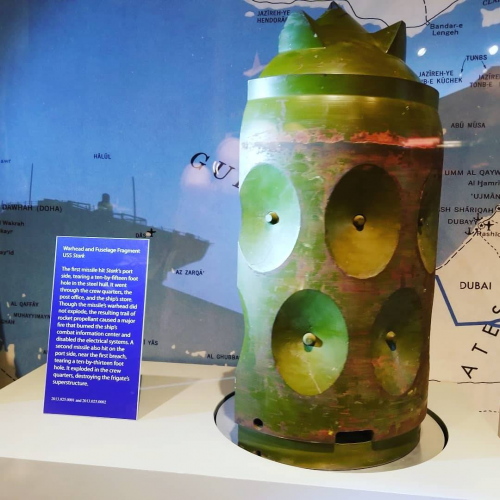
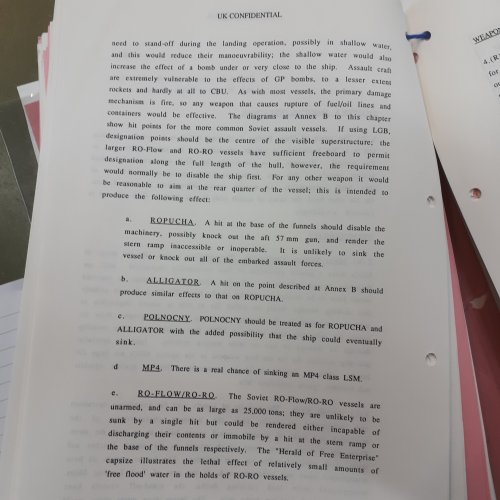
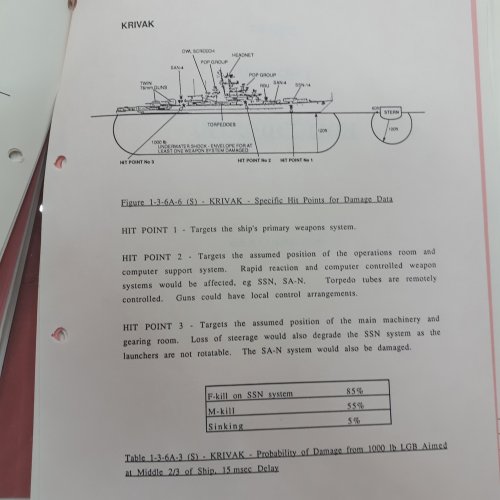
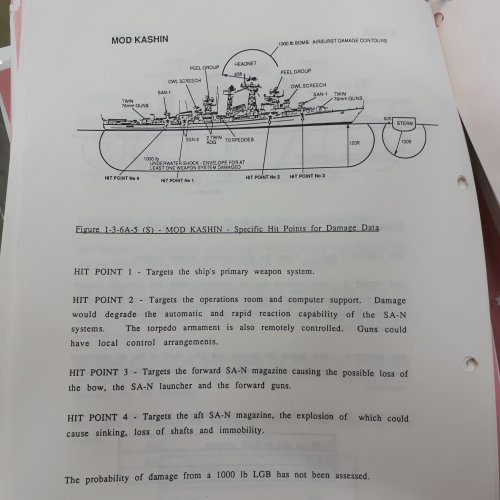
They are molten metal moving at Mach 5 or 6. When they penetrate a steel bulkhead they spall off hot metal fragments and introduce great heat and overpressure into the compartment which will blow off the watertight doors and set everything alight. This makes fires spread further than the immediate warhead blast area, makes fire and flooding more difficult to contain. It's horrendously clever.
They're moving comparably fast to something like an APFSDS dart. Fast compared to a naval shell, but nowhere near as fast as a munroe effect (hollow-charge) jet, which is on the order of 10km/s. I'd be very skeptical of a watertight door being blown off
from the EFP slug. At the same time, the shock from the warhead going off is more than likely to cause damage to watertight doors, and the hole from the EFP will absolutely cause problems for fire and smoke barriers and/or watertight integrity.
The best way to think of the EFP is that it's one step above pre-fragmented shrapnel. A normal shell casing makes lots of semi-random shrapnel in random directions, a pre-fragmented casing makes more consistent shrapnel in more consistent directions, and EFPs make VERY consistent shrapnel in particular directions. It's optimizing it to fly through several internal bulkheads/walls vs make a lot of little holes.
It fits in the middle of the spectrum of anti-ship warheads between stuff like TASM (a 1000lbs SAP bullpup warhead), Harpoon's blast-frag, Walleye/Condor's 500kg 'death star' linear shaped charges, P-700's 750kg SAP egg, BROACH's two-stage shaped charge and follow-through warhead, and the Styx-Kitchen family of 500-1000kg combined shaped charge / HE-FRAG warheads.
Ideally, yes.
Just not molten. Molten metals don't penetrate solids well, no matter how fast the two meet.
this is one of the reasons APFSDS top out around 2km/s. Above a certain speed you start getting hydrodynamic penetration interactions (i.e. it's all going so fast it acts like liquids) and this is less than ideal.
The explosive formation makes them molten in order to got from a dish in the warhead casing to a projectile. Presumably it turns solid very quickly, although some HEAT ATGMs have stand-off probes to allow the penetrator more time and space to properly form.
No, it is not liquid. The explosives are putting so much force on the metal that it induces superplastic deformation, which is the same modus operandi as lined munroe effect (hollow-charge) jets, but it is a much slower and heavier projectile. EFPs trade penetration for better coherence and stability. This gives better stand-off and coherence, which gives some advantages when attempting to penetrate complex but thin structures.
I also can't remember off the top of my head if EFPs use the Misnay–Schardin effect or the Munroe effect (IIRC it's Misnay–Schardin, but I'm not 100%). Hollow Charges / HEAT warheads use Munroe Effect and a liner.