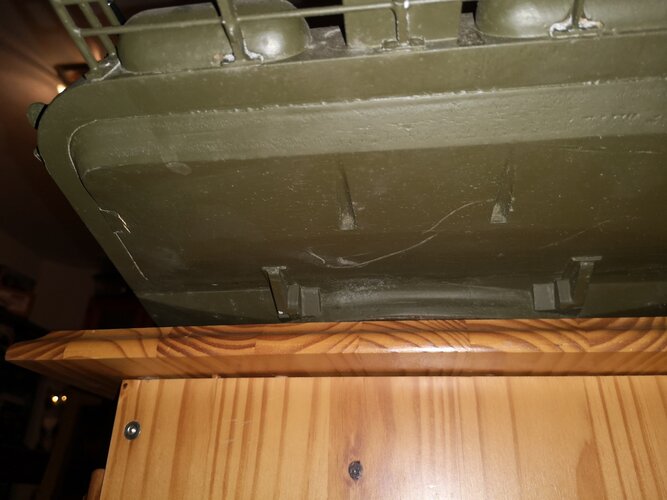
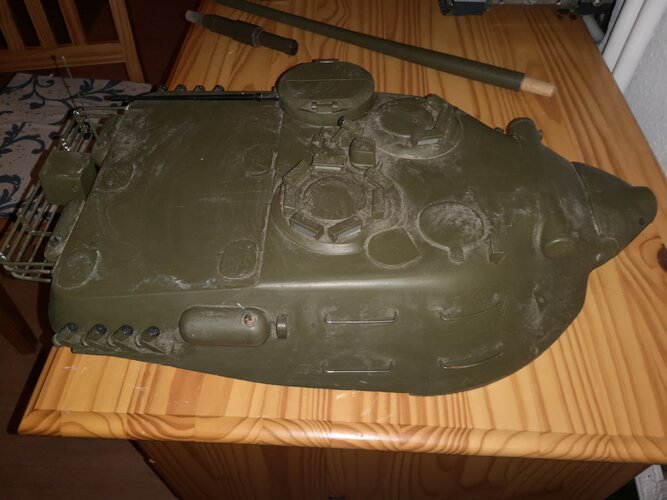
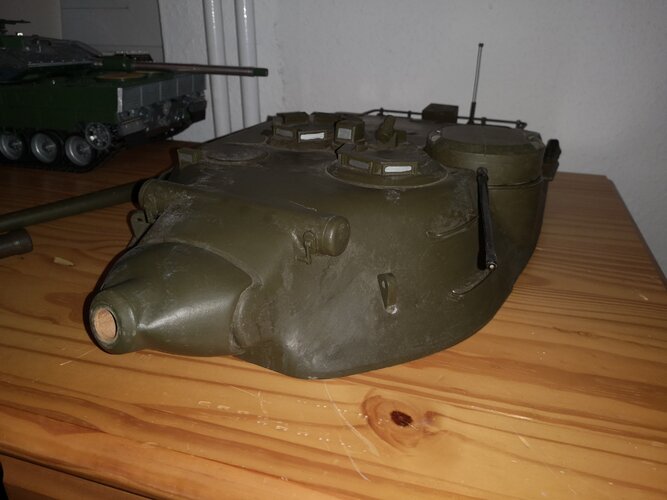
Furthermore, the T-72 had a thick internal anti-radiation lining on the surfaces of the turret and hull. On the frontal cheeks of the turret where the armour was thickest, the lining was only 10-20mm thick as the armour itself provided good shielding from penetrating radiation such as gamma rays and neutrons, but on other parts of the tank including the sides, rear, and ceiling of the turret, the sides of the hull, and on the autoloader carousel cover, the anti-radiation lining was 45-50mm thick to compensate for the low thickness of armour. This lining was known as "Podboi". Beginning in 1983, an external anti-neutron cladding with a thickness of 50mm was added on the turret and hull surrounding the inhabited parts of the tank as a response to an announcement by U.S president Ronald Reagan in 1981 that the production of neutron bombs would be restarted. This cladding was known as "Nadboi". Both the internal lining and external cladding were made from a laminate of hydrogen-rich polyethylene (UHMWPE) and polyisobutylene sheets impregnated with lead.
Besides offering excellent protection from harmful radiation and blast waves as detailed in
Part 2 of this T-72 article, the thick anti-radiation lining inside and outside the tank provides thermal insulation for the crew and internal equipment in hot and cold weather. In cold weather, the temperature of the steel shell of a tank eventually equalizes with the outside temperature so that the crew would essentially be sitting in an ice box, and when the temperature drops below 0 degrees Celsius, the steel surfaces of a tank become too cold to be touched safely with bare skin. The same is true in hot weather as the interior of a tank heated by direct sunlight will become hotter than the ambient air temperature, given enough time. The laminated polymer material (polyethylene and polyisobutylene) of the anti-radiation lining acts as an insulator and a physical barrier between the steel shell of the tank and the crew, thus ensuring that the crew cannot accidentally burn or freeze themselves on the bare steel surface while also helping to regulate the internal temperature of the tank; in winter, the lining helps retain heat inside the crew compartment, and in summer, the lining helps prevent the heated steel shell from raising the internal temperature. The additional "Nadboi" cladding found on newer tanks adds another layer of insulation that is particularly useful in summer as the turret roof is the most exposed to sunlight.