Hi T. A.,


Stüwe contradicts you on p. 703, stating that the transmitter voltage was 200 V DC.

Regards,

Henning (HoHun)
The 200 VDC system was used with standard Keil-Strassburg and Kogge-Brigg. They upped it to 600 VDC for the X-4 system because of the line loss (wire resistance).
 
Hi T. A.,

The 200 VDC system was used with standard Keil-Strassburg and Kogge-Brigg. They upped it to 600 VDC for the X-4 system because of the line loss (wire resistance).

You seem to have "forgotten" to mention the source for your claim. So, what is it this time?

(Stüwe, p. 703, is explicitely talking about the X-4 system.)

Regards,

Henning (HoHun)
 
Hi T. A.,


You seem to have "forgotten" to mention the source for your claim. So, what is it this time?

(Stüwe, p. 703, is explicitely talking about the X-4 system.)

Regards,

Henning (HoHun)
The X-4, a development of the Fritz X, was line controlled with the “Dusseldorf* (FuG 510) system as transmitter and a system similar to the “Detmold" type as receiver. The “Dusseldorf" transmitter was essentially the same as the "Duren," but its working voltage was only 200 V, as compared with the 600 V of the “Duren."

https://archive.org/details/AGARD20/AGARD-AG-20/page/128/mode/1up?view=theater
Because the wire was so long, and so thin, and that steel was being used, made the resistance so high that they had to up the voltage to get a useful signal to the missile.
 
Hi T. A.,

You don't seem to be very consistent:

With Dusseldorf / Detmold the combo on the X-4, yes. [...]

It's 200 VDC (there is a 600 VDC system that's similar that was proposed for Hs 293 and the Fritz X. Higher voltage due to longer wire runout. That's shown in the video too).

Additionally, the signals from the guiding aircraft are 600 VDC to cover line loss (resistance in the wire)

The X-4, a development of the Fritz X, was line controlled with the “Dusseldorf* (FuG 510) system as transmitter and a system similar to the “Detmold" type as receiver. The “Dusseldorf" transmitter was essentially the same as the "Duren," but its working voltage was only 200 V, as compared with the 600 V of the “Duren."

You're 2:1 in favour of 200 V DC, which would put you in agreement with Stüwe.

Regards,

Henning (HoHun)
 
Hi T. A.,

You don't seem to be very consistent:


You're 2:1 in favour of 200 V DC, which would put you in agreement with Stüwe.

Regards,

Henning (HoHun)
X-4 used Duren Detmold as the control system. It was a 600 VDC system upped from the previous 200 VDC of other similar systems.

Pocock German Guided Missiles says the same thing on pg 74
 
Hi T. A.,

X-4 used Duren Detmold as the control system. It was a 600 VDC system upped from the previous 200 VDC of other similar systems.

Here is the very source you quoted:

The X-4, a development of the Fritz X, was line controlled with the “Dusseldorf" (FuG 510) system as transmitter and a system similar to the “Detmold" type as receiver. The “Dusseldorf" transmitter was essentially the same as the "Duren", but its working voltage was only 200 V, as compared with the 600 V of the “Duren".

Regards,

Henning (HoHun)
 
Hi T. A.,

X-4 used Duren Detmold as the control system. It was a 600 VDC system upped from the previous 200 VDC of other similar systems.

Pocock German Guided Missiles says the same thing on pg 74

Pocock on p.74 talks about "equipment reserved for the SD 1400 X only". If you read p. 75, he writes, "As the SD 1400 X went out of service, from the spring of 1944, production of the 'Düren-Detmold' also stopped, but existing apparatus was modified into 'Düsseldorf-Detmold' sets for the Ruhrstahl X-4 air-to-air missile. This system was almost identical with the 'Düren-Detmold', but working with a lower voltage."

Regards,

Henning (HoHun)
 
Maybe a quick calculation clears things up?!

Resistance of one wire:
length 5500m
diameter 0,2mm
surface = (0,2²*PI)/4 = 0,031416 mm²
specific resistance [rho] for steelwire = 0,13 in (ohm*mm2)/m

R = (5500m * 0,13)/0,031416 = 22759.1 ohm


that gives for 200V :
200V/(2*22760 ohm)=0.00439 Ampere
or 4.4 mA
in the control circut

seems a little low in my eyes ( i have only superficial knowledge ) but still possible.
the decoder relais must be quite small but they only have to switch the 9V internal circut propably with low amp allowing them to be small.


Anyway our written sources dont seem to contradict each other anymore so the discussion about the 200V DC system seems to be settled.

nice:cool:
 
i just reread Stüwes article about the x4, he also mentions 5mA in the control circut.

he later gives the encoder drum frequency with 20 Hz instaed of 5 Hz that i used to describe in my long post some days ago.
 
Hi Basil,

A well made analytic description of the whole system:
View: https://youtube.com/watch?v=zXan1fo6qi0&si=YLKPklG5AhBD3OgC

This was actually linked near the begining of this thread already :)

https://www.secretprojects.co.uk/th...jaegerrakete-ruhrstahl-x-4.38058/#post-586401
One inaccuracy I noticed is that it depicts a drum encoder despite stating that the joystick used is a "Knirps", which as far as I've been able to tell from the various sources covered in this thread is actually using potentiometers to evaluate the position, with the pulse width modulation obviously being done by a different technology.

"Knirps" means "midget", implying miniaturization, which was achieved by eliminating the moving parts of the older rotating-drum encoder joysticks that can be seen here:

View: https://www.youtube.com/watch?v=ALtdaBgo8JE&t=462s


Regards,

Henning (HoHun)
 
Hi Basil,


This was actually linked near the begining of this thread already :)

https://www.secretprojects.co.uk/th...jaegerrakete-ruhrstahl-x-4.38058/#post-586401
One inaccuracy I noticed is that it depicts a drum encoder despite stating that the joystick used is a "Knirps", which as far as I've been able to tell from the various sources covered in this thread is actually using potentiometers to evaluate the position, with the pulse width modulation obviously being done by a different technology.

"Knirps" means "midget", implying miniaturization, which was achieved by eliminating the moving parts of the older rotating-drum encoder joysticks that can be seen here:

View: https://www.youtube.com/watch?v=ALtdaBgo8JE&t=462s


Regards,

Henning (HoHun)
as far as i know knirps had potentiometers that regulated the position of the decoder drums... so that you can have a small joystick in the cockpit and wire the commands to the larger decoder drum box in a more convinient place on the aircraft.

i have to read stüwes take again, remake of this video is scheduled anyway so im going to watch out for these differences and change to the correct Steuergerät name (with the drums).
 
Hello boys !
I see that you have been discussing at length the (de)merits of the X-4 but to go back to hardware:
a) how many X-4 were built and completed (that is : those which did not get mated to an engine because said engine had gone "boom" in a bombing of the factory do not count)
b) which aircraft were actually used for testing :
I found here X-4 Story on Balsi.de a list of aircraft
- Fw 190 V69 WkN 582079
- Fw 190 F-8 WkN 583431
- Fw 190 F-8 WkN 583438
- Fw 190 F-8 WkN 584221
But this site does not source its information.
And what of the Ju 88 (filmed) and the alleged Ju 388 and Me 262?
c) which aircraft were intended to receive the X-4 ? Models have been produced of a 1/48 Ta 183 A and there is a soon coming 1/32 Me P1101 which come armed with X-4. The wiki even claims the Ta 183 A would have been the choice carrier for the X-4...while claiming ten lines above that , that test flights proved that a single guy could not at the same time pilot a fighter AND a missile. And the only document I know showing the X-4 under the wing of a fighter X-4 under a Me 262 depicts a single-seater Me 262 ....
I am losing my latin over this X-4 story !
 
Hello boys !
I see that you have been discussing at length the (de)merits of the X-4 but to go back to hardware:
a) how many X-4 were built and completed (that is : those which did not get mated to an engine because said engine had gone "boom" in a bombing of the factory do not count)
b) which aircraft were actually used for testing :
I found here X-4 Story on Balsi.de a list of aircraft
- Fw 190 V69 WkN 582079
- Fw 190 F-8 WkN 583431
- Fw 190 F-8 WkN 583438
- Fw 190 F-8 WkN 584221
But this site does not source its information.
And what of the Ju 88 (filmed) and the alleged Ju 388 and Me 262?
c) which aircraft were intended to receive the X-4 ? Models have been produced of a 1/48 Ta 183 A and there is a soon coming 1/32 Me P1101 which come armed with X-4. The wiki even claims the Ta 183 A would have been the choice carrier for the X-4...while claiming ten lines above that , that test flights proved that a single guy could not at the same time pilot a fighter AND a missile. And the only document I know showing the X-4 under the wing of a fighter X-4 under a Me 262 depicts a single-seater Me 262 ....
I am losing my latin over this X-4 story !
Well, the part about a pilot not being able to fly and guide the missile is quite true. The USN found the same thing in testing their Gorgon II missiles in the air-to-air role, including at least one live fire at a flying drone target plane using a similar MCLOS control system but with television for tracking the target.

As for the Ta 183... Anything on that borders on fantasy. There's no clear proof the plane, as designed on paper, would have even gone to prototype testing without serious issues requiring lots of modifications if it even reached a pre-production stage.
 
Hello boys !
I see that you have been discussing at length the (de)merits of the X-4 but to go back to hardware:
a) how many X-4 were built and completed (that is : those which did not get mated to an engine because said engine had gone "boom" in a bombing of the factory do not count)
b) which aircraft were actually used for testing :
I found here X-4 Story on Balsi.de a list of aircraft
- Fw 190 V69 WkN 582079
- Fw 190 F-8 WkN 583431
- Fw 190 F-8 WkN 583438
- Fw 190 F-8 WkN 584221
But this site does not source its information.
And what of the Ju 88 (filmed) and the alleged Ju 388 and Me 262?
c) which aircraft were intended to receive the X-4 ? Models have been produced of a 1/48 Ta 183 A and there is a soon coming 1/32 Me P1101 which come armed with X-4. The wiki even claims the Ta 183 A would have been the choice carrier for the X-4...while claiming ten lines above that , that test flights proved that a single guy could not at the same time pilot a fighter AND a missile. And the only document I know showing the X-4 under the wing of a fighter X-4 under a Me 262 depicts a single-seater Me 262 ....
I am losing my latin over this X-4 story !

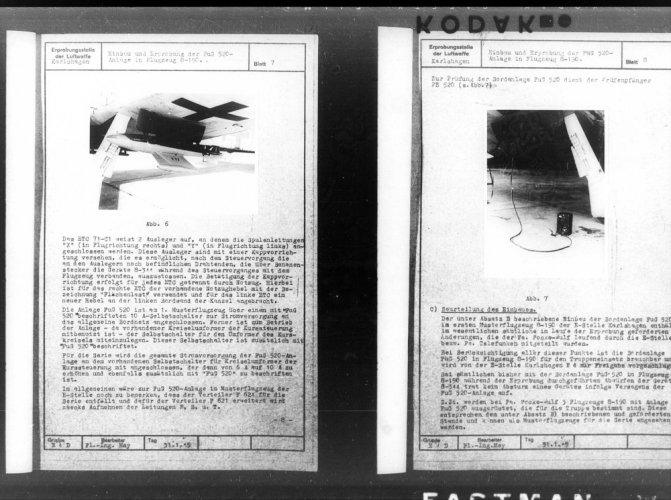
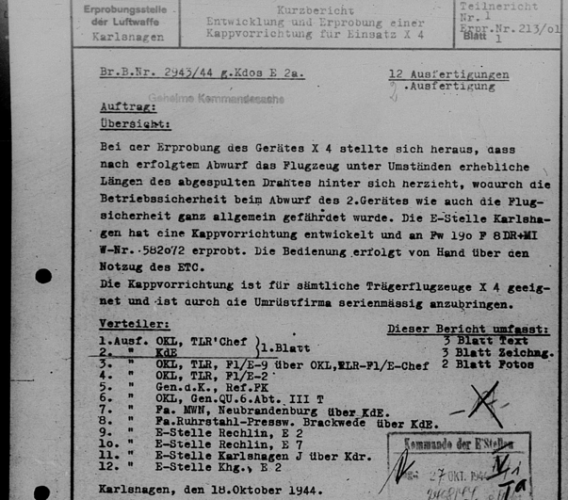
The main test aircraft at Karlshagen seems to have been Fw 190 F-8 DR+MI W-Nr. 582072 - not on that list. A Ju 88 G-1 is also mentioned as a test aircraft for the FuG 520 (that installation having been carried out by Dornier for some reason), but it's explicitly stated that the Ju 88 installation will not go into series production. As such, the test report I showed an extract from in post #137 doesn't include any discussion on how the Ju 88 tests went.

582072.png

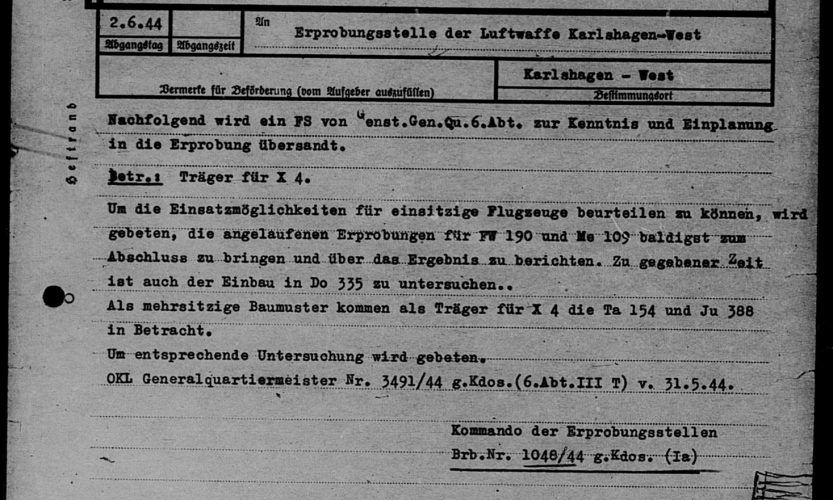
It seems as though the missile was originally intended for the Fw 190 and Me 109 but was then also considered for the Do 335, Ta 154 and Ju 388:

X-4 carriers.png

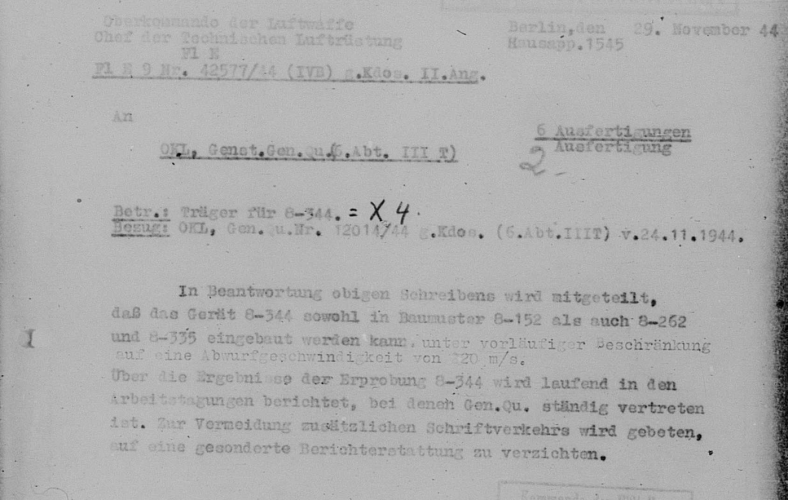
Then later it was said that it could be installed in the Ta 152, Me 262 and Do 335:

X-4 carriers 2.png

I've never seen any evidence, I don't think, that the Ta 183 was considered as a carrier for the X 4, probably because the X 4 had been cancelled before the Ta 183 was, briefly, selected for development.
 
Last edited:
A very interesting article about the X-4 in Waffen Revue 1998.the author tells the subject point by point,from the beginning of the X-4 adventure to its realization.an article to read without getting tired between the websites.
file is not opening
 
X-4 missile homing devices:
- DOGGE, LUCHS, PUDEL
- KARUSSELL
-

Source: Bundesarchiv
Signatur: RH 8/1987
Aufgabe des selbststeuernden Zielsuchgeräts und Stand der Entwicklung 13.10.1944 (EW 224, Dr. Weiß)
https://invenio.bundesarchiv.de/invenio/direktlink/b8f997b7-9545-45ac-abc8-658b4f724a96/
Infrared homing device Karussell and other homing devices. Stage of development. October 13, 1944.
Homing devices for Wasserfall & X-4.
Page: 19 Drawing "Jägerrakete"
Page: 20 Drawing "Submarine Flak Rakete*"

*Missiles equipped with Karussell homing devices have also been proposed as weapons against low-flying aircraft, e.g., on submarines.


More infos:
TECHNICAL INTELLIGENCE SUPPLEMENT by H.S. Tsien, May 1946
Page: 55 -- HOMING DEVICES
Page: 57-64 -- GERMAN PROJECTS ON HOMING DEVICES, STATED TO BE IN PROGRESS, 15 August 1944 (Acoustic, Infrared, Optical, Electrical)

GERMAN ELECTRO-ACOUSTIC & INFRA-RED HOMING DEVICES
https://www.secretprojects.co.uk/threads/german-special-air-air-anti-bomber-weapons.6945/post-734023
 
X-4 missile homing devices:
- DOGGE, LUCHS, PUDEL
- KARUSSELL
-

Source: Bundesarchiv
Signatur: RH 8/1987
Aufgabe des selbststeuernden Zielsuchgeräts und Stand der Entwicklung 13.10.1944 (EW 224, Dr. Weiß)
https://invenio.bundesarchiv.de/invenio/direktlink/b8f997b7-9545-45ac-abc8-658b4f724a96/
Infrared homing device Karussell and other homing devices. Stage of development. October 13, 1944.
Homing devices for Wasserfall & X-4.
Page: 19 Drawing "Jägerrakete"
Page: 20 Drawing "Submarine Flak Rakete*"

*Missiles equipped with Karussell homing devices have also been proposed as weapons against low-flying aircraft, e.g., on submarines.


More infos:
TECHNICAL INTELLIGENCE SUPPLEMENT by H.S. Tsien, May 1946
Page: 55 -- HOMING DEVICES
Page: 57-64 -- GERMAN PROJECTS ON HOMING DEVICES, STATED TO BE IN PROGRESS, 15 August 1944 (Acoustic, Infrared, Optical, Electrical)

GERMAN ELECTRO-ACOUSTIC & INFRA-RED HOMING DEVICES
https://www.secretprojects.co.uk/threads/german-special-air-air-anti-bomber-weapons.6945/post-734023

You are digging up highly interesting documents ... !
 
I understand the purpose, but without evidence I doubt that PWM were used for that. going back and forth from left to right is not a typical application for PWM. It also doesn't fit very well to an analog computer.
 
I understand the purpose, but without evidence I doubt that PWM were used for that. going back and forth from left to right is not a typical application for PWM. It also doesn't fit very well to an analog computer.
It started with the pointer indicators being servo/synchro controlled, then they removed the human from having to line up the turret and guns with the pointers.
 
Servos are usually not driven by PWM signals. A stepper motor would be the obvious choise. A DC powered servo engine eith variable voltage would also work but require feetback for the position.

Again, were is the evidence for using PWM on WW2 warships?
 
Glad they Nazis did not figure out even a crude heatseeker. Piston driven jets were pretty big targets in the infrared bandwidth.Although they didn't appear for a decade the groundwork was in place by 1946. Post war budgets froze most of the programs during that decade.
 
There has been a considerable amount of excellent information posted on this forum about the X-4. I wrote an article about it for the Defence Electronics History Society (DEHS) which gives an overview of the development programme, based mainly on primary sources, which may help put the extensive information already posted into an overall context. The article was published in the e-Newsletter of the DEHS, eDEN # 131 Part 1, pages 25 to 33. An updated version with some minor corrections is attached.
After the article was published, I continued my research, and wrote a more comprehensive article for "Axis Wings Volume 2", published by Chandos Publications in 2024, which gives more detail on the guidance system, the rocket motor and the matching of the warhead and proximity fuze. One area where I suspect there is more information to be uncovered, is on operational testing. The order for the formation of the operational test detachment at Peenemunde West, Erprobungskommando 4, was approved on 1 December 1944. By that time Allied air superiority in daytime had forced the Luftwaffe into mostly night operations. Although X-4 was designed for use against daylight bomber formations, operational tests could have been carried out on clear nights with strong moonlight. A British Air Intelligence Report dated 29 March 1945 states: "Reports from night bomber crews, over the past months, have frequently referred to supposed winged missiles which could well have been Hs 298, X-4 or Hs117. ----------". Has anyone come across any information about operational testing of X-4 against Allied bombers?
 

Attachments

  • German X-4 AAM DEHS article updated - 23May2024.pdf
    567.9 KB · Views: 28
There has been a considerable amount of excellent information posted on this forum about the X-4. I wrote an article about it for the Defence Electronics History Society (DEHS) which gives an overview of the development programme, based mainly on primary sources, which may help put the extensive information already posted into an overall context. The article was published in the e-Newsletter of the DEHS, eDEN # 131 Part 1, pages 25 to 33. An updated version with some minor corrections is attached.
After the article was published, I continued my research, and wrote a more comprehensive article for "Axis Wings Volume 2", published by Chandos Publications in 2024, which gives more detail on the guidance system, the rocket motor and the matching of the warhead and proximity fuze. One area where I suspect there is more information to be uncovered, is on operational testing. The order for the formation of the operational test detachment at Peenemunde West, Erprobungskommando 4, was approved on 1 December 1944. By that time Allied air superiority in daytime had forced the Luftwaffe into mostly night operations. Although X-4 was designed for use against daylight bomber formations, operational tests could have been carried out on clear nights with strong moonlight. A British Air Intelligence Report dated 29 March 1945 states: "Reports from night bomber crews, over the past months, have frequently referred to supposed winged missiles which could well have been Hs 298, X-4 or Hs117. ----------". Has anyone come across any information about operational testing of X-4 against Allied bombers?
The only attempt to shoot down an aircraft with an guided AAM in WW 2 that know of is this single US attempt by the US Navy:

On March 8, 1945 the first live fire test against a TDC-2 target drone of a Gorgon IIA using TV MCLOS took place. The system was the same as used successfully on the Bat guided bomb. The Navy’s project engineer, Cdr. Moulton “Molt” Taylor, reported that this guidance system was unworkable against an aerial target where closing speeds were too high for human mind and hand-eye coordination to match the speed of response needed to make it work. This launch represents the first time in history that a guided air-to-air missile had been tried in a live fire test against a target.

Basically, he was trying to fly an AAM much like the X-4 would have been flown to hit another aircraft. The Germans came to the same conclusion that the X-4 couldn't be used on a single seat fighter where the pilot was trying to guide it. You'd need something like a Ju 88 with the missile guidance crewman in the nose and even then it was likely to miss.
 
The only attempt to shoot down an aircraft with an guided AAM in WW 2 that know of is this single US attempt by the US Navy:

On March 8, 1945 the first live fire test against a TDC-2 target drone of a Gorgon IIA using TV MCLOS took place. The system was the same as used successfully on the Bat guided bomb. The Navy’s project engineer, Cdr. Moulton “Molt” Taylor, reported that this guidance system was unworkable against an aerial target where closing speeds were too high for human mind and hand-eye coordination to match the speed of response needed to make it work. This launch represents the first time in history that a guided air-to-air missile had been tried in a live fire test against a target.

Basically, he was trying to fly an AAM much like the X-4 would have been flown to hit another aircraft. The Germans came to the same conclusion that the X-4 couldn't be used on a single seat fighter where the pilot was trying to guide it. You'd need something like a Ju 88 with the missile guidance crewman in the nose and even then it was likely to miss.
Hi T.A.,

Comparison of Steering Gorgon II-A and X-4

Thanks for your response to my post about the X-4. The comparison with Gorgon II-A is very interesting, but on closer examination there are important differences that can explain why the Gorgon II-A live fire test was unsuccessful, but flight testing of the X-4 showed it to be satisfactory when used against targets with a low sight line rate relative to the launch aircraft. In William Wolf’s book, “Off Target; America’s Guided Bombs, Missiles and Drones 1917-1950”, he makes the following comments on the Gorgon II-As live fire test in March 1945:

“A live air-to-air test of the Gorgon II-As radio command guidance system with a TV camera in the nose, failed badly, because the closing speeds of the missile and its target (approaching 800 mph) were too excessive for the Gorgon II-As rather limited maneuverability to allow the missile’s controller to correctly steer the weapon”.

Some key differences relevant to steering the 2 missiles are:
  • The closing speed of an X-4 missile against a B-17 or B-24 at the point of intercept would have been around 100 to 150 m/s (224 to 336 mph), which is much lower than the closing speed in the Gorgon II-A test. This increased the available response time to steer the X-4 missile by a factor of 2 to 3.
  • The X-4 missile had a maximum lateral acceleration (latax) capability of only around 4 “g”, but this was adequate for rear aspect shots against non-manoeuvring bomber targets. The corollary of this limited latax capability, was that the X-4 missile was very stable. Steering commands from the launch aircraft were in effect heavily damped by the aerodynamic response of the X-4 to it's spoiler control system, minimizing the risk of operator induced oscillations in the missile flight path.
  • As the TV camera in the Gorgon II-A closed on the target, the rapidly reducing range progressively increased any changes in the sight line and sight line rate to a much greater degree than for the view from the much greater range of the launch aircraft gunsight, as used on X-4. For example, a target 2”g” lateral manoeuvre would be seen as a sight line rate of 11°/sec from the Gorgon II-A TV camera at 100 metres from the target, whereas the same target manoeuvre would be seen as a sight line rate of only 1.1°/sec from the X-4 launch aircraft at its closest range before breakaway of 1,000 metres. The increasingly rapid increase in any changes in the sight line and sight-line-rate as the Gorgon II-A closed on the target, as seen from the TV camera, would have made it considerably more difficult for the missile controller to fine tune his steering commands to the missile.
It is important to remember that the X-4 was designed for rear aspect engagements against large bombers flying straight and level courses in formation. It’s effectiveness would have dropped off rapidly against manoeuvring targets, but it managed to achieve it’s primary requirement with a relatively simple design, at a time when the technology for homing guidance was too immature to support a practical design for a homing missile.
 
I think we can look at tactics used by real pilots with MCLOS systems. I gather that the missile is usually launched with the aircraft itself aligned to the intended intercept point so that a minimum number of oscillations are made and there is time to make fine adjustments (as well as a minimum of relative angular motion between the aimer, the missile, and the target).

I suspect that the missiles would be fired using the gunsight from astern of the bomber formation, and most of the corrections would just be used to compensate for wind or altitude drift... as much making sure that the missile doesn't drift off-course as it is aiming the missile.

The result would be a higher likelihood of flying near to at least one of the bombers than the WGr.21 and an ability to engage at a longer range without needing as many rockets compared to the R4M (allowing a larger and more lethal warhead per rocket).

In this sense it would have been a significant (if somewhat incremental) improvement in capability against daylight bomber formations (assuming the launch platforms could have been protected against daylight fighters).

I suspect it would have been very impractical for night fighters though.

P.S. The obvious exception regarding the MCLOS launch profile I described is if one needs to turn to a more oblique course to avoid defensive fire or keep the target in view (i.e. a ground target that would otherwise be obscured by the nose of the aircraft).
 
X-4 Additional Information

[1] February 12, 1945 – February 18, 1945
8-344:
Reduction of the previously requested units from 5,000 to 300 units per month.

[2] February 16, 1945
Meeting with Kammler - Generalmajor Dornberger reports:
f.) X-4
Development with wire control may be completed sooner; rejected by the General der Jagdflieger due to the wire control system. Jamming of the high-voltage power lines is to be expected. No homing device or rangefinder is yet ready. Deployment will not be possible for several months.

[2] March 26, 1945
Meeting with Kammler:
Setup of small-scale test equipment for Henschel 117, X-4, and Taifun.

[1] March 16, 1945 – April 4, 1945
Special Weapons:
8-344 (X-4) and 8-347 (X-7) included in the Emergency Program (Notprogramm).


[3] The “Compilations of Technical Guidelines for a 1-TL Fighter with 109-011” from January 1945 to March 1945 do not mention the X-4 or Hs 298 guided missiles.

Additional armament options included:
- R4M (30-40 rounds; "Faun")
- AG 140 (2-4 BR 100 BS rockets; "Oberon")
- Vertical armament, SG 500 or Rohrblock 108
- Instead of standard armament (4x MK108 or 4x MG 213/30), special armament with 4x Raketenautomat RA 55
- Bomb load of 500 kg or 600 liters external fuel tank

To easily accommodate variations in armament resulting from the development of new weapon systems, a "Waffenkanzel" is desirable.

[4] According to the construction description dated November 2, 1944, the Messerschmitt P.1101 (Schönwetterjäger, Schlechtwetterjäger & Interzeptor) was planned to be equipped with either 4x X-4 or 2x HS 298 missiles.


Sources:
Bundesarchiv
[1] Signatur: RL 3/2567; Page: 197, 317
[2] Signatur: RH 24-30/274; Page: 54, 146
[3] Signatur: RL 3/2568; Page: 211 - 219
[4] https://www.secretprojects.co.uk/threads/messerschmitt-me-p-1101.15737/post-442663

 
X-4 Additional Information

[1] February 12, 1945 – February 18, 1945
8-344:
Reduction of the previously requested units from 5,000 to 300 units per month.

[2] February 16, 1945
Meeting with Kammler - Generalmajor Dornberger reports:
f.) X-4
Development with wire control may be completed sooner; rejected by the General der Jagdflieger due to the wire control system. Jamming of the high-voltage power lines is to be expected. No homing device or rangefinder is yet ready. Deployment will not be possible for several months.

[2] March 26, 1945
Meeting with Kammler:
Setup of small-scale test equipment for Henschel 117, X-4, and Taifun.

[1] March 16, 1945 – April 4, 1945
Special Weapons:
8-344 (X-4) and 8-347 (X-7) included in the Emergency Program (Notprogramm).


[3] The “Compilations of Technical Guidelines for a 1-TL Fighter with 109-011” from January 1945 to March 1945 do not mention the X-4 or Hs 298 guided missiles.

Additional armament options included:
- R4M (30-40 rounds; "Faun")
- AG 140 (2-4 BR 100 BS rockets; "Oberon")
- Vertical armament, SG 500 or Rohrblock 108
- Instead of standard armament (4x MK108 or 4x MG 213/30), special armament with 4x Raketenautomat RA 55
- Bomb load of 500 kg or 600 liters external fuel tank

To easily accommodate variations in armament resulting from the development of new weapon systems, a "Waffenkanzel" is desirable.

[4] According to the construction description dated November 2, 1944, the Messerschmitt P.1101 (Schönwetterjäger, Schlechtwetterjäger & Interzeptor) was planned to be equipped with either 4x X-4 or 2x HS 298 missiles.


Sources:
Bundesarchiv
[1] Signatur: RL 3/2567; Page: 197, 317
[2] Signatur: RH 24-30/274; Page: 54, 146
[3] Signatur: RL 3/2568; Page: 211 - 219
[4] https://www.secretprojects.co.uk/threads/messerschmitt-me-p-1101.15737/post-442663
Hi moin 1900,

Many thanks for the X-4 Additional Information, and especially for including the Bundes Archiv online references (Signatur) plus the relevant page numbers. I had previously tried to track down the Chef TLR's War Diary (your reference (1)) but struggled to find it using the Bundes Archiv online search engine. However, using the Bundesarchiv references you gave in your post, I found it and the relevant pages straight away. I already had some of the X-4 information in your references (1) and (2) from secondary sources, but it is great to see the information in a primary source. I also now have a slightly better understanding of how to find something online in the Bundesarchiv. I don't speak German, but can recognize a few words and have found Google Translate to be a very effective tool for translating German language documents and articles to English. Thanks again.
 
An excellent video on the X-4 (and several other German guided missiles), using original German film from WW2, is available online from the Imperial War Museum archives at https://www.iwm.org.uk/collections/item/object/1060008373
If there is a problem with the link, you can get the video by putting AMY 534 in the IWM Search box, and selecting the "Rocket Flight" film from the search results. The X-4 section of the film is at number 9/11 of the film clip thumbnails.

The early flight trials of rocket-powered X-4s used the Schmidding 109-603 solid-fuel rocket motor as a temporary measure, as the planned BMW 109-548 liquid-propellant rocket motor was not available until later in the flight test programme. The 109-603 did not achieve the full thrust profile required, but the 150 Kgf thrust for 8 seconds was more than adequate for the initial boost phase, ensuring safe separation from the launch aircraft.

The performance of the 109-548 rocket motor was substantially improved over a number of design iterations of the propellant injectors, and eventually achieved very close to the original Total Impulse specification. The video includes clips of the X-4 mounted on aircraft, the outer spiral propellant tank of the 109-548 being filled with the nitric-acid-based oxidiser, a ground-test of the 109-548 rocket motor and an airborne firing of the X-4 missile.

Does anyone have details of the development, dimensions and flight-test record of the Schmidding 109-603?
 
X-4 - solid-fuel rocket engines

It appears that two solid-fuel rocket engines were used for the X-4 missile:
- 109-603
- SG 45

January 15, 1945 – January 21, 1945
8-344:
Despite a lack of familiarity with the technical specifications applicable to this project and notwithstanding the tests conducted at Schmidding, which had been evaluated very positively, Professor Gladenbeck has initiated the development of a second solid-fuel rocket engine without prior consultation.
Source: Bundesarchiv
Signatur: RL 3/2567; Page: 97

Further reading
Bundesarchiv Files:
Signatur: RL 3/2567; Page: 119, 175
Signatur: RL 3/2572; Page: 19, 64
Signatur: RL 3/2573; Page: 121

Direct Link:
https://invenio.bundesarchiv.de/invenio/direktlink/447f91bc-6920-40a7-8558-36778ba4d563/
 
An excellent video on the X-4 (and several other German guided missiles)
I liked the Wasserfall rollout a lot. Shows very clearly that the quick release access hatch on the tail section is removed. Used for access to gyros and servo-actuators before launch.

Whenever it wobbled on its launch trolley i think i would be running for the hills, given the tonne of nitric acid onboard.
 
I liked the Wasserfall rollout a lot. Shows very clearly that the quick release access hatch on the tail section is removed. Used for access to gyros and servo-actuators before launch.

Whenever it wobbled on its launch trolley i think i would be running for the hills, given the tonne of nitric acid onboard.
I agree that the wobble on the Wasserfall rollout in the "Rocket Flight" film looked scary, but it's very unlikely that its oxidizer tank would have been filled at that time. It is more likely that, in order to minimise risk, it would have been filled after the missile was in a firing position.

For X-4, the production policy was for the the fuel tank to be filled with the fairly stable Tonka 250 fuel at the manufacturers before the missile was shipped, but the the oxidiser tank was to be filled with the nitric-acid-based oxidiser after the missile arrived at the flight-test unit (or front line), and only when it was being readied for use. In the French flight trials of their X-4 copy, the AA-10, they filled the oxidiser tank just before they loaded the missile onto their Ju-88 flight-test aircraft, as described in Pierre Dumollard's book "Junkers 88 et 188 Français" (which is in French).

Junkers 88 et 188 Francais.JPG
 
X-4 - solid-fuel rocket engines

It appears that two solid-fuel rocket engines were used for the X-4 missile:
- 109-603
- SG 45

January 15, 1945 – January 21, 1945
8-344:
Despite a lack of familiarity with the technical specifications applicable to this project and notwithstanding the tests conducted at Schmidding, which had been evaluated very positively, Professor Gladenbeck has initiated the development of a second solid-fuel rocket engine without prior consultation.
Source: Bundesarchiv
Signatur: RL 3/2567; Page: 97

Further reading
Bundesarchiv Files:
Signatur: RL 3/2567; Page: 119, 175
Signatur: RL 3/2572; Page: 19, 64
Signatur: RL 3/2573; Page: 121

Direct Link:
https://invenio.bundesarchiv.de/invenio/direktlink/447f91bc-6920-40a7-8558-36778ba4d563/
What was the fuel used, the usual Digycol double base power propellant?
 
it's very unlikely that its oxidizer tank would have been filled at that time. It is more likely that, in order to minimise risk, it would have been filled after the missile was in a firing position.
Sadly not. Wasserfall was designed to be loaded with fuel and oxidiser in the horizontal position, then erected using a crane by attaching a scissors device to the two lifting holes in the forward section. This hair raising procedure can be seen in the several copies of the Luftwaffe handling and launching films, on YouTube.

Filling when horizontal was a concious deviation from A4 practice, made possible by the move from Lox to Nitric Acid, which didnt require topping off pre-launch. Once filled, the missile was required to stand ready for up to a year with a full propellant load. So when the intrepid launch team pushed an operational missile from its storage shed or bunker to the launch position, on its wheeled launch platform, it would have a full load of fuel, oxidiser and its explosive warhead. The development test missile in the film would lack the warhead but would have a full propellant load.
 
I guess this method allowed to do all the preparation in a shelter. The rocket could have been transported in an horizontal position to a choosen starting ground on a single truck. The starting procidure would have required very little time compared to the A4 and minimized the risk of beeing attaced during this period.

The structure of the rocket was surely somewhat strengthened compared to the A4 so that the bending stresses could be handled.
 
Back
Top Bottom