Nico

ACCESS: Secret
Joined
9 September 2008
Messages
289
Reaction score
174
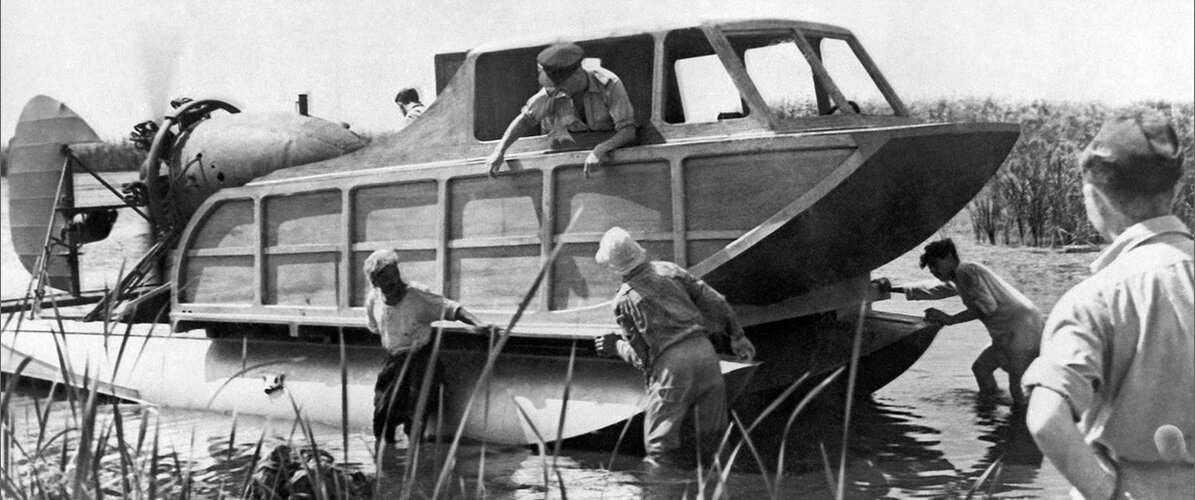
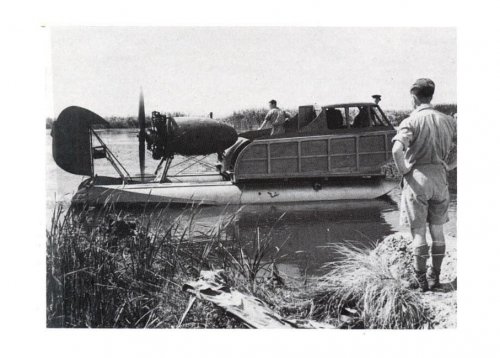
I received, via an anonimous reader, a picture of an unusual vehicle. Today my memory suffers for the corruption of some neurons and I don't remember if the same subject already appeared on this blog. I tried the function Search with the word 'hydroplane' but nothing of the same kind appeared...
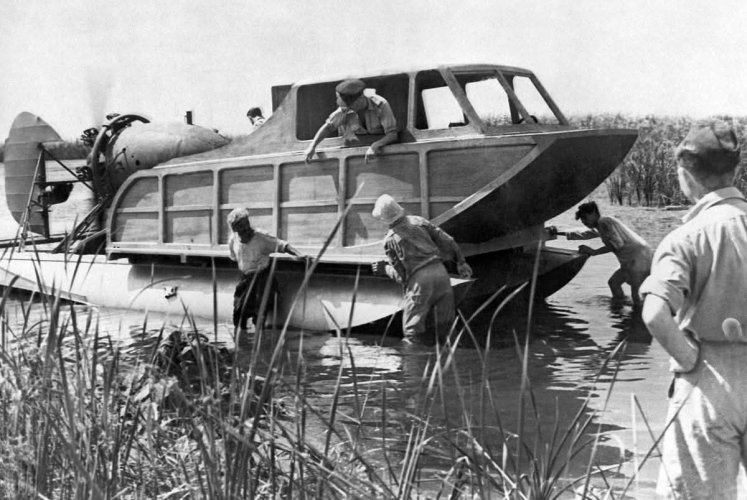
The strange vehicle was described as an 'hidroplane' (sic) and belonged to the RAF Western Desert Force in early forties. This sort of water sled was used to retrieve from swamps and rivers the downed aircrews.
The cabin seems to be a sort of station wagon, the floats probably are part of a seaplane, the engine seems to be a Bristol Pegasus with a nacelle from a Supermarine Walrus and the rudder is that of an Hawker Hind.
I published the same photo on the last issue of 'Eserciti nella Stori' (september) but it's to early to have some sort of talkback by the readers
Nico
 

Attachments

  • Hydroplane_RAF.jpg
    Hydroplane_RAF.jpg
    87 KB · Views: 748
The Italian name for this type of vehicle is Idroscrivolante and was proposed as a colonial shallow river craft . The type found most use as racing craft in the famous Pavia - Venezia motorboat race in the 1930's , piloted notabley by Theo Rossi many variants were used in the pre war years built mostly by SIAI Marchetti. One remaining Idro T108 has been restored for the Leonardo de Vinci museum in Milan and is currently stored at the Lake Como aero club . T 108 is driven by a 9 cylinder Alfa Romeo radial engine.
Idroscivolante+T108.jpg.html


http://hellasga.com/gallery/v/sotiropoulos/SOTIRO_COMO/Idroscivolante+T108.jpg.html?g2_imageViewsIndex=1
 
It's actually 'idroscivolante', not scrivolante, with the verb scivolare, which means to slip/to glide, so technically is like 'slipping onto water'. Google translate prefers airboat, I guess I will be pressed to agree :)
 
charley said:
Thank you for correcting my typo, I am new here and did not know how to edit the mistake.

No problem, didn't mean to sound like a smart-ass there :) Just thought a lot of people, who don't know the verb, could make the honest mistake and write it wrongly.
 
Grey Havoc said:
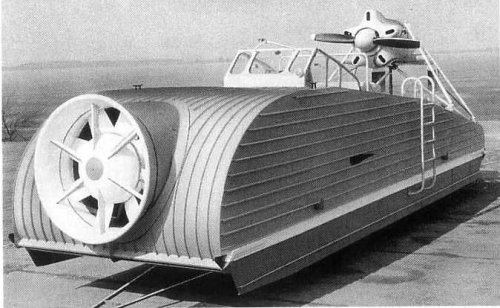
Interestingly, the East German Volksmarine seem to have done some work on this concept as well. ..

"Luftkissenfahrzeug" means air cushion vehicle and this seems to be supported by the object at the front,
that looks like an intake and by the given "Tiefgang" (draught) = 0m. What's not quite clear to me is, how the
single (mentioned) engine would have driven both the prop and a fan to produce the air cushion. Maybe
what appears like a strut, or just a fuel line actually is a transmission shaft.
Airboats on the other hand are kind of prop driven speed boats, I think.

BTW, thanks for those links about ships and projects of the GDR navy ! ;)
 
Found a frontal view of LKFz 1355 here <edit>posted image as attachment, in case something bad happens to its source
 

Attachments

  • LKF 1355.jpg
    LKF 1355.jpg
    70 KB · Views: 90
Jemiba said:
"Luftkissenfahrzeug" means air cushion vehicle and this seems to be supported by the object at the front,
that looks like an intake and by the given "Tiefgang" (draught) = 0m. What's not quite clear to me is, how the single (mentioned) engine would have driven both the propo and a fan to produce the air cushion. Maybe what appears like a strut, or just a fuel line actually is a transmission shaft.
Airboats on the other hand are kind of prop driven speed boats, I think.

Ack! I know my german is (very) rusty, but I still should have realised!
banghead.gif


BTW, thanks for those links about ships and projects of the GDR navy ! ;)

No problem, although thebig C and Michel Van deserve a lot of the credit.

By the way, thanks for the picture and link, Arjen
 
Grey Havoc said:
By the way, thanks for the picture and link, Arjen

Would second to this !
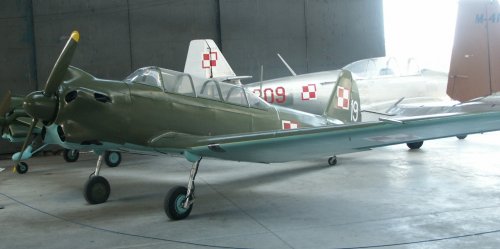
It looks as if the the complete engine with cowling was taken from the Yak 18 (photo from
http://en.wikipedia.org/wiki/File:Yak-18_PICT0032.JPG ). Considering size of the vehicle and
power of the Schwetzow M-11 (160 hp), I somewhat doubt, that there wasn't a second
engine powering the blower.
 

Attachments

  • Yak-18_PICT0032.JPG
    Yak-18_PICT0032.JPG
    240.4 KB · Views: 40
I wonder if they were developing it as a light patrol vehicle for the Grenzkommando Küste (CKK). The CKK was part of the Border Guards but under the operational control of the Volksmarine. The 6. Grenzbrigade Küste [6th Frontier Brigade Coast] was the sharp end of the CKK.
 

Attachments

  • RAF-Nile-Delta.jpg
    RAF-Nile-Delta.jpg
    227.4 KB · Views: 48
This machine is haunting me for many years.
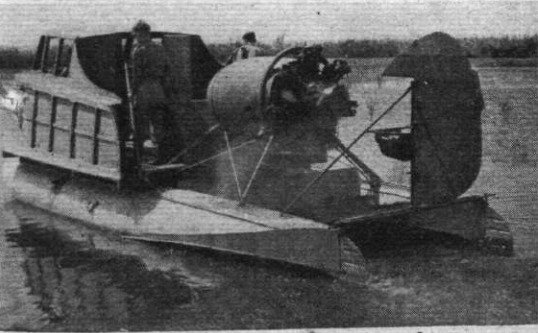
I believe the rudder is from a Hawker Demon. As far as I could check, there were Demons in North Africa and were obsolete by WW2, so a good candidate for being cannibalized. it's a derivative of Hawker Hart/Hind, but the Demon rudder is more similar to the one in the photo. The floats are probably from a Fairey IIIF, they look mostly from that aircraft than from a Swordfish or any other floatplane including captured Axis built. There were some IIIFs in North Africa and also mostly obsolete by 1942, when this device was built. The engine with the nacelle puzzled me a lot. I wish it would have been a Bristol Pegasus from a Supermarine Walrus, but it's not. The ring shouldn't be there and the engine should be much larger than the nacell. It's most probably an Armstrong-Siddeley Lynx and that third photo I have found shows that it's most probably a 7-cylinder engine which fits with this hypothesis. And then comes the question about the nacelle. it has the general shape of a Walrus nachelle but it doesn't quite fit in such details as the fittings. But I couldn't find a Lynx application in an aircraft with a similar nacelle, not another aircraft, British or captured Axis, with such a nacelle. So this is the last question that remains for me wide open. The other 3 - rudder, floats, engine - I consider them 95% closed.

tumblr_ogk1weMB2a1uryk28o3_540.jpg
 
Last edited:
https://amp.theatlantic.com/amp/photo/100140/
'This hydroplane is part of the R.A.F. rescue service in the Middle East. It operates on the lakes of the Nile Delta for the assistance of pilots who may make forced landings in the water. Consisting of a cabin mounted on seaplane flats it is driven by an aircraft engine and propeller mounted in the stern and steered by an aircraft rudder. There are also rudders on each of the floats. The top speed of the craft is about fifteen knots. Photo taken on March 11, 1942.'
AP Photo
 

Attachments

  • FB_IMG_1752317988168.jpg
    FB_IMG_1752317988168.jpg
    95.5 KB · Views: 38
Looks cobbled together--the top modified from an old boat cut away from a damaged lower hull?

It seems like the 1980s was when pontoon boats caught on with folks who lived on lakes--around Alabama at least.
 

Similar threads

Back
Top Bottom