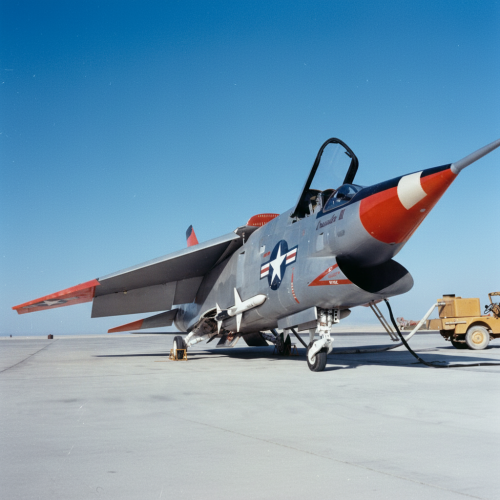
Mach 2 supercruise? Even the F-104 with the -19 couldn't do that. o_O
It wasn't supercruise by the definition that most use these days (i.e. the ability to accelerate to and maintain supersonic speed without the use of afterburner): Afterburner was required to get it up to speed and as ram-compression effects built-up, thrust reached a point that one could maintain speed when the afterburner was turned off.

The capability was remarkable for it's time, though the CF-105 and English Electric Lightning (AFAIK) fit the modern critera for supercruise (both flew before the XF8U-3, albeit the Arrow by a few months).

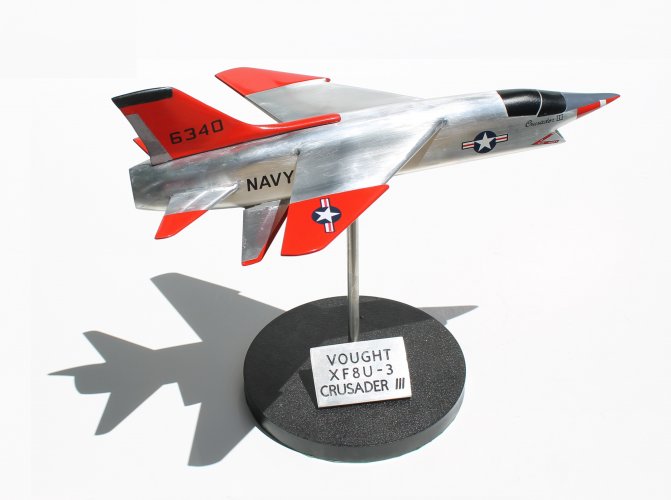
While the production designs were to have a five-staged afterburner, the prototypes (146340 and -41) had a simple on/off afterburner. This is an excerpt from Tommy Thomason's book
Vought F8U-3 Crusader: Naval Fighters Number Eighty-Seven (pp 46-47) said:
However, it was amazing at high Mach number, as we would typically throttle back at Mach 2 on our early test flights. We were limited by windshield and lower wing skin temperatures as higher Mach numbers were explored."

...."A typical flight would involve taking off from Edwards AFB and climbing to 40,000 feet to the east boundary of California. Here we would enter the supersonic corridor with a USAF F-104 chase airplane. We would accelerate out to Mach 2, throttle back at this speed, and run through our test plan. As we passed over Edwards we would drop subsonic and say goodbye to the 104, as he was about out of fuel. We would then pick up an F-100 chase for the remaining tests. As a former USAF fighter pilot, I got a perverse chuckle out of running their star fighter out of fuel half-way through our test plan."
 
Last edited:
It wasn't supercruise by the definition that most use these days (i.e. the ability to accelerate to and maintain supersonic speed without the use of afterburner): Afterburner was required to get it up to speed and as ram-compression effects built-up, thrust reached a point that one could maintain speed when the afterburner was turned off.

The capability was remarkable for it's time, though the CF-105 and English Electric Lightning (AFAIK) fit the modern critera for supercruise (both flew before the XF8U-3, albeit the Arrow by a few months).

While the production designs were to have a five-staged afterburner, the prototypes (146340 and -41) had a simple on/off afterburner. This is an excerpt from Tommy Thomason's book
It's impressive performance, definitely, but - "Throttle back" does not necessarily mean cutting the Afterburner. Nearly all afterburning jets will have some facility to throttle the core engine (Usually between 85%-90% to 100%) this also affects the afterburning thrust) This modulation allows conditions like a particular airspeed / Mach being held, or the changes in thrust levels needed in formation flight.
 
It's impressive performance, definitely, but - "Throttle back" does not necessarily mean cutting the Afterburner. Nearly all afterburning jets will have some facility to throttle the core engine (Usually between 85%-90% to 100%) this also affects the afterburning thrust) This modulation allows conditions like a particular airspeed / Mach being held, or the changes in thrust levels needed in formation flight.
Afterburner is the same lever as the throttle. You push forward to MIL, then past a detent of some kind to engage the afterburner.

Can't reduce core throttle setting without coming out of afterburner.
 
It's impressive performance, definitely, but - "Throttle back" does not necessarily mean cutting the Afterburner. Nearly all afterburning jets will have some facility to throttle the core engine (Usually between 85%-90% to 100%) this also affects the afterburning thrust) This modulation allows conditions like a particular airspeed / Mach being held, or the changes in thrust levels needed in formation flight.

Afterburner is the same lever as the throttle. You push forward to MIL, then past a detent of some kind to engage the afterburner.

Can't reduce core throttle setting without coming out of afterburner.
AIUI, youre both kinda right. In early afterburning jets, the burner was either all on or all off. But in later jets, you could adjust how much burner you used. The engine core was still at max power regardless in both types though.
 
AIUI, youre both kinda right. In early afterburning jets, the burner was either all on or all off. But in later jets, you could adjust how much burner you used. The engine core was still at max power regardless in both types though.
The J57 and J75 afterburners were On /Off, selected by moving the throttle outboard from the Mil stop. But in AB, the throttle could be retarded from the Mil stop a short distance in the outboard position, resulting in the main engine slowing down and reducing AB fuel flow a proportional amount, allowing for limited thrust modulation in AB. For P&W, it wasn’t until the J58 and TF30 where the AB had multiple zones, allowing thrust modulation from minimum to maximum AB while the basic engine remained at Mil power.
 
The J57 and J75 afterburners were On /Off, selected by moving the throttle outboard from the Mil stop. But in AB, the throttle could be retarded from the Mil stop a short distance in the outboard position, resulting in the main engine slowing down and reducing AB fuel flow a proportional amount, allowing for limited thrust modulation in AB. For P&W, it wasn’t until the J58 and TF30 where the AB had multiple zones, allowing thrust modulation from minimum to maximum AB while the basic engine remained at Mil power.
Doesn't have to be the MIL stop, but that's usually the way it works out. If you get a chance to look at the Throttle Quadrant on an F-105 or F-106, you'll see that the slot for moving the throttle to the AB range is actually parallel to the non-AB range as well, and both max out at the same point forward.
To quote from the F-105D/F Flight Operating Handbook:
"During NORMAL A/B operation a thrust variation is available, ranging between maximum available thrust and the equivalent of about 50 percent A/B thrust, by advancing or retarding the throttle to vary engine RPM. The thrust variation is due primarily to the change in thrust of the engine as the RPM is changed (approximately 6 percent RPM range is available) and the A/B thrust remains relatively constant."
 

Attachments

  • F-105D_Throttle-1.pdf
    205.8 KB · Views: 17
  • F-105D_AB_Operation.pdf
    251.6 KB · Views: 17
Last edited:
Thanks for the clarification on the throttle quadrant from the T.O.s.

The statement that the AB thrust remains relatively constant is somewhat misleading. The AB fuel controls used the main combustor pressure (Pb - burner pressure) as a measurement of total mass airflow thru the engine, and adjusted AB fuel flow to match that mass airflow, with a constant open nozzle position. When the throttle is retarded in the AB position to reduce RPM, the airflow and burner pressure is reduced, with a corresponding reduction in AB fuel flow and thrust, along with the core engine thrust being reduced.
 
Last edited:
Thanks for the clarification on the throttle quadrant from the T.O.s.

The statement that the AB thrust remains relatively constant is somewhat misleading. The AB fuel controls used the main combustor pressure (Pb - burner pressure) as a measurement of total mass airflow thru the engine, and adjusted AB fuel flow to match that mass airflow, with a constant open nozzle position. Went the throttle is retarded in the AB position to reduce RPM, the airflow and burner pressure is reduced, with a corresponding reduction in AB fuel flow and thrust, along with the core engine thrust being reduced.
Yes, quite so. If you think of the Afterburner as a ramjet operating in the exhaust gas of the core engine, (An early description of afterburning was Turboramjet), it's apparent that the afterburner's thrust is determined by the mass flow and temperature of the turbine exit.
 
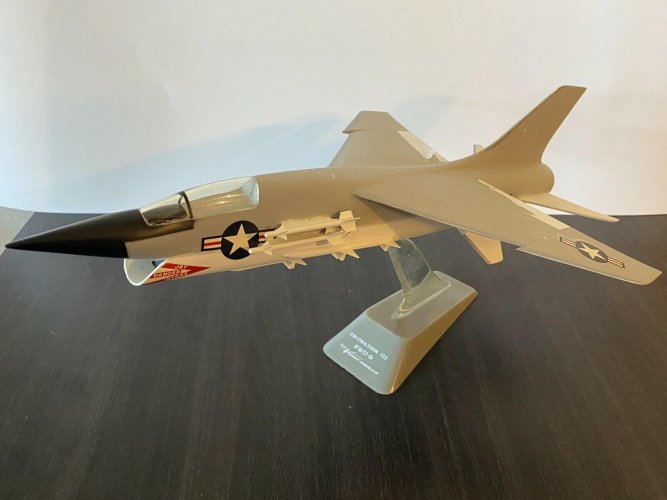
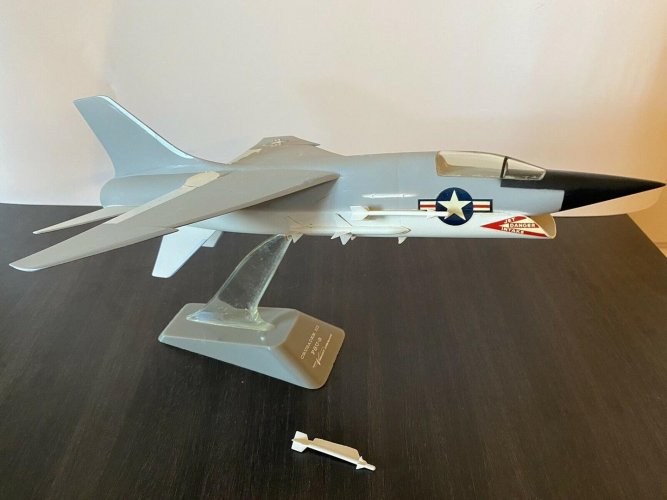
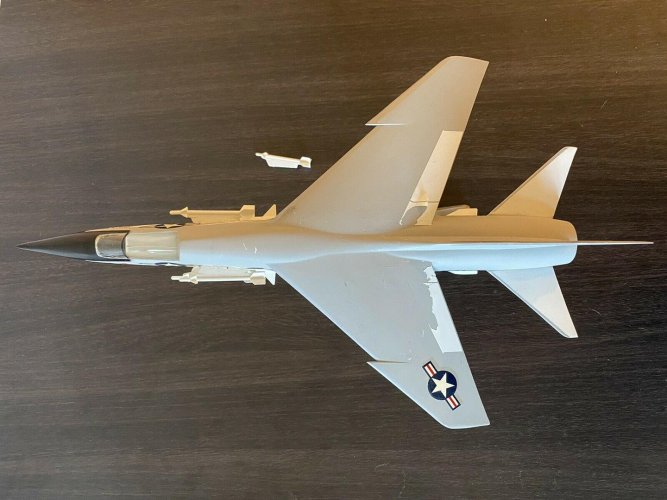
After reading more sources on XF8U-3, I can see it had some major early design flaws. The big central intake bottlenecked growth in the nose. No guns by design was a handicap. The nubs people assumed were for future guns was for IR sensors akin to what would become the lackluster Tiger Eyes program. The awkward folding fins. No realistic growth margin to add RIO. Failure to fit that fourth Sparrow. No accomodation for wing pylons, left it a single role in the prototype phase, which is phase you compared to the F-110. Pilot was overloaded when employing Sparrow. Sluggish rates of rise on takeoff. And its problem with keeping its engine operating smooth revealed the immaturity of its production execution. Must have looked like a cluster in comparison to F-110 as a carrier option. They failed to meet program minimums.
 
I think it's a somewhat harsh evaluation. At the prototype stage, both the F4H and XF8U-3 had a 24-inch radar dish, and in both cases, a 32-inch dish was intended for production aircraft. In fact, in the case of the XF8U-3, incorporation was planned to be even easier than in the Phantom, as it did not require any changes to the radome. Instead, part of the radar equipment was to be moved behind the cockpit. An even larger 36-inch dish was planned for later Phase I improvements.

The engine stall problems were almost completely eliminated during the II NPE (November 1959) and were not considered a serious issue at that stage. Military-power take-off issues were to be remedied by BLC; the afterburner ones were never a problem. The landing qualities - even though Vought was struggling to meet the stall-speed specifications - were already better than in the F8U-1.

While the XF8U-3 had no provisions for wing pylons, the F-8E was already flying with them in 1962, and, taking into account the similarities in wing construction between the U-1 and U-3, it should not have been a problem to fit them to the Crusader III. It is worth remembering that the XF8U-3 had a massive advantage over the Phantom in terms of range: with maximum Sparrow loadout and internal fuel only, it was 1755 nm vs 1126 nm (F-4B SAC data). Therefore, to match the operational range of the Crusader, the Phantom had to sacrifice some hardpoints/loadout to carry additional fuel tanks, which would have made the eventual differences in payload marginal (assuming the addition of pylons).

The single-seat, three-Sparrow configuration was a conscious design choice and, in fact, the pilots were quite pleased with the simulated workload — the Navy’s main concern was that under adverse operational conditions, the workload would be much higher than in simulations. A two-seat configuration was considered an option, but Vought decided that an additional 1800 lbs and slower transonic acceleration (2.9 min for 0.9 to 1.7M vs 2.3 min for the single-seat) were simply not worth it. In the end, the Navy decided otherwise, but it was still a decision based more on philosophy than on negative real-life experience from the prototypes’ fly-off. I would not say that Vought failed to meet the program’s minimums - the Navy wanted the XF8U-3 to present a different approach than the F-4 to the same mission, to have options in case of J79 program failure. Despite a much less competitive engine option, the XF8U-3 still had significant advantages over the F4H in a number of areas - range, maneuverability, speed, cost, etc. It just turned out that the J79 was a huge success, and from the very beginning, the Navy had a preference for a two-engine, two-seat configuration, which ultimately proved to be the deciding factor.
 
When the program lists 4 Sparrows and you do 3, that is a.pretty significant fudge in design. Now if you showed up with 3 Sparrows and an M61 Vulcan, like on the Corsair II in 1965, it sparks my interests. The J75 was the right engine, but it makes me wonder what twin J57s or twin J79s would have done as far as room for future growth, especily to get the RIO. I cannot imagine a pilot sitting in front of his radar dish, even if it is not the transmitters. And from what I read, they never solved the sluggish takeoffs from brake release. But F-110 won on raw utility. It was demonstrated as multipurpose and had an amazing radar. Navy big nose F-4s were better in my opinion than what would filter down to the USAF. Since the USAF was more loyal to XF8U-3, its a wonder it didn't at least get orders for them.
 
The J75 was the right engine, but it makes me wonder what twin J57s or twin J79s would have done as far as room for future growth, especily to get the RIO.
I did ask this in an AH scenario.
Because it struck me, that Vought ought to have produced a twin engined Crusader type design and it's a bit odd nothing like that seems to have been found to my knowledge.

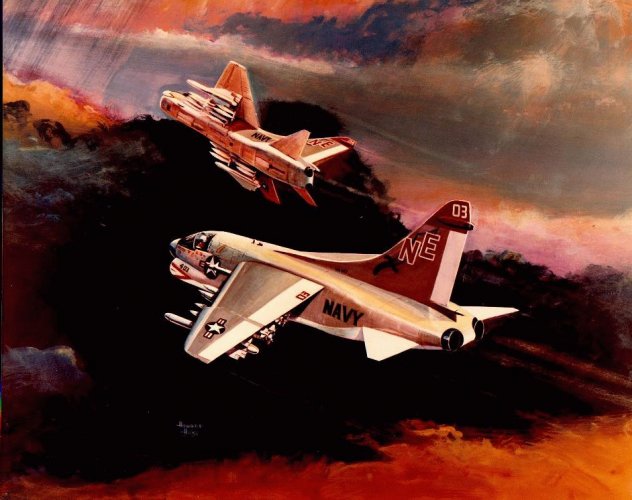
Yet later on a twin engined Corsair design was produced.
 
Yet later on a twin engined Corsair design was produced.

I did not realize they did! Very cool find.

posted by overscan (PaulMM)
https://www.secretprojects.co.uk/threads/vought-v-529-v-531-twin-engined-corsair-ii-projects.15851/
Twin-engined Corsair proposed

A TWIN F404-engined version of the Corsair II has been proposed by Vought as a future US Navy light attack aircraft. The two General Electric engines would total over 50 per cent more thrust than the single 15,000lb Allison of the A-7E. Vought has already built more than 400 A-7Es, and the type is in service with 24 USN squadrons. Although the force has so far flown for more than 750,000hr, the manufacturer claims that a typical squadron aircraft has more than 17 years of service life left and could soldier on into the 1990s. The proposed V-529D version is almost identical to the A-7E except for the two F404 engines, new tailpipes and a wider rear fuselage to house them, and 20in fuselage stretch to keep the e.g. within limits. Both engines would be fed from the existing nose intake, a bifurcated duct splitting the incoming airflow between the two powerplants. Maximum rear fuselage width would be only 29in greater than at present. Empty weight would rise from 19,050lb (A-7E) to 19,952lb as a result, but the internal fuel load would rise from 10,036lb to 12,674lb. The F404 will power the Navy's F-18 fighter, so its use in a modified Corsair would provide useful commonality. Vought does not plan to build all new V-529Ds, suggesting to the US Navy that existing A-7Es be rebuilt. Unit cost of the modification would be less than $3 million, the company claims. Vought has teamed up with General Electric and Grumman. Given a prompt go-ahead by the Navy, the companies hope to start ground tests early next year. First flight would be scheduled for 1979.
http://www.flightglobal.com/pdfarchive/view/1977/1977 - 3858.html
 

Attachments

  • Vought V-529 twin A-7.jpg
    Vought V-529 twin A-7.jpg
    106.9 KB · Views: 52
Last edited by a moderator:

Similar threads

Back
Top Bottom