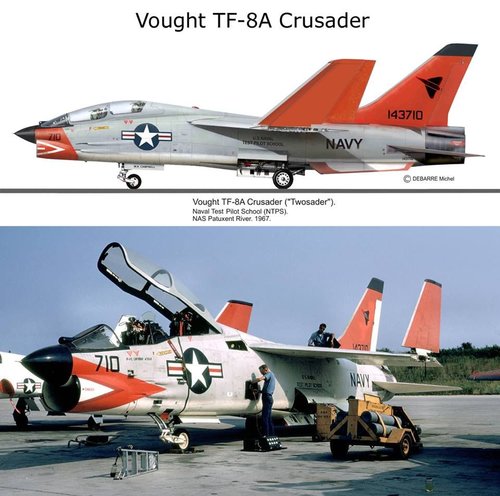
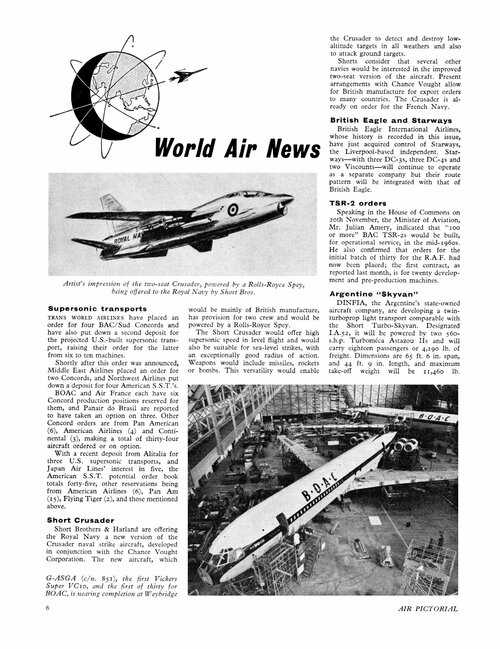
...and also from Foch and Clemenceau. The spey would much shorter than old J57, the shorter rear fuselage would help at launch
from the carrier, making the variable incidence wing (and improved blown flaps done OTL by the French to help further) far less necessary.
40*2.54 cm = 1 m shorter !
Also a 100 pound / 450 kg weight gain (491 kg, actually).
The Crusader variable incidence wing really happened because the bulky J57 needed a very long aft fuselage. There was a very real risk that the rear fuselage would hit the deck when the Crusader took the angle of attack (AoA) it needed for liftoff. So instead they made a wing with a changeable AoA - a variable incidence wing.
And for the French it was even worse, as the Clemenceaus were barely the size of upgraded Essex carriers, not even mentionning the Midway and Forrestal and Kitty Hawk and Nimitz. We had to improve the blown flap system.
Now had the Crusader engine been replaced by a shorter one (J79, Spey, whatever) allowing the rear fuselage to be truncated, the issue would have vanished.
from the carrier, making the variable incidence wing (and improved blown flaps done OTL by the French to help further) far less necessary.
Spey general characteristics
- Type: Low bypass turbofan
- Length: 204.9 in (5204.4 mm)
- Diameter: 43.0 in (1092.2 mm)
- Dry weight: 4,093 lb (1856 kg)
J57 general characteristics
- Type: Afterburning turbojet
- Length: 244 in (6197.6mm)
- Diameter: 39 in (990.6mm)
- Dry weight: 5,175 lb (2,347 kg)
40*2.54 cm = 1 m shorter !
Also a 100 pound / 450 kg weight gain (491 kg, actually).
The Crusader variable incidence wing really happened because the bulky J57 needed a very long aft fuselage. There was a very real risk that the rear fuselage would hit the deck when the Crusader took the angle of attack (AoA) it needed for liftoff. So instead they made a wing with a changeable AoA - a variable incidence wing.
And for the French it was even worse, as the Clemenceaus were barely the size of upgraded Essex carriers, not even mentionning the Midway and Forrestal and Kitty Hawk and Nimitz. We had to improve the blown flap system.
Now had the Crusader engine been replaced by a shorter one (J79, Spey, whatever) allowing the rear fuselage to be truncated, the issue would have vanished.
Last edited: