Actually, wing sweep was known in the aeronautical community before the war.
Yes of course, at theoretical level.
That's why it is hard to find swept wing aircraft fighter before the WWII.

I repeat, in Italy the Guidonia Research Center has conducted a lot of aerodynamical researches in several directions but none (as far as I know) in the direction of swept wings.
 
Personally, I think that the likely fake version of the Re.2007 had to do with the Re.2000 debacle. Longhi already had one "copyright" issue on his hands with the Re.2000 VS P-35, he didn't need another with a "swept wing, fuselage intake, tricycle configuration" with the Re.2008 VS F-86. Essentially, in my opinion it was a "See we DID have something like this already so we aren't copying again!" idea.
 
Personally, I think that the likely fake version of the Re.2007 had to do with the Re.2000 debacle. Longhi already had one "copyright" issue on his hands with the Re.2000 VS P-35, he didn't need another with a "swept wing, fuselage intake, tricycle configuration" with the Re.2008 VS F-86. Essentially, in my opinion it was a "See we DID have something like this already so we aren't copying again!" idea.
“se non è vero, è molto ben trovato”:)
 
This Italian fighter I'm not sure if it is fake but I do know that are you sure this is a world war II design because it could have been designed after the war and how do you even know that these are even swept wings or if they're just slightly swept like the 262 are they even swept wings at all etc also there's clearly a lot of material of it so...regardless why are we even arguing about it etc all of this is making me very confused this design clearly regardless of existed or not exists maybe the Italians just drew this out of randomness in the hopes of something cuz let's be honest the Italians at this point were just shooting in the dark hey by the end of the war they were technically on the Allies side so maybe this could just be an allied aircraft I don't know etc...
 
On this website I heard them all, "Titanium was unknown in the US", "pressurized suits for use above 40k feet during ww2 were impressive", "Idk who Arturo Gaviraghi was, probably an amateur designer, maybe just a guy with drawing skills, those aren't real designs at all", and now we can add to the list "Italian designers were unaware of swept wings"...
 
I have a (potential) lore update for this! In a thread about the SAI 404/504 ground attack (?) aircraft, I stumbled across the Caproni R.105:
https://www.facebook.com/share/p/1CpSV6t3H4/
The Caproni R.105 was a jet fighter project from January 1945 that apparently was also considered for turboprop usage. When looking at the drawing (especially the tail section), one can see how the design was carried over from the Caproni-Vizzola fighter designs. Where this gets good is when one remembers that the Reggiane company was a part of the Caproni group. This means that Reggiane actually did have access to materials for knowing how to convert designs into jet fighters, among other related things. Whether or not Reggiane used this is still up in the air (no pun intended), of course, but it wouldn't be surprising if they did given Capronis own designs.
 
Is this, perhaps, the final confirmation? Is anyone able to do any upscaling work on the photo to see the dates of creation for the aircraft?
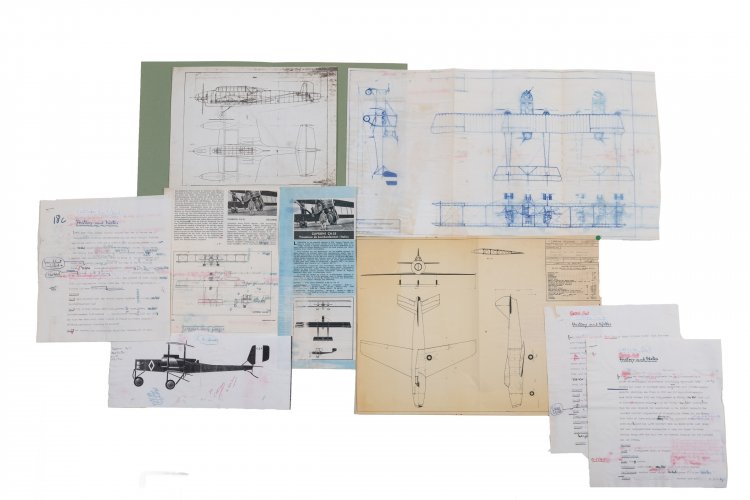
I asked Nico if he knew how the blueprints of the Re2007 ended up in the Caproni collection at Mallams but he didn't say anything
 
I asked Nico if he knew how the blueprints of the Re2007 ended up in the Caproni collection at Mallams but he didn't say anything
Reggiane was a part of Caproni, so that could be why. (Sorry if you already knew that, but I think it was good to share.) I guess it got to Mallams through sharing/trading over time.
 
Reggiane was a part of Caproni, so that could be why. (Sorry if you already knew that, but I think it was good to share.) I guess it got to Mallams through sharing/trading over time.
Of course but the Re2007 blueprints are said to be post war fakes, not made by Reggiane, so they shouldn't be in their archives.
 
Yes: I don't know where now is the large scale sectional view of the RE 2007.
About that mattera I would add something. Longhi's alleged engineering degree is questionable, as this possibility doesn't fit into his biography: in 1927, Longhi was working as a purser (an administrative role) for a shipping company, and during a trip he met industrialist Giuseppe Bellanca, who convinced him to settle in the United States to work on airplanes. He did so, and held organizational positions in small industries (Bellanca and Burnelli), before attempting to set up his own business, with little success. In this regard, Marco Gueli (a respected expert on Italian aeronautical history) wrote in "Storia Militare" No. 266, page 16: "Neither the precise date of his graduation in 1927 nor the American university that awarded it are known."
Caproni was impressed by his management skills, his resourcefulness, and the fact that he had gained an insider's perspective on industries that operated with more advanced technologies than those available in Italy. During several meetings and interviews, Longhi consistently told me that he had indeed taken inspiration from the P-35, but that he had designed a new wing with a profile resulting from the interpolation of the P-39's with the NACA N-38. However, this was not the case: the Re 2000 was, in fact, based on the Clark YH wing profile, which was quite different.
At the end of February 1938, Longhi moved into the Reggiane's Reggio Emilia plant, where he had brought several large trunks (presumably containing the construction plans for the American Seversky P-35 fighter and samples of light alloys such as Dural and Alclad).
The discerning Italian bureaucracy likely overlooked the fact that Longhi lacked the credentials to "sign off" the designs. In fact, he held the title of experimental workshop manager until September 1939, when he was appointed head of the experimental construction factory, and from May 1941 onwards, he became a technical inspector. However, everyone believed he was "Engineer Longhi," and Robert staged a charade, creating a fake technical office inside the factory. Every morning, a team of workers would arrive to impersonate his assistants, busy designing the RE 2000.
In reality, the task of converting the project from the imperial to the decimal metric system, introducing significant modifications such as a new landing gear designed by engineer Virgilio Vardanega, modifications to the wing and the engine cowling design, was assigned to engineer Giuseppe Pambianchi, a competent engineer who had already been consulted several manufacturers for "rescues" or situations requiring confidentiality. Pambianchi had participated in the design work on the Meridionali Ro. 37 and Ro. 41 from 1934 to 1936, when the Neapolitan company still lacked a full technical office. From March 1, 1938, he was head of the aviation technical office of the Caproni Studies and Patents Company, where he worked alongside the inventive engineer Giovanni Pegna. When Pegna left the Caproni group, Pambianchi moved to the Officine Reggiane factory, where he was the actual technical director until October 15, 1941.
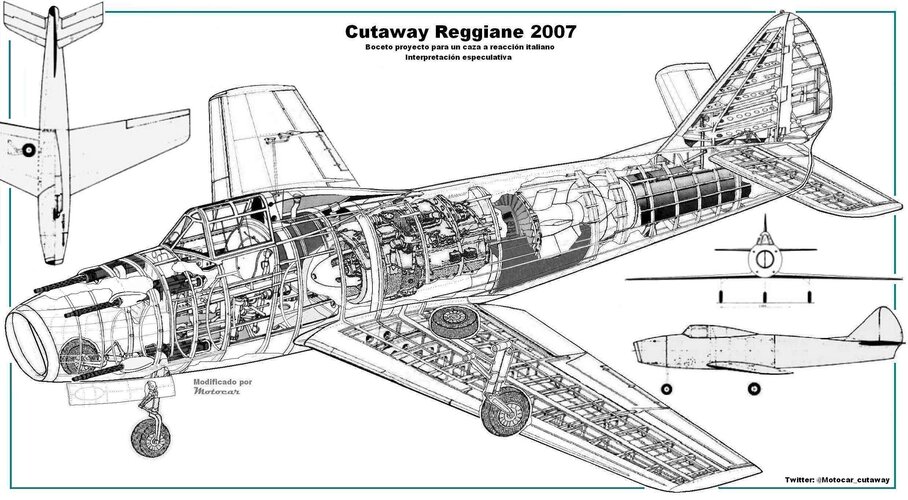
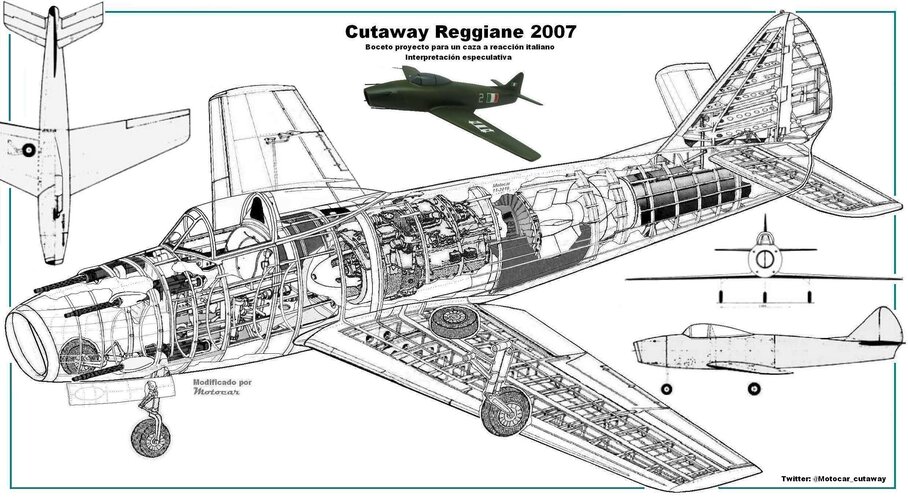
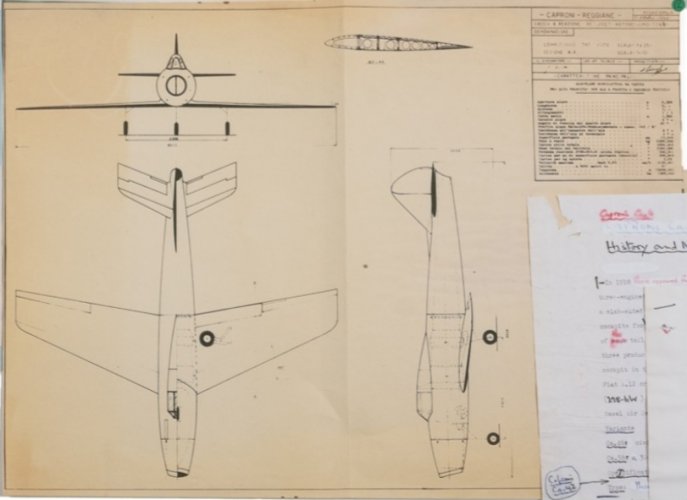
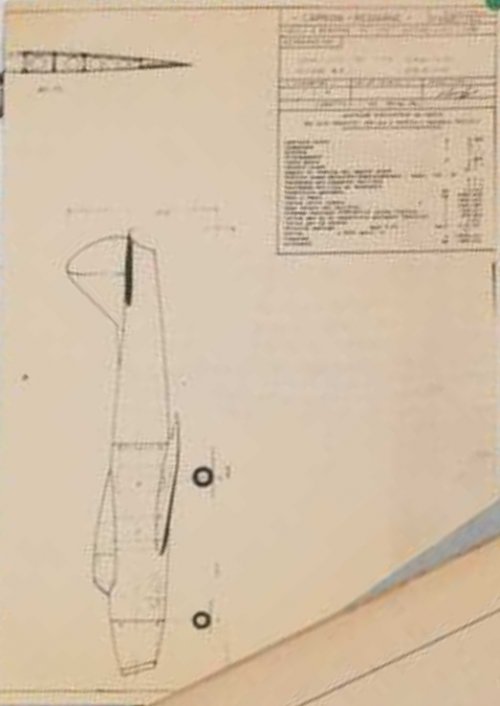
Regarding the RE 2007, I agree with what Sky wrote and, to some extent, with Justo. In 1968, I had the opportunity to see the original cross-section drawing of the RE 2007, and it was clearly visible that the wing, swept at 20° and with marked negative dihedral, appeared to have been added later. Under the same circumstances, the three-view drawing of the Caproni-Reggiane Ca.2008 project also appeared, an apparent reworking of the same RE 2007, which bore a certain resemblance to the North American F-86 Sabre. For sure all the paperwork related to RE 2007 was made after the end of WW II.
Evidently, Longhi and Caproni's idea was an attempt to meet the Italian Air Force's specifications for an advanced trainer, a solution that was later found in the sale of the T-33s from the US.

 
Regarding the RE 2007, I agree with what Sky wrote and, to some extent, with Justo. In 1968, I had the opportunity to see the original cross-section drawing of the RE 2007, and it was clearly visible that the wing, swept at 20° and with marked negative dihedral, appeared to have been added later. Under the same circumstances, the three-view drawing of the Caproni-Reggiane Ca.2008 project also appeared, an apparent reworking of the same RE 2007, which bore a certain resemblance to the North American F-86 Sabre. For sure all the paperwork related to RE 2007 was made after the end of WW II.
Incredible info. So based on what we have, the swept wing very well was likely added in the post war era. However, did a jet design of some sort still exist regardless since you mentioned only the engine being added post war?
 
Thank you Archipepee. About the post of Airborne2001, Skybolt and several others (as Giorgio Apostolo) said that all the paperwork related to RE 2007 was originated postwar on blueprint paper and letterhead of Caproni Group or Caproni-Reggiane, I guess about 1947.
My opinion is that Caproni and Longhi intended find a place in the process of rebuilding of the Aeronautica Militare and Longhi suggested something in the class of the P-80/F-80/T-33 Shooting Star, same idea had Gabrielli (FIAT Aviazione) and Casiraghi (Piaggio), with their G.80 and P.146). As the Casiraghi's aircraft and other in the family of Sagittario by Sergio Stefanutti had a more fashionable swept wing, later on, Longhi asked Cometti to add in the sectional view of RE 2007 a mofication suggesting the idea of a swept wing. All the RE 2007 drawings were the reworked (may-june 1949?) in the Caproni-Reggiane Ca.2008.
 
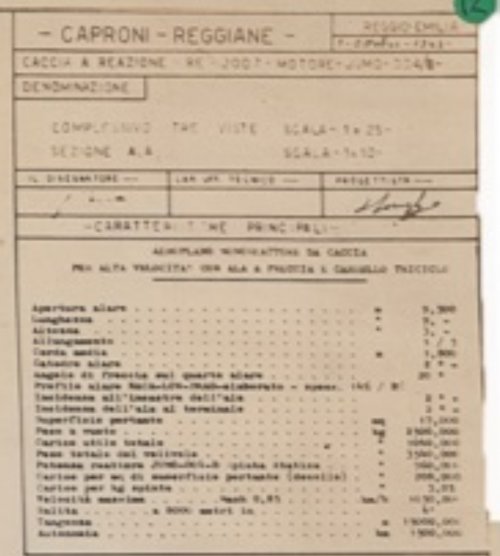
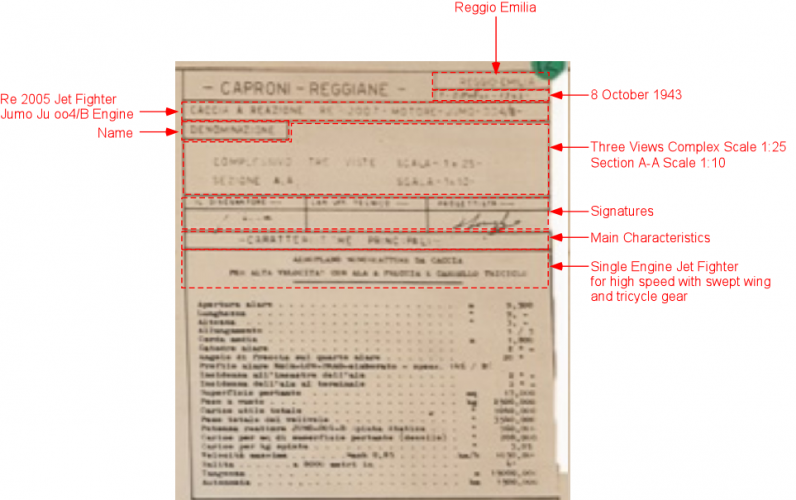
I agree with you Nico, such "cartiglio" (cartouche) could be easily retouched after the war.
My idea is that, maybe, Reggiane was really thinking about a jet fighter in mid-1943 but probably was a simple Re.2006's conversion and such blueprint could belong to this early aircraft.
After the war the same blueprint was reworked in order to make the Re.2007 more similiar to the F-86 (at that times already known) leaving in place the original date.
 
I agree with you Nico, such "cartiglio" (cartouche) could be easily retouched after the war.
My idea is that, maybe, Reggiane was really thinking about a jet fighter in mid-1943 but probably was a simple Re.2006's conversion and such blueprint could belong to this early aircraft.
After the war the same blueprint was reworked in order to make the Re.2007 more similiar to the F-86 (at that times already known) leaving in place the original date.

As the Casiraghi's aircraft and other in the family of Sagittario by Sergio Stefanutti had a more fashionable swept wing, later on, Longhi asked Cometti to add in the sectional view of RE 2007 a mofication suggesting the idea of a swept wing. All the RE 2007 drawings were the reworked (may-june 1949?) in the Caproni-Reggiane Ca.2008.
I think you two got it. Reggiane very well probably did have a jet aircraft project (that wasn't the Re.2005R) in the works during WWII, but probably without any swept wing. It was then likely changed post-war to try and appear more credible as a competitor for aviation designs to put Italy back on the map with its aviation industry. I do also agree with some (and myself lol) who have said that it may have been to avoid copyright with the F-86 given the Ca.2008 looked remarkably similar to it.
 
So, then, the original Re2007 concept might have been a straight-winged design, similar to NAA's early straight-winged Sare designs with the swept wing added later? I wonder if the original concept used a Re2005 wing? With a tricycle gear, you'd need to be careful about wing position and CG. OTOH, I could see a Re2005R or Re2006R as a quick approach to getting a jet fighter flying.
 
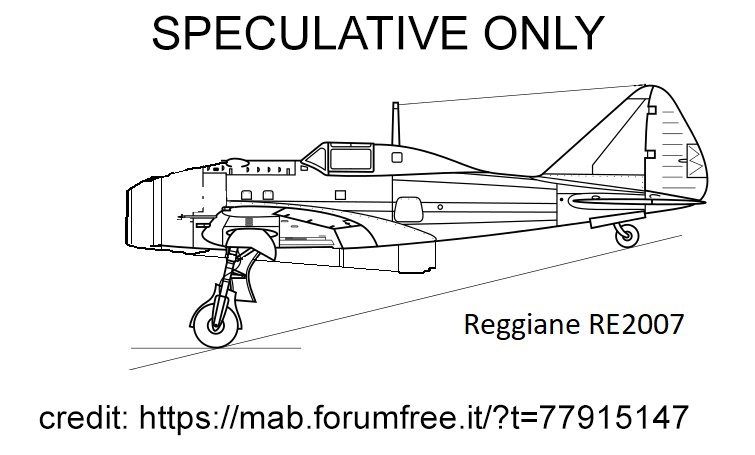
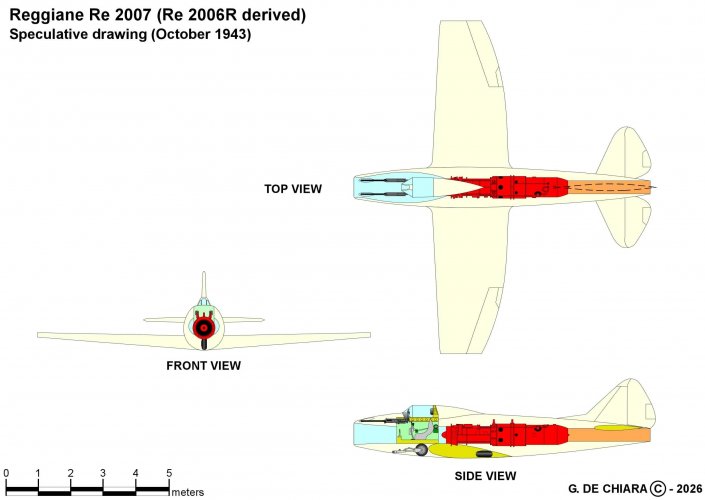
This is my personal interpretation of the real Re.2007.

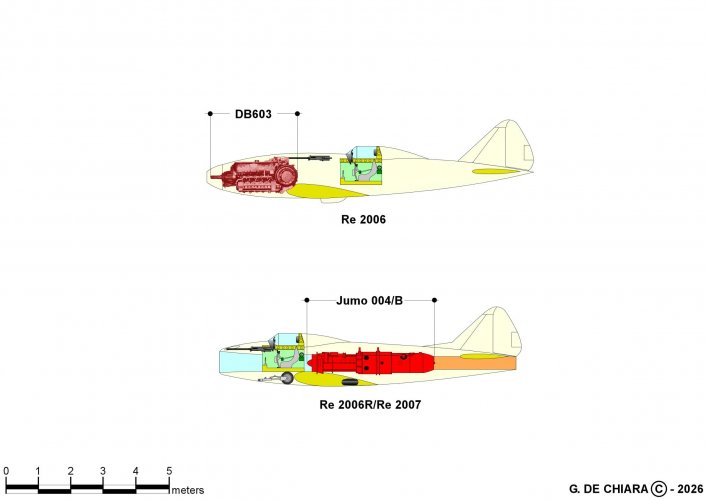
I do really believe that the Longhi/Pambianchi team elaborated a draft proposal of jet fighter in mid-1943, based upon the best propulsion unit they had heard about it: the Junkers Jumo 004/B.

Obiviously, the starting point of such new fighter must be the already designed Re.2006.
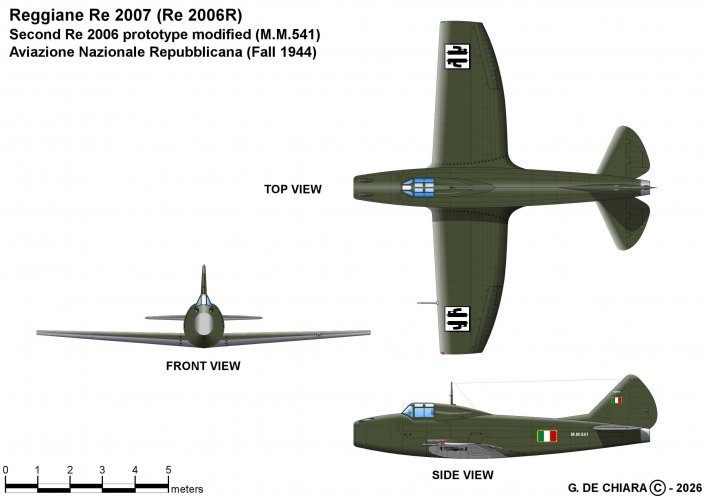
According to what @Nico reported in his "Prototipi della Regia Aeronautica" ("Prototypes of the Regia Aeronautica", Delta Editrice - 2008, page 43) Longhi and Pambianchi would modify the second Re.2006 prototype (MM. 541) turning it into a jet fighter (maybe Re.2006R/2007) with one of the two Jumo 004/B asked by Italy to Germany during 1943 (for sure before the Armistice of September 1943).

What comes out by the above reasoning is for sure more realistic aircraft than the F-86ish lookalike that appeared after the WWII under the designation of "Re.2007/Ca.2008".
No swept wings/empennages, no pointed nose, no chubby centrifugal reaction engine.
Only such configuration could represent the most likely jet fighter that Italy could really afford in the 1943/44 timeframe, given knowledge and technologies available at that time.

What we have at the end is a modified Re.2006 with clipped wingtips (like some Spitfires had during wartime), in order to move from the 11 meters wingspan of the Re.2006 to the 9,5 meters wingspan of the Re.2006R/Re.2007.

Anyway such conceptual sketch worths my two cents...

Reggiane Re 2007_01.jpg Reggiane Re 2007_02.jpg
 
Last edited:
Hi Peppe, Airborne2001 and elmayerle,
after your latest posts I was reminded that, during one of our meetings, Robert Longhi had told me that he didn't like Ferri's idea for a RE 2005(R) and didn't think it was valid. Pambianchi (whom Longhi had always avoided naming) was no longer at Reggiane at the time, and in fact, all the drawings for the RE 2005, the first of which was dated June 15, 1943, were signed by Eng. Giuseppe Maraschini. So it's possible that in the second half of 1943, Longhi had suggested to Maraschini a RE 2006R that would probably have been similar to Archipeppe's design. After the war, with further modifications (Cometti said that requests for corrections were continuous), he switched from the Jumo 004 engine to a more readily available British turbojet.
 
Hi,

I think that as I understand,there was a real Re.2007,but we don't
have its drawing, right ?
 
Hi Peppe, Airborne2001 and elmayerle,
after your latest posts I was reminded that, during one of our meetings, Robert Longhi had told me that he didn't like Ferri's idea for a RE 2005(R) and didn't think it was valid. Pambianchi (whom Longhi had always avoided naming) was no longer at Reggiane at the time, and in fact, all the drawings for the RE 2005, the first of which was dated June 15, 1943, were signed by Eng. Giuseppe Maraschini. So it's possible that in the second half of 1943, Longhi had suggested to Maraschini a RE 2006R that would probably have been similar to Archipeppe's design. After the war, with further modifications (Cometti said that requests for corrections were continuous), he switched from the Jumo 004 engine to a more readily available British turbojet.
Thank you so much Nico, apart for the details, I'm glad that I've nailed it.

Hi,

I think that as I understand,there was a real Re.2007,but we don't
have its drawing, right ?
No we don't have it (as far as I know).

All I can do is transform my skecth into a real Re.2007 three views and take it as baseline until the moment (I hope so) a real blueprint will sort out in future from somewhere....
 
I can't help but think that a Re2006R done similar to the Yak-15 would be plausible, the main landing gear of the Re2005/Re2006 would be well-suited to that whereas the G.55/G.56 and MC205/206/207 main landing gears sweep through where such and installation would have the jet exhaust.

If development had continued post-war, I could see the wing planform going from clipped to one more like that of the P-47N. I've got a 1/100 P-47N whose wings I could clone and splice into 1/72 Re2005 or Re2006 wings.
 
I can't help but think that a Re2006R done similar to the Yak-15 would be plausible, the main landing gear of the Re2005/Re2006 would be well-suited to that whereas the G.55/G.56 and MC205/206/207 main landing gears sweep through where such and installation would have the jet exhaust.

If development had continued post-war, I could see the wing planform going from clipped to one more like that of the P-47N. I've got a 1/100 P-47N whose wings I could clone and splice into 1/72 Re2005 or Re2006 wings.
Nope.
You refers to @Justo Miranda nice work but it clearly a fantasy.
That was the Ambrosini's philosophy carried out after the War (in the early 50's) with the Sagittario, and later with Aerfer/Stefanutti Ariete and Leone.

The Re.2007 bore some not so coincidental resemblance with the later FMA IA-27 Pulqui.
Not so coincidental, because it was designed in Argentina by both Emile Dewoitine and Cesare Pallavicino.
Pallavicino was the head designer for Caproni firm before and during the War and Count Caproni also owned the Reggiane firm.

In this sense Pallavicino could have access to the Re 2006R/2007 blueprints and data during its design phase.
 
Last edited:
The Re.2007 bore some not so coincidental resemblance with the later FMA IA-27 Pulqui.
Not so coincidental, because it was designed in Argentina by both Emile Dewoitine and Cesare Pallavicino.
Pallavicino was the head designer for Caproni firm before and during the War and Count Caproni also owned the Reggiane firm.

In this sense Pallavicino could have access to the Re 2006R/2007 blueprints and data during its design phase.
This is some good info! So the Pulqui I in theory can give us a look into what the Re.2007 may have looked like during the war. I see some similarities in looks with the theoretical you posted earlier this week.
 
Thanks @Nico and all other folks who help me with their inputs, I was able to do my best effort to reconstruct the design of the "real" Re. 2007.

In my opinion the original design should look more like the following artwork than anything else.

Reggiane Re 2007_00.jpg
 
Last edited:

Similar threads

Back
Top Bottom