starviking

ACCESS: Top Secret
Senior Member
Joined
29 September 2006
Messages
1,881
Reaction score
1,624

Attachments

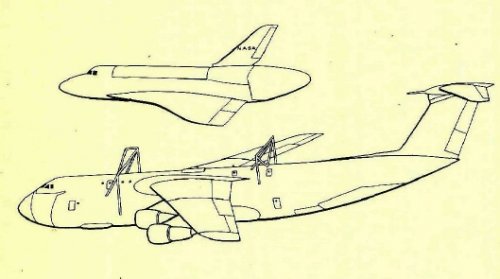
  • C-5 Shuttle Carrier.jpg
    C-5 Shuttle Carrier.jpg
    73.9 KB · Views: 791
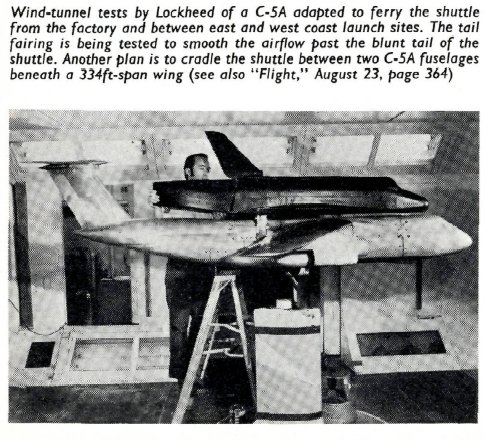
  • C-5 Shuttle Wind-tunnel.jpg
    C-5 Shuttle Wind-tunnel.jpg
    163.9 KB · Views: 767
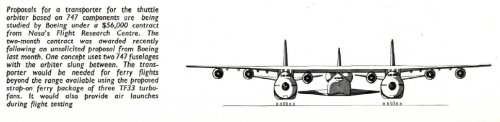
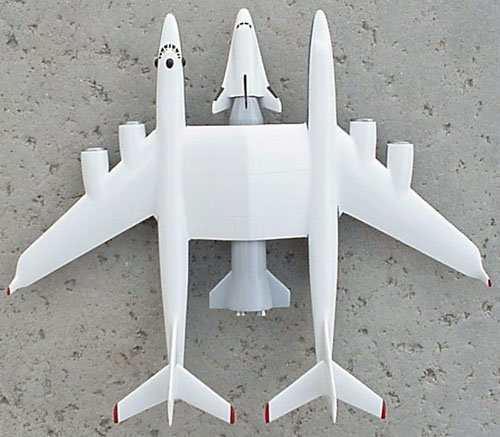
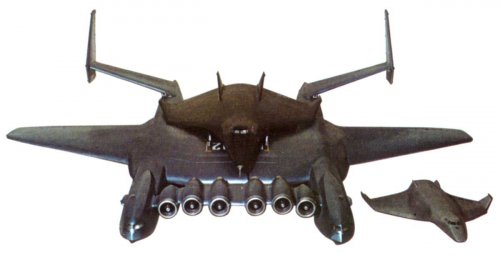
  • Twin 747 Shuttle Carrier.jpg
    Twin 747 Shuttle Carrier.jpg
    95.3 KB · Views: 384
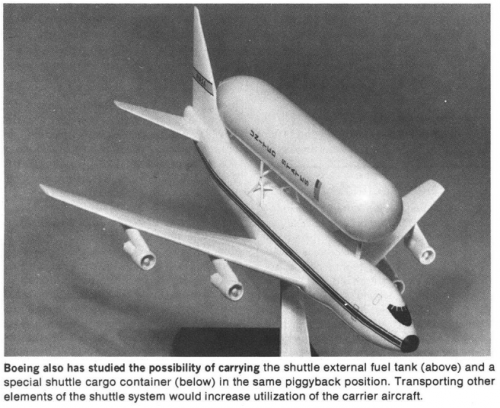
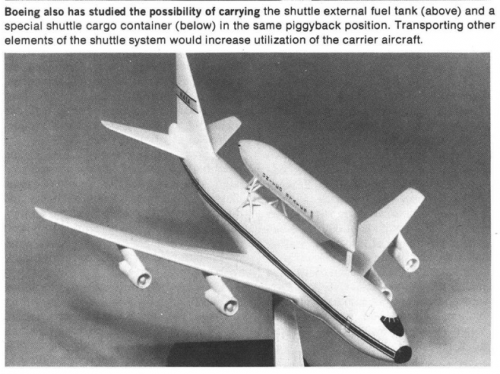
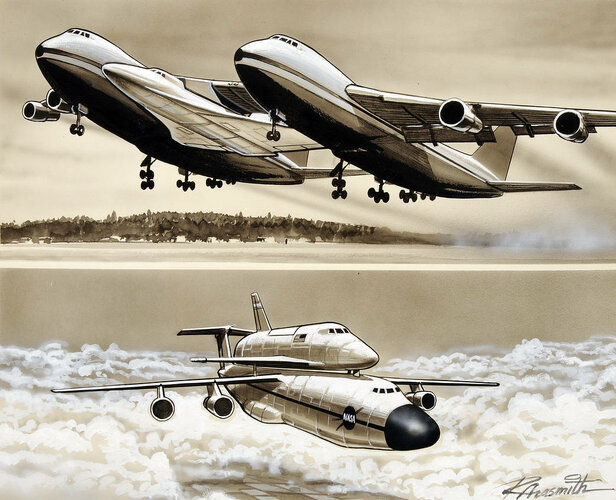
From a strict technical point of view : is a twin-747 feasible ? I'm just curious...
 
Well, the Twin 747 is a Boeing proposal, so I guess it must have some possibility. There'd have to be some serious beefing up of the centre-wing though...
 
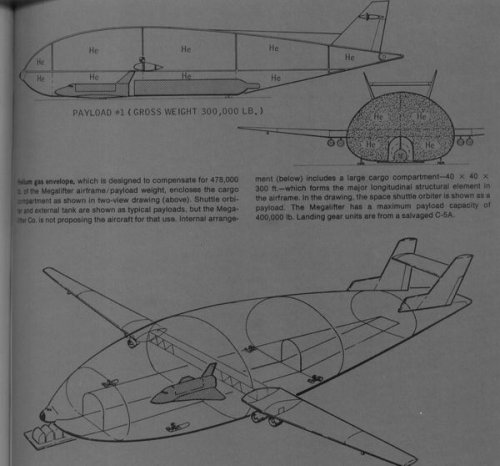
I still prefer this transport .. ;D
(from Aviation Week 1/1974, see http://www.secretprojects.co.uk/forum/index.php/topic,2759.0/highlight,megalifter.html) )
 

Attachments

  • NASA-hybrid-HL-3.jpg
    NASA-hybrid-HL-3.jpg
    42.3 KB · Views: 552
Twin C-5A were also considered for TSTO or SSTO studies in the 70's (again, from Lindroos website)
 
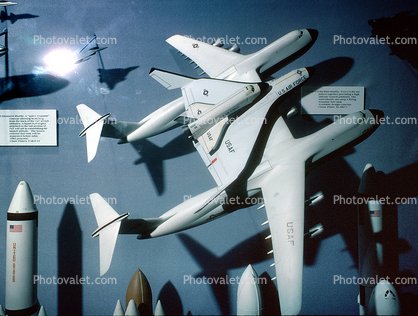
Hi,

http://photovalet.com/182347
 

Attachments

  • USRV01P03_12.jpg
    USRV01P03_12.jpg
    180.9 KB · Views: 599
Anybody can identify what is that beast from hesham post?

Thanks in advance,

Antonio
 
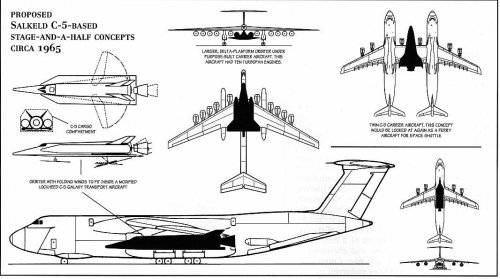
Archibald refers to the Salkeld studies.
Here's the link where I found it at: http://www.capcomespace.net/dossiers/espace_US/shuttle/1960-80/

Hesham, good find.

Moonbat
 

Attachments

  • 1965%20salkeld.jpg
    1965%20salkeld.jpg
    76.7 KB · Views: 680
Thanks a lot Moonbat,

this scan seems to be taken from Dennis R. Jenkins "Space Shuttle" but can't find referenced to Salkeld Studies in my copy which is 1992's first edition...maybe is time to consider to purchase a 3rd edition copy.
 
pometablava said:
Anybody can identify what is that beast from hesham post?

Thanks in advance,

Antonio

Mmmm it's intersting and quite unknown, at least for me.
It seems a twin C-5 with atop a winged (and manned?) first stage with an STS Orbiter as second stage.
The most interesting thing is to see an STS Orbiter with USAF markings.
 
Excuse me,what was this ?,I don't remember.
http://www.space.com/images/ss2blog-B.jpg
 

Attachments

  • ss2blog-B.jpg
    ss2blog-B.jpg
    51.9 KB · Views: 274
hesham said:
Excuse me,what was this ?,I don't remember.
http://www.space.com/images/ss2blog-B.jpg

It seems some Russian thing.
Maybe the good flateric knows something more.
 
Hi,

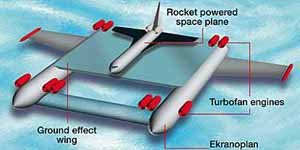
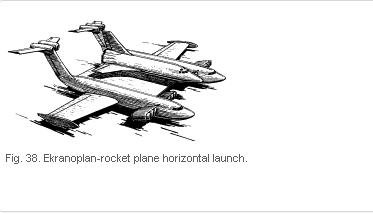
Russia's International Institute for Advanced Aerospace Studies proposes to develop a
1,500-ton twin-body "Ekranoplan" wing-in-ground effect seaplane as a launch platform
for future reusable launch vehicles. Such a vehicle would be able to release launch
vehicles at a speed of about 500 km/h. Demonstration tests are planned with a 400-ton
subscale Ekranoplan model in 2001.
http://www.orbireport.com/News2000-03.html
 

Attachments

  • Ekranoplan.jpg
    Ekranoplan.jpg
    12.1 KB · Views: 1,323
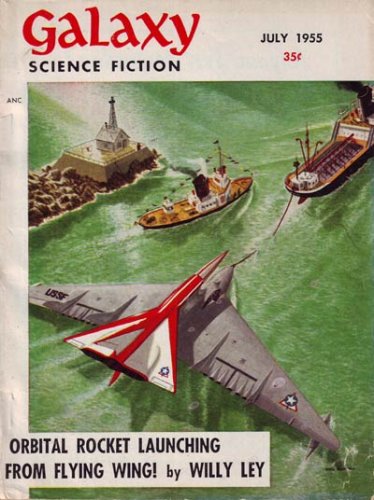
I just LOVE these old covers... This one is particular savory, with its "USSF" (United States Submarine Force?) and the imaginary national markings! Nice find...
 
Stargazer2006 said:
I just LOVE these old covers... This one is particular savory, with its "USSF" (United States Submarine Force?) and the imaginary national markings! Nice find...

I would presume that USSF means United States Space Force. I also presume that the artist reasoned that the United States Space Force emblem would not use the wing design of the United States roundel.
 
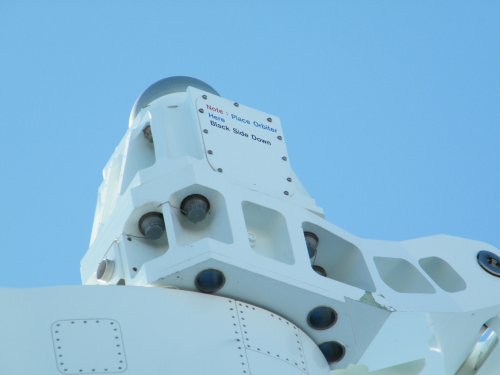
Note helpful instructions.
 

Attachments

  • SCA.jpg
    SCA.jpg
    479.8 KB · Views: 624
Dennis Jenkins' "Space Shuttle" 3rd edition has a picture on page 197 of the same support strut with an older(?) version of the stencil that reads:
Caution Place Orbiter Here Black Side Down
Lefty Loosy
Righty Tighty

Martin
 
Hi,

I can ID this WIG as shuttle carrier.
 

Attachments

  • wsl_1.jpg
    wsl_1.jpg
    35.3 KB · Views: 243
hesham said:
I can ID this WIG as shuttle carrier.

Is that the Beriev Be-5000? (see http://www.secretprojects.co.uk/forum/index.php/topic,10591.msg99832.html#msg99832)

index.php
 
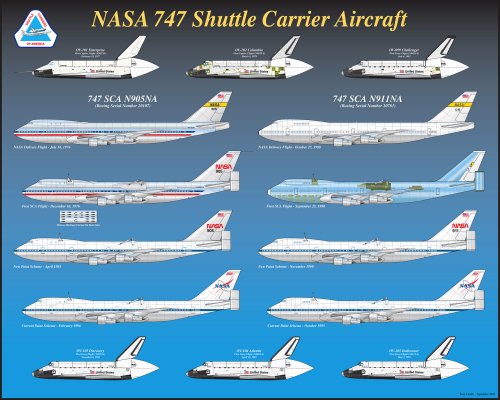
Just saw this on another site:

http://www.collectspace.com/ubb/Forum9/HTML/001838.html

I like it, but I think he needs an image with the shuttle atop the SCA as well.
 

Attachments

  • SCA_Poster.jpg
    SCA_Poster.jpg
    512.3 KB · Views: 1,620
hesham said:
Hi,

Russia's International Institute for Advanced Aerospace Studies proposes to develop a
1,500-ton twin-body "Ekranoplan" wing-in-ground effect seaplane as a launch platform
for future reusable launch vehicles. Such a vehicle would be able to release launch
vehicles at a speed of about 500 km/h. Demonstration tests are planned with a 400-ton
subscale Ekranoplan model in 2001.
http://www.orbireport.com/News2000-03.html


The same concept.


http://www.sciencedirect.com/science/article/pii/S0376042106000637
 

Attachments

  • Ekranoplan-rocket plane horizontal launch.JPG
    Ekranoplan-rocket plane horizontal launch.JPG
    11.5 KB · Views: 149
Hi,

http://archive.aviationweek.com/search?exactphrase=true&QueryTerm=crane&start=640&rows=20&DocType=Article&Sort=&SortOrder=&startdate=1944-11-27&enddate=1980-10-23&LastViewIssueKey=&LastViewPage=
 

Attachments

  • 1.png
    1.png
    370.9 KB · Views: 196
  • 2.png
    2.png
    339.7 KB · Views: 171
A couple of questions for Space Shuttle experts. Is anyone familiar with the emergency procedures for the 747 SCAs? I've always wondered if it was anticipated that some situations would require the crew to jettison the shuttle in order to keep the 747 flyable. Even if the combination were flyable, I'd think that there'd be some emergency landing situations where the prospect of a 75 ton payload above and behind the cockpit would be intimidating. In that case, was there a means for the jettisoned orbiter to glide under autopilot control or would it just be a big lawn dart? Did NASA avoid flying the combination over densely populated areas for this reason? (in routine operation I mean, I know that photo/airshow laps were done over Paris, Washington DC, Sacramento and San Francisco at least)
Also, could the shuttle, as a payload of the SCA, be trimmed in flight? I'd think that that would be useful to improve the combination's flying characteristics and to reduce loads on the airframes.
 
Last edited:
My understanding is that outside the actual Approach and Landing tests, the SCA usually did not fly with the explosive bolts necessary to jettison the Shuttle installed. So the issue is rather moot.

Also, for most of its life, the Shuttle could not drop the landing gear automatically, so it could not have landed from the back of the SCA without crew on board.
 
I thought the SCA had some kind of escape system, so the answer might have been "let the 747 and orbiter crash after crew escaped via parachute".
 
In regards to SCA crews having parachutes.... I don't believe they did. To quote an old friend, who was an F-16 pilot that was asked how tanker crew egress in an emergency.... "They don't." So, I think the simple answer is they would have rode it in one way or the other. Also, so far as jettisoning the orbiter without crew.... well, that's problematic at best. As mentioned above, they rarely carried the explosive bolts. But lets play Devil's advocate and say they did, as soon as the thing is jettisoned, you're going to have to make a nose dive to avoid having the vertical stabilizer smash into the orbiter. Assuming the SCA is at a point where this would be considered, good luck on it being able to do such a maneuver.
 
TomS said:
Also, for most of its life, the Shuttle could not drop the landing gear automatically, so it could not have landed from the back of the SCA without crew on board.


By "controlled glide" I didn't mean to suggest that the orbiter might be able to land itself, only that it would glide (until it crashed) in a controlled manner rather than follow an unpredictable trajectory. Releasing a glider that will keep going in the direction that you point it would be a different decision than jettisoning an unpredictable 75t brick with wings.
 
Conroy really looks weird. The siamese C-5 looks more realistic... except the Galaxy first decade was just horrible. No surprise NASA picked a 747 over it. The irony being that Stratolaunch ultimately used a few major pieces from 747s, mostly the engines. In passing, with 250 mt of payload, a Roc could carry three Shuttle orbiters...
 
But lets play Devil's advocate and say they did, as soon as the thing is jettisoned, you're going to have to make a nose dive to avoid having the vertical stabilizer smash into the orbiter. Assuming the SCA is at a point where this would be considered, good luck on it being able to do such a maneuver.

That's not quite correct... when an aircraft first goes into a dive the tail actually rises - remember that the elevators (and rudders) force the tail to go in the opposite direction of the desired maneuver, in order to re-align the fuselage in the desired direction.

For the tail to drop the aircraft needs to pitch up - and this maneuver would help by increasing the AOA of the shuttle as well, thus increasing its lift.

The procedure would have been:
1. pull the control wheel back, bringing the nose up
2. immediately activate the explosive bolts
3. as soon as the bolts blow pull the throttles back to slow the B747 (to give more time to separate), and gently push the wheel forward, to bring the aircraft back to level without raising the tail, while allowing the higher AOA of the shuttle to lift it further away and up.
4. once the shuttle is fully clear then you advance the throttles to leave the shuttle behind you.
 
Main advantage of these "monstrosities" compared to the 747-SCA that got the job in the end: no need for the "mate/demate device". The big crane used to haul the orbiter on the back of the 747. In stark contrast: just tow the Shuttle Orbiter under the central wing, haul it, hang it to the central wing, fly away. Same for the ALT flight tests: easier and safer to drop Stratolaunch style than flying above the 747 tail...

Funny to think Stratolaunch kinda build such aircraft... only after the Shuttle was retired. No idea if there are 1/144 scale model of Stratolaunch's Roc, might be fun to hang a 1/144 Shuttle orbiter under the central wing.
 

Similar threads

Back
Top Bottom