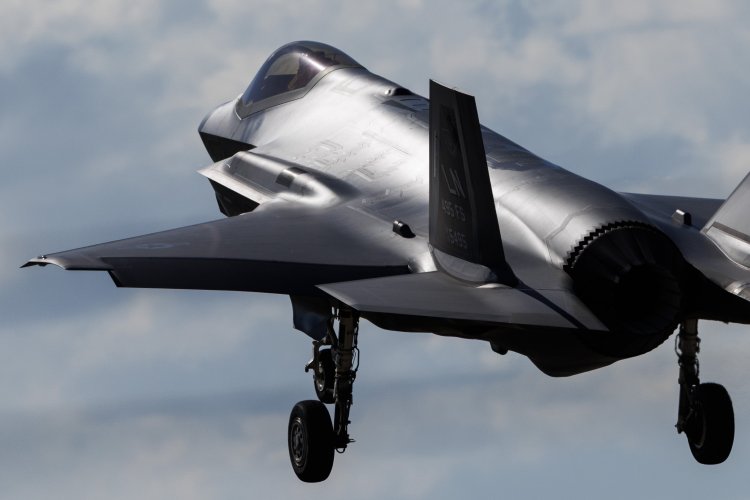
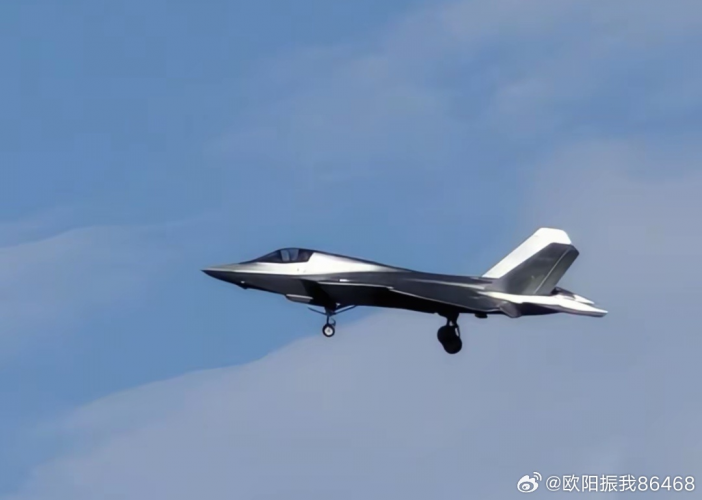
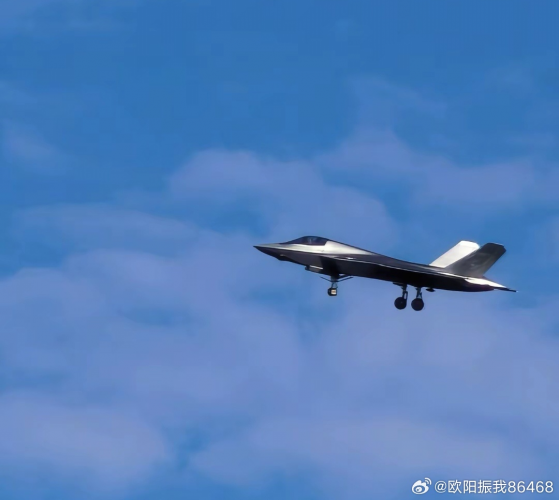
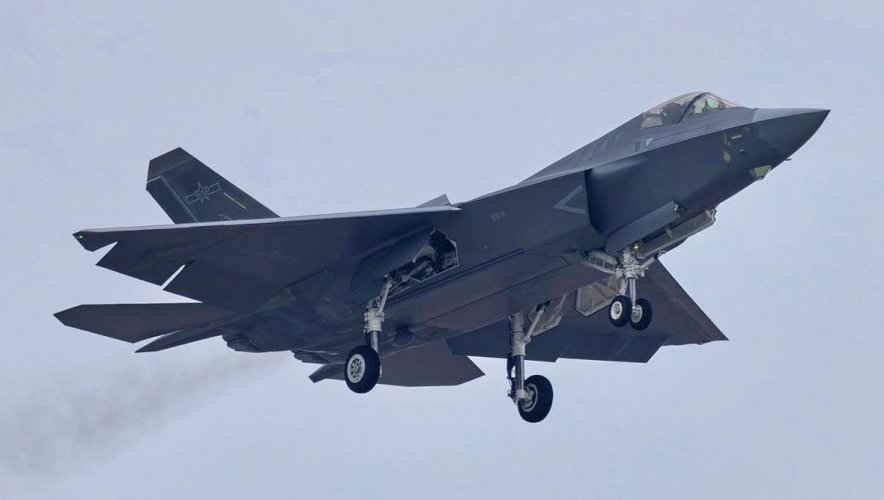
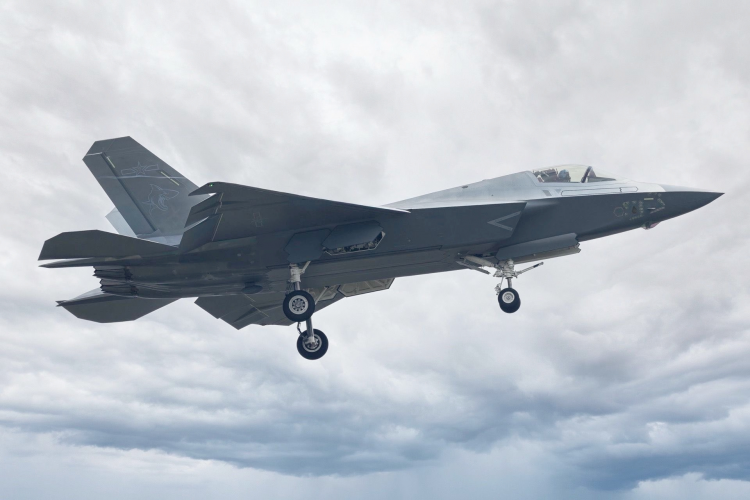
These photos are at the very least "AI enhanced" (more like degraded, look at that shit at the landing gear for example), so who knows what else was done to them.

That aside, aircraft with literal iron bonds embedded in their skin can certainly possess a certain shine if the lighting is bright enough and hits at the right angle. After all we all know that the F-35 tends to be matte under most lighting conditions too, but then such shots exist as well, where the aircraft seems highly reflective in some areas.

69dceea69e149f705fe8c2bdf8e9203f.jpg

In short seems like a total nothing burger unless more concrete and certainly better resolution clues surface.
 
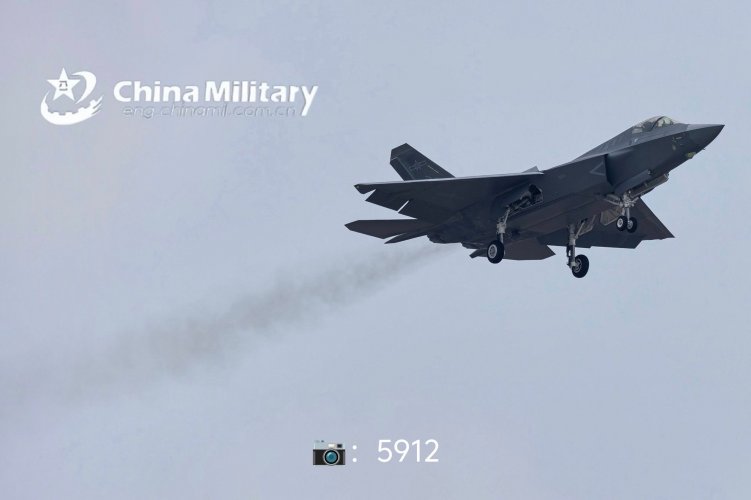
Hey, another LRIP naval J-35 confirmed as cn. 0018.

In fact I would love to know its H-number or at least it’s individual bort number.
 

Attachments

  • IMG_0814.jpeg
    IMG_0814.jpeg
    201.6 KB · Views: 151
  • IMG_0814.jpeg
    IMG_0814.jpeg
    126.1 KB · Views: 204
Last edited by a moderator:
It would be great if someday it had an F22-like nozzle, even though it might not mean much for it.
 

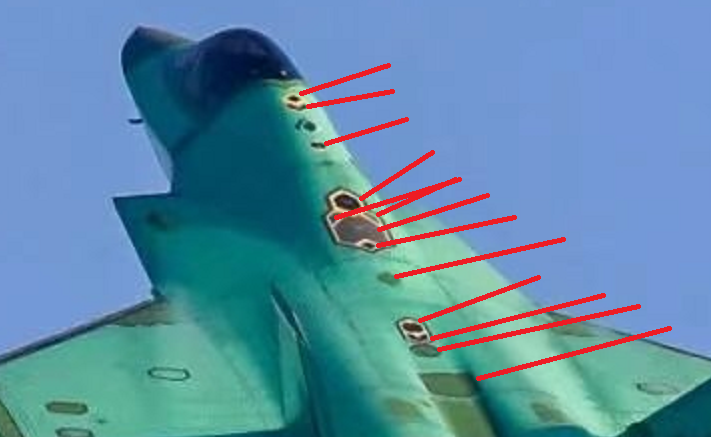
There're so many small/big patches on spine. Apart from DAS, i count separated 13 sections. [check attachment]

Let's try to decipher their use (not in physical order) -
1- GPS antenna
2- UHF/VHF antenna
3- IFF antenna
4- TACAN antenna
5,6- MADL antenna
7- ECS vent
8- Heat exchanger vent
9- upper possible short range radar? IDK

What about remaining 4 patches?
Is there receptacle for boom refueling & surface illumination light?
 

Attachments

  • 1789805162734.png
    1789805162734.png
    270.9 KB · Views: 118
Hey so I’m a big fan of the J-35 and the PLA have been putting out some of the greatest military works in recent years. But I do have some questions regarding the J-35 design choices.

I can’t help to see it as a modern MiG-29. From what I can gather I have no idea what “role” does it intend to play that the J-20 can’t do it better. And if the argument comes down to cost, touché but a modern twin engine stealth jet can’t possible bring down cost much if you’re operating hundreds of them.

Let’s just use the F-35A and J-20 as a comparison. I do deeply respect what Lockheed managed to do with the F-35A despite the B variant dragging the entire program. The F-35A still holds an impressive internal fuel load, internal weapon space and avionics suite (3 things that I think it’s the most important aspect of a modern fighter)

So first of all, the J-35A is intended as a multirole with more emphasis on A2A, why can’t the J-20 do it instead?

The twin engine choice, with a brand new engine btw, wouldn’t it just drive up program and maintenance cost.

Avionics wise, from its size vs the J-20, wouldn’t you assume the J-20 has more real estate for a more complete avionic suite?

Weapons bay, again looks very similar to the J-20, maybe it would the deeper than it but from its slim size, its debatable as there isn’t any pictures out there of the J-35 IWB.

Internal fuel load, obviously lower than the J-20, and somehow even lower than the F-35A (which respectfully it can hold an impressive 8.3 tons of fuel), which makes me doubt that they state that the J-35A has a combat range ~1250km similar to that as a F-35A.

Every angle I look at it from seems odd cause it reminds me of the MiG-29. That whatever it does it’s big brother Su-27 or competitor F-16 somehow does it better or simpler. If the argument does come back to cost, wouldn’t fielding more J-20’s save up on maintenance cost by having commonality across the Air Force?
 
The J‑35 is an internally‑referred‑to "good, fast, cheap" program. It is modified based on the land based FC‑31. Undoubtedly, the core of the J‑35 family is the naval variant J‑35 (the J‑20 was deemed unsuitable for carrier‑borne operations; balancing fifth‑generation fighter orders between SAC and CAC was also likely taken into consideration). So is the J‑35A more of a by‑product? Its avionics suite is reduced compared to the J‑35. Although it is currently fitted with the more advanced WS‑19 engine, it should still be regarded as a lower‑tier variant relative to the J‑35.

The J‑35’s fuel carrying capacity relative to its size came as a pleasant surprise to the Air Force. Nevertheless, its price drew strong dissatisfaction from the Air Force in the early phase (whereas the Navy held no grievances over the more expensive J‑35). Not entirely unexpectedly, the J‑35A can be utilized by the Air Force for F‑35 adversary simulation. Besides this, the J‑35A also serves as the foundation for the export variant, given that its prototype, the FC‑31, was originally developed for export purposes.

As for the engine, the WS‑19 itself may be more important than the J‑35A. An airborne platform is required to accommodate and integrate this indigenously‑developed medium‑thrust engine for its maturation. The WS‑19 will be deployed on the GJ‑11 and other unmanned aircraft in the future.
 
Hey so I’m a big fan of the J-35 and the PLA have been putting out some of the greatest military works in recent years. But I do have some questions regarding the J-35 design choices.

I can’t help to see it as a modern MiG-29. From what I can gather I have no idea what “role” does it intend to play that the J-20 can’t do it better. And if the argument comes down to cost, touché but a modern twin engine stealth jet can’t possible bring down cost much if you’re operating hundreds of them.
Let’s just use the F-35A and J-20 as a comparison. I do deeply respect what Lockheed managed to do with the F-35A despite the B variant dragging the entire program. The F-35A still holds an impressive internal fuel load, internal weapon space and avionics suite (3 things that I think it’s the most important aspect of a modern fighter)

So first of all, the J-35A is intended as a multirole with more emphasis on A2A, why can’t the J-20 do it instead?

The twin engine choice, with a brand new engine btw, wouldn’t it just drive up program and maintenance cost.

Avionics wise, from its size vs the J-20, wouldn’t you assume the J-20 has more real estate for a more complete avionic suite?

Weapons bay, again looks very similar to the J-20, maybe it would the deeper than it but from its slim size, its debatable as there isn’t any pictures out there of the J-35 IWB.

J-35A shares many of its components, structures, materials, subsystems with the naval J-35 which arrived "first" after the export oriented FC-31, which helps to drive down cost somewhat.

More importantly, J-35A (and J-35) as newer designs than J-20 family is said to use some newer construction and production methods to also drive down cost for both procurement and operations (even compared to the newer J-20A/S).

Simply buying more J-20 family aircraft is not as easy as it sounds, because that means CAC would have to massively expand even further than it already has. Furthermore, J-20 family is ultimately still a meaningfully heavier fighter than J-35A, and has higher procurement and operating costs

If I had to summarise it, the benefits of buying J-35A alongside J-20 family come down to:
- Lower cost in procurement, operations per unit than J-20
- Sharing commonalities with naval J-35, driving down cost and logistics
- Expansion of overall PRC 5th gen land based production capacity and rate. CAC was reaching about the limit with their J-20 production rate in recent years, and they also need to prepare for J-36 in the future and other unmanned projects. Giving SAC J-35A helps to expand the annual delivery rate of land based 5th gens without further stretching CAC, while also allowing SAC to expand in experience, scope and preparation for J-XDS production and other unmanned projects (and probably helps them take the resources that are gradually getting idled building SAC-Flankers to a new project).
- Similar/slightly "lower mass" capabilities to J-20 family (i.e.: slightly lower payload etc) but with minimum non-inferior subsystems and signature reduction to J-20A/S -- i.e.: capable in the right areas.


Internal fuel load, obviously lower than the J-20, and somehow even lower than the F-35A (which respectfully it can hold an impressive 8.3 tons of fuel), which makes me doubt that they state that the J-35A has a combat range ~1250km similar to that as a F-35A.

We don't know what the internal fuel load of J-35A is.
You might be getting some figures from legacy FC-31 spec sheets for export, but legacy FC-31 and J-35A are not identical.


Every angle I look at it from seems odd cause it reminds me of the MiG-29. That whatever it does it’s big brother Su-27 or competitor F-16 somehow does it better or simpler. If the argument does come back to cost, wouldn’t fielding more J-20’s save up on maintenance cost by having commonality across the Air Force?

It's likely a combination of cost (procurement and operating, and shared commonality with J-35), industry (CAC alone cannot meet all of the PLA's 5th gen needs), and capability (J-35A is rather capable for its profile).

To be clear -- there was substantial uncertainty whether the PLA would buy a land based J-35 variant for a few years, and there was lots of people who made the same arguments as you have done regarding going for a "all J-20 family" land based 5th gen fleet.


The fact that they went for J-35A, as well as the corroborating rumours around J-35A's lower cost, industry etc, means that basically you can revise the key assumptions underlying your position to ones which are rational.
 
Last edited:
I can’t help to see it as a modern MiG-29. From what I can gather I have no idea what “role” does it intend to play that the J-20 can’t do it better. And if the argument comes down to cost, touché but a modern twin engine stealth jet can’t possible bring down cost much if you’re operating hundreds of them.
Mig-29 was born to a highly specialist requirement (which until the conflict in Ukraine was mostly its downfall), and the problem went well beyond the price. Less specialized fighters rarely fall into the same pit.
Let’s just use the F-35A and J-20 as a comparison. I do deeply respect what Lockheed managed to do with the F-35A despite the B variant dragging the entire program. The F-35A still holds an impressive internal fuel load, internal weapon space and avionics suite (3 things that I think it’s the most important aspect of a modern fighter)
B variant didn't drag the F-35 program down. It was the C variant and broader length limitation.
Just carrying fuel in itself is means to the end; F-35 series have a rather moderate range for its fuel load, which can be viewed as atrocious if you keep in mind that it has just one, world's most advanced fighter engine. It has no drop tanks, too.
It's important, b/c while we don't know specifics, it appears J-35 (which doesn't have all that much fuel volume) flies further than PLA expected.
So first of all, the J-35A is intended as a multirole with more emphasis on A2A, why can’t the J-20 do it instead?
J-35A has a different, multirole IRST. J-35A is assumed (we have an article, though not a definitive proof) to have deeper bays.
J-35A is quite likely a lower-signature aircraft. J-35 is a different manufacturer, with huge capacity available without Chengdu expansions (which are troublesome).
Every angle I look at it from seems odd cause it reminds me of the MiG-29. That whatever it does it’s big brother Su-27 or competitor F-16 somehow does it better or simpler. If the argument does come back to cost, wouldn’t fielding more J-20’s save up on maintenance cost by having commonality across the Air Force?
Mig-29 (9-12) carried as much fuel inside as comparable aircraft carried per engine; furthermore, it was born overweight, as early Soviet composites failed to deliver.
This was acceptable early on, as it was effectively a short-range STOL fighter-interceptor. But keep in mind, that conditions matter both ways: in the already mentioned Ukrainian conflict, the MiG-29 platform(serviceability/repair ability/availability) outperforms the Su-27 (or F-16) ones by a significant margin. It's a shame (for Ukraine) that all the actually up-to-date fulcrums are Russian, and it's a shame (for Russia) that it effectively dropped the platform just when it got its redemption.
 
There are no problems with the MiG‑29’s composite materials — there are more of them than in its contemporary, the Su‑27. And they are still used in the newer versions. As far as I know, the only thing that was abandoned was the carbon‑plastic engine cowlings, which were manufactured in violation of the technological process. Low ambient temperatures and the huge workshops of the Soviet period did not allow for maintaining the temperature regime during the laying out of prepregs.
 
Hey so I’m a big fan of the J-35 and the PLA have been putting out some of the greatest military works in recent years. But I do have some questions regarding the J-35 design choices.

I can’t help to see it as a modern MiG-29. From what I can gather I have no idea what “role” does it intend to play that the J-20 can’t do it better. And if the argument comes down to cost, touché but a modern twin engine stealth jet can’t possible bring down cost much if you’re operating hundreds of them.

Let’s just use the F-35A and J-20 as a comparison. I do deeply respect what Lockheed managed to do with the F-35A despite the B variant dragging the entire program. The F-35A still holds an impressive internal fuel load, internal weapon space and avionics suite (3 things that I think it’s the most important aspect of a modern fighter)

So first of all, the J-35A is intended as a multirole with more emphasis on A2A, why can’t the J-20 do it instead?

The twin engine choice, with a brand new engine btw, wouldn’t it just drive up program and maintenance cost.

Avionics wise, from its size vs the J-20, wouldn’t you assume the J-20 has more real estate for a more complete avionic suite?

Weapons bay, again looks very similar to the J-20, maybe it would the deeper than it but from its slim size, its debatable as there isn’t any pictures out there of the J-35 IWB.

Internal fuel load, obviously lower than the J-20, and somehow even lower than the F-35A (which respectfully it can hold an impressive 8.3 tons of fuel), which makes me doubt that they state that the J-35A has a combat range ~1250km similar to that as a F-35A.

Every angle I look at it from seems odd cause it reminds me of the MiG-29. That whatever it does it’s big brother Su-27 or competitor F-16 somehow does it better or simpler. If the argument does come back to cost, wouldn’t fielding more J-20’s save up on maintenance cost by having commonality across the Air Force?
A more accurate comparison would be the F-15 and F/A-18, if the USAF had bought F-17/F-18L (an inverse of what actually happened).
 

Similar threads

Back
Top Bottom