SWERVE was a big beast and a rather costly miss, if it were to miss, while the BP program prided itself on miniaturization and large numbers though.

SWERVE's aerobody was adapted into the Common Hyper Glide Body tbf. A costly miss sure, but it provides the ultimate standoff in being able to smack a Tu-16 or KJ-2000 or something once it reaches cruise altitude, which is cool.
 
never was that high of production rate. The missile gap was a fallacy.

I think it depends upon the time period. For instance, the Soviet SS-18/R-36M missile entered service in 1975 and by 1981 the US intelligence community estimated that the Soviet Union had 306 of them in service. That's a production rate of at least 50 per year.
 
never was that high of production rate. The missile gap was a fallacy.
"The maximum number of R-16 and R-16U missiles was deployed by 1965. At that time, 186 ICBM launchers of both modifications were on combat duty. R-16 and R-16U ICBMs were on combat duty in missile divisions stationed near the cities of Bershet in Perm Oblast, Verkhnyaya Salda (Nizhny Tagil) in Sverdlovsk Oblast, Vypolzovo in Tver Oblast, Itatka in Tomsk Oblast, Yoshkar-Ola in Mari ASSR, Novosibirsk, Shadrinsk in Kurgan Oblast, Yurya in Kirov Oblast, Baikonur and Plesetsk."


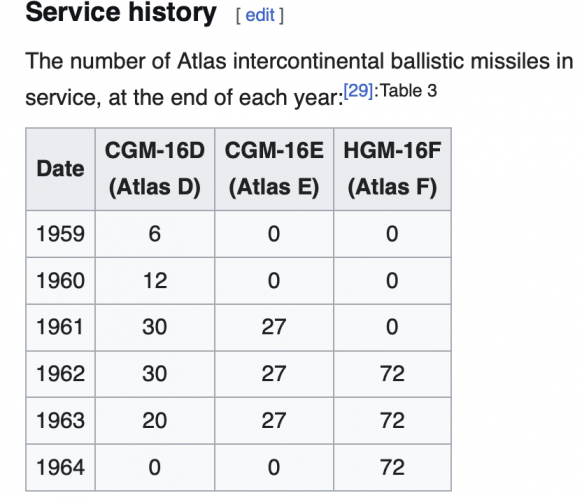
That compares to a peak deployment of 129 Atlas ICBMs.
 
UR-100 was the most numerous...the basis for Eurockot.

You could say there was a rocketry gap (R-7 more powerful, but few number)

--but not a missile gap (most of the USSR's nukes were in free-fall bombs, torpedoes and shorter range missiles during the Cuba Crisis).

It took until the 1970's to have what was called "Deep Parity."

By 1976 there were around 1,400 UR-100s.
 
Last edited:
UR-100 was the most numerous...the basis for Eurockot.

You could say there was a rocketry gap (R-7 more powerful, but few number)

--but not a missile gap (most of the USSR's nukes were in free-fall bombs, torpedoes and shorter range missiles during the Cuba Crisis).

It took until the 1970's to have what was called "Deep Parity."

By 1976 there were around 1,400 UR-100s.
UR-100 was later and smaller. More of a Minuteman equal. R-7 was in the Atlas category by time, size/capability, and number deployed. And according to the link I mentioned, there were MORE R-7s in service than Atlas. 186 to 129.
 
UR-100 was later and smaller. More of a Minuteman equal. R-7 was in the Atlas category by time, size/capability, and number deployed. And according to the link I mentioned, there were MORE R-7s in service than Atlas. 186 to 129.
SS-7 is not the R-7, it was R-16. R-7 is/was the Sputnik/Vostok/Soyuz launcher.

Atlas deployment was a smaller portion of the production. 140 Atlas airframes flew for missile tests and space launch during the same time period as the deployment build up (1959-1963). That is at least 269 total airframes produced over the same time frame. The SS-7 was not used for space launch and I doubt they launched 80 or so for test flights.
 

Attachments

  • Screenshot 2025-07-03 at 9.42.51 PM.png
    Screenshot 2025-07-03 at 9.42.51 PM.png
    86.8 KB · Views: 13
  • Atlas Family - Gunter's Space Page.jpg
    Atlas Family - Gunter's Space Page.jpg
    1.4 MB · Views: 14
Last edited:
You could say there was a rocketry gap (R-7 more powerful, but few number)
Nope, you can't. We didn't need a big booster. Thor Agena, Atlas Agena and Thor Delta were launching better spacecraft
 
Last edited:
UR-100 was later and smaller. More of a Minuteman equal. R-7 was in the Atlas category by time, size/capability, and number deployed. And according to the link I mentioned, there were MORE R-7s in service than Atlas. 186 to 129.
Erm... no. The number of combat-ready R-7 never exceeded five (four on Plesetsk and one on Baikonur). You are mixing numbers for R-7 with R-16.
 
Nope, you can't. We didn't need a big booster. Thor Agena, Atlas Agena and Thor Delta were launching better spacecraft
I didn't say the spacecraft were worse. R-7 simply provided heavier payloads---Agenas and Thors being stretched were ways to compensate. Saturn I was the first American rocket that bested R-7 in terms of thrust---and the reward for that was Herbert York killing it.

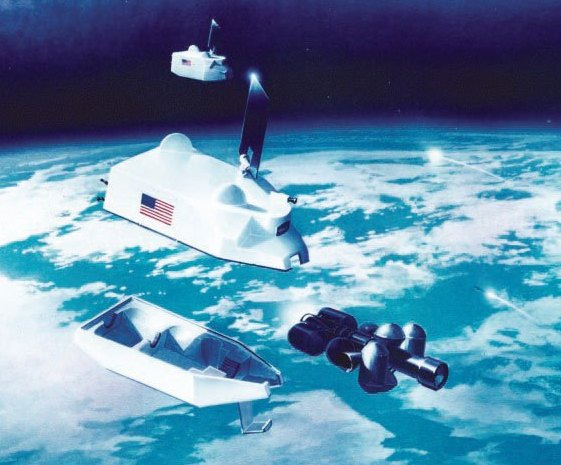
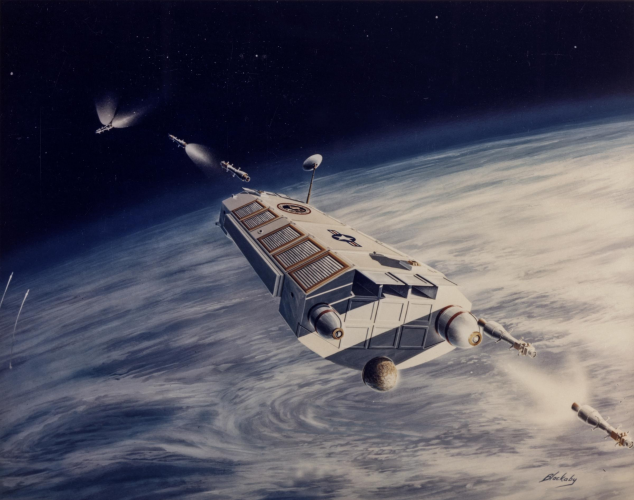
Did all Brilliant Pebbles concepts have those clamshell shrouds?
 
Stumbled on this, not sure it'd been posted before.


1768660087271.png
In this version of a Strategic Defense Architecture, Carrier Vehicles (CVs) would house several Space-based Interceptors (SBIs). The current concept calls for up to 200 CVs, each carrying a battery of SBIs, circling the earth command center, and using information supplied by surveillance satellites, SBIs would be launched to attack enemy ballistic missiles in their boost phase and re-entry vehicles in the mid-course phase of their targets by the force of their trajectories. The SBIs would destroy their targets by the force of their impact with them at extremely high speed. (Department of Defense)
Department of Defense
 
I'm not really as knowledgeable as I should be on SDI: Why did they replace this with Briliant Pebbles?
 
I'm not really as knowledgeable as I should be on SDI: Why did they replace this with Briliant Pebbles?
My understanding is: "garages" with a ton of kinetic interceptors packed inside, made colossal targets for Soviet ASATs like Istrebitel Sputnikov. Also whatever ground based missiles that could hit orbital targets. Shoot down one garage, it kills a whole lot of kinetic interceptors hence makes a big hole in the shield.

That's why it was decided the Brilliant Pebbles were to fend for themselves one by one, up to 100 000 of them. Bad luck, this meant they had to be very autonomous and packed with guidance systems, all this inside a minuscule weight envelope - 100 to 300 pound each. As usual the Moore law was called to the rescue, but 1980s electronics would have had a hard time keeping mass low. A byproduct of that challenge was the Clementine lunar probe - and also Dan Goldin and Mike Griffin, who both worked on the Brilliant Pebbles at their respective companies before leading NASA a few years appart. Faster better cheaper was Brilliant pebbles mentality applied to planetary probes.

That was the big advantage with garage: part of the tracking and guidance and ICBM targeting could be offloaded on the big spaceship.

There might have been another reason: lightweight interceptors could be launched by SSTOs (DC-Y or X-30 Orient Express, pick your choice) which had very tiny payload - as the rocket equation is such an exponential b*tch, and so is ascent-to-orbit delta-v.

The "garage vs pebble" debate wasn't new by SDI time. In the early 1960's Project BAMBI had ran into similar, intractable issues.

 
My understanding is: "garages" with a ton of kinetic interceptors packed inside, made colossal targets for Soviet ASATs like Istrebitel Sputnikov. Also whatever ground based missiles that could hit orbital targets. Shoot down one garage, it kills a whole lot of kinetic interceptors hence makes a big hole in the shield.

That's why it was decided the Brilliant Pebbles were to fend for themselves one by one, up to 100 000 of them. Bad luck, this meant they had to be very autonomous and packed with guidance systems, all this inside a minuscule weight envelope - 100 to 300 pound each. As usual the Moore law was called to the rescue, but 1980s electronics would have had a hard time keeping mass low. A byproduct of that challenge was the Clementine lunar probe - and also Dan Goldin and Mike Griffin, who both worked on the Brilliant Pebbles at their respective companies before leading NASA a few years appart. Faster better cheaper was Brilliant pebbles mentality applied to planetary probes.

That was the big advantage with garage: part of the tracking and guidance and ICBM targeting could be offloaded on the big spaceship.

There might have been another reason: lightweight interceptors could be launched by SSTOs (DC-Y or X-30 Orient Express, pick your choice) which had very tiny payload - as the rocket equation is such an exponential b*tch, and so is ascent-to-orbit delta-v.

The "garage vs pebble" debate wasn't new by SDI time. In the early 1960's Project BAMBI had ran into similar, intractable issues.
The interceptors do appear to have quite a range though, so 1 garage missing only provides a window at one point, there would still be other intercept points across the trajectory of the adversary missile. ASAT systems themselves would also be targetable by the system.
 
My understanding is: "garages" with a ton of kinetic interceptors packed inside, made colossal targets for Soviet ASATs like Istrebitel Sputnikov. Also whatever ground based missiles that could hit orbital targets. Shoot down one garage, it kills a whole lot of kinetic interceptors hence makes a big hole in the shield.

That's why it was decided the Brilliant Pebbles were to fend for themselves one by one, up to 100 000 of them. Bad luck, this meant they had to be very autonomous and packed with guidance systems, all this inside a minuscule weight envelope - 100 to 300 pound each. As usual the Moore law was called to the rescue, but 1980s electronics would have had a hard time keeping mass low. A byproduct of that challenge was the Clementine lunar probe - and also Dan Goldin and Mike Griffin, who both worked on the Brilliant Pebbles at their respective companies before leading NASA a few years appart. Faster better cheaper was Brilliant pebbles mentality applied to planetary probes.

That was the big advantage with garage: part of the tracking and guidance and ICBM targeting could be offloaded on the big spaceship.

There might have been another reason: lightweight interceptors could be launched by SSTOs (DC-Y or X-30 Orient Express, pick your choice) which had very tiny payload - as the rocket equation is such an exponential b*tch, and so is ascent-to-orbit delta-v.

The "garage vs pebble" debate wasn't new by SDI time. In the early 1960's Project BAMBI had ran into similar, intractable issues.

Garage might be better for a sensor satellite like SBIRS or its replacement to avoid being destroyed. Just kill anything that intrudes on its orbital layer in MEO or something to provide a backup to LEO targeting and BP interceptors. You'd probably need a MEO interceptor like the railgun I guess, too.

Probably not at all practical unless you really need to fight a big space war though.
 
Garage might be better for a sensor satellite like SBIRS or its replacement to avoid being destroyed. Just kill anything that intrudes on its orbital layer in MEO or something to provide a backup to LEO targeting and BP interceptors. You'd probably need a MEO interceptor like the railgun I guess, too.

Probably not at all practical unless you really need to fight a big space war though.
You can probably just formation fly a Pebble with each Brilliant Eyes satellite. One of the hopes was that mass production would lower Pebble costs, and it's probably better to do formation flying than extra systems integration, although that depends. Ultimately the whole constellation, sensors, shooters, space-based MTI, reconsats, commsats, etc would essentially be self-defending if your Pebbles can kill ASATs as well as they can kill BMs.

By the time GPALS rolls around, they start getting ideas about embiggening the boosters on each Pebble and adding Brilliant Eyes and modifying the Pebbles to enable Pebbles not only to kill missiles in boost phase, but early, mid and even late midcourse and terminal. As I understand it, GBMD has proven less than easy in practice, and a space-based system would probably have similar hassles (possibly something you can fix with enough Brilliant Eyes and successor IR systems to improve decoy discrimination etc).


At some point, if the enemy gets a constellation of their own, you end up in a game of Red Pebbles vs Blue Pebbles, which is potentially a very short and nasty and violent war especially if you start off with intermingled constellations. Pebbles lets you conduct a space blockade to a much greater extent than it can allow you to perform missile defense, since a space launch vehicle is a heckuva lot easier to shoot down with a thin Pebbles system than say a 10-missile salvo of ICBMs.

Breaking such a space blockade would either require Red or Blue to have a HEO reserve force, to conduct massed ASAT attacks in concert with space launches, or some other fantastical space warmaking capability.

Huh. How did I miss that the Brilliant Pebbles did NOT have a garage?

They called it a lifejacket. One lifejacket per Pebble.
 
Last edited:
Breaking such a space blockade would either require Red or Blue to have a HEO reserve force, to conduct massed ASAT attacks in concert with space launches, or some other fantastical space warmaking capability.
Something I've realized when researching my space TL: Project Orion NPP was part of an early 1960s "proto SDI" (without a President endorsement so it quickly foundered).

https://www.thespacereview.com/article/2714/1
A decade ago Major Brent Ziarnick unearthed the whole breathtaking thing in a series of writtings and books.

BAMBI was to have 100 000 kinetic interceptors (no Ronald ray guns back then) and three fleets of Orion. Fleet one: 1000 miles high, second fleet in GEO, third fleet behind the Moon in hidding (like Mazinger aliens supervillains lol)

Obviously Orion was much more than just ABM / BAMBI - throw weight to orbit and Earth escape was giganormous so it could assume all the fantastic / extravagant / nightmarish missions imagined by very megalomaniac Cold War Air Force Generals.

Orion space "agility" would have been fantastic too : the damn thing would certainly not be bothered by pesky orbital mechanics. No surprise they enlisted it for kinetic spaceborne ABM. Convair had a plan called SPAD: Space Patrol, Active Defense. TRW was already there too.
 

Similar threads

Back
Top Bottom