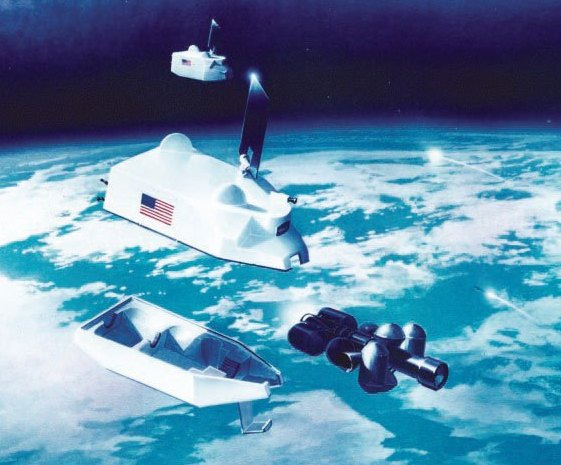
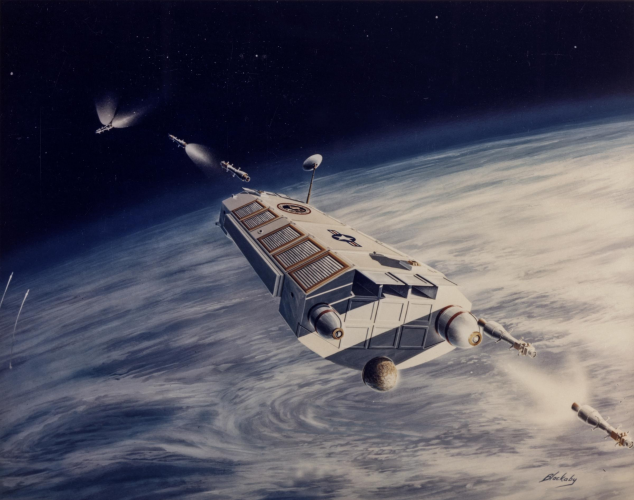
My understanding is: "garages" with a ton of kinetic interceptors packed inside, made colossal targets for Soviet ASATs like Istrebitel Sputnikov. Also whatever ground based missiles that could hit orbital targets. Shoot down one garage, it kills a whole lot of kinetic interceptors hence makes a big hole in the shield.
That's why it was decided the Brilliant Pebbles were to fend for themselves one by one, up to 100 000 of them. Bad luck, this meant they had to be very autonomous and packed with guidance systems, all this inside a minuscule weight envelope - 100 to 300 pound each. As usual the Moore law was called to the rescue, but 1980s electronics would have had a hard time keeping mass low. A byproduct of that challenge was the Clementine lunar probe - and also Dan Goldin and Mike Griffin, who both worked on the Brilliant Pebbles at their respective companies before leading NASA a few years appart. Faster better cheaper was Brilliant pebbles mentality applied to planetary probes.
That was the big advantage with garage: part of the tracking and guidance and ICBM targeting could be offloaded on the big spaceship.
There might have been another reason: lightweight interceptors could be launched by SSTOs (DC-Y or X-30 Orient Express, pick your choice) which had very tiny payload - as the rocket equation is such an exponential b*tch, and so is ascent-to-orbit delta-v.
The "garage vs pebble" debate wasn't new by SDI time. In the early 1960's Project BAMBI had ran into similar, intractable issues.