Enough of this. @Squirrel@Aeria Gloria, your constant argument in multiple topics is irritating. @Squirrel cannot be persuaded from his beliefs by the use of logic or facts and it is illogical to keep trying.
The last thing I will say for Squirrel and others is that I will only attach this video as a parting gift for you to see how long R-27R/ER can take to get ready in a combat situation. I have seen claims of 1s ready times also but also 3-4s, it must be a considerable range. I counted 4s after lock here. It is interesting sparrow is practically identical in this regard. Or that even R-73/R-27T/ET can take up to 1-2s to get ready. It is interesting for the thread as a real life example from search to lock to impact, and you can even see the occasional clutter from the Pursuit mode. I would personally bet R-33 and anything of similar generation is the same. And of course, all missiles would get ready at the same time. Like MiG-29, I’m sure if you lock before Dr.max1 they will be ready for you by the time you get LA/LP. Same thing happens using SNP, and I’m sure MiG-31 with phased array does same thing.
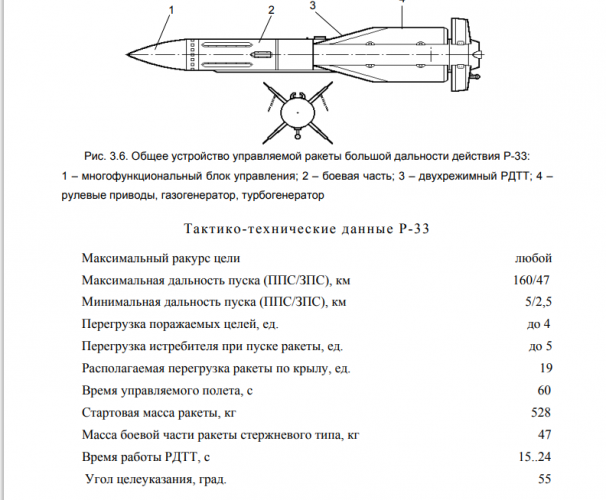
About R-33 ( interesting, there is no launch range data in the mentioned book) ,as wrote, all four under 10 sec where PESA radar has its additional transmitter only for lock-on/Ill. For comparison during 'six on six' test with F-14A/AIM-54A from 1973, it took 38 sec for launch of all six of them. Mathematically about 6 seconds for one,just like the case with R-40R and the MiG-25P.
Just two cents from me. I am talking about R-27R and N-019.
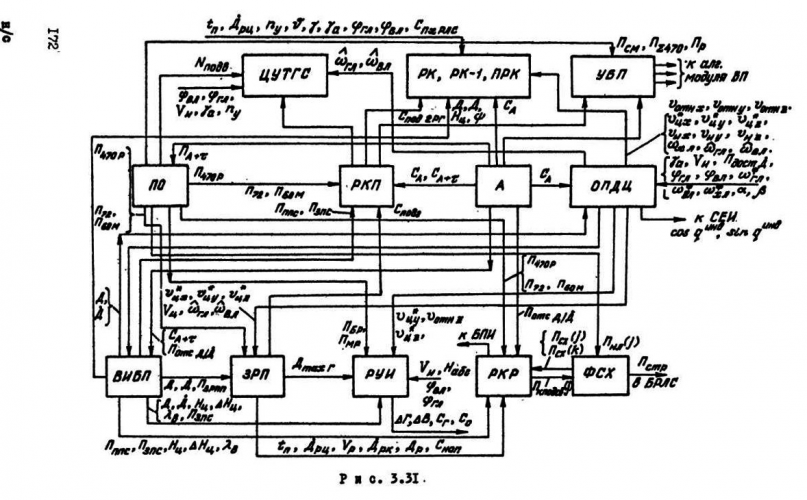
Please take in account that during SNP mode system not only detects the most dangerous target and estimate range of missile.
It also start to do some missile preparation for launch . See for example section 3.4 in Mig-29 "avionic book" - section about algorithms, for radar:
"формирования команды ПОДГОТОВКА (РКП);"
"
Алгоритм РКП, как алгоритм ПО, включается в работу в режимах
обзора и сопровождения цели при наличии признаков выбора к приме-
нению ракет Р-27РГ. Команда ПОДГОТОВКА (подготовка ракеты к пус-
ку) формируется при нажатии летчиком кнопки МРК-ЗАХВАТ-ПЗ
(Прзх =Г). Если в течение 3 мин с момента выдачи команды
ПОДГОТОВКА (Сьодг = Г) команда А не поступит, команда ПОДГОТОВКА
снимается; при снятии команды А (когда произошел сброс цели с
сопровождения) команда ПОДГОТОВКА не должна сниматься в течение
40 с после сброса цели. Алгоритм РКП выдает команду ПОДГОТОВКА 2
(Слод2 ), логика формирования которой будет рассмотрена в
п.4.4.Т. Частота счета алгоритма РКП Ач = 10 Гц,"
"
The RKP algorithm, like the PO algorithm, is activated in the target acquisition or tracking modes when there are indications that the R-27R1 missiles are selected for use. The PREPARATION command (prepare the missile for launch) is generated when the pilot presses the MRK-ZAKHVAT-PZ (Przx = G) button. If command A is not received within 3 minutes of issuing the PREPARATION command (Sjodg = G), the PREPARATION command is cancelled. If command A is cancelled (when the target is released from tracking), the PREPARATION command should not be cancelled for 40 seconds after the target is released. The RKP algorithm issues the PREPARATION 2 (Slod2) command, the logic for generating which will be discussed in Section 4.4.T. The RKP algorithm's counting frequency is Ach = 10 Hz."
Just two cents from me. I am talking about R-27R and N-019.
Please take in account that during SNP mode system not only detects the most dangerous target and estimate range of missile.
It also start to do some missile preparation for launch . See for example section 3.4 in Mig-29 "avionic book" - section about algorithms, for radar:
Question: is there any additional data/ info about IAF purchasing 400 'R-37ME' ( Izdeliye 620 in fact ) for their Su-30MKI ? Decision was made almost immediately after operation Sindoor from May 2025. First news about that was from June 2025.
Certainly would make sense as an immediate stopgap especially after Sindoor, but this being India, who knows. I imagine the radars on the Su-30MKIs must at least be brought to the Su-30SM2 standard in order to use the R-37.
Certainly would make sense as an immediate stopgap especially after Sindoor, but this being India, who knows. I imagine the radars on the Su-30MKIs must at least be brought to the Su-30SM2 standard in order to use the R-37.
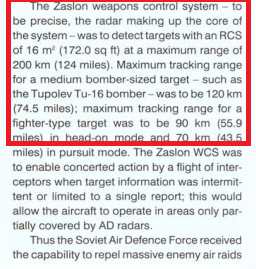
I always heard that while yes it can be up to 400 km in some modes like velocity scan or extremely small FOV searches but the usual RWS/TWS will give fighter detection at 120-140 km PPS and 60 km ZPS. Which is what I think they would use in combat. But that’s just me I’ve also seen 250-330 km PPS given for some other mode, but also max 200 km tracking range lol.
As for Kh-58 loft, I will tell you. It is same loft as basically every Soviet air to ground missile. The missile either flies level or climbs until a certain altitude.
Once it flies far enough that the look down angle to the target increases to 6-30 degrees (depending which missile we talk about), it then activates proportional guidance to curve down on target. View attachment 803373
I think that numbers/values 120km and 160km are not w/o the reason. Really don't know the origin of this chart and many others but there is some details which we must count on.In fact ,crew of the MiG-31 had/have the same task and procedures during patrols and possible interception missions like the pilots of MiG-29 and Su-27.So even before the N007 was turned on,RIO must determine the targets's size with the switch 'BAZA' according to data from the A-50 or NASU.So RIO must set the position on that switch : B,S,M or for the big,medium or small air target. In connection with that,he will get the given launch parameters.
If we talk about the old R-33 ,my opinion is that for the small target max authorised launch range will be 70 or even 90km ( we must keep on mind that N007 was developed to detect and track low flying CM's like Tomahawk with RCS only 0.3 sqm ). Fighter like MiG-21 has forward RCS 3sqm. Than for the medium target ,launch range is 120km and we know from the tests that they achieved engaging RC M-16/Tu-16 ( 19 sqm RCS) from about 120km. Bigger or even faster air target could be engaged from 160km ( of course with the parameter Dr max1).
For the 500 kg heavy AAM , with the burn phase of the dual-stage rocket engine 15-24sec and with 60sec controllable flight time ,straight flight only ,I think it was possible to achieve.
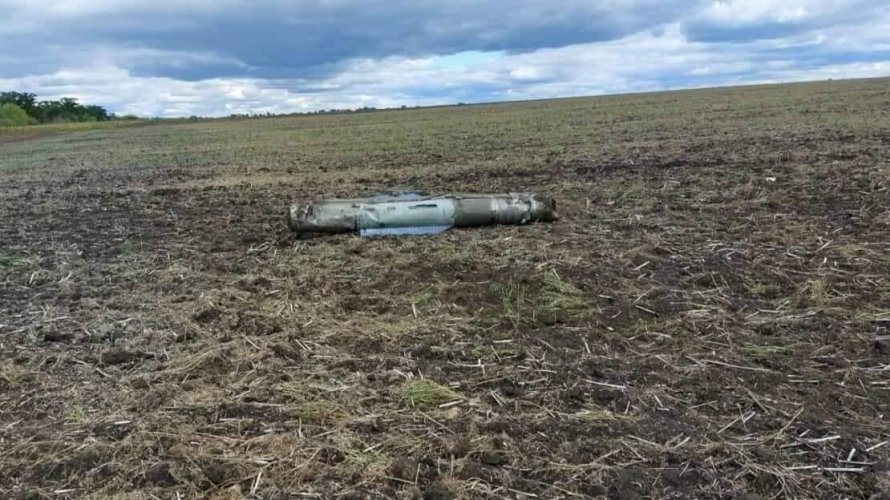
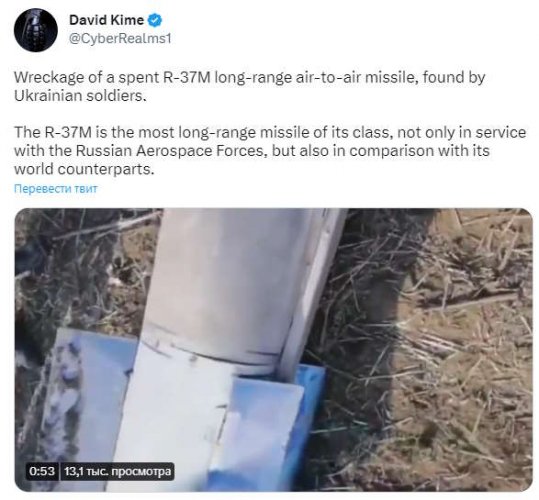
R-37M/Izd. 610M is heavy very long range AAM which is used almost from the beginning of the Russo-Ukr war. Missile is in serial production from 2015 in the KTRV 's factory 'Arrow' in the city of Korolev (Moscow area). Three fighters can carry this newer AAM : MiG-31BM, Su-35S and Su-30SM2. From what I've found so far ,twelve UkrAF combat aircraft ( Su-24,25,27 and MiG-29's) were shot down by this AAM / publicly known cases/.Launch ranges in the most cases were in the range 120-220 km.
Several days ago ,one article was announced and it is very interesting.
How the Su-35S and MiG-31BM Fight: Features of Air-to-Air Missile Use in the Air Defense Zone
In 2026, a Russian specialized publication published its first official analysis of the combat use of long-range air-to-air guided missiles during the SMO. This analysis included actual data on our R-37M missile launches at 300 km, enemy aircraft maneuvering tactics involving 180° turns, SAM kill zones from 50 km, and general conclusions for the development of fighter aircraft tactics.
Factual data on the combat use of aircraft and long-range air-to-air guided missiles during a special military operation.
Since the fall of 2022, MiG-31BM heavy fighters armed with previous-generation R-33 long-range guided missiles have been deployed to carry out special military operations. They have since begun using the modern R-37M missile, which features an active radar homing head capable of locking on to airborne targets at ranges of several tens of kilometers.
The maximum launch range of the R-37M missile at high altitudes when attacking a target in the forward hemisphere reaches 300 km. In addition to the MiG-31BM, the R-37M missile is also used on the Su-35S fighter jet, which outperforms the MiG-31BM in terms of airtime and air target detection range.
Following the effective use of R-37M missiles by Russia, the enemy changed tactics. NATO's high-tech, multi-role reconnaissance assets immediately transmitted information about Russian Aerospace Forces fighter jets flying overhead to the Ukrainian Armed Forces command and control, and also detected missile launches at targets at a significant distance from the line of contact. Upon receiving this information, enemy pilots performed aggressive trajectory maneuvers, including 180-degree turns, and deployed active jamming devices.
The turn maneuver changed the direction of attack from the front hemisphere to the rear, which reduced the maximum launch range of guided missiles of all types by at least half with a fixed time of guided missile flight.
The typical enemy aircraft operation included the following parameters: typically, two pairs of Su-25 or MiG-29 aircraft would participate in the strike, each separated by a two-minute interval and a distance of approximately 30 km. The initial flight altitude would be between 600 and 1,200 m toward the line of contact, with escort provided by a Su-27 fighter escort. At a distance of 60–70 km from the line of contact, the pair would execute a vigorous "snake" maneuver, turning at an angle of 45–60 degrees and descending to 150–200 m. This would then be followed by a flight toward the line of contact, accelerating to 800–1,000 km/h, and the pair would execute a vigorous turn at a distance of 30–35 km from the line.
Upon receiving information about the Russian fighter's departure from the line of combat contact, the strike pair immediately carried out an energetic maneuver with maximum acceleration to reach the line of application of air-to-air weapons, launched a strike, and departed at maximum speed along the return route.
The enemy has also shifted from stationary, site-based air defense to covert, mobile ambush operations. The buffer zone for enemy air defense missile systems ranges from one and a half to several dozen kilometers, depending on the troop's direction of action, and on the main axes, it averages at least 50 kilometers. In one case, a Su-35S fighter jet damaged by an enemy air defense missile was forced to land at the airfield. The pilot remained unharmed, and during a post-flight inspection, specialists counted 28 holes.
The authors' conclusions based on the presented facts.
A comparison of the performance characteristics of the onboard targeting systems of fighters of the Russian Aerospace Forces and fighters of the Ukrainian Armed Forces, as well as the characteristics of the guided missiles used, shows a clear advantage for the Aerospace Forces fighters. However, this advantage could only lead to victory in a duel situation and without outside assistance. The arsenal of medium-range and close-quarters air combat tactics employed in local wars of the relatively recent past remains unused in the context of a special military operation.
The authors cite the following factors as reducing the effectiveness of Russian aviation: large-scale military aid from NATO countries and the European Union, the operation of anti-aircraft missile systems of Soviet and foreign manufacture in the Armed Forces of Ukraine, the effectiveness of multi-service reconnaissance assets of the United States and NATO countries, as well as a number of shortcomings in the intelligence and information support of the Russian Aerospace Forces.
The reasons for the enemy's tactical success in the initial stages of military operations include: powerful information support from Western reconnaissance assets and isolated instances of routine actions on the Russian side, which consisted of the constant use of the same takeoff and landing airfields, flight routes and profiles, and air patrol zones.
The potential capabilities of the Russian reconnaissance system today clearly do not exceed the existing combined potential capabilities of the reconnaissance systems of the opposing countries, which does not yet allow for full and adequate control of the current location and movement routes of the enemy's ground-based air defense systems.
The authors cite the following as key areas for improvement: increasing the acquisition range of the active radar homing head, improving its jamming immunity, reducing the radar cross section of guided missiles, implementing missile retargeting modes, and transferring missile control from one launch vehicle to another. Improving the fighter aircraft control system to more quickly communicate the decision to engage missiles to flight crews is considered essential for increased effectiveness.
Ultimately, the authors conclude that comparing the combat capabilities of opposing air groups solely based on the individual performance characteristics of fighters and missiles cannot adequately reflect the objective situation. Even a significant advantage in certain criteria, such as maximum target detection range or maximum missile launch range, is no guarantee of success.
In a large-scale combat clash, the side with a higher level of command and control, more accurate intelligence, better coordination, and more reliable support will have a greater chance of achieving its goals.
Source of information: “Tactics of using long-range air-to-air guided missiles during the air defense war” (authors: candidates of military sciences Colonel A.Yu. Styopkin, Lieutenant Colonel A.A. Gvozdenko and Yu.G. Kravtsov), official journal of the Russian Ministry of Defense “Military Thought”, No. 1/2026.
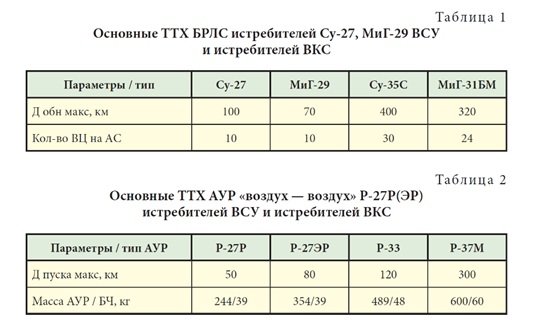
This article gave more info and there is also two mini tables.
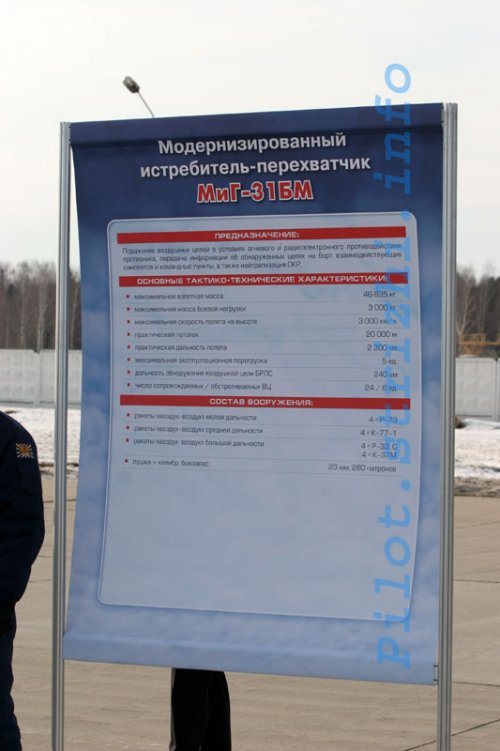
From what I can understand ,max detection ranges in the upper table is for the 3sqm target. For Su-27/N001 it is 100km, for the MiG-29/N019 it is 70km, for Su-35S/N035 is 400km and for MiG-31BM/N007AM is 320km. In the bottom row are the data about max number of tracked aircraft in TWS mode , 10 for both N001/N019, 30 for the N035 and 24 for N007AM.
Bottom table gives us data for the max launch ranges of the R-27R/ER ,R-33 and R-37M .Maybe it is possible ( maybe) ,that those max launch ranges are against 3sqm target ? 50 km for R-27R, 80km for R-27ER, 120km for R-33 and 300km for R-37M . In the bottom row we have data about launch and warhead weight in kgs for the each AAM.
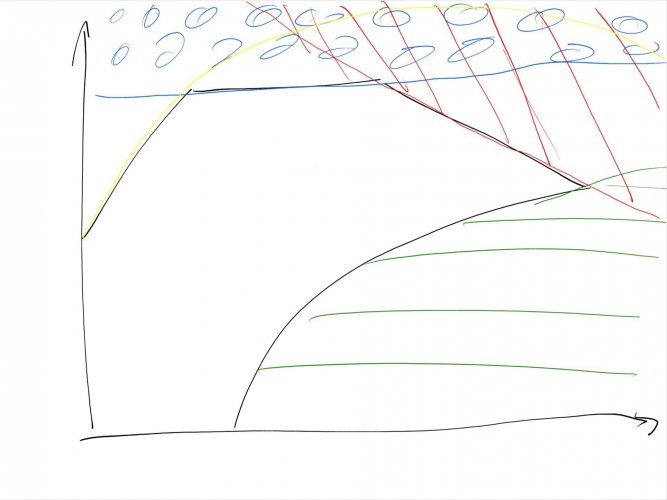
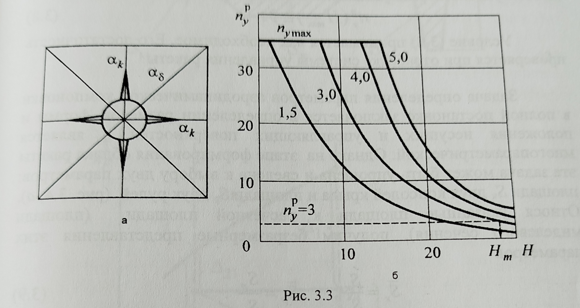
I actually have a lot to say about this image, so I’ve drawn another schematic diagram to illustrate it.
The following are all speculations about the diagram.
You can see that I’ve divided the image into multiple colors, and I’ll explain the meaning of each color one by one.
The yellow part represents the maximum flight envelope of the missile under the assumption that its aerodynamic control surfaces are always functioning properly. This ideal envelope resembles the maximum flight envelope of a fixed-wing aircraft.
However, as we all know, aerodynamic control surfaces require sufficient airflow to function properly, which makes them subject to multiple influencing factors: air density and airspeed.
Generally speaking, a missile’s aerodynamic control surfaces have a defined maximum operational altitude—for example, here it is H = 28 km. Above this altitude, the effectiveness of the control surfaces degrades significantly, which results in the blue region. It becomes difficult for the missile to engage targets above this blue region.
Since this diagram is a launch envelope diagram, the missile’s climb during flight takes time and also consumes additional kinetic energy. The missile’s maximum launch altitude is approximately 20 km, which gives rise to the red region. Within this region, engaging a target requires the missile to climb, and the climb itself will cause a significant loss of speed and time, leading to a more rapid degradation of the aerodynamic control surfaces, thus making it difficult to engage targets in this region.
For targets in the green region, this is the range where, during normal level flight against a target at the same altitude, the missile’s aerodynamic control surfaces will fail.
For targets in the green region, this is the range where, during normal level flight against a target at the same altitude, the missile’s aerodynamic control surfaces will fail.
As the missile flies slower and slower, when the speed slows down to a certain point, the control rudder can no longer effectively control the missile's attitude.This value is called the "minimum control speed." For conventional rudders, this range is roughly in the transonic range, while for grille rudders it can be even lower.
''Any missile that lofts, like AIM-7F/M or AIM-52 Phoenix even will adjust the severity of the loft and turn it off completely depending on range speed altitude.
Within DrMax2/NEZ loft would have no benefit. This is why Phoenix for instant won’t loft on shots less then 20-30 km I believe. And the pilot could very easily have the choice to force it off if they so choose.''
Seems logical, yes.Loft scenario will be used in the long range engagement,in the short range there is no need for something like that ( e.g. case for the R-37M ).
As the missile flies slower and slower, when the speed slows down to a certain point, the control rudder can no longer effectively control the missile's attitude.This value is called the "minimum control speed." For conventional rudders, this range is roughly in the transonic range, while for grille rudders it can be even lower.
Comparison : min controlable speed or the min speed of the aerodynamic stability and controllability for the R-77 ( R-77-1) is 0.6M ,for the AMRAAM family missiles about 1 M.
so i cant really find info if the modern 31BM got the CAS capability like the 90,s one or not, anyone who can 100% comfirm this? also can BM still use the R-40TD1?
The MiG-31BM has five or six different modifications, which one do you have in mind?
Only the MiG-31K has the "ground attack" feature. It is possible that the latest weapon control system can use air-to-ground weapons, but we have not yet seen it attached to the aircraft
The use of the R-40 is pointless
The MiG-31BM has five or six different modifications, which one do you have in mind?
Only the MiG-31K has the "ground attack" feature. It is possible that the latest weapon control system can use air-to-ground weapons, but we have not yet seen it attached to the aircraft
The use of the R-40 is pointless
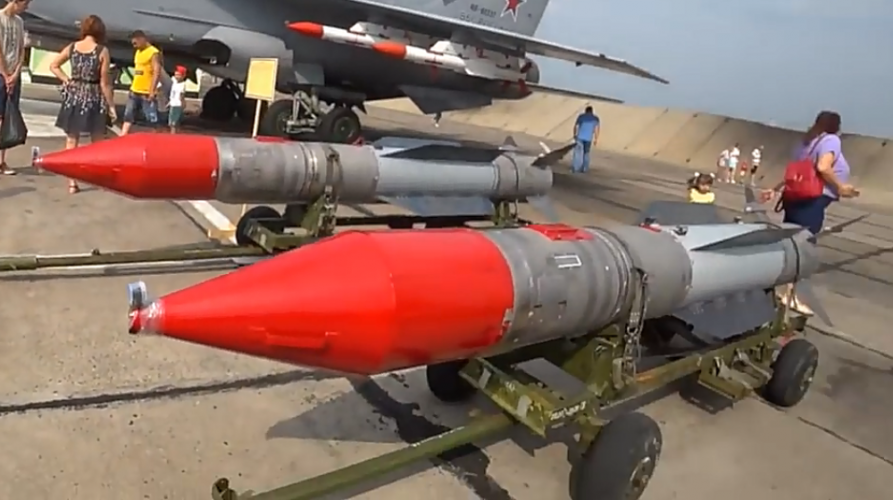
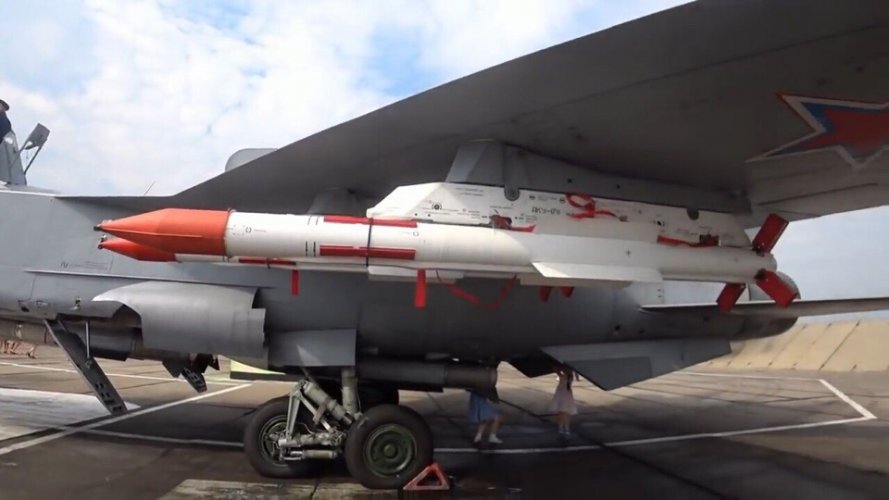
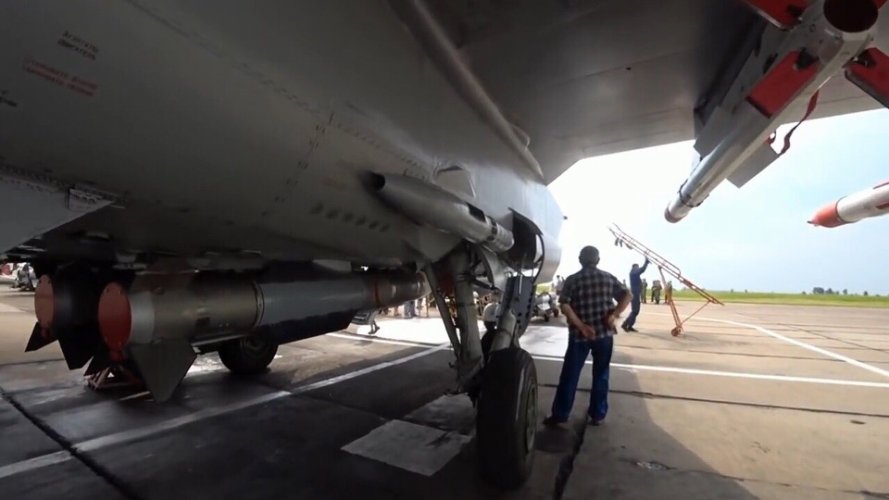
Real photo of combat use. The R-37M on the internal wing pylons is valid for the MiG-31M, but not for the BM
The MiG-31M has a significantly higher maximum takeoff weight, 52 tons, compared to the MiG-31BM's 46 tons.
Real photo of combat use. The R-37M on the internal wing pylons is valid for the MiG-31M, but not for the BM
The MiG-31M has a significantly higher maximum takeoff weight, 52 tons, compared to the MiG-31BM's 46 tons.
I read an official document that included the main characteristics of the aircraft, including the description of the R-37's underwing suspension on internal nodes.
Do you know where the original source for this table is, or did bmpd roughly estimate these figures themselves?
I wanted to ask them under the article, but unfortunately, I don’t have a LiveJournal account. Their site doesn’t seem to allow me to create one, and they don’t even offer the option to log in with Google or Facebook.
The published specifications match what is commonly known, with the exception of the maximum radar range of the Su‑27, which is officially stated to be 240 km.
The published specifications match what is commonly known, with the exception of the maximum radar range of the Su‑27, which is officially stated to be 240 km.
I think the detection range supposed to be against target with RCS of 3 m2 instead of max range
I'm just not sure how accurate that table is since we don't know where he got it from.
Seem slightly different from available poster at exhibition too
As it was mentioned in the bmpd's article ,original source for the both tables is :
''В № 1 за 2026 год официального журнала Министерства обороны Российской Федерации «Военная Мысль» опубликована небезынтересная статья «Тактика применения авиационных управляемых ракет «воздух — воздух» большой дальности в ходе СВО», авторами которой являются кандидаты военных наук полковник А.Ю. Стёпкин, подполковник А.А. Гвозденко и Ю.Г. Кравцов.''
Issue No. 1 (2026) of *Military Thought*—the official journal of the Ministry of Defence of the Russian Federation—published an article of considerable interest titled "Tactics for the Employment of Long-Range Air-to-Air Guided Missiles During the Special Military Operation," authored by Candidates of Military Sciences Colonel A.Yu. Styopkin, Lieutenant Colonel A.A. Gvozdenko, and Yu.G. Kravtsov.
As it was mentioned in the bmpd's article ,original source for the both tables is :
''В № 1 за 2026 год официального журнала Министерства обороны Российской Федерации «Военная Мысль» опубликована небезынтересная статья «Тактика применения авиационных управляемых ракет «воздух — воздух» большой дальности в ходе СВО», авторами которой являются кандидаты военных наук полковник А.Ю. Стёпкин, подполковник А.А. Гвозденко и Ю.Г. Кравцов.''
Issue No. 1 (2026) of *Military Thought*—the official journal of the Ministry of Defence of the Russian Federation—published an article of considerable interest titled "Tactics for the Employment of Long-Range Air-to-Air Guided Missiles During the Special Military Operation," authored by Candidates of Military Sciences Colonel A.Yu. Styopkin, Lieutenant Colonel A.A. Gvozdenko, and Yu.G. Kravtsov.
As the missile flies slower and slower, when the speed slows down to a certain point, the control rudder can no longer effectively control the missile's attitude.This value is called the "minimum control speed." For conventional rudders, this range is roughly in the transonic range, while for grille rudders it can be even lower.
Not sure why you think they would fail in the lower altitude region, even if missile is slow every single missile G per altitude and speed chart shows adequate control don to below Mach 1. We don’t have this data for R-33 but I’m sure it goes down to Mach 1 fine ( where the Zaslon will likely turn off illumination unless target speed is higher).
Slowing down below those 2 speeds, the 60s guidance time, and the proximity fuse are the likely restrictions for this region.
If you mean the high altitude part above 20 km at less then 30 km or so then sure, but I think that “kink” is in the graph becuase the aircraft itself cannot really fly above 20 km yet the missile is rated up to 28 km.
As it was mentioned in the bmpd's article ,original source for the both tables is :
''В № 1 за 2026 год официального журнала Министерства обороны Российской Федерации «Военная Мысль» опубликована небезынтересная статья «Тактика применения авиационных управляемых ракет «воздух — воздух» большой дальности в ходе СВО», авторами которой являются кандидаты военных наук полковник А.Ю. Стёпкин, подполковник А.А. Гвозденко и Ю.Г. Кравцов.''
Issue No. 1 (2026) of *Military Thought*—the official journal of the Ministry of Defence of the Russian Federation—published an article of considerable interest titled "Tactics for the Employment of Long-Range Air-to-Air Guided Missiles During the Special Military Operation," authored by Candidates of Military Sciences Colonel A.Yu. Styopkin, Lieutenant Colonel A.A. Gvozdenko, and Yu.G. Kravtsov.
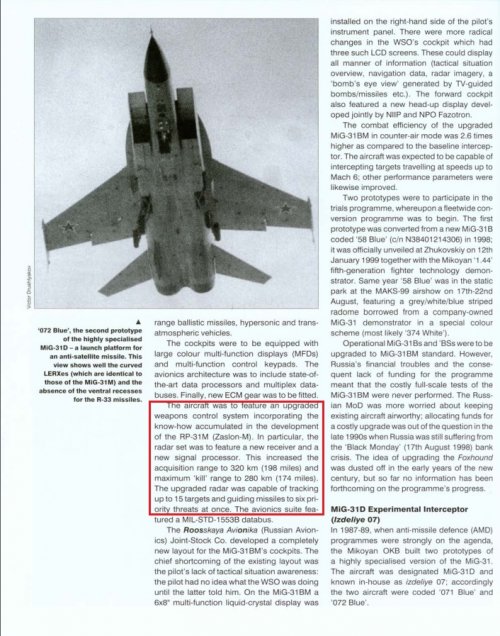
I have mentioned this in another thread, but it seem like the 320 km value for Zaslon-AM is again, a reference back to "Mikoyan MiG-31: Famous Russian Aircraft" book written by Yefim Gordon and Dmitriy Komissarov
What did Ukrainians discover about the R-37M three years ago ...
Су-57 врага оснастили ракетами Р-37М: Рувин рассказал об особенностях этих ракет, одна из которых уже попала к экспертам на исследование
''КИЕВ. 12 сентября. УНН. В последнее время наблюдается уменьшение количества использования современных российских ракет типа Х-101, зато участились случаи ракетных атак старыми образцами в определенной модификации. Речь идет в частности о ракетах Р-37М. Об особенностях ракет этого типа рассказал в своем Телеграмм-канале директор Киевского научно-исследовательского института судебных экспертиз Александр Рувин, сообщает УНН.
«За последнее время мы наблюдаем уменьшение количества использования современных российских ракет типа Х-101, зато участились случаи ракетных атак старыми образцами в определенной модификации. Среди недавних объектов исследования экспертов КНИИСЭ – ракета Р-37М. Это модернизированная версия советско-российской ракеты типа «воздух-воздух» Р-37 «Стрела». Модернизацию провели в начале 2000 годов. В 2020 году модификация ракеты большой дальности Р-37М была интегрирована в комплекс вооружения истребителя пятого поколения Су-57», - сообщил Рувин.
«Эксперты КНИИСЭ проводят комплексную идентификацию этой ракеты, она детализирована по компонентам, устанавливается наличие среди составляющих микроэлектроники не российского производства. Кроме того, специалисты Института изучают технические характеристики ракеты и исследуют вопрос о ее технической спецификации, то есть наличии специфических особенностей или инноваций. Важным также является исследование особенностей работы систем наведения и управления ракеты, информации о запуске, целевых характеристик и тому подобное.
Уже сейчас знаем, что исследуемый объект имеет электронные компоненты иностранного производства. В ракете имеются специализированные интегральные схемы с маркировкой американского производителя. После завершения экспертизы будем иметь полную информацию обо всех ее составляющих. Сделаем все возможное, чтобы не давать врагу шансов создавать орудия массовых убийств!», - написал Александр Рувин.
Он добавил, что экспертами КНИИСЭ проводится работа для предоставления органам досудебного расследования полной информации о преступлениях россиян против нашего государства и оружии, которое используют террористы. Данные собранные в рамках экспертных исследований становятся основой для введения санкций против страны-агрессора и сокращения мощности российского военно-промышленного комплекса.''
Enemy Su-57s have been equipped with R-37M missiles; Ruvin discussed the characteristics of these missiles, one of which has already reached experts for analysis.
''KYEV. September 12. UNN. Recently, a decrease has been observed in the use of modern Russian Kh-101 missiles, while missile attacks using older models—specifically certain variants—have become more frequent. This refers, in particular, to R-37M missiles. Oleksandr Ruvin, Director of the Kyiv Scientific Research Institute of Forensic Expertise, discussed the characteristics of these missiles on his Telegram channel, UNN reports.
"Recently, we have observed a decrease in the use of modern Russian Kh-101 missiles, while missile attacks involving older models—specifically certain variants—have become more frequent. Among the recent subjects of analysis by KSRIFE experts is the R-37M missile. It is an upgraded version of the Soviet-Russian R-37 'Strela' air-to-air missile. The upgrade was carried out in the early 2000s. In 2020, the R-37M long-range missile variant was integrated into the weapons suite of the fifth-generation Su-57 fighter jet," Ruvin reported.
KSRISFE experts are conducting a comprehensive identification of this missile, breaking it down by component and determining whether any non-Russian-made microelectronics are present. In addition, the Institute’s specialists are analyzing the missile's technical characteristics and investigating its technical specifications—specifically, any unique features or innovations. Also of importance is the study of the missile's guidance and control systems, launch data, targeting characteristics, and the like.
"We already know that the object under examination contains foreign-made electronic components. The missile contains specialized integrated circuits bearing the markings of an American manufacturer. Once the analysis is complete, we will have full information about all its components. We will do everything possible to ensure the enemy has no chance of creating instruments of mass destruction!" wrote Aleksandr Ruvin.
He added that KSRISFE experts are working to provide pre-trial investigation bodies with comprehensive information regarding crimes committed by Russians against our state and the weaponry used by terrorists. Data gathered through these expert analyses serve as the basis for imposing sanctions on the aggressor state and curtailing the capacity of the Russian military-industrial complex.''
One thing is certain,R-37M is for sure not the weapon of mass destruction.
This site uses cookies to help personalise content, tailor your experience and to keep you logged in if you register.
By continuing to use this site, you are consenting to our use of cookies.


 I’ve also seen 250-330 km PPS given for some other mode, but also max 200 km tracking range lol.