R-33, R-37 and R-72/KS-172S-1 ALRAAM missiles

So according to the translation from Key publishing, it appear that SUV Zaslon is referring to upgrade version of basic Zaslon, so it seem to be the Zaslon-A. Which mean the test on 18 Aug 1993 was done by Mig-31B using R-33S

I wrote ''Definitely ,yes. '' earlier but but ... Colleague 'paralay' posted this on the MiG-31 thread :

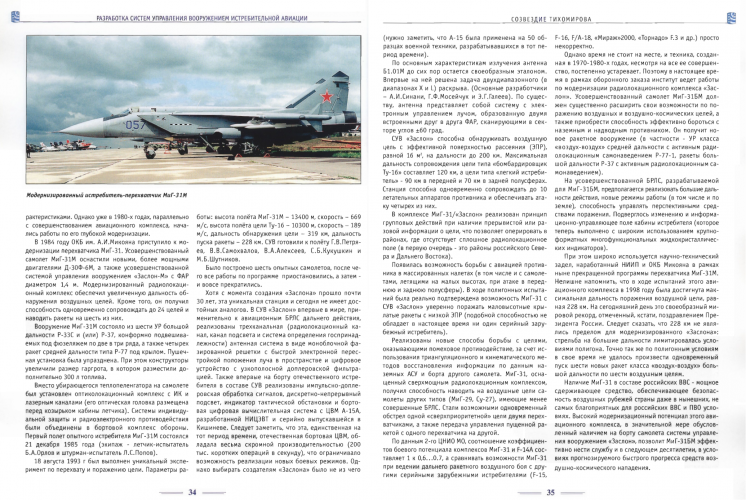
''On August 18, 1993, a unique experiment was performed to intercept and defeat a target. Operating parameters: MiG-31M flight altitude - 13400 m, speed - 669 m/s, Tu-16 target flight altitude - 10300 m, speed - 189 m/s, target detection range - 319 km, missile launch range - 228 km. The SUV (Weapons Control System) was prepared for flight by G.V.Petryaev, V.V.Samokhvalov, V.A.Alekseev, S.B.Kukushkin and M.B.Shutnikov. At the same time, the scientific and technical reserve accumulated by the NIIP and the Mikoyan Design Bureau within the framework of the now discontinued MiG-31M interceptor program is widely used. It is worth recalling that during the tests of this aviation complex in 1998, the maximum range of hitting an air target was reached, equal to 228 km. To date, this is a kind of world record, marked, by the way, by the congratulations of the President of Russia. It should be said that 228 km was not the limit for the upgraded "Barrier": long-range shooting was limited by the conditions of the landfill.
Similarly, due to the testing ground conditions, it was not possible at one time to launch six new long-range air-to-air missiles at six air targets simultaneously.''

He gave a source for this citation :

https://www.secretprojects.co.uk/threads/mikoyan-mig-31-foxhound.38380/page-4
This is so confusing and wrong . We can see that some flight parameters for the MiG-31M? are not the same as this one :

Test from 18 Aug 1993 mod.jpg

Hm, President Yeltsin congratulated only once and it was in April 1994 ( 304 km launch distance of one R-37 launched from MiG-31M against the missile-target ). Also this sentence is so confusing:

''It is worth recalling that during the tests of this aviation complex in 1998, the maximum range of hitting an air target was reached, equal to 228 km.''

1998 ? There was no tests with MiG-31M/R-37 during 1998 because they stopped during 1997 and again that 228km ???

''Испытания ракеты продолжались по 1997 г.''

''Missile testing continued until 1997.''

http://militaryrussia.ru/blog/topic-106.html
 
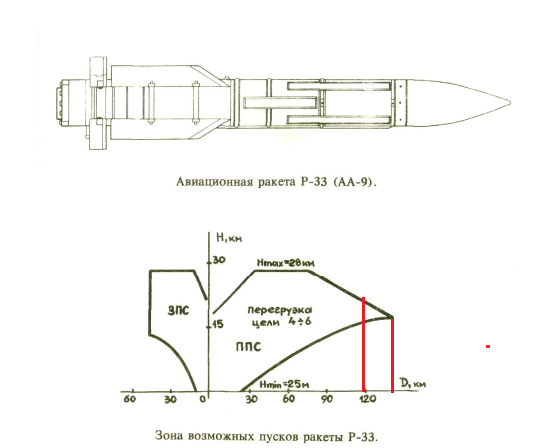
Take a look on what two red lines show to us .I think we can see them.

View attachment 793545
There are much better copies of those photos available, in color. Those are all R-37s. Centre two appear to be mockups. The photo you posted in reply #119 is the one showing a pair of centerline R-33S airframes minus their wings. Notice how the outer forward R-37s have grey radomes and the outer rear R-37s have folded rear fins - that doesn't match what you see in these four photos. Different dates, and possibly different locations (I believe the photo from #119 was from Zhukovskiy at a Moscow airshow, the ones above might've been the Kubinka shots).
 
Does anyone know where and when the R-33S photos were taken?
I believe the shot with a pair of R-33S amongst other AAMs on display was taken at an open house but I can't remember the airbase.

Edit- looks like Kubinka, April 2009
 
Last edited:
There are much better copies of those photos available, in color. Those are all R-37s. Centre two appear to be mockups. The photo you posted in reply #119 is the one showing a pair of centerline R-33S airframes minus their wings. Notice how the outer forward R-37s have grey radomes and the outer rear R-37s have folded rear fins - that doesn't match what you see in these four photos. Different dates, and possibly different locations (I believe the photo from #119 was from Zhukovskiy at a Moscow airshow, the ones above might've been the Kubinka shots).

Aha , mockups .OK, tnx.

I believe the shot with a pair of R-33S amongst other AAMs on display was taken at an open house but I can't remember the airbase.

Edit- looks like Kubinka, April 2009


From the article 'Russian Icon' that overscan posted earlier :

''Displayed at Kubinka alongside two Vympel (now part of Tactical Missile Corp.) R—33 (AA-9 Amos) missiles were two R—33Ss (AA—9B5). The latter variant has only been partially seen in photographs taken in 1994 at the air force flight test center at Ahktubinsk.

The R-33Ss in the 1994 photos were mounted in the two center semi-recessed stations of the MiG-31M. That aircraft was designed to carry up to six long-range air-to-air missiles semirecessed under the fuselage, while earlier versions of the Foxhound could only carry four. The R—33S displayed did have the four fixed destabilizers to the rear of the radome; it did not have its main wing surfaces fitted.''
 
Another way you can tell the R-33S and R-37 apart - R-37 (the original version, not the current R-37M) had four folding rear fins. R-33 and R-33S only had folding on the upper two fins to clear the fuselage when mounted.

R-33S also has the same antenna on a pylon below the lower rear fins, just like the R-33. R-37/R-37M lack that antenna.
 
Last edited:
Another way you can tell the R-33S and R-37 apart - R-37 (the original version, not the current R-37M) had four folding rear fins. R-33 and R-33S only had folding on the upper two fins to clear the fuselage when mounted.

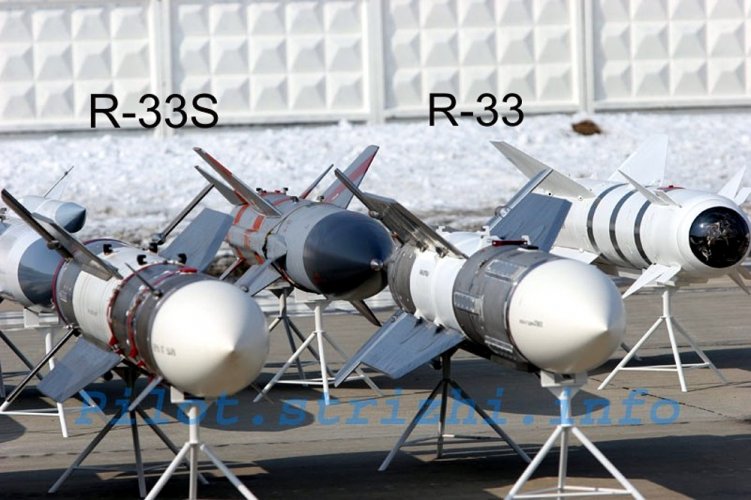
R-33 and R-33S have only upper stabilizers as foldable .Take a look

R-33S  R-33 u prvom redu.jpg

Old R-37 has all four stabilisers as foldable but new R-37M has like R-33/S only upper stabilisers as foldable.

R-37 and R-37M.png
 
R-33S also has the same antenna on a pylon below the lower rear fins, just like the R-33. R-37/R-37M lack that antenna.

As we can see on upper photo, yes. On the lower photo we can see that old R-37 had one way data-link antenna but new R-37M has two way data link antenna?
 
From the article 'Russian icon' , again, one very interesting detail :

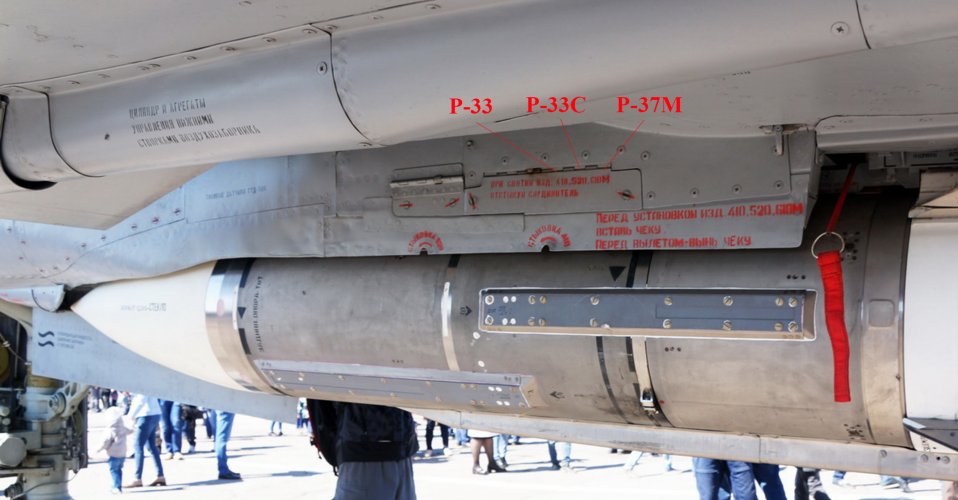
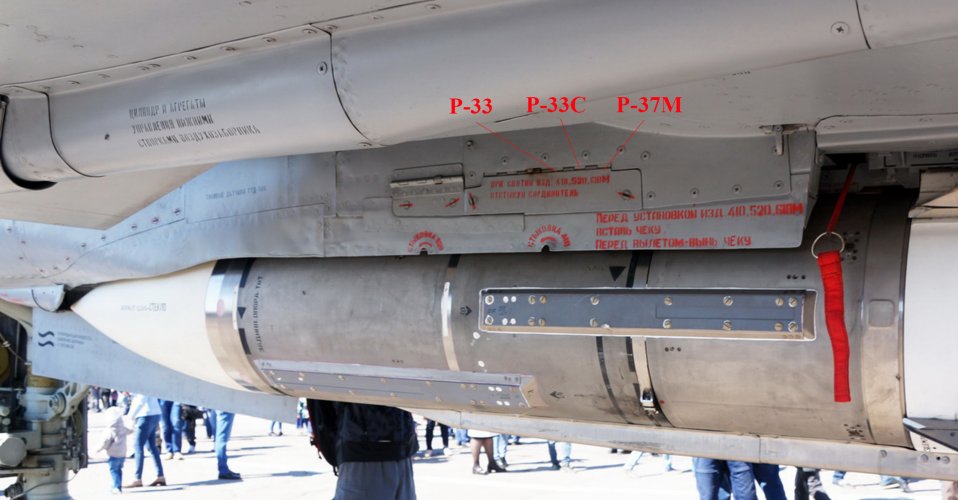
''A pylon variant, the AKU-410-1, however, was described by Vympel as capable of carrying a 530-kg. weapon. ''

MiG-31BM R-33 R-33S R-37M.jpg

OK , R-33/Izd 410 weighs exactly 493 kg, R-33S/Izd 520 about 520kg and now ,how much weighs new R-37M/Izd 610M ? Most sources give data 510/520 kg?

If we compare old R-37/Izd 610 ( weighs 600kg) with its modernised version R-37M, difference is not so small, 80-90kg.R-37M is almost 100kg lighter than R-37,how is that possible anyway?

http://militaryrussia.ru/blog/topic-106.html
Yes, new dual-band radar seeker 9B1103M-350 'Shayba' /MFBU-610M is 3 times lighter than old 9B1388/MFBU-610 ( 13kg vs 39kg), warhead weighs the same 60kg.What about other components and parts ,any info/data ?
 
Last edited:
I wrote ''Definitely ,yes. '' earlier but but ... Colleague 'paralay' posted this on the MiG-31 thread :

''On August 18, 1993, a unique experiment was performed to intercept and defeat a target. Operating parameters: MiG-31M flight altitude - 13400 m, speed - 669 m/s, Tu-16 target flight altitude - 10300 m, speed - 189 m/s, target detection range - 319 km, missile launch range - 228 km. The SUV (Weapons Control System) was prepared for flight by G.V.Petryaev, V.V.Samokhvalov, V.A.Alekseev, S.B.Kukushkin and M.B.Shutnikov. At the same time, the scientific and technical reserve accumulated by the NIIP and the Mikoyan Design Bureau within the framework of the now discontinued MiG-31M interceptor program is widely used. It is worth recalling that during the tests of this aviation complex in 1998, the maximum range of hitting an air target was reached, equal to 228 km. To date, this is a kind of world record, marked, by the way, by the congratulations of the President of Russia. It should be said that 228 km was not the limit for the upgraded "Barrier": long-range shooting was limited by the conditions of the landfill.
Similarly, due to the testing ground conditions, it was not possible at one time to launch six new long-range air-to-air missiles at six air targets simultaneously.''

He gave a source for this citation :

https://www.secretprojects.co.uk/threads/mikoyan-mig-31-foxhound.38380/page-4
This is so confusing and wrong .
To be fair, now I feel like Paralay is probably correct because:
1- All reputable source seem to point out that the test on August 1998 were done by Mig-31M, it seem unlikely that they all made the same mistake
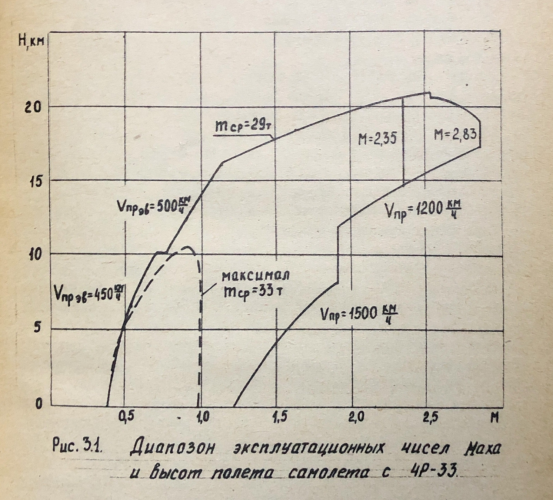
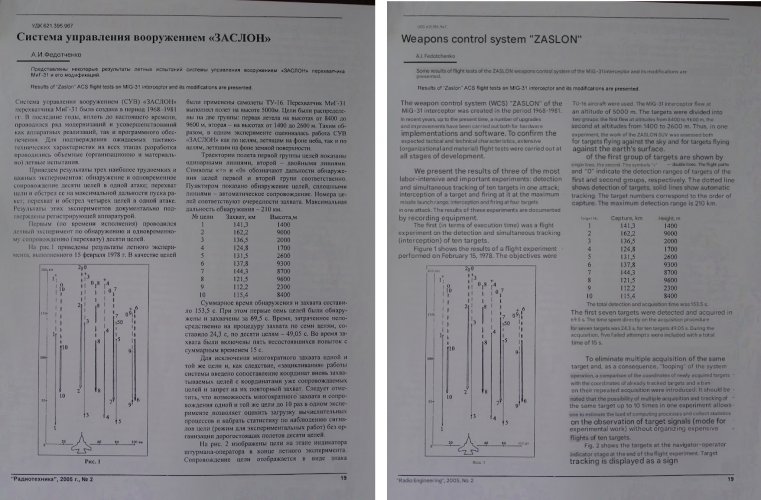
2- Mig-31 speed and altitude (669 m/s at 13400 m) in his article actually seem to match closely with Mig-31 flight envelop in the Mig-31 manual. Whereas the article on Radio engineering seem to suggest that Mig-31 can fly at 669 m/s at altitude of barely 8400 m, this is quite a lot faster than what recorded in flight manual. I think it unlikely.
IMG_0261.png

3- His source apparently is a book published by NIIP (who made Zaslon-M) so logically, they should know their product
1.png

4.png
 
Last edited:
Hm, President Yeltsin congratulated only once and it was in April 1994 ( 304 km launch distance of one R-37 launched from MiG-31M against the missile-target ). Also this sentence is so confusing:

''It is worth recalling that during the tests of this aviation complex in 1998, the maximum range of hitting an air target was reached, equal to 228 km.''
What if we have been thinking about this the wrong way?.
Theory 1: what if 304 km is the lock distance? and 218 km is the missile launch distance?
Theory 2: what if 314 km is the lock distance, 304 km is the launch distance and 228 km is the distance between two aircraft when missile hit?
My point is: what if there is only 1 test of R-37 and not 2 separate test of R-37 like we originally thought?
 
Last edited:
What if we have been thinking about this the wrong way?.
1- what if 304 km is the lock distance? and 218 km is the missile launch distance?
2- what if 314 km is the lock distance, 304 km is the launch distance and 228 km is the distance between two aircraft when missile hit?
My point is: what if there is only 1 test of R-37 and not 2 separate test of R-37 like we originally thought?

Hm ,so confusing... First to write some details about that speed ''669m/s'' .It is almost 2500km/h. MiG-31 ( basic,DZ,B/BS and of course M ,even newer BM ) can achieve that speed at 11.000m and above of course but to achieve that speed at about 9000m ,hm , don't think that it could be achieved by the MiG-31M with modified D-30F-6M engines.

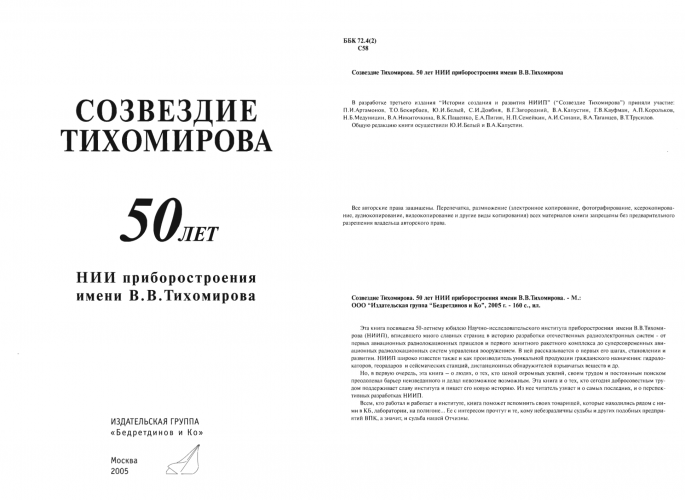
Also are confusing data from both articles : Radiotechnika and that from 50 years of the NIIP ( both dated from 2005).

From that '18.08.1993 case' ,we have now two differ data for value of 319km as lock on range and detection range, hm. Launch range was 228km. Maybe in that test MiG-31M was used but with R-33S not R-37 ?

About 'April 1994 case' it was definitely MiG-31M with R-37 and launch range was 304km.Target was one missile not airplane.
 
Hm ,so confusing... First to write some details about that speed ''669m/s'' .It is almost 2500km/h. MiG-31 ( basic,DZ,B/BS and of course M ,even newer BM ) can achieve that speed at 11.000m and above of course but to achieve that speed at about 9000m ,hm , don't think that it could be achieved by the MiG-31M with modified D-30F-6M engines.
I think we can say with 100% certainty that the Mig-31M altitude in the test is actually 13,400 m rather than 8,400 m, because it consistent with flight manual data, and we know there is no reason to exaggerate or understate value to put into manual used by pilot.
Also are confusing data from both articles : Radiotechnika and that from 50 years of the NIIP ( both dated from 2005).
Radiotechnika is simply a magazine like Jane while "Tikhomirov Constellation. 50 Years of the V.V. Tikhomirov Scientific Research Institute of Instrument Engineering." is commemorative anniversary book authorized by NIIP so logically the book should be more accurate than the magazine article, added to the fact that the data from the book also consistent with flight manual data, I think we can safety trust it

From that '18.08.1993 case' ,we have now two differ data for value of 319km as lock on range and detection range, hm. Launch range was 228km. Maybe in that test MiG-31M was used but with R-33S not R-37 ?

About 'April 1994 case' it was definitely MiG-31M with R-37 and launch range was 304km.Target was one missile not airplane.
What really confuses me is that, for the alleged "April 1994 test", there don’t seem to be any authoritative sources describing what actually happened.

Here is my current working theory:
During 18 August 1993 test, MiG-31M detected and locked onto a Tu-16 target at 319 km. I have read that MiG-31 doesn’t use a Velocity search mode like F-14, so its detection and lock on ranges may effectively be the same. The MiG-31M then launched either an R-33S or R-37 at a distance of 228 km, which at the time set a world record.
On April 1994, Russia President Yeltsin issued a formal congratulation acknowledging the success of that test.
Both events are reported in “Mikoyan MiG-31: Famous Russian Aircraft” by Yefim Gordon and in “Tikhomirov Constellation: 50 Years of the V.V. Tikhomirov Scientific Research Institute of Instrument Engineering” published by NIIP.

The issue, I suspect, is that some people may have confused Zaslon-M lock on range with R-37/R-33S actual launch range during the test. They may also have mistaken the date of Yeltsin’s congratulatory message for the date of the test itself. Therefore, they mistakenly reported that there is a test happened on April 1994 where Mig-31M launched missile from 304 km
 
I think we can say with 100% certainty that the Mig-31M altitude in the test is actually 13,400 m rather than 8,400 m, because it consistent with flight manual data, and we know there is no reason to exaggerate or understate value to put into manual used by pilot.

Yes, it's very possible that was MiG-31M.

Radiotechnika is simply a magazine like Jane while "Tikhomirov Constellation. 50 Years of the V.V. Tikhomirov Scientific Research Institute of Instrument Engineering." is commemorative anniversary book authorized by NIIP so logically the book should be more accurate than the magazine article, added to the fact that the data from the book also consistent with flight manual data, I think we can safety trust it

Of course ,'NIIP 50 years' is more reliant source.

What really confuses me is that, for the alleged "April 1994 test", there don’t seem to be any authoritative sources describing what actually happened.

Here is my current working theory:
During 18 August 1993 test, MiG-31M detected and locked onto a Tu-16 target at 319 km. I have read that MiG-31 doesn’t use a Velocity search mode like F-14, so its detection and lock on ranges may effectively be the same. The MiG-31M then launched either an R-33S or R-37 at a distance of 228 km, which at the time set a world record.
On April 1994, Russia President Yeltsin issued a formal congratulation acknowledging the success of that test.
Both events are reported in “Mikoyan MiG-31: Famous Russian Aircraft” by Yefim Gordon and in “Tikhomirov Constellation: 50 Years of the V.V. Tikhomirov Scientific Research Institute of Instrument Engineering” published by NIIP.

The issue, I suspect, is that some people may have confused Zaslon-M lock on range with R-37/R-33S actual launch range during the test. They may also have mistaken the date of Yeltsin’s congratulatory message for the date of the test itself. Therefore, they mistakenly reported that there is a test happened on April 1994 where Mig-31M launched missile from 304 km

Hm, more data/info ,more we are confused. I hope we will find appropriate data. It will need more ''digging''.Many data we got here earlier (during August).

https://www.secretprojects.co.uk/th...atform-between-mig-31-and-su-35s.39723/page-3
Indeed, there was test during April 1994 and we have info that state trials of the MiG-31M with K/R-37's ended during April 1994. That is very interesting for further investigation.

This citation is from overscan's post ( previous page) :

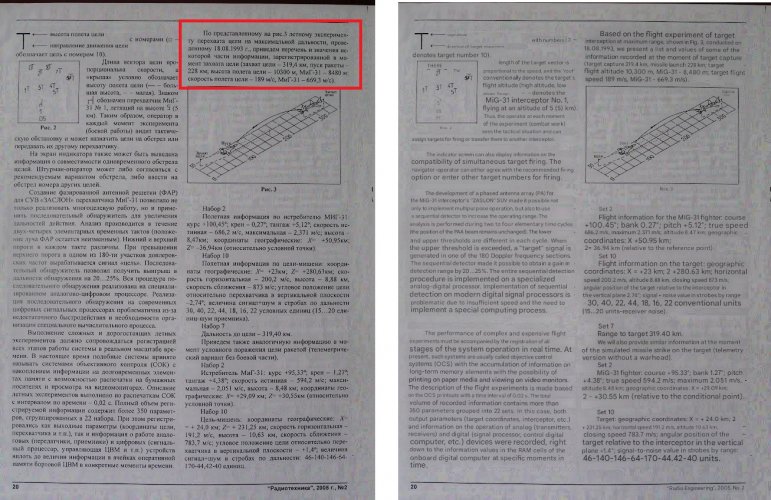
''On August 18, 1993, a series of flight experiments to intercept targets at maximum range were conducted. During the first of these, a radio-controlled target, flying at an altitude of 10,300 m and a speed of 189 m/s, was captured by a MiG-31 interceptor (flying at an altitude of 8,480 m and a speed of 669.3 m/s) at a distance of 319.5 km. The R-33 missile (which successfully hit the target) was launched at a range of 228 km.


MOSCOW 73/23028 67 15/10 1827
PRESIDENT
of the Rassinsky FEDERATION - MOSCOW 17} ZENIT LENINGRADSKOE HIGHWAY 6
TO GENERAL DESIGNER RA BELYAKOV.
I CONGRATULATE YOU AND THE WORK TEAMS OF THE COMPANIES PARTICIPATING IN THE CREATION OF OBJECTS 05 AND PRODUCTS 610 ON THE UNIQUE RESULTS ACHIEVED DURING THEIR TESTING.
THE PRESIDENT AND THE GOVERNMENT WILL ALWAYS SUPPORT EFFORTS AIMED AT THE CREATION OF NEW TECHNOLOGY, INCREASING ITS EFFICIENCY, RELIABILITY, AND COMPETITIVENESS IN THE GLOBAL MARKET.
WE WISH YOU FURTHER CREATI SUCCESS.
NR-PR-1593 B, YELTSIN
1838. 15U 0046

Perhaps the most spectacular flight experiment, which fully demonstrated the capabilities of the aviation complex, was the experiment conducted on April 21, 1994, involving the simultaneous firing of four aerial targets. The latter were specially equipped MiG-21 fighters (controlled from ground command posts), which had a relatively low radar cross-section and high maneuverability.''

Source: 'Aerospace Review, 2005 05' as overscan mentioned. It is interesting that from same year we have both 'Radiotechnika' and that 'NIIP 50 years' articles and that Y.Gordon's book about MiG-31.


Underlined are mistakes : MiG-31 ( in fact MiG-31M), 8840m ( in fact 13400m), R-33 ( in fact R-37).

I bolded three details because I suppose,think, that they are connected : Object 05/Izdeliye 05 or MiG-31M ,Product 610 or R-37 and that date 21 April 1994.

Another interesting detail is next. After the citation about '18 Aug 1993 test' we have that info about President's telegram congrats but under that citation we have info about '21 April 1994' test what is very interesting and confusing in the same time.

After the date ''April 21, 1994'' , I underlined complete next citation, 'cause I think that was big mistake made by V.Ilyin in his article. I suppose he was also confused by so many data and mistakenly wrote details about the engaging of four differ targets ( in fact four La-17MM and M-21 as RC-version of the MiG-21) ,that was happened on 28 August 1978. Overscan gave details about that test in his post.

Take a look on V.Ilyin statement :

''On 28 August of 1978 MiG-31 it successfully destroyed by four simultaneously released rockets R-33 of four radio-controlled airborne target.''

Now,what I underlined in the previous citation, I think we can add to this sentence ??? It makes sense after all because MiG-31M certainly didn't have some firing tests with four instead of six AAM's (R-33S or R-37).

About B.Yeltsin congrats telegram from April 1994 ,I think that it is hardly possible that President sent a telegram eight months after 18 Aug 1993 test .Eight months ,hm, too long.

Yes ,even Y.Gordon wrote about that in his book about MiG-31 ,be aware from 2005 ( you posted earlier scan of the page where we can read some details ).

Scribd ,pdf version of that book : https://www.scribd.com/document/691797706/MiG-31


Now take a look what Y.Gordon wrote about B.Yeltsin's congrats telegram in his book from 1997 ''MiG-25 and MiG-31'' ,page 87, citation :

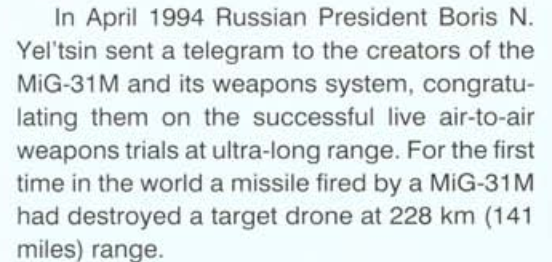
A short while earlier ,in April 1994 ,the Russian President Boris N.Yeltsin sent a telegram to the Mikoyan OKB and other organisations involved in the MiG-31M programme ,extending his congratulations on a successful test.The test in question was really something special,being the world's first instance when an interceptor had destroyed a target flying more than 300km (186 miles) away.The aircraft was a MiG-31M and the missile an R-37.

Source: https://www.scribd.com/doc/156183172/MiG-25-and-MiG-31-pdf


This citation is from the article ''Russian Icon'' ,year 2009, 'overscan' posted this on the previous page .Take a look :

''The K—37M is a further development of the K—37 program intended for the MiG—31M. Test firings of the K—37 were carried out in the mid-1990s, well in excess of the maximum engagement of the R—33. A firing in 1994 included hitting a large target at a range of 260 km.''


On the previous page we have even three citations on Russian ( translated) about that test from April 1994 when MiG-31M engaged one missile ( again not airplane) and where launch distance of the R-37 was 304km ( some sources mentioned more than 300km, OK ). Pls take a look on that .

Why missile and not airplane? My opinion is that Izdeliye 05 /MiG-31M was in fact developed to counter US Army MRBM's like Pershing II which were positioned in the Europe that time.MiG-31 with its N007 and four R-33's could only engage low flying subsonic cruise missiles and high flying non-maneuverable supersonic recce/bomber aircraft ( max speed 3500-4000km/h ). MiG-31M with its N007M and six R-37's could maybe engage not only those targets but even ballistic missiles( speed over 6000km/h as hypersonic)?

 
One more citation about the congrats telegram from April 1994 :

''В апреле 1994 г ОКБ Микояна получило от Президента России телеграмму с поздравлениями как самой фирме, так и ее смежникам, задействованным по программе МиГ-31М, по поводу успешного окончания испытаний. Имелся в виду пуск ракеты, которая успешно поразила цель на дистанции более 300 км, что не доступно ни одному другому перехватчику в мире.''

''In April 1994, the Mikoyan Design Bureau received a telegram from the President of Russia congratulating both the company itself and its subcontractors involved in the MiG-31M program on the successful completion of testing. This referred to the launch of a missile that successfully hit a target at a distance of over 300 km, a feat unmatched by any other interceptor in the world.''

https://testpilot.ru/russia/mikoyan/mig/31/m/
It is obvious that during 1994 there was several tests with MiG-31M and its R-37's where launch ranges were 260km and 304km.
 
This citation is from overscan's post ( previous page) :

''On August 18, 1993, a series of flight experiments to intercept targets at maximum range were conducted. During the first of these, a radio-controlled target, flying at an altitude of 10,300 m and a speed of 189 m/s, was captured by a MiG-31 interceptor (flying at an altitude of 8,480 m and a speed of 669.3 m/s) at a distance of 319.5 km. The R-33 missile (which successfully hit the target) was launched at a range of 228 km.
Ok this seem to be the test mentioned in Radiotechnika and NIIP 50 years
Perhaps the most spectacular flight experiment, which fully demonstrated the capabilities of the aviation complex, was the experiment conducted on April 21, 1994, involving the simultaneous firing of four aerial targets. The latter were specially equipped MiG-21 fighters (controlled from ground command posts), which had a relatively low radar cross-section and high maneuverability.''

Source: 'Aerospace Review, 2005 05' as overscan mentioned. It is interesting that from same year we have both 'Radiotechnika' and that 'NIIP 50 years' articles and that Y.Gordon's book about MiG-31.
This test?
Zaslon-M second test.jpg

Underlined are mistakes : MiG-31 ( in fact MiG-31M), 8840m ( in fact 13400m), R-33 ( in fact R-37).

I bolded three details because I suppose,think, that they are connected : Object 05/Izdeliye 05 or MiG-31M ,Product 610 or R-37 and that date 21 April 1994.

Another interesting detail is next. After the citation about '18 Aug 1993 test' we have that info about President's telegram congrats but under that citation we have info about '21 April 1994' test what is very interesting and confusing in the same time.

After the date ''April 21, 1994'' , I underlined complete next citation, 'cause I think that was big mistake made by V.Ilyin in his article. I suppose he was also confused by so many data and mistakenly wrote details about the engaging of four differ targets ( in fact four La-17MM and M-21 as RC-version of the MiG-21) ,that was happened on 28 August 1978. Overscan gave details about that test in his post.

Take a look on V.Ilyin statement :

''On 28 August of 1978 MiG-31 it successfully destroyed by four simultaneously released rockets R-33 of four radio-controlled airborne target.''

Now,what I underlined in the previous citation, I think we can add to this sentence ??? It makes sense after all because MiG-31M certainly didn't have some firing tests with four instead of six AAM's (R-33S or R-37).
Ah, I see your point. So in your view, the test dated 21 April 1994 wasn’t actually against four MiG-21s, but was instead the MiG-31M being tested against a large target, maybe something like a Tu-16 or Tu-95, but it was not reported in the article. And the test involving four MiG-21s against Mig-31 actually took place on 28 August 1978. In other words, V. Ilyin may simply have assigned the wrong date to the MiG-31 vs 4 MiG-21 trial.
To be fair, while I’m not completely certain your interpretation is correct, your reasoning does seem quite plausible.
Because if we back track a bit
MiG-31 test on 15 February 1978 showed detection of a Tu-16 at 210 km.
The test against four MiG-21s showed detection at around 135 km.
If we assume a Tu-16 has an RCS of about 19 m2 and a MiG-21 about 3 m2, then a radar able to detect a Tu-16 at 210 km would detect a MiG-21 at roughly 132 km. That lines up remarkably well with the reported figures.
Now we just need to figure out what exactly happened on 21 April 1994
basic Zaslon.jpg
 
Now take a look what Y.Gordon wrote about B.Yeltsin's congrats telegram in his book from 1997 ''MiG-25 and MiG-31'' ,page 87, citation :

A short while earlier ,in April 1994 ,the Russian President Boris N.Yeltsin sent a telegram to the Mikoyan OKB and other organisations involved in the MiG-31M programme ,extending his congratulations on a successful test.The test in question was really something special,being the world's first instance when an interceptor had destroyed a target flying more than 300km (186 miles) away.The aircraft was a MiG-31M and the missile an R-37.

Source: https://www.scribd.com/doc/156183172/MiG-25-and-MiG-31-pdf
Yes, I have seen that citation, however, this is from the book that he wrote in 1997
Yet, in his more recent book named Famous Russian Aircraft Mikoyan Mig-31 published in 2005 and Mikoyan Mig-31 Interceptor published in 2015, the distance mentioned is 228 km. Which lead me to firmly believe that in the book written in 1997, maybe Yerfim Gordon also mistaken the Zaslon-M detection/capture distance with the missile launch distance (or there wasn't enough information available to the public at that time, or the information given is super vague which lead him to believe that capture distance is missile launch distance). Then on his later book, once more information were available, he corrected that detail. Of course, the only way for us to know is if someone can send him an email ? :)
1111.png

''В апреле 1994 г. Президент России Б.Н.Ельцин поздравил создателей ракеты с успешным поражением воздушной цели на рекордной дальности 304 км. Испытания ракеты продолжались по 1997 г.''

''In April 1994, Russian President Boris Yeltsin congratulated the missile's creators on their successful destruction of an aerial target at a record-breaking range of 304 km. Testing of the missile continued through 1997.''

''Государственные испытания МиГ-31М завершились в апреле 1994 г. успешным поражением учебной воздушной цели на удалении 300 км. Поздравления с окончанием госиспытаний МиГ-31М и успешным поражением ракеты-мишени коллективу ОКБ МиГ направил Президент России Борис Николаевич Ельцин.''

''In April 1994, the Mikoyan Design Bureau received a telegram from the President of Russia congratulating both the company itself and its subcontractors involved in the MiG-31M program on the successful completion of testing. This referred to the launch of a missile that successfully hit a target at a distance of over 300 km, a feat unmatched by any other interceptor in the world.''

МиГ-31М
далÑний иÑÑÑебиÑелÑ-пеÑеÑваÑÑик ÐиÐ-31Ð (изд.05)
testpilot.ru testpilot.ru
The origin of these citations is unclear, but the striking similarity in sentence structure suggests that these authors may have copied from one another before paraphrasing the material. It is quite plausible that the original source was Yefim Gordon’s 1997 book on MiG-25 & MiG-31. The issue is that, unlike the MiG-31 test on 28 August 1978 or the MiG-31M test on 18 August 1993, there’s no concrete or detailed information about the test that supposedly took place in April 1994. We have no confirmed data on the target’s altitude, type, or the radar capture range. The only consistent detail is that President Boris Yeltsin publicly congratulated the missile’s designers, yet even this is inconsistently attributed, with some sources linking his remarks to the 1993 test and others to the alleged 1994 event.

''State testing of the MiG-31M concluded in April 1994 with the successful destruction of a training aerial target at a range of 300 km. Russian President Boris Yeltsin congratulated the MiG Design Bureau on the completion of state testing of the MiG-31M and the successful destruction of the target missile.''
'В апреле 1994 г ОКБ Микояна получило от Президента России телеграмму с поздравлениями как самой фирме, так и ее смежникам, задействованным по программе МиГ-31М, по поводу успешного окончания испытаний. Имелся в виду пуск ракеты, которая успешно поразила цель на дистанции более 300 км, что не доступно ни одному другому перехватчику в мире.''

Maybe that 'target missile' was this one ?

'Strizh' (swift)

https://www.rusarmy.com/pvo/pvo_vvs/mk_lisa-m.html
http://www.buran.ru/htm/rm.htm
Now ,why missile and not airplane like in the cases with MiG-31/R-33 and MiG-31B/R-33S. It seems or maybe, that MiG-31M with its K-/R-37 was developed to counter US Army MRBM 'Pershing-II' and other ballistic missiles not only low flying cruise missiles and high flying subsonic and supersonic aircraft?

The Pershing II was a United States Army medium-range, mobile ballistic missile that was deployed in West Germany starting in 1983 and targeted the western Soviet Union.
Personally, I think this is most likely just a typo or an error by the author. An MRBM spends most of its trajectory in space, where R-37’s fins fins would provide essentially no control authority, and since the R-37 lacks any sort of altitude control thrusters like those on THAAD or PAC-3, it’s hard to see how it could function effectively during the midcourse phase.
 
Last edited:
Ok this seem to be the test mentioned in Radiotechnika and NIIP 50 years

Yes and it was MiG-31M with its R-37 test against RC M-16 ,lock-on range 320 km , launch range 228km. But this sentence is crucial :

''a series of flight experiments to intercept targets at maximum range were conducted. During the first of these...''

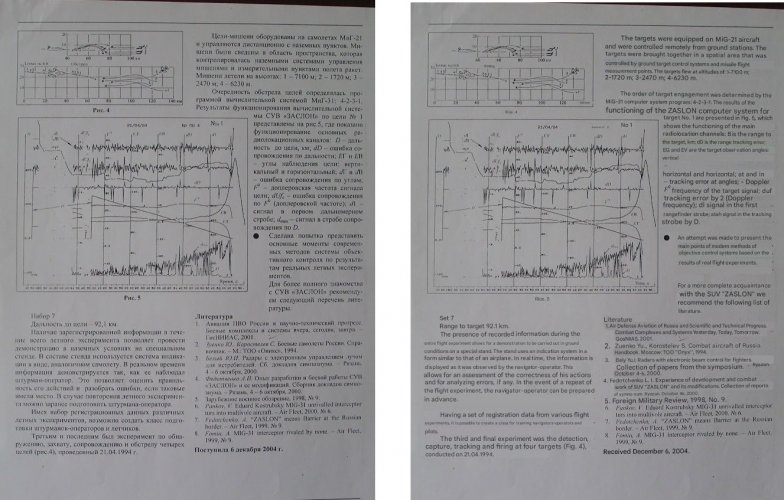
So there were more tests ,not only one. In the 'Radiotechnika' scan , we can see one of those test ?

This test?

That is also from 'Radiotechnika' and really ,test from 21 April 1994 was MiG-31 against RC M-21,exactly four of them. Now the question ,was it maybe MiG-31B with its R-33S ? Four AAM's against four targets. Why would one MiG-31M with 6 max AAM's ( R-33S or R-37) engaged four targets like M-21's ???


Ah, I see your point. So in your view, the test dated 21 April 1994 wasn’t actually against four MiG-21s, but was instead the MiG-31M being tested against a large target, maybe something like a Tu-16 or Tu-95, but it was not reported in the article. And the test involving four MiG-21s against Mig-31 actually took place on 28 August 1978. In other words, V. Ilyin may simply have assigned the wrong date to the MiG-31 vs 4 MiG-21 trial.
To be fair, while I’m not completely certain your interpretation is correct, your reasoning does seem quite plausible.
Because if we back track a bit
MiG-31 test on 15 February 1978 showed detection of a Tu-16 at 210 km.
The test against four MiG-21s showed detection at around 135 km.
If we assume a Tu-16 has an RCS of about 19 m2 and a MiG-21 about 3 m2, then a radar able to detect a Tu-16 at 210 km would detect a MiG-21 at roughly 132 km. That lines up remarkably well with the reported figures.
Now we just need to figure out what exactly happened on 21 April 1994

It really seems now that test from 21 April 1994 was against four M-21's and maybe it was not mistake made by V.Ilyin.

What we know for sure :

15 Feb 1978 ,MiG-31 against two groups of RC M-16 w/o engaging with AAM's.
28 Aug 1978 , MiG-31 against four RC La-17MM&M-21's , all four were successfully engaged by four R-33's.
18 Aug 1993, MiG-31M against RC M-16 .It was K-37 as test-telemetric version(not R-37 )that was launched.

Then:

21 April 1994 ,MiG-31 ? against four RC M-21's.
More tests during 1994...

Yes, I have seen that citation, however, this is from the book that he wrote in 1997
Yet, in his more recent book named Famous Russian Aircraft Mikoyan Mig-31 published in 2005 and Mikoyan Mig-31 Interceptor published in 2015, the distance mentioned is 228 km. Which lead me to firmly believe that in the book written in 1997, maybe Yerfim Gordon also mistaken the Zaslon-M detection/capture distance with the missile launch distance (or there wasn't enough information available to the public at that time, or the information given is super vague which lead him to believe that capture distance is missile launch distance). Then on his later book, once more information were available, he corrected that detail. Of course, the only way for us to know is if someone can send him an email ?

Just as I wrote earlier,so many data,so many mistakes. His data from 1997 are different in comparison with the data from 2005. What we know for now that during 1994 (except that test from 21.04.) , there were more tests with launch distances 260 and 304km.No more specific data/info except that case of engaging missile-target.

The origin of these citations is unclear, but the striking similarity in sentence structure suggests that these authors may have copied from one another before paraphrasing the material. It is quite plausible that the original source was Yefim Gordon’s 1997 book on MiG-25 & MiG-31. The issue is that, unlike the MiG-31 test on 28 August 1978 or the MiG-31M test on 18 August 1993, there’s no concrete or detailed information about the test that supposedly took place in April 1994. We have no confirmed data on the target’s altitude, type, or the radar capture range. The only consistent detail is that President Boris Yeltsin publicly congratulated the missile’s designers, yet even this is inconsistently attributed, with some sources linking his remarks to the 1993 test and others to the alleged 1994 event.

Mostly Russian sites but yes ,maybe the original source was Yefim's book from 1997. President B.Yeltsin sent telegram to the Rostislav Belyakov on April 1994 in the period when state trials of the MiG-31M/R-37 were succesfully finnished with that test ( launch distance 304km) against one missile.That info obviously came to public from Y.Gordon's 1997-book,so three years later.
 
In connection with the K/R-37 from one of many sites:

'Испытания К-37 начаты в 1988 г. автономными баллистическими пусками ракет без системы управления (10 пусков). В 1989 г. в испытаниях участвовали программные ракеты без системы наведения (4 пуска) - совершающие полет под управлением автопилота по программе.
В том же 1989 г. начаты испытания ракет с системой наведения (2 пуска). В апреле 1994 г. была успешно поражена воздушная цель на рекордной дальности - 304 км. Испытания ракеты продолжались до 1997 г.''


"Testing of the K-37 began in 1988 with autonomous ballistic missile launches without a guidance system (10 launches). In 1989, software-controlled missiles without a guidance system participated in the tests (4 launches)—flying under autopilot control according to a program.

That same year, 1989, testing of missiles with a guidance system (two launches). In April 1994, an aerial target was successfully hit at a record range of 304km . Missile testing continued until 1997.''

https://testpilot.ru/russia/vympel/r/37/
We must find further details about this 'April 1994 test'.

P.S.

Now ,this is something very interesting for further 'investigation'. It seems that B.Yeltsin congratulated twice, during 1993 and 1994?! Hm ....


From 'military wikireading' and the real source is Техника и вооружение 2006 02 ,Журнал «Техника и вооружение»

Equipment and Armament 2006 02 , Magazine "Equipment and Armament"

K-37 missile (Product 610)

''Испытания продолжались до 1997 г Президент Российской Федерации в апреле 1994 г поздравил коллектив создателей авиационно-ракетного комплекса с успешным пуском на рекордную дальность.''

"Testing continued until 1997. In April 1994, the President of the Russian Federation congratulated the team that created the aircraft-missile complex on the successful launch to a record range."

''В частности, при испытании одного из последних вариантов усовершенствованной ракеты большой дальности цель была успешно поражена, что отмечено 15 октября 1993 г. поздравительной телеграммой Президента Российской Федерации в адрес коллектива «Вымпела», приведенной в юбилейном издании этой организации.''

In particular, during the testing of one of the latest versions of an improved long-range missile, the target was successfully hit, which was noted on October 15, 1993, by a congratulatory telegram from the President of the Russian Federation to the Vympel team, cited in the anniversary publication of this organization.

https://military.wikireading.ru/54637
Hm,what if President first congratulated on the '18 Aug 1993 test' and then again sent congrats telegram for the 'April 1994 test' / record breaking launch distance?

So first congrats telegram was sent to the GosMKB Vympel during Oct 1993 and second one was sent to OKB Mikoyan during April 1994.

This is the link for the article about Soviet AAM's from the ''Техника и вооружение 2006 02''

http://flibusta.site/b/290836/read
 
Last edited:
Now, after what 'overscan' posted earlier about R-33S /Izdeliye 520 :

''At the beginning of the Perestroika period, the doctrine of development of the aviation industry and weapons of the army was revised, and the needs of the Air Force were sharply reduced. The construction of a plant in Komsomolsk-on-Amur specifically for the serial production of product 520 lost its meaning and was stopped.''

''However, State flight tests of the MiG-31B (BS) complex were being completed, and it was still necessary to organize mass production of the 520 product, but in a much smaller volume. DMZ, under the pretext of reorienting the enterprise to civilian products, abandoned the manufacture of this rocket, and the then still functioning MAP decided to load the Tushinsky Machine-Building Plant (TMZ), freed from the manufacture of the ISS «Buran», with serial production of product 520. Director of TMZ Arutyunov S.G. accepted with satisfaction the offer, which allowed him to keep his specialist staff afloat and support the plant’s activities «afloat». Since 1988, TMZ began preparing the production of product 520 and mass-produced it for 8 years on orders from the Ministry of Defense.
Thus ended the epic with the serial production of product 520 that fell during the perestroika period in the country.''

The underlined is not correct beacuse this is the original citation :

''Подготовка к этому началась в 1988 году, и в течение ряда лет ракеты изготавливались серийно.''

''Preparations for this began in 1988, and for a number of years the missiles were produced in series.''


Similar citations we can find here in the article about R-33S :

https://www.globalsecurity.org/military/world/russia/r-33s.htm
Of course on the photos is R-33 ,not R-33S. About that designation ,letter 'S' ,hm, it is questionable that it means Special /Spetsiyalnaya and for certain R-33S does not have nuclear warhead at all . Apart from test/telemetric K-33S ,so there was very little real R-33S and that is the reason why we could see that version in very rare photos from the 1990's.

P.S.

Can this thread get title: R-33/R-33S (AA-9 Amos),R-37 (AA-X-13 Arrow) and KS-172 (AAM-L) AAM's ? Tnx
 
Last edited:
Finally ...

I thought about where to put all this, in which thread ,whether about the MiG-31 or this one here about the R-33 in fact. As I mentioned earlier, there was one specific exercise during May 2013 which was held on Pemboy test range near the city of Vorkuta-Siberia. Besides one A-50 there were four MiG-31 : two MiG-31DZ Bort 31 and 58 red and two MiG-31BM Bort 10 and 16 blue.Photos of them are here:

http://militaryrussia.ru/blog/index-460.html
The main task was to intercept incoming low flying subsonic cruise missiles type Kh-55 which was launched from Tu-95MS. As we can see on video/photos ,some MiG-31 took of with two ,some with four R-33's. MiG-31 pilot Roman Semenyuk said that they launched four R-33's against one CM ,two from one and two from another interceptor. He also said that lock-on distance was 90km. I don't think that pilot did not know accurate words like 'obnaruzheniye' ( detection), 'soprovozhdeniye' ( tracking) etc .English translation /subtitle is wrong because it stated detection range,not lock-on range . There is also Chinese subtitle from their TV.

Cruise missile intercepted by MIG-31​

View: https://www.youtube.com/watch?v=BCiqIaOZPQ4&t=5s


Now ,I suppose that MiG-31's flew in subsonic cruise mode maybe even in troposphere,not in stratosphere and whether it was N007 in DZ or N007AM in BM ( nevermind) ,they locked one so small and low flying LO air target at 90km. Target which forward RCS is about 0.5 sqm only. For this thread that is not so important as that launch distance of R-33's against such a target was about 90km.

Hm ,against such a target which flew very low (several hundreds meters AGL) ,what about possible launch distance against high flying subsonic or supersonic aircraft than? What about possible launch distance when MiG-31 fly in supersonic/stratospheric regime with e.g. max possible launch parameters : Vmax 3000km/h, Hmax 21km? I really don't think it is or it can be '120km'.

Yes ,'overscan' was right when he wrote that R-33 doesn't have 'lofting' flight profile but maybe there was no need for that at all during 70's and 80's like in the case of the older very fast ( Mach 5-6 ) R-40/D when launched from MiG-25P/PD at 20+km with true air speed 2.5-3 Mach. Of course, launch distance depends on so many launch parameters: flight speed/alt of interceptor than of air target,heading of the target(incoming/receding),target's RCS ,etc etc. When we compare e.g. R-33 and R-40/D with AIM-54 Phoenix ,latter could be launched from lower alt and with much less max speed if combat situation allows something like that. R-33 is about 50kg heavier than AIM-54A and about 40kg heavier than AIM-54C.

On the other hand ,like radars N001 and N019 ,N007 (AM) has also limited max authorised launch ranges for the given AAM and which depend on the given target's RCS ( small,medium and big air target). Low flying cruise missile is definitely small air target.
 
Finally ...
It is true that lofting was less a requirement in Cold War, lofting trajectory was not on Soviet air to air missile radar at all. Lofting does not improve time to target, and Soviet idea was to have a missile with fastest time to target to destroy the other plane and stop them guiding any SARH or using any other weapon. This was whole idea with R-27R/ER/T/ET was not to necessarily beat the sparrow in terms of range but to have a missile that could fly faster and kill the sparrow carrier which would then kill the guidance of any missiles it shot.

But a correct lofting profile always improves maximum range, and if these missiles could loft you would see insane things like R-33 and R-27ER doing 250 km or more. There isn’t really a case where the lofting profile is detriment unless it is “too aggressive” a lofting profile.

So in 1989, it is not really a weakness at all except compared to AIM-54 coming in at 45 degrees from 100,000 feet and the fact that sparrow does get a long range boost from it. But By the time people have AMRAAMs……..
 
R-33 did not loft as we explained except for perhaps experimental versions. R-37 is throughly a 90s missile that didn’t even see service until 37M in 2015.
 
R-33 did not loft as we explained except for perhaps experimental versions. R-37 is throughly a 90s missile that didn’t even see service until 37M in 2015.

That was R-33S but as we can learn ,there was no mass serial production of it. About the old K-/R-37 :

''Испытания ракеты начаты в 1988 г. автономными баллистическими пусками ракет без системы управления (10 пусков). В 1989 г. в испытаниях участвовали программные ракеты без системы наведения (4 пуска) - совершающие полет под управлением автопилота по программе. В том же 1989 г. начаты испытания ракет с системой наведения (2 пуска).''

''Missile testing began in 1988 with autonomous ballistic missile launches without a guidance system (10 launches). In 1989, software-controlled missiles without a guidance system participated in the tests (4 launches)—flying under autopilot control according to a program. Also in 1989, testing of missiles with a guidance system began (2 launches).''

http://militaryrussia.ru/blog/topic-106.html
 
@Ronny

From other thread:

''...that mean R-33S fly 124.6 km in 60 seconds. That average speed of Mach 7''

That means ,max air speed of R-33S can be 10 Mach ... No way. Both R-33 and R-33S ( never was in the real serial production ) ,were made from special high-temp Titanium Alloys ( body,wings and stabilizers).They were developed for 5 Mach and more max speed like older R-40 ( I think first ever AAM with speed after acceleration phase greater than 5 M).

There is that detail about possible launch speed and if max Mach number of the missile depends on aircraft launch speed, than there is big difference between launching with 1 Mach, 2 Mach and max possible 2.8 Mach in the case of the MiG-31( BM now).Suppose that acceleration phase of the R-33/S lasts almost half a minute than I can not see how R-33 or R-33S have max controlable flight time of only 60 sec as ''Time of the aerodynamic stability and controllability'' .

As 'overcan' noted, R-33 has straight flight profile like older R-40 but R-33S has 'ballistic trajectory' or loft flight profile.
 
There is that detail about possible launch speed and if max Mach number of the missile depends on aircraft launch speed, than there is big difference between launching with 1 Mach, 2 Mach and max possible 2.8
Of course, here for R-40

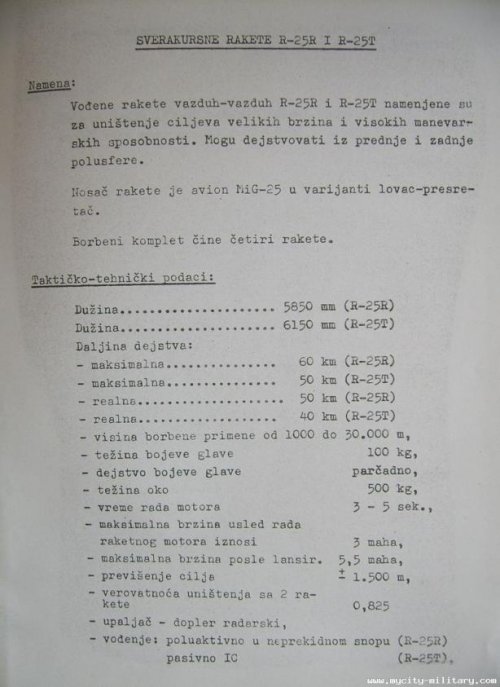
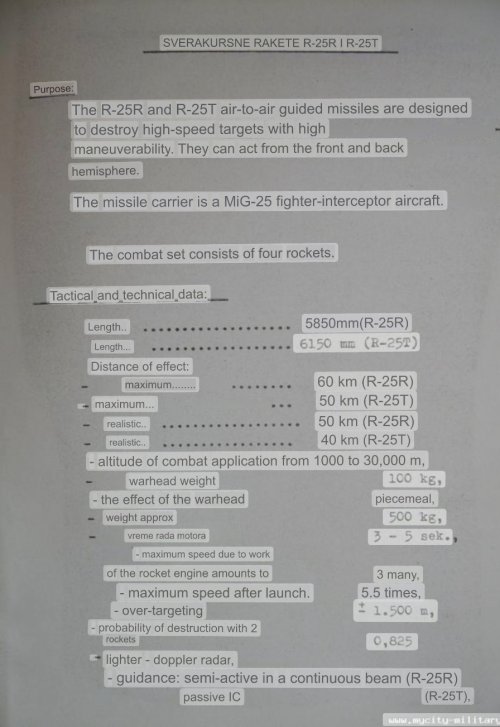
“Maximum speed from work of rocket motor”

Mach 3

“Maximum speed after launch”

Mach 5.5

If you calculate deltav, and add it to launch speed, you will have a slight over estimation of final speed. Of course air resistance is a factor, but it can be surprising how little air resistance affects final velocity compared to the thrust to weight of the missile. Of course depending on altitude and how wether boost, sustain, how much of a sustain, etc.

I do not know of any real life source for the power of the motor.

There also charts for R-3/13/23 for launch velocity and altitude vs flight distance and velocity as well as fly out charts for R-27R/ER can be used for same purpose.
 

Attachments

  • IMG_9405.jpeg
    IMG_9405.jpeg
    69.6 KB · Views: 33
  • IMG_9406.jpeg
    IMG_9406.jpeg
    694 KB · Views: 31
Then it would be good to take into account the maximum possible launch parameters of the MiG-31BM with R-33 ,where Vmax is 2.8 Mach and Hmax is 21000m. Also it will be fine to find some details of the max possible RC-channel range of the N007 /N007AM and max lasting time of the Illumination mode.
 
And if we do take those parameters into account we still only have 120 km for R-33 and 160 km for 33S. The parameters have always been taken into account. You just don’t always see them listed on the chart.

I don’t think anyone is measuring missile range or speed without taking into account launch vehicle speed and altitude.

That means ,max air speed of R-33S can be 10 Mach

Why would Mach be higher from airspeed? Mach 7 is Mach 7.

For R-27ER, most CFD puts it at hitting Mach 6-6.3 at max, and slows down to Mach 3-4 by impact for an average speed of usually around Mach 5 for a 15 km Mach 2 launch.
 
Why would Mach be higher from airspeed? Mach 7 is Mach 7.
I think he meant if the operational time is 60 seconds and rocket burn time is 24 second, that mean it reach top speed at 24 sec then decelerate gradually. Average speed of Mach 7 would mean much higher top speed I think.
It does seem too good to be true even for something launched by Mig-31
 
And if we do take those parameters into account we still only have 120 km for R-33 and 160 km for 33S

So 350kg heavy , 4-5 Mach fast R-27ER launched from Su-27S at 18km with max possible speed M 2.35 has 130km max launch range.

On other side, 500kg heavy ,5-6 Mach fast R-33 launched from MiG-31BM at 21km with speed 2.8M has 120km max launch range. Both with straight flight profile. Strange isn't it ?

Why would Mach be higher from airspeed? Mach 7 is Mach 7.

He meant on the 7 Mach as average speed ( not max ).
 
I think he meant if the operational time is 60 seconds and rocket burn time is 24 second, that mean it reach top speed at 24 sec then decelerate gradually. Average speed of Mach 7 would mean much higher top speed I think.
It does seem too good to be true even for something launched by Mig-31
Agreed, which is why I think it is conflating the 33S range specs with 33 flight time specs.

The book is often about entire families not specific variants, you could think of it as a “range as much as” figure and the battery figure just the one figure they knew

You can see this commonly in media about newer models where specific info is lacking but available for older models
 
Last edited:
So 350kg heavy , 4-5 Mach fast R-27ER launched from Su-27S at 18km with max possible speed M 2.35 has 130km max launch range.

On other side, 500kg heavy ,5-6 Mach fast R-33 launched from MiG-31BM at 21km with speed 2.8M has 120km max launch range. Both with straight flight profile. Strange isn't it ?
Like we discussed before the weight of the missile generally doesn’t correlate with range exactly, it’s an assumption.

BM can carry R-37, why does it need to carry original R-33 or even R-33S?

Zaslon-A does 120 km against fighters, and R-33 is considered by Vympel to be previous generation to R-27. Its seeker is conical scan in one axis.

120 km is a great range and its long sustainer motor likely means it maintains a good range in many conditions and it can launch and guide 4 at once. I see no reason to be unhappy with the range of the original model.

There is good reason missiles are usually skinny, but the shape was mandated by placing under MiG-31. Of course once it can loft, it is easier to overcome the limitation of the aerodynamic shape.

A missile of this diameter slows down 4x as fast as an AIM-120 would slow down.
 
Last edited:
There is good reason missiles are usually skinny, but the shape was mandated by placing under MiG-31.
Partially mandated(length), partially can afford it (expected to be launched really high in thin atmosphere)
 
Partially mandated(length), partially can afford it (expected to be launched really high in thin atmosphere)
Yes, which as we see with AIM-54, R-37, being able to loft allows you to maximize the decrease of drag by increasing altitude over launch altitude.

It also looks pretty rough, the antenna in back and 6x fuses all kindve sticking out.

Notice another change R-37 made other then making it smoother skinned, the wing area was decreased in the back. With similar weight distribution this would lead to a far more unstable missile, but good electronics and flight controls can cover this up.

Soviet industry also needed to catch up in other ways, the reason for this 120-130 km upper limit is all these late Soviet missiles having a 60 second lifetime. Things like AIM-54, R-37, flight time is measured in 4 minutes or more.

Just like R-77 was using grid fins due to not being able to fit a powerful enough actuator for planar fins (along with wishing to specialize in maneuvering and dogfight performance).
 
@Ronny

From other thread:

''...that mean R-33S fly 124.6 km in 60 seconds. That average speed of Mach 7''

That means ,max air speed of R-33S can be 10 Mach ... No way. Both R-33 and R-33S ( never was in the real serial production ) ,were made from special high-temp Titanium Alloys ( body,wings and stabilizers).They were developed for 5 Mach and more max speed like older R-40 ( I think first ever AAM with speed after acceleration phase greater than 5 M).

There is that detail about possible launch speed and if max Mach number of the missile depends on aircraft launch speed, than there is big difference between launching with 1 Mach, 2 Mach and max possible 2.8 Mach in the case of the MiG-31( BM now).Suppose that acceleration phase of the R-33/S lasts almost half a minute than I can not see how R-33 or R-33S have max controlable flight time of only 60 sec as ''Time of the aerodynamic stability and controllability'' .

As 'overcan' noted, R-33 has straight flight profile like older R-40 but R-33S has 'ballistic trajectory' or loft flight profile.
R-33S has a longer max flight time than R-33. Initial assumption is invalid.
 
Like we discussed before the weight of the missile generally doesn’t correlate with range exactly, it’s an assumption.

In the case of the R-27ER and R-33 it does ,both have single chamber dual-stage rocket engines and with the same flight profiles.

BM can carry R-37, why does it need to carry original R-33 or even R-33S?

BM with AKU-410-1

MiG-31BM R-33 R-33S R-37M.jpg

Zaslon-A does 120 km against fighters, and R-33 is considered by Vympel to be previous generation to R-27. Its seeker is conical scan in one axis.

120 km is a great range and its long sustainer motor likely means it maintains a good range in many conditions and it can launch and guide 4 at once. I see no reason to be unhappy with the range of the original model.

There is good reason missiles are usually skinny, but the shape was mandated by placing under MiG-31. Of course once it can loft, it is easier to overcome the limitation of the aerodynamic shape.


There is no precise data for the detection ranges of N007A 'Zaslon-A 'on MiG-31B/BS which btw exist no more 'cause all of them were overhauled and modernised to the BM level with its N007AM Zaslon-AM.

R-33 is not developed for intercepting fighters but low flying subsonic cruise missiles ,high flying supersonic cruise missiles ( usually those ASM) and bigger,non-maneuvarable combat aircraft.

About 120km ,again , is that max ( authorised,calculated) launch distance against small,medium or bigger air target ?

Keep in mind that during one exercise held on May 2013 ,MiG-31 DZ/BM intercepted incoming low flying subsonic CM type Kh-55 ( RCS 0.5 sqm) with several R-33 's from 90km away.
 
Soviet industry also needed to catch up in other ways, the reason for this 120-130 km upper limit is all these late Soviet missiles having a 60 second lifetime. Things like AIM-54, R-37, flight time is measured in 4 minutes or more.

Hm, ARM type Kh-58 /Product 112 was developed in the same time as R-33 during 1970's and let us see some details about its batteries ,potential flight time etc ...

''Бортовая никель-кадмиевая аккумуляторная батарея повышенной емкости со статическим преобразователем тока обеспечивает работу систем и рулевого управления в течение не менее 200 сек.''

''An on-board high-capacity nickel-cadmium battery with a static current converter ensures the operation of the systems and steering for a min 200 seconds.''

Yes ,with the same body diameter of 380mm ,Kh-58 was 150kg heavier, 650kg vs 500kg ( warhead was even three times heavier ,150kg vs ~ 50kg).Kh-58 was much slower 3.5M-4M vs 5M-6M.With version Kh-58U ,MiG-25BM achieved launch ranges 300km with launch parameters : Vmax 2500km/h ,Hmax 21km. Almost the same parameters as MiG-31BM can achieve with older R-33/S and newer R-37M. Btw ,Kh-58/U had loft trajectory option.
 
Because this is appropriate thread...

@Ronny

''Based on your chart, it look like R-33 range is at least 150 km? that give average speed of Mach 6.47 ?''

R-33.png

Don't know who is the original source of this graph but what we can see here ? Launch height 16-18 km.R-33 than climbs to 28km, than descents and achieve about 150 km ( something as possible launch distance) .

This has nothing to do with the reality. As we concluded /mentioned,R-33 has no lofting trajectory ( I thought it has,it was mistake) ,so this graph shows us something that can not be 'calculated'.


MiG-31BM can launch R-33 at 21km ,with 2.8M true air speed and it is possible if combat situation required something like that. Target can be max 10km-15km above or below MiG-31.If target is above ,than R-33 will climb,if it is below R-33 will descent of course but there will be no lofting.R-33 like older R-40 has straight flight trajectory.

Now one interesting data, If I remember well, during flight tests of 350kg heavy K-27E w/o guidance unit ,they achieved straight flight trajectory with full aerodynamic stability and controllability of about 100 km after it was launched at 18km of height.It is easy to compare R-33 with R-27ER.
 

Similar threads

Back
Top Bottom