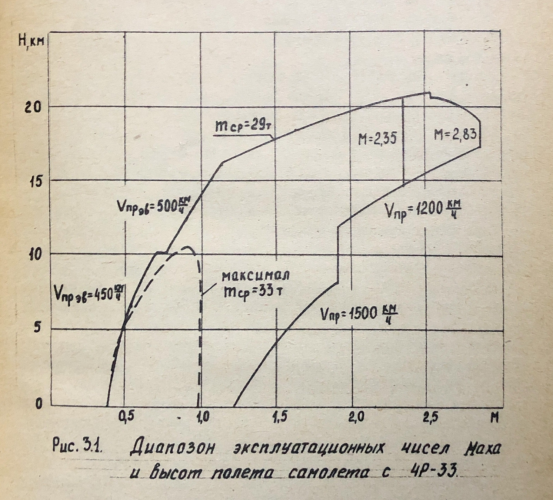
I think we can say with 100% certainty that the Mig-31M altitude in the test is actually 13,400 m rather than 8,400 m, because it consistent with flight manual data, and we know there is no reason to exaggerate or understate value to put into manual used by pilot.
Yes, it's very possible that was MiG-31M.
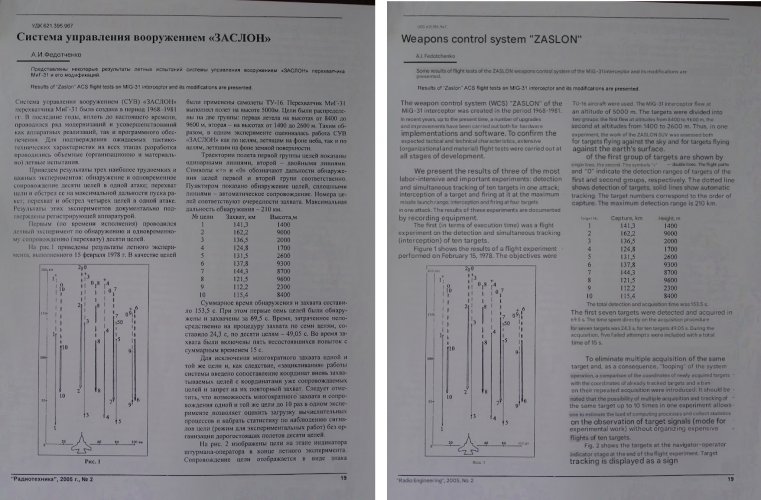
Radiotechnika is simply a magazine like Jane while "Tikhomirov Constellation. 50 Years of the V.V. Tikhomirov Scientific Research Institute of Instrument Engineering." is commemorative anniversary book authorized by NIIP so logically the book should be more accurate than the magazine article, added to the fact that the data from the book also consistent with flight manual data, I think we can safety trust it
Of course ,'NIIP 50 years' is more reliant source.
What really confuses me is that, for the alleged "April 1994 test", there don’t seem to be any authoritative sources describing what actually happened.
Here is my current working theory:
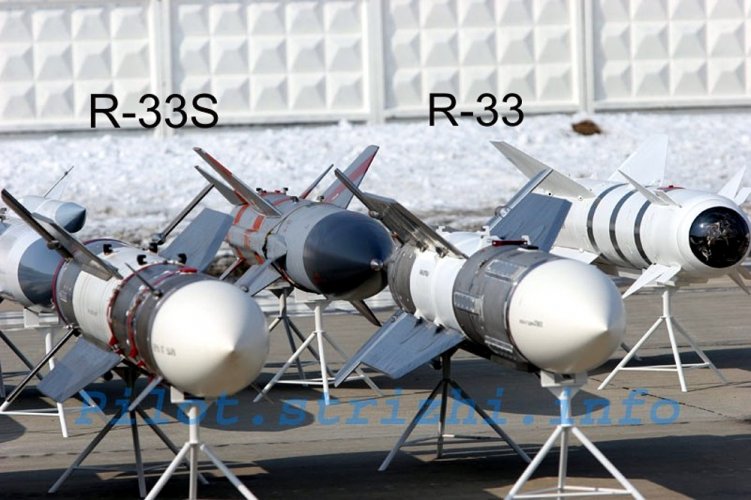
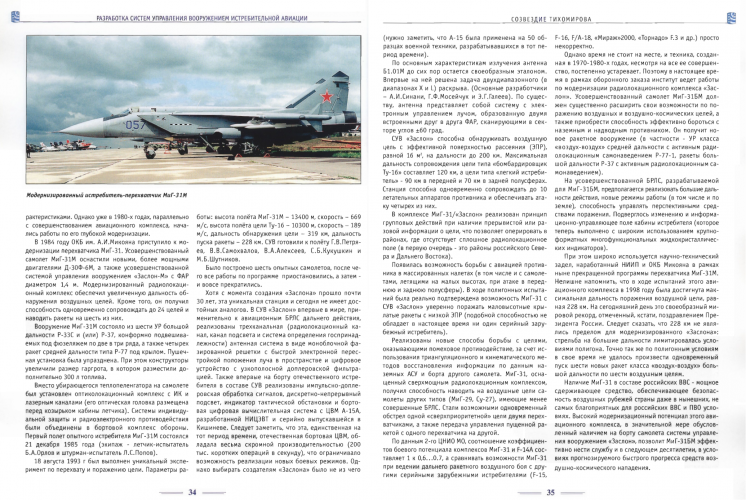
During 18 August 1993 test, MiG-31M detected and locked onto a Tu-16 target at 319 km. I have read that MiG-31 doesn’t use a Velocity search mode like F-14, so its detection and lock on ranges may effectively be the same. The MiG-31M then launched either an R-33S or R-37 at a distance of 228 km, which at the time set a world record.
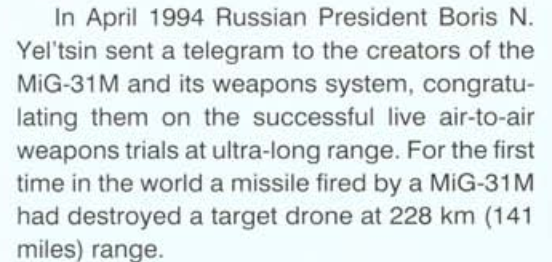
On April 1994, Russia President Yeltsin issued a formal congratulation acknowledging the success of that test.
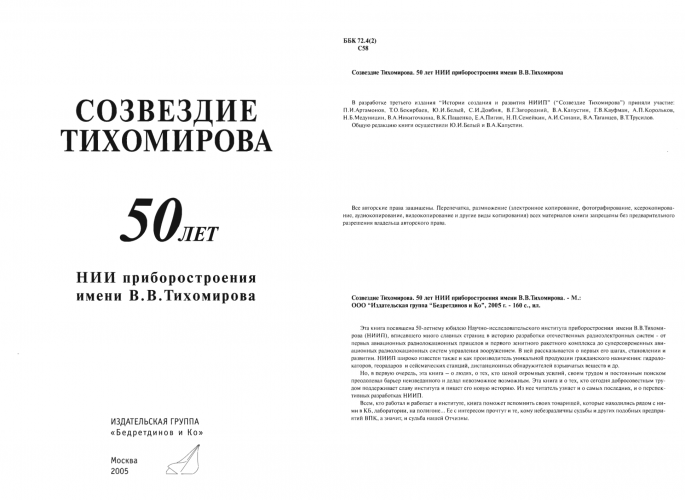
Both events are reported in “Mikoyan MiG-31: Famous Russian Aircraft” by Yefim Gordon and in “Tikhomirov Constellation: 50 Years of the V.V. Tikhomirov Scientific Research Institute of Instrument Engineering” published by NIIP.
The issue, I suspect, is that some people may have confused Zaslon-M lock on range with R-37/R-33S actual launch range during the test. They may also have mistaken the date of Yeltsin’s congratulatory message for the date of the test itself. Therefore, they mistakenly reported that there is a test happened on April 1994 where Mig-31M launched missile from 304 km
Hm, more data/info ,more we are confused. I hope we will find appropriate data. It will need more ''digging''.Many data we got here earlier (during August).
https://www.secretprojects.co.uk/th...atform-between-mig-31-and-su-35s.39723/page-3
Indeed, there was test during April 1994 and we have info that state trials of the MiG-31M with K/R-37's ended during April 1994. That is very interesting for further investigation.
This citation is from overscan's post ( previous page) :
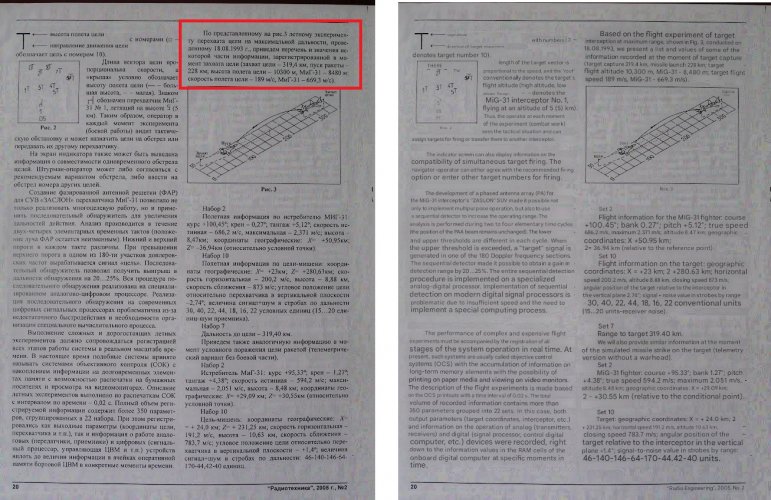
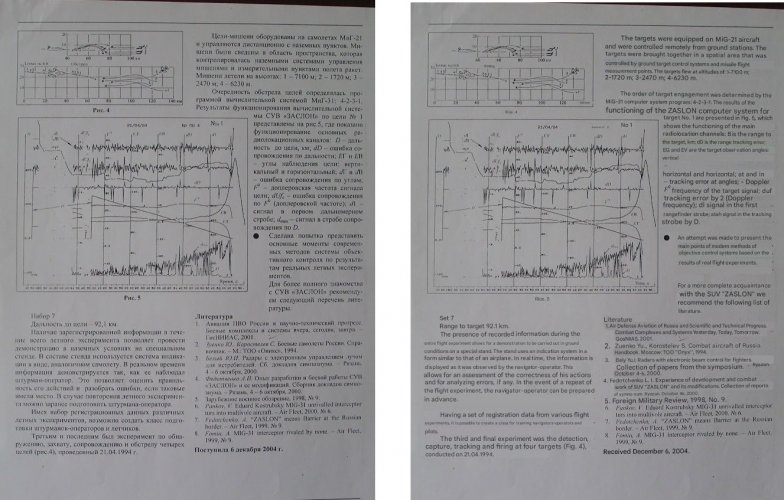
''On August 18, 1993, a series of flight experiments to intercept targets at maximum range were conducted. During the first of these, a radio-controlled target, flying at an altitude of 10,300 m and a speed of 189 m/s, was captured by a
MiG-31 interceptor (flying at an altitude of
8,480 m and a speed of 669.3 m/s) at a distance of 319.5 km. The
R-33 missile (which successfully hit the target) was launched at a range of 228 km.
MOSCOW 73/23028 67 15/10 1827
PRESIDENT
of the Rassinsky FEDERATION - MOSCOW 17} ZENIT LENINGRADSKOE HIGHWAY 6
TO GENERAL DESIGNER RA BELYAKOV.
I CONGRATULATE YOU AND THE WORK TEAMS OF THE COMPANIES PARTICIPATING IN THE CREATION OF
OBJECTS 05 AND
PRODUCTS 610 ON THE UNIQUE RESULTS ACHIEVED DURING THEIR TESTING.
THE PRESIDENT AND THE GOVERNMENT WILL ALWAYS SUPPORT EFFORTS AIMED AT THE CREATION OF NEW TECHNOLOGY, INCREASING ITS EFFICIENCY, RELIABILITY, AND COMPETITIVENESS IN THE GLOBAL MARKET.
WE WISH YOU FURTHER CREATI SUCCESS.
NR-PR-1593 B, YELTSIN
1838. 15U 0046
Perhaps the most spectacular flight experiment, which fully demonstrated the capabilities of the aviation complex, was the experiment conducted on
April 21, 1994, involving the simultaneous firing of four aerial targets. The latter were specially equipped MiG-21 fighters (controlled from ground command posts), which had a relatively low radar cross-section and high maneuverability.''
Source: 'Aerospace Review,
2005 05' as overscan mentioned. It is interesting that from same year we have both 'Radiotechnika' and that 'NIIP 50 years' articles and that Y.Gordon's book about MiG-31.
Underlined are mistakes : MiG-31 ( in fact MiG-31M), 8840m ( in fact 13400m), R-33 ( in fact R-37).
I bolded three details because I suppose,think, that they are connected : Object 05/Izdeliye 05 or MiG-31M ,Product 610 or R-37 and that date 21 April 1994.
Another interesting detail is next. After the citation about '18 Aug 1993 test' we have that info about President's telegram congrats but under that citation we have info about '21 April 1994' test what is very interesting and confusing in the same time.
After the date ''April 21, 1994'' , I underlined complete next citation, 'cause I think that was big mistake made by V.Ilyin in his article. I suppose he was also confused by so many data and mistakenly wrote details about the engaging of four differ targets ( in fact four La-17MM and M-21 as RC-version of the MiG-21) ,that was happened on 28 August 1978. Overscan gave details about that test in his post.
Take a look on V.Ilyin statement :
''On 28 August of 1978 MiG-31 it successfully destroyed by four simultaneously released rockets R-33 of four radio-controlled airborne target.''
Now,what I underlined in the previous citation, I think we can add to this sentence ??? It makes sense after all because MiG-31M certainly didn't have some firing tests with four instead of six AAM's (R-33S or R-37).
About B.Yeltsin congrats telegram from April 1994 ,I think that it is hardly possible that President sent a telegram eight months after 18 Aug 1993 test .Eight months ,hm, too long.
Yes ,even Y.Gordon wrote about that in his book about MiG-31 ,be aware from 2005 ( you posted earlier scan of the page where we can read some details ).
Scribd ,pdf version of that book :
https://www.scribd.com/document/691797706/MiG-31
Now take a look what Y.Gordon wrote about B.Yeltsin's congrats telegram in his book from 1997 ''MiG-25 and MiG-31'' ,page 87, citation :
A short while earlier ,in April 1994 ,the Russian President Boris N.Yeltsin sent a telegram to the Mikoyan OKB and other organisations involved in the MiG-31M programme ,extending his congratulations on a successful test.The test in question was really something special,being the world's first instance when an interceptor had destroyed a target flying more than 300km (186 miles) away.The aircraft was a MiG-31M and the missile an R-37.
Source:
https://www.scribd.com/doc/156183172/MiG-25-and-MiG-31-pdf
This citation is from the article ''Russian Icon'' ,year 2009, 'overscan' posted this on the previous page .Take a look :
''The K—37M is a further development of the K—37 program intended for the MiG—31M. Test firings of the K—37 were carried out in the mid-1990s, well in excess of the maximum engagement of the R—33.
A firing in 1994 included hitting a large target at a range of 260 km.''
On the previous page we have even three citations on Russian ( translated) about that test from April 1994 when MiG-31M engaged one missile ( again not airplane) and where launch distance of the R-37 was 304km ( some sources mentioned more than 300km, OK ). Pls take a look on that .
Why missile and not airplane? My opinion is that Izdeliye 05 /MiG-31M was in fact developed to counter US Army MRBM's like Pershing II which were positioned in the Europe that time.MiG-31 with its N007 and four R-33's could only engage low flying subsonic cruise missiles and high flying non-maneuverable supersonic recce/bomber aircraft ( max speed 3500-4000km/h ). MiG-31M with its N007M and six R-37's could maybe engage not only those targets but even ballistic missiles( speed over 6000km/h as hypersonic)?