For the sake of accuracy, because I just noticed it, I didn't write anything that the Poles were planning 305 mm guns on Moltke (as far as I remember about this ship), it referred to Germany when I wrote the history of the ship.
So I note that there has been a slight misunderstanding in this context.
As for the modernization Grom and Wicher project 30bis destroyers, there were no more details.
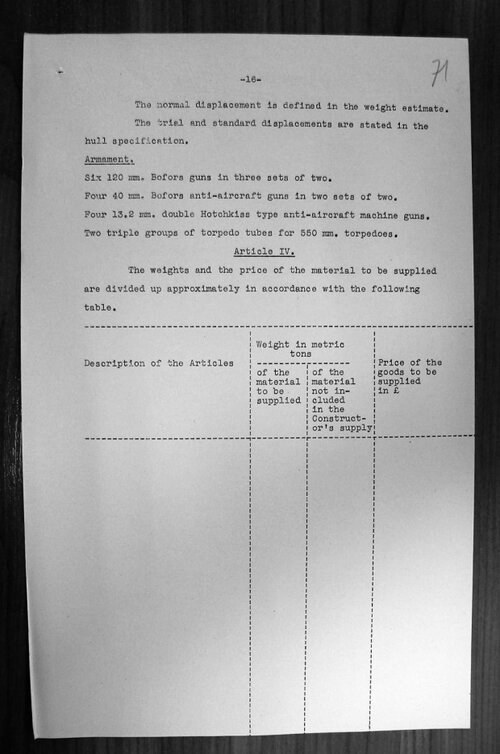
In 1923, the Poles were getting ready to take over the cruiser, which is evidenced, among others, by the found post (from 1923) of Cruiser N.1. It includes not only the personnel composition (commander commander, 21 officers and 488 non-commissioned officers and sailors) but also the planned armament:
8 guns of 150 mm caliber,
4 - four-inch,
2 - three-inch,
10 - 47mm,
4 machine guns,
300 naval mines.
It is probably about SMS Emden konigsberg II class which fell to France.
A hypothesis was put forward, in my opinion, that it was Emden during a historical session at the Polish Army Museum 90 years of the Polish Navy: 1918-2008 in 2008.
As for the 5 light cruisers from naval program 1946 that were supposed to be delivered in the 50's, it's a Tromp-style cruiser, because these cruisers had a displacement of 4,215 tons.
In my opinion, it is not about ordering more ships of the Tromp class, but about ordering new ships, let's say tromp plus, read the enlarged type of Tromp, which would have newer main guns, we leave the design in the sense of the hull, we lengthen it by some meters, so that the standard displacement is 4215 tons.
Because cruiser Tromp fits.
And I think that's what it was about that this ship was taken as a starting point, although it's just my hypothesis.
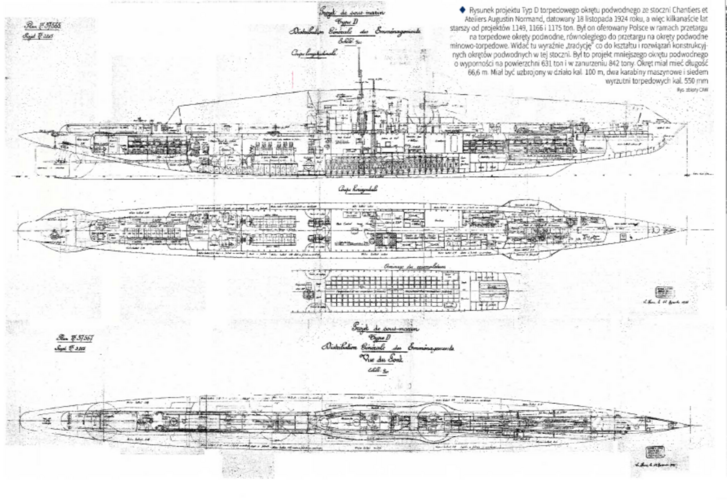
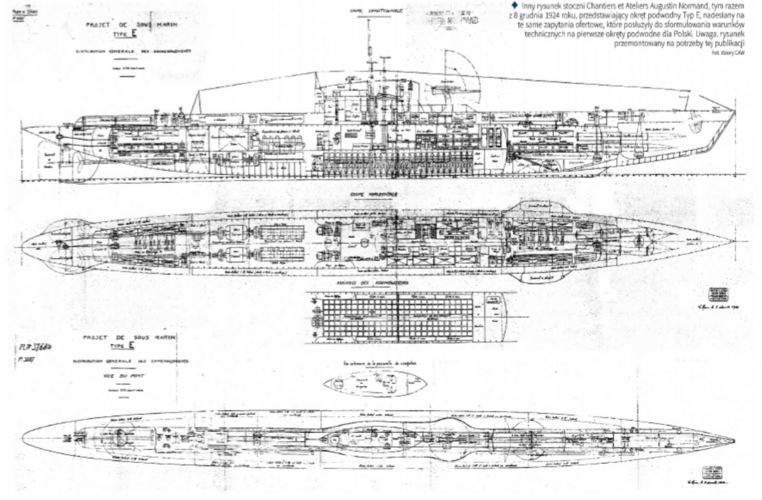
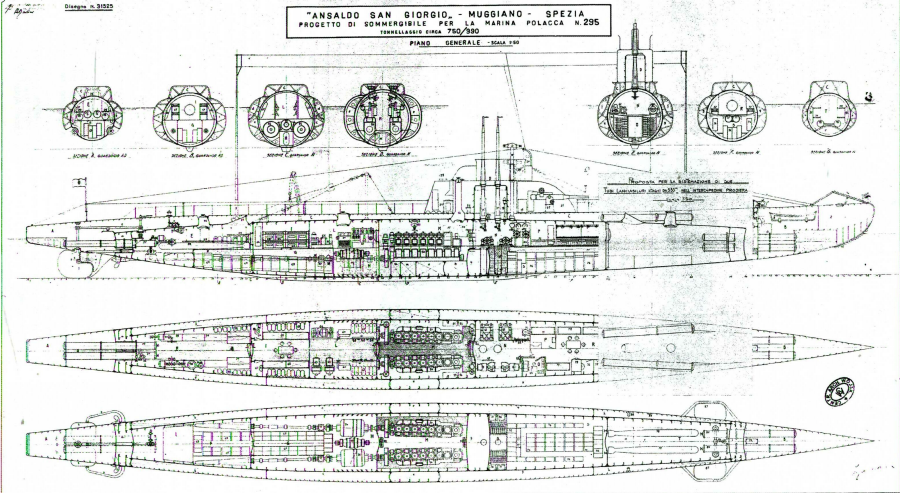
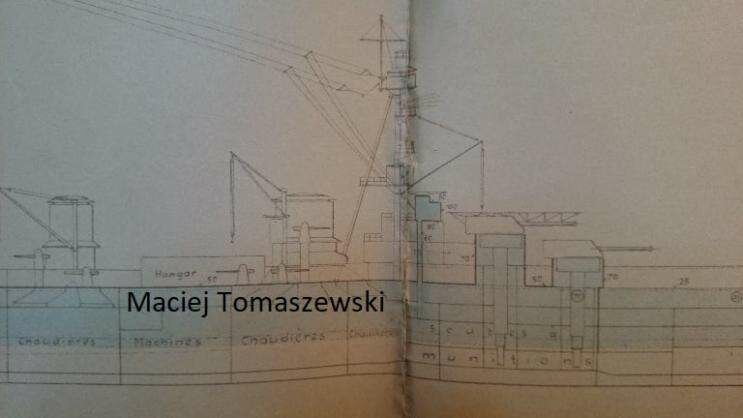
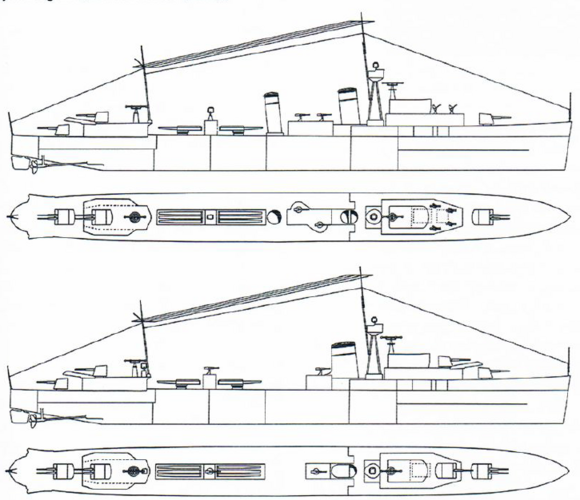
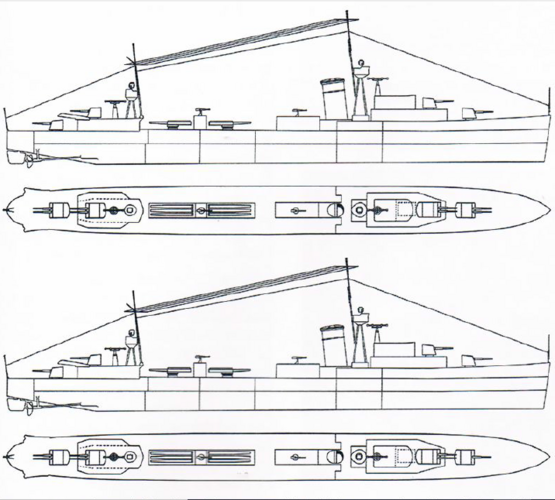
Above, there is a graphic of the Polish Trento, it is the Italian offer from 1925 of a mutated heavy cruiser of the Trento class just for Poland. The original sketches are in the Polish archive.
I will also write that KMW was considering a cruiser during the war that was supposed to have a catapult, currently I don't know anything else about it, but if I find out, I'll write what's going on.
Case of the 8,000-ton cruiser
Well, I'm investigating this case, and it's not that simple.
Well, you have to start with the fact that in the naval plan for 1942 there was a 15,000-ton heavy cruiser, which was abandoned after the reduction, but in the light of orders, a 15,000-ton cruiser already appears, people from KMW were looking for money for it, so perhaps it would be possible whether it will be finally built, or by 1942, I doubt it.
Why?
1. Since 1938, Poland was covered by the Treaty on Arms Limitations at Sea, the treaty expired in 1943, if I remember correctly, and regarding cruisers it was written that Poland could not build cruisers with a displacement of more than 8,000 tons because that was the limit.
The only option to bypass the treaty was to build such a ship in Polish shipyards.
2. The second problem is the shipyard.
Well, the nearest plans were to build 3 slipways, thanks to which it was possible to build ships up to 130 meters long.
Ultimately, Poland had slipways for building ships, see the destroyer, which was tried, but they were faulty, Potyrała said that the attempt to launch the ship would end in a fiasco.
For this reason, there are doubts whether the construction of two destroyers of the improved Grom class, ORP Huragan and ORP Orkan, has actually begun.
Witnesses said yes, but the above fact, as mentioned by Potyrała, plus the lack of evidence such as documents, is currently assumed that no, they were not built.
While it is true that they wanted to try with cruisers once the new destroyers could be launched, but apparently this would have happened later, see 1943-1946 more or less.
In addition, it was planned to build new submarines in a Polish shipyard, the first two submarines were built in France before the war broke out, but I don't know if it was abandoned.
Considering this, the only solution would be to order the cruiser abroad.
And at this point we move on to the 8,000-ton cruiser.
Well, this cruiser was supposed to be ordered in 1940 in some British shipyard, as I remember, this cruiser was 8000 tons as it was written what ships are to be for the years 1943-1944.
Let me remind you what ships they were
- construction of further ships with a minimum displacement of 10,000 tons - it was mentioned that a loan supported by a million members of the Maritime and Colonial League was envisaged to finance the construction of further ships with a minimum displacement of 10,000 tons.
I think they're battleships or heavy cruisers
(I'm betting on the latter).
- 8,000-ton cruiser - it is written that the outbreak of war annihilated the 8,000-ton cruiser order that was supposed to result in the construction of such a cruiser.
- 2 submarines from French shipyards - that's right, construction began in 1938
- 2 destroyers built in the Gdynia shipyard - that's right, they are destroyers No. 5 and 6 of the improved Grom type: ORP Huragan and ORP Orkan, the construction of ORP Huragan began in 1939, 2 weeks before the outbreak of World War II (supposedly).
- 10 speeders (MTB?) that were built in a British shipyard - see S 1 in ww2.
Yes, these were the ships that were supposed to be until 1943-1944.
Now see what the plan for 1942 says
Naval plan for 1942 (war with Germany plus Russia N plus R) i remember
- 1 battleship
- 1 heavy cruiser (15,000 tons, 3x3 203 mm and 9 x 120 mm guns)
- 8 destroyers
- 12 submarines
- 1 minelayer
- 6 escorts
- 22 chasers
- 14 trawlers
A variant of the war with Russia
- 1 battleship
- 8 destroyers
- 1 minelayer
- 12 submarines
- 6 escorts
A variant of the war with Germany
- 1 heavy cruiser
- 6 destroyers
- 1 minelayer
- 12 submarines
- 6 escorts
- 22 MTB
after reduction would be:
- 6 destroyers
- 12 submarines
- 1 minelayer
- 12 MTB
- 12 trawlers
Composition of the fleet in the light of orders (autumn 1942)
-1 CA
- 6 DD
- 12 SS - real 8 [W, R, Ż, S, O, I, II, III]
-1 CM [Gryf] minelayer
- 9 MTB [I - IX]
- 12 PM [J, C, R, M, Cz, Ż, I - VI]
- 2 GB artillery ships
So it seems to me that this may be true, and the 15,000-ton heavy cruiser was abandoned, or postponed, and an 8,000-ton cruiser was chosen instead, what was written about it seems to me that this is some modification of the plan for 1942, since this cruiser was to be ordered already in 1940, if so, it would be built until 1942, and in service until 1943, so it is correct.
The problem is that I haven't found any more information about this cruiser, such as whether it was supposed to be a CL, a smaller Town or Crown Colony type, or a heavy cruiser with a displacement of 8,000 tons.
Because in the years 1936-1939 Polish admirals from KMW stuck to heavier cruisers, and they wanted ships that were heavily armed and, above all, modern, among others, for the latter reason, later such ships as M, N, G class destroyers, generally large ships were taken over, including D-class cruisers, because it was, among other things, prestige, even though we wanted and asked Fiji, we got the D type.
So buying ships like Exeter is out of the question.
Well, on the one hand, I would understand why a light cruiser is mainly financial issues, although I don't know why they would suddenly opt for light cruisers and why, or in other words, how they want to use it and what for, and on the other hand, I would understand if it was a heavy cruiser as a counterweight read the answer for heavy german or light cruisers.
For these reasons, I originally thought that it was a Polish Fiji in the sense of the Crown Colony / Town type, but reduced by the displacement of 8000 tons because it would fit, judging by the displacement of 8000 tons, in my opinion it refers to the standard or construction displacement.
End of my thesis. Recognize for yourself whether it is logical and sensible, and whether I can or am right.
Earlier, I took the 15,000 and 8,000 ton cruisers as 2 separate orders and something didn't add up to me then, because I ended up with 3 to 5 cruisers.
This is what the Anglo-Polish treaty contained.
In principle, this treaty concluded on April 28, 1938, had no greater restrictions than the Anglo-German treaty of 1937.
The Teactate had the following limitations
for battleships with a displacement of to 35,000 tons, guns no larger than 406 mm, until then, it was forbidden to build battleships with a displacement of to 17,500 tons and to arm guns with a caliber of less than 254 mm.
For aircraft carriers, displacement to 23,000 tons and gun caliber up to 155 mm
for submarines, displacement up to 2,000 tons and gun caliber up to 130 mm
A ban on the construction of cruisers with a displacement of over 8,000 tons, when it comes to guns, the limit is up to a caliber of 155 mm.
The treaty was in force until December 31, 1942.
It was a treaty on arms limitations at sea.
It also included the exchange of information about the ships under construction in a nutshell.
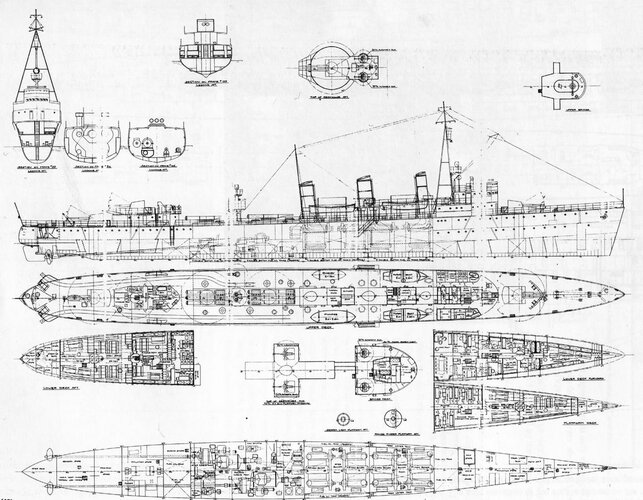
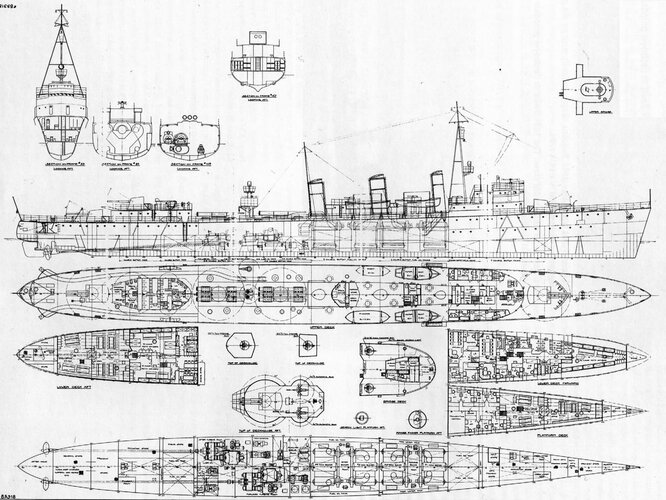
We can try to solve the puzzle by looking for British light cruiser designs 8000 ton from 1936-1939
The second phrase is a canceled order (year 1939 (look ww2 start attack to Poland) if there is such information somewhere).
This way you can try to adjust something.
If you find such projects from those years, I will post them here and I will read them.
If I learn anything new, I will write.