We can look at the German studies immediately preceeding FCAS (DLR Future Fighter Demonstrator, aka Project Diabolo).

The FFD’s net thrust requirement was 112.7kN dry / 177.1kN wet (per engine). This required a 5m long engine with 1m inlet diameter, weighing 1875kg. Thrust also quoted elsewhere as 124kN dry / 183kN wet… possibly gross (uninstalled) engine rating.

The FFD design is quite big… 20.3m long x 14.8m wide with a 100m2 wing. Empty weight is ~16.5t. Take off weight clean is 28.3t with 8x AAMs (1.8t) and 10t internal fuel, increasing to 29.4t in air to ground configuration with internal weapons (4x AAMs + 4x 1,000lb JDAMs). Max take off weight is ~35t with external load. Combat radius is 780nm hi-hi-hi with internal fuel and 2.5min combat, or 550nm with 1hr CAP loiter.

I find these thrust numbers rather high IMHO. Dry thrust is driven by the Mach 1.4 supercruise requirement and wet thrust by requirements for supersonic maneuverability and Mach 2.0 top speed… see charts below. In addition, the wing is oversized (100m2) in order to enable subsonic cruise at 50,000ft, which increases structural weight and thrust requirements.

So perhaps thrust requirements could be cut by 10-20% to ~100kN dry and ~150kN wet with a few performance compromises (eg. supercruise at Mach 1.2 vs 1.4, top speed Mach 1.8 vs 2.0, subsonic cruise at 45kft vs 50kft). Also I would expect Dassault to be able to optimize the design a fair bit (eg. FFD weapons bay volume seems quite oversized).
Those requirements match the specs of Kaan almost exactly.
 
Last edited:
Perhaps a little bit heavier than KAAN I would think due to the nuclear role which is one of the main missions, perhaps that was the main sticking point with the FCAS for France, how to get the FCAS adapted for the nuclear mission.
 
Two engines with 110kn of thrust is 16% greater than the F-35.

The F-35A weighs 13,290 kg. 16% heavier is 15,416kg.

Now if FCAS is 16 ton the thrust to weight is only a couple percent lower than the F-35A. It wouldn't take much for the FCAS to have low supercruise capability. All it would take is a wing and engine slightly more optimised for supercruise than the F-35A.

FCAS doesn't need the same thrust to weight ratio as the Rafale or Eurofighter to offer the same speed and acceleration. FCAS will have less drag due to internal weapons. It will no doubt have a higher fuel fraction to reduce the need for external tanks.

16 ton empty weight and 110kn engines seems perfect for a multi role fighter. Insane thrust to weight ratios to regain energy during a dogfight will no longer be a top priority.

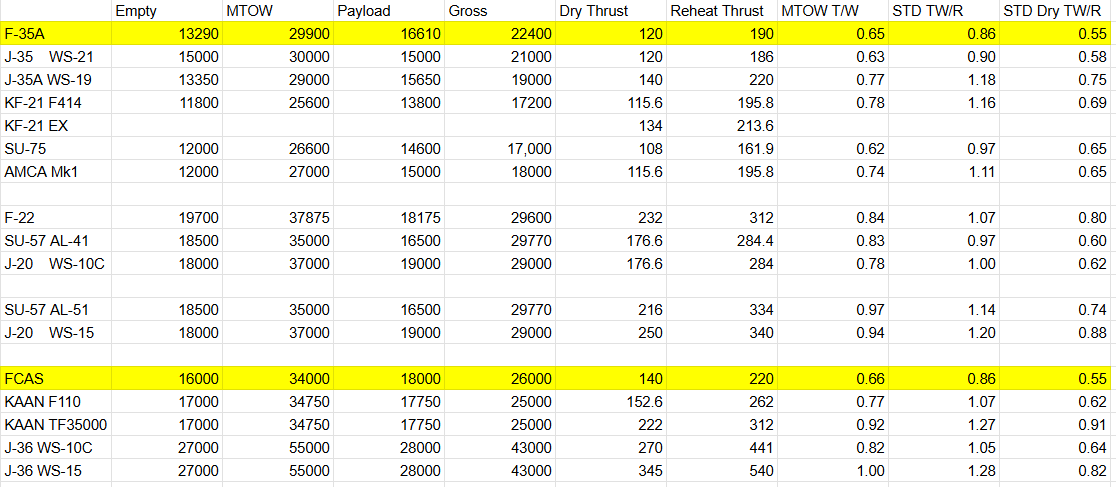
The F-35 by far has the worst TW/R at standard load compared to any 5th gen and the rest of prospective fighters. The FCAS will have extremely poor kinematic performance, this isn't even about dogfighting, acceleration, speed, agility, are all relevant factors in a fighter aircraft. An odd decision as looking at other stealth aircraft in development such as AMCA, KAAN, Su-75, KF-21EX, and even the J-36. All are choosing to retain high kinematic performance.
 

Attachments

  • Screenshot 2025-10-31 115549.png
    Screenshot 2025-10-31 115549.png
    47.6 KB · Views: 139
Oh yes, that's what i was assuming all this time !
That's what I suspected at first as well, but jet engines are usually described in class by their afterburner output. Then they started to defend the 110kN thrust figure as being enough, and only just a bit lower than the F-35A that I slowly realized, wait what.
 
There are easier ways to determine it like by looking at an aircraft constraint graph... but I would have to draw one so no.
Alternatively, we can calculate it based on specs. NATO requires a T/W of no less than 1.1 for a fighter. Let's be generous and apply this to combat weight rather than GTOW.
Assuming, the engineers are competent, we can assume there's 50% useable fuel left. This means combat weight is exactly at 82%, assuming full internal load. So we get a GTOW of 24871 kg. Assuming internal load maxes out at 2950 kg (German requirement) and max. weapons load is 8000 kg, MTOW would be limited to 30 t.
 
Just to keep some perspective... with 2x110kN:
@ 16t empty the thrust/weight would be similar to an F-16 with CFTs, F/A-18C or Super Hornet​
@ 15.5t empty T/W would be similar to a Mirage 4000​
@ 15t empty T/W would be similar to an F-15E with CFTs and slightly better than an F-35A​

The empty weight may be higher than "ideal" for many plausible reasons, e.g. in order to increase internal volume for fuel and weapons, to allow for better fuselage shaping for stealth and higher lift/drag, better sensors, engines with lower fuel consumption (variable cycle etc).

At the end of the day these are capability trade-offs that must weighed for and against. They may well be worth it. Just slapping on more powerful engines has tradeoffs too. Also worth keeping in mind that historically Dassault's fighters have always been somewhat underpowered on paper, but this was offset by low drag and other capabilities that were considered more important in real life combat (e.g. high supersonic thrust, instant turn rate etc).

P.S. One shouldn't take 50% fuel and apply it to all aircraft to determine T/W, as some aircraft can carry more internal fuel than others. Best to take a constant fuel fraction (e.g. 25% of empty weight). Even that is pretty rough as it doesn't account for engine specific fuel consumption, lift/drag etc.
 
Last edited:
Free to leave:


Lmao what? He knows damn well that Airbus cannot do this without Dassault. And if Dassault leaves, they won't be leaving alone.
The best solution is for 2 independent aircraft while keeping the other pillars as a collaboration. If they keep trying to make NGF together, phase 2 won't start until 2035. Someone needs to take that damn decision already and then once this is over, we need an official treaty forbiding Germany and France from ever partnering again on military equipment programs.
 
Last edited:
P.S. One shouldn't take 50% fuel and apply it to all aircraft to determine T/W, as some aircraft can carry more internal fuel than others. Best to take a constant fuel fraction (e.g. 25% of empty weight). Even that is pretty rough as it doesn't account for engine specific fuel consumption, lift/drag etc.
My friend, this is literally standard requirement. I admit Germany has a tougher one which may apply to France. Regardless, the actual weigth ratio might not be the same for all but this won't change the 50% requirement.
 

Attachments

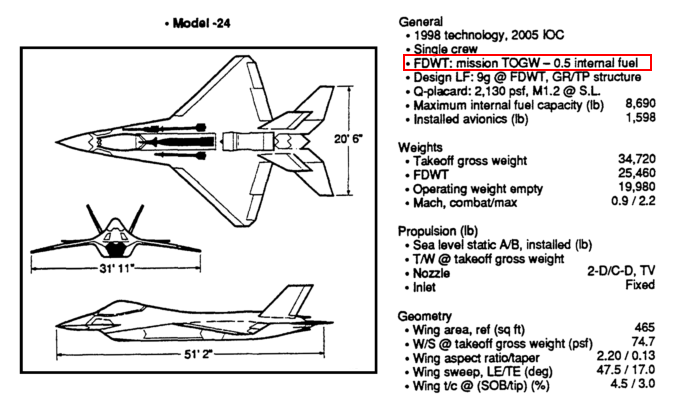
  • Model-24F-annotated.png
    Model-24F-annotated.png
    164.6 KB · Views: 125
My friend, this is literally standard requirement. I admit Germany has a tougher one which may apply to France. Regardless, the actual weigth ratio might not be the same for all but this won't change the 50% requirement.
Using 50% internal fuel only works when comparing fighters designed for the same range. If fighters are designed for different ranges (e.g. long-range fighters like the F-15 with CFTs, Su-27, Mirage 4000, F-35 etc) it's more realistic to use a fixed fuel fraction %. Simple as that.
 
It only works when comparing fighters designed for the same range. If fighters are designed for long range (e.g. F-15 with CFTs, Su-27, Mirage 4000, F-35 etc) you can't use 50% of internal fuel. Simple as that.
But all those CFTs are afterthoughs and not the original design specs.
 
But all those CFTs are afterthoughs and not the original design specs.
You have to keep a reasonable apples-to-apples comparison. Comparing an F-15 without CFTs to modern stealth fighters with large internal weapons bays makes no sense.

Otherwise why not just take an F-20 Tigershark and fit it with an F414 EPE? I bet its T/W would be off the charts... and completely irrelevant.
 
You have to keep a reasonable apples-to-apples comparison. Comparing an F-15 without CFTs to modern stealth fighters with large internal weapons bays makes no sense.

Otherwise why not just take an F-20 Tigershark and fit it with an F414 EPE? I bet its T/W would be off the charts... and completely irrelevant.
What are you going on about?
This is purely about specification that literally requires a fighter at combat weight with 50% fuel to be able to pull +9g and negative -3g and usually at M0.9.
Regardless of whatever aircraft or classic vs. modern stealth as long as the requirement stands the production aircraft is expected to do exactly that. It's not a matter of apples to apple it's a matter of real raw performance.
 
It doesn’t. You are seriously comparing 5th/6th gen fighters based on a dogfighting requirement for a short ranged lightweight fighter?
Yes, because this standard is an entry requirement these days. The actual 5th gen F22 requirement was 6g at M1.8 at altitude.
 
The F-35 by far has the worst TW/R at standard load compared to any 5th gen and the rest of prospective fighters.
You are completely wrong. The F-35 has a higher fuel fraction than every fighter listed. It can fly further on internal fuel than every fighter listed. You are unfairly penalising the F-35 in every calculation on your spreadsheet.

it's more realistic to use a fixed fuel fraction %. Simple as that.
Spot on. Fixed fuel fraction is the bare minimum that should be used.

A perfect comparison would see a comparison with equal payload and the same flight distance. This would then take into account lift to drag ratio and fuel efficiency of the engines. Seragina and Nx4eu don't understand basic data analysis.

To explain this perfectly: An F-16 takes off with 100% internal fuel carrying two 2000lb bombs and two AMRAAM. The F-35A can take off with 50% internal fuel and fly just as far.

In a dogfight for instance an F-16 might have to disengage as soon as fuel drops below 50% due to the lack of fuel to get home. The F-35A could comfortably dogfight until the fuel capacity hit 30%. The F-35A then has a higher thrust to weight ratio than a clean F-16 when compared correctly.
 
You are completely wrong. The F-35 has a higher fuel fraction than every fighter listed. It can fly further on internal fuel than every fighter listed. You are unfairly penalising the F-35 in every calculation on your spreadsheet.


Spot on. Fixed fuel fraction is the bare minimum that should be used.

A perfect comparison would see a comparison with equal payload and the same flight distance. This would then take into account lift to drag ratio and fuel efficiency of the engines. Seragina and Nx4eu don't understand basic data analysis.

To explain this perfectly: An F-16 takes off with 100% internal fuel carrying two 2000lb bombs and two AMRAAM. The F-35A can take off with 50% internal fuel and fly just as far.

In a dogfight for instance an F-16 might have to disengage as soon as fuel drops below 50% due to the lack of fuel to get home. The F-35A could comfortably dogfight until the fuel capacity hit 30%. The F-35A then has a higher thrust to weight ratio than a clean F-16 when compared correctly.

If I got this right If the Su-57M with AL-51F1 was carrying a maximum 10 tons of fuel and 2 tons of payload. The FCAS would need to be carrying 2 tons of fuel and 2 tons of payload to match the TW/R. 2 tons of fuel. The fuel fraction efficiency gains aren't making those 8 tons back.

The Su-57M takes off with 100% internal fuel, The FCAS takes off with what it needs to stay competitive. The FCAS runs out of fuel before even making it to the fight. The Su-57 goes home. Flawless victory.

Second spreadsheet with a not a joke internal fuel capacity, At least it'll be quite competitive against the Mig-31.
 

Attachments

  • Screenshot 2025-10-31 222737.png
    Screenshot 2025-10-31 222737.png
    25.3 KB · Views: 73
  • Screenshot 2025-10-31 224359.png
    Screenshot 2025-10-31 224359.png
    46.5 KB · Views: 64
Last edited:
If I got this right If the Su-57M with AL-51F1 was carrying a maximum 10 tons of fuel and 2 tons of payload.
Is that the Russian engine that blows up on the runway or blows up once it reaches cruising altitude?

The current F135 is capable of 52,000lb of thrust. It produced over 50,000lb of thrust on the test stand back in 2011.

Proof: https://aviationweek.com/pw-reveals-top-thrust-capabilities-jsf-power-battle

Unlike the Russians, the USA doesn't like their engines blowing up randomly every few hours. They derated the F135 to only 43,000lb of thrust so that it can last thousands of hours without failure. The comparison needs to be apple versus apple.

If we move to the latest Chinese Shenyang WS-15. They have achieved that power due to having an extremely low bypass ratio. You have to go back to the leaky turbojet used on the YF-17 flown in 1974 to have a bypass ratio that low. The increased fuel consumption during cruise conditions will completely nullify the high fuel fraction of the J-20 during long range missions.

For the French FCAS you can have a 110kn engine that has a higher 0.8 bypass ratio or a 110kn engine that has a lower 0.3 bypass ratio. The higher bypass ratio engine will be larger in diameter. It will cause the engine bays to be wider and this will increase the empty weight of the aircraft. This empty weight increase however would be completely offset by the reduced fuel consumption provided by the higher bypass. The lower fuel consumption during cruise then allows a lower fuel fraction percentage to be used when calculating the thrust to weight ratio.

If you are building a short range interceptor with extreme dog fighting ability then the design would suit a very low bypass ratio engine. This minimises empty weight and improves thrust to weight ratio. Fuel efficiency is not a priority for a short range interceptor.

If you are building a multirole aircraft with fairly long range then the design would suit a higher bypass engine. The M88-3 and M88-4 proposals already go up to 105kn. They feature larger fans at the front to increase bypass ratio. The M88 core is perfect size to make a 0.5:1 to 0.7:1 bypass ratio engine with 110kn of thrust.

I'm sure this 110kn French engine would be capable of 130+kn in a triple redline test. That would provide a similar comparison to the Russian maximum thrust figures.

A high thrust to weight ratio is not needed to perform an extremely rapid turn. It is only needed to regain energy to do a second turn. While there is still a chance of dogfights in the future it is extremely unlikely it will go for multiple turns.
 
Is that the Russian engine that blows up on the runway or blows up once it reaches cruising altitude?

The current F135 is capable of 52,000lb of thrust. It produced over 50,000lb of thrust on the test stand back in 2011.

Proof: https://aviationweek.com/pw-reveals-top-thrust-capabilities-jsf-power-battle

Unlike the Russians, the USA doesn't like their engines blowing up randomly every few hours. They derated the F135 to only 43,000lb of thrust so that it can last thousands of hours without failure. The comparison needs to be apple versus apple.

If we move to the latest Chinese Shenyang WS-15. They have achieved that power due to having an extremely low bypass ratio. You have to go back to the leaky turbojet used on the YF-17 flown in 1974 to have a bypass ratio that low. The increased fuel consumption during cruise conditions will completely nullify the high fuel fraction of the J-20 during long range missions.

For the French FCAS you can have a 110kn engine that has a higher 0.8 bypass ratio or a 110kn engine that has a lower 0.3 bypass ratio. The higher bypass ratio engine will be larger in diameter. It will cause the engine bays to be wider and this will increase the empty weight of the aircraft. This empty weight increase however would be completely offset by the reduced fuel consumption provided by the higher bypass. The lower fuel consumption during cruise then allows a lower fuel fraction percentage to be used when calculating the thrust to weight ratio.

If you are building a short range interceptor with extreme dog fighting ability then the design would suit a very low bypass ratio engine. This minimises empty weight and improves thrust to weight ratio. Fuel efficiency is not a priority for a short range interceptor.

If you are building a multirole aircraft with fairly long range then the design would suit a higher bypass engine. The M88-3 and M88-4 proposals already go up to 105kn. They feature larger fans at the front to increase bypass ratio. The M88 core is perfect size to make a 0.5:1 to 0.7:1 bypass ratio engine with 110kn of thrust.

I'm sure this 110kn French engine would be capable of 130+kn in a triple redline test. That would provide a similar comparison to the Russian maximum thrust figures.

A high thrust to weight ratio is not needed to perform an extremely rapid turn. It is only needed to regain energy to do a second turn. While there is still a chance of dogfights in the future it is extremely unlikely it will go for multiple turns.
No the AL-51 does not just blow up on the runway nor do you know anything about Chinese engines, I remember you completely dismissed the WS-19 engine because it is Chinese and Chinese accounts are unreliable and so are Russian ones. You simply have prejudice against non western aligned nations.

There is nearly zero information on the WS-15 yet you choose to cherry pick it as an example of poor Chinese technology, yet I’ve already argued with you about the WS-19 possessing a reasonable bypass of 0.5 achieving thrust levels of what you seem to be ideal such as 110kN and you simply ignored it. You cannot be trying to act like the reasonable one here.

Give me an example a real example of the Chinese giving false data on their engines to make them look better than they are. Give me the real world account of it happening, or are you just assuming it so.
 
Last edited:
The requirements are always about sustained turns even if they are not spelled out as such. It's just the basics. The airframe ultimate load is 1.5 at least for the ESAV studies so at 9g it would be 13.5g.
 
To explain this perfectly: An F-16 takes off with 100% internal fuel carrying two 2000lb bombs and two AMRAAM. The F-35A can take off with 50% internal fuel and fly just as far.

In a dogfight for instance an F-16 might have to disengage as soon as fuel drops below 50% due to the lack of fuel to get home. The F-35A could comfortably dogfight until the fuel capacity hit 30%. The F-35A then has a higher thrust to weight ratio than a clean F-16 when compared correctly.

This is hardly a realistic scenario, is it? Realistically the F-16 arrives with two or three partially consumed external tanks, drops the tanks and enters the fight with 100% internal fuel. Bingo fuel might be that needed for RTB, but if there's a tanker handy, that can be extended.

Real life is complicated, while you're trying to reduce comparisons to something like the Standard tonnage of interwar treaty warships, which was hopelessly unrealistic for any real-life role and only having a purpose for treaty compliance. For a comparison that reflects real life, you need to allow both aircraft their individual advantages in realistic combat condition.
 
The Su-57M takes off with 100% internal fuel, The FCAS takes off with what it needs to stay competitive. The FCAS runs out of fuel before even making it to the fight. The Su-57 goes home. Flawless victory.
Analysis that assumes the other side is an idiot really isn't very valuable. Doubly so when it builds from a foundation of unconfirmed rumour.

France has a substantial tanker force, and a strong tradition of buddy tanking, the onboard fuel limits aren't the dominant factor you seem to think. The Spitfire had a substantially lower range than many other WWII aircraft, yet didn't do to badly.

And thrust to weight ratios on their own as a measure of value are so last century, if not so 1950s. Realistically you have three significant factors in physical performance: instantaneous agility (and off-axis nose pointing as a subset), sustained turn performance, and the ability to rapidly recover from a low energy state to a high energy state. Thrust to weight ratio plays into a couple of those but isn't the sole input to either. And those factors only influence the physical side of the fight, they're irrelevant to sensors and data fusion and the combat cloud. If you're fighting smart, your thrust to weight ratio should never come into it, because you'll have killed the other guy before it starts to matter.

Meanwhile the individual performance on any sixth generation aircraft is, by the very definition of sixth generation, of lesser importance than with fifth generation and earlier. What matters is the performance of the entire system of systems: manned aircraft, unmanned aircraft, and the combat cloud they operate in.

TLDR: This isn't Top Trumps.
 
...having a look into my christal ball ... I see ... I see .... this thread turned into a "News Only" one !

The bulk of the last post details chinese engine technology compared it to Russian and US one. Well, sometimes FCAS was at least mentioned somewhere ...
And the tone has deteriorated somewhat !
Please, stay closer on topic, and try to avoid nationalism. Let's just say, we aren't French, Russian, US, Chinese or German, but just blue, green, whatever...

Next posts falling into the described scheme will be deleted without any comment !
 
I doubt that Sweden could since they are heavily involved in their own program and I would think that they would not join the FCAS out of fear of loosing their independence in regards to military aircraft manufacture.
 
Exactly.

The one that put that diagram in the slide certainly did forget all about his Bachelor Math, otherwise he would probably have remembered that, for a system of vectors to be a base, at least each vector must be perpendicular to the others with their scalar product null.

With Engine Power being a strong component of both the electrical power and maneuverability, his referential isn´t a valid one to push forward such arguments ;)
 
Last edited:
With France wanting a carrier variant I would lean to power being more thrust than electrical power. Getting an aircraft in the air over a defined short distance with the most payload possible.
 
"Power" for launch from a carrier is provided by the ship itself (over the deck wind and catapult) as used by French doctrine. The airframe contributing essentially with... Lift.
 
A few nuggets from French Senate hearings today, mostly confirming what is already known about FCAS/NGF:
  • 15t empty weight
  • 11t thrust engines which will leverage work on the 9t M88 T-REX for Rafale F5 (T-REX is a critical stepping stone for Safran to de-risk the FCAS engine and catch up with US technology levels and raise hot section temperatures)
  • Germany, Spain & French defense staffs all aligned on key requirements
 
Last edited:
so it sounds potentially like a plane around the weight class of F-35 and J-35
 
so it sounds potentially like a plane around the weight class of F-35 and J-35
~15% heavier and more thrust than an F-35A, and without the STOVL design penalties, so probably more accurate to think of FCAS/NGF as being in the weight class just above F-35.
 
The FCAS specs are approximately half way between the F-35A and J-20A.

F-35A
Length: 15.7 m
Wing span: 11 m
Empty weight: 13.3 ton
Fuel Capacity: 8.3 ton
Thrust: 190 kn
Combat Radius: 760 nm

J-20A
Length: 21.2 m
Wing span: 13.01 m
Empty weight: 17 ton
Fuel Capacity: 12 ton
Thrust: 284 kn
Combat Radius: 1,100 nm

FCAS half way point between the above.
Length: 18.45 m
Wing span: 12 m
Empty weight: 15.1 ton
Fuel Capacity: 10.1 ton
Thrust: 237 kn
Combat Radius: 930 nm

Big upgrade over Rafale.
 

Similar threads

Back
Top Bottom