Ok then, if there is no news, there is no need to post that its dead.There is no news info instead of a battle between France and Germany on this program.
Listen, if it really dies, I will be the first one here to applaud your predictions, Ok ?

Ok then, if there is no news, there is no need to post that its dead.There is no news info instead of a battle between France and Germany on this program.

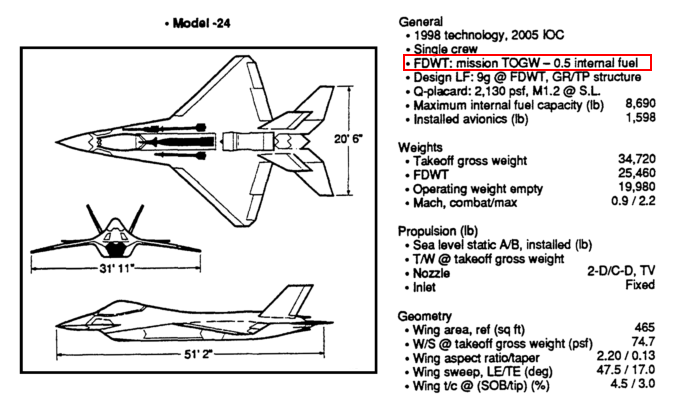
Those requirements match the specs of Kaan almost exactly.We can look at the German studies immediately preceeding FCAS (DLR Future Fighter Demonstrator, aka Project Diabolo).
https://www.secretprojects.co.uk/th...r-demonstrator-dlr-ffd-project-diabolo.43292/
The FFD’s net thrust requirement was 112.7kN dry / 177.1kN wet (per engine). This required a 5m long engine with 1m inlet diameter, weighing 1875kg. Thrust also quoted elsewhere as 124kN dry / 183kN wet… possibly gross (uninstalled) engine rating.
The FFD design is quite big… 20.3m long x 14.8m wide with a 100m2 wing. Empty weight is ~16.5t. Take off weight clean is 28.3t with 8x AAMs (1.8t) and 10t internal fuel, increasing to 29.4t in air to ground configuration with internal weapons (4x AAMs + 4x 1,000lb JDAMs). Max take off weight is ~35t with external load. Combat radius is 780nm hi-hi-hi with internal fuel and 2.5min combat, or 550nm with 1hr CAP loiter.
I find these thrust numbers rather high IMHO. Dry thrust is driven by the Mach 1.4 supercruise requirement and wet thrust by requirements for supersonic maneuverability and Mach 2.0 top speed… see charts below. In addition, the wing is oversized (100m2) in order to enable subsonic cruise at 50,000ft, which increases structural weight and thrust requirements.
So perhaps thrust requirements could be cut by 10-20% to ~100kN dry and ~150kN wet with a few performance compromises (eg. supercruise at Mach 1.2 vs 1.4, top speed Mach 1.8 vs 2.0, subsonic cruise at 45kft vs 50kft). Also I would expect Dassault to be able to optimize the design a fair bit (eg. FFD weapons bay volume seems quite oversized).

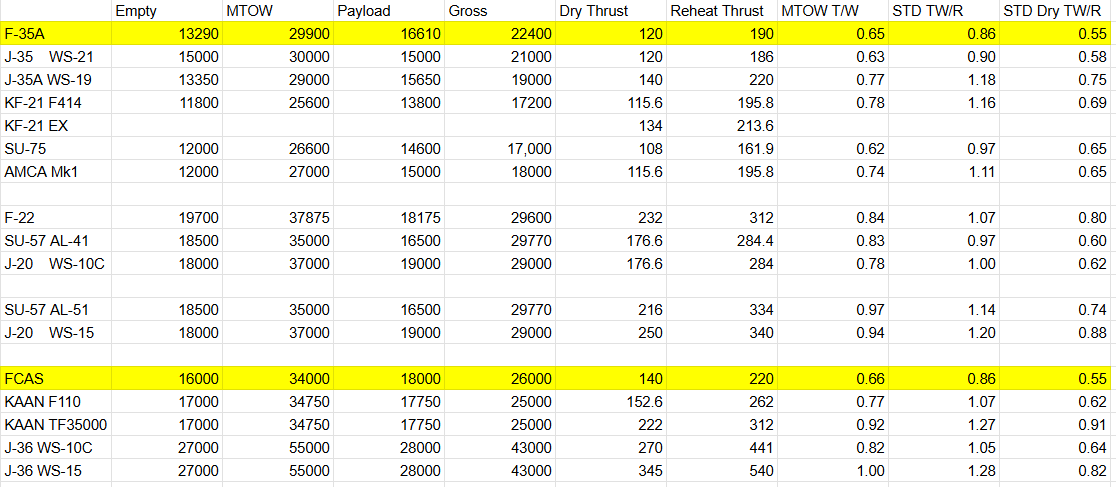
Two engines with 110kn of thrust is 16% greater than the F-35.
The F-35A weighs 13,290 kg. 16% heavier is 15,416kg.
Now if FCAS is 16 ton the thrust to weight is only a couple percent lower than the F-35A. It wouldn't take much for the FCAS to have low supercruise capability. All it would take is a wing and engine slightly more optimised for supercruise than the F-35A.
FCAS doesn't need the same thrust to weight ratio as the Rafale or Eurofighter to offer the same speed and acceleration. FCAS will have less drag due to internal weapons. It will no doubt have a higher fuel fraction to reduce the need for external tanks.
16 ton empty weight and 110kn engines seems perfect for a multi role fighter. Insane thrust to weight ratios to regain energy during a dogfight will no longer be a top priority.

Oh yes, that's what i was assuming all this time !Could the 110 kN be the dry thrust figure?
That's what I suspected at first as well, but jet engines are usually described in class by their afterburner output. Then they started to defend the 110kN thrust figure as being enough, and only just a bit lower than the F-35A that I slowly realized, wait what.Oh yes, that's what i was assuming all this time !
Lmao what? He knows damn well that Airbus cannot do this without Dassault. And if Dassault leaves, they won't be leaving alone.
My friend, this is literally standard requirement. I admit Germany has a tougher one which may apply to France. Regardless, the actual weigth ratio might not be the same for all but this won't change the 50% requirement.P.S. One shouldn't take 50% fuel and apply it to all aircraft to determine T/W, as some aircraft can carry more internal fuel than others. Best to take a constant fuel fraction (e.g. 25% of empty weight). Even that is pretty rough as it doesn't account for engine specific fuel consumption, lift/drag etc.
Using 50% internal fuel only works when comparing fighters designed for the same range. If fighters are designed for different ranges (e.g. long-range fighters like the F-15 with CFTs, Su-27, Mirage 4000, F-35 etc) it's more realistic to use a fixed fuel fraction %. Simple as that.My friend, this is literally standard requirement. I admit Germany has a tougher one which may apply to France. Regardless, the actual weigth ratio might not be the same for all but this won't change the 50% requirement.
But all those CFTs are afterthoughs and not the original design specs.It only works when comparing fighters designed for the same range. If fighters are designed for long range (e.g. F-15 with CFTs, Su-27, Mirage 4000, F-35 etc) you can't use 50% of internal fuel. Simple as that.
You have to keep a reasonable apples-to-apples comparison. Comparing an F-15 without CFTs to modern stealth fighters with large internal weapons bays makes no sense.But all those CFTs are afterthoughs and not the original design specs.
What are you going on about?You have to keep a reasonable apples-to-apples comparison. Comparing an F-15 without CFTs to modern stealth fighters with large internal weapons bays makes no sense.
Otherwise why not just take an F-20 Tigershark and fit it with an F414 EPE? I bet its T/W would be off the charts... and completely irrelevant.
It doesn’t. You are seriously comparing 5th/6th gen fighters based on a dogfighting requirement for a short ranged lightweight fighter?as long as the requirement stands
Yes, because this standard is an entry requirement these days. The actual 5th gen F22 requirement was 6g at M1.8 at altitude.It doesn’t. You are seriously comparing 5th/6th gen fighters based on a dogfighting requirement for a short ranged lightweight fighter?
You are completely wrong. The F-35 has a higher fuel fraction than every fighter listed. It can fly further on internal fuel than every fighter listed. You are unfairly penalising the F-35 in every calculation on your spreadsheet.The F-35 by far has the worst TW/R at standard load compared to any 5th gen and the rest of prospective fighters.
Spot on. Fixed fuel fraction is the bare minimum that should be used.it's more realistic to use a fixed fuel fraction %. Simple as that.
You are completely wrong. The F-35 has a higher fuel fraction than every fighter listed. It can fly further on internal fuel than every fighter listed. You are unfairly penalising the F-35 in every calculation on your spreadsheet.
Spot on. Fixed fuel fraction is the bare minimum that should be used.
A perfect comparison would see a comparison with equal payload and the same flight distance. This would then take into account lift to drag ratio and fuel efficiency of the engines. Seragina and Nx4eu don't understand basic data analysis.
To explain this perfectly: An F-16 takes off with 100% internal fuel carrying two 2000lb bombs and two AMRAAM. The F-35A can take off with 50% internal fuel and fly just as far.
In a dogfight for instance an F-16 might have to disengage as soon as fuel drops below 50% due to the lack of fuel to get home. The F-35A could comfortably dogfight until the fuel capacity hit 30%. The F-35A then has a higher thrust to weight ratio than a clean F-16 when compared correctly.
Is that the Russian engine that blows up on the runway or blows up once it reaches cruising altitude?If I got this right If the Su-57M with AL-51F1 was carrying a maximum 10 tons of fuel and 2 tons of payload.
No the AL-51 does not just blow up on the runway nor do you know anything about Chinese engines, I remember you completely dismissed the WS-19 engine because it is Chinese and Chinese accounts are unreliable and so are Russian ones. You simply have prejudice against non western aligned nations.Is that the Russian engine that blows up on the runway or blows up once it reaches cruising altitude?
The current F135 is capable of 52,000lb of thrust. It produced over 50,000lb of thrust on the test stand back in 2011.
Proof: https://aviationweek.com/pw-reveals-top-thrust-capabilities-jsf-power-battle
Unlike the Russians, the USA doesn't like their engines blowing up randomly every few hours. They derated the F135 to only 43,000lb of thrust so that it can last thousands of hours without failure. The comparison needs to be apple versus apple.
If we move to the latest Chinese Shenyang WS-15. They have achieved that power due to having an extremely low bypass ratio. You have to go back to the leaky turbojet used on the YF-17 flown in 1974 to have a bypass ratio that low. The increased fuel consumption during cruise conditions will completely nullify the high fuel fraction of the J-20 during long range missions.
For the French FCAS you can have a 110kn engine that has a higher 0.8 bypass ratio or a 110kn engine that has a lower 0.3 bypass ratio. The higher bypass ratio engine will be larger in diameter. It will cause the engine bays to be wider and this will increase the empty weight of the aircraft. This empty weight increase however would be completely offset by the reduced fuel consumption provided by the higher bypass. The lower fuel consumption during cruise then allows a lower fuel fraction percentage to be used when calculating the thrust to weight ratio.
If you are building a short range interceptor with extreme dog fighting ability then the design would suit a very low bypass ratio engine. This minimises empty weight and improves thrust to weight ratio. Fuel efficiency is not a priority for a short range interceptor.
If you are building a multirole aircraft with fairly long range then the design would suit a higher bypass engine. The M88-3 and M88-4 proposals already go up to 105kn. They feature larger fans at the front to increase bypass ratio. The M88 core is perfect size to make a 0.5:1 to 0.7:1 bypass ratio engine with 110kn of thrust.
I'm sure this 110kn French engine would be capable of 130+kn in a triple redline test. That would provide a similar comparison to the Russian maximum thrust figures.
A high thrust to weight ratio is not needed to perform an extremely rapid turn. It is only needed to regain energy to do a second turn. While there is still a chance of dogfights in the future it is extremely unlikely it will go for multiple turns.

There's a term for this, chauvinism.You simply have prejudice against non western aligned nations.

To explain this perfectly: An F-16 takes off with 100% internal fuel carrying two 2000lb bombs and two AMRAAM. The F-35A can take off with 50% internal fuel and fly just as far.
In a dogfight for instance an F-16 might have to disengage as soon as fuel drops below 50% due to the lack of fuel to get home. The F-35A could comfortably dogfight until the fuel capacity hit 30%. The F-35A then has a higher thrust to weight ratio than a clean F-16 when compared correctly.
Analysis that assumes the other side is an idiot really isn't very valuable. Doubly so when it builds from a foundation of unconfirmed rumour.The Su-57M takes off with 100% internal fuel, The FCAS takes off with what it needs to stay competitive. The FCAS runs out of fuel before even making it to the fight. The Su-57 goes home. Flawless victory.

Power as Electrical power or engines raw Thrust?

Agreed, otherwise it wouldn't be a compromise against manoeuvrability.If they meant thrust, they would have written thrust or flight performance.
Power is very likely referring to power generation and management.

~15% heavier and more thrust than an F-35A, and without the STOVL design penalties, so probably more accurate to think of FCAS/NGF as being in the weight class just above F-35.so it sounds potentially like a plane around the weight class of F-35 and J-35