@Combat-Master : a Phantom in a hurry to be... A gosht!
Last edited:


No room, the AWG-10 dish is like 80cm, the F-4E uses a small nose and smaller pulse radar.What I can't understand with the F-4 that after several years of combat over North Vietnam and the Ho Chi Minh trail during the mid to late 1960s that it needed an internal cannon that while the USAF when they introduced the F-4E with its' internal M61 Vulcan gun the USN's new much more capable F4J (A massive improvement on the F-4B) didn't have an internal gun.
No room, the AWG-10 dish is like 80cm, the F-4E uses a small nose and smaller pulse radar.
That's exactly it. The F-4E has a much smaller antenna diameter than the F-4J (~20"?), even though the nose of the -E is ~5ft longer.No room, the AWG-10 dish is like 80cm, the F-4E uses a small nose and smaller pulse radar.
That's exactly it. The F-4E has a much smaller antenna diameter than the F-4J (~20"?), even though the nose of the -E is ~5ft longer.
Didn't have the right radar and other avionics (radios, at the least). I don't have the full list of changes between F-4B and F-4E.There's no reason why the USN couldn't have purchased a few F-4Es when it became abundantly clear an internal cannon was needed for the Phantoms.

Other than the fact that it probably couldn't be successfully be launched from the carrier due to forward c.g. due to the gun+ammo+radar.There's no reason why the USN couldn't have purchased a few F-4Es when it became abundantly clear an internal cannon was needed for the Phantoms.
Thank you!

Dang that wingtip came very close to hitting the ground!Turkish F-4E 2020 maneuverer that ended almost in disaster
View: https://x.com/SailorNayad/status/1917584178574680283
No room, the AWG-10 dish is like 80cm, the F-4E uses a small nose and smaller pulse radar.
That's exactly it. The F-4E has a much smaller antenna diameter than the F-4J (~20"?), even though the nose of the -E is ~5ft longer.

No clue. I only have the details of the first clip.Very interesting, Njiiaf. What exactly was attacked in Baghdad by the F-4s as the vid of burning oil tank seems to be independently shot from the footage with the F-4?
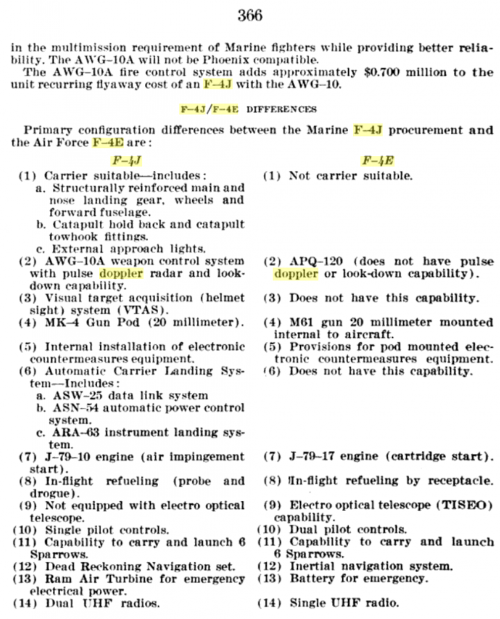
Which year is this document from? I am intrigued by the F-4J ref. #14.
Very early in the war. 80-81, don't have the exact date.Which year did the low altitude sorties near Khorramshahr as depicted in the vid take place?
So it took place in the early war period when IRIAF was capable of long-range airstrikes within Iraq, eg. on 4 April 1981 on the H-3 airbase.Very early in the war. 80-81, don't have the exact date.
Check these articles as they depict IRIAF F-4 airstrikes against Iraq between 1980-1981.
Roughly around that time yes. Coincidentally, the leader of the H-3 operation is the pilot of the Phantom in the 1st clip. Farajollah BaratpourSo it took place in the early war period when IRIAF was capable of long-range airstrikes within Iraq, eg. on 4 April 1981 on the H-3 airbase.
Which year is this document from? I am intrigued by the F-4J ref. #14.
All -From numerous sources, it would seem the F-4 Phantom had a somewhat heavily-loaded wing (medium, medium-heavy).
I'm not saying I dispute this as the F-4's performance obviously reflects it, but I am wondering how an aircraft with such large wings, which appear to be substantially cambered, fairly thick for a supersonic design, and not exactly razor sharp at the leading edge (all things that generally reflect a high L/D ratio) would yield a somewhat heavily-loaded wing?
KJ Lesnick


Film showing the flight control systems on the McDonnell Douglas F-4 Phantom. From the archives of the San Diego Air and Space Museum http://www.sandiegoairandspace.org/re...
On 14 July 1966, Bill 'Swede' Swendner became a MiG-21 killer during the Vietnam War! Hear his incredible story as he took on the most feared Soviet fighter in its day, and won!
On top of that, he is an excellent speaker and will make you laugh. Join us as he tells about incredible career highlights as a USAF fighter pilot.
Recording Date: 29 October 2022

Iranian AMRAAM clone for F-4E Phantom II
Iran is re-upgrading what is left of its Phantom fleet: the old F-4E Phantom II will be armed with an Iranian AIM-120C clone after extensive modernization.
On the 13. In June 2025, the Israeli Air and Space Force (IASF) destroyed ten F-4E Phantom II on the 3rd during Operation Rising Lion. Tactical Fighter Bomber Base (TFB) Nojeh near Hamadan. The attack with precision-guided GBU-39/B small diameter bombs destroyed the 31st. Tactical hunting squadrons (TFS) — Iran’s main phantom unit and main participant in the modernization program “Project Dowran”. Nearly a quarter of Iran's phantom fleet was lost in a matter of minutes -- the heaviest casualties in a day since the Iran-Iraq war. The elimination of 31. TFS forced Tehran to fully commit to the 61st and 91. TFS in Bushehr and Bandar Abbas to leave. Both squadrons had benefited from upgrades as part of the Dowran project: structural overhaul, rewiring, digitization of the AN/APQ-120 radars and integration of Chinese C-704KD and C-802KD anti-ship missiles.

the old F-4E Phantom II will be armed with an Iranian AIM-120C clone after extensive modernization.

Forest -Flying F-4 Reconnaissance Phantoms Unarmed And Unafraid In Desert Storm
https://www.twz.com/air/flying-the-rf-4c-phantom-unarmed-and-unafraid-during-desert-storm
This McDonnell Aircraft promotional film "The Phantom II - (F-4C) Walkaround" (1968) provides an in-depth overview of the Phantom II, a versatile fighter aircraft developed by the U.S. Air Force. Former test pilot Bob Little explains the aircraft's design and performance, highlighting its twin engines, twin-man crew, and exceptional capabilities, including speeds exceeding Mach 2. The aircraft features a unique aerodynamic structure, including large intake ducts, a titanium and stainless steel fuselage, and a 45-degree swept wing for improved maneuverability. The Phantom 2 also boasts advanced systems such as a variable inlet for high-speed performance, boundary layer control for better low-speed handling, and emergency systems like a ram air turbine for hydraulic and electrical power. Other key features include the aircraft's landing gear for stability, ejection seats, a high-performance radar, and various fuel and weapon storage configurations. The Phantom 2's design is a testament to its engineering and adaptability, making it a standout in both Air Force and Navy operations.
00:00: The U.S. Air Force demonstrates the Phantom 2's capabilities, noting its versatility and exceptional performance. The first flight of the Phantom 2 is highlighted as a foundation for its record-breaking flights.
0:45-1:03 – Former chief test pilot Bob Little introduces the aircraft’s features and performance, emphasizing its design as the world’s most versatile fighter.
1:03-1:38 – Little explains the Phantom's design, with emphasis on its twin engines, two-man crew, and performance, capable of flying from 110 knots to above Mach 2.
1:38-3:04 – Detailed description of the Phantom’s structural features: its 58 ft length, weight, titanium and stainless steel fuselage, and the large intake ducts for its J79 engines. The 45-degree swept wings improve maneuverability.
3:04-3:47 – Features that improve stability, including the upswept wing tips for lateral stability at speeds above Mach 2, and the wide landing gear for stability during high crosswinds and carrier operations.
3:53-5:54 – Overview of the cockpit features, including entry via telescoping ladder, external canopy controls, and the rear cockpit's sun curtain for better radar viewing. Ejection seats and the procedure for ejection are explained.
6:01-6:32 – The Phantom’s variable inlet and its automatic adjustment to maintain airflow at high speeds, helping the aircraft achieve high performance.
6:32-7:29 – Comparison of the Air Force and Navy tire designs, the use of a ram air turbine for emergency power, and the different pylon stores. The plane’s low-speed performance is enhanced by boundary layer control.
7:36-9:36 – Explanation of the wing flaps, their boundary layer control, and their function in takeoff and landing conditions. The ailerons and spoilers work together for solid lateral control, while speed brakes provide efficient deceleration.
9:42-11:36 – Details about the rudder, stabilator, tailhook, and the aircraft’s tail section. The stabilator is made of stainless steel honeycomb, and the tail hook is designed for emergency landings. The parabrake compartment is shown, and the wing fold feature is discussed.
12:22-13:03 – The aircraft’s radar and infrared system, including the APQ-100 radar and infrared system for counteracting jamming.
13:03-13:48 – Description of the fuel system, which includes internal and external fuel tanks, and the Phantom’s ability to jettison wing fuel if needed.
13:48 – Closing remarks from Bob Little, expressing his pride in the Phantom program and thanking viewers for joining the tour.
Dating to 1968, this U.S. Air Force film "F-4 Air Combat Tactics" explains the importance of understanding adverse yaw and dihedral effect for effective maneuvering. It describes the basic fighting unit, the two-ship element, and the roles of the leader and wingman in maintaining position and providing coverage. The film also covers the phases of air battle: acquisition, maneuvering, and terminal, emphasizing the use of radar and visual scans for situational awareness.
Various combat maneuvers are detailed, including the high-speed and low-speed yo-yo, barrel roll attack, defensive turn, break turn, and scissors maneuver. The importance of teamwork, radio discipline, and proficiency in air combat tactics is highlighted, with training and practice being essential for success.
Overall, the text provides a comprehensive overview of the tactics and maneuvers used by F4 Phantom II pilots in aerial combat.
1:28 - 1:39: The F4 Phantom II is a versatile tactical fighter used as a fighter, bomber, interceptor, or air superiority fighter.
1:52 - 2:09: Tactical Air Command F4 pilots must be proficient in aerial combat to seek out and destroy enemy aircraft.
2:09 - 2:23: Air-to-air combat is swift and deadly, requiring thorough knowledge of weapons and systems.
2:32 - 2:44: Combat duty exposes pilots to situations demanding skillful maneuvering, teamwork, and timely tactics.
2:52 - 3:00: Flying the F4 in combat requires understanding adverse yaw and dihedral effect.
3:09 - 3:21: Adverse yaw is opposite to the desired turn direction at subsonic speeds and high angles of attack.
3:27 - 3:44: Dihedral effect causes more lift from a wing straightened into the relative wind.
4:10 - 4:46: Pilots must use rudder to control roll rate and bank at high angles of attack.
5:24 - 5:42: The basic fighting unit is the two-ship element, more maneuverable than a flight of four.
6:04 - 6:52: The wingman covers the leader's rear hemisphere and maintains position during turns.
7:10 - 7:47: Upon enemy contact, the wingman moves to the maximum performance maneuvering envelope.
8:00 - 8:41: The wingman provides a spare weapon system if the leader's system malfunctions.
9:02 - 9:36: The two-ship flight's offensive potential is enhanced when part of a four-ship combat patrol formation.
10:01 - 10:53: The supporting element maintains visual contact and correct formation position during turns.
11:02 - 11:31: Visual search techniques improve detection rates in the rear hemisphere.
12:05 - 12:26: Wingmen search specific areas to improve 6 o'clock coverage.
12:44 - 13:10: Radar coverage is improved when each flight member searches a definite area.
14:05 - 14:59: Each flight member uses radar and visual scans to maintain situational awareness.
15:24 - 16:01: The air battle consists of three phases: acquisition, maneuvering, and terminal.
16:07 - 16:25: The F4's long-range radar is crucial for early enemy detection.
17:00 - 17:21: Elements separate to achieve a first-pass ID and missile launch.
18:00 - 18:42: The ID element maneuvers for a collision course while the launch element maintains target lock.
19:17 - 19:32: Both elements engage the enemy, supporting each other until the enemy is destroyed.
20:22 - 20:43: A stern approach is best for surprise in a missile or gun attack.
21:06 - 21:25: Maintain element integrity when attacking as a lone element.
21:59 - 22:17: The high-speed yo-yo maneuver maintains nose-tail separation during an attack.
22:30 - 22:55: The low-speed yo-yo maneuver establishes cutoff while accelerating.
23:12 - 23:56: The barrel roll attack is effective when the defender is turning into you.
24:40 - 25:06: The defensive turn prevents an opponent from achieving a launch or firing position.
25:12 - 25:34: A break turn forces the attacker to overshoot.
26:03 - 26:21: The scissors maneuver rotates your lethal cone away from the attacker.
26:52 - 27:25: Setting the hook maneuver forces the attacker out the bottom.
27:31 - 27:52: Random reversals on the deck spoil the enemy's tracking solution.
28:18 - 28:30: The element under attack separates, and the free element sandwiches the attackers.
29:00 - 29:31: The defensive split forces attackers to choose between the low and high man.
30:57 - 31:07: Teamwork and radio discipline are mandatory for the defensive split.
31:13 - 31:26: Proficiency in air combat tactics comes from training and practice.
31:39 - 31:55: Knowledge and skills in air-to-air gunnery training are essential for success in air combat.
Dating to the 1970s, this film "F-4 Phantom: A Complete Air Force" was made by McDonnell Douglas to promote the F-4 Phantom II for international clientele. The F-4 is an American tandem two-seat, twin-engine, all-weather, long-range supersonic jet interceptor and fighter-bomber originally developed by McDonnell Aircraft for the United States Navy. Proving highly adaptable, it entered service with the Navy in 1961 before it was adopted by the United States Marine Corps and the United States Air Force, and by the mid-1960s it had become a major part of their air arms. Phantom production ran from 1958 to 1981 with a total of 5,195 aircraft built, making it the most produced American supersonic military aircraft in history, and cementing its position as a signature combat aircraft of the Cold War. Aside from being flown by the U.S. Air Force, Navy, and Marine Corps, it also flew with the air forces of at least 11 other nations, making it one of the most widely-adopted military aircraft in aviation history.
The film has no narration, but contains a lively musical score. It begins with images of the aircraft on the drawing board at McDonnell-Douglas, before sequing into footage from the test program.
At 1:00, the aircraft shows how it can dwell or fly very slowly, right behind a propeller powered training aircraft.
At 1:08 an aircraft marked "Sage Burner" is shown. This is from 28 August 1961, when Operation SAGEBURNER took place. To commemorate the 50th anniversary of Naval Aviation, Lieutenants Huntington Hardisty and Earl De Esch, United States Navy, flew a McDonnell F4H-1F Phantom II to a Fédération Aéronautique Internationale (FAI) World Speed Record of 1,452.777 kilometers per hour (902.714 miles per hour) over a 3 kilometer (1.864
mile) course at White Sands Missile Range, New Mexico.
At 1:54, an F-4 in camouflage paint scheme is shown.
At 2:25, Iranian F-4 Phantoms for the Imperial Iranian Air Force. The Imperial Iranian Air Force was the largest operator of the RF-4E after Germany. A total of 32 examples were ordered by IIAF.
At 2:54, Royal Navy F-4s are shown.
At 4:28, a U.S. Navy F-4 lands on a carrier deck.
At 4:51 a Marine Corps F-4 is shown after launch from the carrier.
At 5:27, the aircraft is shown being used for close tactical support in Vietnam, dropping napalm and other ordnance.
At 6:20 what appears to be temporary repairs to a damaged airstrip are shown, with an F-4 taking off using a skid on its nosewheel.
At 6:37, image of an F-4 surrounded by a full load of ordnance it could carry.
6:48 minigun demonstrated. Additional combat missions in Vietnam are shown.
At 10:16, air to air refueling followed by acrobatics by the Blue Angels and the Thunderbirds (in 1969 the aircraft flew for both stunt teams!)