Lots of opportunities to upgrade Raptor to make it less fragile and enhance readiness:

- fundamentally improve F119 reliability
- move away from APG-77 (APG-85 based array?)
- find an easier to maintain and more environmentally robust LO coating (mirror Raptor)
- figure out and fix what’s harming Raptor drivers (eg oxygen generation, cockpit contaminants, etc)
 
Lots of opportunities to upgrade Raptor to make it less fragile and enhance readiness:

- fundamentally improve F119 reliability
- move away from APG-77 (APG-85 based array?)
- find an easier to maintain and more environmentally robust LO coating (mirror Raptor)
- figure out and fix what’s harming Raptor drivers (eg oxygen generation, cockpit contaminants, etc)
I thought they fixed the oxygen systems problems years ago?
 
I thought they fixed the oxygen systems problems years ago?
You’re right I don’t have anything specific except there are still rumblings about suspicions about the Raptor environmental system (encompassing many factors) despite changes made over the years. Perhaps this is like the fringe vaccine side effect stuff, maybe not.
 
Info?

My not so expert opinion is that the big reliability problem is maintaining the LO coatings.

Most of the Raptors are flying with their LO in a degraded state. They are skipping most of the LO maint.
They are still having readiness and availability issues unrelated to LO.
 
Info?

My not so expert opinion is that the big reliability problem is maintaining the LO coatings.
That my understanding too but than sensors/avionics and powerplant are challenges, with P&W obviously implementing some pretty clever ways of squeezing more out of some pretty old engines in terms of sophisticated data collection and monitoring.
 
F119 reliability and availability are not an issue with the F-22. Both are world class as they are. The data collection and analysis show the pilots have not been working the engine as hard as the specification (a first time for everything!!) allowing P&W to turn up the wick via FADEC software update for higher performance in certain parts of the flight envelope.
 
What’s your info as to what the problems are?

I do not have remotely his knowledge or contacts, but you visibly see F-22s shedding their outer coatings all the time. I believe that this is *not* considered being mission incapable for the purpose of those metrics, and that the B-2 fleet has a similar circumstance. That is: available rates are not great, and availability rates also do not account for external coating conditions, which realistically might make an aircraft combat incapable even if all its internal systems were functioning.
 
Couldn't it be possible to apply the coating used on the F-35 to the F-22?

It seems to be rather sturdy, given it was also developed with naval and international use in mind. And given the quantities in which it has to be produced it may be cheaper?

Could be an option for an MLU when the fleet gets an in depth overhaul anyway.
 
Couldn't it be possible to apply the coating used on the F-35 to the F-22?

The F-22 and F-35 coating stacks are different because the aircraft are different. Applying some of the F-35 coatings to the F-22 does not solve these issues, the issues would remain (or be worse).
 
Couldn't it be possible to apply the coating used on the F-35 to the F-22?

It seems to be rather sturdy, given it was also developed with naval and international use in mind. And given the quantities in which it has to be produced it may be cheaper?

Could be an option for an MLU when the fleet gets an in depth overhaul anyway.

No. Different principles and approaches that are unrelated. F-22 is kind of amazing, but also fantasticly dated tech.
 
F119 reliability and availability are not an issue with the F-22. Both are world class as they are. The data collection and analysis show the pilots have not been working the engine as hard as the specification (a first time for everything!!) allowing P&W to turn up the wick via FADEC software update for higher performance in certain parts of the flight envelope.
How many times did they re-run those reports until someone believed that?!?

PW engineers needed to buy a lottery ticket after that!
 
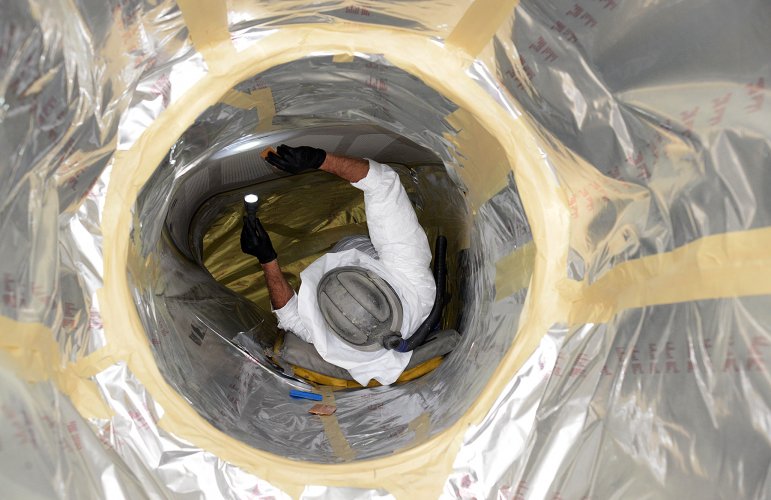
Yep, that looks like a left hand intake. It transitions from the trapezoid shape to round at the front of the engine, going up and inward over the side weapons bay. It is very slippery, and a bitch to get enough traction to climb over the hump while wearing the protective bunny suit. Fun sliding out, just have to tilt your head to keep from bumping it against the inner side.
 
Yep, that looks like a left hand intake. It transitions from the trapezoid shape to round at the front of the engine, going up and inward over the side weapons bay. It is very slippery, and a bitch to get enough traction to climb over the hump while wearing the protective bunny suit. Fun sliding out, just have to tilt your head to keep from bumping it against the inner side.
It must be a little disconcerting with completely disappearing in there. Imagine someone not knowing you were in the inlet and they go to start the engine!

On the other hand, perfect place to hide from the senior leadership.
 
They'd hopefully also notice the missing tools before starting
At least in the USAF, all tools on the flightline and in the back shops are part of inventoried Combined Tool Kits (CTK). Empty pockets rule to enter the inlet, with only CTK tools (flashlight, blade blending files, etc). No engine start until the CTKs are inventoried and closed as part of the pre-run checklist.

Flashlights and the old paper forms have been ingested in the past, with ugly results for the engine, and disciplinary actions against any of the troops who didn’t follow the explicit rules.
 
I assumed this is the case for the USAF as with most/hopefully all operators.*
What kind of damage are we talking about with paper forms?

* The Boeing Company doesn't count.
 
Prior to the F-22, USAF aircraft forms consisted of a series of 781 documents on a tabbed looseleaf binder. That binder has been known to to end up on top of the F16 intake, in the splitter gap under the fuselage, then getting sucked into the intake during the engine run.

I believe most USAF aircraft forms have transitioned into electronic format in a portable laptop computer
 
I assumed this is the case for the USAF as with most/hopefully all operators.*
What kind of damage are we talking about with paper forms?
It's not so much the paper forms, it's the binder or clipboard they're attached to.

A single 3/8" (~9.5mm) bolt will completely destroy a jet engine. A few rivets (~4mm) will destroy a jet engine. The spring clamp in a clipboard will destroy a jet engine.

If you're lucky, the damage is only to the blades, and not to the shaft or case. IIRC shaft damage is unusual unless you get a severe out-of-balance condition. Case damage happens when the blades break close to their base and centrifugal force throws 8" or more of steel or titanium out the case.

It's a Kessler effect inside the engine, as each broken blade travels deeper into the engine and causes secondary breakages, which cause tertiary breakages. All the way through the compressor and out the turbines.
 
It is very slippery, and a bitch to get enough traction to climb over the hump while wearing the protective bunny suit. Fun sliding out, just have to tilt your head to keep from bumping it against the inner side.
Slippery because of the plastic looking drop cloth as in the pic?
The protective suit was to protect you or the inlet, coatings, engine!
 
Couldn't it be possible to apply the coating used on the F-35 to the F-22?

It seems to be rather sturdy, given it was also developed with naval and international use in mind. And given the quantities in which it has to be produced it may be cheaper?

Could be an option for an MLU when the fleet gets an in depth overhaul anyway.
A common misunderstanding about stealth is that it's comprised of 2 straightforward and distinct steps: 1) general outer shaping like smooth semi-faceted surfaces with edge alignments and 2) a stealth coating that wraps around the aircraft.

There are alot more to different techniques employed in rcs reduction. Many of these techniques/features work in tandem to one another to achieve the desired rcs reduction. Without one, the other wouldn't make sense.

The f-22 made alot of advancement in other techniques, structural in nature outside of RAM. This resulted in a reduction in RAM usage in typical spots that were needed for the f-117. Similar advancement was made going from the f-22 to f-35. The coating therefore work in tandem with these techniques that were developed, many are unique to each aircraft. Therefore, it's not suitable to just 'wrap' the f-22 in the f-35's coating.
 
In-theory I think you could include the F-35's all-around "better" stealth coating/outer layer on rebuilt or new-build F-22s. It would just be a much more significant (and costly) process than what somebody might think it to be. To get the most improvement possible requires the most redesign work.

The low-cost option would probably be just to make whatever improvements are possible to the existing type of coating/outer layer used on the F-22 and use that when they are overhauled. But that obviously won't be nearly as much of an upgrade. Short of some unlikely situation that results in new F-22 production I'd expect to see them follow the low-cost route.
 
In-theory I think you could include the F-35's all-around "better" stealth coating/outer layer on rebuilt or new-build F-22s. It would just be a much more significant (and costly) process than what somebody might think it to be. To get the most improvement possible requires the most redesign work.

The low-cost option would probably be just to make whatever improvements are possible to the existing type of coating/outer layer used on the F-22 and use that when they are overhauled. But that obviously won't be nearly as much of an upgrade. Short of some unlikely situation that results in new F-22 production I'd expect to see them follow the low-cost route.

Many of the basic, regular maintenance tasks on the F-22 require removal and reapplication of coatings. This is labor intensive. The F-22 coatings also degrade due to features of the F-22 design.

"F-35 RAM" is not going to solve these problems.

The F-35 was designed to make access to the inside of the aircraft easier and require less messing with the coatings. That can't be retrofitted to the F-22. The F-35 also has a fundamentally different coating stack because the structure was designed differently.
 
Many of the basic, regular maintenance tasks on the F-22 require removal and reapplication of coatings. This is labor intensive. The F-22 coatings also degrade due to features of the F-22 design.

"F-35 RAM" is not going to solve these problems.

The F-35 was designed to make access to the inside of the aircraft easier and require less messing with the coatings. That can't be retrofitted to the F-22. The F-35 also has a fundamentally different coating stack because the structure was designed differently.
Which is why I said new-build or rebuilt aircraft. You'd need to account for access to all the maintenance hatches and such, basically a whole lot of work to implement the new coatings properly.

It would really only be possible if they had chosen to restart F-22 production knowing all the costs that would entail. And when I say rebuild, I mean along the lines of the sort of rebuild they must have done when F-14As were converted into F-14Ds. Pretty much taking the whole aircraft apart and working from there.
 
Last edited:
So, what exactly was the F-22B proposal for Japan back in the day? Everything I read about it said it was using F-35 tech.
Idk what the advertisement lockheed fed the japanese during that time was, but if it was akin to something that just roll off of existing f-22 line then a final paint job over at f-35 line it, it would have been BS.
 
The F-35 was designed to make access to the inside of the aircraft easier and require less messing with the coatings. That can't be retrofitted to the F-22. The F-35 also has a fundamentally different coating stack because the structure was designed differently.
keyword. There is a popular misconception that think the 'coating' part in true VLO aircraft's coating is just a single layer akin to a paintjob that simply and interchangably can be applied to any aircraft.
 
Idk what the advertisement lockheed fed the japanese during that time was, but if it was akin to something that just roll off of existing f-22 line then a final paint job over at f-35 line it, it would have been BS.
No, it was described as being a pretty serious modification. IIRC F-35 mission systems and possibly radar. F-35 stealth.
 
No, it was described as being a pretty serious modification. IIRC F-35 mission systems and possibly radar. F-35 stealth.
Besides that being a new aircraft Lockheed probably meant some of the lessons learnt from developing the f-35 stealth would benefit this new f-22 rather than actual f-35’s stealth features/coating interchangeable with f-22
 
F-14As were converted into F-14Ds
The changes from the A-model (really YF-14s) to the B/D standards would be minuscule comparing to what we're seeing people proposing here: at least a major portion of the internal structure would be re-designed from the ground up to accomodate the new loads and RAS, entire patches of skin would be different and so on to conform to strict electrical properties, changes that would entail a far more costly and labor intensive endeavor than what Grumman were doing to Tomcats.
 

Similar threads

Back
Top Bottom