Mako was the SiAW losing bid. It might get picked up in the future, given the recent RFI related to SiAW, but there is no contract for it. And I highly doubt it would ever be integrated with F-22; those aircraft will have better things to do.

You are using an out of date browser. It may not display this or other websites correctly.
You should upgrade or use an alternative browser.
You should upgrade or use an alternative browser.
Lockheed Martin F-22 Raptor
- Thread starter flateric
- Start date

EmoBirb
ACCESS: Top Secret
- Joined
- 18 January 2025
- Messages
- 2,750
- Reaction score
- 7,030
You could have saved a couple of lines and just say it's yet another case of Lockheed vaporwareThe missile was unveiled in April 2024 at the Navy League’s Sea Air Space exposition in Maryland, with Lockheed Martin pitching it to both the U.S. Navy and Air Force. It has also been considered for deployment on submarines and surface warships
missile_man
ACCESS: Confidential
- Joined
- 17 October 2024
- Messages
- 108
- Reaction score
- 203
Just compiled it from LM and aerospace sources.Where is this from? This is very interesting. Was surprised to see new displays and Mako integration. Would have liked to see a updated APG-77 w/ GaN TR modules but I'm guessing that would be too pricey to develop for a small fleet.
I work for LM Missiles and Fire Control, but have insight on what's happening at LM Aeronautics.
I copy/pasted

- Joined
- 3 June 2011
- Messages
- 21,056
- Reaction score
- 19,413
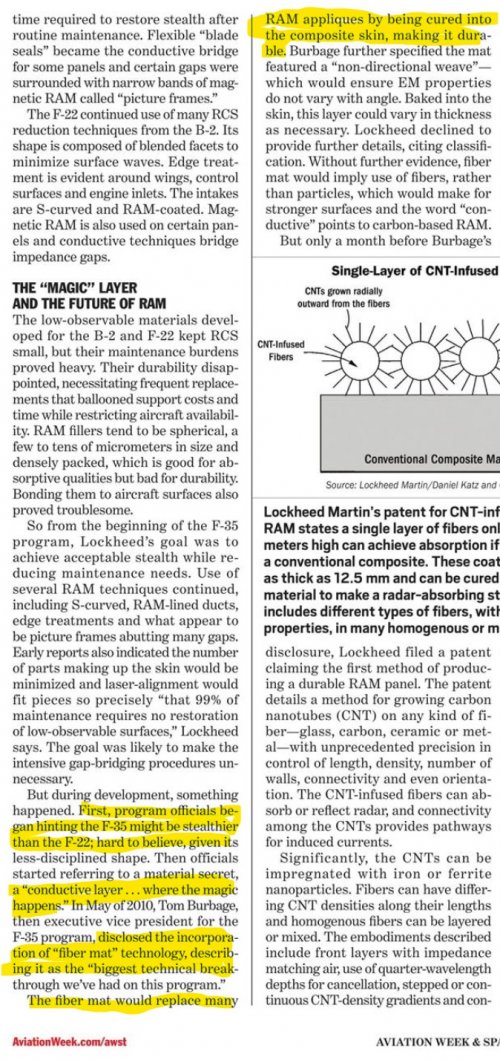
If it's baked into the skins how are you going to do that? Strip an F-22 down to its bare frame and reskin it?I would have thought that LM would have to update the Low Observable coatings on the F-22, I take it that the coatings would come from the F-35? Or even newer LO coatings.
missile_man
ACCESS: Confidential
- Joined
- 17 October 2024
- Messages
- 108
- Reaction score
- 203
Yeah, the Mako development was partially funded through incentives by the Air Force. It was not selected for production but it is a working weapon.Mako was the SiAW losing bid. It might get picked up in the future, given the recent RFI related to SiAW, but there is no contract for it. And I highly doubt it would ever be integrated with F-22; those aircraft will have better things to do.
LM is pursuing other buyers, both domestic and FMS, as a cost savings alternative to more expensive compact missiles.
I see it as just another tool in the toolbox.
missile_man
ACCESS: Confidential
- Joined
- 17 October 2024
- Messages
- 108
- Reaction score
- 203
If it's baked into the skins how are you going to do that? Strip an F-22 down to its bare frame and reskin it?
There is way too much secrecy with US stealth coatings. Everything you find online is 100% speculation.
- Joined
- 3 June 2011
- Messages
- 21,056
- Reaction score
- 19,413
It was in AW&ST years ago.There is way too much secrecy with US stealth coatings. Everything you find online is 100% speculation.
missile_man
ACCESS: Confidential
- Joined
- 17 October 2024
- Messages
- 108
- Reaction score
- 203
The secrets to US stealth technology was in AWST?It was in AW&ST years ago.
- Joined
- 3 June 2011
- Messages
- 21,056
- Reaction score
- 19,413
That some of F-35 stealth was more durable because it was part of the laminate instead of applied after the fact.The secrets to US stealth technology was in AWST?
Attachments

- Joined
- 6 August 2007
- Messages
- 4,549
- Reaction score
- 10,318
It was in AW&ST years ago.
“Fiber mat” is not primarily an absorber material. It is reflective. RAM still goes on top of it.

Reddington777
ACCESS: Top Secret
- Joined
- 23 March 2025
- Messages
- 868
- Reaction score
- 2,928
Why are there no significant upgrades for the APG-77? Better T/R modules? GaN?
missile_man
ACCESS: Confidential
- Joined
- 17 October 2024
- Messages
- 108
- Reaction score
- 203
I certainly don't doubt the durability. I do know the secrecy around our stealth tech is classified at the highest level, not just for aircraft, but our missiles, too, like the LRASM. It's all closed room manufacturing.That some of F-35 stealth was more durable because it was part of the laminate instead of applied after the fact.
novabus_lfx
ACCESS: Restricted
- Joined
- 2 August 2025
- Messages
- 17
- Reaction score
- 56
The F-35 fleet grows and is seeing constant tweaking and updates. The F-47 might enter service in the early 2030s, yes. And now what do you think could happen in 5-6 years that could not be handled by hundreds of F-35s, supported by everything else in the AF, including the aging F-22s?
The bare minimum to keep the Raptors in good condition and in readiness should on paper be enough. But these programs, which take plenty of funding, seem rather odd for an aircraft that's more or less nearing the end of it's frontline service life. Perhaps the USAF isn't confident in the F-47 timeline and/or it's projected capabilities. Because otherwise investing is a low fleet size, low availability, high operating cost maintenance hog seems paradoxical.
I hope that made it a bit clearer on why I find this all very strange (aside from the obvious thing about having external payloads on a stealth aircraft, payloads not meant to be dropped off).
Those are certainly fair points but I think a lot of this can be explained by the issues with the F-35 program. LM owns the entire IP of the F-35 and most of its systems are completely proprietary. This means that any maintenance, weapons integration, and upgrades can only be done through LM, who constantly go far over budget and fall way behind schedule.
To put it in perspective, the projected lifetime cost of the F-35 program is now over $2 trillion, preventing a sufficient number of F-35s from being acquired and forcing older aircraft to stay in service for longer. Additionally, the TR-3/Block 4 upgrades will be at least 3 years late, the F-35's mission capable rate is only 50% (17% below the minimum performance requirement), and its inherent design is compromised due to the STOVL/small size requirements. The USAF has described the F-35 program as "acquisition malpractice" and I suspect that is why LM lost NGAD, CCA, and F/A-XX.
On the other hand, the USAF owns the IP of the F-22, many of its systems can be shared with other US aircraft, and its airframe has an 8000 hr service life. None of the airframes have exceeded 4000 hrs and their operating conditions are gentler than what was anticipated during the Cold War, so the airframes can probably last from 12,000-15,000 hrs with minor upgrades, which is why the USAF intends to keep them in service until 2060.
The Raptor 2.0 upgrades cost $8 billion and since the F-22s will be around for 34 more years, I really think they should upgrade the 32 non-combat coded airframes to Raptor 2.0 spec as well, which would cost ~$5.3 billion. That is peanuts by US MIC standards, especially since it would provide the USAF with 185 5.5 gen fighters that have the range to loiter over the First Island Chain while remaining stealthy. The F-22 will also be the first fighter to control CCAs, making it especially deadly.
In any case, there's no sense in getting rid of the capability that the F-22 provides until the end of its service life, as risk reduction for NGAD and the F-35 upgrades. Even if the USAF doesn't invest in a single F-22 upgrade after Raptor 2.0, it would still be the deadliest fighter in the sky outside of NGAD and maybe the Chinese 6th gens. The F-35 probably has a better sensor suite than the F-22 but the latter still has a lower RCS and bigger radar aperture, flies faster and higher so it can launch missiles further, and is more maneuverable. Interestingly enough, the F-35 and F-22 both generate the same amount of electricity but the F-22 probably has better growth margins for both electricity generation and cooling since it has 2 engines and is bigger, respectively.
Edited from "both electricity generation and cooling since it is bigger and has 2 engines" to clarify the causation between each.
Last edited:

https://www.prnewswire.com/news-rel...-software-delivery-on-the-f-22-302716831.html
EDWARDS AFB, Calif., March 18, 2026 /PRNewswire/ -- Defense Unicorns, the Airgap Software Company, in partnership with the Air Force Sustainment Center Software Directorate, successfully demonstrated a key enabler for continuous software delivery to the F-22 Raptor. For the first time, software in the F-22 open mission system compute enclave was installed and upgraded on the aircraft in a matter of minutes. When operationalized, this will help enable rapid deployment of new capabilities across the fleet. This demonstration lays the groundwork to enable future Air Force personnel, including pilots and maintainers, to update software capabilities within an Open Mission Systems (OMS) computing environment on the aircraft.
Defense Unicorns' Unicorn Delivery Service (UDS) helps make deploying modern software to military systems, like the F-22, simple and secure. Trusted by software teams across the Department of War, UDS enables warfighters to deploy approved software to open mission enclaves within their mission systems. In the future, this technology will enable pilots to update software on their aircraft, ensuring they take off for every mission with the latest software capabilities.
"UDS enabled the rapid deployment of a critical capability and the flexibility to adjust," said Lt Col Gregory "LAB" Bieler, Materiel Leader Software, Autonomy & Teaming.
The F-22 now joins several other DoW aircraft demonstrating the efficacy of UDS. The product's open, modular design and use of commercial standards is helping enable Raptor to field a government owned open compute environment, orchestrating commercial and government software. UDS also enables loading of portable software payloads allowing software capabilities developed for the F-22 open compute environment to be readily installed on other fourth, fifth, and sixth-generation aircraft with compatible compute environments and integration efforts.
"For decades, getting new software onto a fighter jet meant months of integration work and dependency on the OEM," said Rob Slaughter, co-founder and CEO of Defense Unicorns. "With UDS, the F-22 can receive software updates in minutes, on demand, at the edge. Future wars will be won by whoever can adapt fastest. This demonstration proves the U.S. Air Force is building that advantage now."
Capabilities such as UDS are advancing the F-22's combat effectiveness by creating a pathway for the Air Force to independently accelerate software development and insertion for specific onboard systems. This approach complements the significant, parallel modernization efforts being led by the OEM, together ensuring the F-22 weapon system has the latest capabilities to dominate the battlespace.
About Defense Unicorns
Defense Unicorns is a service-disabled, veteran-owned defense technology company founded in 2021 to make software a strategic deterrent for the U.S. Department of War. The company builds open-source, airgap-native technologies that enable the secure development, delivery, and sustainment of mission software across cloud, on-premises, and tactical edge environments. Defense Unicorns' technology is trusted by the operators of some of the most critical systems in the world, including the U.S. Navy, Army, Air Force, and Space Force.
SOURCE Defense Unicorns
The long pole in the tent for the F-22 has always been sustainment costs. The CPFH across the fleet has consistently been high due to the small fleet size and the inherent stealth design. Since air superiority is tied to the mission and not a specific platform, likely once the NGAD/F-47 becomes operational in adequate numbers, the F-22 will probably be phased out accordingly while maintaining adequate fleet size of air superiority fighters.On the other hand, the USAF owns the IP of the F-22, many of its systems can be shared with other US aircraft, and its airframe has an 8000 hr service life. None of the airframes have exceeded 4000 hrs and their operating conditions are gentler than what was anticipated during the Cold War, so the airframes can probably last from 12,000-15,000 hrs with minor upgrades, which is why the USAF intends to keep them in service until 2060.
The Raptor 2.0 upgrades cost $8 billion and since the F-22s will be around for 34 more years, I really think they should upgrade the 32 non-combat coded airframes to Raptor 2.0 spec as well, which would cost ~$5.3 billion. That is peanuts by US MIC standards, especially since it would provide the USAF with 185 5.5 gen fighters that have the range to loiter over the First Island Chain while remaining stealthy. The F-22 will also be the first fighter to control CCAs, making it especially deadly.
That being said, given USAF's longstanding post-Cold War force structure requirements for ~400 air superiority fighters, I wouldn't be surprised if the Block 30/35 F-22 fleet is retained for a while longer even after the F-47 becomes operational in numbers, until an "Increment 2" NGAD is procured and operational beyond the currently planned 185.
"Raptor 2.0" is a cool-sounding brand, but in many ways it's also somewhat of a compromise given the budget and timeline pressures. Ideally, the F-22 should have had an internal IRST system, but such an upgrade now is likely too expensive and lengthy to develop, while USAF wants that capability as soon as possible, hence the current solution. Similarly, the more ideal method for increasing fuel IMO is to reactivate the fin and saddle tanks within the airframe, but those levels of modifications and associated flight testing are likely considered cost-prohibitive. A big part of this is the F-22 production being curtailed so drastically to just 195 airframes (187 operational ones).
- Joined
- 15 January 2021
- Messages
- 659
- Reaction score
- 2,913
I wouldn’t be too sure about the cooling capacity of 2x F119 engines vs one F135. The F119 core is aerodynamically very similar to the F135 core, so the bleed air capacity would only be 2x the original F135 specification, not the overdrawn bleed flow that the F-35 is currently demanding. And the F119 does not have the bleed air and ECS heat exchangers located within the fan ducts like the F135. The increased fuel flow of the 2x F119 is not a player, since both engine have the capability to control fuel flow thru heat exchangers independently of engine burn flow, bypassing the excess flow back to the fuel tanks.Interestingly enough, the F-35 and F-22 both generate the same amount of electricity but the F-22 probably has better growth margins for both electricity generationa and cooling since it is bigger and has 2 engines.
novabus_lfx
ACCESS: Restricted
- Joined
- 2 August 2025
- Messages
- 17
- Reaction score
- 56
Apologies for the confusion, I meant to say "the F-22 probably has better growth margins for both electricity generation and cooling since it has 2 engines and is bigger, respectively" i.e. it has better cooling because it is bigger rather than because it has 2 engines.I wouldn’t be too sure about the cooling capacity of 2x F119 engines vs one F135. The F119 core is aerodynamically very similar to the F135 core, so the bleed air capacity would only be 2x the original F135 specification, not the overdrawn bleed flow that the F-35 is currently demanding. And the F119 does not have the bleed air and ECS heat exchangers located within the fan ducts like the F135. The increased fuel flow of the 2x F119 is not a player, since both engine have the capability to control fuel flow thru heat exchangers independently of engine burn flow, bypassing the excess flow back to the fuel tanks.
Correct me if I'm mistaken but my understanding is that some of the cooling lines in the F-35 were forced to go through structural bulkheads to meet the STOVL/small size requirements. As such, those cooling lines could not be widened to increase the flow rate without compromising those structural bulkheads. It stands to reason that a bigger aircraft like the F-22 would not have those issues.
In any case, the Block 3F F-35 has 32 kW of cooling capacity and Block 4/5 are aiming for 62-80 kW of cooling capacity, while the F-22 has 68 kW of cooling capacity. I suspect that the cooling capacity of the F-22 could be increased relatively easily by the aforementioned widening of cooling lines, especially now that the semipermanent fuel tanks allow more fuel to be used to dissipate the heat. On the other hand, increasing the cooling capacity of the F-35 seems to require much more extensive engineering to increase the available bypass/bleed air, although you would certainly know better than me.
Thanks for your input! Your posts are always so informative and are some of my favourite on this forum.
Last edited:
EmoBirb
ACCESS: Top Secret
- Joined
- 18 January 2025
- Messages
- 2,750
- Reaction score
- 7,030
That seems highly optimistic. Not because it's impossible, but because far more reasonable programs have met the chopping block for less.so the airframes can probably last from 12,000-15,000 hrs with minor upgrades, which is why the USAF intends to keep them in service until 2060.
I'm unsure if that's truly feasible with these specific airframes. It's certainly doubtful that the upgraded F-22 fleet will include all airframes produced.I really think they should upgrade the 32 non-combat coded airframes to Raptor 2.0 spec as well
In the USAF, maybe. Otherwise that ship already sailed in the far east.The F-22 will also be the first fighter to control CCA
A lot of this comes down to available internal volume and packaging. Just because the F-22 is physically larger doesn't mean it has more avilaible volume to utilize. While we know the F-35 is packed inside, so is the F-22 according to various people. Thus major cooling improvments would require avilaible space. And given that they opted to hang huge, non disposable, sensor pods off an supposedly low observable aircraft, I doubt there's a lot of internal real estate to work with.Interestingly enough, the F-35 and F-22 both generate the same amount of electricity but the F-22 probably has better growth margins for both electricity generation and cooling since it has 2 engines and is bigger.
In the USAF, maybe. Otherwise that ship already sailed in the far east.
Which aircraft in the far east controls CCAs?
novabus_lfx
ACCESS: Restricted
- Joined
- 2 August 2025
- Messages
- 17
- Reaction score
- 56
In any case, they should still keep the F-22s to the end of their service life. A high, medium, and low mix of NGAD, F-22/F-35, and CCA/4th gen seems like a prudent combination, especially when the "medium" part still steamrolls every country not named China.That seems highly optimistic. Not because it's impossible, but because far more reasonable programs have met the chopping block for less.
I'm unsure if that's truly feasible with these specific airframes. It's certainly doubtful that the upgraded F-22 fleet will include all airframes produced.
In the USAF, maybe. Otherwise that ship already sailed in the far east.
A lot of this comes down to available internal volume and packaging. Just because the F-22 is physically larger doesn't mean it has more avilaible volume to utilize. While we know the F-35 is packed inside, so is the F-22 according to various people. Thus major cooling improvments would require avilaible space. And given that they opted to hang huge, non disposable, sensor pods off an supposedly low observable aircraft, I doubt there's a lot of internal real estate to work with.
If the Pentagon's budget increases to even a fraction of what they say it will, I'm sure they'll be able to find $5.3 billion (make it $10.6 billion just to be safe since it's LM) from under the couch cushions.
Source? I haven't seen any videos of J-20S with CCA, just GJ-11 flying alongside a regular J-20 and J-16, which doesn't really indicate anything. Also, we really ought to be wary of any military developments coming out of China since they don't have free press, so who knows how good the PLA actually is. I'm not even sure Xi knows the answer to that, but it is prudent to prepare for them to be as good, if not better, than they claim.
Those are fair points but I've never really heard of any cooling controversies for the F-22, whereas I can't stop hearing about them for the F-35. Ultimately, the F-35 is expected to basically double its cooling capacity from 32 kW now to 62-80 kW for Block 4, which is at least 3 years late. On the other hand, the F-22 has been at 68 kW since the beginning and would only need to add 12 kW to match the best case scenario for the F-35. Given LM's track record, I honestly wouldn't be surprised if F-35 Block 4 is still delivered with less than the 68 kW cooling capacity of the F-22.
Last edited:
novabus_lfx
ACCESS: Restricted
- Joined
- 2 August 2025
- Messages
- 17
- Reaction score
- 56
Great analysis, I certainly hope you are correct that the USAF will keep ~400 air superiority fighters since we are basically in a 2nd Cold War now, albeit with a more advanced foe that requires us to overcome the tyranny of distance.The long pole in the tent for the F-22 has always been sustainment costs. The CPFH across the fleet has consistently been high due to the small fleet size and the inherent stealth design. Since air superiority is tied to the mission and not a specific platform, likely once the NGAD/F-47 becomes operational in adequate numbers, the F-22 will probably be phased out accordingly while maintaining adequate fleet size of air superiority fighters.
That being said, given USAF's longstanding post-Cold War force structure requirements for ~400 air superiority fighters, I wouldn't be surprised if the Block 30/35 F-22 fleet is retained for a while longer even after the F-47 becomes operational in numbers, until an "Increment 2" NGAD is procured and operational beyond the currently planned 185.
"Raptor 2.0" is a cool-sounding brand, but in many ways it's also somewhat of a compromise given the budget and timeline pressures. Ideally, the F-22 should have had an internal IRST system, but such an upgrade now is likely too expensive and lengthy to develop, while USAF wants that capability as soon as possible, hence the current solution. Similarly, the more ideal method for increasing fuel IMO is to reactivate the fin and saddle tanks within the airframe, but those levels of modifications and associated flight testing are likely considered cost-prohibitive. A big part of this is the F-22 production being curtailed so drastically to just 195 airframes (187 operational ones).
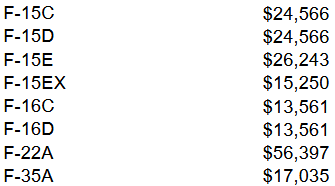
I've attached the 2025 CPFH for several USAF fighters below, for reference. When it comes to capability per dollar i.e. "value", I still think the F-22 is more or less unrivalled despite its high CPFH.
If you were to put the F-22 up against 5 F-16s or 4 F-15 EXs (so that the CPFH is roughly the same), the F-22 would still shoot all of them down, as demonstrated by Red Flag. Admittedly, 3 F-35s would probably shoot down an F-22 but that's hardly a knock since the F-35 is excellent in its own right. Nonetheless, the F-22 would still be able to dictate the terms of the engagement i.e. run since it is faster, more manoeuvrable, flies higher, and has more range with the 2.0 upgrade, although I'd be shocked if Lockheed doesn't give stealthy fuel tanks to the F-35 as well.
Where the F-22 would really excel is in a potential Taiwan conflict, which most analysts predict will happen between now and 2030, preventing NGAD from being available in meaningful numbers. China probably has longer range air to air missiles, given their massive size, and although AIM-260 should be able to make up some of the difference, it will probably need to be stored internally and lofted at max. altitude and speed to reliably kill HVTs such as AWACS, bombers, and ASW aircraft without endangering the shooter.
I can't think of a single platform with that capability besides the F-22. F-35 can't fly that high or go that fast and maybeee AIM-174B could be integrated into the B2/B-21 or F-15 EX, but the former are probably too slow/expensive to risk and the latter is too unstealthy. Either way, if the F-22 can take out a significant number of their AWACS or ASW aircraft, China would be screwed. No AWACS means no OTH radar coverage, making their ships extremely vulnerable to sea skimmers, and no ASW means SSNs run rampant around Taiwan and sink everything in sight.
If the F-22 could achieve that, it would be the bargain of the century. Similarly, if China decides against invading Taiwan, in part due to the F-22s, that would also be a huge bargain. However, if the US doesn't intervene or neglects its military to the point that it can't stop an invasion, giving its biggest geopolitical rival access to the most advanced chips when so much of our economic growth is centered around AI, that would be the end of Western hegemony and all the rights/freedoms it entails. In that case, "saving" on CPFH by divesting the F22s would have unimaginably expensive consequences, so I guess it's all just a matter of perspective.
Regardless, I think we can all agree that hopefully Xi isn't as impetuous as Vlad and only tries to take Taiwan using soft power, so that the death of millions can be prevented.
Last edited:
J-20S
Do we know for a fact it controls CCAs in an operational capacity? Or even a testing capacity?

Tomboy
ACCESS: Top Secret
- Joined
- 4 January 2025
- Messages
- 545
- Reaction score
- 1,974
Do we know for a fact it controls CCAs in an operational capacity? Or even a testing capacity?
Not only implied but directly stated that J-20S is specifically meant to do manned/unmanned pairing operationally, J-20A may also have such abilities but to a lesser degree given that it is mostly referred to a "single seat version of J-20S".
Attachments

Last edited by a moderator:
EmoBirb
ACCESS: Top Secret
- Joined
- 18 January 2025
- Messages
- 2,750
- Reaction score
- 7,030
Keeping the aircraft until their service life ends is obviously to be advised. What I questioned the whole time was being overly invested in it. When a superior platform is around the corner and a more versatile and numerous platform already in service. That's the initial point I made. Not to mention that no amount of airpower let's you steamroll any sizeable country, no matter which one. Something we're seeing currently.In any case, they should still keep the F-22s to the end of their service life. A high, medium, and low mix of NGAD, F-22/F-35, and CCA/4th gen seems like a prudent combination, especially when the "medium" part still steamrolls every country not named China.
You can visit the SDF for a more in-depth look on the matter, it's either in the J-20 thread or the UAV thread. Either way, GJ-11 is in active service, the only aircraft of it's kind to be in that stage already, and it demonstrated the ability to operate with the J-20, the J-16 and is stated to be interoperable with the J-20A and J-20S. There's little reason to have a loyal wingman in large scale service, soon to be adapted by the Navy even, when you can't utilize it in it's intended role. Now pair that with the general lead on unmanned systems China enjoys internationally and it's clear that they already have that one in the bag. With things like Anka-3, S-70, YFQ-42A etc. trailing behind. Also while the media is state controlled, the people aren't. PLA watching relies less on state media reports as is common in the western sphere and more on trusted individuals who have demonstrated a good track record with regards to their claims and predictions. So while the GJ-11 is right now in active service, any US equivalent is still years away from being inducted into service, this should be a red flag to the first-to-CCA ambitions from Washington.Source? I haven't seen any videos of J-20S with CCA, just GJ-11 flying alongside a regular J-20 and J-16, which doesn't really indicate anything. Also, we really ought to be wary of any military developments coming out of China since they don't have free press, so who knows how good the PLA actually is. I'm not even sure Xi knows the answer to that, but it is prudent to prepare for them to be as good, if not better, than they claim.
Which is a fair point on your side as well. But it's worth keeping in mind that the F-35, from day one, has been running a far more intensive sensor and avionics suite. It's stuffed with more things that need plenty of cooling capacity. So naturally it's a big issue that's being discussed. The F-22s systems aren't as the extensive or it's sensor suite as broad as the F-35s, so cooling has yet been not a major factor. But as soon as you'd start to add things internally, which they deliberately avoided, you'd run into similar issues regarding packaging. So yes, it hasn't been much of a concern with the F-22 so far, but that's for a specific reason.Those are fair points but I've never really heard of any cooling controversies for the F-22, whereas I can't stop hearing about them for the F-35.
zebra159357
I really should change my personal text
- Joined
- 30 November 2018
- Messages
- 157
- Reaction score
- 543
The service has been clear, that the modernization program of the F-22 plays a role in bridging the gap for 6th gen arrival. One aspect is extending the Raptor fleet's potency against emerging threats, the other is prototyping and streamlining the open (software) systems architecture & manned-unmanned teaming.Keeping the aircraft until their service life ends is obviously to be advised. What I questioned the whole time was being overly invested in it. When a superior platform is around the corner and a more versatile and numerous platform already in service. That's the initial point I made. Not to mention that no amount of airpower let's you steamroll any sizeable country, no matter which one. Something we're seeing currently.
Realistically, it will take at least 15 years until F-47 is operational in relevant numbers to warrant the divestment of the Raptor fleet, so you are still looking at roughly 20+ years of expected service for F-22s.
EmoBirb
ACCESS: Top Secret
- Joined
- 18 January 2025
- Messages
- 2,750
- Reaction score
- 7,030
I know the proposed plan and reasoning. I just still find it odd and that's why I pointed it out. Because ultimately, with small fleet size and limited availability, in any peer conflict, the impact of the F-22s would be marginal at best. So it's nice when the F-22s that are in service are more capable, but ultimately it's not truly relevant when compared to...(checks notes)...around 500 J-20 (+J-20A and J-20S from now on).The service has been clear, that the modernization program of the F-22 plays a role in bridging the gap for 6th gen arrival. One aspect is extending the Raptor fleet's potency against emerging threats, the other is prototyping and streamlining the open (software) systems architecture & manned-unmanned teaming.
Realistically, it will take at least 15 years until F-47 is operational in relevant numbers to warrant the divestment of the Raptor fleet, so you are still looking at roughly 20+ years of expected service for F-22s.
And in non-peer conflicts the F-22 is second fiddle at best to F-35 and the various other strike focused aircraft in USAF service. Which are more than capable to sling AMRAAMs and derelict MiGs and other mid to late cold war era aircraft.
Not only implied but directly stated that J-20S is specifically meant to do manned/unmanned pairing operationally, J-20A may also have such abilities but to a lesser degree given that it is mostly referred to a "single seat version of J-20S".
I am sure that is its intended role. Is there any evidence it has done so? Are there units organized around UAVs and J-20S already?
Many have pointed out the F-15EX has a back seater that could control drones, but so far there is no UAV force to pair it with.
If we are talking about testing environments, I believe F-35s and F-16s have already controlled CCA types before and I would suspect Chinese efforts along the same lines predate J-20S.
Tomboy
ACCESS: Top Secret
- Joined
- 4 January 2025
- Messages
- 545
- Reaction score
- 1,974
View: https://imgur.com/Cy8Nmn7I am sure that is its intended role. Is there any evidence it has done so? Are there units organized around UAVs and J-20S already?
Many have pointed out the F-15EX has a back seater that could control drones, but so far there is no UAV force to pair it with.
If we are talking about testing environments, I believe F-35s and F-16s have already controlled CCA types before and I would suspect Chinese efforts along the same lines predate J-20S.
J-20(A or S?) was seen with a GJ-11 trailing behind in the wild last year after GJ-11 was announced to be in service, GJ-11 has also been spotted with more and more frequently. So there should atleast be one operational unit with mixed basing for drones and manned fighters, likely to further expand as GJ-11 production ramp up this year.
View: https://imgur.com/Cy8Nmn7
J-20(A or S?) was seen with a GJ-11 trailing behind in the wild last year after GJ-11 was announced to be in service, GJ-11 has also been spotted with more and more frequently. So there should atleast be one operational unit with mixed basing for drones and manned fighters, likely to further expand as GJ-11 production ramp up this year.
Was this sighted near an operational fight base? Basically, what I believe is that the U.S. and China have tested CCAs with fighters; in the U.S. case with at least a couple that are not F-22. But I do not think either has operational combat units functioning as such. So while the statement about tthe F-22 being the first CCA compatible aircraft is incorrect from a testing point of view for either country, it still is possible it might be in an operational sense. The idea that J-20S has somehow jumped in front of US F-22 CCA efforts seems only accurate if it and CCAs it controls have entered IOC.
novabus_lfx
ACCESS: Restricted
- Joined
- 2 August 2025
- Messages
- 17
- Reaction score
- 56
That is certainly fair, I guess you are more bullish on NGAD and F-35 than I am. I meant "steamroll" as in establishing air superiority, not necessarily overthrowing their government.Keeping the aircraft until their service life ends is obviously to be advised. What I questioned the whole time was being overly invested in it. When a superior platform is around the corner and a more versatile and numerous platform already in service. That's the initial point I made. Not to mention that no amount of airpower let's you steamroll any sizeable country, no matter which one. Something we're seeing currently.
You can visit the SDF for a more in-depth look on the matter, it's either in the J-20 thread or the UAV thread. Either way, GJ-11 is in active service, the only aircraft of it's kind to be in that stage already, and it demonstrated the ability to operate with the J-20, the J-16 and is stated to be interoperable with the J-20A and J-20S. There's little reason to have a loyal wingman in large scale service, soon to be adapted by the Navy even, when you can't utilize it in it's intended role. Now pair that with the general lead on unmanned systems China enjoys internationally and it's clear that they already have that one in the bag. With things like Anka-3, S-70, YFQ-42A etc. trailing behind. Also while the media is state controlled, the people aren't. PLA watching relies less on state media reports as is common in the western sphere and more on trusted individuals who have demonstrated a good track record with regards to their claims and predictions. So while the GJ-11 is right now in active service, any US equivalent is still years away from being inducted into service, this should be a red flag to the first-to-CCA ambitions from Washington.
Which is a fair point on your side as well. But it's worth keeping in mind that the F-35, from day one, has been running a far more intensive sensor and avionics suite. It's stuffed with more things that need plenty of cooling capacity. So naturally it's a big issue that's being discussed. The F-22s systems aren't as the extensive or it's sensor suite as broad as the F-35s, so cooling has yet been not a major factor. But as soon as you'd start to add things internally, which they deliberately avoided, you'd run into similar issues regarding packaging. So yes, it hasn't been much of a concern with the F-22 so far, but that's for a specific reason.
For NGAD specifically, I just read that it will probably be delayed to the mid 2030s, which seems to answer your question about why the USAF is investing so much into the F-22. They already had to pause it from July 2024 to March 2025 to reevaluate the requirements, it probably has more technical risk (new engines, airframe configuration, and control strategies) compared to something like the B-21, and is heavily associated with the current administration, which has been quite polarizing to say the least.
https://www.airandspaceforces.com/f-47-air-force-mid-2030s-top-lawmaker/
For the F-35 specifically, LM owns the entire IP of the F-35 and has demonstrated that they are more than happy to repeatedly screw over the US military and taxpayers by nickel and diming them for absolutely everything without even being able to deliver the required capability, which is how you end up with a projected lifetime cost of >$2 trillion (~$5850/American). I cannot overstate what an obscene amount of money that is and how much society could've benefitted by spending that money elsewhere.
If Congress doesn't seize the IP of the F-35, which is agreed on by both parties, or if LM doesn't get their act together, the F-35 will be unable to receive upgrades at a reasonable cost and timeframe, which would probably make it obsolete in a peer conflict and cause the death of many pilots. I unironically think LM is one of the greatest threats to our national security as a result and that their executive leadership should be imprisoned.
Additionally, everyone knows how badly the F-35 was compromised by the STOVL/small size requirements from the USMC. If the F-35A was more akin to a stealthy version of the F-16 XL, it would be able to supercruise, have much better range, much better weapons capacity, especially internally (could probably carry AIM-174B), and probably be stealthier and more maneuverable, especially with 2D thrust vectoring. The naval version would only need beefed up landing gear, folding wings, and maybe canards if the 2D thrust vectoring didn't lower landing speeds sufficiently.
Given how obscenely expensive the F-35 program has turned out to be, the F-35B could've probably been cancelled and CATOBAR installed on all the amphibs, which would increase payload and SGR, and still probably save money compared to the current F-35 program. Hell, many of these things could still be done if the F-35 had open architecture or LM was sufficiently competent/principled, but alas...
Needless to say, the F-22 doesn't have these issues since it has an open architecture, a lot of the avionics/software integration is actually done by Boeing, and LM seems to be doing well with the hardware, which is why I am more bullish on it. Admittedly, the limited fleet size is not ideal given the number of J-20/J-35 China is pumping out, but having another 143 or 185 5.5 gen fighters without the issues that the F-35 is having could still very much be the difference in how a Taiwan conflict goes.
PLA OSINT isn't always accurate e.g. many of them claimed IOC for the GJ-11 in 2019 when it has only showed up to operational bases last year and even the most credible watchers understandably make mistakes sometimes. Also, it is still unclear whether GJ-11 can operate with sufficient autonomy for what the US defines as CCA i.e. the entire mission after 1 command. I don't doubt that the PLA has the ability to beat the US in this field given how many more people China has in STEM and how much Western research is done by ethnically Chinese people, but it's hard to tell given the lack of info coming out of the PLA.
On a somewhat related note, I must say that the J-20S is a gorgeous aircraft that reminds me of the F-14 Tomcat, for some reason. Fixes all my aesthetic issues with the original J-20 and is probably more capable as well, especially if it has WS-15s. Easily the most capable non-US production aircraft, in my opinion.
Last edited:
For the F-35 specifically, LM owns the entire IP of the F-35 and has demonstrated that they are more than happy to repeatedly screw over the US military and taxpayers by nickel and diming them for absolutely everything without even being able to deliver the required capability
Well as the saying turnabouts fair-play so perhaps it's well past time that the US Gov gave LM's senior management a taste of their own medicine.
Last edited:
Tomboy
ACCESS: Top Secret
- Joined
- 4 January 2025
- Messages
- 545
- Reaction score
- 1,974
Well GJ-11 is in IOC as far back as late last year, same with J-20S seen at operational units. That particular base is likely a operational unit in Xinjiang, terrain doesn't match with Malan base. GJ-11s have also been spotted on satellite at Shigatse Airbase from last year which is definitely a operational airbaseWas this sighted near an operational fight base? Basically, what I believe is that the U.S. and China have tested CCAs with fighters; in the U.S. case with at least a couple that are not F-22. But I do not think either has operational combat units functioning as such. So while the statement about tthe F-22 being the first CCA compatible aircraft is incorrect from a testing point of view for either country, it still is possible it might be in an operational sense. The idea that J-20S has somehow jumped in front of US F-22 CCA efforts seems only accurate if it and CCAs it controls have entered IOC.
Attachments
siegecrossbow
I really should change my personal text
- Joined
- 12 March 2012
- Messages
- 854
- Reaction score
- 2,924
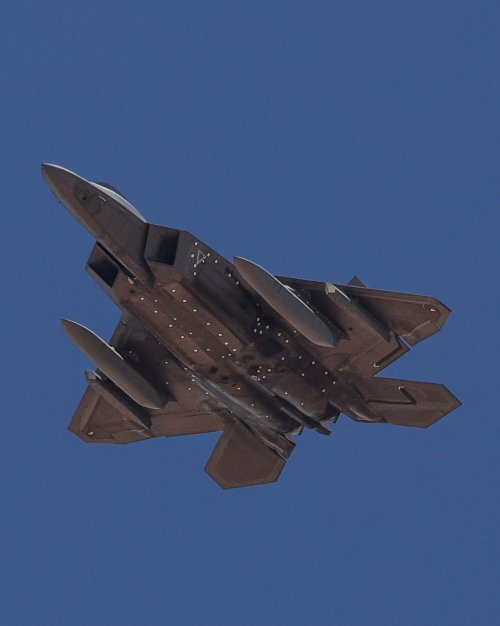
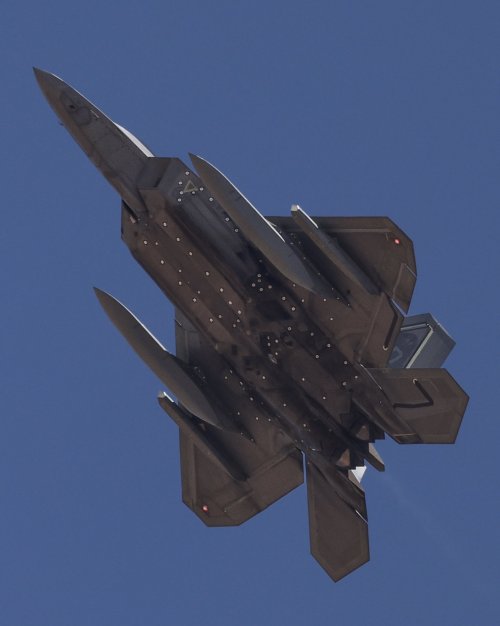
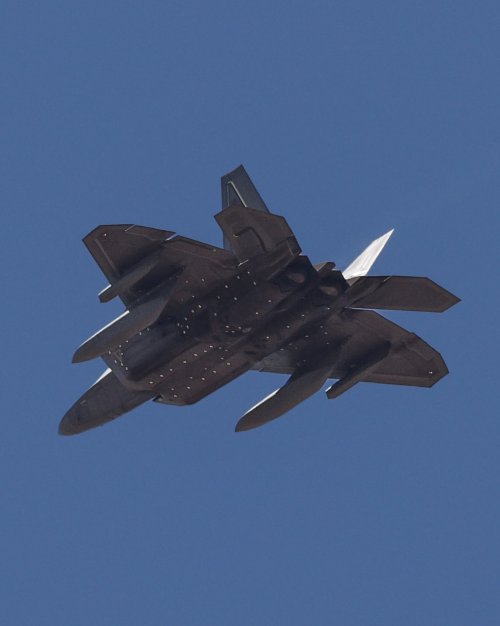
Do we know if there is radar upgrade as well?Despite my objections, it is semites cool seeing the F-22 fully decked out like this. Certainly not the usual look we've come to associate with stealth aircraft.
Scott Kenny
ACCESS: USAP
- Joined
- 15 May 2023
- Messages
- 19,753
- Reaction score
- 28,306
NG dropped out of F-47, to concentrate on FAXX.One can't help but wonder if that played a part in LM losing the F-47. I'm still scratching my head wondering how BOTH LM and NG lost that one.
And USAF is way pissed off at LM for F-35 issues, so chances were not good that LM would have won F-47 to begin with.
The space originally planned for the internal IRST on F-22 was taken up by something else once it was decided to not install an IRST "to save money" back in the 1990s."Raptor 2.0" is a cool-sounding brand, but in many ways it's also somewhat of a compromise given the budget and timeline pressures. Ideally, the F-22 should have had an internal IRST system, but such an upgrade now is likely too expensive and lengthy to develop, while USAF wants that capability as soon as possible, hence the current solution. Similarly, the more ideal method for increasing fuel IMO is to reactivate the fin and saddle tanks within the airframe, but those levels of modifications and associated flight testing are likely considered cost-prohibitive. A big part of this is the F-22 production being curtailed so drastically to just 195 airframes (187 operational ones).
Those IRST pods on the wings are because there's no space for one inside!
Similar threads
-

-
Lockheed Martin F-16 Fighting Falcon News and Developments
- Started by seruriermarshal
- Replies: 902
-
 Lockheed Martin C-5M Super Galaxy replacement
- Started by Triton
- Replies: 46
-
Lockheed Martin F-35 Lightning II Joint Strike Fighter (JSF)
- Started by Triton
- Replies: 8K
-
