https://war-book.ru/heinkel-he-60-bombardirovschik/
Heinkel's jet bomber projects
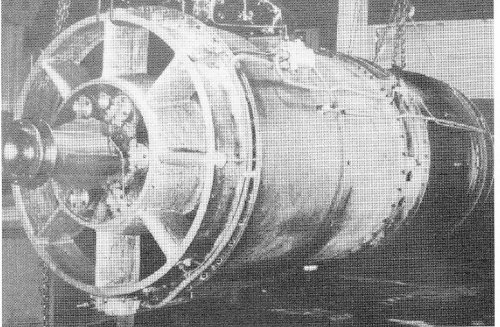
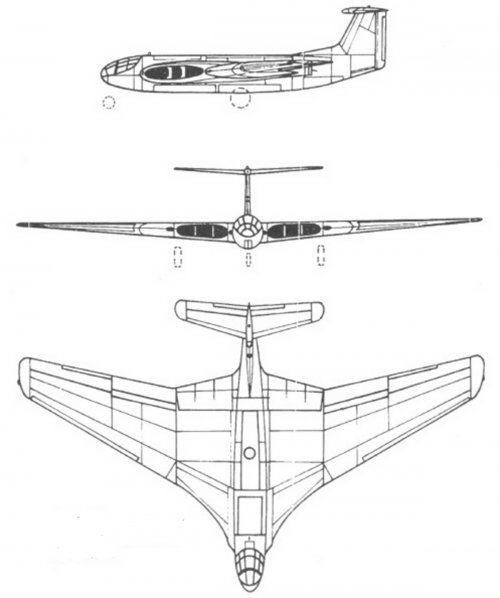
"According to records prepared for October 1, 1945, by Siegfried Ponter, then head of the Heinkel design bureau in Vienna, for the American technical service, Heinkel engineers were working on the development of four-engine, long-range jet bombers with a fuselage and tail unit until May 1945, but were also concentrating their efforts on creating flying wing aircraft. Work was particularly intense on the flying wing, equipped with four HeS 109-011 jet engines producing 1,300 kgf of thrust each and having a takeoff weight of 26 tons.
Another flying-wing bomber was to be equipped with four BMW 109-018 jet engines producing 3,000 kgf thrust each, or six Jumo 109-004 engines producing 1,300 kgf thrust each. The aircraft's takeoff weight was 60 tons, with a relatively high wing loading. As a special innovation, Siegfried Ponter highlighted in his report the fact that, for the first time in the design of a 60-ton aircraft, a double-swept wing, variable from 45 to 35 degrees, was used. This wing was designed for a new biconvex airfoil with a 10% relative thickness.
Performance characteristics of the 60-ton flying wing bomber
Wingspan – 31.50 m
Length – 19.85 m
Crew – 2 people
Engines – Heinkel-Hirth HeS 109-011, 4x1300 kgf
Range – 28,000 km
Droppable load – 3000 kg
These designs were sent back to the ministry for a competition committee, which was urgently revived on February 22, 1945, due to the Reichsmarschall's presence at a meeting in Dessau. According to Günther, the 60-ton "flying wing" design, with a range of 28,000 km, could deliver 3,000 kg of bombs."

![HeinkelLong-RangeBomber6[1].jpg](/data/attachments/51/51667-0e501a74ba7fc5cf18983cef706cb53f.jpg)
![HeinkelLong-RangeBomber-Profile[1].jpg](/data/attachments/51/51668-c612b14c8efca66893c77dd0cdcd675f.jpg)