Systems like SLAM/-ER, Storm Shadow and Taurus require sophisticated ground terminals to assist in mission planning .... besides position co-ordinates, the image templates needed to the do scene matching has to be derived .... not simple as compared with GPS-only or Laser guided bombs ....
They put a Storm Shadow on an Su-24 within months, so I'm sure they could put one on a P-8 if they tried.
 
They put a Storm Shadow on an Su-24 within months, so I'm sure they could put one on a P-8 if they tried.

That integration was likely extremely limited and almost certainly involved all of the missile setting and data inputs being entered by ground crews. And again: why would an MPA need a land attack weapon?
 
They were going to put Storm Shadow on the Nimrod MRA.4 but that got stopped when the Nimrod upgrade was cancled during the Coalition Concervative government back in 2010, so I do not think that it is not impossible to do the same for the P-8 that would give the P-8 a long range land attack capability something that the UK has been lacking.
 
So it can also function as a bomber.

That would be a very modest capability - four missiles on a dozen aircraft already barely sufficient in number for UK ASW needs. I cannot imagine the UK spends the money on integration .
 
Last edited by a moderator:
I am surprised that the Storm Shadow was not put onto the P-8 when the RAF ordered them in the first place if they really wanted the P-8s as a multi-role maritime strike aircraft.
 
I am surprised that the Storm Shadow was not put onto the P-8 when the RAF ordered them in the first place if they really wanted the P-8s as a multi-role maritime strike aircraft.

UK weapons require integration, and you have to pay the U.S. contractor. Short cut: adopt US weapons. I believe Mk54 was purchased for this reason.
 
Another missile that would have suited the mission would have been the Joint Strike Missile which would have fitted into the weapons bay without any problems.
 
I doubt it. It has not been integrated with anything outside F-18 AFAIK and require a datalink pod. Plus I’m pretty sure it exists in rather trivial numbers; it was a rather special purpose weapon. JSOW has already been provided, though I cannot imagine there’s a lot of those either.

At a minimum it was also integrated onto the F-15K for Korea, as those birds were specifically called “SLAM Eagles” for their ability to carry the weapon. I’ve seen photos of Turkish F-16s with the weapon as well, and USN P-3s. So while not a weapon that is frequently or widely discussed, it has a decent range of launch platforms.
 
Yes, but that was not the original UK plan. Not sure if they took delivery of mo54 yet or not.

I believe they have; the contract was awarded in 2018 with completion scheduled for 2022, and there are pics out there of UK P-8s dropping torpedoes.

Stingray integration looks like an AUKUS quid pro quo to me.
 
Last edited:
Found this report on the Teledyne J402 used in the Harppon ...

I find this paragraph interesting :

In the original Harpoon engine configuration,
a drive was provided to power an
alternator housed in the nose cone. It,
too, was directly driven by the main shaft
as shown in Figure 4. This engine configuration
was qualified for the initial
flight test program and powered all of the
early flights. The alternator was ultimately
eliminated in favor of a battery
which was determined to be more cost
effective
. An adaptation of the original
alternator system was later incorporated
into a variant of the engine and qualified
for a target application.

I didn't know the Harpoon only uses battery for electrical power, and it uses two silver zinc batteries as stated in the next link.

Does this means the silver zinc batteries need to be charged during regular maintenance?
 
That integration was likely extremely limited and almost certainly involved all of the missile setting and data inputs being entered by ground crews. And again: why would an MPA need a land attack weapon?

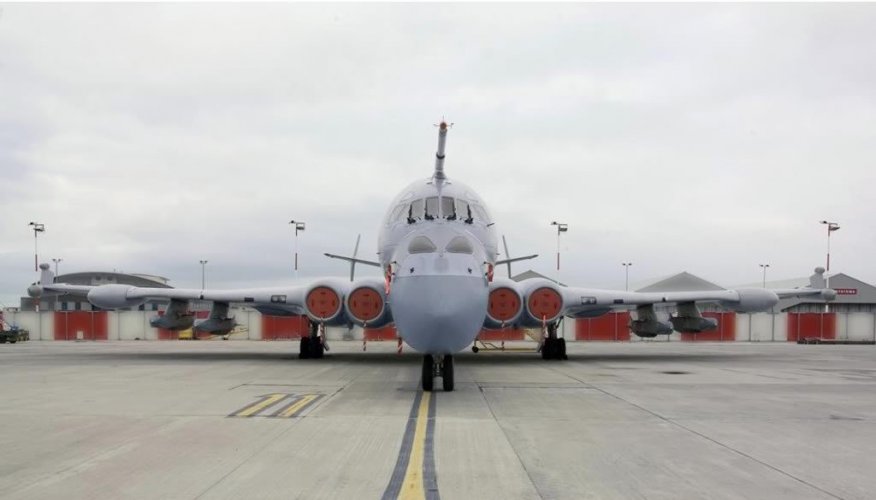
The A in MPA.1 is for Attack, as it was in the Nimrod MRA.4 versus the maritime-only MR.2. The intention from the MRA .4 onwards was multidomain ops:

EtkiAoiXEAMlV8V.jpg

Except for the Poseidon the UK has no platform for sovereign long-range attack capability. Dragging a couple of Typhoons behind a tanker to deliver four Storm Shadows is an inefficient, crew-fatiguing stopgap.
 
Last edited:
Turbine Powerplants for Missiles — Cost Improvement Requirements

0
 
Found this interesting .....

Under BSU-42, 43 and 44 :

BSU-42/BWing of AGM-84 (3 wings per missile)
BSU-43/BWing of AGM-84 (1 wing per missile)
BSU-44/BFin of AGM-84

For air launch Harpoon, there are 2 part no. for the wing, BSU-42 and 43 ..... any idea why is it so?

 
Found this interesting .....

Under BSU-42, 43 and 44 :

BSU-42/BWing of AGM-84 (3 wings per missile)
BSU-43/BWing of AGM-84 (1 wing per missile)
BSU-44/BFin of AGM-84

For air launch Harpoon, there are 2 part no. for the wing, BSU-42 and 43 ..... any idea why is it so?

Doesn't one wing have an antenna fairing on it?
 
Same thing listed here :


The AGM-84 missile (figure 1-1) is an all weather, anti-ship attack weapon capable of airborne launchfrom various platforms including B-52 aircraft. It incorporates the All-Up-Round (AUR) concept and requires no assembly other than installation of mis- sile wings BSU-42/B and BSU-43/B and missile control fins BSU-44/B at the organizational level.See figure 1-2 for missile identification and usage.
 
I'd like to ask, when the U.S. is replacing the Harpoon missiles, is there a domestically produced, highly maneuverable stealth anti-ship missile alternative? I mean a completely new model, not an upgraded version of the Harpoon. It's quite disappointing that the U.S. Navy ultimately chose the NSM.
 
I'd like to ask, when the U.S. is replacing the Harpoon missiles, is there a domestically produced, highly maneuverable stealth anti-ship missile alternative? I mean a completely new model, not an upgraded version of the Harpoon. It's quite disappointing that the U.S. Navy ultimately chose the NSM.
LRASM?


LRASM?


I know about LRASM, but its lateral maneuverability and overload capacity are not particularly high, which is why I asked if there are other alternatives.
 
I know about LRASM, but its lateral maneuverability and overload capacity are not particularly high, which is why I asked if there are other alternatives.

Tomahawk is also getting its anti-ship mojo back:


Also, Standard, as well as pretty much all other U.S. Naval SAMs, can also be used against ships:

"Similar to its precursor—the SM-2—the SM-6 also has limited offensive capabilities, and, when equipped with GPS, can carry out strikes on land and sea targets at a range of 200 miles. This new anti-ship capability is aimed at countering the surface strike threat posed by Chinese naval vessels with long-range anti-ship cruise missiles and would force them to stand off at ranges more favorable to U.S. aircraft carriers."

"The Pentagon’s 2017 budget includes a $2.9 billion request for the SM-6, which Defense Department officials recently revealed will be gaining a supersonic anti-ship capability. This SM-6 upgrade was discussed by Secretary of Defense Ash Carter, who stated that, “We’re modifying the SM-6 so that in addition to missile defense, it can also target enemy ships at sea at very long ranges.” The missile first engaged a surface target in 2016 during a test demonstration."

See:


There's also the "Sea Dragon" program:


Last edited:
I'd like to ask, when the U.S. is replacing the Harpoon missiles, is there a domestically produced, highly maneuverable stealth anti-ship missile alternative? I mean a completely new model, not an upgraded version of the Harpoon. It's quite disappointing that the U.S. Navy ultimately chose the NSM.
NSM/JSM or LRASM are the choices.
 
Tomahawk is also getting its anti-ship mojo back:


Also, Standard, as well as pretty much all other U.S. Naval SAMs, can also be used against ships:

"Similar to its precursor—the SM-2—the SM-6 also has limited offensive capabilities, and, when equipped with GPS, can carry out strikes on land and sea targets at a range of 200 miles. This new anti-ship capability is aimed at countering the surface strike threat posed by Chinese naval vessels with long-range anti-ship cruise missiles and would force them to stand off at ranges more favorable to U.S. aircraft carriers."

"The Pentagon’s 2017 budget includes a $2.9 billion request for the SM-6, which Defense Department officials recently revealed will be gaining a supersonic anti-ship capability. This SM-6 upgrade was discussed by Secretary of Defense Ash Carter, who stated that, “We’re modifying the SM-6 so that in addition to missile defense, it can also target enemy ships at sea at very long ranges.” The missile first engaged a surface target in 2016 during a test demonstration."

See:


There's also the "Sea Dragon" program:


I know about these legacy platforms. What I meant to ask is whether there were any new proposals during the competition when the NSM was selected to replace the Harpoon. Additionally, the Sea Dragon is a ballistic missile, not a cruise missile.
 
I know about these legacy platforms. What I meant to ask is whether there were any new proposals during the competition when the NSM was selected to replace the Harpoon. Additionally, the Sea Dragon is a ballistic missile, not a cruise missile.

There was also the Joint Air-Breathing Multi-Role Missile (JABMM) for the LCS, but that vanished into the mists of obscurity rather quickly.


Last edited:
Some notes about the early days of Harpoon, culled from Av Week between 1969 and 1971.

  1. Concept development for Harpoon was contracted by the Navy to Bird Engineering Research Associates after initial proposals to base the capability on Condor or Standard were rejected ( early 1970 )
  2. Main threats were Russian naval forces in Indian Ocean and Mediterranean Sea
  3. Was considered too large for LAMPS helis to carry, they would potentially provide mid-course guidance but for their own anti-ship operations would carry TOW
  4. Lockheed and Rocketdyne demonstrated variable-thrust rocket motors for Harpoon in early 1970. The Rocketdyne motor had a variable-area nozzle
  5. By late 1970, Navy considering a small turbofan which would cost about $5/lb thrust according to Teledyne. Endurance wouldn't be more than 15 mins
  6. By Dec 1970 the Navy was starting to think about modifying Condor or Standard again as an interim standard, as Harpoon development seemed to be elongating. But Adm Zumwalt's appointment and enthusiasm for Harpoon accelerated the project and discarded the need for a stop-gap
  7. RFP missile teamings in early 1971 were:
    1. McDonnell Douglas airframe; Texas Instruments seeker
    2. Hughes airframe; seeker bids from AIL and Motorola
    3. North American - Rockwell, Columbus Div airframe; seeker bids from Autonetics, AIL and Motorola
    4. General Dynamics Electro Dynamics Div, Pomona, seeker and airframe; Boeing doing propulsion and aircraft integration
    5. LTV airframe and propulsion; Raytheon seeker
  8. Bids were separately solicited from engine suppliers for 500-600lb thrust turbojet:
    1. Teledyne CAE
    2. Williams
    3. Pratt & Whitney
    4. Garrett
    5. GE
    6. Solar Div of International Harvester
    7. Avco Lycoming
  9. Despite the ongoing project, by Jan 1971 the Navy was testing modified Firebees from Pt Mugu as potential interim SSMs
  10. Down-selection in May 1971:
    1. Missile: McDonnell-Douglas with TI and Sperry ( for ship integration ), GD with Boeing & Honeywell ( for ship integration )
    2. Powerplant: Teledyne and Garrett
  11. McDonnell-Douglas missile team was selected in June 1971, $60 million contract
  12. September 1971 McD put out tenders for the onboard computer to CDC, Sperry Rand Univac and IBM
  13. Engine development contract was extended in Oct 1971 for both competitors
  14. McD contracted Aerojet in Oct 1971 to develop the booster, $1.1 million
  15. Further contract to McD to study underwater launch, early 1972, $2.5 million
  16. Teledyne selected for powerplant in June 1972, $10.1 million contract for initial 55 J402s
 
Last edited:
LRASM?


i would have preferred LRASM-B. Too risky. I imagine they'll dub PrSM increment 4 the same and go with the rocket.
 
NSM/JSM or LRASM are the choices.
Depends on what platform we are talking about.

Surface ships: Tonahawk or various SAMs (even RAM blk2 has an anti surface mode), with NSM being introduced to LCS and Harooon still on older Burke’s and Ticos.

Submarine: Harpoon and apparently Sea Dragon, thought to be encapsulated SM-6. Unclear which boats have the latter but my money is on Virgina blk4, based on supposed introduction date circa 2020.

Air launch: primarily LRASM and Harpoon, though a lot of PGMs would be modestly effective at shorter ranges, down to guided bombs (Quicksink). USAF is buying small batches of JSM as well as a LRASM “bridge” for F-35. Newer versions of AGM-158B might have some narrow anti ship applications, and I believe the new D version is to get a weapon datalink which allow it to be fully enabled against ships. MALD-N is not an anti ship weapon but it has a datalink and a radar altimeter, so it could easily *fake* being an AShCM.

Additionally there are probably some classified things as well - a USAF general referred to LRASM as the only unclassified anti ship capability that could be discussed in an open hearing. AIM-174 might retain its anti surface mode. The above mentioned Sea Dragon. HACM and SiAW will most likely have an anti ship mode, etc.
 
Last edited:

Similar threads

Back
Top Bottom