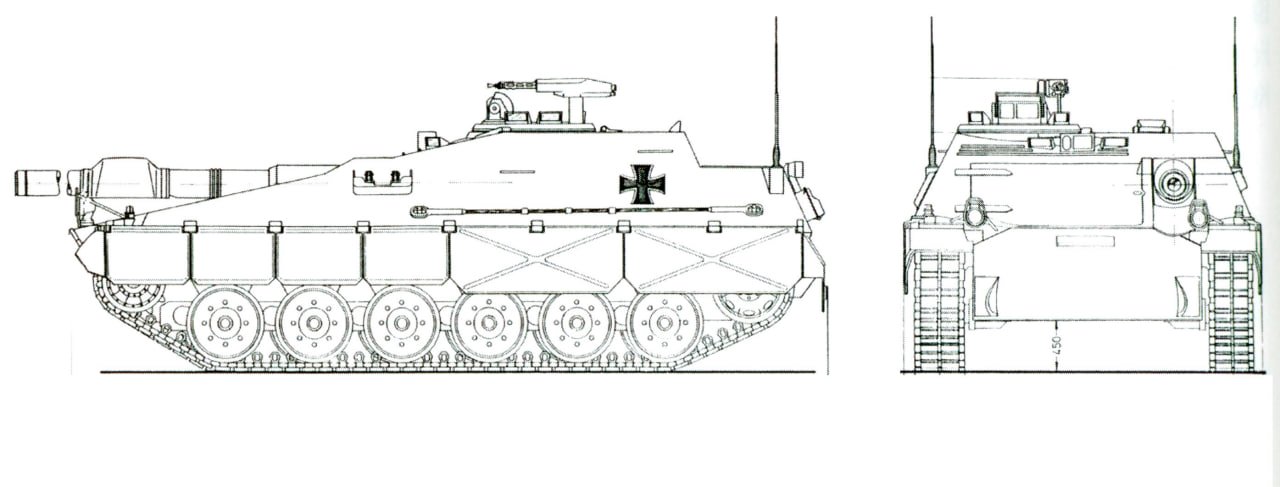
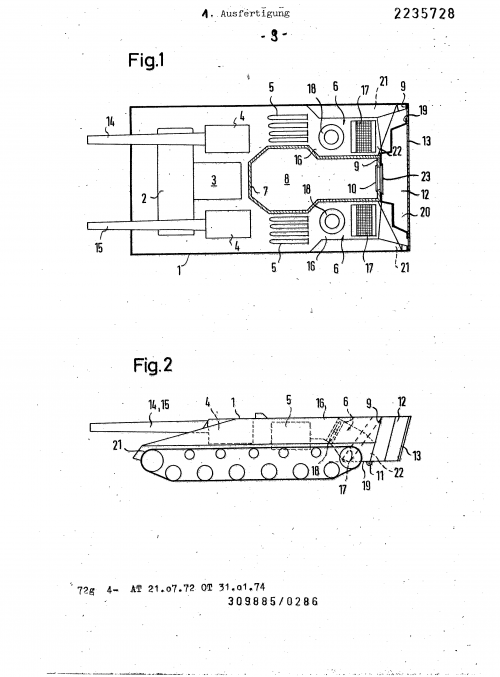
I am currently working on this variant which I only know from a drawing. Apparently, this is how one imagines a series version, with a remote-controlled MG gun carriage controlled by the commander via periscope, which was similar to the Leopard 2 flat turret and Leopard 2 AV. At the moment I'm still trying to create a suitable interior, which I also want to realise in the 1:35 3D printed model.
Some advise for the crew compartment.
DRK has sprung individual seats for its crew.

3.Problems of Shielding the Crew from the Effects of Hull Motion
The crew of a high mobility combat vehicle will be able to accomplish its tasks only if it operates under tolerable conditions . The increased speed of such high - mobility vehicles leads to increased vibration of the entire vehicle body . Since this vibration will not always be absorbed by an advanced track and suspension system ( which may sometimes even be inexpedient ), the crew must be provided with suitable seats that shield it from such vibration .
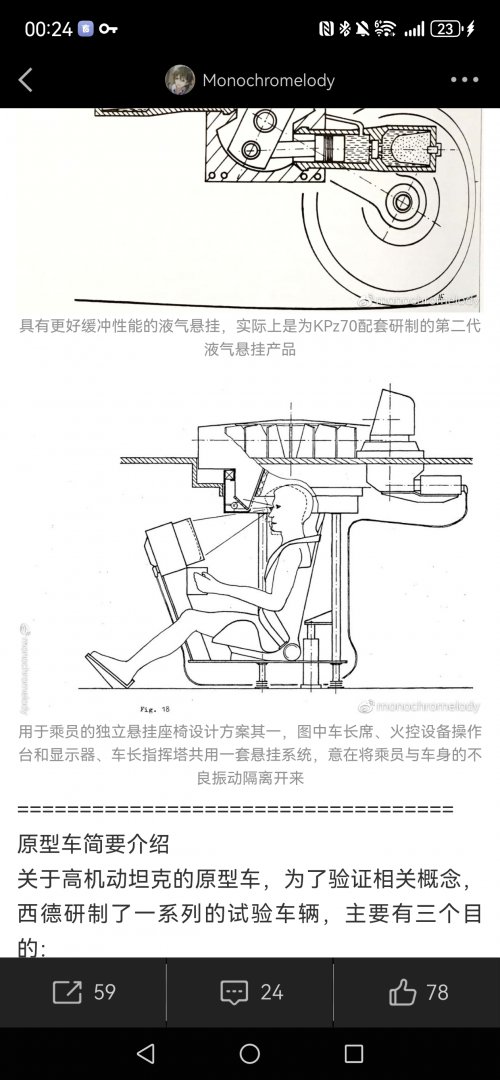
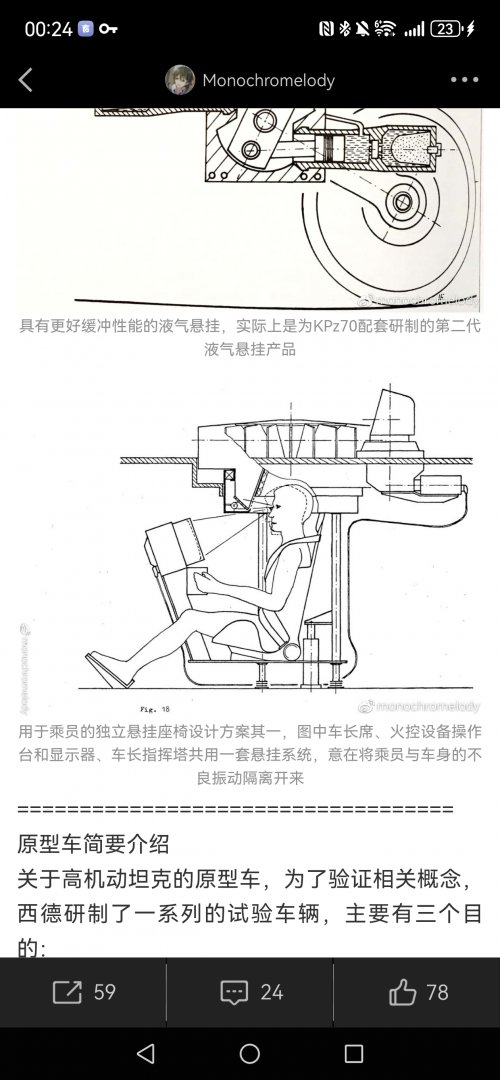
There are several known methods of achieving this aim . In test vehicles FVT , VT and GVT sprung individual seats or platforms accommodating serveral seats were installed . If presently available components ( spring and damper ) are used , long spring travel will be needed for effective suspension which will require additional vehicle space . The seat sus - pension used in the present case employs a combination of a spring damper system with an additional frictional damper and automatic adjustment of the static position of the seat . The frictional damper prevents seat suspension action until a predetermined acceleration is reached so that it is possible to obtain adequate shieldingof the crew from hull motion with a total spring travel of about 130 mm . A model of this system has been tested in a vehicle .

(reference: DTIC report A021702 US-FRG high mobility symposium, p.182)
VT 1-2 was equipped with a sprung seat and an articulated eyepiece for its gunner.
As for a fully developed DRK, the commander with his seat, his fire-control components and commander cupola, mounted on a vertical rail with spring and damper, thus isolated from those harmful vibration.
 

Attachments

  • Screenshot_20250715_002438_com.sina.weibo.jpg
    Screenshot_20250715_002438_com.sina.weibo.jpg
    764.7 KB · Views: 139
  • Screenshot_20250715_002438_com.sina.weibo.jpg
    Screenshot_20250715_002438_com.sina.weibo.jpg
    764.7 KB · Views: 129
Some advise for the crew compartment.
DRK has sprung individual seats for its crew.

3.Problems of Shielding the Crew from the Effects of Hull Motion
The crew of a high mobility combat vehicle will be able to accomplish its tasks only if it operates under tolerable conditions . The increased speed of such high - mobility vehicles leads to increased vibration of the entire vehicle body . Since this vibration will not always be absorbed by an advanced track and suspension system ( which may sometimes even be inexpedient ), the crew must be provided with suitable seats that shield it from such vibration .
There are several known methods of achieving this aim . In test vehicles FVT , VT and GVT sprung individual seats or platforms accommodating serveral seats were installed . If presently available components ( spring and damper ) are used , long spring travel will be needed for effective suspension which will require additional vehicle space . The seat sus - pension used in the present case employs a combination of a spring damper system with an additional frictional damper and automatic adjustment of the static position of the seat . The frictional damper prevents seat suspension action until a predetermined acceleration is reached so that it is possible to obtain adequate shieldingof the crew from hull motion with a total spring travel of about 130 mm . A model of this system has been tested in a vehicle .
(reference: DTIC report A021702 US-FRG high mobility symposium, p.182)
VT 1-2 was equipped with a sprung seat and an articulated eyepiece for its gunner.
As for a fully developed DRK, the commander with his seat, his fire-control components and commander cupola, mounted on a vertical rail with spring and damper, thus isolated from those harmful vibration.
See also the air seats the USN had to install into the MkV SEAL boats.
 
Some advise for the crew compartment.
DRK has sprung individual seats for its crew.

3.Problems of Shielding the Crew from the Effects of Hull Motion
The crew of a high mobility combat vehicle will be able to accomplish its tasks only if it operates under tolerable conditions . The increased speed of such high - mobility vehicles leads to increased vibration of the entire vehicle body . Since this vibration will not always be absorbed by an advanced track and suspension system ( which may sometimes even be inexpedient ), the crew must be provided with suitable seats that shield it from such vibration .
There are several known methods of achieving this aim . In test vehicles FVT , VT and GVT sprung individual seats or platforms accommodating serveral seats were installed . If presently available components ( spring and damper ) are used , long spring travel will be needed for effective suspension which will require additional vehicle space . The seat sus - pension used in the present case employs a combination of a spring damper system with an additional frictional damper and automatic adjustment of the static position of the seat . The frictional damper prevents seat suspension action until a predetermined acceleration is reached so that it is possible to obtain adequate shieldingof the crew from hull motion with a total spring travel of about 130 mm . A model of this system has been tested in a vehicle .
(reference: DTIC report A021702 US-FRG high mobility symposium, p.182)
VT 1-2 was equipped with a sprung seat and an articulated eyepiece for its gunner.
As for a fully developed DRK, the commander with his seat, his fire-control components and commander cupola, mounted on a vertical rail with spring and damper, thus isolated from those harmful vibration.
Seats? I thought they were kneeling on the floor like Fred Flintstone
 
Tanks without a turret are much cheaper to make and lighter. but the disadvantage is the inability to shoot 360 degrees, you have to deflect by turning the body itself.Maybe for flank protection they could have put a hand-held launcher like a Milan or a recoilless cannon which will rotate 360 degrees on the top of the tank
 
Tanks without a turret are much cheaper to make and lighter. but the disadvantage is the inability to shoot 360 degrees, you have to deflect by turning the body itself.Maybe for flank protection they could have put a hand-held launcher like a Milan or a recoilless cannon which will rotate 360 degrees on the top of the tank
Close range protection suggests a Carl Gustav recoilless with HE or canister.
 
What I would add to this German tank is a trench digging bucket, something like the Swedish tank . Both for digging trenches and for pushing obstacles in urban combat. In terms of weapons, why not instead of two 105 mm cannons, one mountain cannon with a short barrel like m116 with a high degree of elevation for the purpose of hitting buildings at a high angle in urban combat. While the 105 mm gun is to be used to fight tanks and bunkers
 

Similar threads

Back
Top Bottom