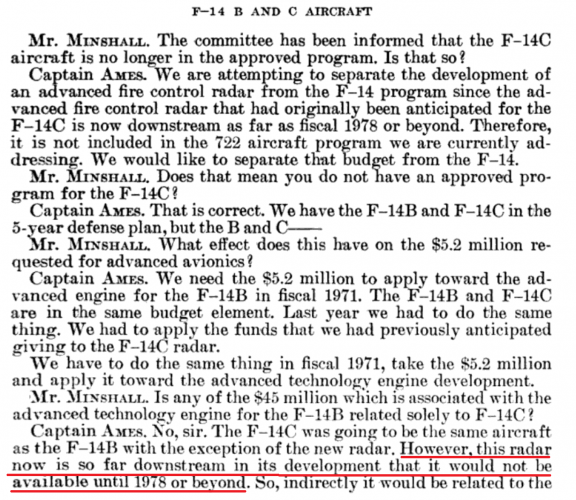
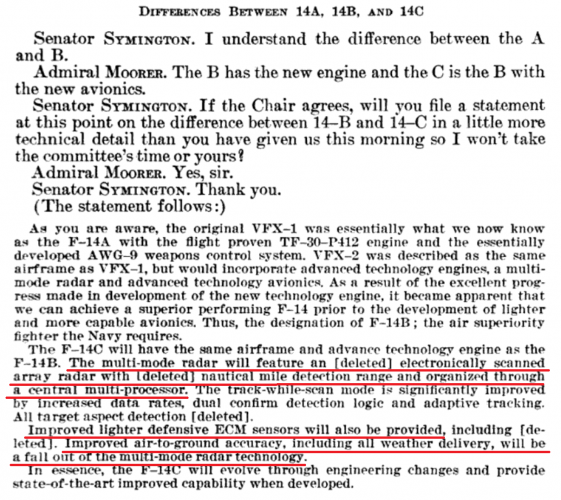
I think point 3 is probably right. According to the 01-F14AAA-1.1(15 May, 1995), the top speed of the F-14A was also limited to approximately M1.8 by NATOP. However, I don’t know what happened, because I don’t have manuals from the 1970s for comparative analysis.
Point 1 is correct, 2 and 3 are not.
On point 2, The Tomcat's inlets were designed for a 30,000 lb thrust engine from the start. (
Sandboxx's info is wrong on this point).
On point 3, the F-14 airframe and the
canopy in particular was designed for mach 2.4+. I've certainly never heard or seen anything to suggest there were delamination/structural issues from mach 2+ flight, and I worked on the Tomcat.
The F-14A was flown to mach 2.41 in official testing, and the top speed with TF30's installed was always listed as mach 2.4. Also, there are at least two pilots who flew the operational A-model to mach 2.5; "Charlie" Brown being one of them. Only a stripped-down F-15 has managed to hit that number, so in reality the F-14A is just as much a mach 2.5 aircraft as the F-15 is.
In fact, the TF30 performs better at that speed than the F100 (look no further than the F-111F; a more honest mach 2.5 aircraft than the F-15. It even had built in airframe temperature sensors to specifically limit time at mach 2.5).
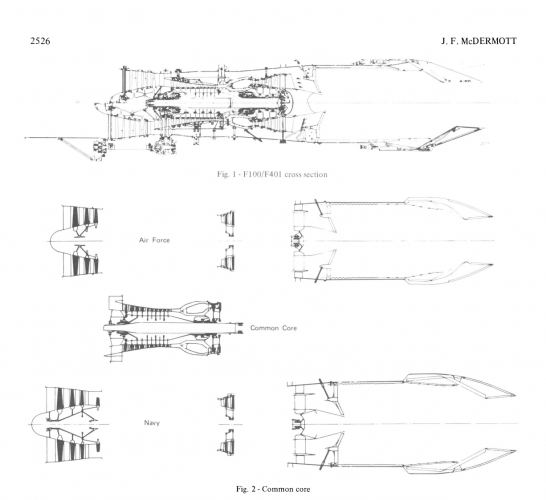
The F401, BTW underwent a 24 hour simulated test at mach 2.4 specifically for the Tomcat installation.
The F110-GE-400 installation did have somewhat higher drag. That was intentional as they evaluated 3 tailpipe lengths and chose the middle length as a compromise. The longer one had the lowest supersonic drag and the short one had the lowest subsonic drag.
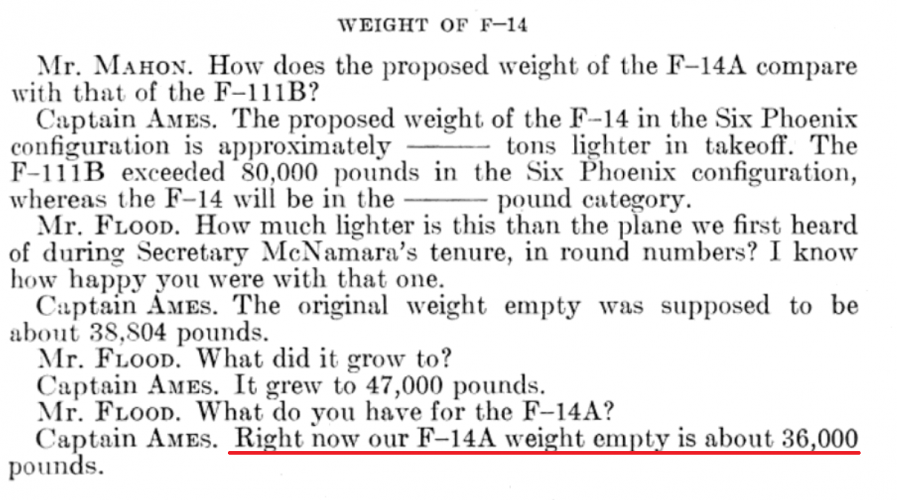
Regarding weight, the F-14A was
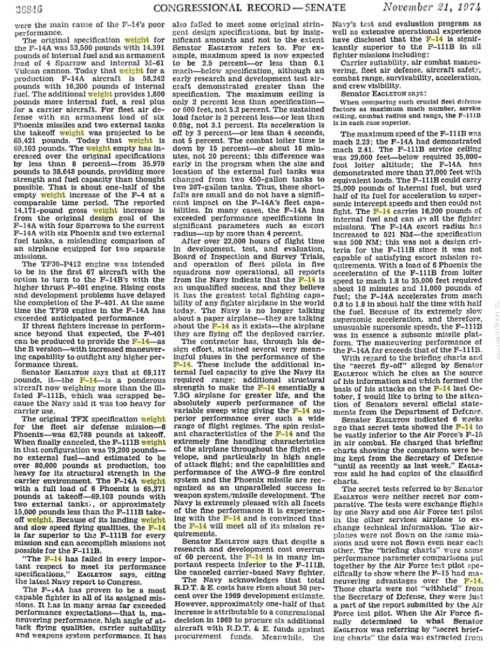
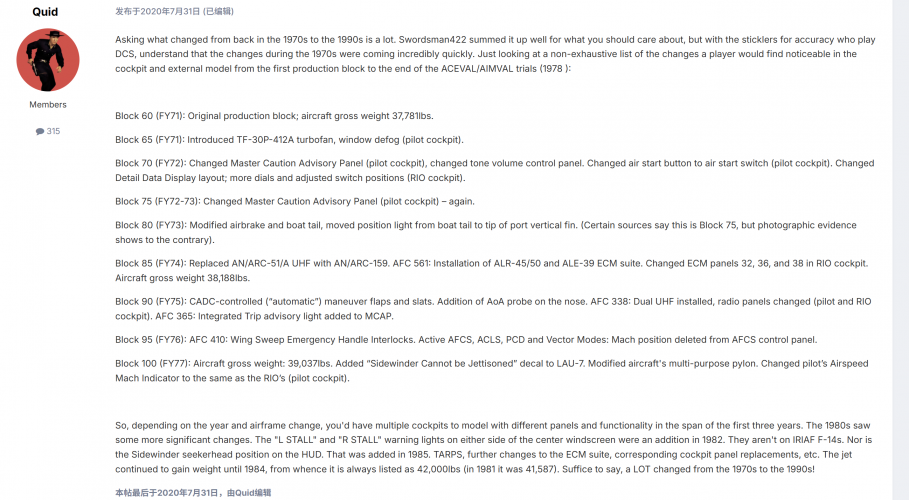
supposed to be 36,000 lbs empty but was overweight from the first protoype. With the TF30-P-412's it weighed 40,100 lbs. That grew to 43,500 lbs in the D.
Recall the F-35A was supposed to be 26,000 lbs but ended up at over 29,000.
With the F401 engines installed, the F-14 empty weight was the lowest of any variant at approximately 38,600 lbs. Ship number 7 (now on the Intrepid) flew with the F401's in 1973, and in that non-weapon system equipped test configuration was likely right around 36,000 lbs empty.
This was by far the highest performance Tomcat ever flown.
In 1973. It also had the ability to pull 7G at mach 2+ because it had the wing glove vanes, which the B, D and ST-21/variants deleted.
The ST-21/variants would have been
at least 46,000 lbs empty even with added use of composites, and with the added drag from the modified wing gloves (to say nothing of all the air to ground paraphernalia) would have completely erased any gains from the -429 engine (or even a -432, for that matter).
The F119 idea made much more sense, but only if they also turned the Tomcat into a full-FBW aircraft actually
reducing weight and enabling greater internal fuel without bulging out the wing gloves.