At the time, the 1960's, the state of the art in Soviet sonar arrays were sets like Feniks, Artika, and Herkules all based on late WW 2 German GHG sonar technology. The longest range of the bunch was Feniks, based on the late war German Balkon array with a range of about 60 NM at most and usually much shorter for anything other than the coarsest detection of an enemy ship.
Facepalm. We are talking about RADAR detection.
That's the "book" value. How long does it take a crew that has never actually launched the missiles and has only been trained by rote. After all, other than a few officers onboard, the crew has 3 or less years total of experience being conscripts and most have maybe a year or so of actual time on the boat.
Exactly the same thing, because Soviet engineers realized that and made P-35 encapsulated weapon, that did not require any assembly and was stored fully ready to launch. The only difference between practice drill & actual launch was, that with actual launch missile actually launched from the container.
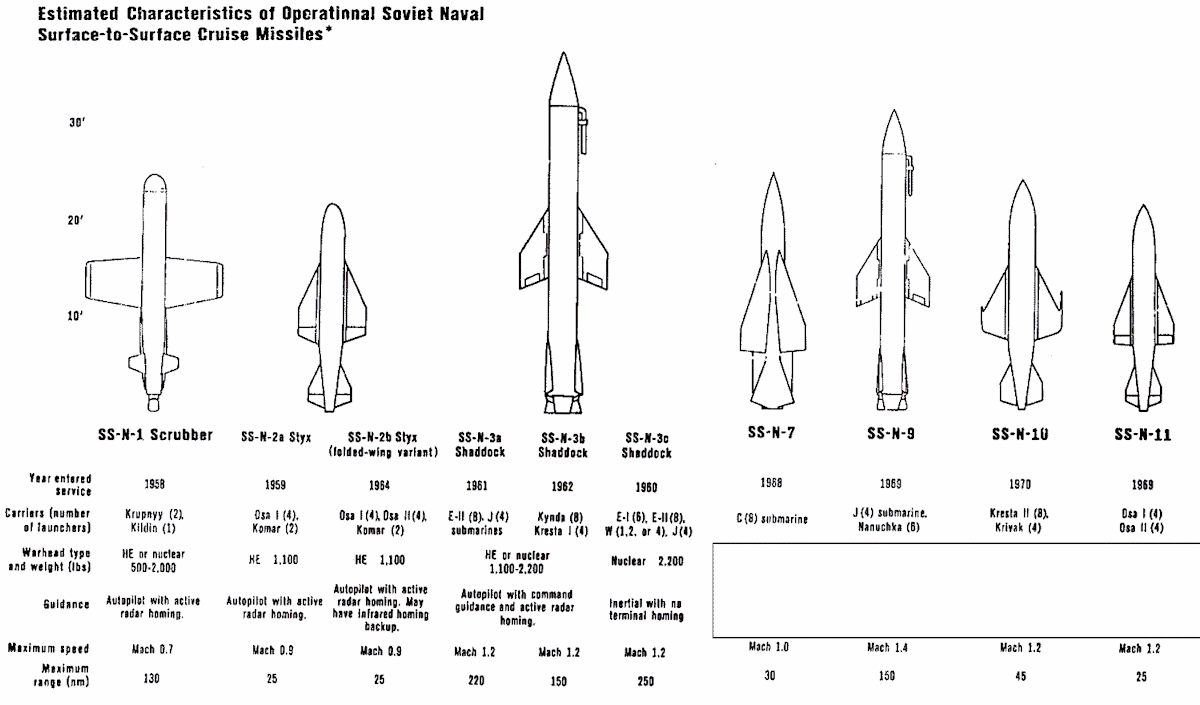
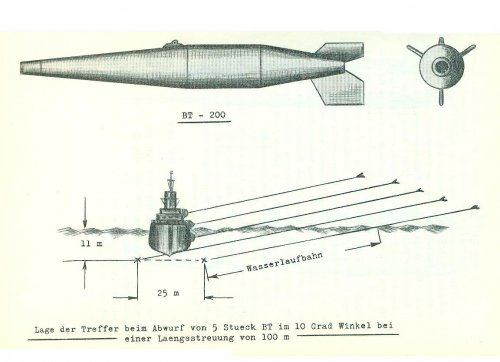
The SS-N-3, the one we're discussing here for the late 60's is huge. It is aircraft sized at nearly 40 feet long. The air launched ones are really no smaller. I've not discussed the SS-N-1 as it was really a bad design. It was boosted to flight using a RATO and then used a small (for the period) turbojet to take it to the target. For launch, you had to start the turbojet and get it up to speed the whole thing taking several minutes to accomplish. Then at the target it dropped something akin to a late war German BT series weapon meant to attack the ship below the waterline.
First of all, please use Soviet designation. Because NATO one is simply wrong there; Americans failed to discriminate between P-5 (strategic cruiser missile), P-6 (sub-launched anti-ship missile) and P-35 (surface-launched anti-ship missile), wrongly assuming that they are different models of the same missile. They aren't.
Second - what are you trying to argue about? I said: "fast fighter-size targets". They are exactly those.
Third - the KSCh is actually based on American "Puffin" missile, which use a "diving" warhead also.
As if the Russians don't have to do the same. But I'd put my money on the US defenses over a Russian sub with four AShM that have been sitting in their launch tubes since leaving port with ZERO maintenance on them.
A bit of info for you; exactly in early 1960s, US Navy technicians found the interesting fact. The RIM-24 Tartar missile (notoriously unreliable at this time) actually performed much better if it was given ZERO maintenance while in sea and was just sitting in the launch cell since leaving port. Because diassembling and assembling a complex electronics in sea was a really bad idea. As soon as they dropped the maintenance and started to follow "sealed round" concept (i.e. missile sitting in tube without any maintenance all deployment, if it showed a malfunction during routine testing, it simply got switched off & labeled "dud") the reliability increased drastically.
USSR realized that already by this time)
There's everything you want to know about Talos. As for Terrier, it has both a good rate of fire and in the 60's could fire to about 30 to 40 NM.
We are talking about Terrier.
Except, the Juliett class submarine doesn't have sensors that can accurately find a target at 100 NM. It's passive sensors (hydrophone / sonar) is good to about half that, and the search radar aboard is good to maybe a third of that.
Facepalm. Could you PLEASE follow? We are talking about bomber attack!
The F-4's don't do that. Either the E-1 or E-2 AEW aircraft aboard the carrier do. That's their job.
Erm... You insist that E-1 and E-2 should be used as interceptors? Because that's what we are talking about.
It depends. If the US was really in a pinch versus an onslaught of missiles and such, in the '60's they'd have just nuked everything incoming.
Sigh. How? The only nuclear anti-air weapon USN have were nuclear-tipped Talos & nuclear-tipped Terrier. The only nuclear Terrier model, the RIM-2D, have 20 miles range. And since attacking missiles would not fly in tight cluster, the nuclear SAM's would still destroy only one missile per shot.
Why? They could throttle down and just stay at range. They could also close and use Sidewinder.
Because:
1) Even at stall speed, loaded F-4 is still moving at about 370-400 km/h. The Tu-16 is running at 1000 km/h. The closing velocity is about 1400 km/h, or 23 kilometers per minute. Considering that the range of AIM-7E launch is about 30 km, even assuming that F-4 is flying at stall speed, it would be less then a minute before distance would be zero.
2) The early 1960s Sidewinders are useless in head-on attack, so they would require tail chase (and considering their limited range, F-4 would be in danger of Tu-16 cannons)
Whatever. It wasn't the Red Navy. In any case, the combat radius of a MiG 23 is pretty limited being, realistically, around 400 NM at most with some drop tanks. So, even in the Pacific, unless the carrier was in the Sea of Japan or just off the Kuril Islands it was out of their range in any case. In Europe they might cover part of the N. Sea at most and they might cover a small area of the Med. They are useless as escorts.
That's why USSR used Tu-128 with more than 1000 miles range as part of fleet cover)