Anyone who thinks the Dutch are going with anything but the missile system families they already have in their inventory, and parts of which will be used (ESSM) for the new ASW frigates, and parts of which can also go into the new air defense ships (ESSM, SM series) is smoking the kind of stuff you can buy in an Amsterdam coffee shop.
 
Last edited:
Anyone who thinks the Dutch are going with anything but the missile system families they already have in their inventory, and parts of which will be used (ESSM) for the new ASW frigates, and parts of which can also go into the new air defense ships (ESSM, SM series) is smoking the kind of stuff you can buy in an Amsterdam coffee shop.

Of course they stay within the current ESSM/SM-family missile's but it is a good idea to look what other options are on the market. Also when you enter negotiations with Raytheon you know what the other systems price range is. And maybe more important all other options have to be adapted for use in the Mk41 VLS, this will bring additional risks and budget into the project.

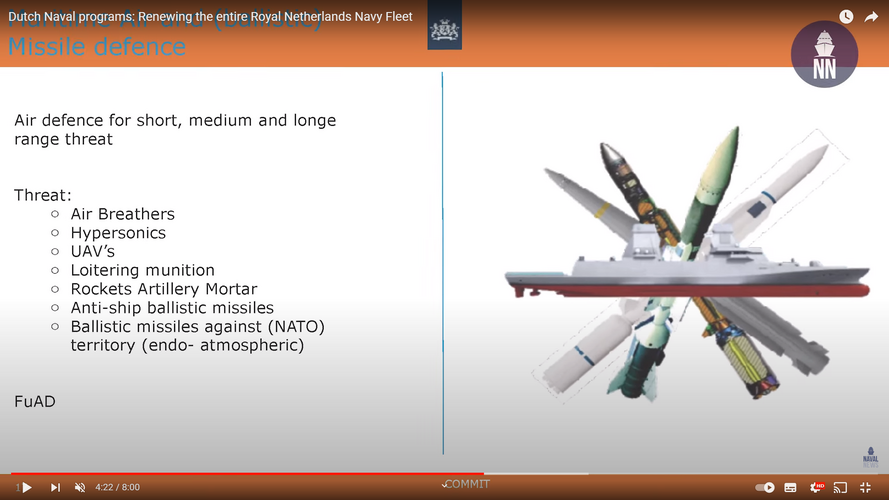
ESSM Block II is 100% confirmed for ASWF and both current and future LCF (FUAD). Both classes will use APAR block II & SM-400 Block II radars. The new LCF or FUAD will also receive SMART-L for the long range detection.

SMART-L MM/N | 3-D D-band Long Range multimission radar | 2000 km BMD, 480 km Air & 60 km surface targets
SM-400 Block II | 4-D S-band multifuction radar | >400 km Air & 80 km surface targets
APAR Block II | X-band multifunction radar | >150 km

In the missile overview we see 4 layers of defense:
- Short Range -> ESSM Block II & RAM Block II
- Medium Range -> SM-2 Block IIIB
- Long Range -> SM-2 Block IV
- Ballistic + Hypersonic -> SM- Block IA
 
*SM-6 as there no production for SM-2 Block IV

Do you mean SM-3? Or SM-6? Both can / could if given missile enters there reach.
It will be a longer range SM-2 , the BMD will be done by SM-6.
The Dutch navy recently announced it will not use SM-3 but an other missile capable of lower BMD. The new missiles will be able to destroy the ballistic missile within the earth atmosphere instead of very high altitude of the SM-3.
 
It will be a longer range SM-2 , the BMD will be done by SM-6.
The Dutch navy recently announced it will not use SM-3 but an other missile capable of lower BMD. The new missiles will be able to destroy the ballistic missile within the earth atmosphere instead of very high altitude of the SM-3.

There is no "longer range SM-2" in production. Block IV/IVA production ended ages ago (at least 10, possibly 20 years) and current SM-2 production is entirely the short MR configuration. So if you want extended-range air defense from Standard, it's SM-6 or nothing.
 
There is no "longer range SM-2" in production. Block IV/IVA production ended ages ago (at least 10, possibly 20 years) and current SM-2 production is entirely the short MR configuration. So if you want extended-range air defense from Standard, it's SM-6 or nothing.
SM-6 ist just an extended SM-2 Block IIIC.
We know that for SM-2 there is a new Version called Block IIICU which may even will include new the MK.104 rocket motor in development but even that won't be near SM-2 Block IV/ SM-6
 
SM-6 ist just an extended SM-2 Block IIIC.
We know that for SM-2 there is a new Version called Block IIICU which may even will include new the MK.104 rocket motor in development but even that won't be near SM-2 Block IV/ SM-6

You've got the relationship backwards. Block IIIC is effectively SM-6 minus the booster. SM-6 came first by a long way.

As for Block IIICU, the FY23 DOT&E report says that it is IIIC with a modified Guidance Section Electronics Unit to address obsolescence issues. (The same GS EU is being applied to SM-6 Block IA, converting it to Block IAU) No mention of a new Mk 104 motor.


The contract announcements for new Mk 104 motor designs seems aimed mainly at qualifying new ways of manufacturing something equivalent to the existing motor (e.g. Ursa Major, X-Bow Systems, and Aerojet Rocketdyne all doing additive manufacturing for energetics).
 
You've got the relationship backwards. Block IIIC is effectively SM-6 minus the booster. SM-6 came first by a long way.
I looked at it from the SM-2 but your right.
As for Block IIICU, the FY23 DOT&E report says that it is IIIC with a modified Guidance Section Electronics Unit to address obsolescence issues. (The same GS EU is being applied to SM-6 Block IA, converting it to Block IAU) No mention of a new Mk 104 motor.
Yes but one can Hope that there fas enough for it.

The contract announcements for new Mk 104 motor designs seems aimed mainly at qualifying new ways of manufacturing something equivalent to the existing motor (e.g. Ursa Major, X-Bow Systems, and Aerojet Rocketdyne all doing additive manufacturing for energetics).
I have to look into that again but if i remember it right an improvement would be achieved.
 
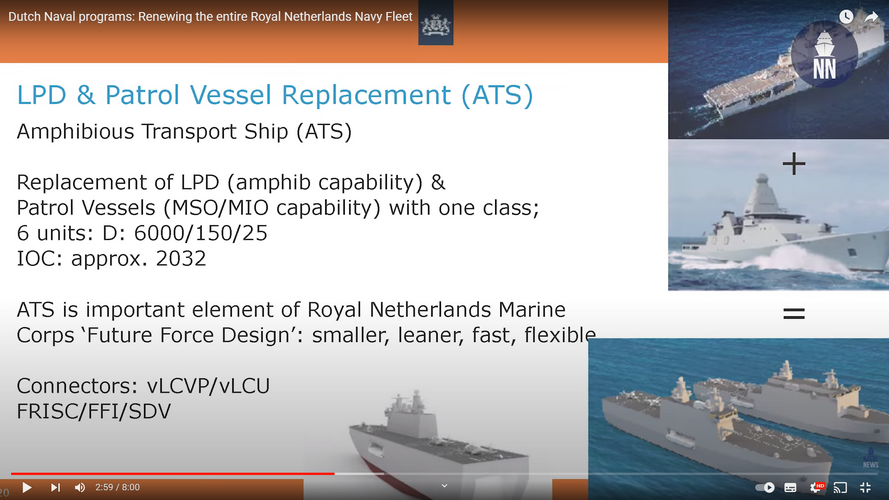
The ATS got me hyped

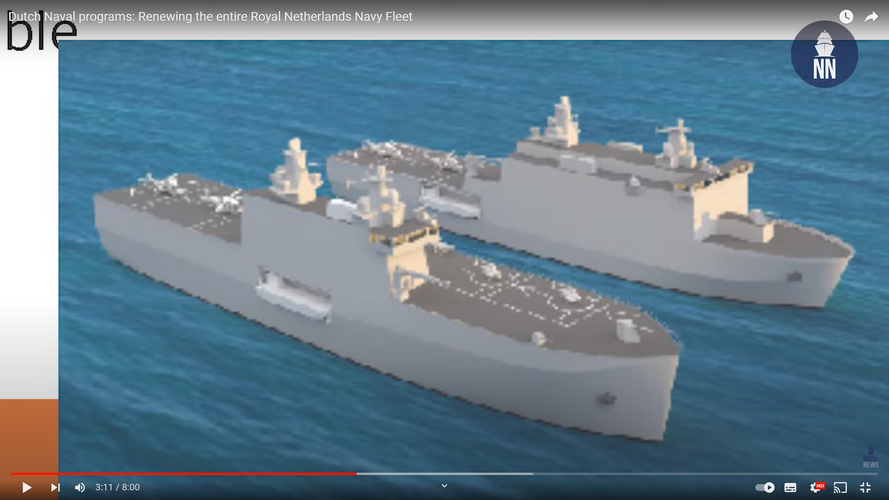
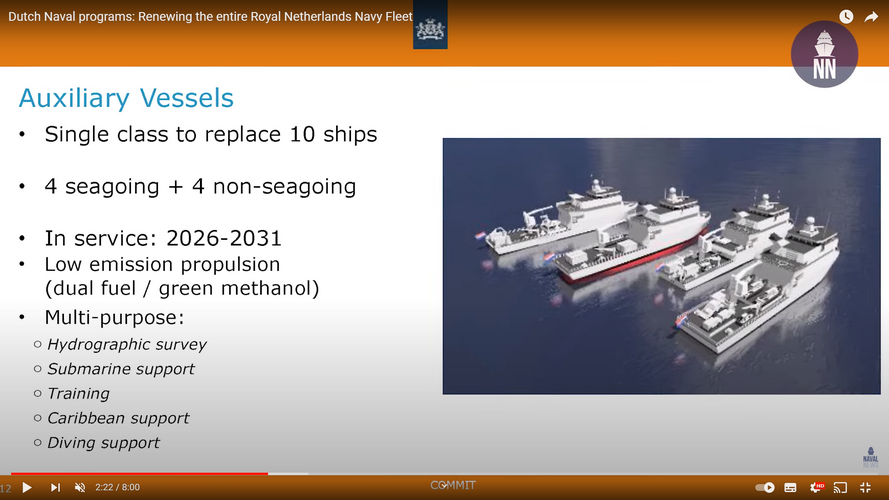
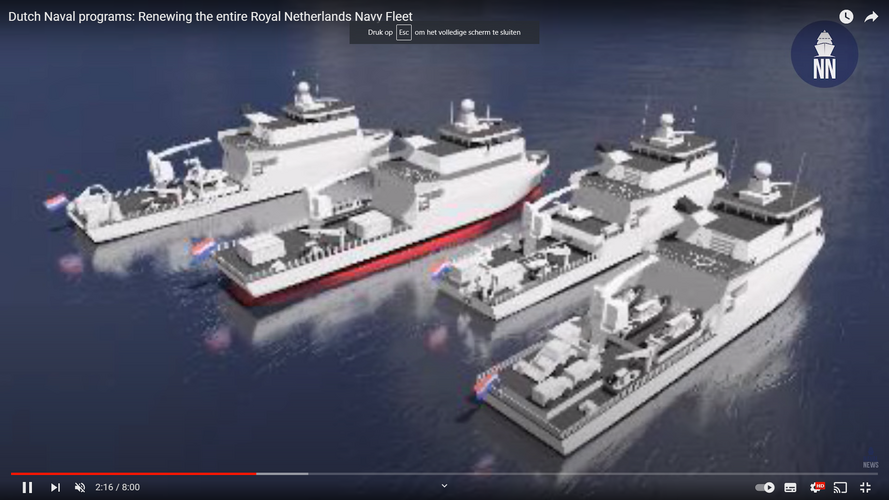
It has me hyped to but with some caution. We know this is only a very early concept and that the full deck design is only a option for now. The full deck option is the best option if you want to be able to focus on UAV's in the future.

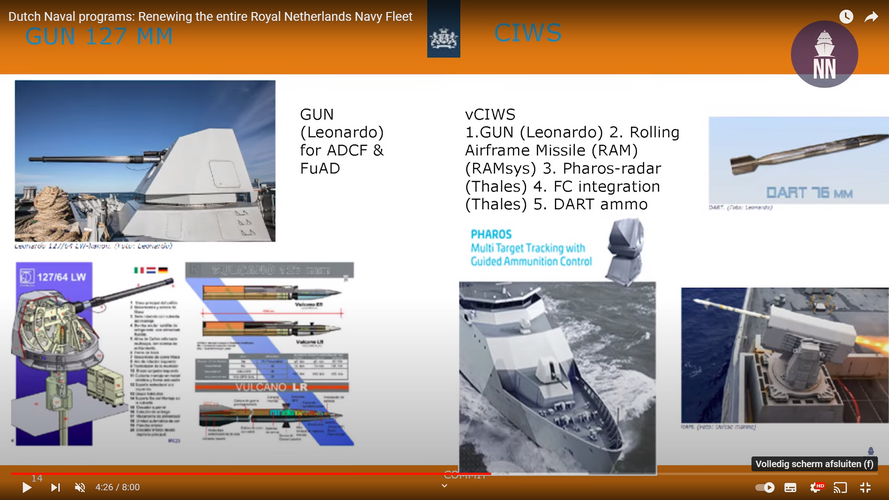
I zoomed in on the bow area and we see 2 MQ-8B Fire Scout type UAV's , a 76 mm Sovraponte & 40 mm cannon. Just behind the 2nd UAV we see a RHIB in Davit. On the aft deck we see 2 NH-90's and on the superstructure you can see a RAM CIWS and NS-100 radar. For amphibious raidings we see at least 1 LCVP/LCA on each side in davits and a dock door at the stern.

All of this will also fit in a standard LPD type ship but limits the number of flight movements. Damen's recent Enforcer LPD series has a added UAV flight deck that could work around that problem but the full deck gives more flexibility.
 
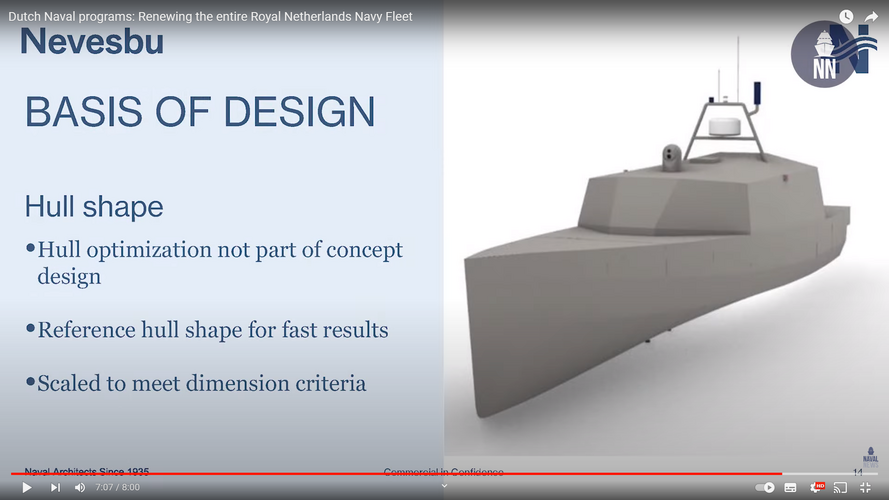
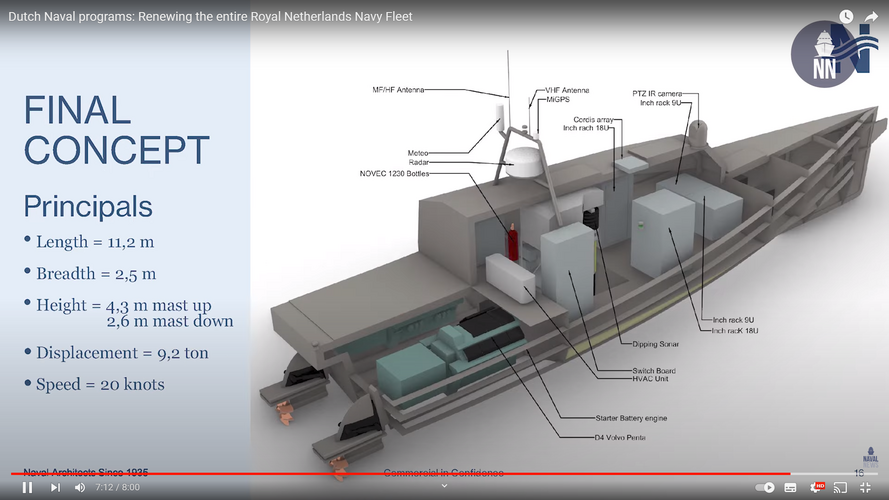
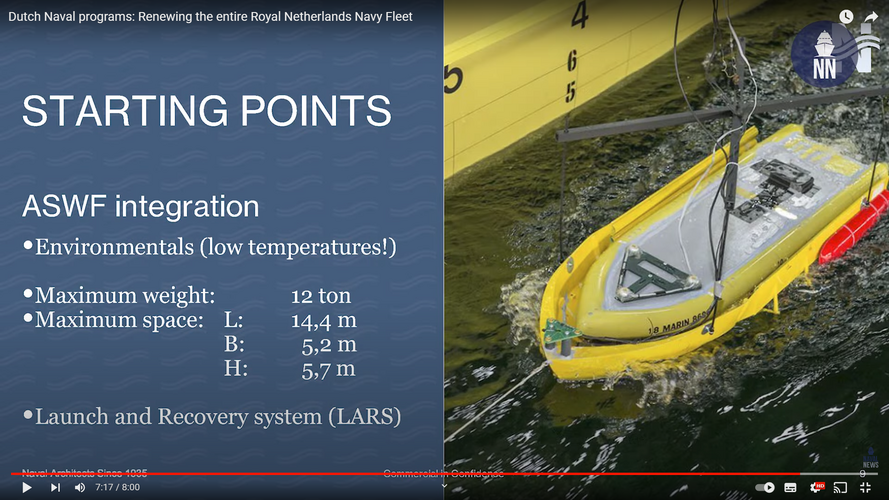
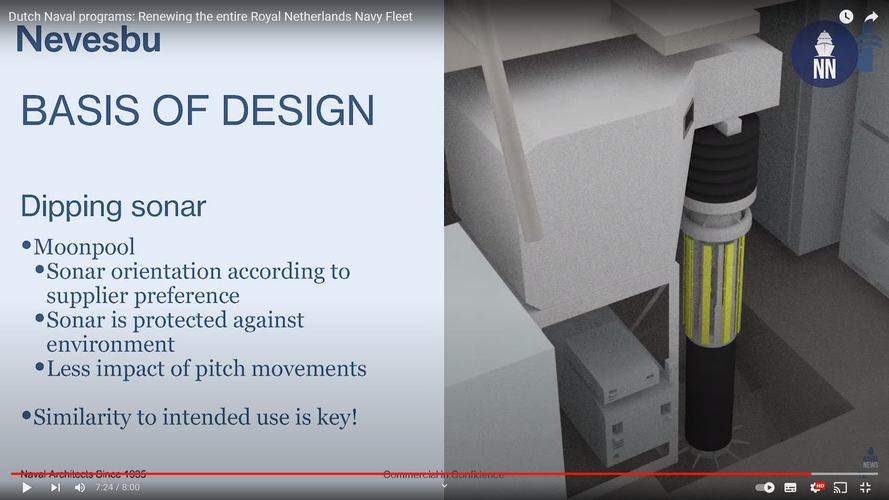
The website Navalnews.com interviewed Captain André van der Kamp from the Dutch COMMIT at Combined Naval Event (CNE) 2024.

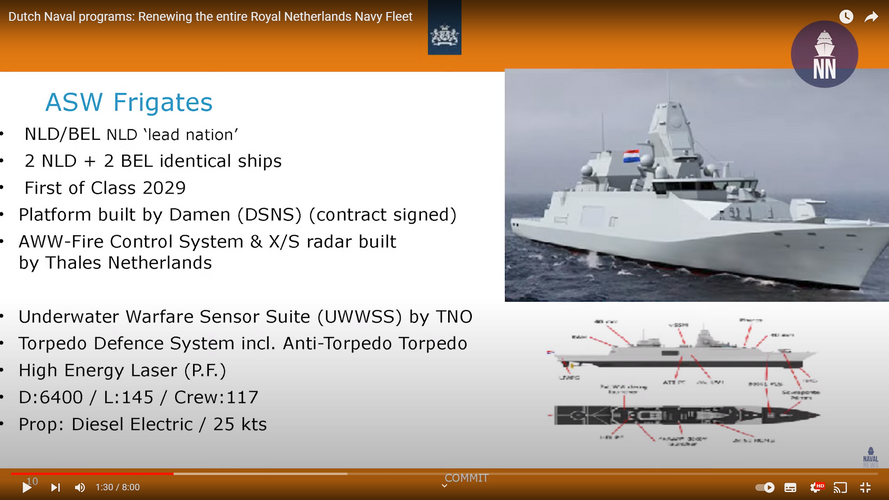
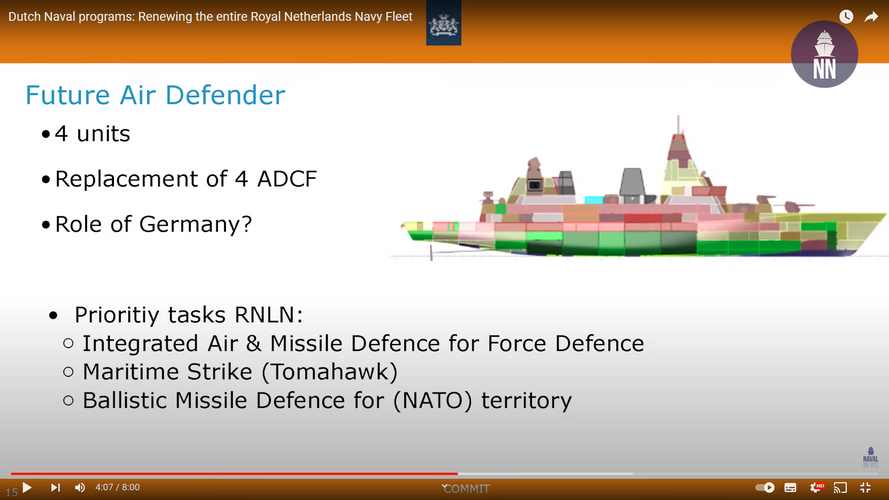
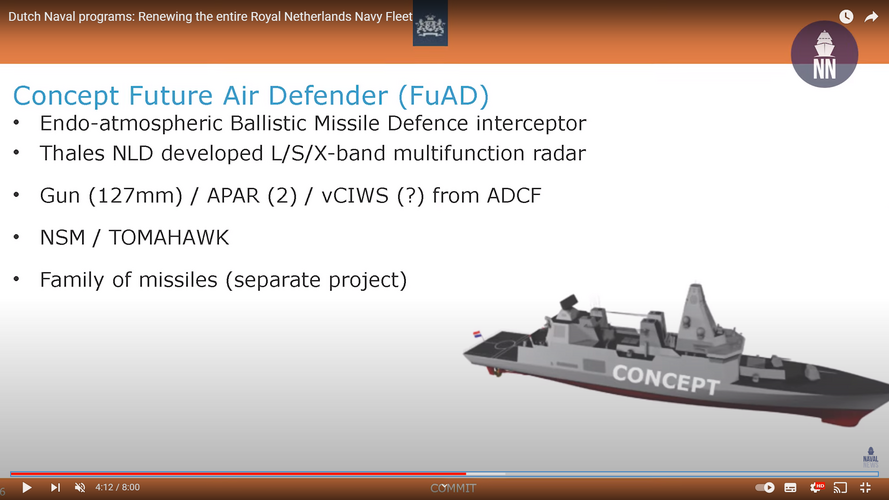
In the video there are multiple screenshots of concepts from the RNLN and her future fleet. The FUAD / vLCF ship is rumored to have 80 VLS cells.
 

Attachments

  • ASW_USV_ss1_0624.png
    ASW_USV_ss1_0624.png
    744.5 KB · Views: 190
  • ASW_USV_ss2_0624.png
    ASW_USV_ss2_0624.png
    1.1 MB · Views: 138
  • ASW_USV_ss3_0624.png
    ASW_USV_ss3_0624.png
    2.8 MB · Views: 125
  • ASW_USV_ss4_0624.png
    ASW_USV_ss4_0624.png
    1.7 MB · Views: 130
  • ASWF_Specs_NN_0624.png
    ASWF_Specs_NN_0624.png
    816 KB · Views: 138
  • ATS_0624_screenshot.png
    ATS_0624_screenshot.png
    1.2 MB · Views: 167
  • ATS_0624_ss_closeup_concepts.png
    ATS_0624_ss_closeup_concepts.png
    1.6 MB · Views: 182
  • FUAD_0624_Screenshot.png
    FUAD_0624_Screenshot.png
    588.3 KB · Views: 198
  • MICAN_0624_screenshot_01.png
    MICAN_0624_screenshot_01.png
    513.4 KB · Views: 159
  • MICAN_0624_screenshot_02.png
    MICAN_0624_screenshot_02.png
    1.2 MB · Views: 155
  • FUAD_0624_Screenshot_02.png
    FUAD_0624_Screenshot_02.png
    490.6 KB · Views: 179
  • FUAD_0624_Screenshot_03.png
    FUAD_0624_Screenshot_03.png
    721.9 KB · Views: 174
  • FUAD_0624_Screenshot_04.png
    FUAD_0624_Screenshot_04.png
    1.6 MB · Views: 162
  • FUAD_0624_Screenshot_TLAM.png
    FUAD_0624_Screenshot_TLAM.png
    530 KB · Views: 140
  • Supports_NN_0624.png
    Supports_NN_0624.png
    869.9 KB · Views: 156
  • Supports_NN_0624_2.png
    Supports_NN_0624_2.png
    1.9 MB · Views: 184
Last edited:
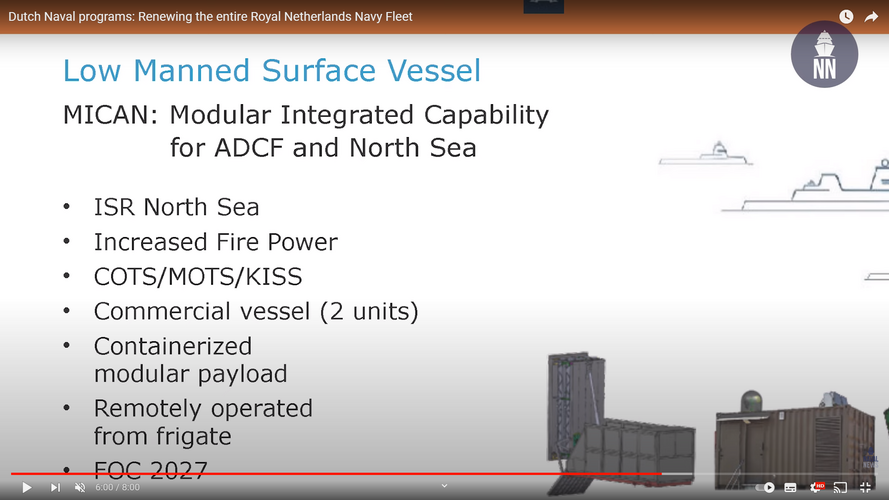
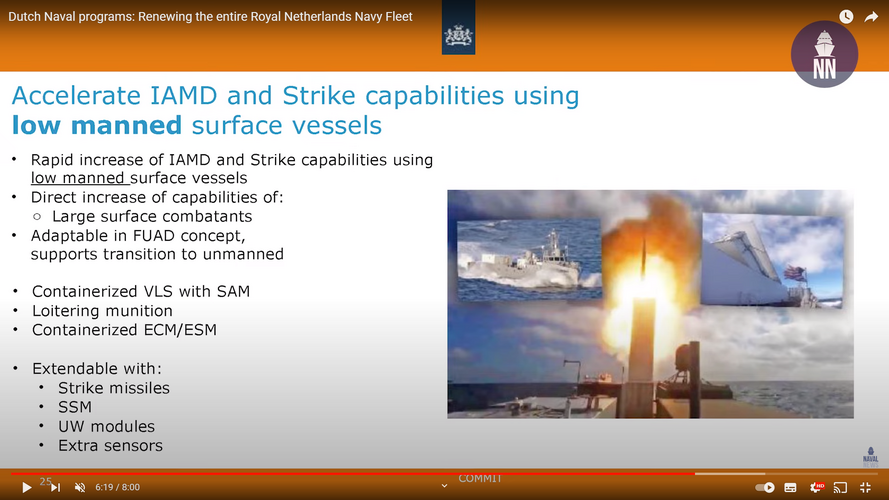
Project update: The RLNL will order 2 additional ASWF's and additional NH-90 helicopters. The number of helicopters has not been confirmed yet, rumors are 3 to 6 new NH-90 NFH. It was also officially announced that 2 low-manned vessels will be build for underwater protection of the North Sea that can also be fitted with missile modules to enhance a frigate's load out.

No further information on the FUAD or ATS/LPX projects.

A 3rd Belgian ASWF is rumored to be planned by the Belgian navy.
 
Regarding possible use by the new design of an ATT (Anti-torpedo Torpedo) hard-kill countermeasure system based on the Atlas Elektronik SeaSpider:
In the end, the timing of a European anti-torpedo torpedo program could line up with Dutch Navy plans for new anti-submarine warfare frigates, the first of which is expected to become operational in 2029. That is because German officials expect the PESCO program to yield a production-ready system that passes all regulatory requirements by the end of the decade, with a prototype built in 2028.
 
Self-defence missiles only is historically the definition of an FFG. The ones with area defence capability are mostly DDG's in sheep's clothing for navies where buying something 'larger' than a frigate might be a problem politically, eg Germany, or where there are local idiosyncracies around class naming - cf France with its talk of '1st rank frigates' and 'intermediate frigates' and where the Horizons are frigates in French use, yet DDGs in Italian use.
That’s not even remotely true, mostly because there’s hasn’t been an internationally recognized or accepted definition of what a frigate is…but just as an example OHPs carried SM-2s just like destroyers and cruisers and those were the longest range SAMs available in the fleet at the time.
 
Nations using VL Asroc (or local equivalent) for ASW: US, Japan, Korea. Everyone else decided if you have a helicopter you don't need anything else a generation ago. Italy's a slight anomaly with MILAS, but that's on a grand total of 6 ships, 2 of those 30 year old AAW DDGs and due for replacement.
So…russia…and how well is their navy actually doing in combat?
 
Regarding possible use by the new design of an ATT (Anti-torpedo Torpedo) hard-kill countermeasure system based on the Atlas Elektronik SeaSpider:
The below may suggest that the adoption of the ATT system might be finally in sight:
A revised tender for a Low Frequency Active TAS was subsequently issued by DALO. This outlined requirements for a dedicated blue water ASW solution “interoperable with existing Danish sonar systems in a bistatic and multistatic sonar environment, and [being] the primary sensors for future Torpedo Counter Measure systems”.
 
I wonder if Denmark and the Netherlands had a heads up that the Germans were finally about to move ahead with procurement of the SeaSpider / Anti Torpedo Torpedo when making their own decisions earlier in the year.

 
I wonder if Denmark and the Netherlands had a heads up that the Germans were finally about to move ahead with procurement of the SeaSpider / Anti Torpedo Torpedo when making their own decisions earlier in the year.

Very likely, they cooperate on some systems. Unfortunately the cooperation between the german navy and RNLN collapsed for F-127/FUAD.

But looking at the current Dutch plans FUAD will have more VLS cells then any current European destroyer. The most recent (publicly known) plans for FUAD will be 80 up to 100 VLS cells. The Germans chose AEGIS over Thales sensors but with ''only'' 64 VLS cells.

Recently Thales announced it has been working on integration controlling of multiple UAV's and USV's into its Tacticos CMS. This can be smaller USV's or large USV's as planned with RNLN's MSS missile boats.

The Dutch naval blog marineschepen.nl published this new development in a exclusive interview with Thales Nederland during DSEI 2025 in London (paywall article).

Source: https://marineschepen.nl/nieuws/Thales-werkt-aan-bediening-van-wapens-op-varende-drones-280925.html
Thales is developing a concept for remotely controlling weapon systems and sensors aboard unmanned vessels. This was revealed at the major defense trade fair DSEI in London. Marineschepen.nl obtained an exclusive explanation. "We've only told delegations from certain countries about this program, but we haven't shown it to a journalist yet," said a company spokesperson.
 
Very likely, they cooperate on some systems. Unfortunately the cooperation between the german navy and RNLN collapsed for F-127/FUAD.

But looking at the current Dutch plans FUAD will have more VLS cells then any current European destroyer. The most recent (publicly known) plans for FUAD will be 80 up to 100 VLS cells. The Germans chose AEGIS over Thales sensors but with ''only'' 64 VLS cells.
64x VLS cells is basically the VLS of a Burke without the cells holding Tomahawks or SM3s.

The Dutch boats will have more than a Tico-load of SAMs.
 
64x VLS cells is basically the VLS of a Burke without the cells holding Tomahawks or SM3s.

The Dutch boats will have more than a Tico-load of SAMs.
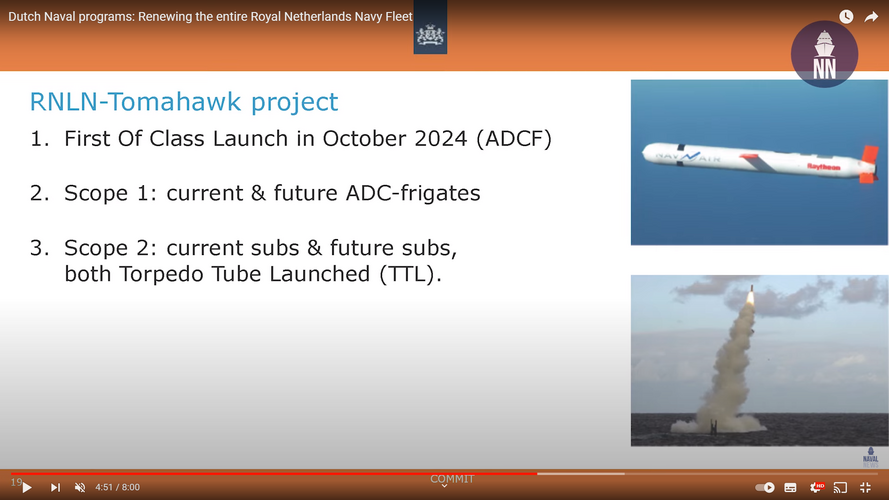
The FUAD will be equipped with SAM's & tomahawks . In 2026 the RNLN will decide what missile will be purchased for the future frigates/destroyers. The FUAD will likely also be capable of controlling multiple low-crewed/unmanned missile platforms, so they will have control over a total number of missiles equivalent to multiple Burke DDG's on SAM capacity.

The options are still open but with the purchase of tomahawk missiles a Mk41 VLS compatable missile is the most likely option.
But recently the Royal Navy decided to integrate the sea viper (Aster) into the future type 83 destroyer with Mk41 VLS so even a European missile would be an option. A few years ago the RNLN made public the wish to purchase all its future SAM's from 1 supplier, this still does not exclude any of the options:
- ESSM + SM-family from Raytheon (USA)
- Barak from Israel Aerospace Industries (ISR)
- CAMM + Aster from MBDA (EU)

My personal favorite will be Aster family combined with CAMM family into the Mk41 VLS.
The ESSM could be kept in service as long as LCF remain in service and for ASWF until MLU.
 
Very likely, they cooperate on some systems. Unfortunately the cooperation between the german navy and RNLN collapsed for F-127/FUAD.

But looking at the current Dutch plans FUAD will have more VLS cells then any current European destroyer. The most recent (publicly known) plans for FUAD will be 80 up to 100 VLS cells. The Germans chose AEGIS over Thales sensors but with ''only'' 64 VLS cells.
It all comes with its ups and downs and for example there atleast twice as many F-127 planned. Both Sides also plan USVs with Missile launcher too but for now F-126 is a more pressing matter for the german navy
 
It all comes with its ups and downs and for example there atleast twice as many F-127 planned. Both Sides also plan USVs with Missile launcher too but for now F-126 is a more pressing matter for the german navy
I don't think the cooperation will never reach the same level again as it was planned with F-127/FUAD. They would have been identical ships or at least the same weapons and sensors.

In my opinion it never had a chance of succeeding due to the pressure from the German naval industry. With F-126 order to Damen the German industry (mostly TKMS) put pressure on both projects. As far as i know the F-124's have no problems with Thales sensors , the switch to AEGIS was out of the blue for the RNLN.

Both navies will field USV missile launchers next to current and next generation AAW ships. F-126 from start was a platform for ASW, so 16 VLS cells is sufficient (ASWF and F-110 have same amount). The Ukraine war showed all navies in the world that more missiles are needed in a modern conflict to counter missile and drone treaths.

The RNLN delayed start of production of ASWF to be able to integrate lessons learned from Ukraine & Red Sea. For now it is unknown what these changes will be. The ASWF amount wil double for RNLN from 2 to 4 , the Belgian Navy will purchase 1 additional ASWF so total will be 7 ASWF's. For FUAD no additional plans were announced until now, 4 ships are planned to be build.

In my opinion to increase naval capacity the 4 OPV's should be replaced by 4 frigates with support capacity for amphibious tasks not the currently planned LPX (combined replacement OPV and LPD capacity). Both of the LPD's should be replaced by 4 smaller amphibious ships with firepower. In the future the JSS Karel Doorman should be replaced by a LHD/drone carrier and a 2nd AOR. To increase firepower efficiently a additional 2 Orka class submarines should be considered.
 
Last edited:
In my opinion it never had a chance of succeeding due to the pressure from the German naval industry. With F-126 order to Damen the German industry (mostly TKMS) put pressure on both projects. As far as i know the F-124's have no problems with Thales sensors , the switch to AEGIS was out of the blue for the RNLN.
As far as i know there quite some problems with it which was then enhanced by the whole combination on F-124 but even then all future tenders where supposed to be sourced mostly local which could have brought its own problems with it...
Both navies will field USV missile launchers next to current and next generation AAW ships. F-126 from start was a platform for ASW, so 16 VLS cells is sufficient (ASWF and F-110 have same amount). The Ukraine war showed all navies in the world that more missiles are needed in a modern conflict to counter missile and drone treaths.
Lets wait and see as F-126 is at its turning point with a relativ good chance at dying.
 
The Dutch are never all that free with info handouts on their warship projects. There is some discussion on Dutch military forums that, considering the changing times, there is actually a redesign going on to improve survivability regarding drones.

(read: More VLS. Maybe more 40 mil. guns.)
 
Given how inflated the ASWF’s costs already are, I can’t help but wonder how much higher they’ll climb... The Belgians for instance, had already budgeted nearly 1.3 billion € for their 3rd frigate.

Still can’t fathom why they opted for Ultra Maritime’s LFAPS instead of Captas, especially when virtually all their neighbors (UK, France, Norway, Denmark, Poland, Ireland, and further away Italy, Spain, Greece or even the US) went with the Thales system.

Also, while this is a non-issue for the dutch who already have dedicated AAW ships, I can't help but wonder if the begians wouldn't preferred a more multirole design (like FREMM EVO or FDI) given that this will be their only class of ships.
 

Attachments

  • image.png
    image.png
    387.7 KB · Views: 37
Given how inflated the ASWF’s costs already are, I can’t help but wonder how much higher they’ll climb... The Belgians for instance, had already budgeted nearly 1.3 billion € for their 3rd frigate.

Still can’t fathom why they opted for Ultra Maritime’s LFAPS instead of Captas, especially when virtually all their neighbors (UK, France, Norway, Denmark, Poland, Ireland, and further away Italy, Spain, Greece or even the US) went with the Thales system.
There could be lots of reasons like performance, maybe logisitic stuff or simple that they already invested quite some money into it.
Also, while this is a non-issue for the dutch who already have dedicated AAW ships, I can't help but wonder if the begians wouldn't preferred a more multirole design (like FREMM EVO or FDI) given that this will be their only class of ships.
If this re design happens which i kinda doubt (but as far as i heard was said from people at damen) then this ship could become more multi role. That said there is also news about F-126 being redesigned so who knows what happens behind there Doors
 
Did they include provisions for additional VLS cells on ASWF? 16x VLS cells is quite low... and leaving room for future growth is always a smart design practice.

But perhaps the more important priority would be to include provisions for a longer ranged SAM... perhaps CAMM-MR? Even with only 16 VLS you could easily mix & match 40-50 medium/long-ranged SAMs with dual-packed CAAM-MR and quad-packed ESSM.

Add the short ranged defenses which are already top-notch (21x RAM + 76mm Strales gun + 2x 40mm Bofors), and that would be better than any ASW frigate I can think of.
 
Given how inflated the ASWF’s costs already are, I can’t help but wonder how much higher they’ll climb... The Belgians for instance, had already budgeted nearly 1.3 billion € for their 3rd frigate.

Still can’t fathom why they opted for Ultra Maritime’s LFAPS instead of Captas, especially when virtually all their neighbors (UK, France, Norway, Denmark, Poland, Ireland, and further away Italy, Spain, Greece or even the US) went with the Thales system.

Also, while this is a non-issue for the dutch who already have dedicated AAW ships, I can't help but wonder if the begians wouldn't preferred a more multirole design (like FREMM EVO or FDI) given that this will be their only class of ships.
The reason behind LFAPS is very easy, the current 2 Dutch M-frigates (Van Amstel & Van Speijk) are already fitted with Ultra Maritime's LFAPS. Both systems will be transferred to the ASWF. The Belgian ASWF's & two additional Dutch ships will be fitted with new LFAPS systems.

And you are right about the Belgian need for a more multirole vessel, but the ASWF infact will be a multirole frigate with high end ASW focus. The missionbay can be fitted with a 12 m RHIB or other USV's, under the helicopter deck a area for multiple 20 ft containers (mission modules) is planned.

Did they include provisions for additional VLS cells on ASWF? 16x VLS cells is quite low... and leaving room for future growth is always a smart design practice.

But perhaps the more important priority would be to include provisions for a longer ranged SAM... perhaps CAMM-MR? Even with only 16 VLS you could easily mix & match 40-50 medium/long-ranged SAMs with dual-packed CAAM-MR and quad-packed ESSM.

Add the short ranged defenses which are already top-notch (21x RAM + 76mm Strales gun + 2x 40mm Bofors), and that would be better than any ASW frigate I can think of.

No they did not, the currently planned additions do not include more VLS cells. The navy answerd questions from marineschepen.nl and made clear that additional VLS cells are not being considered. Thet confirmed the rumors about that the requirements do not fit into the current design. The current options are simple:
- lower the requirements (this will limit the capabilities and/or make the ships more vulnerable.
- enlarge the design to fit requirements (this will also increase the price)

Exact details were not disclosed by the navy.

As far as made public CAMM is not being concidred at this point, but with the upcomming decision for new SAM missiles for LCF/FUAD it is possible. The RNLN wants to buy its future missile family from 1 supplier so that can be Raytheon (ESSM/SM-family), IAI (Barak familiy) or MBDA (CAMM/Aster-family).

My guess is that additional counter-drone systems are planned to be included and/or fitted but not with. The current USV-bay's were very small and had no margin for larger USV's this might also be changed.
 
Last edited:
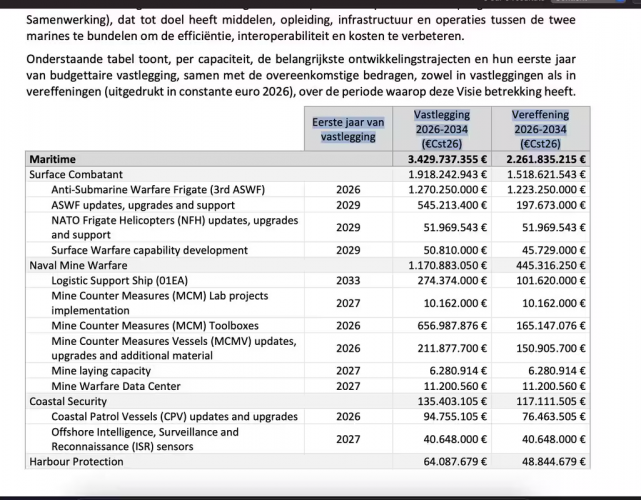
A duel between Standard Missile, Barak and Aster.
Weirdly nothing on CAMM ...
I'd be surprised if MBDA tried to bid both Aster 30 and CAMM-ER/MR, usually companies prefer not to compete with themselves. Plus Aster 30 outperforms CAMM-ER, while CAMM-MR has yet to fly. MBDA particularly won't want to bid Aster 30 + CAMM (baseline), as it gives the impression they don't have any faith in Aster 15.
 
I'd be surprised if MBDA tried to bid both Aster 30 and CAMM-ER/MR, usually companies prefer not to compete with themselves. Plus Aster 30 outperforms CAMM-ER, while CAMM-MR has yet to fly. MBDA particularly won't want to bid Aster 30 + CAMM (baseline), as it gives the impression they don't have any faith in Aster 15.
Didn't think of that ... although Aster 15 still complements CAMM fairly well, especially against higher end leakers.

Also, Singapore's MRCV will feature 32 cells for both Aster and MICA, the latter probably replacing the Aster 15 ?
 
Didn't think of that ... although Aster 15 still complements CAMM fairly well, especially against higher end leakers.
CAMM has the advantage of denser packing, so you're trading off more missiles against performance, and if you want Sylver/Aster, why not go Aster 30, not 15 (which is effectively what the RN is doing in the Type 45 upgrade).

Also, Singapore's MRCV will feature 32 cells for both Aster and MICA, the latter probably replacing the Aster 15 ?
I keep forgetting MBDA have three different short range VL SAMs, not two. And MICA NG means it's more competitive than it used to be.
 
Choice of missile system family for the 4 Future Air Defenders (FuAD) announced before end-2025.

A duel between Standard Missile, Barak and Aster.
Weirdly nothing on CAMM ...
The RNLN wants a family of missiles for its future ships. If MBDA is selected for Aster-30 it would be possible that the ESSM wil be replaced by CAMM family. The RNLN wish is to have 1 supplier for its missile systems in the future, but it might not include all missiles.

The biggest problem with the new SM missiles is the integration with RNLN/Thales Netherlands CMS ''Guardian''. Because only the RNLN and Belgian navy operate this system the changes to the missiles are expensive. The US also needs to approve these changes made by Thales Netherlands in Hengelo.

Yesterday on the NEDS 2025 tradeshow in Rotterdam a new Dutch missile was announced, the Dutch industry will build a tomahawk alternative in the coming 3 to 6 months. The missile will be a cheap alternative to the US made Tomahawk, 25% of the critical parts need to be 3d printed (even in the field during combat). It will have a range of at least 1000 km and a warhead of 100 kg (220 lbs). The launch platform(s) are not announced so far, i assume it will be a land based cruise missile.


Similar threads

Back
Top Bottom