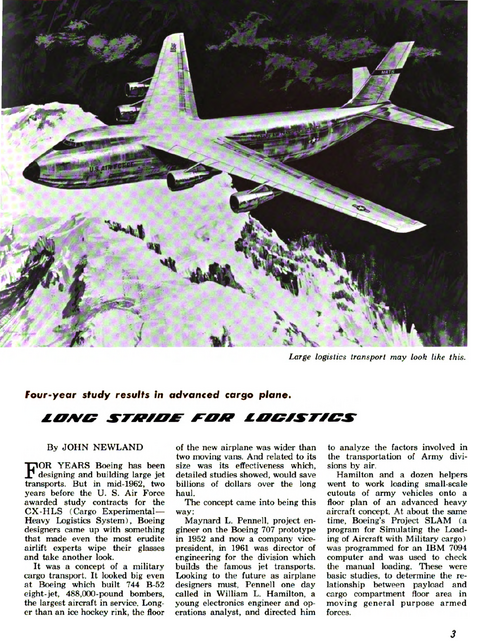
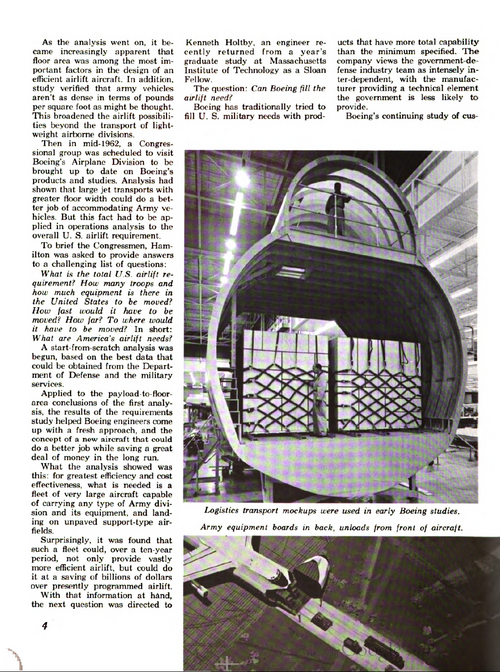
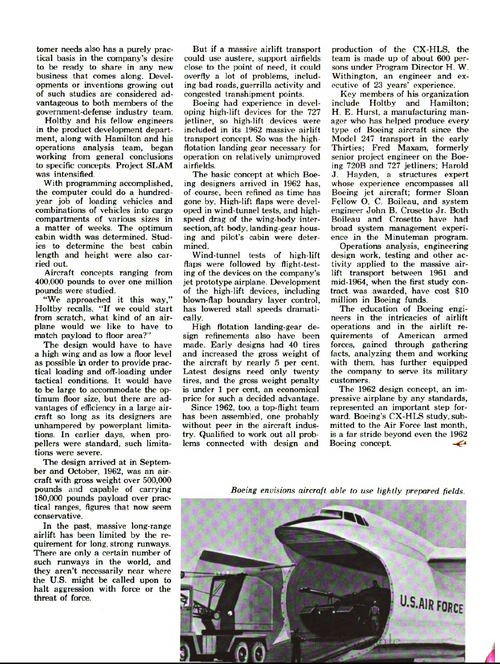
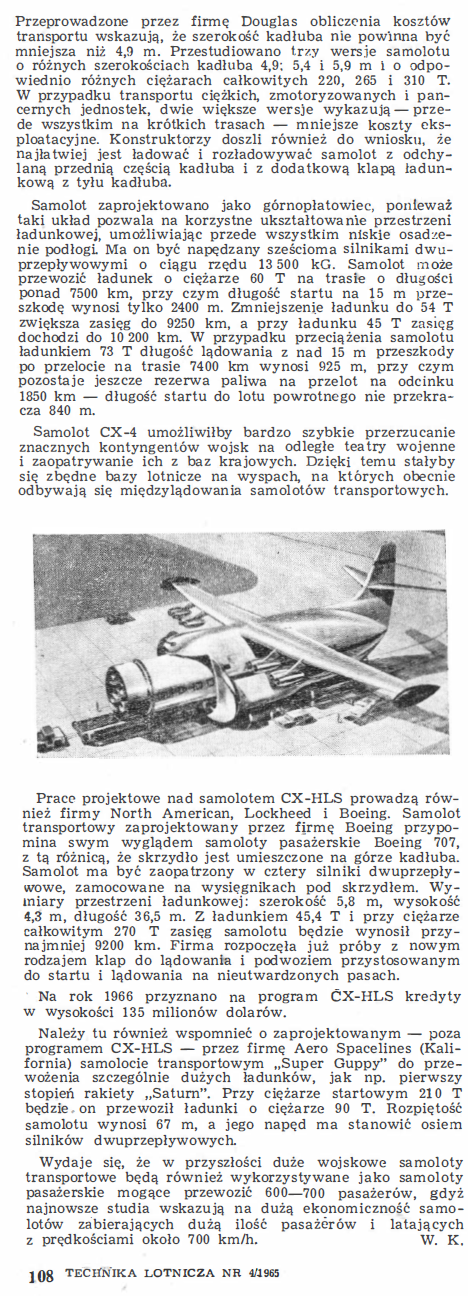
You are bidding on an original press photo from 1964 featuring Artist's Concept of Boeing Transport Design The Boeing Co's bid to develop and produce the proposed CX-HLS heavy transport for their Air Force is based on company-funded studies beginning in late 1961, Boeing Magazine reported yesterday. Boeing is one of three major aerospace firms engaged in competition to design the CX-HLS (Cargo, Experimental, Heavy Logistics System.) The other contenders are the Lockheed Aircraft Corp. and a team headed by the Douglas Aircraft Co. Operations analysis, engineering design, testing a n d other work applied to the transport concept between 1961 and mid-1964, when the first study contract was awarded, have cost $10 million in Boeing funds, the company said. Boeing noted that in late 1961 its operations analysts carried out a study of the factors involved in the transportation of Army divisions by air. Studies in early 1962 made use of electronic computers to "load" all types of Army vehicles, including tanks a n d other heavy fire1964-10-20T14:02:33+05:30go compartment of various sizes. The purpose of this exercise was to determine the best fuselage size for maximum aircraft efficiency. Boeing Engineers later studied transport aircraft ranging from 400,000 pounds gross weight to more than 1 million pounds. Additional studies were made to determine which design would provide maximum cost effectiveness. Boeing studies showed a fleet of large logistics transports, such as the type studied, not only would provide vastly more efficient air lift but would do so over a ten-year period at a saving of "billions of dollars over presently programmed air lift." The basic concept for a CX-type transport has been substantially improved and re-fined by the company. At the moment, Boeing has a team of about 600 employes assigned to the CX-HLS project. Head of the team is H. W. Withington, long-time Boeing engineering executive. . Photo is 8” x 10” in size.

URL:
http://www.ebay.com/itm/1964-Boeing...78339?pt=Art_Photo_Images&hash=item2ec15cc623

From Boeing magazine 1964
 

Attachments

  • 20.png
    20.png
    1.1 MB · Views: 293
  • 21.png
    21.png
    2.3 MB · Views: 170
  • 22.png
    22.png
    2.6 MB · Views: 156
  • 23.png
    23.png
    2.2 MB · Views: 170
I wonder if the STF200 was an all-new design or similar in concept to the far later refanned JT8D-200 series?

It is noteworthy that Rolls-Royce was promoting a refanned Medway in this era as well - the 22,000lb st RB177-2.

The great irony is that it took longer than expected for high bypass ratio turbofans to dominate the commercial airliner market.
Takes a while to get the new fans civilian-certified, and the airlines are unlikely to want to divest of their existing planes till they're fully depreciated. 10 years minimum service time, and often closer to 20 years in service before their initial buyer sells them off. It'd take an absolutely enormous fuel price hike to make airlines even consider the idea, and that price would have to stick for almost a decade.

So while some planes got re-engined with JT3Ds or CFM56s, that wasn't until the 1980s. Everything else was new build (757, 767, A300 series) so basically replaced 707s etc when the airlines sold off theirs. 727s were still going pretty strong in 1998, and just getting an engine with a giant muffler to comply with noise rules. MD80/90s got fans to comply with noise rules.

Barring some oddities like the gravel kit equipped 737s. Those are the old skinny jets and will never, can never be fans.
 
Last edited:
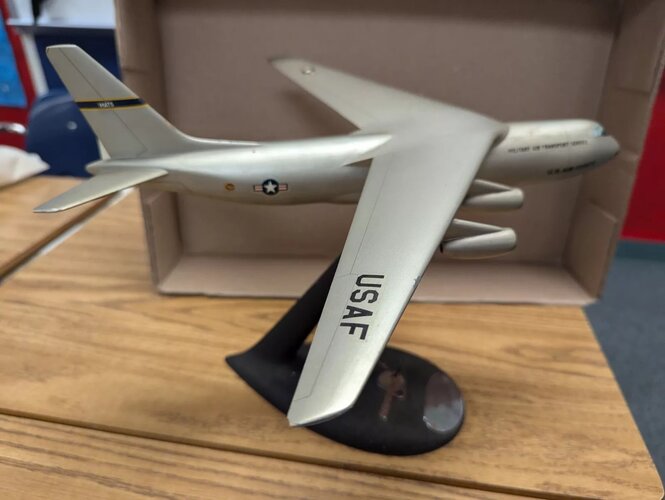
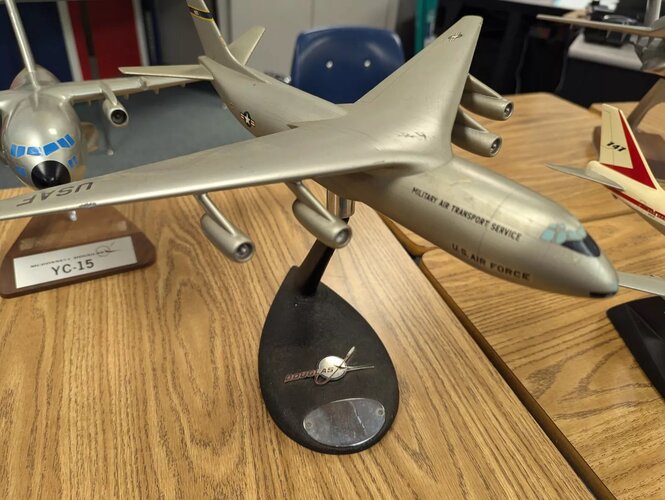
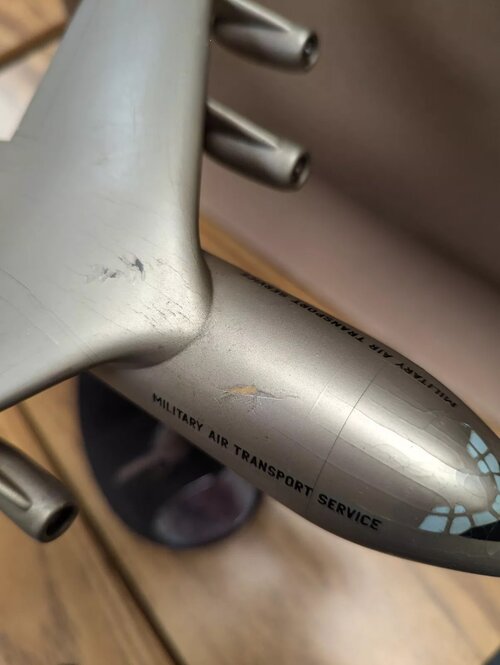
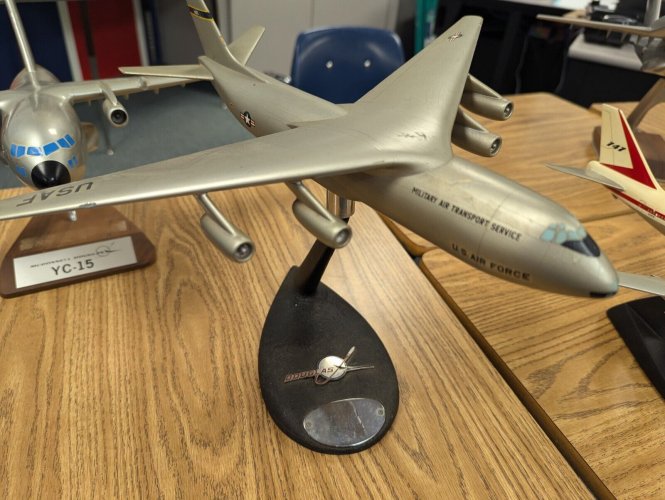
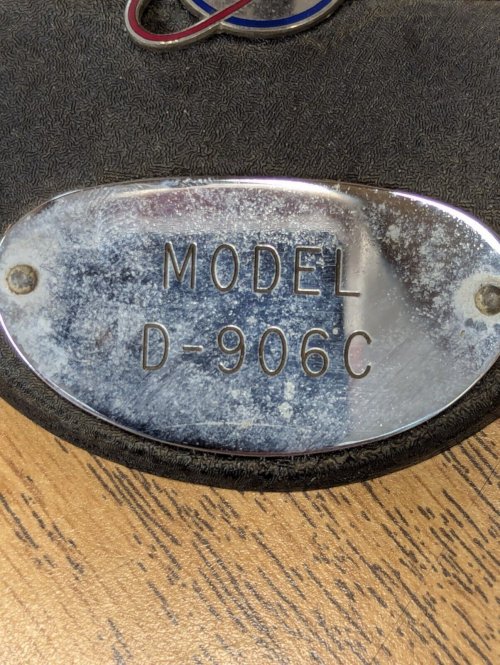
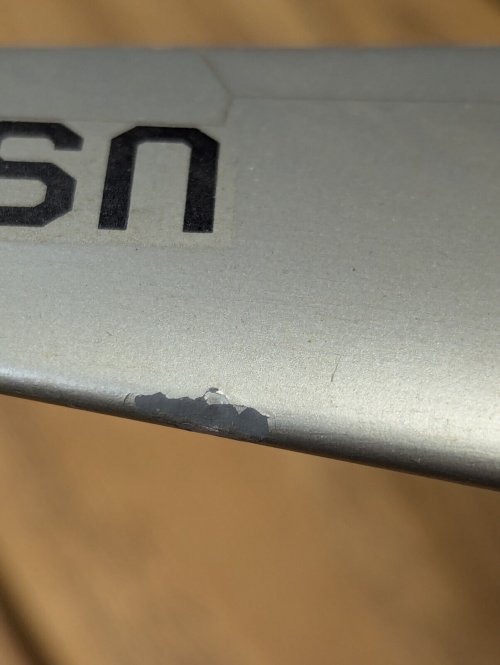
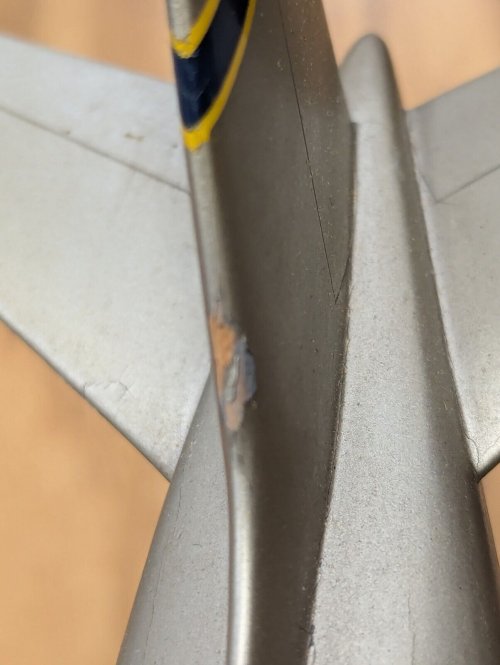
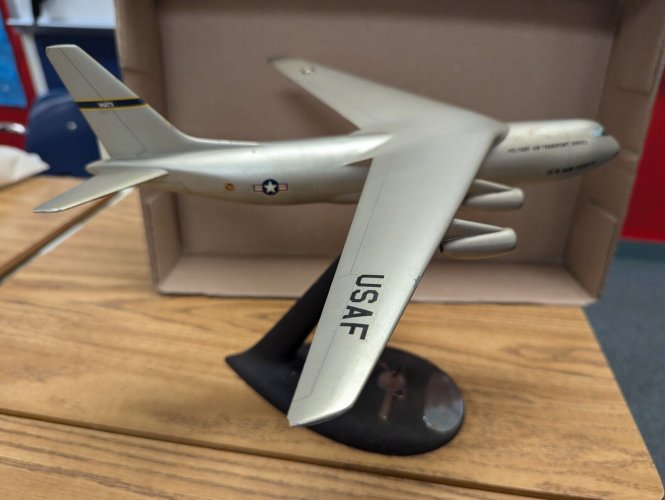
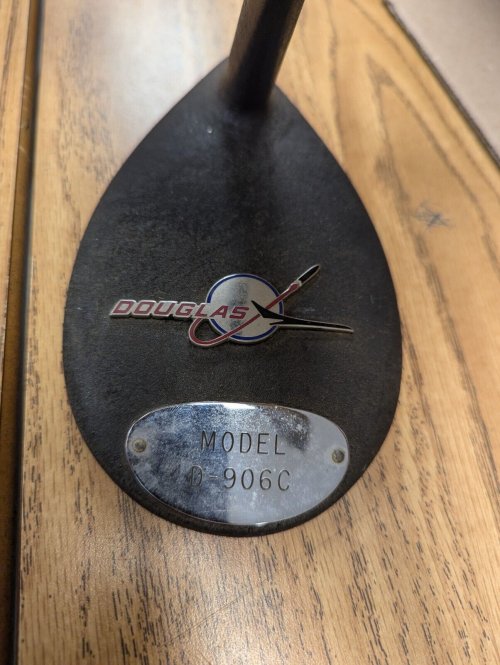
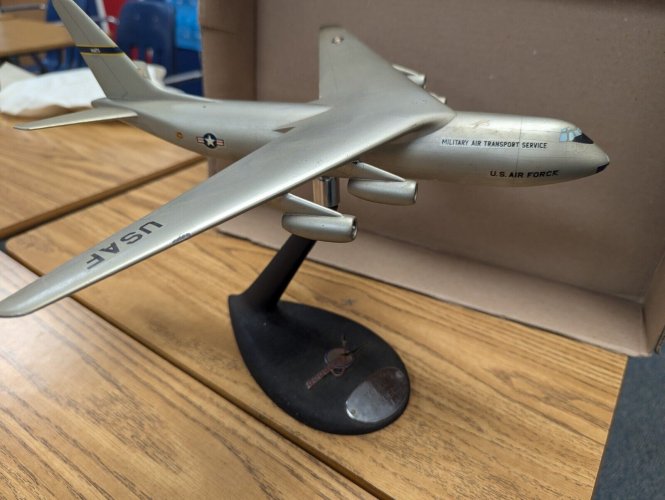
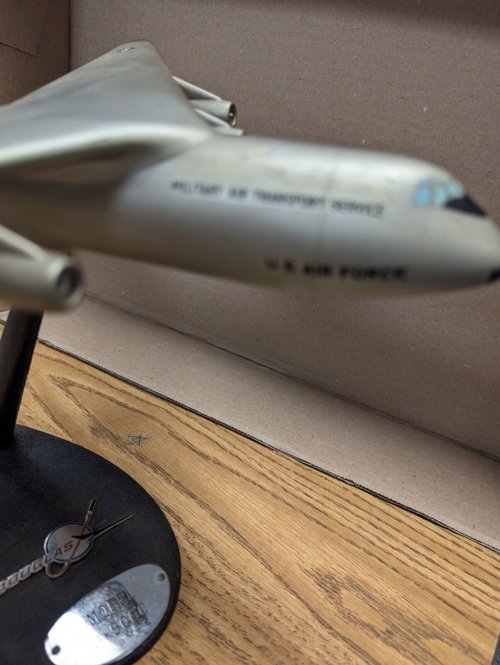
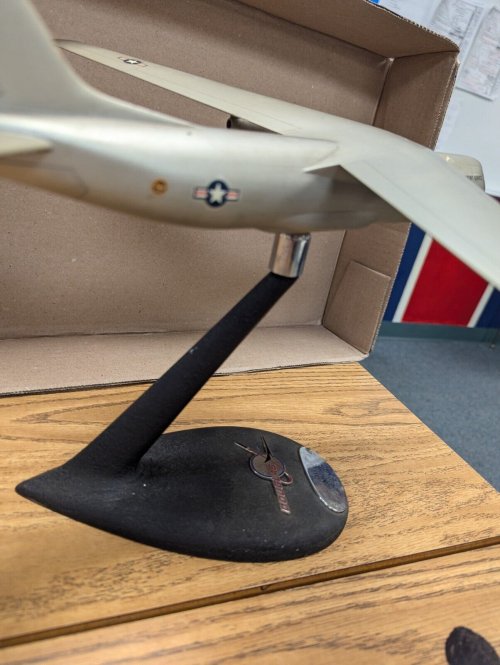
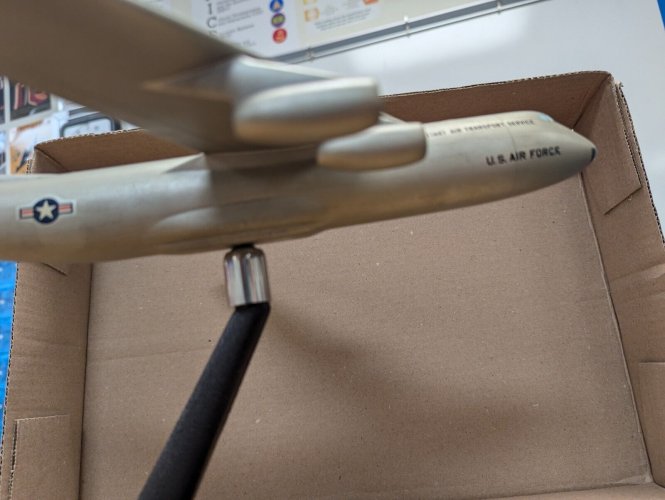
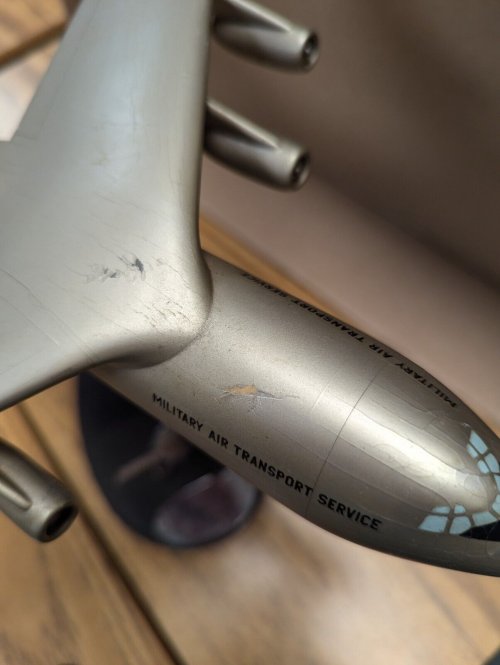
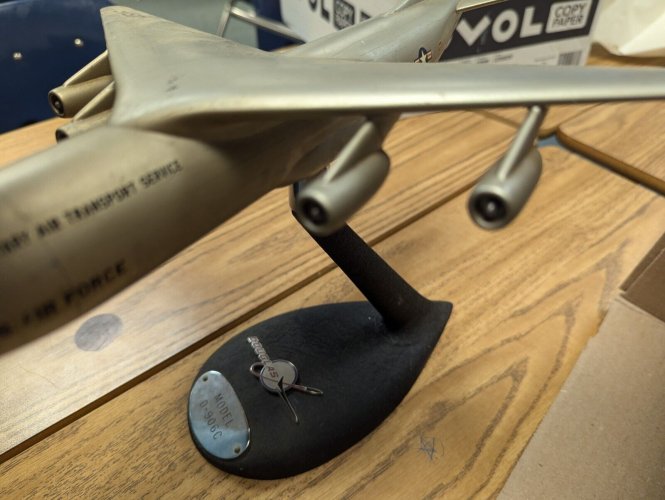
Recently acquired model of the Douglas D-906C. It looks a little smaller than the CX-HLS contenders, probably as large as possible with the 4 low-bypass turbofans depicted. I'm not sure how it relates to the C-5 competition, so please relocate this if there's a better place for it. One unusual feature is what looks like a break aft of the cockpit where the nose would swing open. There are no hinge fairings or details of how the nose gear would be arranged.
 

Attachments

  • s-l1600aaaaaaaaaaaaaaaaaaaaaaaaaaaaaaaaaaaaaaaaaaaaaaaaaaaaaaaaaaaaaaaaaaaaaaaaaaaaaaaaaaaaaaa...jpg
    s-l1600aaaaaaaaaaaaaaaaaaaaaaaaaaaaaaaaaaaaaaaaaaaaaaaaaaaaaaaaaaaaaaaaaaaaaaaaaaaaaaaaaaaaaaa...jpg
    234.1 KB · Views: 145
  • D-906C.jpg
    D-906C.jpg
    451.1 KB · Views: 139
  • D-906Ca.jpg
    D-906Ca.jpg
    219.7 KB · Views: 150
Recently acquired model of the Douglas D-906C. It looks a little smaller than the CX-HLS contenders, probably as large as possible with the 4 low-bypass turbofans depicted. I'm not sure how it relates to the C-5 competition, so please relocate this if there's a better place for it. One unusual feature is what looks like a break aft of the cockpit where the nose would swing open. There are no hinge fairings or details of how the nose gear would be arranged.
I'd expect that the nose gear would be just aft of the break, to make things simple.
 
I'd expect that the nose gear would be just aft of the break, to make things simple.
That's one way to do it but it requires the weight and other loads of the nose section to be carried across 1 or 2 hinges and one side of the fuselage when the nose is open.
Another way would be to distribute the gear fore and aft of the break so that the nose section could be supported directly. The forward would have a nose-open position matching the radius of the opening process. The rear element could be an actual 2nd nose gear or consist of one or more struts that would only be used when parked.
My guess is that having a real landing gear aft of the break and a parked-only gear forward of the break would be most efficient.
 
The six engine D-906 (sans suffix) was 220,000lb OWE and 606,0000 lb MTOGW with 192.21ft wingspan and 190.7ft length.

It seems D-606 spans CX-4 / CX-X timeframe, before CX-HLS.
 
American Secret Projects. US Airlifters since 1962. G Cox and C Kaston. Ed Crécy.

D-900 can be found as a 3-view drawing at Pg 19. And model photos in Pg 20.
D-906A 3 view drawing is on page 31 (D-906C was a 4 engined variant of the 6 engined D-906A)

Both D-900 and D-906 look almost identical in any detail. D-906 was larger than the D-900 ( 191 ft long 192 ft span vs 175 ft long 175 ft span )
but this is not clearly apparent from a drawing or a model.
 
Douglas Model 920 is an incorrect Douglas model number in the CX-HLS proposal submission, as there is nothing written about it in such a fundamental book as is "American Secret Projects Vol.3, US Airlifters Since 1962"
 
Please see the "yellow box" titled Douglas Project Numbers on page 16 of ASP3.
 

Attachments

  • 1_9bbf09a46230c38a5f389da473fa8af7.jpg
    1_9bbf09a46230c38a5f389da473fa8af7.jpg
    281 KB · Views: 100
  • 1_9bbf09a46230c38a5f389da473fa8af7 (1).jpg
    1_9bbf09a46230c38a5f389da473fa8af7 (1).jpg
    438.6 KB · Views: 94
  • 1_9bbf09a46230c38a5f389da473fa8af7 (2).jpg
    1_9bbf09a46230c38a5f389da473fa8af7 (2).jpg
    145 KB · Views: 81
  • 1_9bbf09a46230c38a5f389da473fa8af7 (3).jpg
    1_9bbf09a46230c38a5f389da473fa8af7 (3).jpg
    151.6 KB · Views: 77
  • 1_9bbf09a46230c38a5f389da473fa8af7 (4).jpg
    1_9bbf09a46230c38a5f389da473fa8af7 (4).jpg
    154.3 KB · Views: 77
  • 1_9bbf09a46230c38a5f389da473fa8af7 (6).jpg
    1_9bbf09a46230c38a5f389da473fa8af7 (6).jpg
    295.8 KB · Views: 81
  • 1_9bbf09a46230c38a5f389da473fa8af7 (5).jpg
    1_9bbf09a46230c38a5f389da473fa8af7 (5).jpg
    200.4 KB · Views: 87
  • 1_9bbf09a46230c38a5f389da473fa8af7 (7).jpg
    1_9bbf09a46230c38a5f389da473fa8af7 (7).jpg
    255.4 KB · Views: 78
  • 1_9bbf09a46230c38a5f389da473fa8af7 (8).jpg
    1_9bbf09a46230c38a5f389da473fa8af7 (8).jpg
    246.7 KB · Views: 71
  • 1_9bbf09a46230c38a5f389da473fa8af7 (9).jpg
    1_9bbf09a46230c38a5f389da473fa8af7 (9).jpg
    211.1 KB · Views: 73
  • 1_9bbf09a46230c38a5f389da473fa8af7 (10).jpg
    1_9bbf09a46230c38a5f389da473fa8af7 (10).jpg
    147 KB · Views: 74
  • 1_9bbf09a46230c38a5f389da473fa8af7 (11).jpg
    1_9bbf09a46230c38a5f389da473fa8af7 (11).jpg
    206.2 KB · Views: 93
From the Spangenberg archives, in a discussion of Lockheed and the S-3 contract:

As I already indicated, Lockheed won that second phase of the competition. I
suppose that was close to what they now talk about as "best and final offer" although it
went on longer and was less of a bidding contest. Before we were able to announce
Lockheed as a winner however we ran into a complication with our own CNM financial
people and our secretary for logistics or whatever he was called, I&L of Financial
Management maybe, questioning whether or not Lockheed was in any financial
condition to undertake a contract. The Air Force C-5 had Lockheed in trouble. They
were getting guaranteed loans from the government. It obviously became then
something that the managers on high could question since they were usually not in a
position to question anything else. That held us up for quite a while. We had to show the
differences between our kind of a contract and the C-5 contract.
Just as an aside on all this for those that don't know the story the C-5 really got in
trouble right from the start in that competition run by the Air Force, and reported in a

-205-
congressional hearing. It appeared that the Boeing design had won the C-5 competition,
and that decision got overturned by the Secretary of the Air Force or OSD, I can't
remember which one, primarily because Lockheed had a lower price than the Boeing.
Unfortunately, however, there was a reason for the difference in price. The Lockheed
airplane was a little too small but the decision went to Lockheed and then they were
pressured by the higher ups in Defense Department to "not change their cost" while
increasing the aircraft size by something like ten percent. They made a lot of other
changes but they were held to that original cost quotation.
In addition, the whole
procurement was done under a contracting scheme called Total Package Procurement,
and that didn't help either. In Total Package Procurement the air frame contractor is held
responsible for buying the engines and the equipment that's usually GFE where the
government would take the responsibility if any of those items went overweight or over
cost. Even then Lockheed would have been all right financially if the Air Force had
bought all the items that were initially on the contract. As I recall there were three lots,
lots A, B, and C. They had actually bought the first two, lots A and B, and they had given
Lockheed a letter of intent for the last and big lot. At the time of their financial crisis that
contract had not been definitized. Well, the way the contract was set up each lot was
priced, but included a correction factor for the actual price of the preceding ones. And if
you worked out the mathematics of what the contract called for, the loss on the final
contract, if they had bought all the airplanes , would have been minimal and would not
have caused a problem for the contractor. But since they never reached that point
Lockheed found themselves unable to proceed without getting some loans that had to be guaranteed by the government. Eventually they all got repaid of course and the
government made money on the deal.
The bold section is new to me. I always thought it was Lockheed being Lockheed and overpromising, but if the DoD wanted them to scale up the design but keep the cost the same - well that's stupid even by the standards of the McNamara era.
 
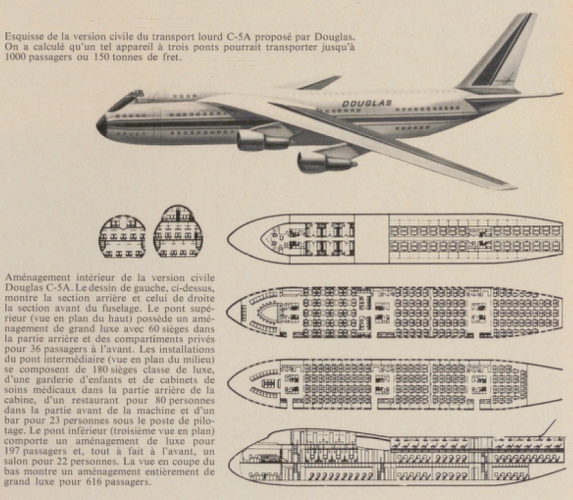
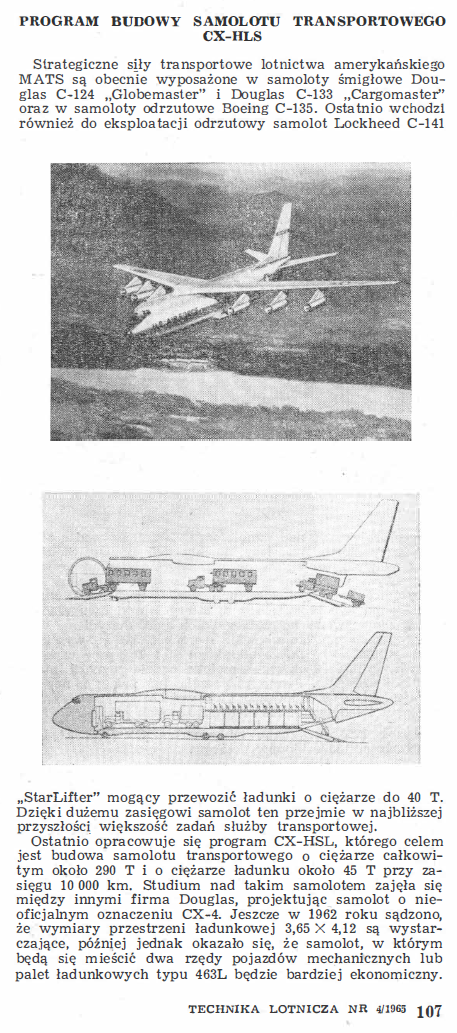
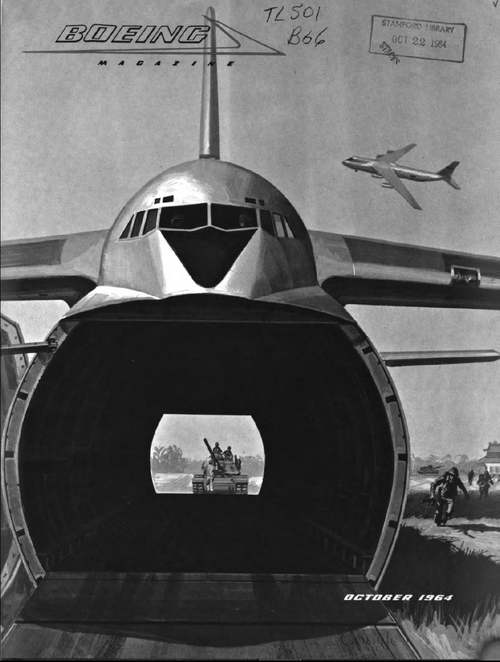
From Technika Lotnicza 1965,

and I notice that,the North American proposal,there's no sign or
detail about it ?.
 

Attachments

  • 5.png
    5.png
    398.2 KB · Views: 108
  • 6.png
    6.png
    509.8 KB · Views: 102

Similar threads

Back
Top Bottom