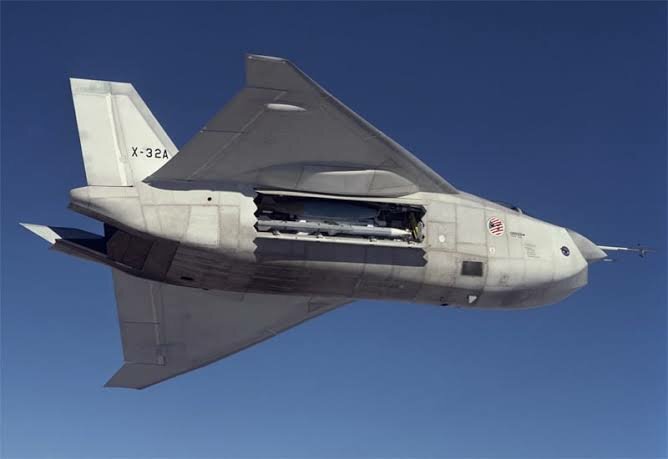
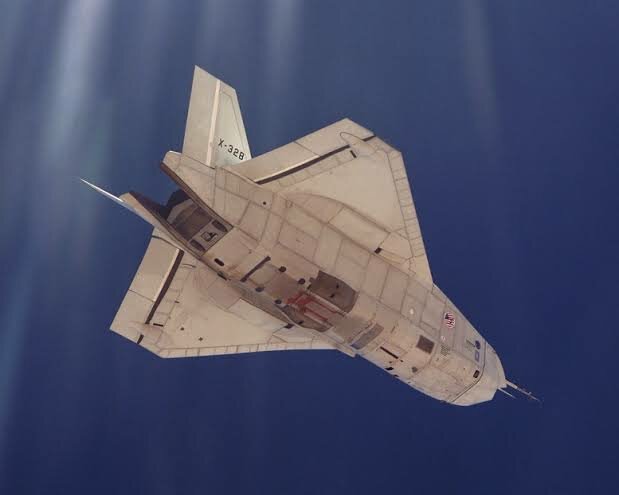
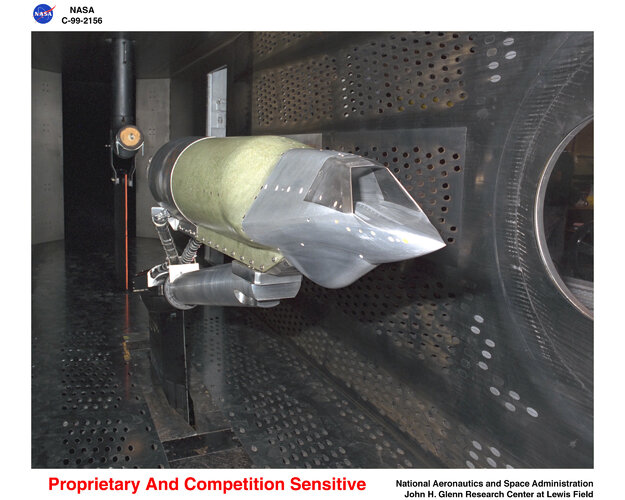
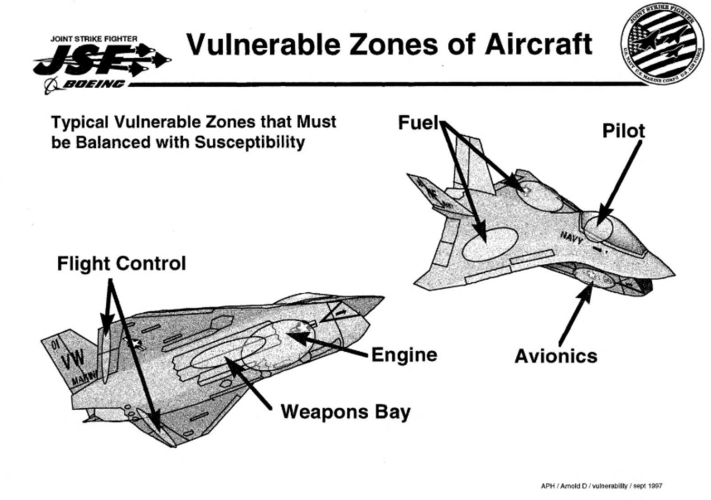
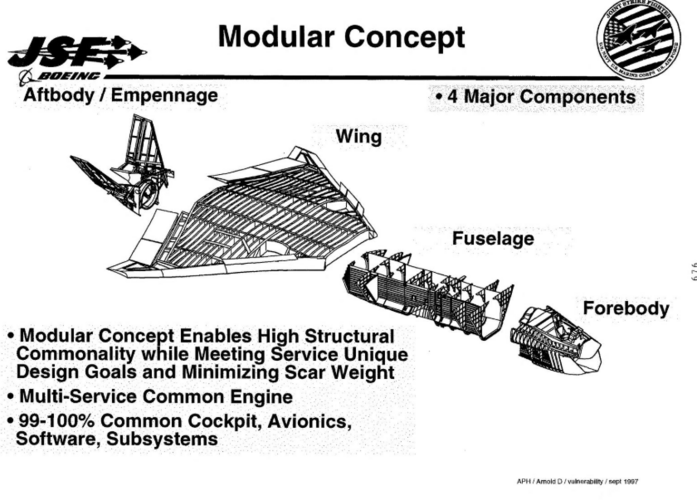
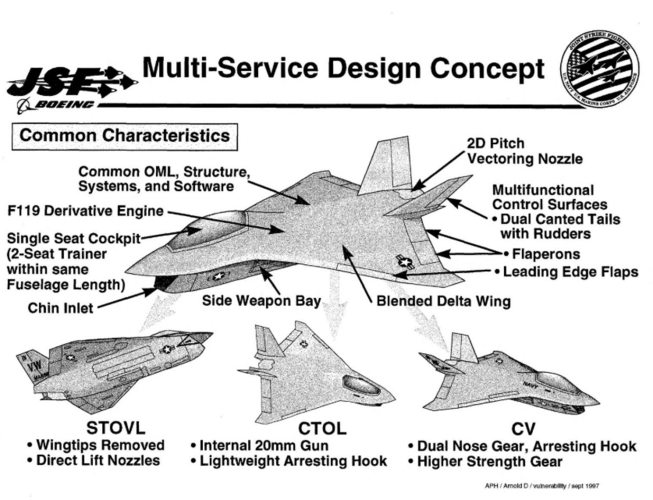
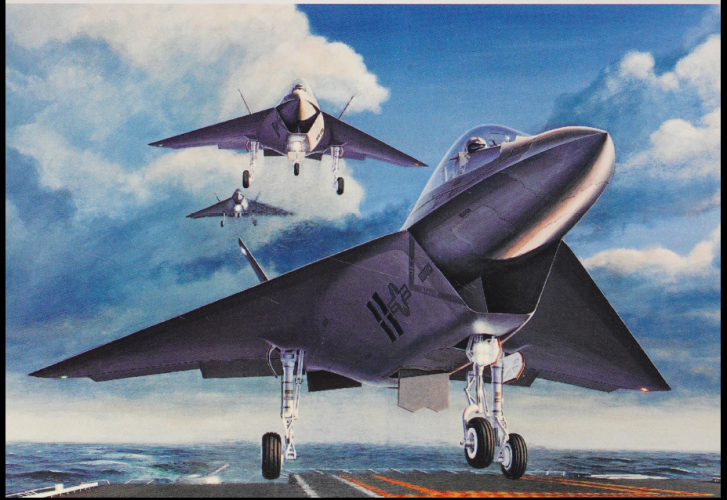
What's interesting, both X/F-32 and X/F-35 carried the same basic payload internally, one bomb, one missile. X/F-32 on the sides and F-35 underneath. I think the X-32 could have evolved into a pseudo A-4/A-7 type attack jet (the redesigned shaping, inlet and the H-tails), god knows we need a good mix of aircraft mission types on our flattops now, not just F-18's and F-35's.
 
If I remember correctly the X-32 met all the JSF program targets as did the X-35. The main difference between them was the complexity of the V/STOL method. The X-32 team chose a relatively simple low weight solution while the X-35 went with a more complex higher performance solution. The X planes produced didn’t fully represent an operational fighter due to budget constraints.

Remember that the Joint Strike Fighter program was basically going to provide F-117 stealth capabilities plus air to air (2x 2000lb bombs and 2x AMRAAM) to replace all the Harrier, F-16 and FA-18 fleets. Pretty impressive really!

Using JSF airframes to replace the F-14, F-15 and A-6 and F-111 roles doesn’t seem as good though does it! Shame the JSF program didn’t cover two airframes really. Single engine lightweight to replace Harrier and F-16, then twin engine heavy to replace F-14, F-15 and FA-18. Same gear, but heavy has twice the weapons etc.

I always thought that the simpler X-32B/F-32B was the way to go for the UK Harrier replacement. The RAF could have operated them in STOL mode most of the time if bring back weight was the issue on land operations. Even if the internal payload was reduced to 2x 1000lb bombs and 2x AMRAAM as in the F-35B it would have beat the Fleet Air Arm Sea Harrier FA2’s 4x AMRAAM maximum load (6x AMRAAM or 4 plus 2x ASRAAM maybe?).

Anyway, I’m a Boeing X-32/F-32 fan! :D
 
Last edited:
The redesign of the X-32 didn't have anything to do with problems with stability. It had to do with meeting the Cl required for the carrier approach once their, the Navies, requirements changed. Otherwise, he X-32 was faster and more maneuverable than the X-35. STOVL has always been hard especially for the mission being pushed for JSF. However, Boeing always knew that if LM got the lift fan to work they couldn't compete in the STOVL realm. LM got the lift fan to work and that was that.
I would assume the X-32 was more maneuverable than the X-35, at least at some speeds, due to the 2D thrust-vectoring nozzle. But was it really faster? I had thought both were designed for a max speed of about Mach 1.8, although I don't think either did flight testing at such speeds since it was beyond the scope of what the demonstrators were supposed to prove. Most of the later sources on the subject only mention speeds as being Mach 1.6+ or so.

I do wonder how much the redesigned wing and tail intended for the production "F-32" would have changed flight characteristics.
 
If I remember correctly the X-32 met all the JSF program targets as did the X-35.
You aren’t remembering correctly I’m afraid.
The main difference between them was the complexity of the V/STOL method. The X-32 team chose a relatively simple low weight solution
Low weight, low capability. It could barely hover. The weight difference was <2000lb btw, 10%. X-32 appears to have had a more powerful engine btw.

And that’s just wrong, it wasnt stovl “complexity” the main difference - it was the entire conceptual design of the aircraft. Look at the planform, crucially where the engine is, where and how the wing joins the fuselage, the cockpit, what control surfaces you do/dont have. What that means for stability and control and how this thing flies and is manoeuvred.

Everything on X-32 was subordinated to a layout barely moved on from Harrier and hopelessly compromised by the stovl “solution”. Everything on X-35 is a layout that decades of operational aircraft had always shown was the layout for a combat aircraft and a decade plus of R&D looking at options to design a stovl system that worked with the layout, not vica versa.
while the X-35 went with a more complex higher performance solution. The X planes produced didn’t fully represent an operational fighter due to budget constraints.
Nothing to do with budget constraints, they were concept demonstrators to enable a downselect. A level of maturity commensurate with the timeline and desire to then initiate the main program. The planform, STOVL, cv-ctol-stovl commonality (incl conversion), LO and FCS working were what they wanted to see in the flesh before going further. As we saw the X-35 with all its potential took many billions to mature to an operational platform.
Remember that the Joint Strike Fighter program was basically going to provide F-117 stealth capabilities plus air to air (2x 2000lb bombs and 2x AMRAAM) to replace all the Harrier, F-16 and FA-18 fleets. Pretty impressive really!

Using JSF airframes to replace the F-14, F-15 and A-6 and F-111 roles doesn’t seem as good though does it! Shame the JSF program didn’t cover two airframes really. Single engine lightweight to replace Harrier and F-16, then twin engine heavy to replace F-14, F-15 and FA-18. Same gear, but heavy has twice the weapons etc.
That’s two completely different aircraft. The entire point was a single program. Can you point to any such twin program ever?

I always thought that the simpler X-32B/F-32B was the way to go for the UK Harrier replacement.
It was absolute rubbish. Really, this thing had no potential and could hardly carry itself. It’d have been a step back from Harrier.

It quite literally could never have entered service, it would never have met the full (ie not experimental) set of flight requirements (handling etc) and had zero (if not negative) margin to cope with adding systems and development growth etc.

The RAF could have operated them in STOL mode most of the time if bring back weight was the issue on land operations. Even if the internal payload was reduced to 2x 1000lb bombs and 2x AMRAAM as in the F-35B it would have beat the Fleet Air Arm Sea Harrier FA2’s 4x AMRAAM maximum load (6x AMRAAM or 4 plus 2x ASRAAM maybe?).
You are making a huge leap of utterly unsubstantiated faith that it could do that. It couldn’t.

Anyway, I’m a Boeing X-32/F-32 fan! :D
Enthusaism is one thing, dismissing reality is another. X-32 got absolutely owned by X-35’s demonstrated and potential capability. So much so that X-35 was able to take a decade and a half development program with all the compromises and back steps that imposes and still come out with a credible platform. X-32 never started even close to that place and no amount of fanboism changes that.

Had X-35 failed, the program would almost certainly have been cancelled soon after with STOVL stripped out and a new one started for the USAF/USN. Possibly the latter would have gone sole SH (although this was in serious trouble at the time ?perhaps a little earlier? with flight safety handling/control issues) and so we’d have got a USAF single engine FAsomething. Probably very similar to F-35A in layout as funny old thing, that’s what combat aircraft should look like. Take a punt on LM or Boeing doing/winning that, perhaps the latter would listen to Macair folk this time and design something decent. I guess F-22 would have seen more attention also and not the later cessation of its build.
 
Last edited:
And were the doors (and actuators) of those bays fitted for the STOVL flights (not the PR ones, key test points), or any internal gubbins of any sort…
I don't know.

But that means that there was still all the structure inside the airframe even if you rip out the actuators etc.
 
And were the doors (and actuators) of those bays fitted for the STOVL flights (not the PR ones, key test points), or any internal gubbins of any sort…
Only the X-32A (CTOL) had a bay. The X-32B did not.

Perhaps I'm influenced by the Nova documentary, but I always understood that Boeing's failure to get their advanced and giant composite wing skin right was a primary killer as suddenly their demonstrators gained a huge amount of mass late in the construction thanks to a change in material. Not to mention that their early design freeze limited them in what they could demonstrate. I won't go so far to say it could not be made to work, but there was significantly more risk in the X-32. The X-35 had riak, but the rewards were more visible and tangible.
 

Attachments

  • images (29).jpeg
    images (29).jpeg
    16.6 KB · Views: 421
  • images (30).jpeg
    images (30).jpeg
    15.1 KB · Views: 321
Only the X-32A (CTOL) had a bay. The X-32B did not.
Wasnt that the one converted? I forget now.
Perhaps I'm influenced by the Nova documentary, but I always understood that Boeing's failure to get their advanced and giant composite wing skin right was a primary killer as suddenly their demonstrators gained a huge amount of mass late in the construction thanks to a change in material. Not to mention that their early design freeze limited them in what they could demonstrate. I won't go so far to say it could not be made to work, but there was significantly more risk in the X-32. The X-35 had riak, but the rewards were more visible and tangible.
It’s the conceptual layout of the entire aircraft and system that is fundamentally flawed. All 3 variants completely dominated by the need to have thrust post and thus engine near CG.

Getting the wing that wrong is a terrible mistake and points to the the real lack of expertise they had.

I also don’t think it hides their STOVL numbers just didn’t add up - “voodoo engineering” to qoute an ex macair chief who was also incredulous how little they knew about stovl aerodynamics - and frustrated as hell they were too arrogant to listen.
 
Wasnt that the one converted? I forget now.

It’s the conceptual layout of the entire aircraft and system that is fundamentally flawed. All 3 variants completely dominated by the need to have thrust post and thus engine near CG.
And Weapons Bays! You end up with a very chunky shape when you need engine and weapons bays in the same place.

F-35 is a lot better in that sense, though the LiftFan still eats a lot of space where you would prefer to put weapons bays (or a fuel tank).


Getting the wing that wrong is a terrible mistake and points to the the real lack of expertise they had.
Wasn't that the same technology that Mitsubishi used for the F-2?
 
And Weapons Bays! You end up with a very chunky shape when you need engine and weapons bays in the same place.

F-35 is a lot better in that sense, though the LiftFan still eats a lot of space where you would prefer to put weapons bays (or a fuel tank).
Its a fat thing to be sure, but if you want STOVL something has to give :)

Wasn't that the same technology that Mitsubishi used for the F-2?
And the AV8B iirc. The fact they even went down that route tells you they knew their numbers were marginal to begin with.
 
All speculations and opinions aside, the simple fact is that X-32 lost for two basic reasons. (My credentials: I worked on AV-8B, advanced Harrier variants, McDonnell Douglas's ASTOVL and JAST, then Boeing's JSF after the merger.) First, the years-long secret relationship between Lockheed and DARPA to develop and mature the shaft-driven lift fan gave Boeing no choice but to go with what they knew worked. Second, the design effort was going on from Day One of the merger between Boeing and MDC, so all sorts of organizational incompatibilities were having to be fixed, reaching from program control all the way down to the fact that MDC used Unigraphics to design parts while heritage Boeing used CATIA. There was an entire unit in each location whose only task was to take drawings from the other site and convert them from CATIA to UG or UG to CATIA, whichever was needed by that site. This introduced delays and was a significant drain on resources, but not nearly as much as the squabbling over who was in charge of what. The original ugly X-32 tailless delta was purely a Seattle idea, and I believe they had patented it. It wasn't capable of meeting the requirements, as I recall particularly for the USN variant, and it was only after a great deal of time-wasting struggle that a tail section was finally put on the basic design, which, along with the change away from the backward-facing inlet, (in my opinion) made it look 100% better. But it was always overweight, and the basic engine core had been stretched as far as it could be without spending billions to develop a whole new engine. In a very strange move, the St Louis site leadership brought back a senior exec from retirement to secretely form a small team whose charter was to find a way to get rid of the excess weight. I was on that team. It was found that replacing the 2D rear nozzle with an axisymmetric one would buy back the weight we needed. When the axi nozzle was sprung on Seattle, they reacted with vehement negativity to this unexpected and unasked-for St Louis idea. Instead, they revealed in one of our periodic coordination meetings that they were going to fix the weight problem by adding "lift thrust augmentors" (small jet engines) for vertical operations. I was on the conference call where that was announced, and there was consternation not only in St Louis (because we knew the Marines would never accept a multiengine VTOL solution) but also among the Seattle crowd, whose subsystem people objected that they hadn't been consulted about things like what would have to be relocated to make room for these LTAs and how the things were to be provided with fuel and air and electrical power. Whoever was in charge of that meeting told them that the decision had been made, and LTAs were going into the aircraft. I recall that we St Louis people knew the jig was up, and we muted our end of the call and filed back to our desks. We were right. None of this would have happened if the Harrier 21 had been allowed to go forward years earlier instead of being quashed by MDC's ASTOVL group, but that's a whole other story.
 
Thanks stever_sl!

Fascinating post. As usual facts beat wishful thinking, what iffery? :(:D

Are you allowed to tell us more about the Harrier 21?

Sorry, you already had in the advanced Harrier projects thread :)
 
Last edited:
All speculations and opinions aside, the simple fact is that X-32 lost for two basic reasons. (My credentials: I worked on AV-8B, advanced Harrier variants, McDonnell Douglas's ASTOVL and JAST, then Boeing's JSF after the merger.) First, the years-long secret relationship between Lockheed and DARPA to develop and mature the shaft-driven lift fan gave Boeing no choice but to go with what they knew worked. Second, the design effort was going on from Day One of the merger between Boeing and MDC, so all sorts of organizational incompatibilities were having to be fixed, reaching from program control all the way down to the fact that MDC used Unigraphics to design parts while heritage Boeing used CATIA. There was an entire unit in each location whose only task was to take drawings from the other site and convert them from CATIA to UG or UG to CATIA, whichever was needed by that site. This introduced delays and was a significant drain on resources, but not nearly as much as the squabbling over who was in charge of what. The original ugly X-32 tailless delta was purely a Seattle idea, and I believe they had patented it. It wasn't capable of meeting the requirements, as I recall particularly for the USN variant, and it was only after a great deal of time-wasting struggle that a tail section was finally put on the basic design, which, along with the change away from the backward-facing inlet, (in my opinion) made it look 100% better. But it was always overweight, and the basic engine core had been stretched as far as it could be without spending billions to develop a whole new engine. In a very strange move, the St Louis site leadership brought back a senior exec from retirement to secretely form a small team whose charter was to find a way to get rid of the excess weight. I was on that team. It was found that replacing the 2D rear nozzle with an axisymmetric one would buy back the weight we needed. When the axi nozzle was sprung on Seattle, they reacted with vehement negativity to this unexpected and unasked-for St Louis idea. Instead, they revealed in one of our periodic coordination meetings that they were going to fix the weight problem by adding "lift thrust augmentors" (small jet engines) for vertical operations. I was on the conference call where that was announced, and there was consternation not only in St Louis (because we knew the Marines would never accept a multiengine VTOL solution) but also among the Seattle crowd, whose subsystem people objected that they hadn't been consulted about things like what would have to be relocated to make room for these LTAs and how the things were to be provided with fuel and air and electrical power. Whoever was in charge of that meeting told them that the decision had been made, and LTAs were going into the aircraft. I recall that we St Louis people knew the jig was up, and we muted our end of the call and filed back to our desks. We were right. None of this would have happened if the Harrier 21 had been allowed to go forward years earlier instead of being quashed by MDC's ASTOVL group, but that's a whole other story.
Yeah, there was no way the LTA version was going to fly, metaphorically speaking. That's precisely why the Northrop/BAe design didn't make the cut. I'll have to check out the Harrier 21. I was always partial to the model 279, myself. Also, I know what you mean about the lift fan B.S. There were all of the NASA contracts to develop better means of STOVL and the development of the lift fan should have been independent of a contractor, then used as part of the requirements.
 
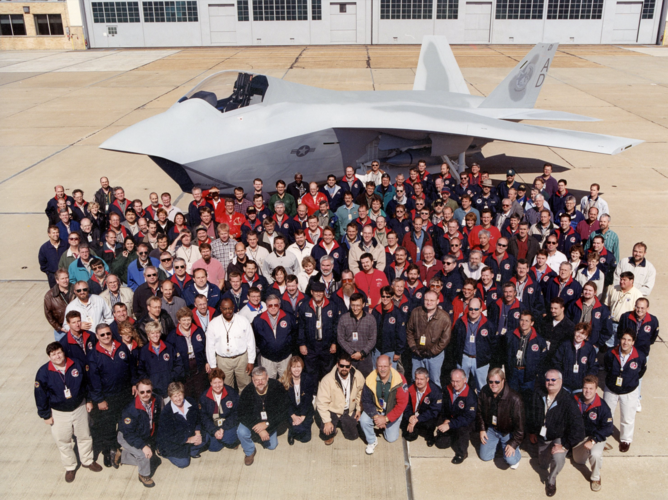
Once we got the inlet angled the right way, and horizontal tails put on the airplane, I personally thought it looked fine. There was a patent on the original tailless delta configuration though and I (and many others) wondered whether that contributed to the extreme reluctance of Puget Sound program management to make such extensive changes. The mockup made it to St Louis once and we had a big group photo made. It was absolutely miserable, the photographer on his elevated perch took forever to get things to his liking, and we were all staring straight into the sun behind him until our eyes watered and our heads ached. But it's a good photo. I'm the one who wasn't wearing the official JSF project jacket, I wore my hoodie with the old MDC JAST logo on it as a sort of protest, but it doesn't show in the picture anyway. Behind us is the historic Building 1 where so many Curtiss-Wright and McDonnell aircraft were built. It's about to be torn down, if it hasn't been already, so that Boeing can put up a different building to serve the same function. Go figure.

1732742961374.png
 
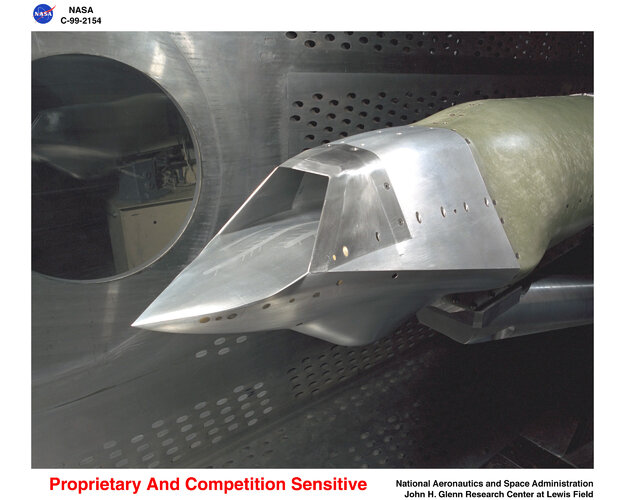
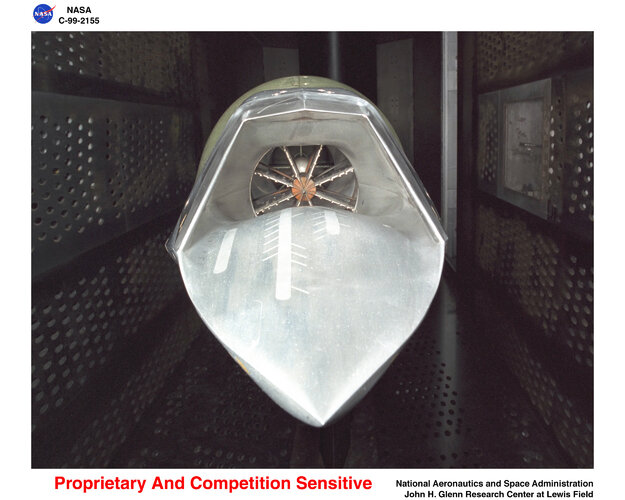
Are the bumps on the fan blocker anti flutter weights? Or were they just test ports for measuring pressure in the wind tunnel?
 
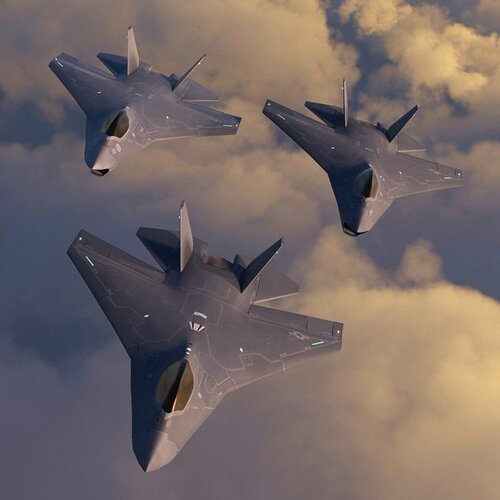
Nothing wrong with this version of F-32, I like it, second coming of the A-7 Corsair II. The USN "NEEDS"" at least one dedicated attack aircraft and with some level of easily maintainable LO. A USN LO aircraft would not be as stealthy as its USAF counterpart but it does not need to be. CVN-78 on its last deployment had all F-18s, that's it, very sad. The USN should have also at least procured some quantity of the F-117N when it had the chance, LM had a good deal for the USN too.
 
Recent photos I took:

6f7b8b82-98d3-43b8-85e2-89f1cdde8d83-jpeg.827038
88d4982b-516b-469a-a2f1-3383b236ebc7-jpeg.827037


6d2dbaf0-d146-44ce-859b-f1c03fd3d648-jpeg.827034
ce495115-32ff-49c7-b2d8-a56ef66a4e3c-jpeg.827035
 
Last edited:
All speculations and opinions aside, the simple fact is that X-32 lost for two basic reasons. (My credentials: I worked on AV-8B, advanced Harrier variants, McDonnell Douglas's ASTOVL and JAST, then Boeing's JSF after the merger.) First, the years-long secret relationship between Lockheed and DARPA to develop and mature the shaft-driven lift fan gave Boeing no choice but to go with what they knew worked. Second, the design effort was going on from Day One of the merger between Boeing and MDC, so all sorts of organizational incompatibilities were having to be fixed, reaching from program control all the way down to the fact that MDC used Unigraphics to design parts while heritage Boeing used CATIA. There was an entire unit in each location whose only task was to take drawings from the other site and convert them from CATIA to UG or UG to CATIA, whichever was needed by that site. This introduced delays and was a significant drain on resources, but not nearly as much as the squabbling over who was in charge of what. The original ugly X-32 tailless delta was purely a Seattle idea, and I believe they had patented it. It wasn't capable of meeting the requirements, as I recall particularly for the USN variant, and it was only after a great deal of time-wasting struggle that a tail section was finally put on the basic design, which, along with the change away from the backward-facing inlet, (in my opinion) made it look 100% better. But it was always overweight, and the basic engine core had been stretched as far as it could be without spending billions to develop a whole new engine. In a very strange move, the St Louis site leadership brought back a senior exec from retirement to secretely form a small team whose charter was to find a way to get rid of the excess weight. I was on that team. It was found that replacing the 2D rear nozzle with an axisymmetric one would buy back the weight we needed. When the axi nozzle was sprung on Seattle, they reacted with vehement negativity to this unexpected and unasked-for St Louis idea. Instead, they revealed in one of our periodic coordination meetings that they were going to fix the weight problem by adding "lift thrust augmentors" (small jet engines) for vertical operations. I was on the conference call where that was announced, and there was consternation not only in St Louis (because we knew the Marines would never accept a multiengine VTOL solution) but also among the Seattle crowd, whose subsystem people objected that they hadn't been consulted about things like what would have to be relocated to make room for these LTAs and how the things were to be provided with fuel and air and electrical power. Whoever was in charge of that meeting told them that the decision had been made, and LTAs were going into the aircraft. I recall that we St Louis people knew the jig was up, and we muted our end of the call and filed back to our desks. We were right. None of this would have happened if the Harrier 21 had been allowed to go forward years earlier instead of being quashed by MDC's ASTOVL group, but that's a whole other story.
You should have 'quashed' the STOVL. Because STOVL (as remote/rough field operations) and stealth do not play well together.

Avionics heavy platforms cannot be made X-Jet downselects.

That X-Jet concept demonstrator is basically just a minimalist set of FLCS rules to make sure the pointy end goes forwards except in datasets A/B/C (STOVL, CATOBAR, Radius At Cruise Point X).

But the airframe is not going to perform to these metrics when you take the AMAD out of the weapons bay and push the engine about 10-12 inches back to allow for the dong and the swivel nozzle to not interact negatively with the ground.

Same deal, with the wide-stance gear. You have just gone from a 4ft gear strut, similar to an F-15 on the X-35, to a 7ft strut akin to the A-6, and from a no-weapons-bay box structure to a cut-to-hollow equivalent. Which means all your carry through for the lap joint is at the top of the airframe as the spars have no push because the side of the airframe box is weakened by the weapons bays cutout of the lower corners.

People forget all this when they 'overlook' the fact that the LM STOVL had a 3,400lb overage from PDR that was NOT solved (or even acknowledged) for CDR where 3.5-4.8% of the airframe weight became 4.8-6% by dint of those massive, forged steel, MLG tubes.

Why is this important for STOVL? Well, it shortened bay and reduced the munition weight which differentiated assembly even beyond the centerline cutout for the SDLF and the Aux tank. It also meant the jet, while nominally running on 14,600lbs of gas was actually going to be taking off on about 10-12,000lbs which meant that the IPP/PTMS had to work about twice as hard and risk getting gummed up by very hot JP as fuel for cooling was marginal.

And this was before they discovered the engine itself had structural rigidity and thermal issues which resulted in an airframe loss after a ridgerunning exercise to wear it the turbine stages.

Hot bay with limited cooling and now you have an avionics problem, like it or not. All of which should have come up up before the TR-1/2 and Blk3.1 switchover on software which 'brought the jet to life'.

It didn't, because SDD was not FSD but rather some kind of EMD as a mad rush to reach production. And so, together with the lingering weight issues and the refusal to decouple the tactically/operationally worthless STOVL, led to a second Nunn McCurdy breach which saw a 2012 F-35A become a 2016 F-35B IOC as the least capable variant became the production start lynch pin at a time when the USN/USMC TAMP 2001 agreement had already severely cut back the 620+580 numbers to something like 450 and 250, leaving the USAF stuck with the full meal deal ticket.

And a dead F-22 program.

Speaking of which, the F-22 spent 50% of its 60 billion R&D on the ICNIA/INEWS/URR combination.

MIRFS and the EO Turret on the X-32 needed proving as much as the DAS/EOTS on the X-35. Because when you push STOVL _and_ Stealth together to get the least useful, least produced (thanks Britain) airframe under the door, on a 460nm radius guarantee, that issue with using fuel to dump waste heat while having a hot weapons/engine bay (with the IPP right above the engine) is going to haunt you.

And all the while, your up and away performance is not even being considered. So when the numbers start looking bad, with a 8-16-43 second KPP acceleration lag and a you 'change the upper modl line just a little' (adding 6" to the spine and recontouring everything under it to get more gas _for cooling_) the already overweight STOVL jet now is at critical weight and environmentals which it can't even take advantage of because it's already below takeoff weight margin without the mandatory fuel offload and Golly Wally, the Corps doesn't have a tanker to make up the radius or the PTMS difference.

STOVL destroyed the F-35. For schedule, for weight, for systems function. For damn near everything.

Now look at the Boeing design. Drop the ten foot exhaust tube, push the engine to the back end of the jet where it belongs. Push a long weapons bay under a vertical serpentine with natural DSI on the nose to further plug the basking shark inlet mouth (zero speed mass flow is a STOVL problem) and finally give the radar the antenna face area it needs to have more than APG-68 performance and you are left with... An Su-75.

All of which only really becomes obvious when the PWSC configuration (of the X-32) adds the tail booms as suspension structure, hanging off the rear of a jet whose implicit weight issues are not configurational but material (thermoset vs. thermoplastic composites) in nature. And so have to go regardless, to eliminate the unobtanium problem.

I am not fond of the JSF. I think JAST should have been a missile and the targeting for that weapon should have been by a 20-30hr UCAV. But if you are going to wring out a horribly concurrent system, then _do it_. By making the CD/SDD (FSD) phase something like an iterative testing process for what is now, by far, the most critical platform element of system stuff, not moldline freeze.

Within that context, both manned jets should have been funded with the DARPA X-45A UDS/ODS phaseline acting as a 'technology relief' feeder so that when both the big bad union jets went over budget and under promise on the avionics side, the ORIGINAL INTENT of the JSF program, to be a receiver node, not a sensor node, could have been the means to offload the excesses implied.

Because you don't want a stealth platform which is also an RF (ROBE/BACN) lighthouse.

Unfortunately, dumb people just don't think past the pilots-vote-for-generals-who-become-chiefs-of-staff the political side of procurement. Those kinds of procurement officials are a contagion spread throughout the acquisition process.

On purpose.

Which is why we no longer see major improvements in performance or mission roles, consequential to maintaining the generational lead ahead of our enemies, real or imagined.

Because today's tripartite air forces are so busy ensuring the manned uber alles approach to $hared guilt that they never think about whether having yet another F-111 is a good idea.

Strange how people who were trained to fight Communism, a little over 30 years ago, now use group think as a circle-the-wagons weapon.

 
All speculations and opinions aside, the simple fact is that X-32 lost for two basic reasons. (My credentials: I worked on AV-8B, advanced Harrier variants, McDonnell Douglas's ASTOVL and JAST, then Boeing's JSF after the merger.) First, the years-long secret relationship between Lockheed and DARPA to develop and mature the shaft-driven lift fan gave Boeing no choice but to go with what they knew worked. Second, the design effort was going on from Day One of the merger between Boeing and MDC, so all sorts of organizational incompatibilities were having to be fixed, reaching from program control all the way down to the fact that MDC used Unigraphics to design parts while heritage Boeing used CATIA. There was an entire unit in each location whose only task was to take drawings from the other site and convert them from CATIA to UG or UG to CATIA, whichever was needed by that site. This introduced delays and was a significant drain on resources, but not nearly as much as the squabbling over who was in charge of what. The original ugly X-32 tailless delta was purely a Seattle idea, and I believe they had patented it. It wasn't capable of meeting the requirements, as I recall particularly for the USN variant, and it was only after a great deal of time-wasting struggle that a tail section was finally put on the basic design, which, along with the change away from the backward-facing inlet, (in my opinion) made it look 100% better. But it was always overweight, and the basic engine core had been stretched as far as it could be without spending billions to develop a whole new engine. In a very strange move, the St Louis site leadership brought back a senior exec from retirement to secretely form a small team whose charter was to find a way to get rid of the excess weight. I was on that team. It was found that replacing the 2D rear nozzle with an axisymmetric one would buy back the weight we needed. When the axi nozzle was sprung on Seattle, they reacted with vehement negativity to this unexpected and unasked-for St Louis idea. Instead, they revealed in one of our periodic coordination meetings that they were going to fix the weight problem by adding "lift thrust augmentors" (small jet engines) for vertical operations. I was on the conference call where that was announced, and there was consternation not only in St Louis (because we knew the Marines would never accept a multiengine VTOL solution) but also among the Seattle crowd, whose subsystem people objected that they hadn't been consulted about things like what would have to be relocated to make room for these LTAs and how the things were to be provided with fuel and air and electrical power. Whoever was in charge of that meeting told them that the decision had been made, and LTAs were going into the aircraft. I recall that we St Louis people knew the jig was up, and we muted our end of the call and filed back to our desks. We were right. None of this would have happened if the Harrier 21 had been allowed to go forward years earlier instead of being quashed by MDC's ASTOVL group, but that's a whole other story.

Do you recall the timeframe of when the MDC weight team was formed or the meeting where LTAs were announced? Would the LTAs have had their own doors? I don't see them in any of the mockups.


Was the weight problem that needed fixing the result of airframe weight increases, extra equipment, increased bringback requirements, or something else? Can you roughly quantify this weight issue?


You mention the axisymmetric nozzle would have solved the weight problem, but I have a few questions regarding how it would have functioned, its impacts on the design, and other negative externalities.

1: A 2D nozzle is easy to close because the first set of ramps can just be rotated all the way so they close, but axisymmetric nozzles have lots of petals that would need a lot of range/overlap to go from fully open to fully closed. How would the cruise nozzle have been closed for STOVL? Would it have used a butterfly valve like the two lift nozzles, some other kind of valve, or would the cruise nozzle itself have enough range to fully close and fully open? I imagine any valve would have to be located before the augmentor.

2: What makes an axisymmetric nozzle lighter? Is it just the ratio between the perimeter and the cross sectional area?

3: How much of an impact would the axisymmetric nozzle have had on the rear aspect signature and boat tail drag? A 2D nozzle smoothly tapers and can be aligned nicely with the planform, whereas the rounded nozzle requires the aft to taper more sharply at the sides, and the edge and surface alignment isn't as neat.

4: Would the axisymmetric nozzle have had vectoring in pitch like the 2D nozzle (and maybe yaw too, like the MCD JSF design)? If not, it seems like a larger empennage would have been necessary. Maybe this tradeoff is worth it, with the larger empennage surfaces being lighter than the smaller empennage with TVC?
 
The composite delta wing was the best feature of the X-32 and offered superior performance to the X/F-35's conventional layout in the areas of lift, drag, and fuel capacity. When Boeing did away with that and adopted a conventional tail setup, it was game over. The competition-winning superiority of the X/F-35's lift fan system was a distraction. The number of F-35B's is only a fraction of the CTOL variants, to say nothing of the breach-of-contract speed limitations imposed on the B and C.

Its been said before but I'll say it again: The STOVL requirement for the JSF was one of the biggest mistakes in the history of military aviation and has resulted in one of the most compromised fighter-attack aircraft ever built.
We could have had a far better aircraft.

Venting complete.
 
The composite delta wing was the best feature of the X-32 and offered superior performance to the X/F-35's conventional layout in the areas of lift, drag, and fuel capacity. When Boeing did away with that and adopted a conventional tail setup, it was game over. The competition-winning superiority of the X/F-35's lift fan system was a distraction. The number of F-35B's is only a fraction of the CTOL variants, to say nothing of the breach-of-contract speed limitations imposed on the B and C.
The analyses were done and the A and B variants were OK, but the Navy variant just didn't work for the original delta wing. You need to separate your pitch control surfaces from your high lift ones when you're trying to hit a small deck in rough weather. You can't compromise the effectiveness of either flaps or elevators by combining their functions or by reducing their areas to fit them all on one trailing edge, it just wasn't feasible. So it was very detailed analyses that showed that a conventional tail was absolutely needed for the USN/carrier variant. Actually it made pitch and yaw control a bit easier for the STOVL variant due to the longer moment arm of those parts of the reaction control system but it wasn't absolutely essential. It was the carrier variant that wouldn't come together without it. Elevons are fine for aircraft that don't have to come aboard ship, they've worked well on things from F-102 to F-117 in that regime, but nobody has fielded a delta-wing shipboard fighter for half a century or more, which suggests that moving away from that layout was a pretty shrewd move on Boeing's part.
 
Do you recall the timeframe of when the MDC weight team was formed or the meeting where LTAs were announced? Would the LTAs have had their own doors? I don't see them in any of the mockups.


Was the weight problem that needed fixing the result of airframe weight increases, extra equipment, increased bringback requirements, or something else? Can you roughly quantify this weight issue?


You mention the axisymmetric nozzle would have solved the weight problem, but I have a few questions regarding how it would have functioned, its impacts on the design, and other negative externalities.

1: A 2D nozzle is easy to close because the first set of ramps can just be rotated all the way so they close, but axisymmetric nozzles have lots of petals that would need a lot of range/overlap to go from fully open to fully closed. How would the cruise nozzle have been closed for STOVL? Would it have used a butterfly valve like the two lift nozzles, some other kind of valve, or would the cruise nozzle itself have enough range to fully close and fully open? I imagine any valve would have to be located before the augmentor.

2: What makes an axisymmetric nozzle lighter? Is it just the ratio between the perimeter and the cross sectional area?

3: How much of an impact would the axisymmetric nozzle have had on the rear aspect signature and boat tail drag? A 2D nozzle smoothly tapers and can be aligned nicely with the planform, whereas the rounded nozzle requires the aft to taper more sharply at the sides, and the edge and surface alignment isn't as neat.

4: Would the axisymmetric nozzle have had vectoring in pitch like the 2D nozzle (and maybe yaw too, like the MCD JSF design)? If not, it seems like a larger empennage would have been necessary. Maybe this tradeoff is worth it, with the larger empennage surfaces being lighter than the smaller empennage with TVC?
The meeting was late in the proposal preparation phase. It was a long time ago and I can't remember exactly, but the whole airplane was basically designed and weighed and costed. I only ever saw one or two drawings showing the LTAs, it was that late in the program. As I dimly recall, they were located in the upper part of the main landing gear bays, so they wouldn't have needed doors of their own. But maybe somebody else from the program can shed more authoritative light on that question.

My part (the vulnerability analysis to various threats) was done by that point except for some tweaking. Actually if we'd been allowed to change the aft nozzle, we'd have saved enough weight at that end of the aircraft to move the whole ECS package further aft and away from the cockpit area, which would have had beneficial effects on the vulnerable areas. But we were already meeting the requirements there anyway, so maybe that was a moot point.

The weight problem had been chronic since the beginning of the effort, before the Boeing/MDC merger. It eventually got so bad that we had had to "grow" the basic engine to some extraordinary degree, to try (and fail, as it turned out) to meet the vertical bring-back weight requirements. Since there was no possibility of further engine growth, something had to be done to cut the weight, or so we thought. For that reason the "secret team" was called together. I'm not sure why I was on it, my specialty wasn't really involved except very peripherally, but it did give me a chance to watch some very creative people do a remarkable reengineering job in a really short time. Changing the type of exhaust nozzle ticked all the boxes. It got rid of the required amount of weight, it didn't hurt the LO numbers for the rear hemisphere, it was just as efficient a thruster in level flight. But what we didn't know is that apparently Seattle had formed their own secret team to look at solving the problem by adding more vertical thrust rather than by removing any of the excess weight. Each site surprised the other, but program leadership was in Seattle, so their solution won the toss.

I no longer have any details about the vertical flight configuration of either the original or the axisymmetric nozzle, so I can't answer those questions. When I retired, I wasn't allowed to take anything home with me, and my laptop's hard drive was erased. I'm not an engine guy either, except as far as how to damage or kill one with bullets and missile warhead fragments, but the analysis of the weight savings was done by our best people and we had full confidence in our numbers. All STOVL functions were preserved, and no resizing of the tails was needed as far as I can remember. The axi simply duplicated what the original had done, in a lighter package.

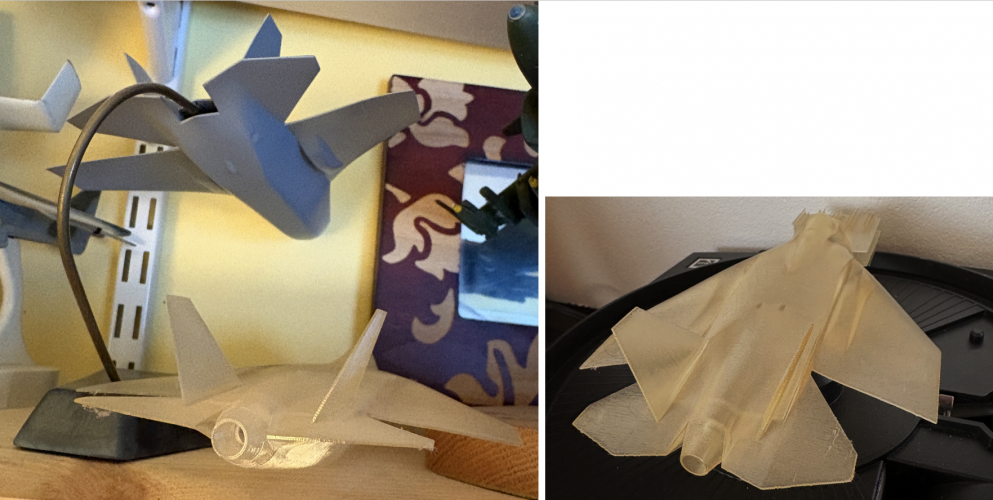
Actually I've got one of the very few 3D printed models of our JSF with the axi nozzle. Can't do any harm to show it now, since it lost and doesn't represent any hardware that was ever actually built.

1773959842618.png
 
Do you recall the timeframe of when the MDC weight team was formed or the meeting where LTAs were announced? Would the LTAs have had their own doors? I don't see them in any of the mockups.


Was the weight problem that needed fixing the result of airframe weight increases, extra equipment, increased bringback requirements, or something else? Can you roughly quantify this weight issue?


You mention the axisymmetric nozzle would have solved the weight problem, but I have a few questions regarding how it would have functioned, its impacts on the design, and other negative externalities.

1: A 2D nozzle is easy to close because the first set of ramps can just be rotated all the way so they close, but axisymmetric nozzles have lots of petals that would need a lot of range/overlap to go from fully open to fully closed. How would the cruise nozzle have been closed for STOVL? Would it have used a butterfly valve like the two lift nozzles, some other kind of valve, or would the cruise nozzle itself have enough range to fully close and fully open? I imagine any valve would have to be located before the augmentor.

2: What makes an axisymmetric nozzle lighter? Is it just the ratio between the perimeter and the cross sectional area?

3: How much of an impact would the axisymmetric nozzle have had on the rear aspect signature and boat tail drag? A 2D nozzle smoothly tapers and can be aligned nicely with the planform, whereas the rounded nozzle requires the aft to taper more sharply at the sides, and the edge and surface alignment isn't as neat.

4: Would the axisymmetric nozzle have had vectoring in pitch like the 2D nozzle (and maybe yaw too, like the MCD JSF design)? If not, it seems like a larger empennage would have been necessary. Maybe this tradeoff is worth it, with the larger empennage surfaces being lighter than the smaller empennage with TVC?
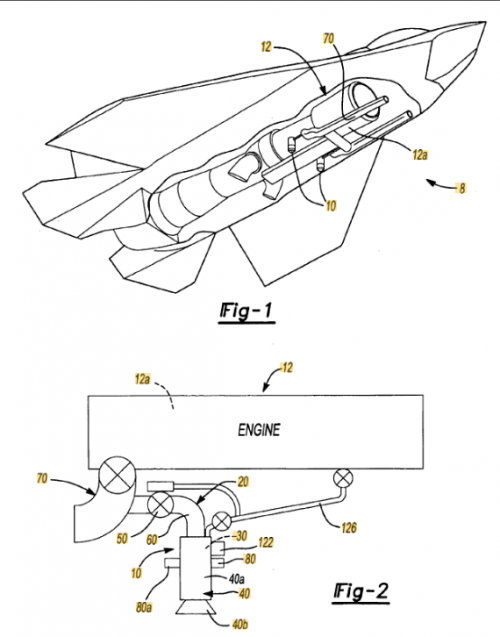
About those LTAs, you're in luck, I found the patent that Aerojet Rocketdyne filed on them for our proposal aircraft, and it clears up something I didn't understand at the time and have puzzled over occasionally ever since. I distinctly remember us being told at the time that they didn't count as "engines" because they didn't have any moving parts, they were just ramjets. Looking at this patent I finally understand. The application was filed in September of 2002 so that would have been the timeframe when all of this back-and-forth of secret teams was taking place. And I had the precise location of the LTAs wrong, but this clears that up as well.


1773960285726.png
 
Its been said before but I'll say it again: The STOVL requirement for the JSF was one of the biggest mistakes in the history of military aviation and has resulted in one of the most compromised fighter-attack aircraft ever built.
We could have had a far better aircraft.
It's really too bad that we didn't stick with CALF for USAF and USMC, then whatever you want to call the replacement for the Legacy Bugs as a separate airframe.

The lightening needed for the VTOL bits conflicts with the reinforcements needed for carrier operations. However, the lightening needed for VTOL does not conflict with the USAF requirements. (and I've read that the lightening greatly improved the F-35A)
 
It's really too bad that we didn't stick with CALF for USAF and USMC, then whatever you want to call the replacement for the Legacy Bugs as a separate airframe.

The lightening needed for the VTOL bits conflicts with the reinforcements needed for carrier operations. However, the lightening needed for VTOL does not conflict with the USAF requirements. (and I've read that the lightening greatly improved the F-35A)
If we'd only known that CALF, along with ASTOVL, was just a white world cover story to hide unacknowledged funding by DARPA and USAF to Lockheed to develop what became the RR LiftFan! If we had, then maybe, just maybe, MDC management would have realized the futility of trying to pursue those fake programs and let us push forward with Harrier 21, instead of letting ASTOVL shut us down. The Marines were excited by H21. The other critical STOVL launch customer, the Royal Navy, offered us 2 billion pounds in support if we'd add a certain range and loiter time requirement to our list. Satisfying the Harrier replacement needs with H21 would have removed the relevance of ASTOVL in the JAST/JSF customer list, leaving only the CTOL land- and sea-based variants to contend with. And in that case the original MDC/BAe/Northrop design might have won the first round downselect in 1996, leaving no need for a merger with Boeing in 1997. Now there's an alternative history story for somebody to write... :)
 

Similar threads

Back
Top Bottom