BlackBat242
OK, I changed my personal text ;)
- Joined
- 10 April 2013
- Messages
- 1,620
- Reaction score
- 5,024
Admin suggestion: if there is an appropriate existing thread, please combine.
The RAN has had a very spotty track record after 1945 with regards to actually landing forces on any of the islands in its neighborhood outside of existing port facilities.
This first post is to establish what historically entered service, so as to set a firm basis for altering things beyond recognition.
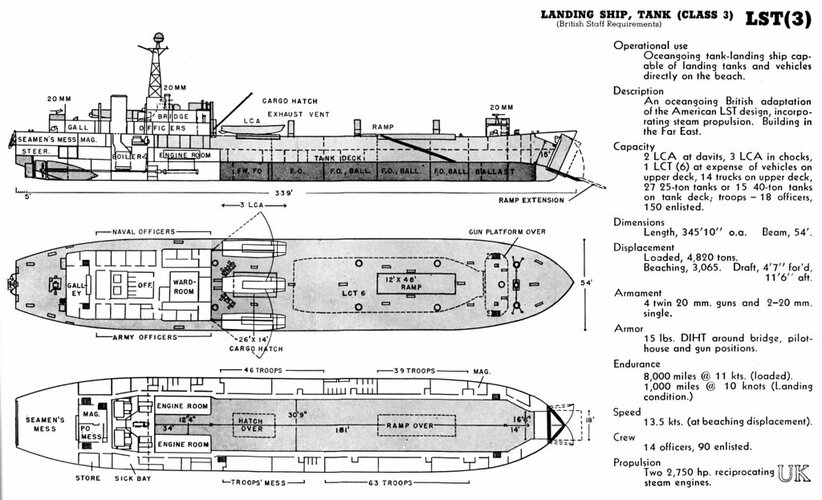
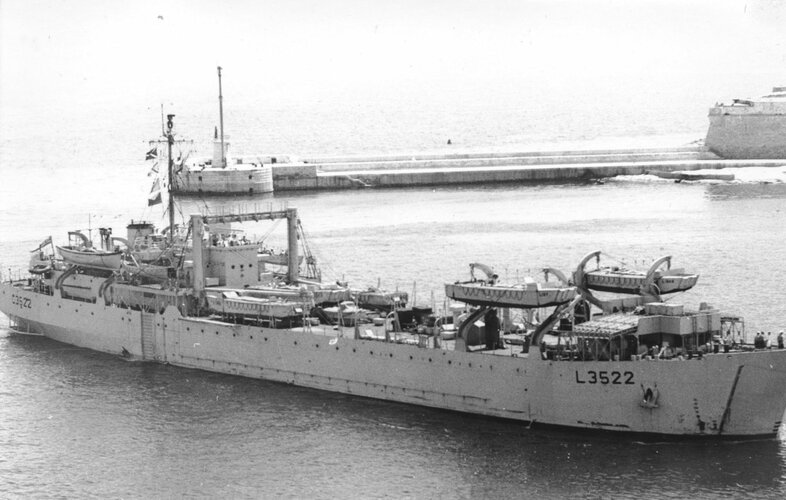
At the end of WW2, outside of ships converted to the role and so on, the RAN had little such capacity, so a fleet of 6 LST-3 type vessels were transferred from the RN in 1946.
HMAS Tarakan (L-3017) was a Mark III Tank Landing Ship, or LST(3), built for the Royal Navy by R. and W. Hawthorne, Leslie and Company at Hebburn-on-Tyne in England and launched on 28 November 1944 as LST 3017.
The ship was loaned to the Royal Australian Navy and commissioned on 4 July 1946. She was named Tarakan on 16 December 1948, and served in Australian and New Guinea waters as a general purpose vessel, but was mainly used for dumping condemned ammunition at sea.
On 25 January 1950 the Tarakan was berthed alongside the HMAS Kattabul naval base at Garden Island in Sydney, making good defects prior to departure for New Guinea, when an explosion occurred aft under the mess decks, resulting in the deaths of seven sailors and one dockyard tradesman. A further 12 sailors and one dockyard tradesman were injured. The ship was extensively damaged and never returned to seagoing service.
She was sold for breaking up on 12 March 1954.
HMAS Tarakan was the first of two Australian naval vessels named after Tarakan in Borneo, site of an attack by the I Australian Corps on May 1, 1945.
HMAS Lae (L-3035) was a Mark III Tank Landing Ship built by Denny Brothers at Dumbarton in Scotland and launched on 24 October 1944.
She was commissioned into the Royal Australian Navy on 15 July 1946, and named HMAS Lae on 16 December 1948.
HMAS Lae paid off to reserve in July 1947 and was sold on 9 November 1955.
HMAS Labuan (L-3501) was a Mark III Tank Landing Ship built by Canadian Vickers, Limited, of Montreal in Canada and launched on 31 August 1944.
She was commissioned in the Royal Australian Navy on 1 July 1946. She was primarily used in support of the Australian National Antarctic Research Expedition (ANARE, transporting personnel and equipment to and from Heard Island and Macquarie Island (equipped with a Walrus seaplane).
She was named Labuan on 16 December 1948.
She paid off to reserve on 28 September 1951 and was sold on 9 November 1955.
L-3008 was a Mark III Tank Landing Ship.
She was commissioned into the Royal Australian Navy on 1 July 1946.
She paid off to reserve in 1948, and was sold on 4 June 1950.
L-3014 was a Mark III Tank Landing Ship.
She was commissioned into the Royal Australian Navy on 1 July 1946.
She was used for dumping condemned ammunition at sea, and was sold on 4 June 1950.
L-3022 was a Mark III Tank Landing Ship.
She was commissioned into the Royal Australian Navy on 1 July 1946.
She paid off to reserve in 1946, and was sold on 4 June 1950.
The LST-3 was a UK design variation that was powered by steam-fed reciprocating engines, rather than by diesels as per the US-built vessels.


The disposal of these vessels 1950-55 left the Australian military with no such capability, a state which persisted into 1960.
It was then that the Australian Army took upon themselves the task of geting some kind of capability.
This took the form of ex-USN LSMs - the smallest sea-going landing vessels built by the USN.
Specifications: LSM-1 Class Landing Ship Medium: http://www.navsource.org/archives/10/14/14idx.htm
LSM-319
· Laid down (date unknown) at Pullman Standard Car Manufacturing Company, Chicago, IL.
· Launched (date unknown)
· Commissioned USS LSM-319, 10 August 1944, LTjg. Oren J. Mollenkopf, USNR in command
· Decommissioned, 14 June 1946, at Astoria, OR.
· Laid up in the Pacific Reserve Fleet, Columbia River Group, Astoria
· Transferred (sold) to the Australian Army, 16 July 1959, renamed Harry Chauvel (AV-1353) and assigned to the Australian Army Royal Engineers, 32 Small Ship Squadron
· Final Disposition, sold in 1972, to Pacific Logistics S.A., Philippines, fate unknown
LSM 477
· Laid down (date unknown) at Brown Shipbuilding Co., Houston, TX.
· Launched (date unknown)
· Commissioned USS LSM-477, 3 April 1945, LT. Charles R. Miller Jr., USNR in command
· Decommissioned, 15 May 1946, at Astoria, OR.
· Laid up in the Pacific Reserve Fleet, Columbia River Group, Astoria
· Struck from the Naval Register (date unknown)
· Transferred (sold) to the Australian Army, 16 July 1959, renamed Brudenell White (AV-1354) and assigned to the Australian Army Royal Engineers, 32 Small Ship Squadron
· Final Disposition, deactivated by Australian Army and sold in 1972 to Pacific Logistics of Panama
· Reported sunk in 1975 on her maiden voyage to Phnom Penh, Cambodia by rocket fire on the Mekong River.
LSM-315
· Laid down (date unknown) at Pullman Standard Car Manufacturing Company, Chicago, IL.
· Launched (date unknown)
· Commissioned USS LSM-315, 13 July 1944, LT. Alfred W. Holmes, USNR in command
· Decommissioned, 14 June 1946, at Astoria, OR.
· Laid up in the Pacific Reserve Fleet, Columbia River Group, Astoria
· Struck from the Naval Register, (date unknown)
· Transferred (sold) to the Australian Army, 26 January 1960, renamed Vernon Sturdee (AV-1355) and assigned to the Australian Army Royal Engineers, 32 Small Ship Squadron
· Sold for commercial service in 1972, possibly modified as a timber carrier
· Final Disposition, believed to have sunk in the Solomon Islands, circa 1984
LSM-547
· Laid down (date unknown) at Brown Shipbuilding Co., Houston, TX.
· Launched (date unknown)
· Commissioned USS LSM-547, 25 January 1946, LTjg. Charles W. Faust, USNR, in command
· Decommissioned, 11 March 1947, at Green Cove Springs, FL.
· Laid up in the Atlantic Reserve Fleet, Florida Group, Green Cove Springs
· Recommissioned, 22 September 1950
· Decommissioned, 5 July 1955, at Astoria, OR.
· Laid up in the Pacific Reserve Fleet, Columbia River Group, Astoria, OR.
· Struck from the Naval Register (date unknown)
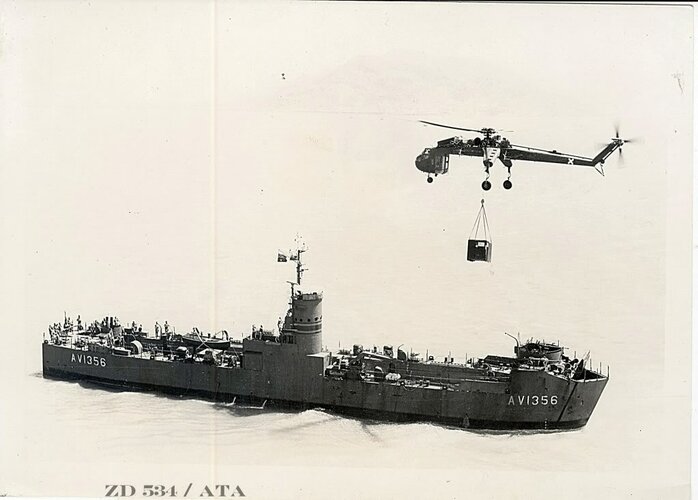
· Transferred (sold) to the Australian Army, 26 January 1960, renamed Clive Steele (AV-1356) and assigned to the Australian Army Royal Engineers, 32 Small Ship Squadron
· Decommissioned by the Australian Army in 1972 and sold in 1972, to Pacific Logistics S.A., Philippines
· Struck by Communist rockets, 6 July 1973, in the Mekong Delta, beached and abandoned
Harry Chauvel AV-1353 Vietnam:

Clive Steele AV-1356:

The light aircraft carrier HMAS Sydney had been in Special Reserve in Sydney since 30 May 1958, but was recommissioned as a Fast Troop Transport on 7 March 1962, and after refitting entered operational service in July 1963. Sydney would remain in service (with modifications to better suit her role) until decommissioning on 12 November 1973. She was sold for scrap on 28 October 1975.
The RAN commissioned the merchant ships Jeparit and Boonaroo during the 1960s for the transport role during the Vietnam War. This was brought about by the unpopularity of the war and the refusal of a number of maritime unions to man the vessels. Naval crew members were drafted to work alongside some civilian crew members and the ships were employed on logistic runs from Australia to Vietnam supplying the Australian Task Force and also humanitarian aid.
The Australian Army, in 1970, went about replacing their LSMs with oversized landing craft... the Balikpapan class Landing Craft Heavy (LCH).
Balikpapan Class Landing Craft Heavy (LCH)
# name laid down launched commissioned assigned
L126 Balikpapan May ’71 5 Aug.’71 22 Sept. ’74 Darwin Naval Base
L127 Brunei July ’71 5 Oct.’71 5 Jan.’73 HMAS Waterhen
L128 Labuan (II) Oct.’71 29 Dec.’71 9 Mar.’73 HMAS Cairns
L129 Tarakan (II) Dec.’71 16 Mar.’72 15 Jun.’73 HMAS Cairns
L130 Wewak Mar.’71 19 May ’72 10 Aug.’73 HMAS Cairns
L131 Salamaua: commissioned 19 Oct.’73 and transferred to Papua New Guinea 14 Nov.’74
L132 Buna: commissioned 19 Oct.’73 and transferred to Papua New Guinea 14 Nov.’74
L133 Betano Sep.’72 5 Dec.’72 8 Feb.’74 HMAS Waterhen
Displacement (tons): 311 t. Normal; 503 t. Full Load
Dimensions (feet): 146 x 33 x 6.5 (44.5 x 10.1 x 2 metres)
Propulsion: 2 x GM diesels; 1,350 hp; 2 shafts
Max. Speed (knots): 10
Armament: 2 x 0.5” MGs (2 x 1)
Landing Craft: 3 x battle tanks; 20 x small trucks; or 13 x APCs; 180 tons load
Complement: 13
Note: Built by Walkers Ltd, Maryborough, Qld.
These were operated until 2012-2014.
The RAN went about "replacing" HMAS Sydney with an enlarged version of the RN's Round Table class LSL, the Landing Ship, Heavy (LSH) HMAS Tobruk. She was laid down on 7 February 1978, launched on 1 March 1980, and commissioned on 23 April 1981.
She served until decommissioned on 31 July 2015. She was scuttled off the coast between Bundaberg and Hervey Bay on 29 June 2018.
The RAN also purchased an existing commercial Ro/Ro passenger and vehicle ferry in 1977, commissioning her as HMAS Jervis Bay. She served until 18 April 1994.
In 1994 the RAN purchased two Newport class LSTs from the USN and set about modernizing them. Much more work was needed than had been thought, and they finally commissioned in 1999 (HMAS Kanimbla) and 2000 (HMAS Manoora).
They both decommissioned in 2011, and were sold for scrap in 2013.
The two Kanimblas were followed into service by the transfer of a RFA Bay class LSD from the UK, commissioning on 13 December 2011 as HMAS Choules.
The RAN also had built a pair of Landing Helicopter Docks (LHDs) based on the Spanish LHD Juan Carlos I. The commissioned as LHD-02 HMAS Canberra on 28 November 2014 and LHD-01 HMAS Adelaide on 4 December 2015.
The RAN has had a very spotty track record after 1945 with regards to actually landing forces on any of the islands in its neighborhood outside of existing port facilities.
This first post is to establish what historically entered service, so as to set a firm basis for altering things beyond recognition.
At the end of WW2, outside of ships converted to the role and so on, the RAN had little such capacity, so a fleet of 6 LST-3 type vessels were transferred from the RN in 1946.
HMAS Tarakan (L-3017) was a Mark III Tank Landing Ship, or LST(3), built for the Royal Navy by R. and W. Hawthorne, Leslie and Company at Hebburn-on-Tyne in England and launched on 28 November 1944 as LST 3017.
The ship was loaned to the Royal Australian Navy and commissioned on 4 July 1946. She was named Tarakan on 16 December 1948, and served in Australian and New Guinea waters as a general purpose vessel, but was mainly used for dumping condemned ammunition at sea.
On 25 January 1950 the Tarakan was berthed alongside the HMAS Kattabul naval base at Garden Island in Sydney, making good defects prior to departure for New Guinea, when an explosion occurred aft under the mess decks, resulting in the deaths of seven sailors and one dockyard tradesman. A further 12 sailors and one dockyard tradesman were injured. The ship was extensively damaged and never returned to seagoing service.
She was sold for breaking up on 12 March 1954.
HMAS Tarakan was the first of two Australian naval vessels named after Tarakan in Borneo, site of an attack by the I Australian Corps on May 1, 1945.
HMAS Lae (L-3035) was a Mark III Tank Landing Ship built by Denny Brothers at Dumbarton in Scotland and launched on 24 October 1944.
She was commissioned into the Royal Australian Navy on 15 July 1946, and named HMAS Lae on 16 December 1948.
HMAS Lae paid off to reserve in July 1947 and was sold on 9 November 1955.
HMAS Labuan (L-3501) was a Mark III Tank Landing Ship built by Canadian Vickers, Limited, of Montreal in Canada and launched on 31 August 1944.
She was commissioned in the Royal Australian Navy on 1 July 1946. She was primarily used in support of the Australian National Antarctic Research Expedition (ANARE, transporting personnel and equipment to and from Heard Island and Macquarie Island (equipped with a Walrus seaplane).
She was named Labuan on 16 December 1948.
She paid off to reserve on 28 September 1951 and was sold on 9 November 1955.
L-3008 was a Mark III Tank Landing Ship.
She was commissioned into the Royal Australian Navy on 1 July 1946.
She paid off to reserve in 1948, and was sold on 4 June 1950.
L-3014 was a Mark III Tank Landing Ship.
She was commissioned into the Royal Australian Navy on 1 July 1946.
She was used for dumping condemned ammunition at sea, and was sold on 4 June 1950.
L-3022 was a Mark III Tank Landing Ship.
She was commissioned into the Royal Australian Navy on 1 July 1946.
She paid off to reserve in 1946, and was sold on 4 June 1950.
The LST-3 was a UK design variation that was powered by steam-fed reciprocating engines, rather than by diesels as per the US-built vessels.
The disposal of these vessels 1950-55 left the Australian military with no such capability, a state which persisted into 1960.
It was then that the Australian Army took upon themselves the task of geting some kind of capability.
This took the form of ex-USN LSMs - the smallest sea-going landing vessels built by the USN.
Specifications: LSM-1 Class Landing Ship Medium: http://www.navsource.org/archives/10/14/14idx.htm
LSM-319
· Laid down (date unknown) at Pullman Standard Car Manufacturing Company, Chicago, IL.
· Launched (date unknown)
· Commissioned USS LSM-319, 10 August 1944, LTjg. Oren J. Mollenkopf, USNR in command
· Decommissioned, 14 June 1946, at Astoria, OR.
· Laid up in the Pacific Reserve Fleet, Columbia River Group, Astoria
· Transferred (sold) to the Australian Army, 16 July 1959, renamed Harry Chauvel (AV-1353) and assigned to the Australian Army Royal Engineers, 32 Small Ship Squadron
· Final Disposition, sold in 1972, to Pacific Logistics S.A., Philippines, fate unknown
LSM 477
· Laid down (date unknown) at Brown Shipbuilding Co., Houston, TX.
· Launched (date unknown)
· Commissioned USS LSM-477, 3 April 1945, LT. Charles R. Miller Jr., USNR in command
· Decommissioned, 15 May 1946, at Astoria, OR.
· Laid up in the Pacific Reserve Fleet, Columbia River Group, Astoria
· Struck from the Naval Register (date unknown)
· Transferred (sold) to the Australian Army, 16 July 1959, renamed Brudenell White (AV-1354) and assigned to the Australian Army Royal Engineers, 32 Small Ship Squadron
· Final Disposition, deactivated by Australian Army and sold in 1972 to Pacific Logistics of Panama
· Reported sunk in 1975 on her maiden voyage to Phnom Penh, Cambodia by rocket fire on the Mekong River.
LSM-315
· Laid down (date unknown) at Pullman Standard Car Manufacturing Company, Chicago, IL.
· Launched (date unknown)
· Commissioned USS LSM-315, 13 July 1944, LT. Alfred W. Holmes, USNR in command
· Decommissioned, 14 June 1946, at Astoria, OR.
· Laid up in the Pacific Reserve Fleet, Columbia River Group, Astoria
· Struck from the Naval Register, (date unknown)
· Transferred (sold) to the Australian Army, 26 January 1960, renamed Vernon Sturdee (AV-1355) and assigned to the Australian Army Royal Engineers, 32 Small Ship Squadron
· Sold for commercial service in 1972, possibly modified as a timber carrier
· Final Disposition, believed to have sunk in the Solomon Islands, circa 1984
LSM-547
· Laid down (date unknown) at Brown Shipbuilding Co., Houston, TX.
· Launched (date unknown)
· Commissioned USS LSM-547, 25 January 1946, LTjg. Charles W. Faust, USNR, in command
· Decommissioned, 11 March 1947, at Green Cove Springs, FL.
· Laid up in the Atlantic Reserve Fleet, Florida Group, Green Cove Springs
· Recommissioned, 22 September 1950
· Decommissioned, 5 July 1955, at Astoria, OR.
· Laid up in the Pacific Reserve Fleet, Columbia River Group, Astoria, OR.
· Struck from the Naval Register (date unknown)
· Transferred (sold) to the Australian Army, 26 January 1960, renamed Clive Steele (AV-1356) and assigned to the Australian Army Royal Engineers, 32 Small Ship Squadron
· Decommissioned by the Australian Army in 1972 and sold in 1972, to Pacific Logistics S.A., Philippines
· Struck by Communist rockets, 6 July 1973, in the Mekong Delta, beached and abandoned
Harry Chauvel AV-1353 Vietnam:
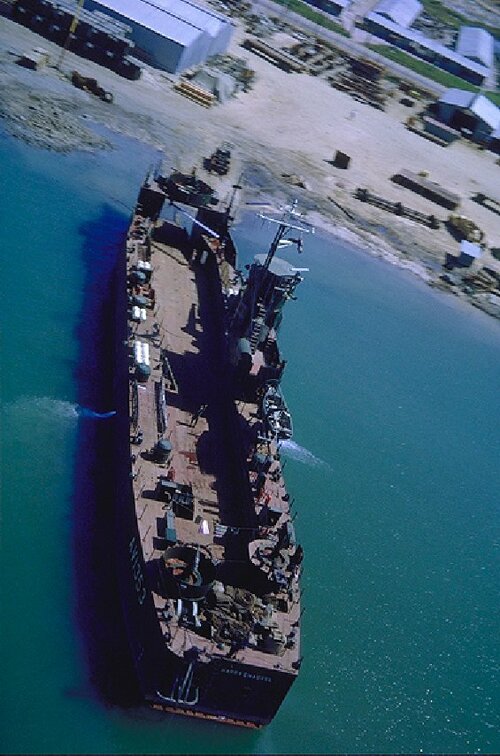
Clive Steele AV-1356:
The light aircraft carrier HMAS Sydney had been in Special Reserve in Sydney since 30 May 1958, but was recommissioned as a Fast Troop Transport on 7 March 1962, and after refitting entered operational service in July 1963. Sydney would remain in service (with modifications to better suit her role) until decommissioning on 12 November 1973. She was sold for scrap on 28 October 1975.
The RAN commissioned the merchant ships Jeparit and Boonaroo during the 1960s for the transport role during the Vietnam War. This was brought about by the unpopularity of the war and the refusal of a number of maritime unions to man the vessels. Naval crew members were drafted to work alongside some civilian crew members and the ships were employed on logistic runs from Australia to Vietnam supplying the Australian Task Force and also humanitarian aid.
The Australian Army, in 1970, went about replacing their LSMs with oversized landing craft... the Balikpapan class Landing Craft Heavy (LCH).
Balikpapan Class Landing Craft Heavy (LCH)
# name laid down launched commissioned assigned
L126 Balikpapan May ’71 5 Aug.’71 22 Sept. ’74 Darwin Naval Base
L127 Brunei July ’71 5 Oct.’71 5 Jan.’73 HMAS Waterhen
L128 Labuan (II) Oct.’71 29 Dec.’71 9 Mar.’73 HMAS Cairns
L129 Tarakan (II) Dec.’71 16 Mar.’72 15 Jun.’73 HMAS Cairns
L130 Wewak Mar.’71 19 May ’72 10 Aug.’73 HMAS Cairns
L131 Salamaua: commissioned 19 Oct.’73 and transferred to Papua New Guinea 14 Nov.’74
L132 Buna: commissioned 19 Oct.’73 and transferred to Papua New Guinea 14 Nov.’74
L133 Betano Sep.’72 5 Dec.’72 8 Feb.’74 HMAS Waterhen
Displacement (tons): 311 t. Normal; 503 t. Full Load
Dimensions (feet): 146 x 33 x 6.5 (44.5 x 10.1 x 2 metres)
Propulsion: 2 x GM diesels; 1,350 hp; 2 shafts
Max. Speed (knots): 10
Armament: 2 x 0.5” MGs (2 x 1)
Landing Craft: 3 x battle tanks; 20 x small trucks; or 13 x APCs; 180 tons load
Complement: 13
Note: Built by Walkers Ltd, Maryborough, Qld.
These were operated until 2012-2014.
The RAN went about "replacing" HMAS Sydney with an enlarged version of the RN's Round Table class LSL, the Landing Ship, Heavy (LSH) HMAS Tobruk. She was laid down on 7 February 1978, launched on 1 March 1980, and commissioned on 23 April 1981.
She served until decommissioned on 31 July 2015. She was scuttled off the coast between Bundaberg and Hervey Bay on 29 June 2018.
The RAN also purchased an existing commercial Ro/Ro passenger and vehicle ferry in 1977, commissioning her as HMAS Jervis Bay. She served until 18 April 1994.
In 1994 the RAN purchased two Newport class LSTs from the USN and set about modernizing them. Much more work was needed than had been thought, and they finally commissioned in 1999 (HMAS Kanimbla) and 2000 (HMAS Manoora).
They both decommissioned in 2011, and were sold for scrap in 2013.
The two Kanimblas were followed into service by the transfer of a RFA Bay class LSD from the UK, commissioning on 13 December 2011 as HMAS Choules.
The RAN also had built a pair of Landing Helicopter Docks (LHDs) based on the Spanish LHD Juan Carlos I. The commissioned as LHD-02 HMAS Canberra on 28 November 2014 and LHD-01 HMAS Adelaide on 4 December 2015.
Last edited: