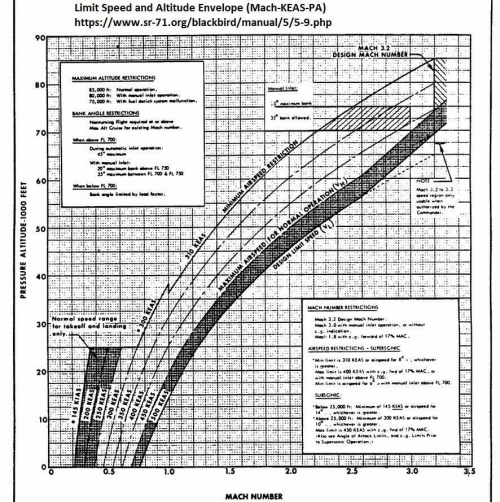
In general, it does seem the SR maxed out at almost M3.5.
IIRC the F-12 interceptor design had a top speed of M3.5 (I don't know if the YF-12A reached M3.5 during flight-tests though).

In general, it does seem the SR maxed out at almost M3.5.
That's what I thought but wasn't sure, thanks for that.IIRC the F-12 interceptor design had a top speed of M3.5 (I don't know if the YF-12A reached M3.5 during flight-tests though).

According to an issue of "Wings of Fame" The A-12 was able to reach Mach 3.6 and 97,000 feet in early testing. I'm aware of the limits frequently mentioned for suspecting that's impossible (TET, shock angle, etc.) but thought I'd pass it along. Mary Shaefer, who was the head of the flight dynamics portion of the NASA Blackbird effort, didn't dismiss it but said the two figures might not have been on the same flight. (On USENET back in the day.)I briefly worked with the late and very nice Joe Vida at the B-2 CTF in the 90s and who was apparently the high-time RSO in the SR community. He did tell me a few great stories regarding North Korea missions. In general, it does seem the SR maxed out at almost M3.5.
He did tell me a story about returning from a mission and they were to land at McGuire AFB, they contacted the tower related to landing, the young tower Sgt asked their position and Joe stated they were just coming across the west coast of Africa at 90kft, M3.35. I thought I would share this, the Sgt had a moment of silence as well then responded.
I'd think that very unlikely.Could it be that the SR-72 is needed to test new 6th generation fighter engines? Since it can fly faster and higher than anything in the inventory?
Thanks for the info, I knew the A-12 had much higher performance than the SR.According to an issue of "Wings of Fame" The A-12 was able to reach Mach 3.6 and 97,000 feet in early testing. I'm aware of the limits frequently mentioned for suspecting that's impossible (TET, shock angle, etc.) but thought I'd pass it along. Mary Shaefer, who was the head of the flight dynamics portion of the NASA Blackbird effort, didn't dismiss it but said the two figures might not have been on the same flight. (On USENET back in the day.)
The Blackbird achieved its maximum speed in 1976, when it set a speed record. The coldest day was chosen, and the aircraft had minimal fuel. This speed was 3,529.56 km/h or Mach 3.3 or 2,194 mph. They wanted to reach 2,200 mph, but they fell short by 6 mph. The SR‑71 pilot himself said so. In various dubious sources, we read about Mach 3.5, Mach 3.6, Mach 4, Mach 4.5 and so on. But there is no evidence to support this. The A‑12 is lighter than the SR‑71 and therefore can fly 3000 feet higher, but it practically cannot fly faster. They have the same thrust, dimensions, and aerodynamic shape. I saw a page from a NASA document where the difference in maximum speed between the A‑12 and the SR‑71 was stated as “up to 20 (twenty, not two hundred! ) mph.”According to an issue of "Wings of Fame" The A-12 was able to reach Mach 3.6 and 97,000 feet in early testing. I'm aware of the limits frequently mentioned for suspecting that's impossible (TET, shock angle, etc.) but thought I'd pass it along. Mary Shaefer, who was the head of the flight dynamics portion of the NASA Blackbird effort, didn't dismiss it but said the two figures might not have been on the same flight. (On USENET back in the day.)
As I said, this was in testing, not an official record-setting flight. Also, there was a stretch in the last record-setting flight where they did reach 2,242 mph.The Blackbird achieved its maximum speed in 1976, when it set a speed record. The coldest day was chosen, and the aircraft had minimal fuel. This speed was 3,529.56 km/h or Mach 3.3 or 2,194 mph. They wanted to reach 2,200 mph, but they fell short by 6 mph. The SR‑71 pilot himself said so. In various dubious sources, we read about Mach 3.5, Mach 3.6, Mach 4, Mach 4.5 and so on. But there is no evidence to support this. The A‑12 is lighter than the SR‑71 and therefore can fly 3000 feet higher, but it practically cannot fly faster. They have the same thrust, dimensions, and aerodynamic shape. I saw a page from a NASA document where the difference in maximum speed between the A‑12 and the SR‑71 was stated as “up to 20 (twenty, not two hundred! ) mph.”
I think that saying “in fact, the SR‑71 or the A‑12 sometimes flew faster than that SR‑71, which set the record in 1976, but this is still classified” is the same as saying “in fact, the F‑15 can accelerate and climb faster than the F-15 Streak Eagle, but this is classified.”
Thanks for the info, I knew the A-12 had much higher performance than the SR.

No, I think a Blackbird could zoom climb up there. It won't stay up there, but a 2gee pull up at Mach 3.2 should do the job to get you there for a heartbeat.Shortly before it achieved -50ft I imagine
I don't disagree that this type of maneuver could be risky. But I do disagree with the statement "this is a very important capability". For the A-12 / SR-71 reconnaissance mission, I would argue that this capability is completely unnecessary, thus not worth risk in demonstrating with a rare national security asset operating at the edge of its extreme flight envelope.If the SR‑71 or the A‑12 could have performed a zoom climb to reach an altitude of more than 100,000 feet, the test pilots would certainly have done so during test program. Because this is a very important capability. If they didn’t do it, it means it was dangerous for this plane.
No, I think a Blackbird could zoom climb up there. It won't stay up there, but a 2gee pull up at Mach 3.2 should do the job to get you there for a heartbeat.
Probably fall out of the sky to about 30,000ft to restart the engines, however.
Exactly what I was thinking.I don't disagree that this type of maneuver could be risky. But I do disagree with the statement "this is a very important capability". For the A-12 / SR-71 reconnaissance mission, I would argue that this capability is completely unnecessary, thus not worth risk in demonstrating with a rare national security asset operating at the edge of its extreme flight envelope.
If we were talking about the F-12 interceptor mission, the discussion about a zoom climb capability might be different
The F-12 would likely need to do such a zoom climb, but not the recon Blackbirds.
I don't believe so. The graphs from that study imply steady-state flight, and launching from M3 and 85kft gave a ~500nmi down range and ~250nmi cross range.What about the cancelled B-12 variant? Would it have used a zoom-climb to launch an AGM-69A SRAM for a long-range shot?
I don't believe so. The graphs from that study imply steady-state flight, and launching from M3 and 85kft gave a ~500nmi down range and ~250nmi cross range.
Really expensive way to deliver 3-4 SRAMs, though.With performance like that it's surprising and disappointing that the B-12A never went into production, it would've given the Soviets a major case of heartburn.
Really expensive way to deliver 3-4 SRAMs, though.
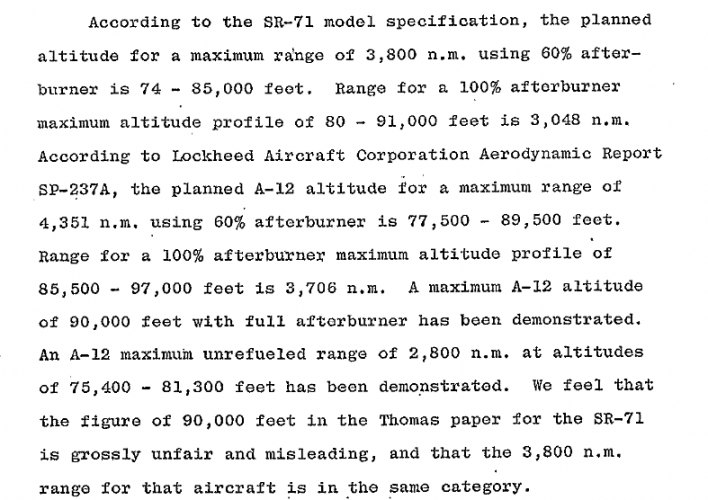
Are you sure it was Lockheed and not some other organization? Not everything written on paper is trustworthy. An example of the greatly inflated projected performance of the SR‑71 was already given earlier.In 1975, Lockheed attempted to determine the feasibility of extending the Blackbird’s speed and altitude capabilities. The results of several studies concluded the airplane’s maximum speed limit could be extended to Mach 3.5 for short periods of time. The only structural limit to speeds above Mach 3.5 was a KEAS limit of 420, set by inlet duct pressures and temperatures that exceeded acceptable values. Limited inlet-capture area and excessive engine compressor inlet temperatures also limited operations at higher Mach numbers.
And did that list include all A-12 early test flights or just SR-71? The notion that it could cruise at Mach 3.2-3.3 but would explode into fiery bits at Mach 3.4 is laughable.I read a discussion on a forum where there was one person from the SR‑71 technical team. In their department, they received records of every flight. He said that over many years he had never seen anything higher than Mach 3.2, and all the stories about Mach 3.5 and the like are just pilots’ fantasies.

Not when you consider that they had like a 500nm range when launched from an SR-71Bx.Really expensive way to deliver 3-4 SRAMs, though.
According to a pilot one exceeded M3.5 running away from a SA-5 above Libya in '86. Inlet duct temperatures and engine longevity probably weren't his primary concerns at the time.And did that list include all A-12 early test flights or just SR-71? The notion that it could cruise at Mach 3.2-3.3 but would explode into fiery bits at Mach 3.4 is laughable.
Are you sure it was Lockheed and not some other organization? Not everything written on paper is trustworthy. An example of the greatly inflated projected performance of the SR‑71 was already given earlier.
Yes, but 20 years later, the Soviet report on these events was declassified and published (the Soviets had all the information about the air defense situation). In reality, the SR‑71’s speed was not Mach 3.5 but Mach 3.15. And the SA‑5 was not used against the SR‑71 at all. Three SA-2 missiles were launched, but they failed to shoot it down. Brian Shul (the pilot of that same SR-71) is a fabricator who had no idea he could be exposed a few years later.According to a pilot one exceeded M3.5 running away from a SA-5 above Libya in '86. Inlet duct temperatures and engine longevity probably weren't his primary concerns at the time.
A Soviet document may not be the most trustworthy source, probably why it's omitted from the Wikipedia page. Doesn't really make sense to go slower than cruise speed to evade a missile.

Ballistic climbs over 100,000 ft should be well within the Blackbird's capabilities, since lesser aircraft can do it. However, the real issue are maintaining control at those altitudes and the ability to restart both engines in-flight while coming down. Did the Blackbird have an APU that could operate at that altitude? Could it maintain control at slower speeds while the engines were flamed out? If it can't then kinematic performance (which it does have) does not matter.