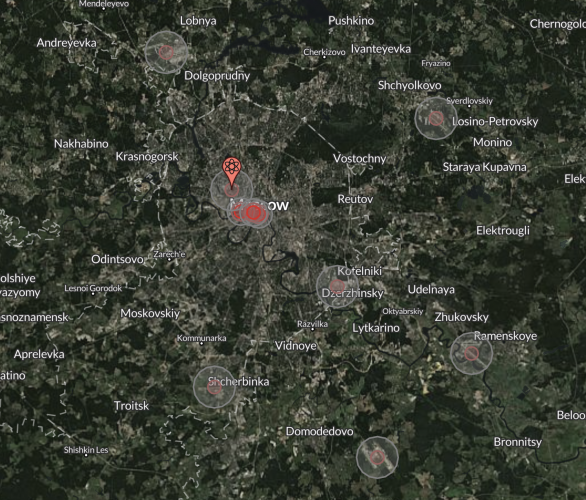
Ukraine managed to do just that a few weeks ago. They forced the Kapotnya Oil Refinery to shut down.

They hit the refinery; I’ve not seen anything to indict was shut down. It seems like there were several hits out of a hundred drones; that’s hardly a good payoff. But forcing over a hundred air defense systems to cover Moscow *is* a good payoff, in and of itself.
 
Hey guys let's bring the Russian-Ukraine conflict up in every thread mmkay? Thx.
One truly wonders. It is amusing though, seeing people compare low cost, small payload drones with literal high yield nuclear devices (I.e the effect of a 1-2 Apartments damaged in a housing complex versus wiping swathes of land from the face of the earth). But it's not like there's much else to expect, looking at the preferred..."sources"...for their research.

Certainly relevant for "current nuclear weapons development".
 
One truly wonders. It is amusing though, seeing people compare low cost, small payload drones with literal high yield nuclear devices (I.e the effect of a 1-2 Apartments damaged in a housing complex versus wiping swathes of land from the face of the earth). But it's not like there's much else to expect, looking at the preferred..."sources"...for their research.

Certainly relevant for "current nuclear weapons development".
Screenshot 2026-05-30 at 5.45.34 PM.png
Except as you can see in this hypothetical attack scenario I made up on nukemap, one Trident missile would not in fact wipe out Moscow from existence.

I went with 10 W76 warheads

3 groundbursts
-Kremlin
-White House
-Ministry of Defense HQ

7 Airbursts
-Kapotnya Oil Refinery
-MiG Manufacturing Complex No. 2
-Domodedovo Airport
-Ostofeyo Airport
-Zhukovsky Airport
-Sheremetyevo Airport
-Chkalovsky Military Air Base

The outermost grey rings represent 5 psi blast overpressure, where most residential structures collapse, the light red is 10 psi, and dark red is 20 psi, where even hardened structures collapse and virtually nobody survives (note how only the groundburst ones even reach that high).

Assuming that Muscovites heeded warnings and found cover, almost all of them would survive uninjured.
 
The thread is called Nuclear Weapons Development. Every member is free to start topics such as “drones vs. nukes” or whatever but let’s try and keep existing threads on topic.

Now if they make a nuke for a drone sure have at it.
 
This sounds like the "Dash-to-shelter" idea that was proposed for MX
 
Last edited by a moderator:
Something to consider is that the CEP of our ICBMs is likely going to be a lot higher than rated. We test our ICBMs on an east-west flight path. For obvious reasons, nobody has ever tested an ICBM going over the arctic. It's certain that drag forces on that route will be subtly different and introduce substantial inaccuracy
 
Something to consider is that the CEP of our ICBMs is likely going to be a lot higher than rated. We test our ICBMs on an east-west flight path. For obvious reasons, nobody has ever tested an ICBM going over the arctic. It's certain that drag forces on that route will be subtly different and introduce substantial inaccuracy

Yeah, no.

Defenders also argued that the auxiliary assumptions involved in moving from test-range to operational firings were secure. The gravity field over the North Pole, at least at the heights of ICBM trajectories, was well known from observation of satellite orbits; the effects of unpredicted winds and other climatic variations was negligible with modern, fast reentry vehicles, the build-up of electrical charge on a reentry vehicle would have to be implausibly large for a significant effect to be exerted by the earth’s magnetic field, and other potential effects would be vanishingly small in their consequences.

In sum, wrote General Robert T. Marsh, Commander of the Air Force Systems Command, "this pseudo-technical world [of the critics] says one cannot predict ballistic trajectory accuracy a priori, i.e., prior to actually firing some missiles on the expected trajectory. Such reasoning defies all the demonstrated rigor of physical laws from Newton to Einstein. It is akin to saying a gun may not be fired on a new azimuth without a prior shot in that direction. We certainly cannot allow such logic to affect important strategic decisions."

Or as Charles Stark Draper concluded: "There is indeed grave risk in using ballistic missiles, but that risk is not uncertainty of accuracy."

(Excerpted from page 372 of Inventing Accuracy: A Historical Sociology of Nuclear Missile Guidance by Donald MacKenzie)
 
That's called a cruise missile. AGM-86Bs for example. AGM-181 LRSO, etc.
Is that the nomenclature we use for those systems? When we talk about drones has anyone ever grouped nuclear cruise missiles into the mix?
 
I don't know why we're glorifying one-way-attack systems with the name "drone"

If it's guided, has propulsion and a warhead it's a missile not a drone, maybe we could get @Andreas Parsch two add his two-cents worth as he seems to be the forum's resident aircraft and missile designations expert.
 
If it's guided, has propulsion and a warhead it's a missile not a drone, maybe we could get @Andreas Parsch two add his two-cents worth as he seems to be the forum's resident aircraft and missile designations expert.
I may know a bit about missile designations, but this doesn't seem to cover the question at hand. Which is, why are some weapon systems called "one-way attack drones" and not "cruise missiles", even though the former term describes the very same operational functionality as the latter one. My best guess is that "cruise missile" sounds like "big and expensive", which the typical attack drones are not. Also, drones are all the rage nowadays, so everything is a drone now ;).

If someone manages to put a nuclear warhead (to get a bit back on topic) into an airframe, which looks like a drone (as in "propeller-driven, relatively slow"), my guess is that the resulting weapon would be called a "nuclear attack drone" and not a "cruise missile".
 
"Drone" is the new hotness. They'd probably call Project Pluto a "drone" today too. An "A.I. drone" for good measure.
 
Last edited by a moderator:
View: https://www.reddit.com/r/nuclearweapons/comments/1txpjbd/it_looks_like_russian_eks_early_warning/

Proof of what has been suspected for a long time but never proven until now – the GNSS constellations are highly susceptible to extremely wide area jamming from GEO/HEO, and apparently Russia has already fielded and tested multiple satellites with this capability.

Even crazier, the satellites with this capability have been identified to be satellites that are publicly identified as being the Russian equivalent of DSP satellites — so in other words, their nuclear early warning satellites are playing double duty as continental-scale GNSS jammers!

Including this capability aboard their DSP-equivalent satellites instead of on board separate satellites may not be the smartest move since it strongly incentivizes targeting their DSP satellites, the loss of which would be incredibly destabilizing in the most dangerous way possible (one of the fundamental tenants of "stable MAD" is that you do not touch or interfere with nuclear early warning systems in any way, as degrading or destroying them is massively destabilizing and greatly increases the odds of nuclear first use by the nation with degraded/destroyed nuclear early warning capabilities).

On the other hand, by co-locating it with the DSP satellites, you could argue that they've tried to take advantage of how damaging it would be to nuclear stability to target and destroy their DSP satellites, thereby relying on the importance of not damaging nuclear warning capabilities to shield the blatantly weaponized wide area GNSS jamming capability from interference. It's a ballsy and risky move, but it could pay off for Russia.

This also lends further credence to the long-standing dogma in the US nuclear ballistic/cruise missile design community of never ever relying on GNSS in any way on nuclear delivery platforms (e.g. pure INS or pure INS + star sighting on ballistic missiles, onboard SINS/ESGN with extended period between resets and multiple PNT sources beyond GNSS for resets aboard ballistic missile submarines, pure INS or pure INS + TERCOM/DSMAC for cruise missiles, etc), and limiting its use to only one of multiple sources for periodic ESGN resets aboard the Trident submarines (which can operate in GNSS-denied environments with minimal accuracy degradation in the short to mid term, although in the long term accuracy would degrade more significantly if they were forced to rely exclusively on non-GNSS PNT sources for ESGN resets over a longer period of time).

As you can see, it is quite trivial to jam GNSS over a wide area, and in any scenario involving an exchange of nuclear weapons, the designers quite justifiably assumed that GNSS would be unreliable or denied entirely. And as it turns out, Russia has actually fielded and tested the exact systems that the designers were concerned about protecting these nuclear delivery systems against the existence of.

The satellite that has been confirmed to be the source of GNSS interference is Kosmos 2546 (aka Cosmos 2546). However as the earliest detected event was in October 2019 (prior to Kosmos 2546's launch), this suggests that at minimum at least one (if not multiple) of the first three EKS satellites also has this capability. The most conservative possible explanation would be that this October 2019 event came from the recently-launched Kosmos 2541, which would possibly imply that potentially only Kosmos 2541 onwards has this GNSS jamming capability. Unfortunately high resolution raw radio data is not available for older events, so it is impossible to prove which EKS satellite(s) produced the numerous examples of GNSS jamming signals observed prior to the capture of the Kosmos 2546 event, especially so prior to the launch of the Kosmos 2546 satellite. It is equally (potentially even more) likely that all EKS satellites carry this system on board, and thus Russia only began these brief semi-operational diagnostic tests of the system after Kosmos 2541's launch (which brought the constellation to a total of 3 active satellites). The timing could be a coincidence, or it could be due to the orbits required, or due to coverage required, or due to needing a certain minimum number of operational satellites before attempting to test the system, or any of many other possible explanations.

For more information on the satellite that produced this event, refer to https://en.wikipedia.org/wiki/EKS_(satellite_system)

Veritasium has also produced an unusually decent quality video covering the history of this discovery in significant depth with the actual professor involved in much of the research that has been done on this, which can be viewed at:

View: https://www.youtube.com/watch?v=tz23G_UXCGA

I recommend giving it a watch – the title is pure clickbait, but the content is unexpectedly solid, and it's well worth watching for the additional background information provided thanks to their access to and extensive interviews with the actual professor who co-authored the original research paper. Note that I don't normally consider content from Veritasium (or similar channels) to be worth watching after having observed a streak of abominably poor quality reporting from them in multiple videos (and was never a huge fan of the concept to begin with), but this video is a rare exception where they actually did a pretty fantastic job, and as far as I can tell, the facts reported in it match up to the details in the original research paper on arxiv. I am a bit surprised to find myself recommending one of their videos, but hey, I can't argue with the excellent work they did on this one. It's a pity that they can't apply the same rigor to all of their other videos.

 
Last edited:

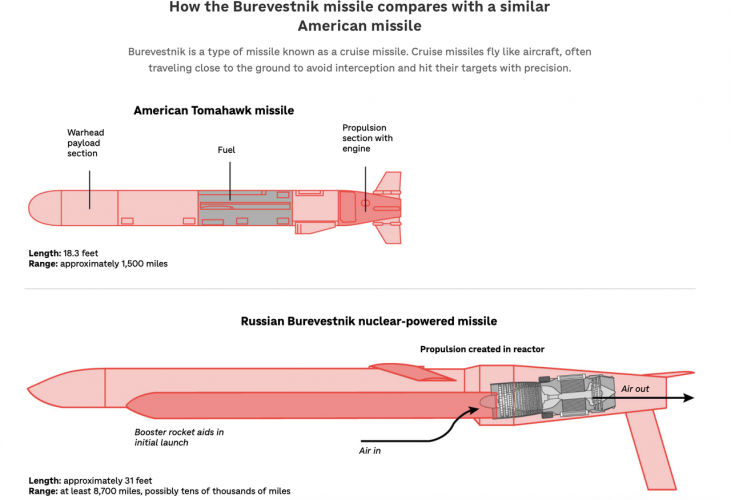
Report: Russia's nuclear-powered 'Skyfall' missile is dirty and dangerous​


https://www.npr.org/2026/06/18/nx-s1-5843252/russia-nuclear-powered-missile-burevestnik

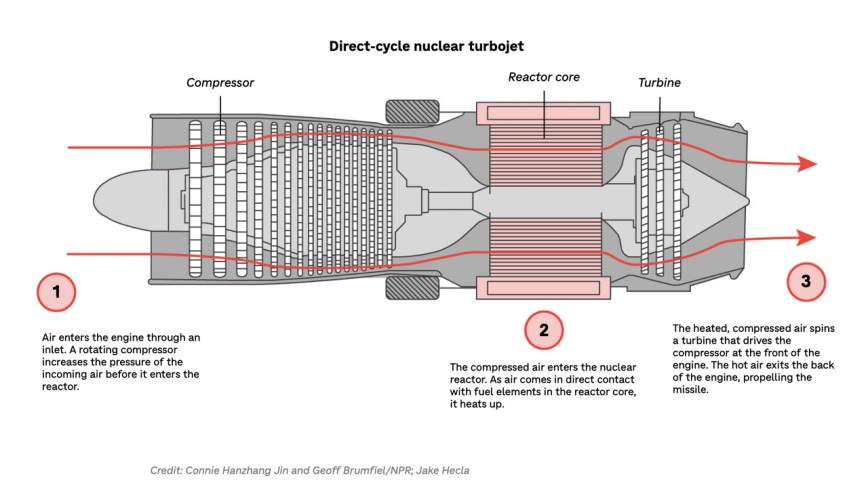
His conclusion: "It's almost certain that the system uses a direct-cycle air-breathing nuclear propulsion system, most likely driving a turbojet," he told NPR.
A direct-cycle system means that the reactor runs by pushing air from the atmosphere directly through the nuclear fuel. A compressor forces the air through tiny straw-like channels in the reactor core, where nuclear reactions cause the air to heat and expand out the back of the engine. Such a system is radically different from most nuclear reactors, which use an "indirect" closed loop. Those sealed systems are filled with water or another coolant and transfer heat out of the reactor while limiting radiation exposure.

Hecla said he can't completely rule out that some sort of indirect loop is used in the missile, but given the complexity and extra weight involved with building such an indirect system, he finds it far more likely that Burevestnik is heating air by sucking it right through the reactor core.

And that's a big problem. "The direct cycle is very likely to result in a large quantity of radioactive material in the exhaust," Hecla said. Air itself is irradiated as it passes through the engine, and fission decay products from the nuclear fuel also diffuse into the straw-like cavities and are shot out the back.

Hecla said his calculations show that a direct-cycle system would produce large quantities of radioactive isotopes of argon, krypton and carbon. He admits the reactor could release still more radioactivity if the core starts to corrode during hours of flight.

"Heated, compressed atmospheric air is very good at eroding engine components," Hecla noted. There's no reason to think this new nuclear reactor would be different.

image.png
 

Attachments

  • image.png
    image.png
    245.6 KB · Views: 16
The sad thing is that with how things are going, everyone and their brother is going to make the world into the prequel to the GURPS setting Reign of Steel... with enough WMDs that, geopolitically, you can't take one step before you trip over one.

The NPT is dead; it's just taking time for it to be realized.
 
View: https://x.com/defense_news/status/2072698825446240316?s=20

UK ratchets up nuclear spending, with new warhead and delivery planes in the works​

https://www.defensenews.com/global/...new-warhead-and-delivery-planes-in-the-works/
Britain will pour more than £63 billion ($84 billion) into its nuclear deterrent over the next four years, the government confirmed this week.
The money will fund the Dreadnought-class ballistic missile submarines and SSN-AUKUS attack boats, along with a new sovereign warhead named Astraea, according to the announcement.
The nuclear spending is a significant portion of a broader £298 billion ($398 billion) four-year spending profile meant to lift U.K. defense spending to 2.7 percent of GDP en route to NATO’s 3.5 percent target by 2035.
Central to the current package is Astraea, the warhead designated A21/Mk7 that the Atomic Weapons Establishment has been developing since 2020 to replace the aging Holbrook design carried on Trident II D5 missiles.
Astraea is being developed “in parallel” with the W93 and will share its Mk7 re-entry body, according to the government. The new British warhead’s estimated yield will reportedly fall somewhere between 90 and 455 kilotons

US Stuff
Little bit about AGM-86, AGM-181, B61 and LGM-35 on P147-149:

https://www.airandspaceforces.com/app/uploads/2026/06/Almanac2026_Weapons-Platforms-1.pdf
 
Last edited:
They fired over Japan, ROK and the PI ?! Well that’s a dick move…
Not really much choice. At least with the trajectories flown the missile was still climbing over those countries.

And it's not like there weren't half the Aegis ships in the Pacific Ocean standing by waiting to shoot debris while gathering data on the missiles.
 
From what I've read so far, most say it's JL-2, not the newer JL-3.
 
Are those the launch-canisters for the JL-2 on parade on those trucks?
 

Similar threads

Back
Top Bottom