Another amazing find from /r/nuclearweapons:

View: https://www.reddit.com/r/nuclearweapons/comments/1szrzjg/naval_ordnance_lab_1966_multipoint_initiated/


H-tree multipoint initiation tiles are widely believed to be the basis used for many modern nuclear weapon primaries (excluding certain niche special cases like the W88). There are a few other techniques that could possibly substitute for H-tree MPI tiles (air lenses are probably the one with the most support for spherical primaries), but evidence to support the use of alternative techniques is mixed, and it is widely believed that H-tree MPI tiles are likely one of the most commonly used techniques in most US nuclear weapons.

Modern techniques for primary HE initiation/lens designs has historically been one of the most closely guarded nuclear weapon design secrets. Notably, the US has been unusually consistent about guarding details regarding HE initiation/lens design from disclosure, and unusually aggressive about redacting any details even vaguely related to this area of weapon design during the declassification process.

Enough little bits and pieces have slipped past the censor over time for certain informed commenter-analysts to piece together evidence suggesting that H-tree MPI was definitely used in at least some historical US weapons. However, the release of direct information of this level of detail including actual images of real MPI tile design details is unprecedented.

You can read the linked thread for an explanation of why this got declassified (it's a very unusual and unique one of a kind case).
 
I gotta agree with the redditors, this must have been independently developed by NRL and the folks over at AEC/DOE never saw it to get Restricted Data stamped all over it.
 
Another amazing find from /r/nuclearweapons:

View: https://www.reddit.com/r/nuclearweapons/comments/1szrzjg/naval_ordnance_lab_1966_multipoint_initiated/


H-tree multipoint initiation tiles are widely believed to be the basis used for many modern nuclear weapon primaries (excluding certain niche special cases like the W88). There are a few other techniques that could possibly substitute for H-tree MPI tiles (air lenses are probably the one with the most support for spherical primaries), but evidence to support the use of alternative techniques is mixed, and it is widely believed that H-tree MPI tiles are likely one of the most commonly used techniques in most US nuclear weapons.

If we could see an unreacted photograph of the W87/88 primary I suppose it would look something like that?
 
If we could see an unreacted photograph of the W87/88 primary I suppose it would look something like that?
The W87 primary, most likely yes, albeit only if you first stripped off and discarded the radiation case, primary interstage/padding, detonator wiring, detonators, etc. Obviously this would only be the outermost visible layer. Below this would be a single monolithic layer of IHE (no need for bulky explosive lenses with MPI tiles!), then you'd have a beryllium pusher-tamper-reflector, a coating of vanadium (to provide the FRP properties), a thin coating of stainless steel, then finally the hollow plutonium pit.

The W88 primary, no. It is a spheroid primary, not a spherical primary. It is unclear what kind of initiation system is used. Some believe that it may use a two point initiation system. Others believe that it may use something a bit more complicated than that. Two point initiation is quite plausible but has traditionally been associated with serious one point safety issues, although in theory there are ways that could be worked around. Honestly we have nowhere near enough information to say with certainty what the exact design details inside look like. The most common guess is that it's a two point initiation system, and I weakly agree with this theory.
 
The W88 primary, no. It is a spheroid primary, not a spherical primary. It is unclear what kind of initiation system is used. Some believe that it may use a two point initiation system. Others believe that it may use something a bit more complicated than that. Two point initiation is quite plausible but has traditionally been associated with serious one point safety issues, although in theory there are ways that could be worked around. Honestly we have nowhere near enough information to say with certainty what the exact design details inside look like. The most common guess is that it's a two point initiation system, and I weakly agree with this theory.
I would expect something very sophisticated, not a 2-point squish. If only because the USN would utterly lose their minds over the one-point safety issues.
 
Two point allows a 'rugby ball' like shape which cuts diameter along one axis. Not sure that's ideal for something to fit a cone shaped RV?

But it's very useful for tubular atmospheric missiles, where cross sectional area matters.
 
Two point allows a 'rugby ball' like shape which cuts diameter along one axis.

From the wikipedia article on the SWAN-device:

960px-U.S._Swan_Device.svg.png


This was first tested in the Redwing Inca shot (Which was the XW-45 warhead used in the RIM-2D Terrier, it yielded 15.2KT) on its' own then in the Redwing Mohawk shot (A test of a two-stage device with the FLUTE secondary (Total yield was 360KT), the PICCOLO device was developed from it and it was used in the W47Y1 warhead) in 1956 during operation Redwing.

The SWAN device was developed into the ROBIN primary which was used as the W47's primary, due to the primary not being one-point safe and due to the inability to test a one-point safe design during the 1958-1961 nuclear-test moratorium. A Boron-Cadmium safety wire was inserted into the interior of the primaries pit during manufacture (It was removed during arming by a small electric-motor), this proved to be highly unreliable and prone to jamming (Rendering 50-75% of W47s duds).​
 
Interesting line from an Economist article on the UK's ability to maintain nuclear weapons.

“To my best understanding the UK has never designed a modern thermonuclear weapon on its own,” says Jeffrey Lewis of the Centre for Nonproliferation Studies at the Middlebury Institute in Monterey. “The United States executes a design; that information is shared with the UK and they modify it.” A British official insists that the country could go it alone if needed. “We’ve got what we need out of them on Astraea,” he says. But even if AWE could produce an all-British design, it would still need America in other ways. “The non-fissile components are all basically produced in the United States,” says an insider.

Under the MDA, 955 non-nuclear parts of nuclear weapons were sent from America to Britain in 2020-23 alone, according to the Nuclear Information Service, a research group. That might have included so-called interstage materials, ultralight gels which transport radiation from the fission part of the bomb to the fusion part. “My understanding is those are only made in the United States,” says Mr Lewis, “and the United Kingdom does not have the capability to make them.” Britain also relies on America for tritium, a hydrogen isotope that boosts the explosive yield.


Full article below

From the Economist April 23rd 2026

“I USED TO joke”, says a former Pentagon official, “that the only thing British about British nuclear weapons is the fissile material. Everything else is American.” That is an exaggeration. But not by much. There are few areas where America and Britain are entangled as deeply as in the nuclear domain. How long would it take Britain to produce a home-grown bomb?

Britain’s deterrent comprises Trident D5 missiles carried on four Vanguard-class (and soon Dreadnought-class) submarines. Contrary to popular belief, they can be fired “completely independently” of America, says a naval officer familiar with the system, with no reliance on GPS for navigation. But for everything up to that point, Britain is dependent on its ally.

The bedrock of Anglo-American nuclear co-operation is the Mutual Defence Agreement (MDA) of 1958 and the Polaris Sales Agreement of 1963. These get around America’s draconian laws on sharing nuclear technology. No other country enjoys remotely similar arrangements. The MDA was signed only after the Russian Sputnik shock and when Britain had demonstrated its ability to build an H-bomb.

It is sometimes hard to “disentangle what is purely a US piece of information from a UK one”, says John Walker, a former British arms-control official. Take warheads. In theory, Britain designs its own at the Atomic Weapons Establishment (AWE) in Aldermaston. In practice, American and British warheads both have to fit into the same aeroshell, which shields them as they re-enter the atmosphere. Britain’s Holbrook warhead is derived from America’s W76; its next-generation Astraea A21 is closely linked to America’s new W93.

“To my best understanding the UK has never designed a modern thermonuclear weapon on its own,” says Jeffrey Lewis of the Centre for Nonproliferation Studies at the Middlebury Institute in Monterey. “The United States executes a design; that information is shared with the UK and they modify it.” A British official insists that the country could go it alone if needed. “We’ve got what we need out of them on Astraea,” he says. But even if AWE could produce an all-British design, it would still need America in other ways. “The non-fissile components are all basically produced in the United States,” says an insider.

Under the MDA, 955 non-nuclear parts of nuclear weapons were sent from America to Britain in 2020-23 alone, according to the Nuclear Information Service, a research group. That might have included so-called interstage materials, ultralight gels which transport radiation from the fission part of the bomb to the fusion part. “My understanding is those are only made in the United States,” says Mr Lewis, “and the United Kingdom does not have the capability to make them.” Britain also relies on America for tritium, a hydrogen isotope that boosts the explosive yield.

As for the missiles, Trident D5s are stored and refurbished in Kings Bay in the American state of Georgia; Britain leases and picks up its missiles from that common pool. “If we had to create a similar facility over here, that would be an extraordinarily expensive thing to do,” says a former official. Missile testing is a joint endeavour; when a British test failed spectacularly in 2024, it was because of a problem with the American test kit.

That is not to say co-operation is all one-way traffic. America’s nuclear labs have long welcomed technical input from Britain, says Mr Walker, with AWE serving as a “neutral” voice among the sprawling and sometimes cacophonous American ecosystem. “If there were differences between Livermore and Los Alamos,” he says, referring to two of the largest labs, “then getting a kind of third valid opinion from the UK was always welcome.”


Voulez-vous lancer avec moi?


If America were to sever all co-operation, Britain could hang on to one boatload of missiles at sea and another waiting to relieve it. That could buy a few years. What would a crash nuclear programme look like? The most ambitious and expensive effort would require building new ballistic missiles that could fit with Astraea, as well as production facilities for components and material and a new testing range. Reproducing “all the infrastructure” without America would cost more than £100bn, claims Dominic Cummings, a former adviser in Number 10.

A slightly simpler option would be to develop an air-launched nuclear missile, a capability that Britain gave up in the 1990s. A nuclear-tipped cruise missile would be simplest. A Trident warhead could not simply be strapped to cruise missiles—they are too big and would experience very different sorts of stresses in flight. But a new warhead would need to be designed and validated without explosive testing. Even if Britain were willing to walk away from the Comprehensive Test Ban Treaty, it would still have nowhere to test.

A government review in 2013 found that it would take 17 years to field a new Trident warhead and 24 years for a cruise-missile warhead. Those numbers were contested—a crash programme could surely be quicker. But the lack of testing is what would slow things down.

That leaves a third option: ask for help. In 1990 France offered to share the design of a nuclear warhead that would fit a French air-launched missile, notes James Jinks, a historian, in a new paper for Policy Exchange, a think-tank. Britain demurred, though it contemplated the French option as “one we might revert to later”. ■


Correction (April 24th 2026): An earlier version of this story said that Britain gave up an air-launched nuclear-armed cruise missile in the 1990s. In fact the WE177 was a gravity bomb, not a cruise missile. Sorry.
 
A slightly simpler option would be to develop an air-launched nuclear missile, a capability that Britain gave up in the 1990s.

The UK lost that ability when the RAF retired its' Blue Steel cruise-missile at the end of 1970.
 
Like I say, beware these sources as they have a anti-nuclear agenda and it literally infused everything they say. Set in a manner to shape your views and encourage abandonment of our Deterrent.

It is much more accurate to say that it is cheaper to acquire components from the US than fund domestic.

But it is false to state the UK cannot provide such from it's domestic industry and scientific establishments. Elements of that exist precisely to provide that fallback.

What is also clear is Establishment Elements be driving a domestication agenda for quite rational reasons. Current events have collapsed a lot of ambiguous factions that have been too reliant on the current state of affairs.

So we have a process of sorting out, as the two 'extreme' positions remain consistent while the rest must choose.
 
What is also clear is Establishment Elements be driving a domestication agenda for quite rational reasons. Current events have collapsed a lot of ambiguous factions that have been too reliant on the current state of affairs.
I still believe that the Establishment Elements are greatly understating the costs of restoring independent national nuclear design and production capacity.
 
I still believe that the Establishment Elements are greatly understating the costs of restoring independent national nuclear design and production capacity.
No I think that's Ed Davies leader of the LibDems who thinks an additional 20 billion will do.
At best enough for tactical weapons. But then the LibDems have had a thing for such going back decades.

Lord West (Labour) is a lot closer suggesting a near doubling to over 120 billion or more. But he puts this in context of the overall budget and the need to raise defence spending.

The harder elements inside the military and Civil Service have no such illusions. But their battle is not just over budgets, but the very strategic posture the UK should take.
Which takes us right into Elite factions disputing what is best for them.

But we can see moves towards various elements of a different posture.

Currently bogged down in delays, budget wrangling and all that is cover for factions getting their cut or playing politics with it.

It's obviously playing on the minds of senior politicians that if Trump plays around with the current arrangements, they've essentially got a choice of going for independence or giving up to European leadership permanently.

Though by permanently we mean until 2029, when the electoral hammer falls on the current crop.

I'd say "preparing for war" is actually the biggest political get "out of jail" card senior politicians have.
The question is, will they play it.....
They're holding back hoping they won't have to because results matter and in this sort of topic failure will be seen as treason.
 
Thanks:).

I still think that cancelling the WE-177 replacement was incredibly shortsighted and wilfully naive, as for HM's treasury harping on about cancelling it well the more intransigent bean-counters should've been told to shut up or they'd be reassigned to newly established treasury branches in the Falklands, South Georgia or the British Antarctic Territory.​
 
I still think that cancelling the WE-177 replacement was incredibly shortsighted and wilfully naive, as for HM's treasury harping on about cancelling it well the more intransigent bean-counters should've been told to shut up or they'd be reassigned to newly established treasury branches in the Falklands, South Georgia or the British Antarctic Territory.
As usual, the single greatest threat to HMArmed Forces is HMTreasury.
 
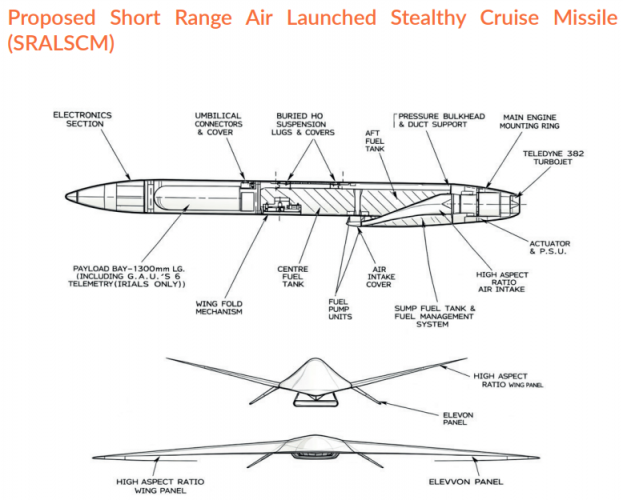
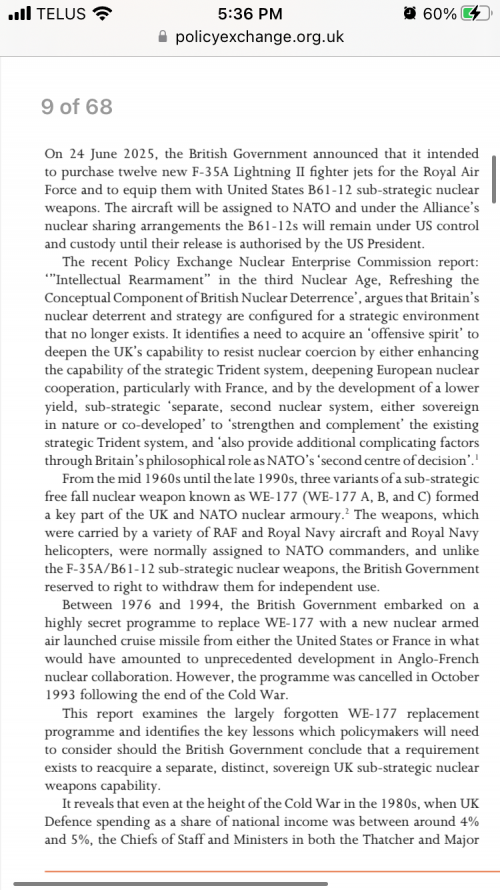
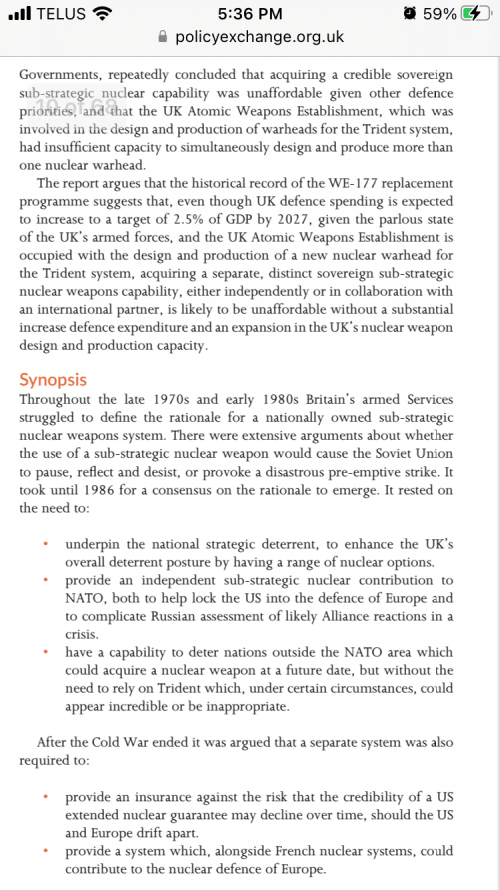
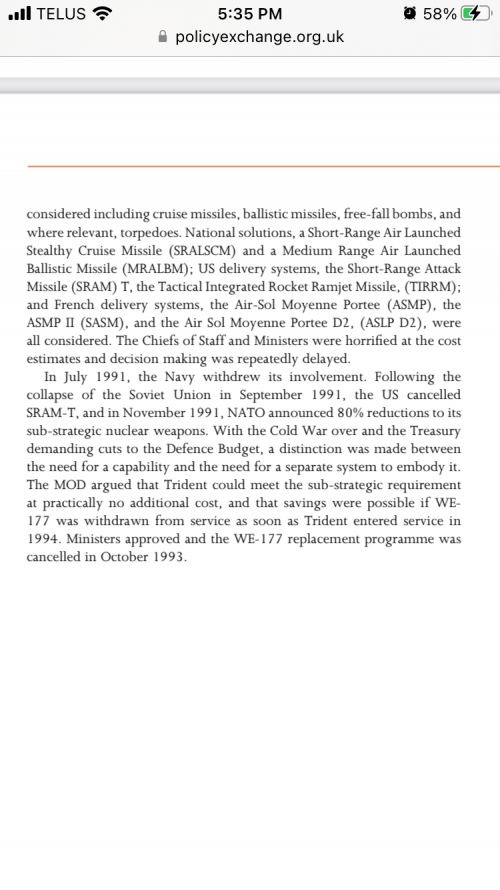
They did design at least one during the 1980s (SRALSCM):
A degree of correlation with the conventional cruise missile options in the side view.
 
Last edited by a moderator:
Rather alarmist.

The work funded in these two parallel programs seeks to overcome the technological barriers to future re-entry vehicle designs. The Navy program’s sub-project on future aeroshells notes the need to “withstand extreme temperatures and pressures encountered during hypersonic flight.” The equivalent Air Force justification document explains a recent bump in funding as “increased development and procurement of materials for multiple designs of the high lateral acceleration (high-g) and boost glide [government reference designs].”
So, the USN program quote ignores the fact that all intercontinental ballistic missiles are Hypersonic during reentry. Plus, there is currently only one maker of aeroshells in the US. We absolutely have to fix that, and get at least 3 different makers.

Also, the USN is very length-limited on their RB shapes, which makes the rolling conical boost-glider shape unusable. I also doubt that you could pack wings on the RBAs and still fit more than 4-6 per missile. So I don't believe that the USN will have hypersonics on their SLBMs.

Now, the USAF is absolutely talking about Avangard-style boost-gliders. I will give them that one.
 
UNARMED MINUTEMAN III ICBM TEST LAUNCH SCHEDULED AT VANDENBERG SPACE FORCE BASE

Published May 18, 2026
VANDENBERG SPACE FORCE BASE, Calif. --
An operational test launch of an Air Force Global Strike Command unarmed Minuteman III intercontinental ballistic missile is scheduled between 12:01 and 6:01 a.m. Pacific Time, May 20, from the northern portion of the installation.

This routine launch, designated GT 256, was scheduled years ago, and is not in response to world events.

The purpose of the ICBM test launch program is to validate and verify the effectiveness, readiness and accuracy of the weapon system, according to AFGSC.

For questions regarding the launch window or Vandenberg Space Force Base (VSFB) range operations, contact SLD 30 Public Affairs at 805-606-3595 or [email protected].

For queries regarding the ICBM test launch mission and missile, contact AFGSC Public Affairs at 318-456-1305 or [email protected].

-30-
 
It's actually quite a bit more than that. You'd need at least 200 RVs just to take out the ABM system. That doesn't count any of the RVs that'd be allocated to strike any of the actual targets within the Moscow area!

For example, if you're performing 2:1 strikes on 100 targets within the Moscow ABM system's umbrella, then you'd need 400 RVs to disable those 100 targets (200 to disable the ABM system, then 200 more to strike the 100 discrete targets once the ABM system has been taken out of service).

In 1968, there were thought to be approximately 130 warheads allocated to target the Soviet ABM systems, of which at least 70 were dedicated to the Moscow ABM system alone. This does not even include any of the warheads allocated towards targeting the various civilian and military sites within Moscow! That is just the warheads assigned to suppress the Soviet ABM systems to a sufficient degree to allow those other warheads to be able to hit their targets.

Of those 130 warheads, six targeted the Dog House radars, sixty-four targeted the eight ABM launch complexes, forty-eight targeted the six Tallinn system launch complexes, and twelve targeted the two Hen House early warning radars.

You can see a breakdown in https://journals.sagepub.com/doi/10.2968/060002018 (see the table titled "Projected U.S. ABM suppression strike, 1968")

At another unknown point in the Cold War, 200 warheads had been allocated to target the Tallinn ABM system alone (which is 4x the number from the estimate for 1968). See the quote and image in this post: https://www.secretprojects.co.uk/threads/spartan-sprint-abm-and-derivatives.8778/post-874925

During the cold war, there were 179 Designated Ground Zeros (DGZs) within Moscow. That means up to 179 sites within Moscow could be targeted during a nuclear exchange. Depending on the type of site, anywhere from 1–3 warheads might be targeted on it. Most important military targets will have a minimum of 2 warheads targeted on them. The most critical and/or heavily hardened sites will have 3+ warheads assigned to target them. Sites protected by ABM systems may also independently have additional warheads allocated to them in order to assist with breaking through ABM systems and protect against attrition by ABM interceptors.

Ref: https://nsarchive2.gwu.edu/nukevault/ebb538-Cold-War-Nuclear-Target-List-Declassified-First-Ever/

So during a nuclear exchange between the US and the Soviet Union, Moscow could potentially quite easily have several hundred nuclear warheads targeting it and its ABM system.

The logical conclusion to be drawn from this is that the UK lacks the ability to credibly strike targets within Moscow with nuclear weapons.

However by simply bypassing Moscow entirely and exclusively targeting military/infrastructure/industrial/civilian targets that lie outside of the Moscow ABM umbrella, the UK nuclear deterrent is still more than adequate to instantly cripple Russia.

For a last resort absolute minimum viable retaliatory strike capability like the UK has, this is arguably an acceptable compromise.

The Moscow ABM system is interesting as it inherently skews warhead numbers in Russia's favor when it comes to arms control treaties (even more so than they are already skewed by factors like tactical weapons not being counted). It's kind of funny how the Russian response to the US GMD system has been total outrage, when they already possess a far more capable system protecting their capital city. Pretty hypocritical if you ask me. Sure, you can arguably just bypass Moscow entirely, but I somehow doubt that the US would ever accept that kind of limitation.
You're telling me Ukraine can raise hell on Moscow with a few cheap drones but Britain would need nuclear weapons??
 
To be fair, I don’t think anyone is effectively attacking Moscow. There’s two dozen S300/400 batteries and two rings of ~100 Pantsir on rooftops and elevated flak towers. It’s pretty easily the most defended airspace on earth.
 
To be fair, I don’t think anyone is effectively attacking Moscow. There’s two dozen S300/400 batteries and two rings of ~100 Pantsir on rooftops and elevated flak towers. It’s pretty easily the most defended airspace on earth.
Ukraine managed to do just that a few weeks ago. They forced the Kapotnya Oil Refinery to shut down.
 

Similar threads

Back
Top Bottom