N-1 gets criticized for having separate internal fuel tanks--but might its conical first stage then be able to support heavier upper stages?
I know Wade's site isn't perfect---but I do wonder if something like this might have been possible: http://astronautix.com/n/n-imv-ii-iii.html
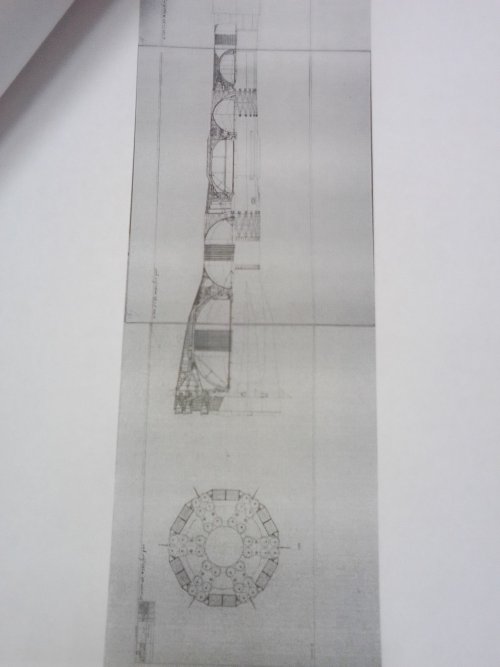
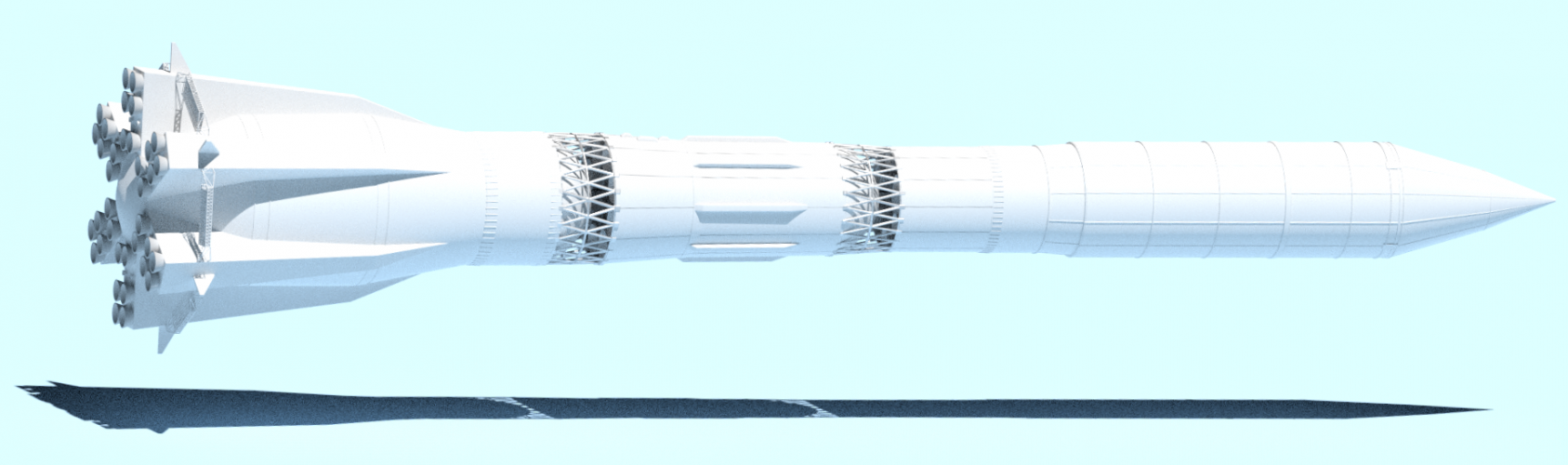
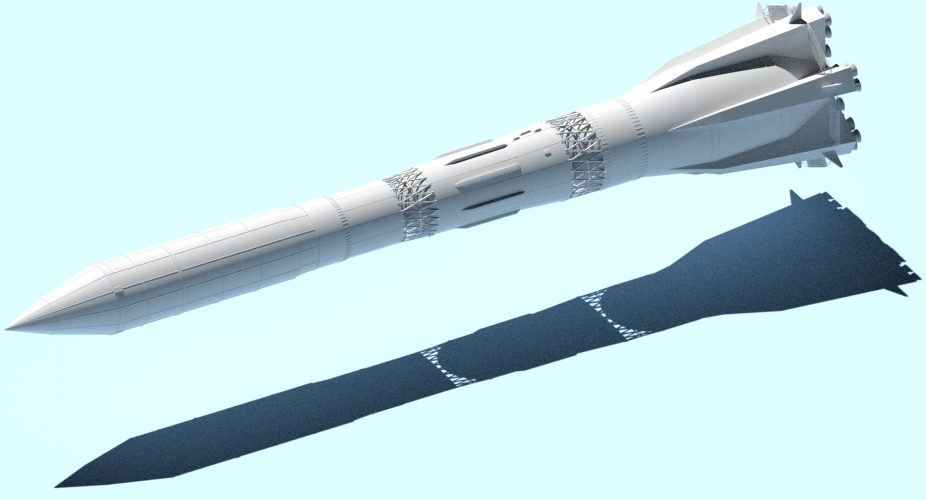
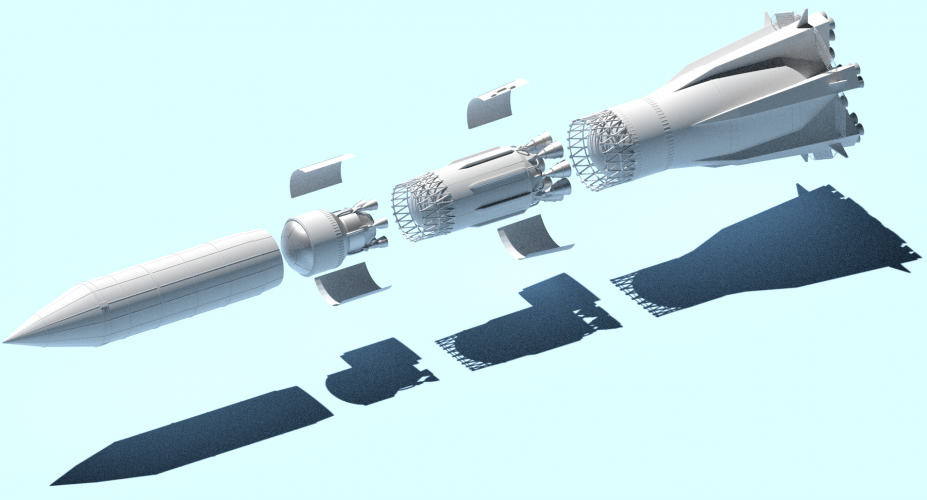
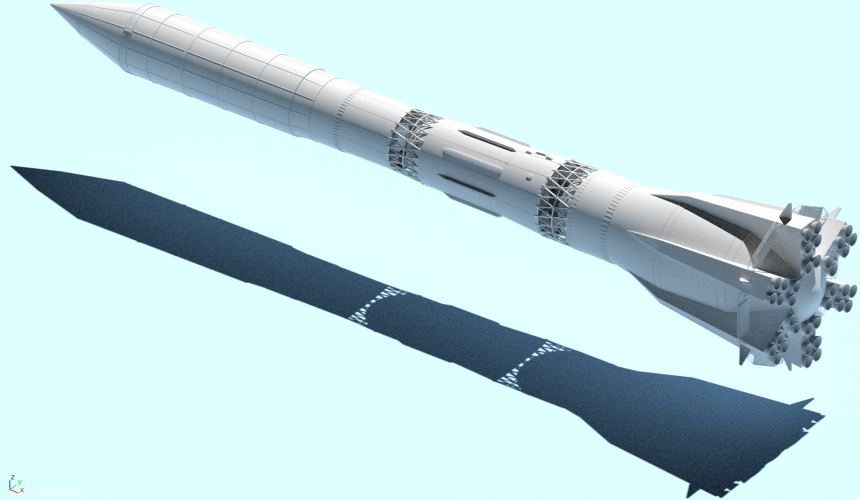
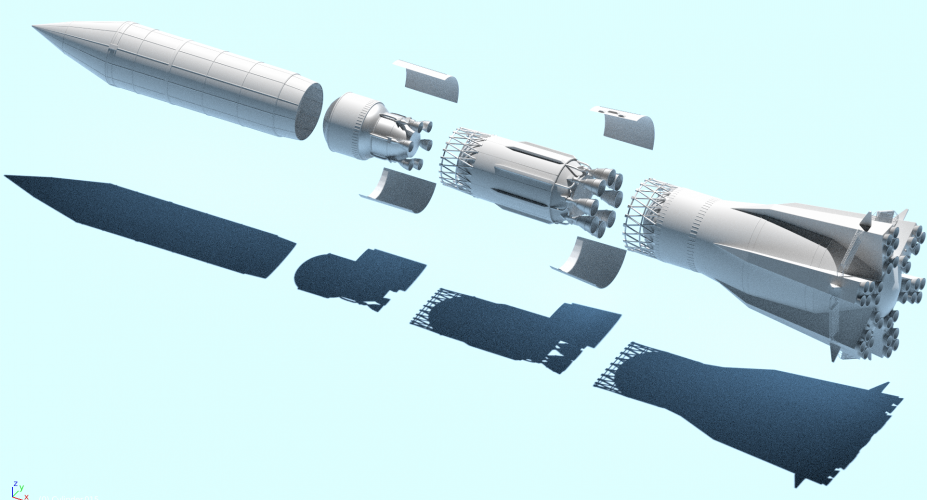
Based on the new graphics released, I have tried to make a quick 3d model of the N1M. A few details are speculative (notably, the greebles on the fairing are simply based on the flown N1), but it should be reasonably accurate to the drawings. When the launchpad graphic disagreed with the detailed drawing I preferred to follow the latter, being more detailed; however, the fairing shape was taken from the former.
Some notes on each stage:
Blok A:
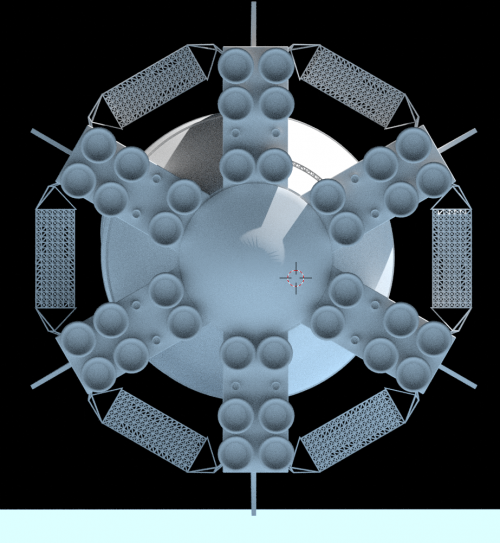
- the most obvious feature is certainly the 6, massive engine blocks, each housing 6 NK-15 engines. They are entirely structural, not tanks; the propellant is stored in the tanks at the center of the stage, which are the same spheres on N1's Blok A stretched with some cylindrical sections. These engine blocks instead house the propellant lines and presumably the hardware related to the fins and grid fins.
- the roll control engines appear to have been moved below the vehicle, between the inner and middle pair of engines. They are 12, versus 6 on the N1; note that these graphics are from May 1969, just before the second flight, which means before the extensive upgrade received after they were not able to control the vehicle on the third flight.
- the grid fins are 6, large, and attached laterally to each of the engine block. This very unique arrangement means they can't control roll, which is perhaps why a fin made an appearance on each engine block?
Blok B:
- The oxidizer tank is the same sphere as N1's Blok B stretched with some cylindrical sections. The propellant tank, however, is a wholly new lenticular structure that make sthe stage essentially cylindrical.
Blok M:
- Replacing Blok V, it's a hydrogen oxygen stage with a hanging LOX tank. A curious stage, but not much to say that can't be seen at first glance.
Fairing:
- No escape tower (see the launchpad graphic posted earlier)? Was it, perhaps, meant to fly an LKM (1969 version) dual-launch mission with N1 carrying the lander with the crew, and N1M carrying the injection stage? Anatoly Zak mentions it in reference to L3M at least, but I do not have access to the subscriber section of russianspaceweb
I will have an article about this next week. Apparently there were three of these albums of photographs. One of them was turned over to an archives and the other two remain classified. Back around 2018, somebody published a booklet with most of these photos, but not all of them. The new release includes about 3 new ones that were not previously published (I know that there are 2 new ones, but I'm not sure if there is a third new one).
I've been told that there are about 100 other N1 photos like this that remain classified but have been seen by people who worked on the program.
"Photos of the Soviet N-1 rocket have gone viral on Facebook, Telegram, and forums, being passed off as "new" and, pardon the harshness, making even those supposedly "in the know" swoon.
So, let me explain.
First, these are old photos, familiar to anyone interested in the history of Soviet cosmonautics. The primary source is a long-known album in the open collection of the RGANDT (Russian State Archive of Scientific and Technical Documentation), archive number - F. 213 Op. 1-1 D. 134. This album is so well-known that back in 2018 it was published as a large-format brochure available to anyone, see https://alien3.livejournal.com/2331022.html (even though its author, Pavel Shubin, processed these photos for printing better than today's).
Secondly, at least some of the photographs do not depict a mock-up 1M1 rocket, as stated in the album itself, but, judging by the snow, the third flight-ready 3L (during a fitting rollout to the launch pad in late 1968), which was the first to fly on February 21, 1969.
Thirdly, all the photographs were heavily cropped during printing, losing important details, as the original negatives were square. For example, in the photo of the solitary, towering rocket, the tall servicing truss next to it was cropped out, and so on.
Fourthly, there were at least three such "general's" photo albums, but only one of them made it to RGAND (the others, like the original negatives, remained at RSC Energia). In total, as far as I know, many dozens (almost a hundred) of photographs have been preserved in excellent quality (the negatives have remained virtually undamaged over decades of storage), and are still waiting for their time."
I'm wondering that Korolev hadn't died prematurely on the operating-table in 1966 and lived, say, another ten years if we'd seen an N1 successfully liftoff? The whole programme basically apart after he died due him being a manager par-excellence.
That depends mostly on Korolev being able to persuade USSR leadership to continue spending money on N-1 after losing the Space Race. The USSR wasn't doing well economically at the time, so I kind of doubt that.
That depends mostly on Korolev being able to persuade USSR leadership to continue spending money on N-1 after losing the Space Race. The USSR wasn't doing well economically at the time, so I kind of doubt that.
I'm wondering that Korolev hadn't died prematurely on the operating-table in 1966 and lived, say, another ten years if we'd seen an N1 successfully liftoff? The whole programme basically apart after he died due him being a manager par-excellence.
This is the question.
Korelev died too soon and too young, just after had defeated the Chelomey/Glushko (and their pet project UR-700/LK-700).
Korolev managed practically everything (from the spacecraft and rocket design to the employee furniture) while his successor, Mishin, was a poor leader and politically uninfluent.
But the real question is, if Korelev hasn't died, would be able to stop the ill-fated Soyuz 1 mission? Saving Komarov's life and also saving two precious years of time?
In any case he would have a very narrow window to beat the Americans on the Moon before the Apollo 11.
This site uses cookies to help personalise content, tailor your experience and to keep you logged in if you register.
By continuing to use this site, you are consenting to our use of cookies.