Passive radar seeker 9B-1032 can receive centimetric wave radar signals sent from the fighters, AWACS etc ,from 200km away but the max launch ranges are in the level of R-27R/ER. Right now I can't find any info /data if R-27P1/EP1 are really produced and exported but if someone find the photo where we can see yellowish radome ,that's exactly what R-27P/EP(P1/EP1) is looklike.
9B-1032E for the export version R-27P1/EP1 besides Izdeliye 112E for the export Kh-31P, both as ARM's ( A-A,A-S).
From what I learned on some Russian sites and forums, only about 200 of R-27P/EP were serially produced in the Artem factory in Kiev before USSR dissolution.During 1991 they were transported to the Akhtubinsk air base together with about 200 R-77's.
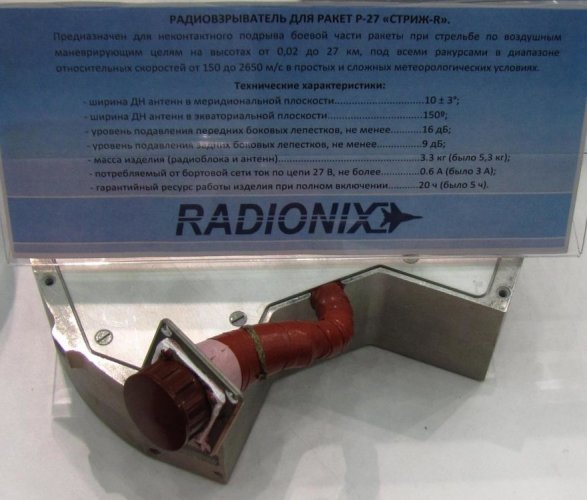
On the right side ,suppose 9B-1032E with its passive 'radio-pelengators' presented by the Ukr. company Radionix. Did Radionix produce some R-27P1/EP1 so far?
As Gennady S. described ,R-27P/EP were developed against NATO fighters for combat tactics were they would be used with or w/o the turning on the fighter's radar. It must be mentioned that R-27P/EP like old R-77 probably were never used by some operational VVS fighter unit throughout 1990's and after 2000.
With R-27P/EP Soviet fighters like Su-27 and MiG-29 ( that the USSR existed after 1991),would be very dangerous in any possible confrontation with NATO fighters.But this is not the end of this story. They already had R-27T/ET with their passive IR guidance (Su-27 only , with only 16 MiG-29S in the Russian AF).R-27T/ET together with R-27P/EP would provide serious threat.
Although we already mentioned T/ET in some aspects, I must ask some questions .As we know ,T/ET are also all aspects medium/long range AAM's which can be used in complete radio- silence regime.With T/ET it is possible to engage e.g fighters from behind/tail -on and from ahead/ head-on.There is that detail where IR seeker can be adjusted to work on average wavelengths of the radiation (airframe,jet stream from the nozzles etc ) ,of course all of this on the testbed.
Now what about the fighter's radars ? Is there any possibility that one IR seeker like those in T/ET can be guide on the radar's antenna as the heat source ? Example,during the so called 'stand by mode' ( EKV/ EA on the Russian ) where TWT sends signals to the reflector of the antenna w/o sending them to airspace.Some of the radar energy must be converted to the heat energy and thus radar itself becomes the heat source even in the situation where it is not radiating in the space? Can this be real ? One radar even turned off can be heat source for some time ?
What can be the 'heat value' of one modern PESA and especially AESA during radiation?There is one interesting detail from the K-27/E development history where we can find info that they tried to develop combined passive radar and heat seeker for one missile.Something like that we can find today on the newer ARM type Kh-58UShK-TP.
This "mode of operation" was first somehow presented by Piotr Butowski in his book (in other thread, somehow treated with, as source, disregards) from "90tees". (Actually from 1994). And missile "P" was that time already known.
And it was presented (especially version "E") as way to counter semi active missile in way" shoot later - engage first" (due to high speed of "E" missile). This will break guidance of semi active missiles.
This "mode of operation" was first somehow presented by Piotr Butowski in his book (in other thread, somehow treated with, as source, disregards) from "90tees". (Actually from 1994). And missile "P" was that time already known. And it was presented (especially version "E") as way to counter semi active missile in way" shoot later - engage first" (due to high speed of "E" missile). This will break guidance of semi active missiles.
Very useful combat tactics just like usage of radar and IR guided R/T (ER/ET) where IR guided medium/long range AAM's would be launched as first. Su-35S in Syria were carried old R-27T and new R-77-1 with the reason.
No need to be curt. What you underlined is EXACTLY what I said after the part you quoted. Yes INS + DATALINK can be up to 75% distance but not ONLY INS which will be anywhere from 1% to 33% of the range depending on launch from 1-1.5x seeker range. Ive read the manuals, you simply misunderstood.
What you underlined is EXACTLY what I said after the part you quoted. Yes INS + DATALINK can be up to 75% distance but not ONLY INS which will be anywhere from 1% to 33% of the range depending on launch from 1-1.5x seeker range. Ive read the manuals, you simply misunderstood.
So you know S-H language? As I wrote ( don't know what I did not understand), inertial phase ( with or w/o the use of data-link as mentioned before) , can be up to 70% ( not 75%) and SARH phase is up to 30% of the missile's flightpath, simple. Launch range,any other launch parameter is something else, different story.
So you know S-H language? As I wrote ( don't know what I did not understand), inertial phase ( with or w/o the use of data-link as mentioned before) , can be up to 70% ( not 75%) and SARH phase is up to 30% of the missile's flightpath, simple. Launch range,any other launch parameter is something else, different story.
I don’t need to know other languages when things like Yandex and Google Translate exist.
I said the inertial only phase was 20-30%. You said “nuh uh it’s 70%” and I said no you are talking about datalink phase not INS only. That’s what you misunderstood.
SARH only: launch from inside 1x seeker range
INS only before using SARH: if fired at 1-1.5x seeker distance the INS ONLY phase will last 20-30% of the flight profile.
It might also be INS only when datalink ends from 30s/25 km in which case it would use INS until seeker capture.
Datalink then SARH: launch from above 1.5x seeker range is the only time datalink is included. “Up to” 70% of the trajectory.
When I say INS phase; I mean INS only phase. When I mean datalink phase I say datalink. They are two separate phases with datalink having a maximum length of about 2x that of INS (70% vs 30% of the trajectory at maximum.)
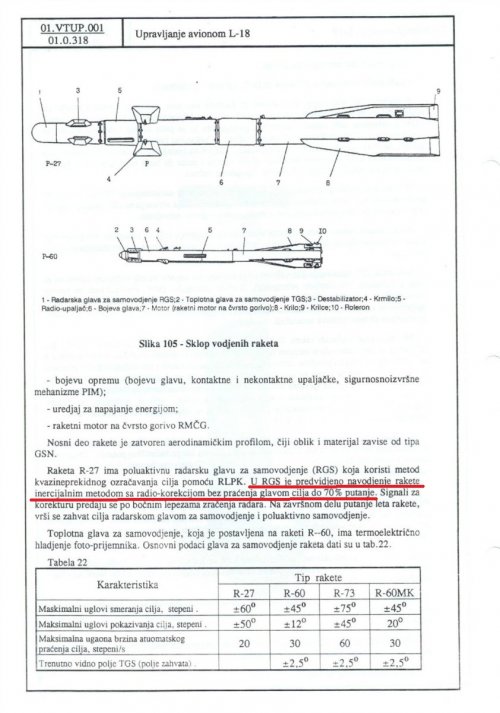
Again ,during live test launches w/o guidace unit ,K-27E achieved controlable flight of almost 100km. R-27R/ER have 70% of its flight path in INS phase ( with or w/o use of data link) and 30% of SARH phase.
Let’s look at what was originally said. You said this.
And I was trying to correct you becuase it’s incorrect. You say 70% of the trajectory can be INS (with or without datalink) but this is false. It is 70% with datalink and 20-30% without. It would be correct to say up to 70% of the trajectory can be radio corrected INS and 20-30% INS only.
When I say INS phase; I mean INS only phase. When I mean datalink phase I say datalink. They are two separate phases with datalink having a maximum length of about 2x that of INS (70% vs 30% of the trajectory at maximum.)
And I was trying to correct you becuase it’s incorrect. You say 70% of the trajectory can be INS (with or without datalink) but this is false. It is 70% with datalink and 20-30% without.
It would be correct to say up to 70% of the trajectory can be radio corrected INS and 20-30% INS only.
''В систему управления ракеты Р-27 помимо ГСН входит инерциальная навигационная подсистема с радиокоррекцией. На начальном участке траектории применяется инерциальное наведение на «математическую» цель с радиокоррекцией ее положения и скорости при маневре цели (по информации с носителя, передаваемой по радиолинии).''
''In addition to the seeker, the R-27 missile's guidance system includes an inertial navigation subsystem with radio correction. During the initial phase of the trajectory, inertial guidance is used to target a "mathematical" target, with radio correction of its position and velocity during target maneuvers (based on information transmitted from the carrier via radio).''
Inertial phase can be up to 70% of trajectory/ missile flightpath and that's it. RC-channel /data- link will be used only in the case when active jamm isn't used by the enemy ( index АП or AP ). RC-channel coded signals will be sent through sidelobes if the combat situation allows something like that. RC-channel range is 50km max.
There is catch in using of RC channel or not using the same. So if there will be no use of data-link, inertial phase will be only 20%-30% as you wrote ??? Example, R-27R/R1 ( one launched missile) has Prob. of hitting the fighter w/o using data-link only 0.2 .
Inertial phase can be up to 70% of trajectory/ missile flightpath and that's it. RC-channel /data- link will be used only in the case when active jamm isn't used by the enemy ( index АП or AP ). RC-channel coded signals will be sent through sidelobes if the combat situation allows something like that. RC-channel range is 50km max.
There is catch in using of RC channel or not using the same. So if there will be no use of data-link, inertial phase will be only 20%-30% as you wrote ??? Example, R-27R/R1 ( one launched missile) has Prob. of hitting the fighter w/o using data-link only 0.2 .
EDIT: INS only stage would be if launched at 26-37.5 km with target size in medium (25 km seeker activation). 13-18 km if launched with target size in small (12 km seeker activation).
''Целое семейство управляемых (скорее самонаводящихся) ракет "Воздух-Воздух" средней дальности. Делится на три типа в зависимости от башки самонаведения, которая на ней установлена.
Р-27р(эр) - ракета с радиолокационной полуактивной башкой, которая применяется по всему, что летает и имеет радиоотражающую поверхность. Да, эти ваши F-22 и F-35 тоже имеют такую поверхность. В общем, ей можно сбить всё, кроме ворон и воздушных шаров. Хотя, если включить "неуправляемых пуск", то можно как НАРиной заебенить в дирижабль. Полуактивная - это значит цель до попадания ракетой подсвечивается прицелом самолёта-носителя. Буковка "Э" обозначает модификацию ракеты с увеличенной энергетикой, т.е. такой ракетой можно стрелять дальше, чем ракетой без такой буковки. "Э" - это круто, в общем.
Р-27т (эт) всё то же самое, только головка тепловая и ракету можно пулять по принципу "пустил-забыл", а дальше она уже как-нибудь сама.
И Р-27п(эп) - ракета с пассивной радиобашкой, предназначенная как для казней самолётов - постановщиков помех, так и самолётов, которые пытаются взять вас на прицел локатором. Ну и в суицидальной (пардон, геройской) атаке можно попробовать атаковать ей АВАКС.
По идее, ими можно жахнуть и по наземным целям, лишь бы цель вещала в эфир в диапазоне головы ракеты. Р-27п самые дальнобойные из серии.
Все ракеты широко и активно применяются и по сей день на планете, вешаются на носитель кучей с разными головками и семимильными шагами меняются на Р-77 и прочие убервафли.''
"An entire family of guided (or rather homing) medium-range air-to-air missiles. Divided into three types depending on the homing turret/head they carry.
The R-27R(ER) is a missile with a semi-active radar homing turret, which is used against anything that flies and has a radar-reflective surface. Yes, your F-22 and F-35 also have such a surface.
Basically, it can shoot down everything except crows and balloons. Although, if you enable "unguided launch," you can ram it into a blimp like NARina. Semi-active means the target is illuminated by the carrier aircraft's sight before the missile hits. The letter "E" denotes a missile modification with increased energy, meaning it can fire further than a missile without the letter. "E" is pretty cool, basically.
The R-27T (ET) is the same thing, only it has a thermal warhead and the missile can be fired using the "fire and forget" principle, and then it will do its job on its own.
The R-27P(EP) is a missile with a passive radar turret, designed to kill both jamming aircraft and aircraft attempting to lock onto you with their radar. And in a suicide (pardon me, heroic) attack, you can try to attack AWACS with it.
In theory, they could also be used against ground targets, as long as the target is broadcasting within range of the missile's warhead. The R-27P is the longest-range missile in the series.
All these missiles are still widely and actively used around the world, being mounted on carriers in a variety of warheads and rapidly being replaced by R-77s and other überwaffes.''
No, letter E is from 'energetic' ,version with 100kg heavy booster. So we have R-27 and R-27E with their versions like R-27R/ R1,T/T1,P/P1 than, ER/ER1,ET/ET1 and EP/EP1. Number '1' designates export variant.
The R-27(R-27E) missile guidance system provides a launch range that is 2.5 times longer than the S-A homing range, and this coefficient is almost independent of the target's maneuver.
When the launch range is 1.5 times or more the missile's homing range, the missile's inertial system uses data from the radio correction channel. If this coefficient is less than 1.5, radio correction is not used.
This is particularly relevant for the R-27E missile. It's launch range in the front hemisphere can range from 60 to more than 100 km (if the target is flying at a speed of more than Mach 3 at high altitudes). At the same time, the missile reaches a speed of about Mach 5.5 for a short period, but the average speed is Mach 3-3.4. During the 60 seconds of controlled flight, the missile travels up to 60 km.
The R-27E does not use a rise above the target to increase its range. Its guidance system does not allow this even theoretically. Its long flight range is achieved through its extremely high energy (the highest fuel ratio relative to the missile weight among all Air-to-Air missiles)
Of the Soviet missiles, only the R-33 uses a rise above the target. It is smartest among all missiles.
Squirrel said: "for R-27R : 30 km against small target,70 km against medium target,90 km against big target"
The launch zone of the missile with INS+Homing depends mainly on the target's speed rather than its size. Theoretically, the R-27 can reach a launch range of approximately 80 km (conditions like this: the target at 2300 km/h and a MiG-29 at 2000 km/h flying at high altitude towards each other). The missile itself will travel about half of this distance in 60 seconds before reaching its target.
In practice, the launch zone rarely exceeds 30 km.
The R-27 had significant limitations. But it was the best medium-range AAM before the AIM-120
130km is the max launch distance ( as calculated, authorised) for the R-27ER. That can be only for the so called 'Dr max 1' launch parameter ,so for the engaging of the non-maneuvering air target.
Its long flight range is achieved through its extremely high energy (the highest fuel ratio relative to the missile weight among all Air-to-Air missiles)
Theoretically, the R-27 can reach a launch range of approximately 80 km (conditions like this: the target at 2300 km/h and a MiG-29 at 2000 km/h flying at high altitude towards each other). The missile itself will travel about half of this distance in 60 seconds before reaching its target.
Manual for the SUV-29E in the MiG-29B gives us data that 90 km can be maximum ( possible, permitted ) launch range for the 27R/R1 against one strategic bomber like B-52H e.g.
Hi !
Could you please post these graphics over there on Secretproject forum, R-27 topic...
They write some interesting stuffs and this could help them to make estimation of INS and radio correction distance values, relative to fighter, easier. Actually with this they could make several scenarious, I think it will be helpful
''Apparently the R-73 radar fuse as well as R-60 radar fuse also have a minimum closure limitation of 150 m/s. There is maximum closure limitation of 1400 m/s for R-60 so R-73 likely a little higher or even the same.''
Same value is for the radar proximity fuse 'Strizh' of the R-27/E and 2650m/s is the max value.
Значения задержек срабатывания радиовзрывателя, м/с
Тип цели
прогнозируемая скорость сближения ракеты с целью м/с
150-350
350-1050
1050-2650
Малая цель (МЦ)
5±2,5
0
о
Средняя цель (СЦ)
З6±8
10±4
о
Большая цель (БЦ)
41±10
15±5
0
Values of radio fuse response delays, than values from the left for the type of target: small,medium and big target.
Some details about the single-chamber dual-stage rocket engine of the R-27E and why that version can fly for so long , so far away.
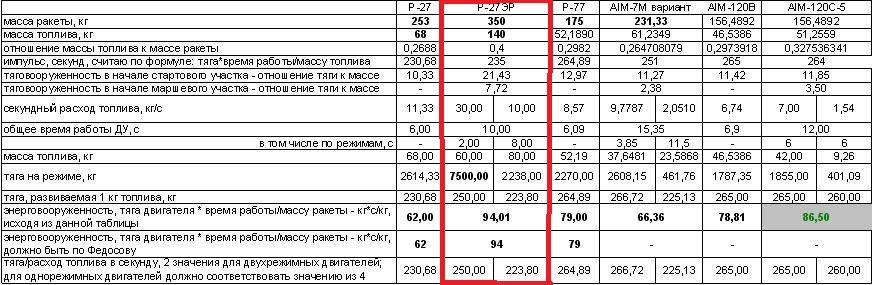
After some time,I've finally found one table with some interesting details for the R-27,R-27E,R-77,AIM-7M,AIM-120B and AIM-C5.Table which I 've found is from the ''forum.dcs.world'' and the 'original' one, I lost in my archive.
Some data about that R-300E as the designation of the mentioned rocket engine.
''Двухрежимный РДТТ Р-300Э с повышенной стартовой тягой с последующим постепенным её снижением.Масса двигателя 192.5 кг.''
''The R-300E dual-mode solid rocket motor offers increased initial thrust and subsequent gradual reduction. Engine weight is 192.5 kg.''
If we compare this data for those in the table,we have 140kg of solid rocket fuel in the 195kg heavy rocket engine.Also we can see in the table that the fuel weight of the single chamber single stage R-300 engine of the R-27 is 68kg but the fuel weight of the booster of R-300E is 60 kg. In the same time ,the fuel weight for the sustain stage is 80kg. Also data from the table that complete working time of the engine is 10sec ( 2 sec for the boost and 8 sec for the sustain stage) .
''Ракета Р-27Э комплектуется двухрежимным твердотопливным двигателем массой 192,5 кг повышенной тяги (до 7500 кг), работающим в течение 8,6—11 с.''
''The R-27E missile is equipped with a dual-mode solid-fuel engine weighing 192.5 kg with increased thrust (up to 7,500 kg), operating for 8.6-11 s.''
Boost stage which lasts 2 sec ( hm,is this right? ) ,have enormous t/w ratio during that stage (acceleration). 7500kgf : 350kg ( ER/ER1)=21.43 or 21.43 : 1 at the start point. After those 2 sec ,R-27E is lighter by 60kg. Than we have data that thrust of the sustain stage is 2238kg. We learned that R-27E has increase of its speed vs fighter's speed by about 1000m/s.In the max launch speed scenario that would be 700 m/s +1000 m/s ,so about 1700m/s. Precisely, for ER/EP it is 800-1000m/s ,for ET it is 700-1100m/s. At almost 20000m ( speed of sound at that height is almost 300m/s) , that would be Mach number of the R-27E equal to 5.6 . After the acceleration phase ,the speed starts to decrease of course. 35G is max lateral G load of the missile's body.For the 210 kg heavy R-27ER e.g. it will be 7350 kg of the aerodynamic pressure.
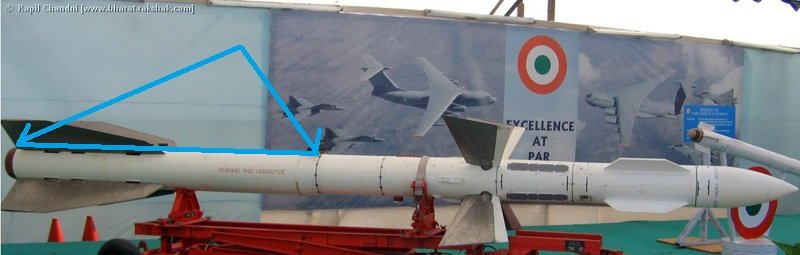
I suppose that booster is cylindrical and its length is in fact the length of the dual-stage engine section from expansion of the missile's body to the nozzle itself.That will be the section between 230mm diameter to 260mm for the booster and the sustainer is inside that 230 mm body section.On the photo is the R-27ER1 for the IAF fighters.
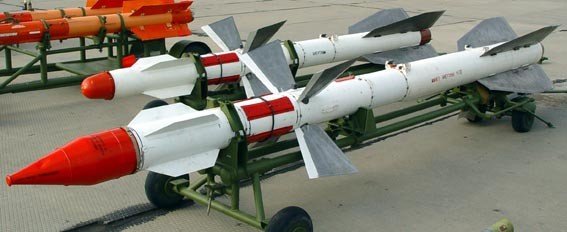
R-27ER besides R-27T .
Lenght of the R-27E in comparison with the R-27 is increased by exactly 0.7m and that is for the engine section only. In this article we have the schema of the modular construction.
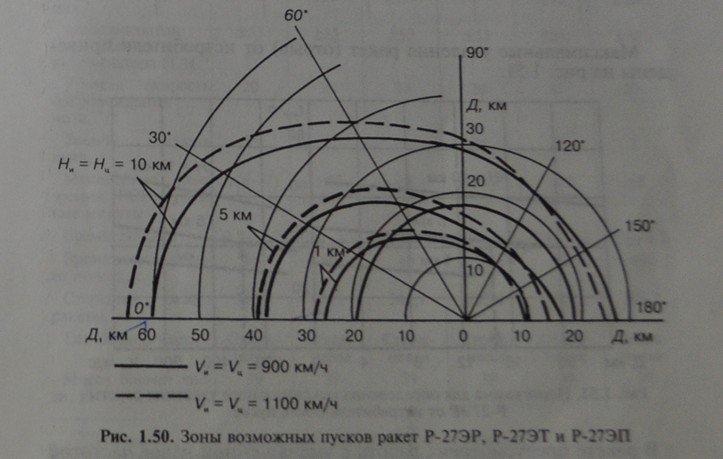
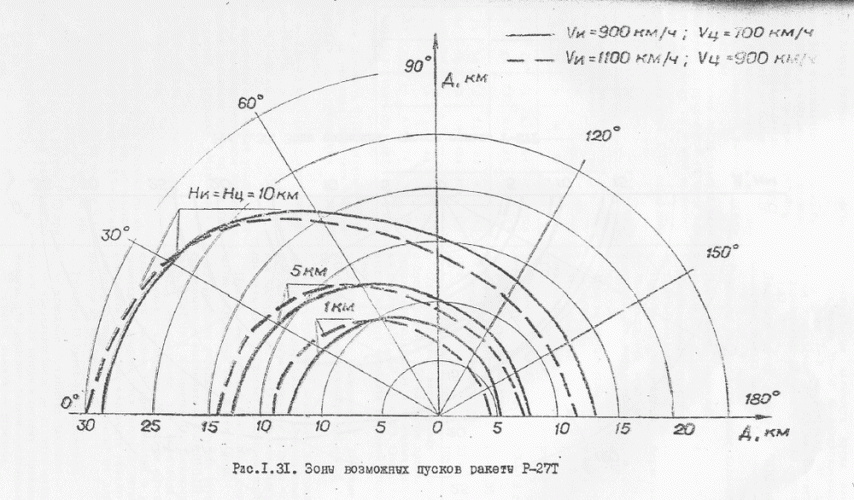
Some details about the distances/ranges ( launch,flight,ballistic).Beside all charts and tables ( often they have nothing to do with the military editions) , that we have here,there are some details from available manuals which give us so important data.When we discussed details about target's size and target's speed (closure speed) in relation with the possible launch range ,there is info from the manuals that even before radar will be turned on ,pilot must determine target's size with the switch called 'BAZA' ( Baza Tsely). With that switch ,pilot will determine three possible targe's size values : big,medium and small. Data about that will come via data-link channel from the NASU ( ground automatic guidance station).Immediately after radar is turned on and given combat mode is chosen,pilot will get given launch parameters for the given target's size with the three basic parameters: Dr max1 ( max authorised launch range against non-maneuvering air target),Dr max2 ( max authorised launch range against maneuvering air target) and Dr min ( min authorised launch range). Nothing else,there is no such thing like ''Дальность действия эффективная (км)/Effective range (km)'' or something else which we can find on some Russian or other sites.
Also we have some data like launch range for the R-27R/R1 is between 2km and 50km ,for the N019/E. Data like this one ...
''Для обеспечения заданной вероятности поражения цели в различных условиях максимальная разрешенная дальность пуска ракеты в ППС, вычисляемая в БЦВМ РЛПК, ограничена до 90, 70 и 30 км соответственно для большой, средней и малой цели.''
''To ensure a given probability of hitting a target under various conditions, the maximum permitted missile launch range in the PPS, calculated in the RLPK on-board computer, is limited to 90, 70 and 30 km, respectively, for a large, medium and small target.''
...can be for the N019M Topaz.There is also data ,that MiG-29B with R-27R1 can engage something big/fast from 90km away with max possible speed/height launch parameters.For the N001/E values are: 50,90,130km.
After target's size/launch parameter is chosen,WCS (radar's comp/ BTsVM) will calculate all other flight parameters: speed,height of the fighter/target, target's angular coordinates,possible closure speed/rate etc...
Max launch range for the ER/ER1 can be those 130km in the given combat situation with max possible speed/alt launch parameters.Example ,against some big,very fast target. Controllable flight time is 60 sec ( operational/working time of the stabilizers) ,just like of R-27 ,that is because attachable stabilizers in the front section of the missile has its own batteries and they don't use hot gases like it is case of some earlier AAM's.Flight path is straight and pilot is strictly forbidden to fly at the same height as the given target.Flight range depends on launch range,target's speed or closing speed/ rate but max possible(ballistic range e.g. w/o use of guidance) can be almost 100km from the launch point.For the first 10 sec ,R-27E will accelerate and get speed more than 5.5 M. After 10 sec ( burn phase) ,inertia will do the job together with the gradual slowing and descending.If we count that average speed during that 1 min is almost 3.5M ( ≈1200m/s ), missile will fly straight about 70 km.
Very probable that you were right ,yes but only for the R-27R.
''Продолжительность инерциального наведения с радиокоррекцией при удалении от носителя до 25 км - до 30 с.''
''The duration of inertial guidance with radio correction at a distance of up to 25 km from the carrier is up to 30 s.''
So we have 25km as the max RC-channel range but for the old N019/E Rubin with the R-27R/R1. Also we have data that 30 sec can be inertial phase with use of the data-link and we know that max controllable flight time is 60 sec.
http://militaryrussia.ru/blog/topic-103.html
For the 'ER' it must be 50km for the modernised N019M Topaz of the MiG-29S/9.13S and the Ukrainian modernised N019M1U and also old N001 Myech in the Su-27S/P/UB. We could see some UkrAF MiG-29 9.12/9.13 with the R-27ER.
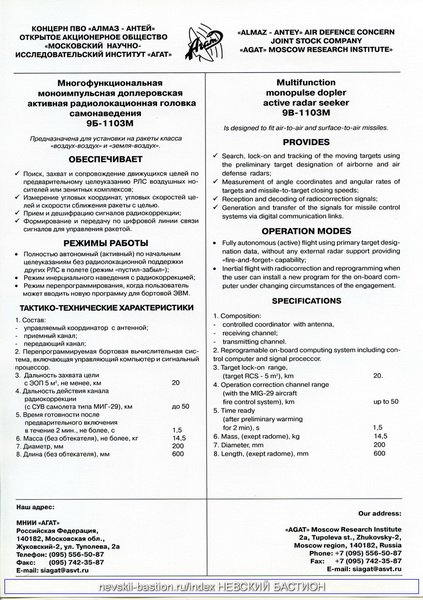
Example ,the monopulse Dopler active radar seeker 9B1103M of the R-27EA .We can see that max RC channel range is in fact 50km ( of the N019M/M1 of course).
Sorry but must add something. Max G-load of the Su-27S/SK during launch of the R-27T/ET (T1/ET1) is 6 and can be 7. Max G load in the case of the R-27R/ER ( R1/ER1) is only 5. Data from the Su-27SK F.M. We have the table here from the earlier. So it is not 7G-8G. From which book is that table anyway ?
For the 'ER' it must be 50km for the modernised N019M Topaz of the MiG-29S/9.13S and the Ukrainian modernised N019M1U and also old N001 Myech in the Su-27S/P/UB.
Why do you think this? Overall their electronics are the same only ER is flashed with different data to tell pylon which variant it is and the rocket motor.
MiG-29 manuals which talk about ER say the 2.5x seeker range max launch distance applies equally for R-27R and ER. I think this is part of the reason there are many past references of the designers not designing ER to necessarily go further then Sparrow but to achieve similar range with much lower flight time then R-27R. If they have same INS and seeker, same reference antennas, 70 km is a really good range against fighters. The sparrow would be launched no further then 75 km perhaps usually closer to 50 km and the R-27ER would hit the carrier in half the time almost and stop its AIM-7 guidance and trashing their missile unless it was HOJ.
I had always seemed to read that Soviets thought more intently about trying to get their missile to achieve ranges with lower flight time for this purpose to destroy the target Fox 1 guidance. And this is why their missiles usually have shorter burn times attempting to get the missile to the highest possible speed as soon as possible.
As for propellant mass more precisely I have seen 138.55 kg. I have done calculations that R-27R has CG 1x body diameter before motor burn and CG at burn pit is right around middle of wing. For the R-27ER the CG is around 2x diameter behind the wing and upon burnout it is just at the rear edge of the wing.
we compare this data for those in the table,we have 140kg of solid rocket fuel in the 195kg heavy rocket engine.Also we can see in the table that the fuel weight of the single chamber single stage R-300 engine of the R-27 is 68kg but the fuel weight of the booster of R-300E is 60 kg. In the same time ,the fuel weight for the sustain stage is 80kg. Also data from the table that complete working time of the engine is 10sec ( 2 sec for the boost and 8 sec for the sustain stage) .
Can be doesn’t have to be. For example, Fi0 is the only mode in which R-27P/EP is instructed be launched in as it could accidentally see host radar (IRST would still use radar range finding after 8 seconds of no laser range in MiG-29 and there is no case that IRST works without radar ranging/lock in Su-27 unless turned off manually)
Becuase it’s the max height for that missile per manufacturer. Being able to Hit a target 12 km above you doesn’t mean it can do this at all altitudes. If you do a zoom climb to 20 km, 27 km would still be max rated altitude. The R-27 autopilot has 4 range bands for different altitudes, its autopilot is not tuned for altitudes higher then 27 km.
What source says this? You? All sources I have say “rocket design is titanium alloy with the engine body being steel.” This is direct quote, engine body not ‘rocket.’ Also, the missile skin is lined with insulation under it according to the polish docs I attached and Markovsky.
This adds up to over Mach 5.7 . Also, I highly doubt this figure is with a max speed and altitude in mind but an “average”, and I highly suggest a typo as there is NO WAY R-27ET is reaching a higher speed then 27ER. Perhaps they were switched. In such a case that we assume it is a typo and real speed is 1100 m/s, we get Mach 6.1.
36T seeker housing is much more draggy then R/ER radome. It wouldn’t be the first typo in that manual where it says 36T cools its photodetector to practically below absolute zero which is impossible and makes no sense for InSb detector. That manual has good info but I’m not the only one to find occasional “mistakes” in it. It does not take genius to understand why R-27ER should be faster than ET and not the other way around.
If we add deltav to velocity, which is also exactly 1177 m/s (so close to 1100 m/s figure given for R/27ET probably mistakenly) we get about just above Mach 6.3. So yes, It’s atleast Mach 5.7 with Mach 6+ more likely. Atmosphere will also reduce deltav acceleration most at low altitude, and much less at 15-18 km. CFDs show almost negligible difference at high altitude. This is also one reason manually lofting it in the simulator game DCS works because gravity ( or for that matter air density at 15-18 km) has such a small effect on the burnout speed of a missile with a thrust to weight ratio of 94:1, R-33 thrust to weight ratio is 73:1. Here also R-27R and R-77.
Here is a chart of CFD of multiple missiles. This graph is showing the approximate deceleration speed of each missile after motor burnout.
You will notice that 27ER slows down even slower then 27R becuase of its greater inertia.
R-33/AIM-54 on the other hand, I have added as a black line, and it cannot cover the whole chart as its drag is atleast 4x that of AMRAAM. The lower a line is on the chart the slower it decelerates (the better it preserves it energy). I even underestimated its drag slightly for you.
To be precise it is measuring ballistic coefficient, which measures the amount of drag something produces vs its inertia to calculate this speed of deceleration.
Even if altitude changes, the rough relationship of R-33/AIM-54 having 4x the frontal surface area or more will mean that this relationship/ratio of ballistic coefficient between these missiles will be the same or very similar at all altitudes.
Aerodynamics is no joke. Weight and size is not everything or missile aerodynamics innovation would stop with R-8 Anab or R-40.
Here are more thrust to weight ratios (specific power) to compare
Phase mono-pulse antenna system for tracking targets in azimuth and elevation (two planes). Each antenna has its own transmitter. In operation one antenna works in transmit mode, three others in receive mode. The target signal received ís fed to "phase detectors", where formation of azimuth and elevation correction signals take place. If the phase sum is zero, the target is straight ahead. If the target is above/below or left/right, correction signals created in the "phase detectors" are used to control the missile flight direction.
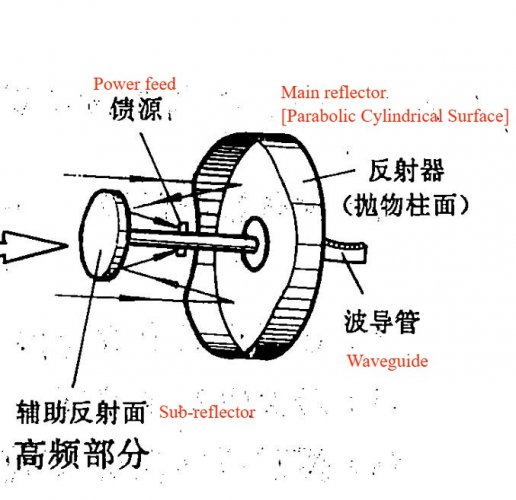
This antenna is quite unusual—it uses a cylindrical surface [which may have some curvature, though it's imperceptible] for reflection as a Cassegrain antenna, rather than the more conventional and much more obvious paraboloid. In addition, I suspect that this antenna is unidirectional, and that it cannot achieve an ideal radar beam by loading a transmitted beam onto the feed; instead, it can only attain reasonably good gain when receiving reflected beams.
This site uses cookies to help personalise content, tailor your experience and to keep you logged in if you register.
By continuing to use this site, you are consenting to our use of cookies.