I still think this is about radar range or datalink and not that changing target size actually changes DLZ on HUD. I just read HUD and DLZ chapter and only talk of size commands is for synchronous gun mode and commands to missile at launch and during flight.
For example, each range would mean the datalink phase is almost exactly 1/2-2/3rds the total flight distance. Almost as if it wants to keep datalink period to a certain fraction of the flight distance.
What about DNP mode in the case of complete instrumentation ? There is so many factors,parameters,values etc and we must count on all of them in the same time.
Instrumentation = Lazur guidance.
All it would do is give DNP range when it’s jammed and allow it to slew to target automatically when lock is broken and re acquire.
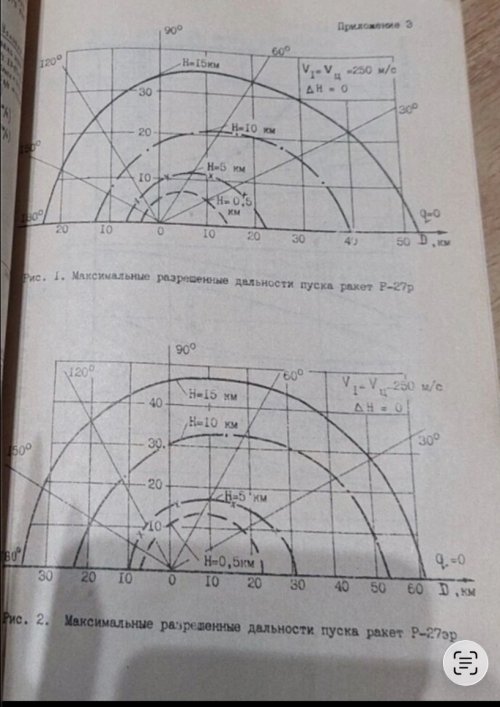
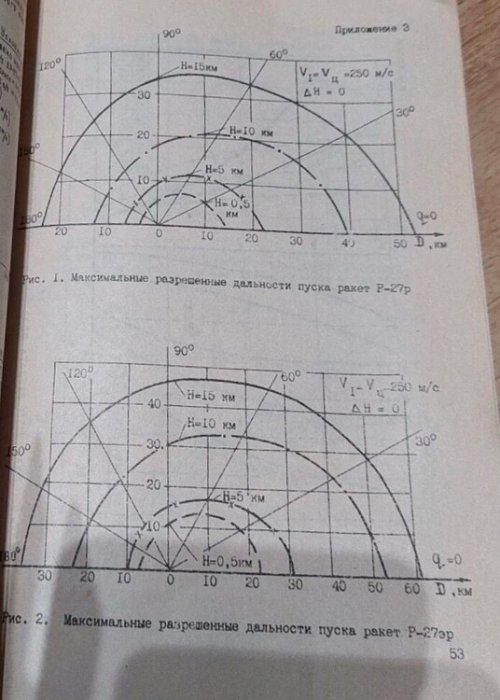
once graph say R-27ER can reach 60 km, the other say it can only reach 53 km?. I assume the first one is from Mig-29 manual and the second graph from Su-27 manual?
I still think this is about radar range or datalink and not that changing target size actually changes DLZ on HUD. I just read HUD and DLZ chapter and only talk of size commands is for synchronous gun mode and commands to missile at launch and during flight
BTsVM classifies targets as small,medium and big. Very simple.In the relation with that and with all target parameters it gives those three main launch parameters : Drmax1 ,Drmax2 and Drmin.
Instrumentation = Lazur guidance.
All it would do is give DNP range when it’s jammed and allow it to slew to target automatically when lock is broken and re acquire.
NPO- radar and IRST have no all needed parameters ( e.g. if there is jamming etc).
NASU has nothing to do with all of this. If there is jamming, pilot will not use the RC -channel. DNP ( tracking/illuminating) will lasts only 60sec. In the relation with bolded, there is no lock because radar locks target in the RNP mode.
R-27UR or Izd. 470-UR as Uchebno- razrezonaya .This version is used in the technical classrooms.
It does not describe target size as part of this. As I defined above only Missile to target closure x flight time for Drmax1 and Drmax1 - missile fight distance for Drmax2. Of course including allowance for 150 m/s minimum closure and 280 m/s minimum speed.
Why? I mean Lazur GCI not radio correction. This is what is considered “instrumented combat.”
I stand by what I said, the radar has lock in DNP, and if it loses lock the Lazur GCI will re direct the antenna too the target automatically.
As for range from datalink, it is stated in multiple flight manuals that if you have target locked in RNP/DNP, and range is being denied by jamming, it will use Lazur/Beryuza GCI range. Russian flight manual, memo, MiG-29B will all state this.
Even you have to agree job of datalink is to aim radar when in search mode, lock it 0.5s before Drmax1 using lock command.
All while giving necessary commands of afterburner or climbing or target speed/altitude/hemisphere/range radar illuminate command, and desired intercept trajectory.
For R-27R/ER or R-27P/EP I imagine this would be immensely helpful in doing a HOJ attack when within range.,You could even use the radar diamond to point you at the target, switch to Fi0 (which will break lock, and shut off radar, as is needed for R-27P/EP), then get seeker LP and fire P/EP.
R-27T/ET and R-27P/EP in the radio-silence mode and its passive attack capabilities.
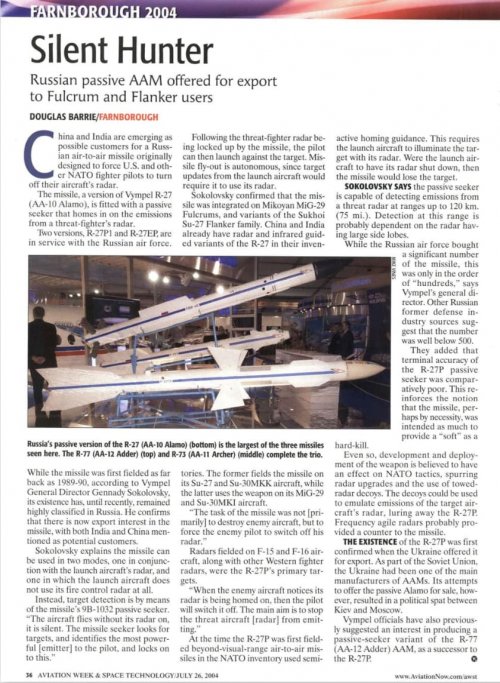
It was Farnborough 2004 when Gennadiy Sokolovsky from GosMKB 'Vympel' told some details about the R-27P/EP with its passive radar seeker type 9B-1032.
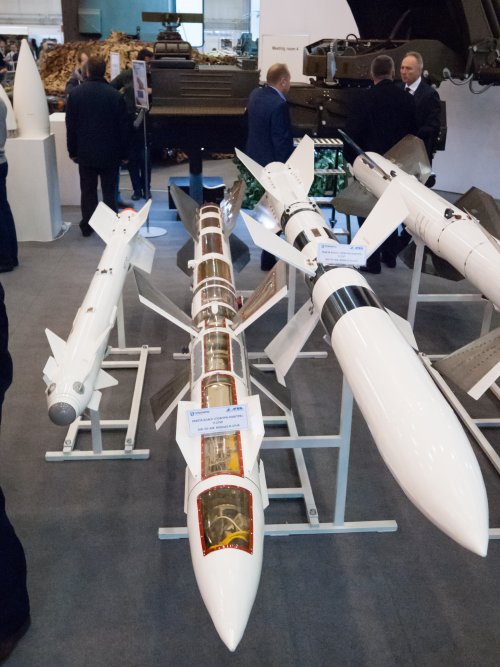
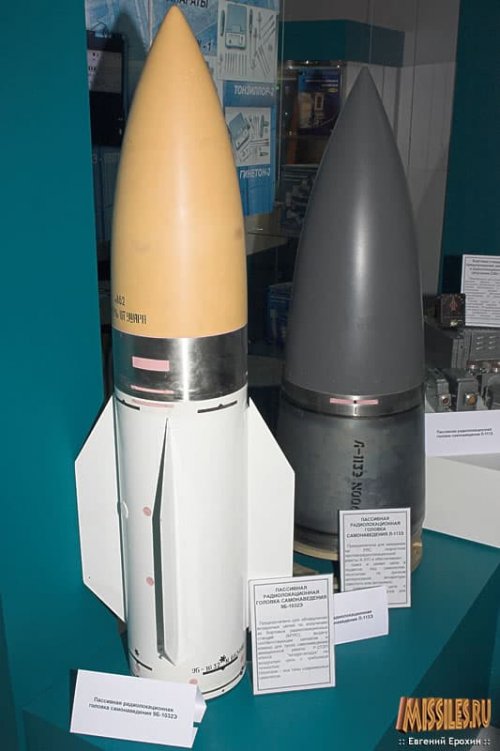
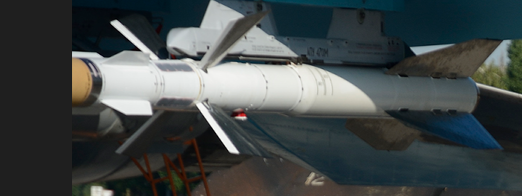
Passive radar seeker 9B-1032 can receive centimetric wave radar signals sent from the fighters, AWACS etc ,from 200km away but the max launch ranges are in the level of R-27R/ER. Right now I can't find any info /data if R-27P1/EP1 are really produced and exported but if someone find the photo where we can see yellowish radome ,that's exactly what R-27P/EP(P1/EP1) is looklike.
9B-1032E for the export version R-27P1/EP1 besides Izdeliye 112E for the export Kh-31P, both as ARM's ( A-A,A-S).
R-27EP.
From what I learned on some Russian sites and forums, only about 200 of R-27P/EP were serially produced in the Artem factory in Kiev before USSR dissolution.During 1991 they were transported to the Akhtubinsk air base together with about 200 R-77's.
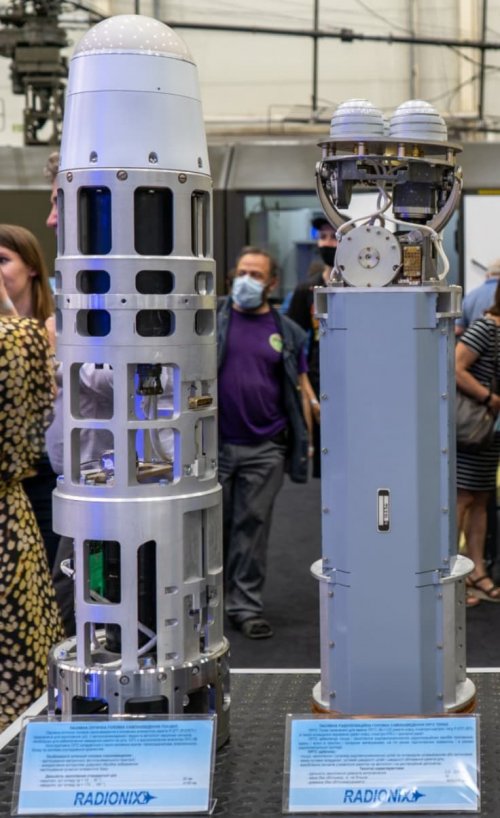
On the right side ,suppose 9B-1032E with its passive 'radio-pelengators' presented by the Ukr. company Radionix. Did Radionix produce some R-27P1/EP1 so far?
As Gennady S. described ,R-27P/EP were developed against NATO fighters for combat tactics were they would be used with or w/o the turning on the fighter's radar. It must be mentioned that R-27P/EP like old R-77 probably were never used by some operational VVS fighter unit throughout 1990's and after 2000.
With R-27P/EP Soviet fighters like Su-27 and MiG-29 ( that the USSR existed after 1991),would be very dangerous in any possible confrontation with NATO fighters.But this is not the end of this story. They already had R-27T/ET with their passive IR guidance (Su-27 only , with only 16 MiG-29S in the Russian AF).R-27T/ET together with R-27P/EP would provide serious threat.
Although we already mentioned T/ET in some aspects, I must ask some questions .As we know ,T/ET are also all aspects medium/long range AAM's which can be used in complete radio- silence regime.With T/ET it is possible to engage e.g fighters from behind/tail -on and from ahead/ head-on.There is that detail where IR seeker can be adjusted to work on average wavelengths of the radiation (airframe,jet stream from the nozzles etc ) ,of course all of this on the testbed.
Now what about the fighter's radars ? Is there any possibility that one IR seeker like those in T/ET can be guide on the radar's antenna as the heat source ? Example,during the so called 'stand by mode' ( EKV/ EA on the Russian ) where TWT sends signals to the reflector of the antenna w/o sending them to airspace.Some of the radar energy must be converted to the heat energy and thus radar itself becomes the heat source even in the situation where it is not radiating in the space? Can this be real ? One radar even turned off can be heat source for some time ?
What can be the 'heat value' of one modern PESA and especially AESA during radiation?There is one interesting detail from the K-27/E development history where we can find info that they tried to develop combined passive radar and heat seeker for one missile.Something like that we can find today on the newer ARM type Kh-58UShK-TP.
Now what about the fighter's radars ? Is there any possibility that one IR seeker like those in T/ET can be guide on the radar's antenna as the heat source ?
No, why? The radome is covering the antenna and blocking such wavelengths.
It is not an x ray detector even if antenna reaches 500–1000 degrees Celsius like engine exhaust.
Some of the radar energy must be converted to the heat energy and thus radar itself becomes the heat source even in the situation where it is not radiating in the space? Can this be real ? One radar even turned off can be heat source for some time ?
EKV sends radar energy to a resistor which burns the emission energy without loading the antenna.
Do you think a radar antenna would heat up so much as to heat the fiberglass radome enough to be seen over engine heat and skin friction? No, it does what is says on the tin.
No, why? The radome is covering the antenna and blocking such wavelengths.
It is not an x ray detector even if antenna reaches 500–1000 degrees Celsius like engine exhaust.
EKV sends radar energy to a resistor which burns the emission energy without loading the antenna.
Do you think a radar antenna would heat up so much as to heat the fiberglass radome enough to be seen over engine heat and skin friction? No, it does what is says on the tin.
''ЭКВ – передатчик работает на эквивалент антенны при отсутствии команды излучения с НАСУ или на антенну с излучением СВЧ при прохождении команды с НАСУ в режиме КН.''
But to be honest ,so called stand by mode ( warm up ) or EKV is some kind of low power mode .Btw, AESA radars have no stand by mode at all. Engine heat can be only 'seen' from behind but in the case of AB mode, it can be 'seen' even from ahead ( certain angle aspects). In the AB mode, temp can be 1000°C or more °C. Temp from the skin friction varies and it depends on height/speed. Can be from e.g. 100°C to 300°C .
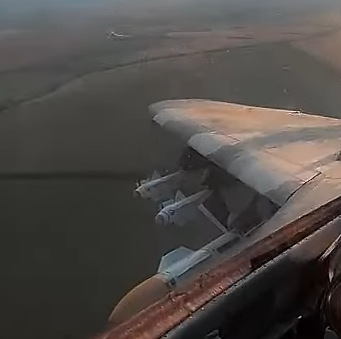
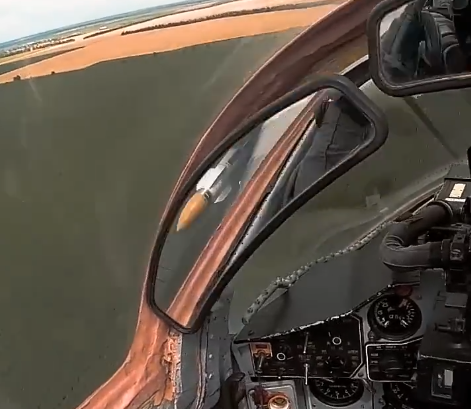
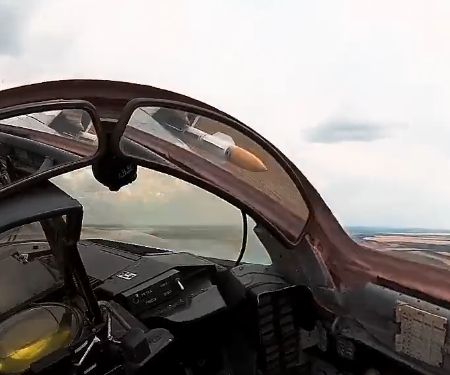
It seems that Ukr. Radionix really produced some ARAAM type R-27P/EP and here we can see that missile with the dark yellow radome attached on the Ukr AF MiG-29.
Yes, did you think it didn’t?? It is designed to let radar radiation through. The front reflector also blocks anything of incorrect polarization, as does the antenna.
''ЭКВ – передатчик работает на эквивалент антенны при отсутствии команды излучения с НАСУ или на антенну с излучением СВЧ при прохождении команды с НАСУ в режиме КН.''
But to be honest ,so called stand by mode ( warm up ) or EKV is some kind of low power mode .
I don’t think it depends. We know exactly what it does. It burns radar energy with a resistor so it can be warmed and “ready.”
If you want to be extremely specific
MiG-29: EKV/dummy also used to make COOP work with IRST modes and is used in GCI datalink to turn radar off so datalink turns on radar remotely at correct range
Su-27: is used in GCI datalink turn radar off so datalink turns on radar remotely at correct range
That it, it’s no low power mode and is not illuminating missiles unless your in a MiG-29 and selected coop and IRST modes within the conditions for radar STT and for Su-27/MiG-29 when Datalink turns on radar remotely.
You can’t forget that different detectors look for different wavelengths. PbSe like in R-3-R-60 or KOLS look for 3-4 microns which is from engines. InSb in 36T seeker and R-73 and OLS-27 is optimized for more 4-5 microns where skin heating is seen and since it’s longer wavelength that means it penetrates atmosphere better (more range).
Yes, did you think it didn’t?? It is designed to let radar radiation through. The front reflector also blocks anything of incorrect polarization, as does the antenna.
Okay. Welcome to Ukraine uses R-27P/EP party proving it’s a real and practical missile, these were released 2-3 years ago. It is cool to see it actually used and all the theories proved.
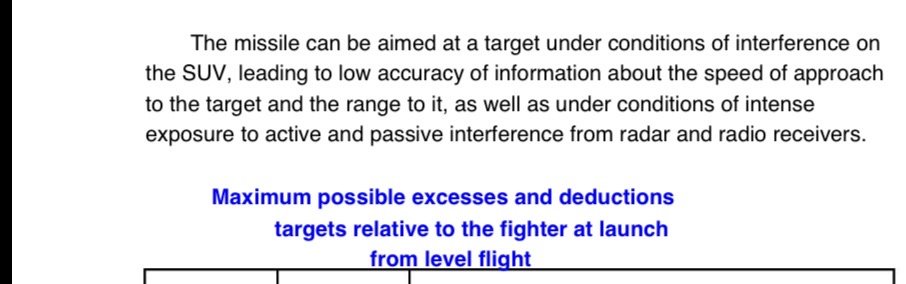
I also found reason for max range of 30/70/90 km according to target size
It is stated that max datalink range is 2.5x seeker range, idk the limitation exactly, but we get exactly 30 km for small target just short of 70 km for medium (much closer to 70 if you average 50 km max datalink + range of seeker range and 2.5x seeker range), and 112 km for large target but of course limited by datalink range and max range of 27R to 90 km.
One reason for small targets to be shorter is that it is stated pk when launching missile at max range at low flying small target is only 0.1-0.2.
If target flies below 1 km in rear aspect, these values decrease 8x. Including that from 1.1-1.5x seeker range it is using only INS until seeker range and not radio correction. For max datalink range that is 3.75 km and 7.5 km for small and medium target respectively
In addition with it giving limits for small low flying targets of 2 km ZPS and 12 km PPS under under 4 km altitude
I am sure the normal datalink range limits are becuase of INS accuracy and the low altitude limits from seeker issues with clutter
Question I have, if these are limits for R-27R, what are limits for R-27ER with the same seeker? It’s a little hard to believe they would be the same but it’s entirely possible.
The only time these limits can be exceeded is from HOJ shot. So no wonder loft wasn’t an option if INS accuracy limits them so.
Okay. Welcome to Ukraine uses R-27P/EP party proving it’s a real and practical missile, these were released 2-3 years ago. It is cool to see it actually used and all the theories proved.
I knew for that video,also knew for that Ukr pilot nazzi-style nickname.It is questionable if they had any chance to launch P/EP at all during all these years.
Question I have, if these are limits for R-27R, what are limits for R-27ER with the same seeker? It’s a little hard to believe they would be the same but it’s entirely possible.
Why do you think there is no Radio correction? It is just small target at low altitude. None of that stops datalink unless you launch the missile over 30 km in front aspect or beyond 4.5 km in rear aspect. OR when you launch between 1-1.5x the seeker distance such as 12-18 km and 1.5-2.25 km in this case which is when it only uses INS until seeker lock on.
It is same radio correction antenna on both R and ER. Why would it have more range?
Only time the max range is significantly less then max datalink range here is for small targets and low altitude rear aspect targets. We could also explain by the phrase we see “max 70% of time flown is under datalink” which I think tells us this was important to designers. The longer the datalink phase the larger the drift of the missile INS and the larger chance for target maneuver. Additionally, missile does not do a search pattern when it goes active, it only looks where it expects target to be with its +/-6 degree seeker and widens velocity/angle/range gates as time increases without target found.
I assume they didn’t trust the INS and perhaps possible target maneuvers to allow it to be able to aim the 6 degree seeker accurately enough once in seeker range if fired with more then 70% TOF using radio correction. Even if you don’t consider maneuvering, remember that MiG-29 and Su-27 don’t even use INS in default navigation mode but dead reckoning and only use INS mode with 15 minute alignment and with significant errors. This R-27 INS is inside a 230mm wide missile and only their 3rd try at INS correction and 2nd try at radio correction.
Yes, but just becuase it might have a max 112 km range against a large target when using datalink does not mean that is its max range. The missile has no seeker range limits against jamming targets. If max range is still limited to say 112 km with large target size, it could still achieve 130 km if it was launched in HOJ mode or commanded by datalink to do so.
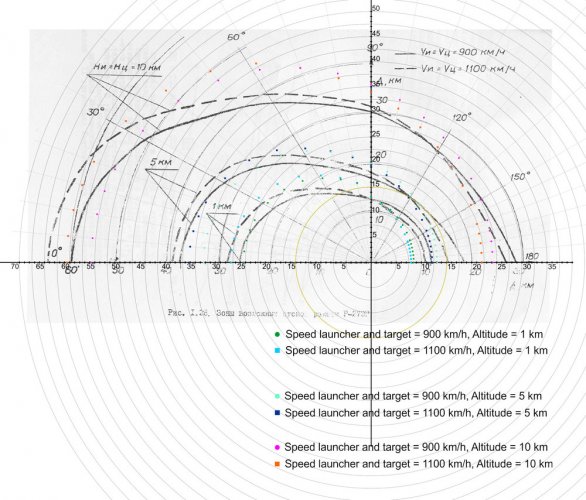
Found some things to add to our range discussion. So for the simulator game DCS, there has been much argument about the performance of R-27. One of the developers with an infamous reputation said that the most well known chart was drawn incorrectly with the circle too flat and low. Many people thought this ridiculous. He posted a correction. The correction matches almost exactly to the ranges we see in the other chart!
If true, it is interesting because it shows that at such subsonic speeds and high altitude the difference in range becomes smaller especially in front aspect. As carrier velocity increases I’m sure the heavier missile benefits from the inertia, and low speeds will always decrease difference between front and rear aspect.
As wrote ,if there is jamming by the enemy ,pilot will not use RC-channel.
About R and ER. Hm, there must be some details ,maybe unknown details so far. Maybe, N001 possess RC- channel with greater range than one of the N019 ? Logically for use of the longer range ER. On the other hand, we could see some UkrAF MiG-29 ( 9.13) with ER's. Ukrainians modernised some of their 9.13's some times ago and integrated their version similar to old Soviet N019M Topaz.
As wrote ,if there is jamming by the enemy ,pilot will not use RC-channel.
About R and ER. Hm, there must be some details ,maybe unknown details so far. Maybe, N001 possess RC- channel with greater range than one of the N019 ? Logically for use of the longer range ER. On the other hand, we could see some UkrAF MiG-29 ( 9.13) with ER's. Ukrainians modernised some of their 9.13's some times ago and integrated their version similar to old Soviet N019M Topaz.
Yes becuase the missile will home on the jammer from distances far exceeding launch range meaning it will never need datalink for HOJ.
I was talking about the datalink limitation on rear aspect targets under 1 km altitude being max range of 3.75 km and 7.8 km for small and medium targets respectively. I have no idea where you got jamming out of that statement, there is absolutely datalink in this situation unless the pilot launches missile after locking jammer or lock is switched to HOJ part way through datalink phase only. As long as pilot uses it correctly.
N-019 isn’t limited by datalink range for small or low altitude rear aspect targets like I said in my last post. It is most likely limited by the accuracy of the missile INS and 50 m/s increments of datalink commands using a Cartesian coordinate system by a dead reckoning nav system (without 15 min align) likely RSBN corrected to multiple hundreds of meters distance that will also have errors. This would explain literally why datalink is limited to 2.5x seeker range despite the radar being capable of transmitting datalink further.
Why do you think I keep telling you to read R-27 chapter of MiG-29B? The HOJ is also described in the section of Yugo/german/russian manuals about attacks against jammers. It is there multiple times if you read as much as I
AP was also not needed to lock jammer until BZPP-4 radar block.
Why do you think I keep telling you to read R-27 chapter of MiG-29B? The HOJ is also described in the section of Yugo/german/russian manuals about attacks against jammers. It is there multiple times if you read as much as I
AP was also not needed to lock jammer until BZPP-4 radar block.
MiG-29B R-27 chapter states it does. There is reason it can send datalink command to missile “I lost range from jamming please HOJ.” Also Russian manuals, Yugo manuals, German manuals all claim it does on chapters against jammers by instructing you to fire when range is inside max per KMOD ranging per voice GCI or per Lazur/Beryuza radio link. These chapters are at the end so if you only read the beginning you wouldn’t see it. You haven’t done enough reading.
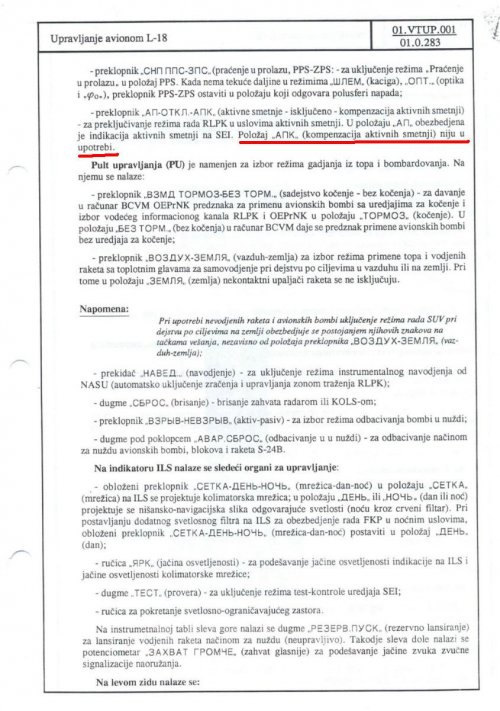
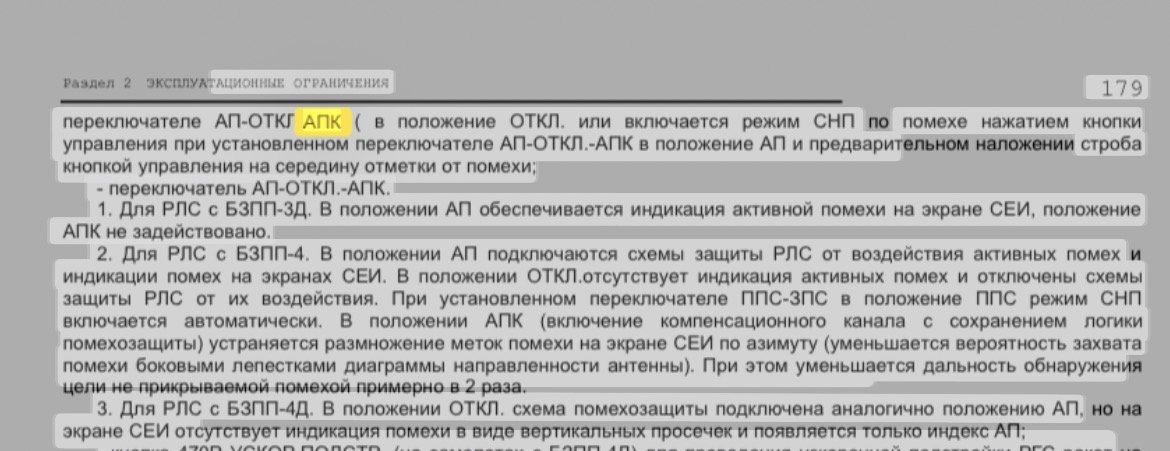
You also were unable to prove that N-019EB does not have APK when both German Polish and Yugo manuals mention the APK switch position. Read more then we can argue about MiG-29 and R-27.
There is very good reason it describes a command to the missile and datalink command as “range finder jammed” which stops datalink transmission oddly enough…….or why it is instructed to fire R-27 at jammers even when you do not have range after ensuring it is inside range with Datalink range or KMOD or Voice GCI.
There is reason MiG-29B described the missile only tracking by angles after “radio range finder jammer” command is sent.
I have done my research
On another topic. If DLZ is really a minimum of Mach 1.5 above 12 km and Mach 1 under it, it means that I don’t think it would ever show 90 km DLZ for R-27R.
MiG-29B R-27 chapter states it does. There is reason it can send datalink command to missile “I lost range from jamming please HOJ.” Also Russian manuals, Yugo manuals, German manuals all claim it does on chapters against jammers by instructing you to fire when range is inside max per KMOD ranging per voice GCI or per Lazur/Beryuza radio link. These chapters are at the end so if you only read the beginning you wouldn’t see it. You haven’t done enough reading.
You also were unable to prove that N-019EB does not have APK when both German Polish and Yugo manuals mention the APK switch position. Read more then we can argue about MiG-29 and R-27.
Do you know what are you writing about here ? R-27R(R1) or ER/ER1 is not some passive radar homing missile like P/EP so ... It is SARH and needs from fighter's radar to track/illuminate target ( with or w/o jamming capabilities). R-27R(R1) has no so called 'automat zakhvata pomekhy ' like R-33 has.
What did I mention about APK in the N019EB ? It is not usable ....
you know what are you writing about here ? R-27R(R1) or ER/ER1 is not some passive radar homing missile like P/EP so ... It is SARH and needs from fighter's radar to track/illuminate target ( with or w/o jamming capabilities). R-27R(R1) has no so called 'automat zakhvata pomekhy ' like R-33 has.
R-27R/ER is designed to see same frequency as N-019/N-001. So if something jams N-019/001 its frequency….. is…… the same!
The missile is only homing on the signal of this frequency.
P/EP is different matter. It needs more sensitivity to pick up sidelobes and back lobes, it needs to be wide band enough to see the different frequencies and PRFs that different planes might use. It needs it computer to extrapolate and guide between reception of signals. Just because R-27R/ER can HOJ does not mean P/EP is without purpose.
Oh, so because the Yugo manual says “APK is not in use” you think it doesn’t work? It could as easily mean “please don’t use it” as it decreases radar range by 50%. It is just combining AP and compensation Chanel. Flipping both switches up does same thing. A manual saying “we do not use it” does not mean it was non functional.
It is just basically useless. Read the chapters on jamming In such manuals and you see it’s use.
Like I’ve said before, if you read the whole thing. The info will be there, here, Same exact manual that in your opinion says APK “is not in use.”
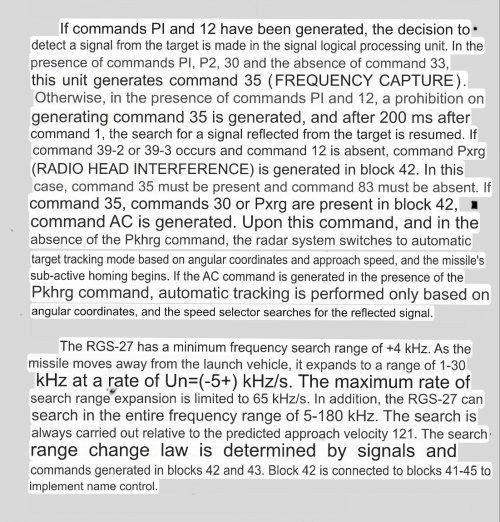
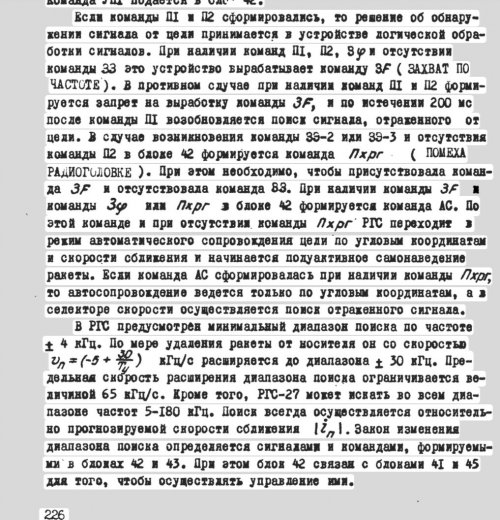
It is saying that when seeker turns on at estimated seeker range is begins a search for something within 60 m/s velocity of the estimated target speed. Then as time goes on the velocity gate expands to be 450 m/s or even 75-2700 m/s at the highest if I read it right.
It is simply saying that the seeker does not scan, it only increases the range of its velocity gate as time without acquisition increases.
Oh, so because the Yugo manual says “APK is not in use” you think it doesn’t work? It could as easily mean “please don’t use it” as it decreases radar range by 50%. It is just combining AP and compensation Chanel. Flipping both switches up does same thing. A manual saying “we do not use it” does not mean it was non functional.
APK is not in use ,yes. That was only translation of the original MiG-29/9.12 F.M. For the 9.12B ,there was additional explanation that APK mode was really not in use. Btw, I knew translator of that 'L-18 VTUP' F.M. (professor R.T.). There was even additional version of the original L-18 F.M. with the explanation about R-73E.
It is saying that when seeker turns on at estimated seeker range is begins a search for something within 60 m/s velocity of the estimated target speed. Then as time goes on the velocity gate expands to be 450 m/s or even 75-2700 m/s at the highest if I read it right.
It is simply saying that the seeker does not scan, it only increases the range of its velocity gate as time without acquisition increases.
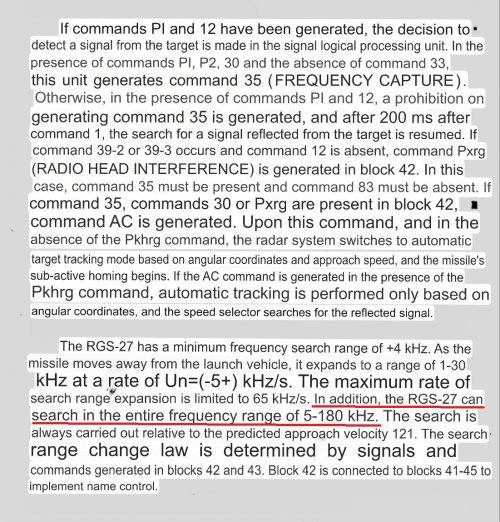
It is saying that R-27R(R1) seeker uses frequency range within search/track mode of the N019 where e.g. during HPRF mode ,PRF can be 180 kHz. Of course, working frequencies are in the X-band range.
''SARH Illumination and main channels use different frequencies within the X band, and are multiplexed in time.''
It does. You only say this becuase you convinced yourself it’s true.
I have already attached some material that references this ability.
Everywhere about its capabilities we see references to hitting jamming enemies to the point that N-001/019 has no range and must use KMOD or GCI datalink or voice GCI for range
The MiG-29B manual R-27 chapter rigorously describes a command “radio head interference” that STOPS all further datalink transmissions once the radar has no range as the missile is autonomous once it is HOJ. Manual chapters on attacking jamming enemies mention firing on jammers the radar has no range to and turning away.
It is not my fault if you haven’t read MiG-29B or understood it or to the end chapters of other manuals.
Think what is jamming. Noise of the exact same frequency PRF PRT and pulse width as the host radar. Thus a signal from the jammer and radar is basically identical, only jammer far more powerful since it’s transmissions reach the missile seeker only going one way.
If it’s same frequency, PRF/PRT/pulse width, why can’t the missile track it? Yes some older SARH missiles are not HOJ capable, but any passive seeker can see the jammer you just need to design it to guide using the jammer signal. The R-27 uses proportional navigation of PN constant= 4 no matter the range or type of guidance (only once when it loses signal does it actually fly towards
Intercept point.)
So if it’s the same frequency and pulse information, why can’t it guide on jammer?
27P/EP is designed to hit radars. Less power, longer distance between possible emissions as it scans or locks other targets, needs to see sidelobes or back lobes while a jammer will have its main lobe pointed at the missile. Possibly different frequency and pulse information as it’s a totally different plane not trying to jam you. Different job, but it’s why both P/EP and R/ER seekers are 4 antenna mono pulse set ups.
Please, explain to me why you all of a sudden “know” that it can’t do HOJ when all primary sources point to it being capable of HOJ.
Yes it is SARH, and semi active radar homing uses a passive radar seeker to see host radar reflections. If this radar is jammed it is becuase the jammer is identical frequency and pulse information, and if identical frequency and pulse information the passive SARH seeker can see it as long as it’s programmed too. So please give me a better argument for it not doing HOJ then “it’s supposed to use INS and SARH.” Jammers work by mimicking the enemy and then overwhelming their seeker with noise, and R-27R/ER has no trouble tracking this as it’s the exact right frequency and pulse information as the radar it would normally use. So why does it not HOJ?
Is it becuase you think a missile can only have one operating mode? Even though it is anywhere from LOBL to LOAL with INS only or LOAL with datalink depending on range and target size and target altitude/aspect? What did you think all the sentences about “can hit targets hidden by jammer or denying range” were about?
That was only translation of the original MiG-29/9.12 F.M. For the 9.12B ,there was additional explanation that APK mode was really not in use. Btw, I knew translator of that 'L-18 VTUP' F.M. (professor R.T.). There was even additional version of the original L-18 F.M. with the explanation about R-73E.
What’s your point? I showed you a page from same manual showing effect that APK has on azimuth jammer. This means APK functions for MiG-29B and anything to the contrary is incorrect.
is saying that R-27R(R1) seeker uses frequency range within search/track mode of the N019 where e.g. during HPRF mode ,PRF can be 180 kHz. Of course, working frequencies are in the X-band range.
''SARH Illumination and main channels use different frequencies within the X band, and are multiplexed in time.''
Well the PRF might change but I don’t think frequency does. It is decided by shape and size of antenna at 10 GHz or 3 cm frequency/wavelength.
The part you asked me about about the seeker doing a 5-160 kHz search It says is about “frequency of search” not PRF. Head on PRF is 160-220 so it goes higher then 180 kHz. If you look at Doppler effect, each kHz corresponds to specific doppler closure difference in speed. This is what I believe it means. Why do you think it means the radar is doing different wavelength frequencies and not using PRF or effect of closure on recorded frequency?
Again no . You posted so many translations or whatever or from whichever F.M. but the fact is that you don't understand the basics, that is the point. How many times is necessary to write that there is no real HOJ in R-27R(R1) ? After R-27R(R1) is/are lunched ,target ( with or w/o jamm capabilites ), must be tracked and illuminated .It is simple as that.
What’s your point? I showed you a page from same manual showing effect that APK has on azimuth jammer. This means APK functions for MiG-29B and anything to the contrary is incorrect.
As I wrote ,I personally know who was the translator, personally know some people who worked on the L-18 VTUP /F.M. ( both first and second edition).It is only but only the translation of the original F.M. for the MiG-29 9.12,nothing else. That is the reason why 'some people' with that translator wrote that APK mode is not usable for the N019EB of the L-18/MiG-29B although there is a page where we can see the possible use of that mode but it was only the translation from Izd 9.12 F.M. , nothing else.
Even German MiG-29G/ 9.12A F.M. mentioned the same. APK mode is not usable !
Yes it is SARH, and semi active radar homing uses a passive radar seeker to see host radar reflections. If this radar is jammed it is becuase the jammer is identical frequency and pulse information, and if identical frequency and pulse information the passive SARH seeker can see it as long as it’s programmed too. So please give me a better argument for it not doing HOJ then “it’s supposed to use INS and SARH.” Jammers work by mimicking the enemy and then overwhelming their seeker with noise, and R-27R/ER has no trouble tracking this as it’s the exact right frequency and pulse information as the radar it would normally use. So why does it not HOJ?
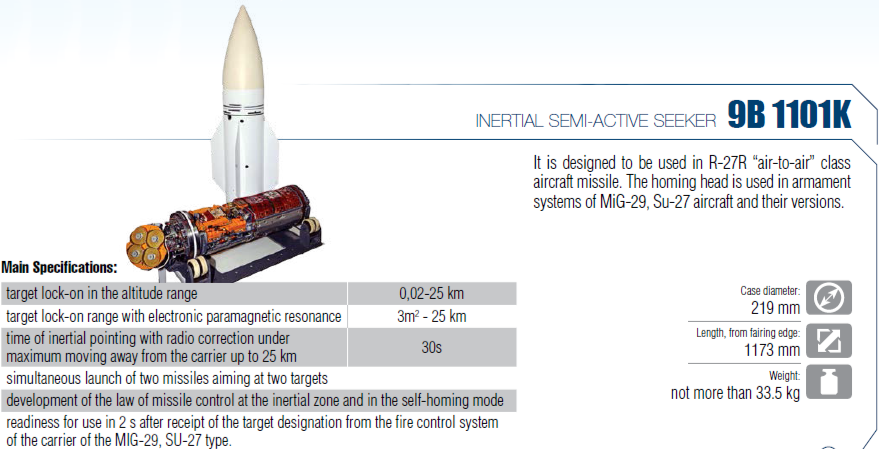
Very simple. First seeker type 9B-1101K does not have the real passive 'radio-pelengator'. Second, that radar seeker can work only with the given working '' LITER'' frequencies which were choosen during arming procces ( on the tarmac or inside of the HAS ).
If R-27R(R1) really has that HOJ mode it would mean that after launching, MiG-29 can turn w/o need for the scanning of the zone where the target is. That would also mean that R-27R(R1) is some kind of F&F missile but that is not the case in reallity .HOJ mode is usually part of the seekers with ARH in the terminal phase.
Well the PRF might change but I don’t think frequency does. It is decided by shape and size of antenna at 10 GHz or 3 cm frequency/wavelength.
The part you asked me about about the seeker doing a 5-160 kHz search It says is about “frequency of search” not PRF. Head on PRF is 160-220 so it goes higher then 180 kHz. If you look at Doppler effect, each kHz corresponds to specific doppler closure difference in speed. This is what I believe it means. Why do you think it means the radar is doing different wavelength frequencies and not using PRF or effect of closure on recorded frequency?
5-180kHz exactly and it is not some working frequency as they belong to the X-band ( already explained). Maybe it was bad translation ,whatever but the point is that seeker uses frequency range which is specific for the search/track mode ,not lock on mode of the N019/E after R-27R(R1) is launched.That's why F.M. gives info that R-27R(R1) uses quasi-continuous irradiation of the target.
This will be the end of story....
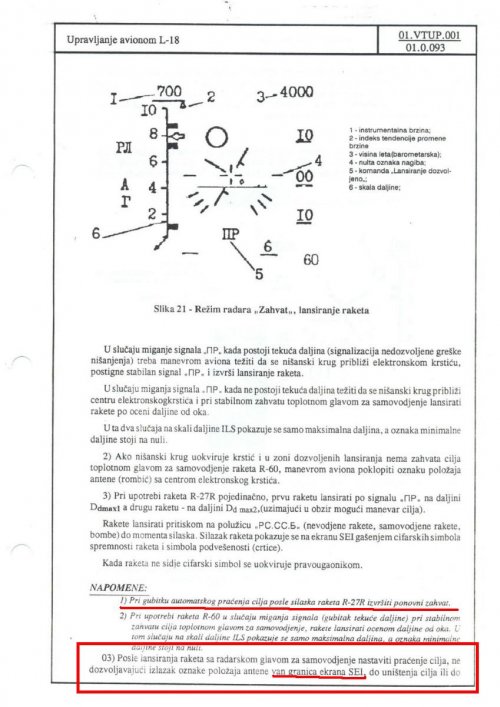
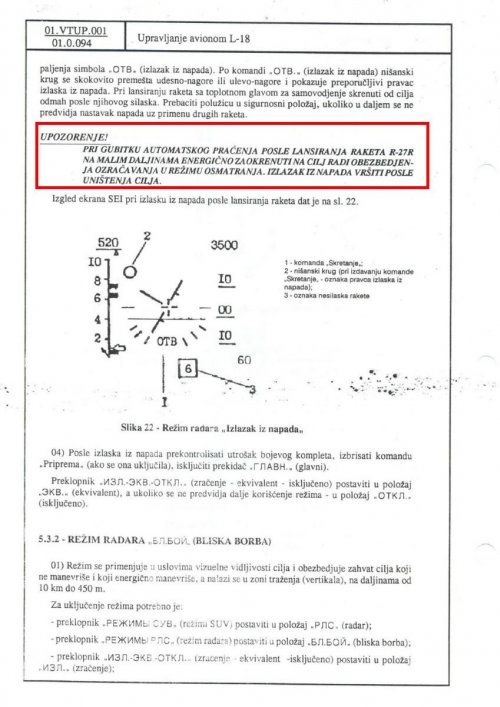
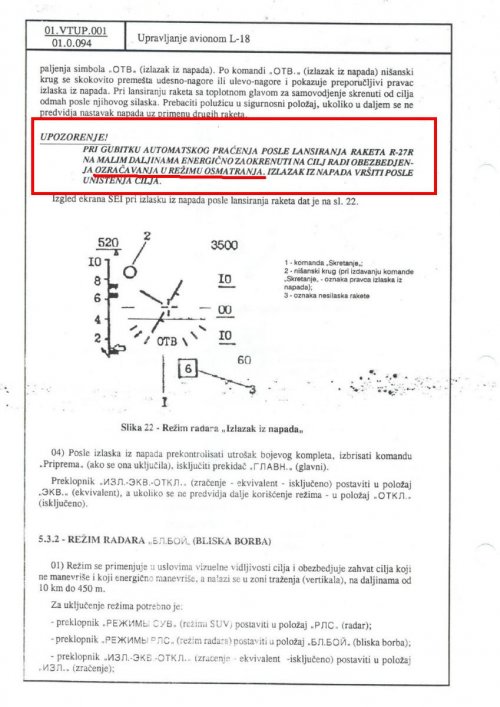
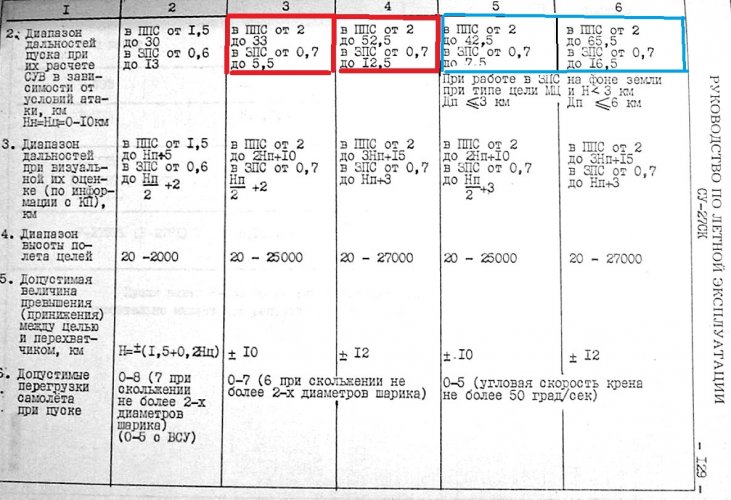
Now read what is described inside of the red rectangles,especially underlined blue.Suppose that you know S-H language as I asked once... It is easy to understand all of that.
For some reason it will not let me post a quote, so I will answer your whole post here
You state R-27R/ER does not HOJ without a source and thus it cannot be believed. I attached multiple sources. You told people to read MiG-29B and so I did and it affirms it on R-27 chapter. What is your reason or source for such statements?
Oh yay I can quote now. Russian manual has exact same sentence. The context is when you see jamming strobe with BZPP-3D and up since this radar block changed the jamming strobe logic. It does not mean it is not used, only to not use it unless explicitly instructed.
Perhaps they just did not want pilots to mistakenly use it and cut radar range in half. It is same function as turning on compensation switch with AP switch position. So here it says “not in use” for specific situation then says how to use it correctly later. Thus “not in use” doesn’t necessarily mean it doesn’t work at all.
Very simple. First seeker type 9B-1101K does not have the real passive 'radio-pelengator'. Second, that radar seeker can work only with the given working '' LITER'' frequencies which were choosen during arming procces ( on the tarmac or inside of the HAS ).
It doesn’t matter about the frequency chosen, if the radar is jammed so is the missile seeker.
How can it be a passive radio seeker without a “pelengator,” it’s a passive monopulse seeker. With one reception cycle it would see any interference and the exact direction to it. As I said, Read R-27 chapter it is described
Yes, if fired the MiG-29 can turn away.
However if enemy turns off jammer the missile is dead. If the jammer is working in “only turn on when locked or being irradiated” the jammer will automatically shut off as soon as MiG-29 turns away and the missile will be dead.
Along with needing KMOD or datalink for range it means that HOJ is not as reliable as locking the target and illuminating it yourself since the jammer only needs to shut off.
Very few people in modern day will leave a jammer on in “barrage jamming mode” and not have it in mode to only transmit to break lock or while being scanned.
Yes becuase radar antennas can receive interference of the correct frequency. You do not need ARH seeker to receive and locate direction of interference.
Maybe it was bad translation ,whatever but the point is that seeker uses frequency range which is specific for the search/track mode ,not lock on mode of the N019/E after R-27R(R1) is launched.That's why F.M. gives info that R-27R(R1) uses quasi-continuous irradiation of the target.
If you mean frequency as “pulses” and not wavelength then yes. It’s looking for quasi continuous pulse. But the frequency is the same (3 cm, 10 GHz.) changing the PRF PRT and pulse width does not change the frequency of the wavelength.
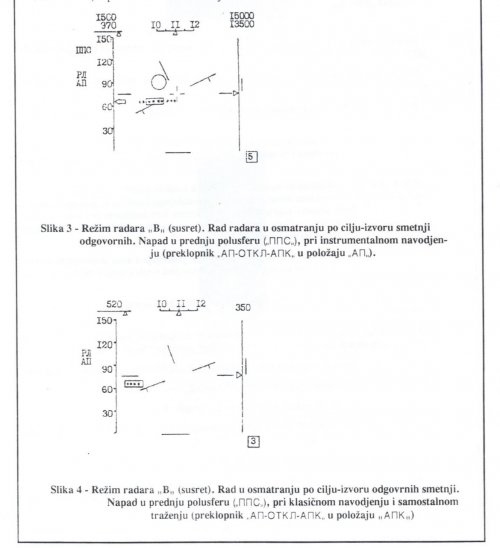
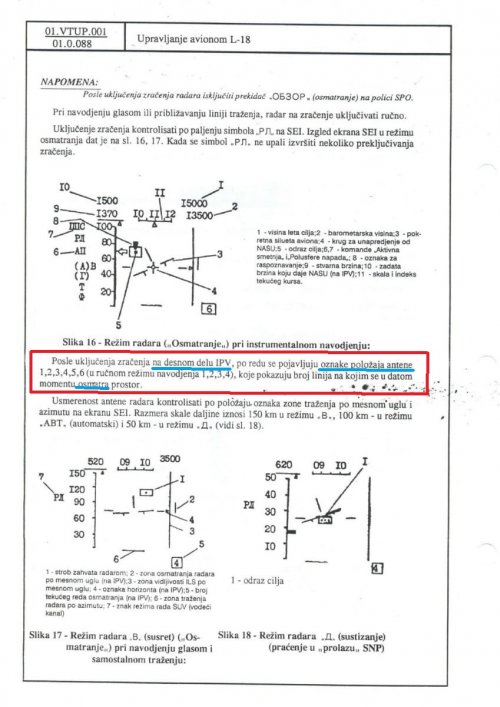
Now read what is described inside of the red rectangles,especially underlined blue.Suppose that you know S-H language as I asked once... It is easy to understand all of that.
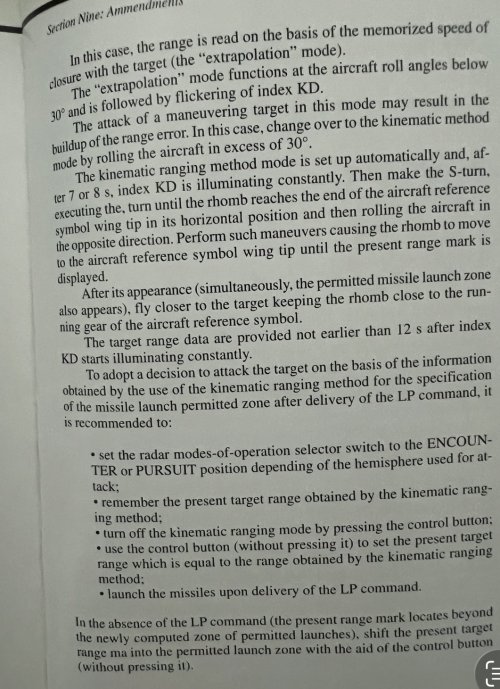
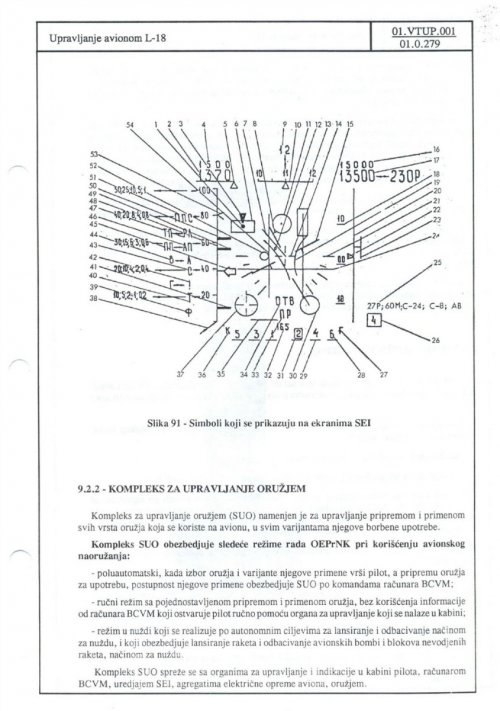
The red boxes explain that in search mode with datalink it shows the bar being scanned 1-6 on bottom right of HDD and that with lock the HUD/HDD show a diamond/rhombus which shows the direction the radar is pointing when roll is level.
I have no idea how either of these are relevant or say anything about HOJ or anything else. Late AIM-7 can HOJ. Many Fox 1 can HOJ. It is not a unique thing for a passive radio frequency missile.
You state R-27R/ER does not HOJ without a source and thus it cannot be believed. I attached multiple sources. You told people to read MiG-29B and so I did and it affirms it on R-27 chapter. What is your reason or source for such statements?
The red boxes explain that in search mode with datalink it shows the bar being scanned 1-6 on bottom right of HDD and that with lock the HUD/HDD show a diamond/rhombus which shows the direction the radar is pointing when roll is level.
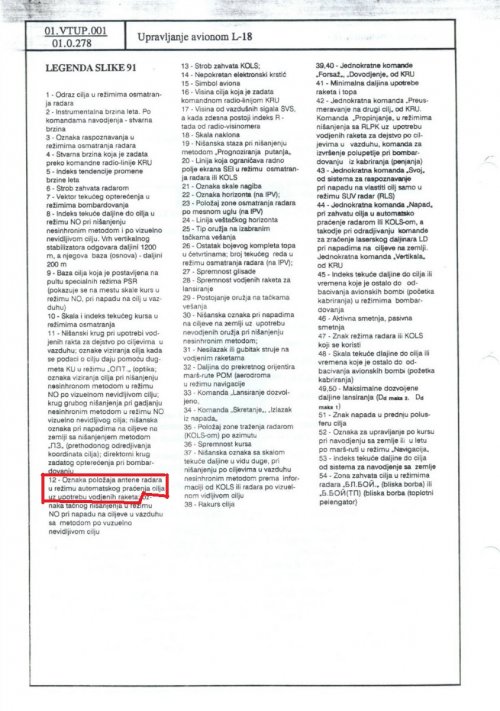
No,red boxes with underlined blue in those two pages explain to us what is exactly happening after radar-guided AAM is launched.It says that on the right side of the IPV/ HDD, there will be line as 'antenna position mark' which can be seen during scanning,searching and auto- tracking. Exactly that line pilot must follow during Ill mode after R-27R(R1) is /are launched as it is described with No 12 and on the upper page in this comment.That's what I was waiting for as answer but but ...
''Yes, if fired the MiG-29 can turn away.''
About that HOJ mode of the R-27R/ER, do you think that Ukrainians are stupid ? As we can see ,almost every Russian fighter fly with those wingtip jammer stations and ? Why they never tried to engage Russian fighters on that way ? Maybe they didn't have a chance to use R-27P/EP and not to mention those R/ER w/o the real HOJ mode. I'm done ,goodbye.
Understand? You haven’t even read the R-27 chapter of MiG-29B. What did I misunderstand? A SARH can see a jammer and guide on it if designed to so, this not new or unique and many other missiles like AIM-7 do this while being SARH Fox 1. A missile can operate more than one way.
You attach pages of Yugo manual with red squares. Yes it says to maintain lock becuase it is talking about a normal SARH attack. It says to turn towards target becuase it is talking about normal SARH attack. Read the chapters at the end about attacking jammers. Read R-27 chapter in MiG-29B.
Like I said, HOJ is not as reliable as SARH becuase the jammer may manually or automatically shut off stopping any missile guidance. So it is only used in cases of steady noise jamming and often as more of a back up in case the aircraft cannot receive range. The chapters on jamming at the end mention this. MiG-29B mentions in R-27 chapter that when radar is jammed enough to not resolve range it commands missile to switch to homing on the jammer.
Just becuase the main function is SARH and requires constant lock does not mean HOJ does not exist.
Read the chapters on jamming, read R-27 chapter of MiG-29B, then come back to me and tell who misunderstands what
It cannot be seen with scanning. It only exists on HUD during radar lock. Unless you mean the radar elevation mark which ONLY works during search mode.
Exactly that line pilot must follow during Ill mode after R-27R(R1) is /are launched as it is described with No 12 and on the upper page in this comment.That's what I was waiting for as answer but but ...
The pilot has no need to follow it. Manuals instruct to fly so as to keep it within the borders of the HUD as the HUD scale at this point is 70 degrees to each side and 45 degrees up and down. So radar rhombus must stay within HUD to not exceed gimbal limits.
Exactly that line pilot must follow during Ill mode after R-27R(R1) is /are launched as it is described with No 12 and on the upper page in this comment.T
The only reason to put the mark on the crosshairs is if trying to make visual contact with the target or directly point at it for a pursuit curve intercept.
Its existence does not mean the missile is not capable of HOJ. It only means designers wanted pilot to know where radar pointed to both know location of target and keep it within radar gimbal limits. When locking jammer it serves to tell you where the locked jammer is
Many manuals instruct after firing to turn until the diamond/radar rhombus is at the wingtips of the artificial silhouette OR about halfway across the HUD. No need to follow it unless you are trying to increase closure speed to possible enemy missile while your missile is on the way. It instructs you to turn until diamond is halfway or at the silhouette wingtip for a reason (cranking as it’s called).
During HOJ you would see the mark and thus know where the jammer you locked is, get LP, then fire and you can continue locking the jammer/target or turn away.
do you think that Ukrainians are stupid ? As we can see ,almost every Russian fighter fly with those wingtip jammer stations and ? Why they never tried to engage Russian fighters on that way ? Maybe they didn't have a chance to use R-27P/EP and not to mention those R/ER w/o the real HOJ mode.
1. Ukraine was forced to fly at low altitudes where missile range is low. Even at high altitude against R-77-1 and R-37M there is just no competition
2. You think becuase the Russians flew with jammers that Ukraine was dumb not to use HOJ?
Do you remember what I told you about HOJ being unreliable. The enemy can just turn off the jammer especially if they become aware of the launch. Many jammers only turn on when locked or being irradiated and thus will shut off automatically as soon as lock breaks or they are no longer scanned.
Thus, HOJ is basically an unreliable back up mode. It can be very deadly if used right but with a conscientious opponent and modern equipment it loses effectiveness.
In the simulator game DCS I have killed many people with HOJ, even using it to fire at one person then lock someone else and fire SARH, however as soon as F-16/18 got jammers that were able to only turn on when locked or scanned drastically decreased their effectiveness.
Now, you either must keep scanning/locking them to keep their jammer on. OR when you turn away you need a friendly to scan/lock them to make their jammer stays on so the missile can keep guiding. Unlike SARH mode it cannot compute intercept trajectory if signal is lost as it does not know range to the jammer.
The presence of a jammer on a plane does not mean it is permanently turned on. It is illogical and a fallacy to think so. Also, on MiG-29 9.13 and Su-27SK turning on the jammer in front PPS mode turns off the radar. Turning on radar forces jammer into rear aspect ZPS only mode. I do not know what is the case with Su-35 and Khibiny but if it is like many western planes the radar might lose quite a bit of detection range/sensitivity due to the jammer operation. So there are lots of reasons to not indiscriminately leave your jammer on all the time.
I also see spurious mentions of datalink only having 30s time limit and max 25 km distance from launch vehicle for R-27R/ER. I’m sure this is part of 2.5x seeker lock range limitation as it would need INS after using datalink for 30s or flying beyond 25 km from launcher until within seeker range.
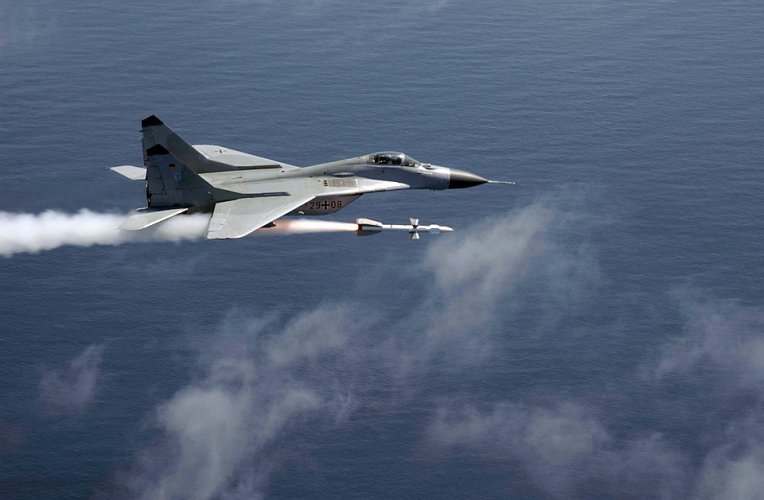
''A Soviet-built MiG-29 Fulcrum fighter flown by Major (MAJ) Peter Meisberger, from Germany`s (DEU) 73rd Fighter Wing (FW), Laage Air Base (AB), Germany, fires a radar guided AA-10 "Alamo" short-burn air-to-air missile at a QF-4 "Rhino" full-scale aerial target drone during a live-fire weapons training mission. Command Shown: ANG''
I mean, to be fair, if the closure rate is 150 m/s or higher then obviously target and missile can’t have same speed in tail chase?.
Btw
The missile guidance system implements a modernized method of proportional guidance both in the inertial-corrected guidance phase (flight with radio correction) and in the semi-active homing phase after target acquisition on the flight trajectory.
Yes. This was first done on R-23 where the seeker had an unfortunate tendency to lock onto radar sidelobes and try to blow off the nose of the host aircraft, so the missile was cued to target and then fired, and locked on autonomously shortly after launch once it had cleared the vicinity of the host. R-27's INS + datalink allowed the lockon to be delayed for 25-30% of flight time, which was done because the SARH seeker couldn't lock on at sufficiently long distances to outrange AIM-7 Sparrow.
Completely wrong data for the max launch ranges in that table. There can be situations where SARH mode will be used immediately after launch, so in the LOBL mode.
Translated :
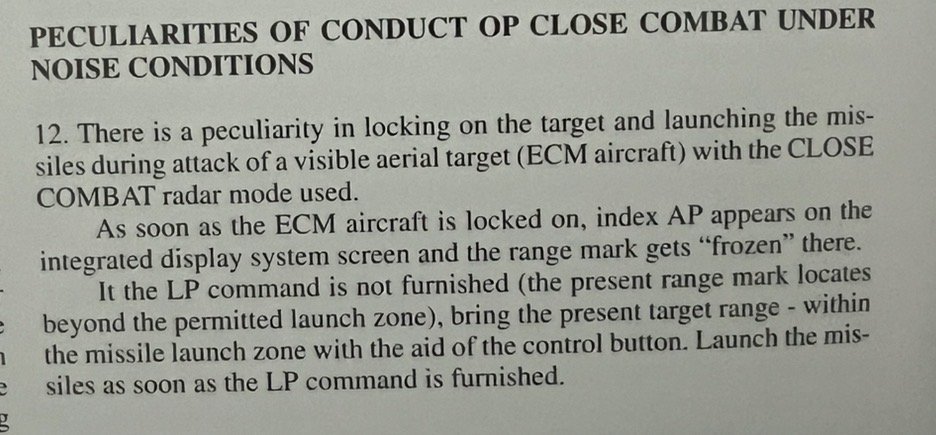
''Upon the loss of the automatic tracking after the launch of R-27R/R1 missiles at short distances, energetically turn to the target in order to ensure irradiation in the search mode,leave the attack after destroying the target.''
Seeker has 12 km range against cruise missiles, 25 km against fighters 45 km against bombers
If fired at 1-1.5x seeker range the missile will fly to predicted point of seeker capture using only INS.
If fired beyond this range it will use datalink.
There is a limitation of datalink at 2.5x range of the seeker. But I have feeling this is due more to 30s limit of datalink, INS accuracy, etc, since the missile does not scan for target but the target HAS to fall into the 6 degree FOV of the seeker (it will just point at the one spot INS/datalink told it to point).
Completely wrong data for the max launch ranges in that table. There can be situations where SARH mode will be used immediately after launch, so in the LOBL mode.
I disagree. It seems clear to me they aren’t quoting seeker ranges, they are quoting the max ranges we see in various charts. 62 km and 50 km are ranges we see for R-27R and R-27ER in these charts with specific conditions. I think that’s all it is.
Then it quotes 75 and 90-100 km which is just max range full stop against fighters for that missile.
It’s a corporate website being translated, it’s not gonna be always super accurate with wording.
For R1/ER1 launch ranges e.g. there is MiG-29B/ Su-27SK F.M. and have this :
''Для обеспечения заданной вероятности поражения цели в различных условиях максимальная разрешенная дальность пуска ракеты в ППС, вычисляемая в БЦВМ РЛПК, ограничена до 90, 70 и 30 км соответственно для большой, средней и малой цели.''
"To ensure a given probability of hitting a target under various conditions, the maximum permitted missile launch range in the forward hemisphere, calculated in the radar onboard computer, is limited to 90, 70 and 30 km, respectively, for large, medium and small targets."
Yes. This was first done on R-23 where the seeker had an unfortunate tendency to lock onto radar sidelobes and try to blow off the nose of the host aircraft, so the missile was cued to target and then fired, and locked on autonomously shortly after launch once it had cleared the vicinity of the host. R-27's INS + datalink allowed the lockon to be delayed for 25-30% of flight time, which was done because the SARH seeker couldn't lock on at sufficiently long distances to outrange AIM-7 Sparrow.
Seeker has 12 km range against cruise missiles, 25 km against fighters 45 km against bombers
If fired at 1-1.5x seeker range the missile will fly to predicted point of seeker capture using only INS.
If fired beyond this range it will use datalink.
There is a limitation of datalink at 2.5x range of the seeker. But I have feeling this is due more to 30s limit of datalink, INS accuracy, etc, since the missile does not scan for target but the target HAS to fall into the 6 degree FOV of the seeker (it will just point at the one spot INS/datalink told it to point).
Hmm, now, I'm totally confused. Earlier we assume the controlled flight time of R-27 to be 60 seconds because radar operate in illumination mode for 60 seconds. But if the flight time also include time on INS guidance, wouldn't that mean total fly time of missile equal to: Time on INS or datalink+ time under radar illumination (60 seconds) ?
При пуске ракет с РГС в режиме НПО РЛПК переходит в режим ДНП на 60 сек, в течение которых необходимо продолжать отслеживать цель, если цель не будет поражена раньше
For R1/ER1 launch ranges e.g. there is MiG-29B/ Su-27SK F.M. and have this :
''Для обеспечения заданной вероятности поражения цели в различных условиях максимальная разрешенная дальность пуска ракеты в ППС, вычисляемая в БЦВМ РЛПК, ограничена до 90, 70 и 30 км соответственно для большой, средней и малой цели.''
"To ensure a given probability of hitting a target under various conditions, the maximum permitted missile launch range in the forward hemisphere, calculated in the radar onboard computer, is limited to 90, 70 and 30 km, respectively, for large, medium and small targets."
Hmm, now, I'm totally confused. Earlier we assume the controlled flight time of R-27 to be 60 seconds because radar operate in illumination mode for 60 seconds. But if the flight time also include time on INS guidance, wouldn't that mean total fly time of missile equal to: Time on INS or datalink+ time under radar illumination (60 seconds) ?
It’s unclear. I theorized earlier that if the 90 km limit is from datalink and INS inaccuracy, the 130 km range might be only truly reliable on a HOJ target. But I would expect the datalink+ INS inaccuracy issue to mostly effect targets that would maneuver.
Hmm, now, I'm totally confused. Earlier we assume the controlled flight time of R-27 to be 60 seconds because radar operate in illumination mode for 60 seconds. But if the flight time also include time on INS guidance, wouldn't that mean total fly time of missile equal to: Time on INS or datalink+ time under radar illumination (60 seconds) ?
DNP mode works for 60 sec only in the NPO ( incomplete instrumentation ) mode but for the PPO ( full instrumentation) mode there is no precise data. Btw , mode DNP is not only illuminaton but the tracking of the engaged target too.
In the book called ''РЛЭ и БП МиГ-29 '' , Руководство по летной эксплуатации и Боевое применение'' or Flight Manual -combat use MiG-29 , it is written exactly what I posted in my earlier comment from the R-27E chapter. To be honest with you and all other, it was mistake ( MiG-29B/Su-27SK F.M.) and I think that 'Doc' is not the real 'official doc.' at all. It is for the MiG-29S/SE/SD btw, but not as real F.M. Doc like those from MiG-29 or Su-27SK.That's the catch.
In the real ,translated Su-27SK F.M. for the R-27ER1 stands next: 65.5km is the max launch range in the PPS in the situation when fighter and its target fly in troposphere ,0-10km.
So max authorised launch ranges ,for R-27R/R1 is 90km ,for ER/ER1 is 130km,data from the real offical sources. Parameters? High speed/alt of fighter and its target, forward hemisphere or incoming target, 'Dr max1' launch parameter against big non-maneuvering target . In theory,on the paper yes. In practice ,on 21 Feb. 1999 , Ethiopian AF Su-27SK engaged Eritrean MiG-29B with R-27ER1 from about 50km.
Again ,during live test launches w/o guidace unit ,K-27E achieved controlable flight of almost 100km. R-27R/ER have 70% of its flight path in INS phase ( with or w/o use of data link) and 30% of SARH phase.
I think it is wrong. Such a tiny difference between R and ER ???
No 5 is for R1 and No 6 is for ER1 .It is clear that the difference is more than 50% in favour of ER1 for the same case : fighter and its target fly under 10km.
Yes the average distance is 30-40% advantage. However I think there’s the possibility that the lines are somewhat off like we see in other charts. I think ER might’ve been squeezed a bit. It’s also very possible in addition to all this that a slow target right at the altitude when battery becomes the limit is possibly the condition where the gap between R and ER is smallest.
This site uses cookies to help personalise content, tailor your experience and to keep you logged in if you register.
By continuing to use this site, you are consenting to our use of cookies.