It's not though, there are more people today who do NOT believe the Moon Landings were real than every before and even more that believe the Earth is in fact flat and that space is fake. Couple that with the fact that far to many people don't understand how the politics and economics worked for the "Space Race" in general and the decision to stop going to the Moon in specific came about and the number of people, (including relevant politicians) gets scary fast.

Politics in general and the economics from those politics have kept us in Earth orbit without any major advances, (and some backsliding even) for half a century. From the looks of things that's not going to change any time soon.

Randy

You are not talking about technology here. You are talking about programs and goals. They are not the same thing. It is not "technological stagnation" that explains why the United States did not send humans to Mars, or develop a lunar base. It was a lack of political support for doing those things. That does not mean that "space technology" itself stagnated.
 
Incidentally, there's a strong theory that the Cuban Missile Crisis was not without the hand of the Great Helmsman (Maojidong). It was he who proposed attacking the West first and ending imperialism.
There is even a pretty silly joke about it.
1968, the height of the Cultural Revolution. Mao brings its best nuclear scientists and generals together, because he has a great plan.
"Comrades, our nuclear program has advanced to such a sophistication, I consider possible to build ten suitcase nukes, give them to ten red guards, and send them destroying ten imperialist cities. Any objections ?"
All the scientists and generals just nod in approval.
Except one tiny general, bent under the weight of dozen of medals pinned to his chest and with thick spectacles. He timidly raise his hand, to Mao furor.
"Great Helmsman I can see a troubling issue that may endanger you great plan execution" the little guy said, shaking in terror.
"You dare ? tell me then. Is it a problem about the nukes ?"
"Oh no, great leader. As you say, we can make it."
Mao sighs, his anger flaring.
"Are you suggesting I may not found ten Red Guards fanatical enough to our great cause ?"
The tiny general visibly wants to vanish under the surface of the Earth
"No, not a problem either. One snap of your fingers and we will get a thousand of them !"
Mao anger erupts.
"So what, in the end ? will you tell me, or I throw you into a reeducation camp for the rest of your miserable life ?!!!"
"It is the suitcases, Great Helmsman.
"The... suitcases ? are you fucking kidding me ? What's wrong with... suitcases ? "
"Well, Great Leader... there is no way we can find ten suitcases in the entire country !"
 
«Ну, Великий Вождь... нам никак не найти и десяти чемоданов во всей стране!»
We in the USSR also loved to make fun of the Chinese. Incidentally, in the late 1970s, we were genuinely afraid of war with the Chinese. Somehow, we never feared war with the US! We were sure the Americans were as afraid of us as we were of them, and no one would attack anyone. But the real fear of the time was that the Chinese would attack us! We were afraid of their numbers! Not their bombs. Although, bombs too. I'm not talking about the government in the USSR, but about rumors and sentiments circulating among the people.

We also told jokes about how China launched the first artificial satellite and how 10 million Chinese people developed hernias.

But he who laughs last laughs best. China is now challenging the US in a new race to the moon. Right? And, frankly speaking, looking at the madness going on in the USA (yes, it’s no longer the country that we fools so unrequitedly loved), I would (for the thrill of it) bet on the Chinese! :)
 
Last edited:
And of course the movie "predicted" Three Miles Island by, what ? a week ? talk about a stupid coincidence.
So, you believe there were real secret forces that orchestrated all the events that led to the terrible radiophobia that's now engulfing modern Western society?
I know the Russian physicist Ostretsov, who (besides his good idea about relativistic nuclear technology) is known for his outrageous conspiracy theories. He claims the tsunami that engulfed Fukushima was deliberately created by an underwater nuclear explosion, and was intended to steal from Japan the remaining uranium that the US lacks.
Even if that's true, it's pointless to stage such incidents (no one will notice them if they're properly framed) without first stimulating public opinion, which requires UNDIVIDED control over the media. That is, we need to brainwash every journalist on the planet while they're still in university. I'd look for the enemies of humanity there!
The greatest enemy of cosmonautics and nuclear energy, in my opinion, is H.G. Wells. He's the master manipulator and instigator! The man whose science fiction novels I practically grew up on. :)

Мы живём в мире, придуманном Уэллсом.jpg
And yes, Leo Tolstoy as a mirror of the Russian Revolution is a reference to Pelevin's "Omon Ra." Wells was truly imitating Tolstoy in the title of his most famous novel, which aimed at world peace.
And yes, Leo Tolstoy's reflection in the "mirror" is no accident. It's a vulgar mockery of the entire 20th century (and our own, too).


If you're looking for the "root of evil," don't look for evil people. Look for the WRONG ideas that we all really like and that feed on our collective consciousness. People don't rule the world. Ideas rule the world
 
Thanks for this inside view of Politics
but we deviate from the Topic NUCLEAR POWERD SPACECRAFTS
I get it. Good things in moderation. Don't overuse them!

Regarding nuclear vehicles IN GENERAL.

There's one nasty question. A thermal nuclear rocket must have very high power. Gigawatts. The RD-0410 has 200 MW of thermal power. And all this is released in a small volume. If the cooling stops, there's an explosion. The KIWI-TNT experience demonstrated this clearly. Who would fly such a dangerous engine?
Controlling such an engine is difficult, starting it is difficult, shutting it down is even more difficult. Regulation is also difficult.
Let's say we've managed to control the radiation during its operation. Gamma, neutrons... But even after shutdown, there is residual radiation. Especially gamma. How can we live with that?
And then there's residual heat! The same thing that has become the bane of all nuclear accidents.
A thermal nuclear rocket engine is an obvious, but very bad solution! It's no wonder the idea's originator was the mocking Richard Feynman! "Surely You're Joking, Mr. Feynman" (c)
FFFFF.jpg
Hydrogen, as a working fluid, is one of the worst substances to store. And a nuclear rocket truly requires a lot of it (much less for a chemical rocket, since the main propellant there is oxygen). With a nuclear rocket, you need a monstrously large tank!
And what's all this for? For (just) double the specific impulse (900-1200 s)! Thermal nuclear rockets pose so many problems that I wouldn't be surprised if such engines were forgotten one day, once and for all. They'd be written off as a crazy idea.
Although...
Perhaps it could find a very narrow niche. Say, propelling chunks of ice in the asteroid belt. Like a steam rocket?

Gas-phase nuclear rocket? Sorry, I don't believe in fairy tales. It's more likely that annihilation or controlled thermonuclear fusion will emerge than that someone will ride a gas-phase nuclear rocket engine with a decent exhaust velocity. This is, of course, just my opinion.
 
Last edited:
There's one nasty question. A thermal nuclear rocket must have very high power. Gigawatts. The RD-0410 has 200 MW of thermal power. And all this is released in a small volume. If the cooling stops, there's an explosion. The KIWI-TNT experience demonstrated this clearly. Who would fly such a dangerous engine?
it was cold war product, first design as ICBM engine by US and USSR (no Joke)
but Generals with brains in heads realised those ICBM were not what they needed.
so the design ended in nuclear testing for possible use in Space Program.

On paper it look great, you double the ISP you halve the Mass you launch to Moon or Mars
but reality it hab allot unsolved issue like losing parts of engine during operation.
in fact a NERVA engine had to got to critical operation in seconds to heat hydrogen,
Then need to cool the engine after MECO, what could take hours venting hydrogen true the NERVA reactor
and also restart of engine with radioactive waste products like Xenon & co was unsolved issue.

On Remass for Thermal Nuclear rockets is Hydrogen best choice, follow by Ammonia.
NO METHANE you don't want that highly reactive stuff in the Reactor,
it will choke the Cooling pipes with soot and you have flying Chernobyl !

All this let at Soviet side to Nuclear electric propulsion
while USA made political decision to build the space shuttle, what killed the NERVA program...
 
So, I haven't mentioned all the problems. A reactor is a simple thing. But any simplicity is worse than theft. When you delve into the details, it becomes clear that simplicity comes at a special, higher price. For example, I was shocked by the details in Neal Stephensen's novel Seveneves about the tiny radioactive particles from the reactor flying and hopping in zero gravity like fleas. When they entered the crew compartment, they eventually killed all the crew members one by one. It was impossible to catch them, no matter how hard they searched for them with a detector, so they simply ended up in the respiratory tract and inside each person. And then alpha radiation and... death with bloody diarrhea. Of course, this seems like a very exaggerated picture. And yet...At the same time, without atomic energy, there's no point in thinking about conquering space. That's undeniable. It's like the rise of humanity on Earth without mastering fire.
 
So, I haven't mentioned all the problems. A reactor is a simple thing. But any simplicity is worse than theft.

Americium seems manageable


The best part about Americium is that only 12 kg is needed for criticality

In terms of deposition, 3D printing may help with spreading Americium as thin as Rubbia wants--this trick will also help:

In 2008, a team of UCLA-led scientists proposed a scheme to use a laser to excite the nucleus of thorium atoms to realize extremely accurate, portable clocks. Last year, they realized this longstanding goal by bombarding thorium atoms embedded in specialized fluoride crystals with a laser. Now, they have found a way to dramatically simplify and strengthen the process by replacing the specialized crystals with thorium electroplated onto steel.

Anti-matter spiking

Thorium craft

Rad proofing solar

Comet chasers

More

Pre-JIMO

An author's take on pulse Orions

Propulsion rankings
 
Last edited:
Nuclear -electric has tiny thrust
Combined Response

Yes, but the truth (and the good news) is that it's not a problem.
This was already known in 1952. Trajectories with accelerations of even 10^(-6)g make sense and offer advantages!
Thrust is a consequence. The cause is the specific power of the power plant. And the whole point is that if we increased the ship's specific power from 50 W/kg (already achievable) to 500 W/kg, we would reach Titan in a year. What can we say about Mars?
But even with around 100 W/kg (and this is undoubtedly achievable if we don't play dumb, as everyone loves to do these days), we'll see Titan in 2.3 years. Low thrust is not a problem on interplanetary routes. Here, nature has given us a concession that we have never learned to appreciate. For we, humanity, are stupid and capriciously spoiled.
Very true, for outer planets and/or deep space exploration.

Higher accelerations, even if they're still at the "just high enough to be noticeable to a human" level, work quite well in the inner solar system. For example, 0.015m/s/s will get you from Earth to Mars in about 90 days. 0.1m/s/s will get you to Mars in 35 days.

Those do include some pretty ludicrous delta-vee numbers, however. 0.1m/s/s Earth to Mars requires over 300,000 m/s delta-vee, and 0.015m/s/s requires over 120k m/s.


Nuclear-thermal has large thrust, but fails somewhere between the reactor (full of energy) and the hydrogen propellant (also full of energy)


It takes a 2700 K NERVA core to get 825 seconds of isp. Not enough to make a significant difference with chemical propulsion, and even less since Starship pioneering propellant-rich architecture.

Getting beyond 3000 K core can't be done with a solid one : the best materials are on their knees.
For example, the rather ludicrous Tory IIA ramjet (which might as well be a nuclear rocket) only got up to about 1725K and the Beryllium Oxide ceramic was white hot.


A [Pulsed Nuclear Thermal Rocket/Fission Fragment Rocket] PNTR / FFR bimodal drive would have unbelievable performance... high thrust PNTR inside gravity wells, lower thrust FFR for cruise between planets.
Agreed, if you can get people to not freak out when they hear the word Nuclear.

Radiphobia is rampant.


Regarding nuclear vehicles IN GENERAL.

There's one nasty question. A thermal nuclear rocket must have very high power. Gigawatts. The RD-0410 has 200 MW of thermal power. And all this is released in a small volume. If the cooling stops, there's an explosion. The KIWI-TNT experience demonstrated this clearly. Who would fly such a dangerous engine?
Controlling such an engine is difficult, starting it is difficult, shutting it down is even more difficult. Regulation is also difficult.
Let's say we've managed to control the radiation during its operation. Gamma, neutrons... But even after shutdown, there is residual radiation. Especially gamma. How can we live with that?
And then there's residual heat! The same thing that has become the bane of all nuclear accidents.
So you figure out how much heat you remove from the engine by continuing to run reaction mass through the reactor until it's safe enough to stop the flow, and include that calculation in your burn timing.


A thermal nuclear rocket engine is an obvious, but very bad solution! It's no wonder the idea's originator was the mocking Richard Feynman! "Surely You're Joking, Mr. Feynman" (c)
View attachment 793274
Hydrogen, as a working fluid, is one of the worst substances to store. And a nuclear rocket truly requires a lot of it (much less for a chemical rocket, since the main propellant there is oxygen). With a nuclear rocket, you need a monstrously large tank!
And what's all this for? For (just) double the specific impulse (900-1200 s)! Thermal nuclear rockets pose so many problems that I wouldn't be surprised if such engines were forgotten one day, once and for all. They'd be written off as a crazy idea.
Although...
Perhaps it could find a very narrow niche. Say, propelling chunks of ice in the asteroid belt. Like a steam rocket?
Water, Ammonia, or Methane are all "better" reaction masses than pure hydrogen for a nuclear thermal rocket. At least in terms of tank bulk. Water or Ammonia are better than Methane because at NTR temperatures Methane breaks down into hydrogen and carbon and that carbon builds up in the reactor. Chernobyl shows us what happens with carbon inside a nuclear reactor.

Water and Ammonia also break down into hydrogen and oxygen or nitrogen, but that doesn't coke up your reactor. The loose oxygen may be a little scary at NTR temperatures, but I think proper core design can mostly counter that issue.


Gas-phase nuclear rocket? Sorry, I don't believe in fairy tales. It's more likely that annihilation or controlled thermonuclear fusion will emerge than that someone will ride a gas-phase nuclear rocket engine with a decent exhaust velocity. This is, of course, just my opinion.
IMO the only viable gas-phase nuclear thermal rocket is fusion, not fission.
 

White House Order Underlines Space Force’s Counterspace Mission​

Nuclear Propulsion​

Among the technology initiatives referenced in Trump’s order is a push for the U.S. to embrace nuclear power in space. The document names space nuclear propulsion as a key priority and commits to having a nuclear reactor ready to launch as part of a lunar mission by 2030.

The memo also directs the Assistant to the President for Science and Technology to issue guidance within 60 days on establishing a “National Initiative for American Space Nuclear Power.”

The order’s imperative for the U.S. to leverage space nuclear power is notable, Galbreath said. Thermal and electric nuclear propulsion system technology could offer a solution to the DOD’s satellite mobility needs as Space Command pushes for more maneuverable spacecraft.

The Defense Department has pursued several space nuclear power projects with varying success. A Defense Advanced Research Projects Agency effort to develop a nuclear thermal spacecraft engine through the Demonstration Rocket for Agile Cislunar Operations, or DRACO, was cut short earlier this year. A separate Air Force Research Laboratory program—Joint Emergent Technology Supplying On-orbit Nuclear Power, or JETSON—is focused on nuclear electric propulsion for space applications.
 
"Maintenance Station Envisioned for Nuclear-Powered Spacecraft" -
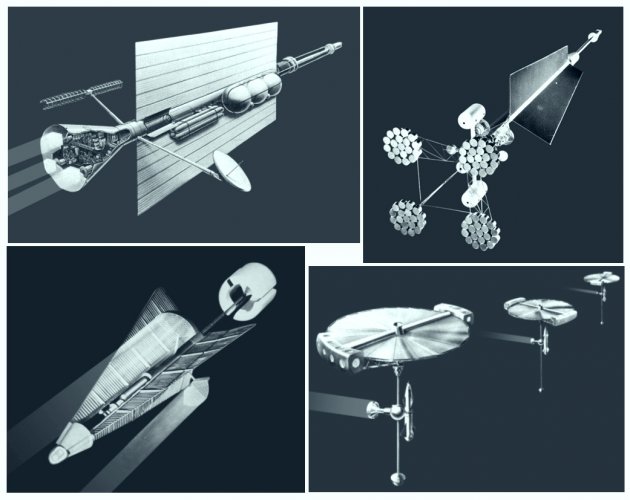
1962 - Westinghouse Electric Corp's Astronuclear Laboratory - Artist's concept
https://www.aerospaceprojectsreview.com/blog/?p=3557
This is interesting. I love looking at projects from the 50s and 60s. Unlike later "designs," they all usually had common sense in engineering. But I'm afraid this picture isn't as well-thought-out as others from the same era.
ионники 60х.jpg
 
Those cooling fins...
I remember multiple notions for replacing such fixed arrays, often invoking dust or beads, torrents of the stuff streaming between 'hot' and 'cold' end, caught, returned...

Reminded me of the steam 'Road Engines' my father described, which had radiator / condenser arrays on their roof. This facility *some-what* extended their range between 'watering holes'.
It also increased their 'Dead Weight', and rather raised their 'Centre of Gravity'...

FWIW, meson-catalysed fusion may yet trump all but the most niche fission reactors...
 
The comments here are especially valuable and revealing. It seems everyone has had their say. From flat-Earth theorists (Kubrick filmed everything on a soundstage) to those who remember what NERVA is. But the overall tone is one of extreme skepticism. :)
The main question: why is nuclear power being implemented in space so slowly and with such difficulty? Although, one could also ask a more general question: why are space technologies "developing" so slowly? It's safe to say they've been stagnating for half a century. Entire generations have grown up who can be shown projects from the 1950s and 1960s, and they won't believe that their grandfathers and even great-grandfathers invented them!
Because the voting public has been told to be terrified of anything nuclear. It's tough enough getting an RTG up, without some activist crawling out from under their rock. A "nuclear rocket that could Three Mile Island / Chernobyl on the pad"? Good luck.
 
Last edited:
This is interesting. I love looking at projects from the 50s and 60s. Unlike later "designs," they all usually had common sense in engineering. But I'm afraid this picture isn't as well-thought-out as others from the same era.
View attachment 799967

The one at lower right is from the Stuhlinger Mars mission. That was featured in the Disney documentary from the mid-1950s.
 
But I'm afraid this picture isn't as well-thought-out as others from the same era.
clock wise:
1 Artist Sol Dember conception of nuclear-electric ion spacecraft - somewhere in 1960s
2 Lewis Research Center - May 1965
3 USAF SPUR Spacecraft Concept by Airresarch (the Garrett Corporation) - 1963 ?
4 Stuhlinger Mars mission - 1957

Source

 
I see Eager Space is sliming NTRs
View: https://www.youtube.com/watch?v=e8pL44Z-81Y


You know, those can generate electricity too--like for BNTEP

NTR
file:///C:/Users/piw10/Downloads/6502-Article%20Text-43376-1-10-20240807.pdf

NEP

Small

If there is anything-anything--to this latest scribbling

---=-Then you need electricity from something with better energy density than Musk's methane.

Ion engines, quantized inertia--whatever.

Nukes! Learn to quit worrying and love them.
 
Last edited:
I know...right next to Mallet's time machine ;)
View: https://m.youtube.com/watch?v=wxc82VmVLyM&pp=0gcJCcMKAYcqIYzv


At any rate...whether it's Scotty's unobtainium, a laser to zap rocks with, or messages home...they are going to need electricity.

Eager space hates SLS and hydrogen. Since NTRs work best on hydrogen-naturally he dumps on that too.
 
Last edited:
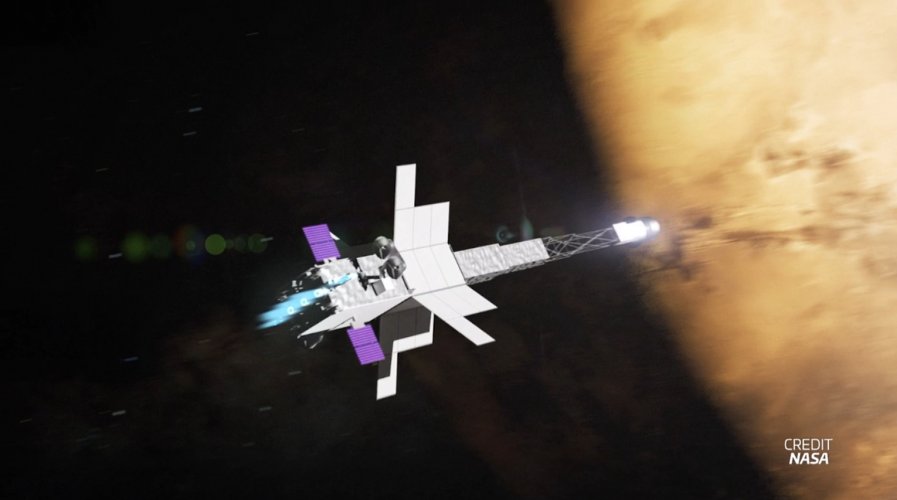
The laws of physics and engineering are the same everywhere, I've said. Looking at the render of Space Reactor 1 Freedom with the repurposed Gateway propulsion module and seeing that NASA will be favouring nuclear-electric over nuclear-thermal, a crewed Mars spacecraft seems likely to be a scaled-up version of the concept.

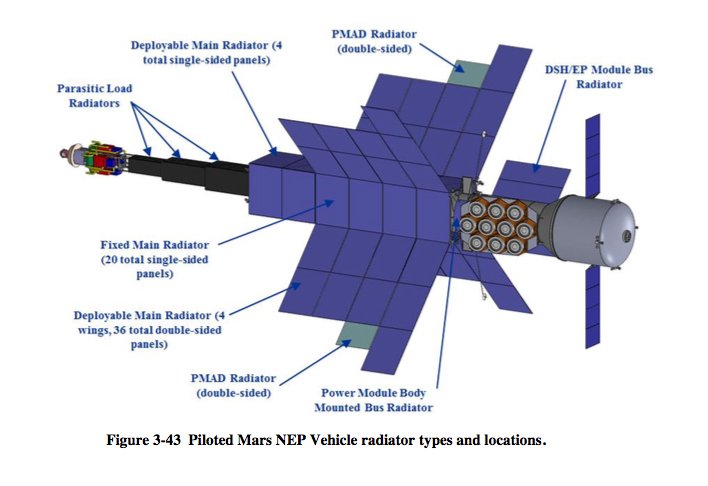
This report went into great detail back in 2014.


It's a big document - nearly 70 MB.

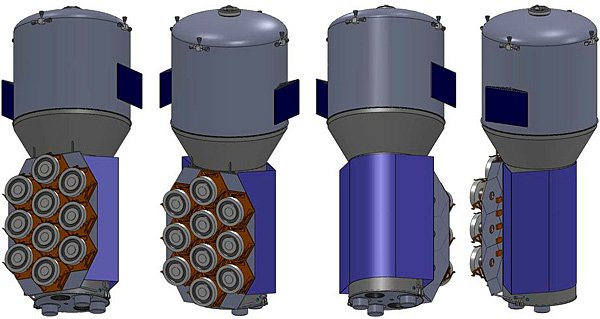
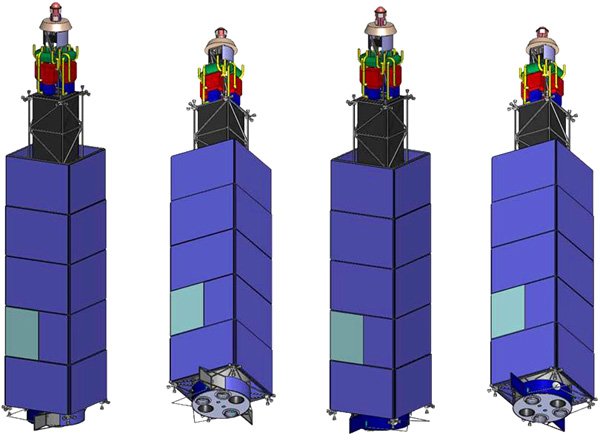
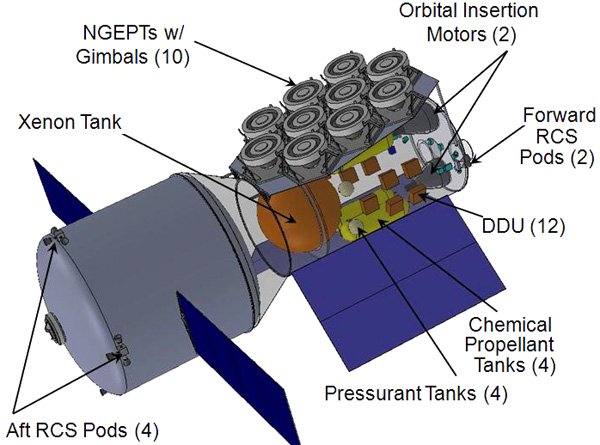
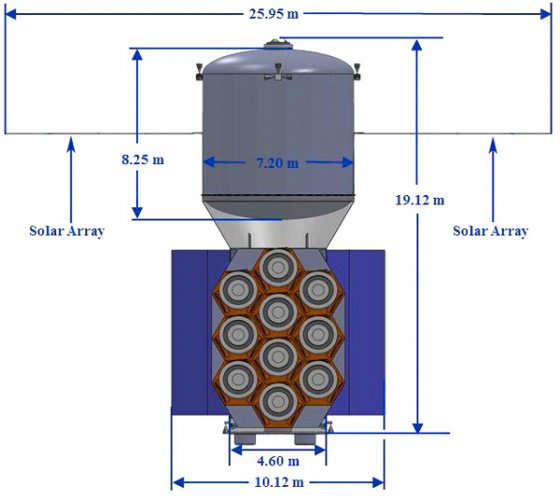
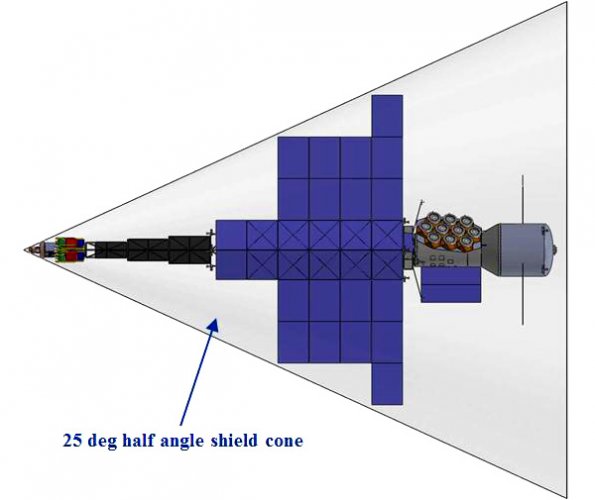
A few illustrations of SR-1 and the crewed spacecraft. One interesting detail in the crewed design is the orientation of the thrusters perpendicular to the long axis. Since thrust is so low, mechanical stresses wouldn't be a major concern.
 

Attachments

  • NSF-2026-03-24-13-24-00-604.jpg
    NSF-2026-03-24-13-24-00-604.jpg
    200.8 KB · Views: 21
  • 3-43.jpg
    3-43.jpg
    156.2 KB · Views: 20
  • MarsDRA5_NEP12.jpg
    MarsDRA5_NEP12.jpg
    79.9 KB · Views: 21
  • MarsDRA5_NEP15.jpg
    MarsDRA5_NEP15.jpg
    82 KB · Views: 20
  • MarsDRA5_NEP32.jpg
    MarsDRA5_NEP32.jpg
    105 KB · Views: 19
  • MarsDRA5_NEP25.jpg
    MarsDRA5_NEP25.jpg
    82.2 KB · Views: 19
  • MarsDRA5_NEP18.jpg
    MarsDRA5_NEP18.jpg
    62.3 KB · Views: 17
  • MarsDRA5_NEP26.jpg
    MarsDRA5_NEP26.jpg
    44.3 KB · Views: 20
From next-big

Still more compact than some of the solar electric Mars ships--those looked between Gateway and ISS...

Pulse Orion
View: https://x.com/Mangeon4/status/2044795594007331297
 
Last edited:
Let me float this out...
Anyone look at NSWR gun launch? Lunar launch only...

The great power and the weaker gravity allows large, heavy objects----payload protected by sabot.
 
Let me float this out...
Anyone look at NSWR gun launch? Lunar launch only...

The great power and the weaker gravity allows large, heavy objects----payload protected by sabot.
Splat
 

Similar threads

Back
Top Bottom