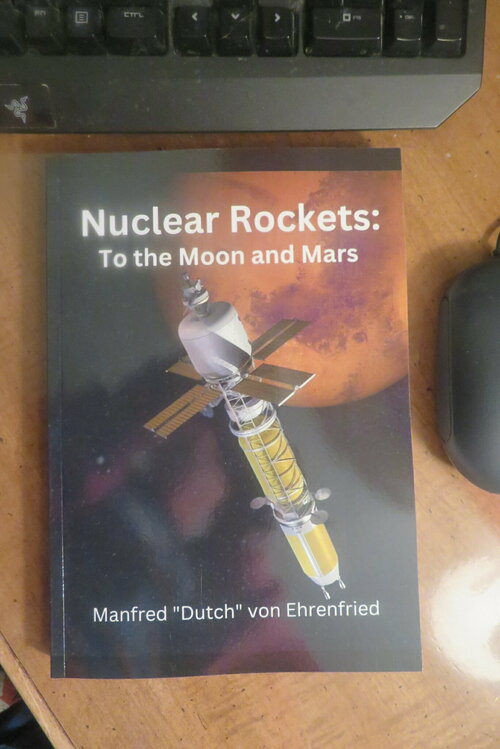
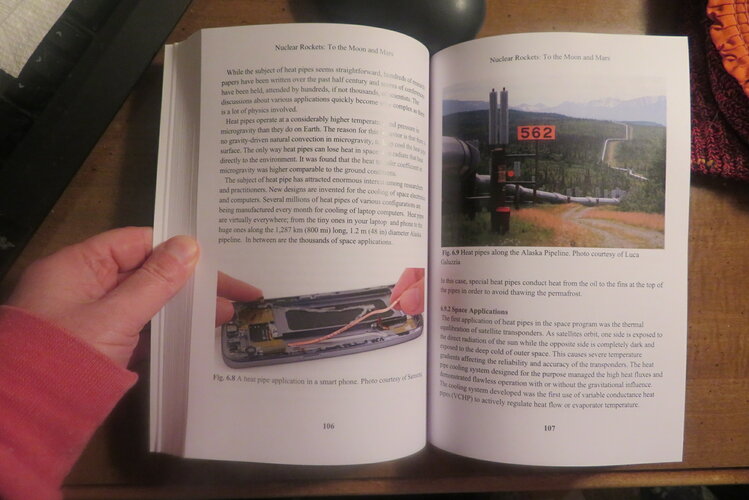
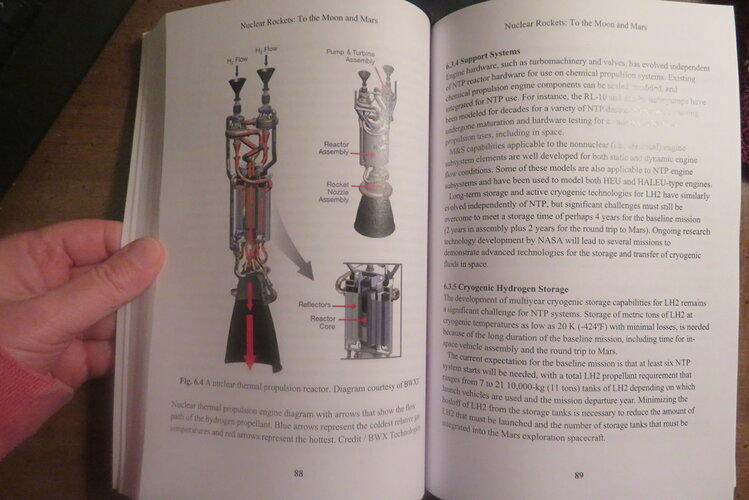
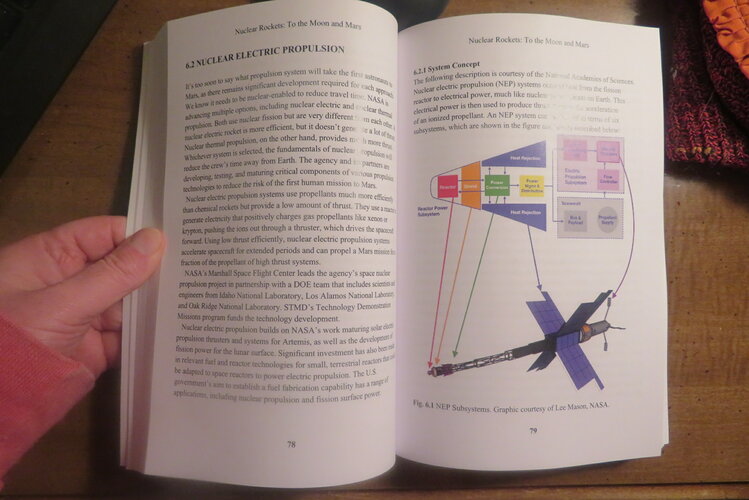
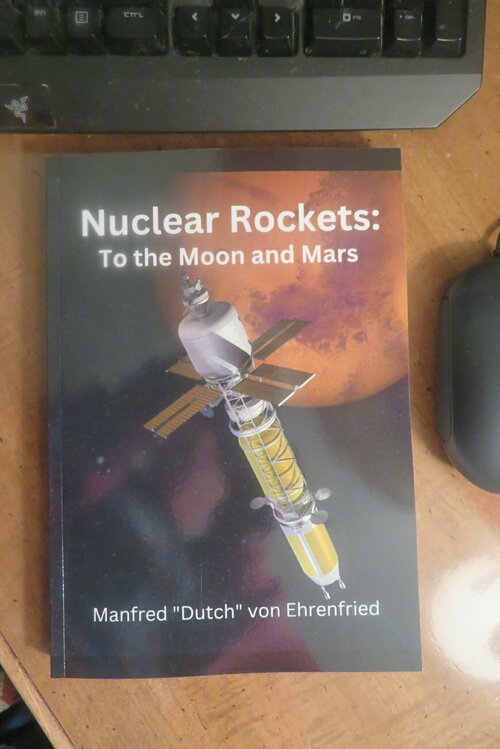
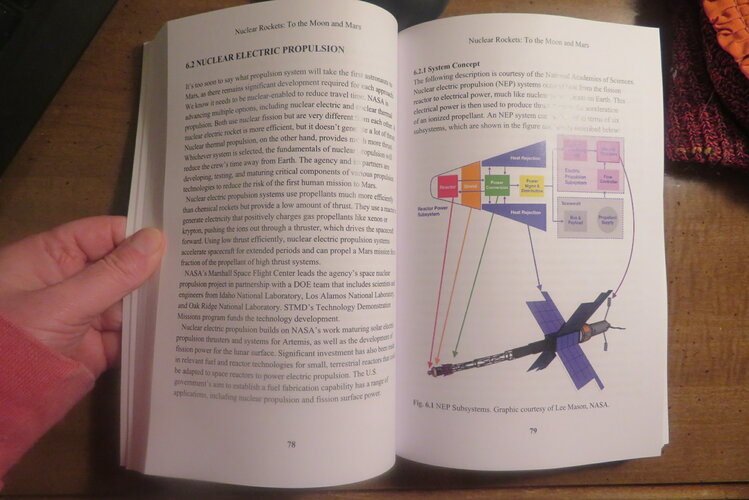
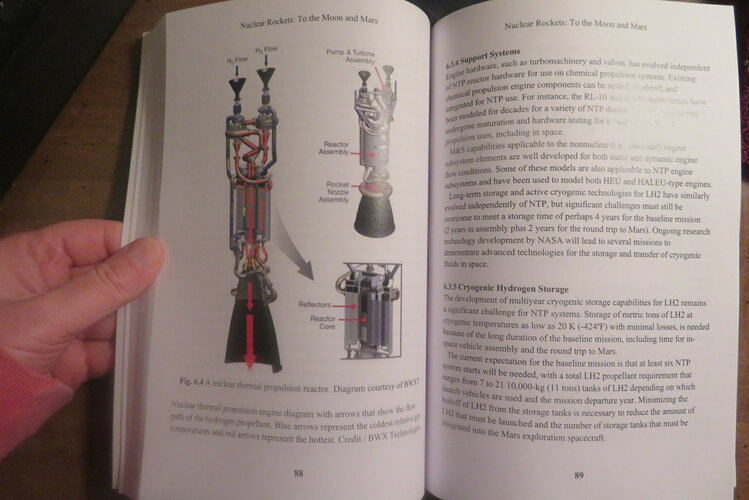
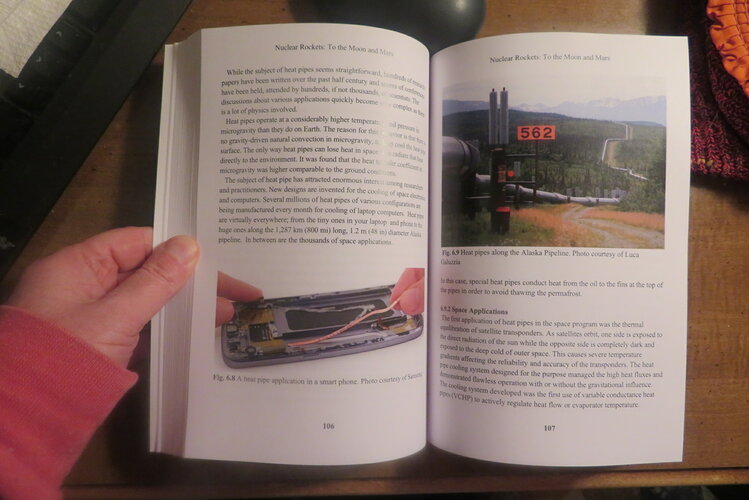
A copy of that arrived here yesterday.
Have only skimmed through it at this point.
Looks good.
Was published April 16, 2023; is print on demand and this copy was printed January 23 in the little burg of Monee, Illinois, just south of Chicago.
Wright: Today is March 25th, 2009. This oral history interview with Manfred “Dutch” von Ehrenfried is being conducted for the Johnson Space Center Oral History Project in Lago Vista, Texas. The interviewer is Rebecca Wright, assisted by Sandra Johnson. We thank you so much for taking time this afternoon to sit down and visit with us for this project.
von Ehrenfried: Well, this ought to be fun.
Wright: We’re looking forward to it. We would like to start today by you sharing with us how you first became involved with NASA.
von Ehrenfried: Okay. I was going down to Langley [Air Force Base], [Hampton] Virginia to join the Air Force, and I was teaching school, and I was applying for jobs at the national laboratories, having just gotten a degree in physics. I thought I would be a physicist. But they would send me back little terse letters like, “Well, when you get your PhD, give us a call.” In the meantime I realized that I wasn’t going to go to a national lab. But I was interested in flying. So I went down to Langley, took my physical, flunked it—because I checked item 12, had asthma as a child, or something like that. Flunked me on the spot. I walked out the door with my head between my tail and just was really depressed. I saw a sign that said NASA [Langley Research Center]. I said, “Well, I’ve heard of them.” Knocked on the door, so to speak, interviewed with Chris [C.] Critzos, who showed me around, and met Gene [Eugene F.] Kranz and John [D.] Hodge and a few others. Sort of hired me on the spot, like, “You’re just what we needed.”
"For missions that could last years, [electric propulsion] thrusters must operate smoothly and consistently over long periods of time," Chen Cui of the University of Virginia School of Engineering and Applied Science said in a statement.
Before solutions can be put in place to protect a spacecraft from these backscattered electrons, their behavior in an ion-engine plume must first be understood, which is where Cui and Joseph Wang of the University of Southern California come in. They've performed supercomputer simulations of an ion engine's exhaust, modeling the thermodynamic behavior of the electrons and how they affect the overall characteristics of the plume.
"These particles may be small, but their movement and energy play an important role in determining the macroscopic dynamics of the plume emitted from the electric propulsion thruster," said Cui.
What Cui and Wang found was that the electrons in the plume behave differently depending upon their temperature and their velocity.
"The electrons are a lot like marbles packed into a tube," said Cui. "Inside the beam, the electrons are hot and move fast. Their temperature doesn't change much if you go along the beam direction. However, if the 'marbles' roll out from the middle of the tube, they start to cool down. This cooling happens more in a certain direction, the direction perpendicular to the beam's direction."
In other words, the electrons in the core of the beam that are moving fastest have a more or less constant temperature, but those on the outside cool off faster, slow down and move out of the beam, potentially being back-scattered and impacting the spacecraft.
Now that scientists better understand the behavior of the electrons in the ion plume, they can incorporate this into designs for future electric propulsion engines, looking for ways to limit the back-scatter, or perhaps confine the electrons more to the core of the beam. Ultimately, this could help missions powered by electric propulsion to fly farther and for longer, pushed by the gentle blue breeze of its ion plume.
Twice the average speed is actually quite impressive. With acceleration that slow it indicates ~4 x the peak speed, which if we say the current rocket-based burnout speed is ~12km/s gives almost 50km/s Vmax.
One use would be to burn to near depletion as a probe approachs Jupiter and do a reverse gravity assist. The payload might be a sundiver sail.
In this way, it doesn’t really matter if your destination isn’t exactly in Jupiter’s path…working best if Jupiter is across the solar system from where you want to go? https://arc.aiaa.org/doi/10.2514/1.A36308
Twice the average speed is actually quite impressive. With acceleration that slow it indicates ~4 x the peak speed, which if we say the current rocket-based burnout speed is ~12km/s gives almost 50km/s Vmax.
A sub-milligee constant burn isn't anywhere near enough to really make a good case for hauling humans to Mars without some very massive shielding (probably mostly water, which is generally useful anyways)
But a centigee, 10cm/s/s, will get you to Mars in a month.
A sub-milligee constant burn isn't anywhere near enough to really make a good case for hauling humans to Mars without some very massive shielding (probably mostly water, which is generally useful anyways)
But a centigee, 10cm/s/s, will get you to Mars in a month.
Closest distance to Mars is ~55 million km. 25km/s average gets you there in 2.2 millions seconds or 25 days. At average distance of 225m km, it becomes ~104 days. For longer journeys, the maths of this new powerplant vs rocket power becomes even better.
Closest distance to Mars is ~55 million km. 25km/s average gets you there in 2.2 millions seconds or 25 days. At average distance of 140m km, it becomes ~65 days. For longer journeys, the maths of this new powerplant vs rocket power becomes even better.
Well I just noted that depending on whether the 'half the time' quote is for shortest distance or average, the further Mars is away the greater the increase in speed. E.g. if the 25km/s average speed is for 55m km, then for 225m km it may be 100km/s!
Well I just noted that depending on whether the 'half the time' quote is for shortest distance or average, the further Mars is away the greater the increase in speed. E.g. if the 25km/s average speed is for 55m km, then for 225m km it may be 100km/s!
Starwisps are doomed to coast, but so are M2P2/MagSails. And I don't remember which one has the velocity advantage.
Starwisps, of course, are best used with farking ginormous green lasers for propulsion, if we're sending them to another star. I'm talking terawatts of beam output.
I suspect that MagSails would have an advantage for inner solar system runs. Not fast like a nuke-thermal torch drive, but better than Hohman Transfer orbits.
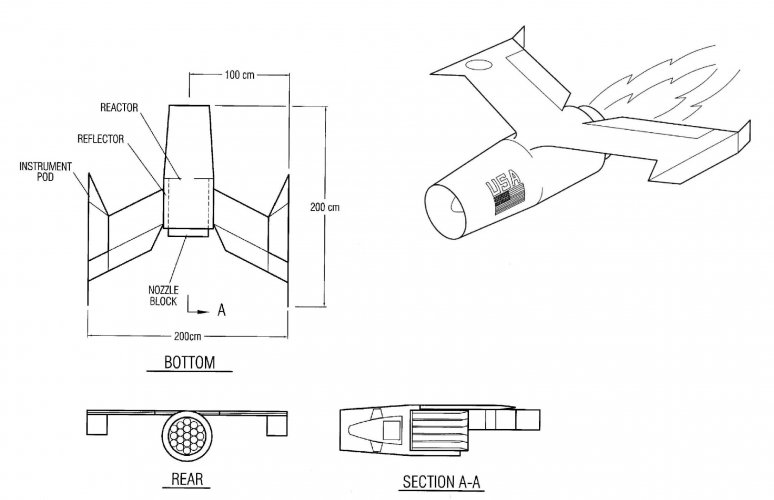
A couple of papers about nuclear ramjet powered flyers to explore the Jovian atmosphere, The first is based on the MITEE nuclear rocket, this is a compilation of two figures taken from the report:
Attachments
Exploration of Jovian Atmosphere Using Nuclear Ramjet Flyer.pdf
4.5 MB
· Views: 30
Jovian Flyer – Engine Concept in First Approximation.pdf
The comments here are especially valuable and revealing. It seems everyone has had their say. From flat-Earth theorists (Kubrick filmed everything on a soundstage) to those who remember what NERVA is. But the overall tone is one of extreme skepticism.
The main question: why is nuclear power being implemented in space so slowly and with such difficulty? Although, one could also ask a more general question: why are space technologies "developing" so slowly? It's safe to say they've been stagnating for half a century. Entire generations have grown up who can be shown projects from the 1950s and 1960s, and they won't believe that their grandfathers and even great-grandfathers invented them!
A couple of papers about nuclear ramjet powered flyers to explore the Jovian atmosphere, The first is based on the MITEE nuclear rocket, this is a compilation of two figures taken from the report:
An interesting project. A device 2 by 2 meters and weighing only 200 kg? 10-20 MW of thermal power? Excellent parameters! I'm amazed.
We chose the smallest possible engine that would go critical with U-235 fuel and with a lithium hydride moderator. This engine is cylindrical in shape with a both the diameter and the length equal to about 50 cm. The mass of this engine of 100 kg. The instrument package mass was taken equal to 59 kg.
I can't find the mass of the U-235 loaded into it! Just recently, there was a debate about how little fuel can be loaded into the Burivesnik-Skyfall reactor.It won't consume even 10 grams of fuel during the flight. But how much U-235 must be loaded to achieve criticality? The main limitation is heat removal. This requires channels. This means the density of the reactor assembly decreases. This quadratically (as with compression in a bomb) increases (in a bomb, decreases) the required mass of fissile material.It's interesting that the moderator here is also lithium-7. It must be extremely pure, as lithium-6 has a thermal neutron absorption cross-section of 1,000 barns.
Challenger, and all the other rockets that have blown up during launch.
Aided and abetted by "Nuclear Derangement Syndrome," that unfortunate condition when someone loses their mind utterly at the mention of the word "nuclear."
I can't find the mass of the U-235 loaded into it! Just recently, there was a debate about how little fuel can be loaded into the Burivesnik-Skyfall reactor.It won't consume even 10 grams of fuel during the flight. But how much U-235 must be loaded to achieve criticality? The main limitation is heat removal. This requires channels. This means the density of the reactor assembly decreases. This quadratically (as with compression in a bomb) increases (in a bomb, decreases) the required mass of fissile material.
Based off of the size of the US Tory IIA reactor prototype developed for Project Pluto, I'd guesstimate ~10kg of HEU or ~4kg of Plutonium as about as low as you can go, and that's using neutron-reflectors around the outside and probably even inside the plant. The most efficient tamper is beryllium oxide ceramic, and that's what the Tory reactors were made from in order to handle the heat.
As I understand it, Russia has a lot of plutonium sitting around they can use.
It's interesting that the moderator here is also lithium-7. It must be extremely pure, as lithium-6 has a thermal neutron absorption cross-section of 1,000 barns.
The comments here are especially valuable and revealing. It seems everyone has had their say. From flat-Earth theorists (Kubrick filmed everything on a soundstage) to those who remember what NERVA is. But the overall tone is one of extreme skepticism.
The main question: why is nuclear power being implemented in space so slowly and with such difficulty? Although, one could also ask a more general question: why are space technologies "developing" so slowly? It's safe to say they've been stagnating for half a century. Entire generations have grown up who can be shown projects from the 1950s and 1960s, and they won't believe that their grandfathers and even great-grandfathers invented them!
In 'For All Mankind', they landed on Mars about 30 years ago and they started mining an asteroid for Iridium about 20 years ago. All because the Soviets landed on the moon first in their timeline.
Nuclear -electric has tiny thrust
Nuclear-thermal has large thrust, but fails somewhere between the reactor (full of energy) and the hydrogen propellant (also full of energy)
It takes a 2700 K NERVA core to get 825 seconds of isp. Not enough to make a significant difference with chemical propulsion, and even less since Starship pioneering propellant-rich architecture.
Getting beyond 3000 K core can't be done with a solid one : the best materials are on their knees.
NASA imagined a whole bag of different core "states" to try and push that limit: starting with 900 seconds CERMET & Soviet twisted-ribbon, next : pebble-bed, liquid, dropplet, vapor, plasma. Each one push the isp by approximately 100- 200 seconds : 1200, 1400, 1600, 1800, and finally : 2000 seconds and 20 000 K for gas-core. Unfortunately each of these pushes also gets beyond state-of-the-art: the last that could be done today is probably liquid-core.
Pulsed NTR first changes the core from NERVA to TRIGA. In the process it gets powerful prompt neutron pulses : that are used to carry the energy from reactor to hydrogen; rather than fission fragments for NERVA.
Big advantage : unlike fission fragments, prompt neutrons are not bound by the 2nd law of thermodynamics (the transfer is done at atomic level). And this the key : it allows tremendous specific impulse. Somewhat like its cousin, the Fission Fragment Rocket. They are the two faces of the same coin.
Although, one could also ask a more general question: why are space technologies "developing" so slowly? It's safe to say they've been stagnating for half a century. Entire generations have grown up who can be shown projects from the 1950s and 1960s, and they won't believe that their grandfathers and even great-grandfathers invented them!
What if your assumption is wrong? The pace of development for any technology is not going to be constant. The technology can mature rapidly and then plateau. It can be "good enough" for the requirements and R&D funding can be reduced. But there have been technology developments during this time in areas like life support and also sensor and processing technology. You may not have noticed them, but they still occurred.
The main question: why is nuclear power being implemented in space so slowly and with such difficulty? Although, one could also ask a more general question: why are space technologies "developing" so slowly? It's safe to say they've been stagnating for half a century. Entire generations have grown up who can be shown projects from the 1950s and 1960s, and they won't believe that their grandfathers and even great-grandfathers invented them!
Well, the root cause was that the solid state transistor was invented.
So instead of a nice big space station with human crew onboard simply to be able to replace burned out vacuum tubes, you could have small, completely unmanned satellites. Satellites so small that a human cannot fit inside.
Instead of needing massive electrical power to drive vacuum tubes delivered via nuclear power, you could power the small unmanned satellite with nothing more than solar panels.
And with no need to loft those huge space stations, there's no need for monster rockets like Orion.
What if your assumption is wrong? The pace of development for any technology is not going to be constant. The technology can mature rapidly and then plateau. It can be "good enough" for the requirements and R&D funding can be reduced. But there have been technology developments during this time in areas like life support and also sensor and processing technology. You may not have noticed them, but they still occurred.
It's not though, there are more people today who do NOT believe the Moon Landings were real than every before and even more that believe the Earth is in fact flat and that space is fake. Couple that with the fact that far to many people don't understand how the politics and economics worked for the "Space Race" in general and the decision to stop going to the Moon in specific came about and the number of people, (including relevant politicians) gets scary fast.
Politics in general and the economics from those politics have kept us in Earth orbit without any major advances, (and some backsliding even) for half a century. From the looks of things that's not going to change any time soon.
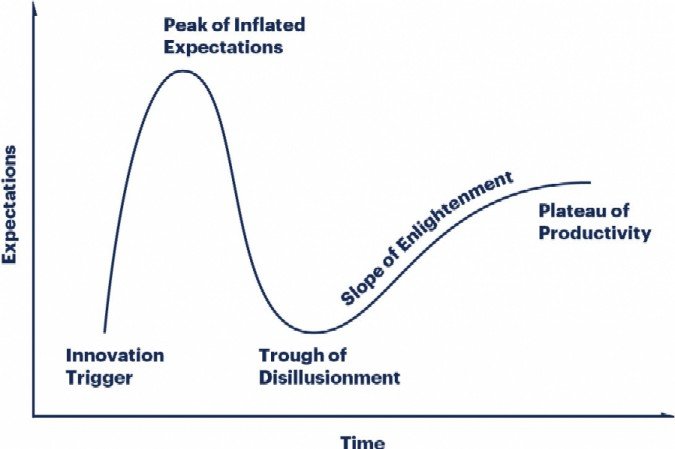
You're perpetuating the core myth of the "era of maximum frustration" in space from 1990-2010. A minimum of decline and disillusionment.
Moreover. Like most here, you're citing the symptom but not the cause. Indeed, symptomatically, it seems like everything was heading in that direction. The atomic bomb emerged simultaneously with the liquid-propellant rocket, one might even say it slightly preceded it. Therefore, early versions of nuclear weapon delivery ideas (in the 1940s) even envisioned combining the bomb and a nuclear rocket, but this was quickly realized to be foolish. Nevertheless, in 1955, Project Rover was born. It was still a military project. The first hydrogen "bomb" weighed over 80 tons. Let me remind you that the USSR's initial lead in space was secured by Sakharov's significant miscalculation of the mass of the proposed megaton warhead (5 tons), and so Korolev was commissioned (and he happily took it on, knowing it promised access to space) to build an excessively large and powerful rocket. The US began developing its Atlas rocket for much more realistic warheads. But by 1960, the ultra-compact W-47 submarine-launched nuclear warhead had emerged, and the US was essentially beginning to move away from liquid-fueled missiles for its military. Weapons were becoming smaller and smaller. Even technology like RIPPLR was "late" in its development, as it ran counter to the trend in nuclear weapons development (compactness, increased accuracy, reduced explosive yield, high energy density (kt/m³) rather than specific yield (kt/kg) for penetrating the atmosphere to the target).
War is the father of all things. (c) Herodotus. But space had little luck here. The military quickly found itself at odds with astronautics. Of course, the US Air Force was eager to get into space, but Kennedy and McNamara defeated them. As a result of all the treaties from 1963 to 1972, the military was left with orbital reconnaissance, communications, and geolocation. For both military and civilian purposes. But even here, it quickly became clear that humans were unnecessary. The Salyut station—a simplified Almaz—was a manned space reconnaissance station. The Space Shuttle received enormous wings (which ultimately failed it) precisely for wide lateral maneuvers to ensure the delivery of reconnaissance film in a single orbit. But by the mid-1970s, even this was no longer necessary. Advances in electronics eliminated the need to carry film "in hand."
In essence, the satellites launched at the end of the 20th century demonstrated unique survivability. The Voyagers demonstrated that robots could do far more than was expected. Ultimately, the idea emerged that humans are unnecessary in space. Incidentally, experiments in orbit growing crystals and drugs have shown that the presence of people nearby is a hindrance. They create precisely that. HUMANS ARE NOT NEEDED IN SPACE! The peak of this, as I said, was 1990-2010.
Essentially, it degenerated into a new philosophy of life. I was a young man (in the late 1970s), dreaming of space, when this philosophy began to be heard "from every corner of the earth," something that struck me, a young, naive simpleton, and deeply wounded me. What's the point?
This story has a long history. Don't confuse cause and effect. The idea of human expansion into space has always been considered so progressive that NO ONE dared to openly oppose it. No one, ever! Even people like H.G. Wells (a man terrified of progress and who became a science fiction writer, "glorifying" progress simply because there was no other way).
But if you look closely, the key philosophy of the West since the Enlightenment (if not earlier) has been globalism, the construction of a universal, just order on Earth, and this idea fundamentally contradicts the idea of expansion into space. Look closely. I myself only recently realized this. They are antagonistic! After all, if people settle across different planets of the solar system (not to mention other stars), there can be no talk of any single, global system of Universal Human Values (or someone's hidden power?) over the entire civilization. No world government! No Universal Human Values! So how is the idea of a City on a Hill, towering over the entire world, compatible with the cosmic expansion of Humanity? But it is precisely this idea of a single Western World for all that has become paramount since 1991, when the USSR "surrendered" to the USA, in the "competition between two systems of globalization." Although this is only the beginning. The process begins with the Enlightenment!
So, what am I saying? The stagnation in space (and nuclear stagnation, which is only part of the overall stagnation) is historically inevitable. The winds of history blew against the idea of human spaceflight. Pay attention. This isn't a conspiracy theory about some secret human society. It's simpler. It's a "conspiracy of ideas." People don't rule the world. Ideas, always on the surface, rule the world. Space couldn't help but die, couldn't help but stagnate, over the last half-century (which has encompassed most of my life, and yours too) precisely because the world was dominated by the idea that space was not only useless, but even hostile (except perhaps for practical applications and for scientists). That's why, since the 1970s, Hollywood hasn't made a single science fiction film where space is portrayed as something bright. There, space is always a source of horror.
Back in 1945, after the founding of the UN, the world set a course for globalization (it was now simply a matter of choosing a version; there were three: globalization under the US, globalization under the USSR, and globalization under the UN, the European bureaucrats). The fact that the moon race happened was a "coincidence." Because Emperor Roosevelt's plan didn't work out smoothly. Stalin broke free from the Bretton Woods Agreement, and a confrontation ensued that prolonged (for a time) the competition in space. But it soon faded, replaced by the desire of the USSR's ruling elites to initiate convergence. Progress in space also faded. The conventional date for this should be considered the "handshake in orbit" in 1975. From that moment, we should count the half-century of stagnation in space. This was a purely POLITICAL reason. I would say a historical one. Not a technical one. Yes, the shuttle error was probably a coincidence, unless we want to indulge in conspiracy theories. Then we'd have to include Chernobyl here. That would be a far cry from sanity. But seeing these events, we must understand that they wouldn't have had the resonance they did if the general public mood hadn't been what it was. Don't confuse causes with reasons!
During the 1970s, humanity simply abandoned space. With the Club of Rome report and the new "green" course. It's obvious. No secrets. Everything is on the surface. It was then that everyone "woke up" to the space race, the "insane" spending, and everyone "smarted up" (especially in the USSR, which had to justify the shame of abandoning the Moon), saying that Earth's problems can't be solved in the sky, they need to be solved here (and few dared to argue with this). Earth first, space is SECONDARY, on a residual basis. Space is for Earth, not Earth for space! We can't live there! Live on Earth! Yes, the new "religion" still promised to someday ("after a little rain on Thursday") explore the Moon, land on Mars... But now these were promises without deadlines. People no longer needed space. Explore? For God's sake! Here are your automated robots! They are better and cheaper! Electronics, which is advancing by leaps and bounds, is precisely what's needed for this! And, in fact, human penetration (conquest, expansion) of space could now be postponed indefinitely. Note that this philosophy peaked precisely in the 1990s-2010s. The Golden Age of Hyperglobalism! The parallel mass, mystical radiophobia (space is RADIOACTIVE!) couldn't have come at a better time! If it hadn't arisen spontaneously, it would have had to be deliberately implanted in people's minds!Yes, the system of ideas that rules humanity relies on progress (the 3% growth rate in banks cannot be reversed!) and therefore it cannot openly reject space altogether. One cannot openly demonstrate one's hostility to space. That would be too radical. But that's not necessary. It's enough to prioritize (no money!) and there will be a stagnant swamp! Any ideas will drown in this quagmire. Which is what has been happening for half a century.You all see only the symptoms. Not the causes. The reasons are too deep and painful. You don't have the strength to see them, for it would collapse your entire value system. And the reason is that modern Western Civilization is absolutely hostile to the idea of humanity's expansion into space. Yes, hostile. For a multi-planet humanity would return to what the modern West considers savagery and disorder. And we have only just begun to build a New World Order on a single Earth!!!
Sorry for the long text. I myself suffer from the inability to express my thoughts more briefly.
Challenger, and all the other rockets that have blown up during launch.
Aided and abetted by "Nuclear Derangement Syndrome," that unfortunate condition when someone loses their mind utterly at the mention of the word "nuclear."
You're listing only a few of the "unfortunate coincidences." There were many more. In both the American and Russian space programs. It could be said that the entire history of cosmonautics, as we know it, is a history of continuous mistakes and unfortunate strategic miscalculations.
But this in itself explains nothing. It's merely a symptom of the disease, not the illness. Everyone makes mistakes. But the winners correct their mistakes, learn from them, become stronger, while the losers use them to justify themselves.
Paranoid radiophobia? Yes. Where does it come from? From Chernobyl? Earlier? It's perfectly clear that ordinary people, as intellectuals in the spirit of Montaigne joke, wouldn't come up with such insanity on their own. It was a "spirit of the times." Where did it come from? Who? What was the purpose of this swapping of the "awl" of nuclear energy for the "soap" of a "green utopia"? For what ideals?
Do you want to see the essence of things? Start by being brutally honest with yourself. And before you look for enemies elsewhere, consider whether you are your own enemy. Weren't we too foolish and naive to expect that we could live peacefully and develop (conquer space) simultaneously? War is the father of everything. We decided to end wars once and for all, dreaming that this would help us reach other planets faster. Evolution? Not for us! We have Reason and Good Will! Madmen! After all, it's been known since ancient times that development and prosperity are opposites. But only Modernity resisted this, and at first it even seemed that Modernity's rebellion was winning. But "you can't count your chickens before they hatch."
As I understand it, Russia has a lot of plutonium sitting around they can use.
I am entirely too amused by that word to describe something down at the particle scale!
Plutonium is less suitable for use in reactors because it has far fewer delayed neutrons than uranium-235. But yes, if you have no other option, plutonium can also be used in reactors.
Without the need to lift humans into space on large space station because they were needed to replace vacuum tubes, you don't need giant rocket factories or a training pipeline for astronauts.
Paranoid radiophobia? Yes. Where does it come from? From Chernobyl? Earlier? It's perfectly clear that ordinary people, as intellectuals in the spirit of Montaigne joke, wouldn't come up with such insanity on their own. It was a "spirit of the times." Where did it come from? Who? What was the purpose of this swapping of the "awl" of nuclear energy for the "soap" of a "green utopia"? For what ideals?
Honestly, a lot of the American nuclear scientists have been saying it came out of the KGB. For the purposes of making the US weaker in the Cold War.
When? in the 1970s, as there was a movie called the China Syndrome that came out in 1979 and I ran across a few other books about nuclear plant disasters in the same publication range.
Yes, but the truth (and the good news) is that it's not a problem.
This was already known in 1952. Trajectories with accelerations of even 10^(-6)g make sense and offer advantages!
Thrust is a consequence. The cause is the specific power of the power plant. And the whole point is that if we increased the ship's specific power from 50 W/kg (already achievable) to 500 W/kg, we would reach Titan in a year. What can we say about Mars?
But even with around 100 W/kg (and this is undoubtedly achievable if we don't play dumb, as everyone loves to do these days), we'll see Titan in 2.3 years. Low thrust is not a problem on interplanetary routes. Here, nature has given us a concession that we have never learned to appreciate. For we, humanity, are stupid and capriciously spoiled.
You're missing my point.
Without the need to lift humans into space on large space station because they were needed to replace vacuum tubes, you don't need giant rocket factories or a training pipeline for astronauts.
I understand everything. But the question isn't simply one of utility. Humanity's presence in space in my childhood required no justification. Humanity must settle there! It's their destiny! That's how the question was posed. And what will they do there? That's no longer important.
Honestly, a lot of the American nuclear scientists have been saying it came out of the KGB. For the purposes of making the US weaker in the Cold War.
When? in the 1970s, as there was a movie called the China Syndrome that came out in 1979 and I ran across a few other books about nuclear plant disasters in the same publication range.
They clearly overestimate the KGB. In fact, the USSR "lost its teeth" when Stalin dissolved the Comintern at Roosevelt's request in 1943 and replaced the globalist Internationale anthem with an imperial one. From that moment on, the USSR merely defended itself and peacefully coexisted (a point about which Khrushchev and Mao disagreed). Incidentally, there's a strong theory that the Cuban Missile Crisis was not without the hand of the Great Helmsman (Maojidong). It was he who proposed attacking the West first and ending imperialism. Khrushchev, of course, had no intention of attacking anyone, but he was eager to please the Chinese. Khrushchev intended to compete peacefully (believing in the power of socialism). Brezhnev (having already realized that there was no such power) simply wanted to coexist. The KGB in the 1970s was, above all, the "Andropov matrix." So it was the KGB, political intelligence, that led the USSR to "convergence," the merging of the two systems. It was there that the first "deals" emerged, the belief that everything could be agreed upon amicably.
Putin is the very embodiment of the "Andropov matrix," and look how reluctantly and with difficulty he gives up the age-old dream of the Russian comprador intelligentsia ("the scum of the nation," as Lenin aptly called it, although he himself was a "rootless cosmopolitan" of the same consistency) about the unity of Russia with the West!
"Institutions the US and the Canada", created as think tanks for the fight against the West, have turned into institutions for the adoration of the US and Canada. By the 1970s, they were all toothless, disgusting nonentities ready to sell themselves for clothes and the good life! And you're ascribing some hidden, insidious, far-reaching plans to all this? Don't make me laugh, a former Soviet imperialist!
If you're looking for the dark forces that have steered our civilization down a false path, you shouldn't look for them among humans. If this isn't a series of absurd coincidences, but a cunning mind, then it's a non-human mind. Such ideas can't be taken seriously. But, jokingly, I could imagine that there's some highly evolved extraterrestrial observer, a non-human superintelligence that has been watching Earth for a million or ten million years. Why not? Are you familiar with the Fermi Paradox? I've been arguing for years that there are only three answers to it (the rest are unlikely combinations).
1. They're not around us (we're alone here). I call this option "The Swan."
2. They're there, there are many of them, but they all don't live long (no one goes into space). Like mayflies. And we're going to die soon. I call this option "The Pike."
3. They exist, they are older and more powerful than us, and they've been here a long time. But they're hiding from us. We're under their thumb. We're their property. They're playing with us. I call this version of the paradox's solution "Cancer."
How can the latter be detected? Saucers? Don't make me laugh. That's too stupid. An anomalous historical process. Only that could point to that! And there are plenty of anomalies in our history. For example, we haven't had a nuclear war yet (so many coincidences contributed to this that it's hard to believe it was a coincidence).
Do I believe that aliens are controlling our history?
No. I want with all my might for us to be alone here. I'm a "Swan." I'm even prepared for space to be nothing but bare, lifeless rocks up to the event horizon (the Kunin-Mazur hypothesis). But as a conscientious thinker, I must admit all three options are possible.
"Politics" is the means by which government programs get prioritized, approved, and funded. It's not like it is some separate thing that is on the outside of all this, affecting it, and if it did not affect it, things would otherwise happen.
The requirements for most space nuclear programs over the last seventy years, whether they be power or propulsion (rockets) have not been sufficient to justify the high costs of the programs. And very often the programs have been engineering and technology people pushing research on a project because they hope that eventually a requirement for it will emerge.
This site uses cookies to help personalise content, tailor your experience and to keep you logged in if you register.
By continuing to use this site, you are consenting to our use of cookies.